REVIEW 3 major objections 6 minor 41 references
Generative wave propagator
T0 review · 3 major / 6 minor · reviewed 2026-07-11 · grok-4.5
Pith's one-line read A conditional diffusion model advances seismic wavefields recursively at ten times the usual time step while matching finite-difference results on familiar geology.
desk verdict Solid empirical surrogate: recursive conditional diffusion with causal EMA loss and single-step x0 inference delivers a real 2.17 imes GPU speedup and 10 imes time step on 2-D acoustic models. read the letter →
The pith
A machine-rendered reading of the paper's core claim, the machinery that carries it, and where it could break.
The reading
What carries the argument
The conditional diffusion wave propagator with causal time-weighted loss: a U-Net that, given noisy input plus history, velocity, and time index, directly outputs the next clean snapshot in one forward pass; adaptive per-snapshot weights (exponential moving averages of earlier residuals) force the network to master early times first so one-step errors do not amplify under recursion.
What would settle it
Train the same architecture without the causal time-weighted loss, or with only one conditioning snapshot, then measure whether per-snapshot error still stays flat across a full 0–1 s recursion on Overthrust and SEG/EAGE; a late-time blow-up comparable to the paper’s ablation baseline would falsify the claim that the conditioning-plus-weighting combination controls recursive error.
Extended reading notes
Core claim
A conditional diffusion model trained to predict the clean next wavefield snapshot from five preceding snapshots, the velocity model, and the snapshot index, using a causal time-weighted loss, functions as a recursive wave propagator that advances seismic fields at a physical time step ten times larger than the finite-difference stability limit while reproducing reference snapshots and shot gathers on in-distribution models and remaining stable under moderate geological distribution shift.
Load-bearing premise
That five recent wavefield snapshots plus the velocity model and time index contain enough information for a single network evaluation to recover the next clean snapshot accurately over long recursive horizons, even when the geology differs from training.
Editorial extensions
If this is right
- Iterative inversion and migration workflows can replace each fine-step finite-difference call with a learned step ten times larger, cutting the number of time marches by roughly an order of magnitude.
- Multi-shot workloads gain extra speed because independent sources become a batch dimension of the network rather than separate solver runs.
- The same trained operator can be run to arbitrary recording length without architectural change, since horizon length is set only by the recursion count.
- Spatial as well as temporal stability costs can be moved offline: training data generated on fine grids can be downsampled so inference runs on coarser grids that would otherwise be dispersion-limited.
- On geology inside the training distribution the method already supplies usable surface gathers; modest residual growth under distribution shift still preserves travel times and wavefront geometry.
Reading between the lines
- If the five-frame history is truly sufficient, the same single-step conditioning idea should transfer to elastic or anisotropic wave equations once matching training pairs are generated.
- Fine-tuning a few shots of target-survey data generated on the fly could close much of the Marmousi-style distribution gap at far lower cost than full retraining.
- The causal weighting scheme is a general recipe for any recursive neural simulator (weather, fluid dynamics) whose error multiplies along a causal chain.
- Because the network never sees the source after t = 0, source-injection and absorbing-boundary behavior are learned only statistically; surveys with novel free-surface topography may need explicit boundary conditioning.
Editorial analysis
A structured set of objections, weighed in public.
Referee Report
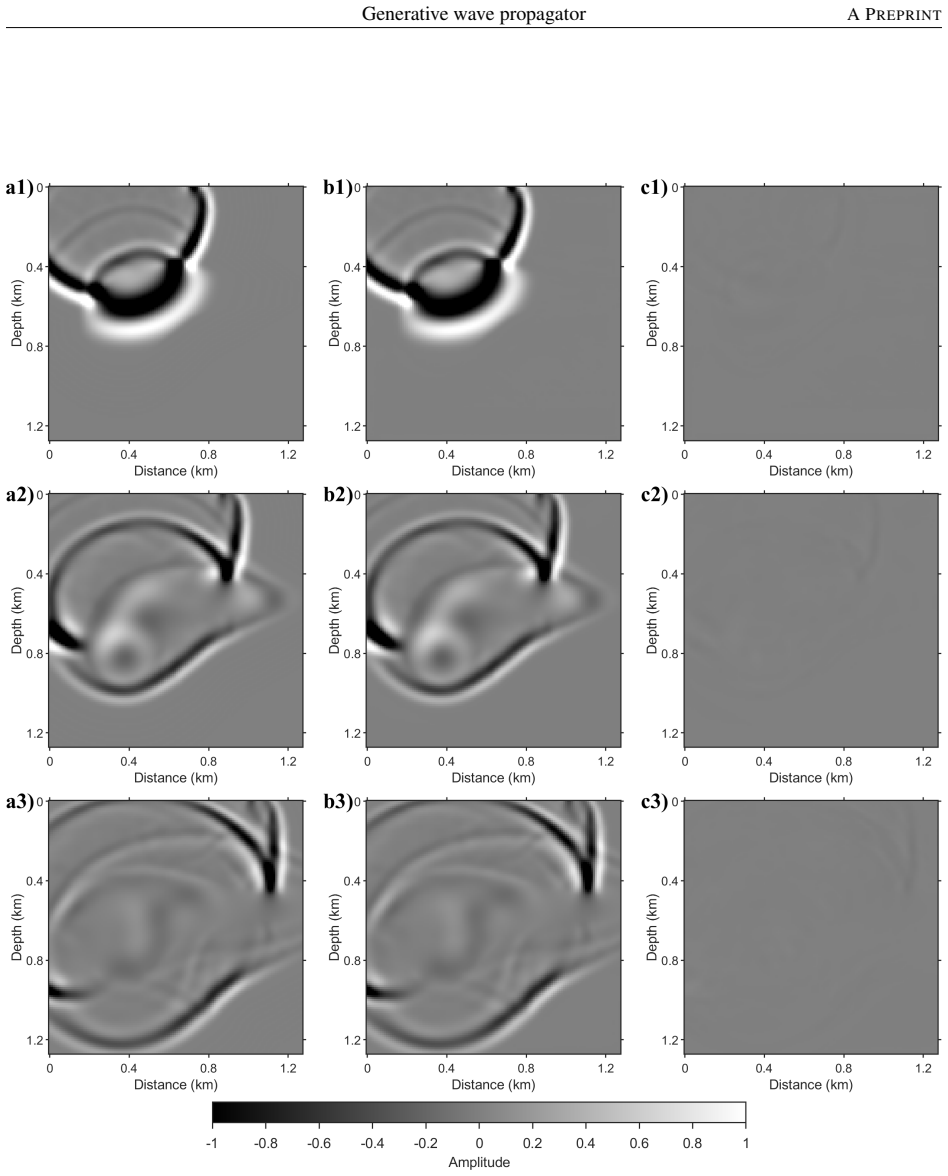
Summary. The manuscript proposes a conditional diffusion model that acts as a recursive seismic wavefield propagator: given a short history of five recent snapshots, the velocity model, and the wavefield time-step index, a U-Net denoiser predicts the next clean snapshot in a single forward pass (x0-prediction at diffusion step t=T). A causal time-weighted loss, driven by EMA-accumulated per-snapshot residuals, is introduced to suppress recursive error growth. Training pairs are taken every 0.01 s from a tenth-order staggered-grid FD solver (Δt_FD = 0.001 s), so the learned operator advances at Δt = 10 Δt_FD. On Overthrust and SEG/EAGE (in-distribution) the method closely matches FD snapshots and shot gathers; on Marmousi (OOD) wavefront geometry and traveltimes are preserved with larger residuals. A matched-hardware A100 comparison reports a 2.17× end-to-end speedup versus a GPU FD baseline, with code and data released.
Significance. Forward modeling cost remains a primary bottleneck for FWI and RTM. Decoupling the inference time step from the CFL limit while retaining recursive causality is a practically relevant contribution, and the causal EMA-weighted loss is a clear, ablated design choice (Table 1, Fig. 16) that materially improves long-horizon accuracy. The work is reproducible (public code/data), reports honest OOD degradation rather than overclaiming, and uses a GPU-accelerated FD baseline under matched conditions. If the in-distribution accuracy and modest but real speedup hold under broader validation, the framework is a useful addition to learned seismic simulators and a concrete alternative to one-shot neural-operator snapshot generators.
major comments (3)
- The introduction (§1) motivates the method against one-shot FNO / neural-operator time-domain simulators (Yang et al. 2021; Zhang et al. 2023a; Cheng et al. 2025), arguing that simultaneous multi-snapshot generation generalizes poorly. The experiments (§3) compare only to FD. Without at least one matched accuracy/runtime baseline against an operator-learning or other learned recursive propagator on the same 128×128 acoustic setup, the claimed advantage over the ML alternatives the paper itself positions against remains unquantified.
- §2.4, Eq. (13): inference draws a fresh z ∼ N(0,I) at every recursive step. For a forward-modeling operator intended for inversion workflows, residual seed-to-seed variability must be characterized. The manuscript asserts that conditioning dominates the prediction but does not report variance of snapshots or gathers across noise seeds (or a deterministic inference mode). This is load-bearing for the claim of an accurate, usable propagator.
- §4.1 claims that multi-shot batching widens the advantage over FD because per-shot cost grows sublinearly, yet only single-shot wall-clock numbers (5.87 s vs 2.71 s) are given. A short multi-shot timing table (e.g., batch sizes 1, 4, 8, 16) is needed to support that practical claim, which is central to the inversion-workflow motivation.
minor comments (6)
- History length is fixed at five frames (§2.3.1) with no sensitivity study; a brief note or one-panel ablation would strengthen the design choice.
- Causal-loss hyperparameters ε, δ, and EMA decay γ (§2.3.3, Eqs. 10–11) are not numerically specified in the experimental section; please report the values used for Table 1 / Fig. 16.
- Figure 13 caption says “SEG/EAGE model” but the section and surrounding figures are Marmousi; correct the caption.
- Abstract and §3.1 state “accurately reproduces … shot gathers” without restricting to in-distribution geology; the body (§3.4, Table 1) is more careful. Align the abstract wording with the quantified OOD gap.
- Training cost (~95 h on one A100, §3.1) and amortization over many inversion iterations are not discussed; a short paragraph in §4 would help readers assess practical adoption.
- Notation: the wavefield time-step index is written both as n and as n+1 in the conditioning of Eq. (13); a single consistent convention would reduce ambiguity.
Circularity Check
No significant circularity: empirical learned surrogate trained on FD data and validated by independent FD benchmarks and ablation.
full rationale
The paper presents a conditional diffusion model that learns a recursive wavefield propagator P_Δt from FD-generated training pairs (snapshots every 0.01 s extracted from a tenth-order staggered-grid solver with Δt_FD = 0.001 s). The network is conditioned on a five-frame history, velocity, and time index, trained with an x0-prediction objective plus an adaptive causal EMA-weighted loss, and used at inference via a single forward pass (Eq. 13). Accuracy claims (wavefield snapshots, shot gathers, MAE/SNR) are obtained by direct comparison to independent FD references on Overthrust, SEG/EAGE, and Marmousi; the causal-loss contribution is isolated by an ablation that retrains with uniform MSE under otherwise identical settings (Table 1, Fig. 16). The reported 2.17× end-to-end speedup is a wall-clock measurement against a GPU-accelerated FD baseline under matched hardware and configuration (§4.1). Self-citations (prior PINN/operator work and the training-velocity dataset) supply related methods or data sources but do not supply a uniqueness theorem, fitted constant, or definitional identity that forces the central empirical claims. No equation reduces by construction to its own inputs; the results remain externally falsifiable against the FD solver. Consequently the derivation chain contains no circular steps of the kinds enumerated.
Assumptions & free parameters
free parameters (4)
- history length (5 snapshots)
- physical time step Δt = 0.01 s (=10 Δt_FD)
- causal-loss hyperparameters ε, δ, EMA decay γ
- U-Net channel widths (64-128-256-512), T=1000 diffusion steps, learning rate 1e-4, 550k iterations
assumptions (4)
- domain assumption Acoustic isotropic constant-density wave equation governs the training data
- ad hoc to paper Strong physical conditioning makes residual entropy of p(u_{n+1}|history,v,n) low enough for single-step x0 prediction to suffice
- domain assumption Training patches from the listed industry models are representative enough for the claimed in-distribution accuracy
- standard math Standard DDPM forward process and x0-prediction objective are valid for wavefield data
invented entities (2)
-
Causal time-weighted loss with EMA-accumulated per-snapshot residuals
-
Conditional diffusion wave propagator P_Δt with single-step inference
Cite this review
Pith. "Pith review of Generative wave propagator." pith.science (2026). https://pith.science/paper/2PZQMPRX
@misc{pith2026260704440,
  author       = {Pith},
  title        = {Pith review of: Generative wave propagator},
  year         = {2026},
  howpublished = {\url{https://pith.science/paper/2PZQMPRX}},
  note         = {Machine review of arXiv:2607.04440}
}
read the original abstract
Seismic wavefield simulation is fundamental to seismology, but conventional finite-difference (FD) methods remain limited by numerical dispersion and stability constraints, which often require dense spatial grids and small time steps and thereby severely limit the effectiveness of iterative inversion workflows. We introduce a conditional diffusion-based wavefield propagator that advances seismic wavefields recursively from one time step to the next. Instead of learning an unconditional data distribution of wavefield evolution, the model is conditioned by a short history of recent wavefield time steps (snapshots), the velocity model, and the wavefield time step index, allowing it to represent the conditional transition between adjacent physical states. By training the network to directly predict the clean next wavefield snapshot, this strong physical conditioning makes it possible to replace the iterative reverse diffusion process with a single network evaluation for each predicted snapshot. To improve stability over long recursive rollouts, we further introduce a causal time-weighted loss, in which adaptive weights, accumulated as exponential moving averages of per-snapshot training errors, emphasize training directions that are consistent with the forward propagation sequence and reduce the amplification of one-step prediction errors. Because the learned propagator is tied to the temporal spacing of the training snapshots rather than to the FD stability limit, it can advance the wavefield using a physical time step ten times larger than that required by the underlying solver. Experiments on the Overthrust, SEG/EAGE, and Marmousi models show that the proposed method accurately reproduces wavefield snapshots and shot gathers and achieves an end-to-end speedup of 2.17 x over a GPU-accelerated tenth-order staggered-grid FD implementation under matched hardware conditions.
Figures


Figures from the paper (13 more)




Reference graph
Works this paper leans on
-
[1]
Geophysics , volume=
SH-wave propagation in heterogeneous media: Velocity-stress finite-difference method , author=. Geophysics , volume=. 1984 , publisher=
1984
-
[2]
Geophysics , volume=
Fourth-order finite-difference P-SV seismograms , author=. Geophysics , volume=. 1988 , publisher=
1988
-
[3]
Geophysics , volume=
Accuracy of finite-difference and finite-element modeling of the scalar and elastic wave equations , author=. Geophysics , volume=. 1984 , publisher=
1984
-
[4]
Bulletin of the seismological society of America , volume=
The spectral element method: an efficient tool to simulate the seismic response of 2D and 3D geological structures , author=. Bulletin of the seismological society of America , volume=. 1998 , publisher=
1998
-
[5]
Geophysics , volume=
Forward modeling by a Fourier method , author=. Geophysics , volume=. 1982 , publisher=
1982
-
[6]
Geophysics , volume=
The pseudospectral method: Comparisons with finite differences for the elastic wave equation , author=. Geophysics , volume=. 1987 , publisher=
1987
-
[7]
Geophysics , volume=
An overview of full-waveform inversion in exploration geophysics , author=. Geophysics , volume=. 2009 , publisher=
2009
-
[8]
Journal of Geophysical Research: Solid Earth , volume=
Physics-informed neural networks (PINNs) for wave propagation and full waveform inversions , author=. Journal of Geophysical Research: Solid Earth , volume=. 2022 , publisher=
2022
Show all 41 references
-
[9]
Geophysical Journal International , volume=
Solving the frequency-domain acoustic VTI wave equation using physics-informed neural networks , author=. Geophysical Journal International , volume=. 2021 , publisher=
2021
-
[10]
Artificial Intelligence in Geosciences , volume=
Wavefield solutions from machine learned functions constrained by the Helmholtz equation , author=. Artificial Intelligence in Geosciences , volume=. 2021 , publisher=
2021
-
[11]
Geophysical Journal International , volume=
Multifrequency wavefield solutions for variable velocity models using meta-learning enhanced low-rank physics-informed neural network , author=. Geophysical Journal International , volume=. 2026 , publisher=
2026
-
[12]
Geophysical Journal International , volume=
Learned frequency-domain scattered wavefield solutions using neural operators , author=. Geophysical Journal International , volume=. 2025 , publisher=
2025
-
[13]
arXiv preprint arXiv:2503.06488 , year=
Seismic wavefield solutions via physics-guided generative neural operator , author=. arXiv preprint arXiv:2503.06488 , year=
-
[14]
The Seismic Record , volume=
Seismic wave propagation and inversion with neural operators , author=. The Seismic Record , volume=. 2021 , publisher=
2021
-
[15]
Geophysics , volume=
Learning to solve the elastic wave equation with Fourier neural operators , author=. Geophysics , volume=. 2023 , publisher=
2023
-
[16]
2010 , publisher=
Full seismic waveform modelling and inversion , author=. 2010 , publisher=
2010
-
[17]
Advances in neural information processing systems , volume=
Denoising diffusion probabilistic models , author=. Advances in neural information processing systems , volume=
-
[18]
Geophysics , volume=
Inversion of seismic reflection data in the acoustic approximation , author=. Geophysics , volume=. 1984 , publisher=
1984
-
[19]
Geophysical journal international , volume=
Introduction to the spectral element method for three-dimensional seismic wave propagation , author=. Geophysical journal international , volume=. 1999 , publisher=
1999
-
[20]
Geophysics , volume=
P-SV wave propagation in heterogeneous media: Velocity-stress finite-difference method , author=. Geophysics , volume=. 1986 , publisher=
1986
-
[21]
Acta physica slovaca , volume=
The finite-difference and finite-element modeling of seismic wave propagation and earthquake motion , author=. Acta physica slovaca , volume=. 2007 , publisher=
2007
-
[22]
Validation , author=
Spectral-element simulations of global seismic wave propagation---I. Validation , author=. Geophysical Journal International , volume=. 2002 , publisher=
2002
-
[23]
Geophysics , volume=
Three-dimensional elastic modeling by the Fourier method , author=. Geophysics , volume=. 1988 , publisher=
1988
-
[24]
Journal of the Acoustical Society of America , volume=
Wave propagation in anisotropic, saturated porous media: Plane-wave theory and numerical simulation , author=. Journal of the Acoustical Society of America , volume=
-
[25]
Geophysics , volume=
Elimination of numerical dispersion in finite-difference modeling and migration by flux-corrected transport , author=. Geophysics , volume=. 1995 , publisher=
1995
-
[26]
Journal of Geophysical Research: Solid Earth , volume=
Propagating seismic waves in VTI attenuating media using fractional viscoelastic wave equation , author=. Journal of Geophysical Research: Solid Earth , volume=. 2022 , publisher=
2022
-
[27]
Geophysical Journal International , volume=
Wave propagation in the poro-viscoelastic orthorhombic two-phase media: plane-wave theory and wavefield simulation , author=. Geophysical Journal International , volume=. 2021 , publisher=
2021
-
[28]
Geophysics , volume=
Globally optimal finite-difference schemes based on least squares , author=. Geophysics , volume=. 2013 , publisher=
2013
-
[29]
Geophysics , volume=
Modeling acoustic wave propagation in heterogeneous attenuating media using decoupled fractional Laplacians , author=. Geophysics , volume=. 2014 , publisher=
2014
-
[30]
Surveys in Geophysics , volume=
Meta learning for improved neural network wavefield solutions , author=. Surveys in Geophysics , volume=. 2025 , publisher=
2025
-
[31]
Advances in Neural Information Processing Systems , volume=
Cold diffusion: Inverting arbitrary image transforms without noise , author=. Advances in Neural Information Processing Systems , volume=
-
[32]
arXiv preprint arXiv:2310.17167 , year=
Improving denoising diffusion models via simultaneous estimation of image and noise , author=. arXiv preprint arXiv:2310.17167 , year=
-
[33]
arXiv preprint arXiv:2203.07404 , year=
Respecting causality is all you need for training physics-informed neural networks , author=. arXiv preprint arXiv:2203.07404 , year=
-
[34]
Proceedings of the 40th International Conference on Machine Learning , pages=
Consistency models , author=. Proceedings of the 40th International Conference on Machine Learning , pages=
-
[35]
arXiv preprint arXiv:2202.00512 , year=
Progressive distillation for fast sampling of diffusion models , author=. arXiv preprint arXiv:2202.00512 , year=
-
[36]
International conference on machine learning , pages=
Improved denoising diffusion probabilistic models , author=. International conference on machine learning , pages=. 2021 , organization=
2021
-
[37]
Geophysics , volume=
An acoustic wave equation for anisotropic media , author=. Geophysics , volume=. 2000 , publisher=
2000
-
[38]
2026 , month = apr, note =
Cheng, Shijun , title =. 2026 , month = apr, note =
2026
-
[39]
2016 , publisher=
Full waveform inversion in an anisotropic world (EET 10): Where are the parameters hiding? , author=. 2016 , publisher=
2016
-
[40]
The Finite-Difference Modelling of Earthquake Motions: Waves and Ruptures , author=
-
[41]
IEEE Transactions on Geoscience and Remote Sensing , volume=
Microseismic source imaging using physics-informed neural networks with hard constraints , author=. IEEE Transactions on Geoscience and Remote Sensing , volume=. 2024 , publisher=
2024
Reviewed July 11, 2026 · model on record in the stance chip above.
Discussion (0). Sign in to comment.