REVIEW 3 major objections 6 minor 50 references
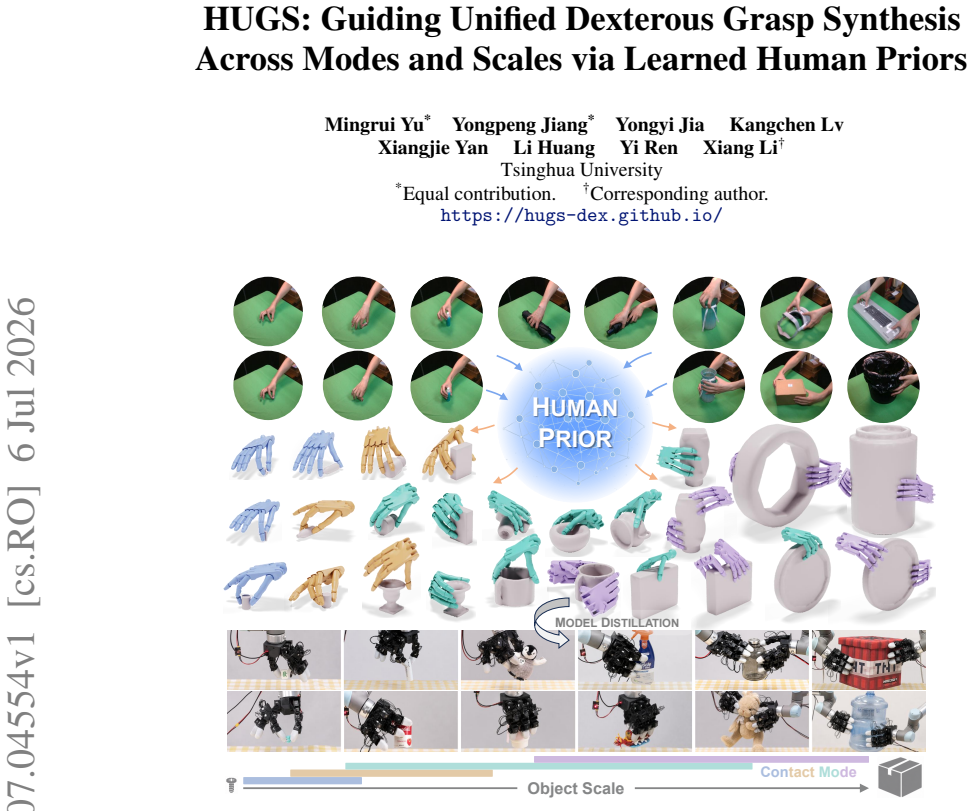
A small set of human grasps can teach robots which contact modes and wrist starts to try, so force-closure optimization spans pinches to two-hand grasps across object scales.
Reviewed by Pith at T0; open to challenge. T0 means a machine referee read the full paper against a public rubric. the ladder, T0–T4 →
T0 review · grok-4.5
2026-07-11 17:24 UTC pith:Y4P5WKEW
load-bearing objection Solid systems paper: geometry-aware mode/wrist prior from 1.8K human grasps beats scale heuristics for multi-mode dexterous synthesis and ships a usable 3.2M dataset. the 3 major comments →
HUGS: Guiding Unified Dexterous Grasp Synthesis Across Modes and Scales via Learned Human Priors
The pith
A machine-rendered reading of the paper's core claim, the machinery that carries it, and where it could break.
Core claim
An object-conditioned human prior over discrete contact modes and wrist initializations, learned from a compact multi-mode human grasp set, guides force-closure-aware robot optimization so that synthesis covers modes from two-finger to bimanual grasps across object half-diagonals of roughly 2–30 cm more successfully and more usefully than scale-only heuristics, without one-to-one retargeting of each human demonstration.
What carries the argument
Object-conditioned human prior π(c|o) and π(T0|c,o): a geometry-aware model that predicts preferred contact modes (Single-Two, Single-Three, Single-Full, Both-Full) and mode-conditioned wrist starts, then allocates synthesis budget and seeds a bi-level force-closure optimizer for the robot hand.
Load-bearing premise
That four coarse contact modes and wrist poses learned from a few hundred everyday objects, after one scalar hand-size rescale, give good enough global guidance for force-closure optimization on new shapes and robot hands.
What would settle it
On a held-out set of objects whose shapes and scales sit far outside the human collection, compare success rate, mode coverage, and downstream generator quality when optimization is guided by the learned prior versus matched-budget scale heuristics; if the prior no longer improves success or mode allocation, the central claim fails.
If this is right
- Large multi-mode robot grasp datasets can be grown from limited human data instead of exhaustive human retargeting or pure heuristics.
- Synthesis budget can shift smoothly with geometry, not only with a single size number, raising success while still covering several modes per object.
- Generators trained on the resulting data can choose two-finger versus full-hand versus bimanual grasps at deployment when clutter or load changes.
- The same prior-plus-optimization pipeline can be transferred across anthropomorphic hands by a human-to-robot scale factor and embodiment mapping of the wrist frame.
Where Pith is reading between the lines
- If high-level mode-and-wrist priors are the transferable core, denser contact maps may be less necessary for stable lifting synthesis and more of a next step for functional use.
- The same budget-allocation idea could extend to environment-aware modes (top-only in clutter, dual-hand under heavy load) if the prior were conditioned on free space or task force requirements.
- Compact, deliberately multi-mode human capture may be more leverageable for robotics than larger single-mode reconstruction datasets that lack wrist and mode diversity.
Editorial analysis
A structured set of objections, weighed in public.
Referee Report
Summary. HUGS proposes a human-prior-guided pipeline for unified multi-mode, multi-scale dexterous grasp synthesis. From a compact self-collected dataset (HUGS-Human: 1.8K grasps, 304 objects), the authors learn an object-conditioned prior over four discrete contact modes and index-MCP wrist poses, then use that prior to allocate optimization budget and initialize force-closure-aware bi-level optimization (Eqs. 1–3). Under a fixed budget of B=40 attempts per scene, they synthesize 3.2M validated robot grasps over 157K rescaled DGN2k scenes (half-diagonals 2–30 cm), spanning Single-Two through Both-Full modes. Systematic ablations against scale-heuristic baselines (Heur-Fix/Single/Multi) and a wrist-prior-only variant (HUGS-Single), held-out mode-prediction metrics (Table 1), LEAP-hand transfer, distillation of online generators (Fig. 6), and qualitative real-world LEAP demos support the claim that geometry-aware human priors improve the success–coverage trade-off relative to hand-crafted heuristics.
Significance. Unified synthesis across contact modes and object scales is a genuine bottleneck for large-scale dexterous grasp datasets and for training generators that must choose modes at deployment. The Human-Prior + Robot-Optimization framing is a clear conceptual contribution: high-level human preferences (modes, wrists) guide search without one-to-one retargeting, while force-closure optimization enforces robot kinematics and physics. Strengths include a released multi-mode human dataset with broad scale coverage, controlled ablations that isolate mode allocation vs. wrist initialization, cross-embodiment synthesis (Shadow and LEAP), and a large multi-mode synthetic corpus. If the claims hold under the stated scope, the work is a solid systems and data contribution for the dexterous-grasping community and a useful template for prior-guided analytical synthesis.
major comments (3)
- Abstract and Sec. 4.4 state that models “autonomously select appropriate contact modes in the real world,” but Appendix A.5 describes sampling 25 grasps per mode and manually selecting three candidates for execution, and explicitly frames the demos as non-quantitative “deployment potential.” This is a load-bearing mismatch for the real-world claim. Please align the abstract/intro/conclusion wording with the actual protocol (e.g., “mode-aware candidates that support adaptive selection under deployment constraints”) or report quantitative success rates with a fully automatic selection rule.
- Sec. 3.4 and A.3 introduce two free parameters that are central to embodiment transfer and bimanual success: the human-to-robot hand scale ratio (1.0 Shadow, 1.4 LEAP) used when querying the prior, and the 10 cm palm-outward initialization offset for bimanual cases. Results in Fig. 4/16 and the LEAP distillation (Fig. 18) depend on these choices, yet no sensitivity study is reported. A short ablation (e.g., ratio ∈ {1.0, 1.2, 1.4, 1.6}; offset ∈ {0, 5, 10} cm) on success rate and penetration failures (D.1) is needed to support the claim that the prior generalizes across hand sizes rather than being tuned per embodiment.
- Table 1 evaluates contact-mode prediction only on held-out HUGS-Human objects, while synthesis (Sec. 4.2, Fig. 4) is run on rescaled DGN2k meshes. The central efficiency claim rests on the prior allocating budget correctly on the synthesis distribution. Please report mode-prediction quality (KL / soft precision-recall, or at least predicted mode histograms vs. successful modes) on a held-out subset of the DGN2k scenes, or otherwise show that the geometry-aware advantage over scale rules transfers to the objects used for the 3.2M synthesis.
minor comments (6)
- Fig. 4(c): HUGS shows lower first-PC explained-variance ratio (more concentrated poses). The text correctly notes that heuristic diversity partly comes from unnatural wrists (Fig. 5), but the abstract’s “diversity” language should consistently distinguish contact-mode coverage from wrist-pose dispersion to avoid over-reading Fig. 4(c) as a pure win.
- Eq. (2) and Sec. 3.1: the factorization π(Q,T|T0,c,o)π(T0|c,o)π(c|o) is clear; briefly state whether π(c|o) is treated as a soft budget prior or hard mode selection at inference (A.3 suggests soft allocation with a per-mode cap Bc=20).
- A.1 / Fig. 11: exclusion of Both-Three is reasonable given rarity; a one-sentence note in the main Sec. 3.1 mode list would help readers who only skim the appendix.
- A.3 scale-dependent density d(s)=d0(s/s0)^−2 is a sensible mass-control choice; state the resulting mass range in the main evaluation section so readers can interpret lift success across 2–30 cm without opening the appendix.
- Related Work: UltraDexGrasp and BiDexGrasp are cited; a short explicit comparison of multi-mode-per-object coverage vs. scale-tied single modes would sharpen the novelty claim relative to concurrent synthetic multi-mode work.
- Typos / polish: “arXiv:2607.04554v1” date line is fine; ensure consistent spelling of “bimanual” vs. “dual-hand,” and that Fig. 1 caption matches the four-mode taxonomy used in Sec. 3.1.
Circularity Check
No significant circularity: human prior is trained and held-out-evaluated independently of physics-validated robot synthesis success.
full rationale
HUGS trains an object-conditioned prior over four discrete contact modes and index-MCP wrist poses on a self-collected 1.8K-grasp human dataset, then uses the prior only to allocate optimization budget and initialize wrists for a separate force-closure QP (Eqs. 1–3) whose success is measured by independent MuJoCo lift/stability/collision criteria on DGN2k scenes. Table 1 evaluates mode prediction on held-out HUGS-Human objects against scale-rule baselines derived from the same training statistics; Figs. 4/16 compare synthesis success under identical B=40 budgets against Heur-Fix/Single/Multi; HUGS-Single isolates the wrist prior; distillation (Figs. 6/18) and real-world demos are downstream uses of the validated synthetic set. No equation equates a claimed prediction to a fitted quantity by construction, no uniqueness theorem is imported from overlapping authors, and no ansatz is smuggled via self-citation. The four-mode abstraction and compact human set are acknowledged limitations (Sec. 5), not circular reductions. The derivation chain is therefore self-contained and externally falsifiable.
Axiom & Free-Parameter Ledger
free parameters (5)
- Total optimization budget B and per-mode cap Bc =
B=40, Bc=20
- Human-to-robot hand scale ratio =
1.0 / 1.4
- Bimanual palm-outward initialization offset =
10 cm
- Diffusion training/inference steps and noise schedule =
128 / 10
- Scale-dependent object density d(s)=d0(s/s0)^-2 =
d0=700, s0=0.06
axioms (4)
- domain assumption Force closure under point contact with Coulomb friction is a sufficient proxy for stable lifting grasps.
- ad hoc to paper Four discrete contact modes (Single-Two/Three/Full, Both-Full) adequately cover the dominant human strategies executable by current dexterous hands.
- domain assumption Human grasp preferences over modes and wrists, after a global hand-scale correction, transfer usefully to robot kinematics via force-closure refinement.
- ad hoc to paper A compact 1.8K-grasp / 304-object human corpus is representative enough to learn a generalizable object-conditioned prior.
invented entities (2)
-
Object-conditioned human prior π(c|o), π(T0|c,o) over four modes and index-MCP wrists
independent evidence
-
HUGS-Human dataset (304 objects, 1.8K multi-mode grasps)
no independent evidence
read the original abstract
Dexterous grasping across diverse object scales requires contact modes ranging from two-finger pinches to bimanual grasps. Existing dexterous grasp synthesis methods reduce the high-dimensional optimization space with manually designed expected contacts and initialization heuristics, which struggle to balance synthesis success rate and diversity. We present HUGS (Human-prior-guided Unified Dexterous Grasp Synthesis), a human-prior-guided framework for unified dexterous grasp synthesis across modes and scales. Instead of directly retargeting human demonstrations, HUGS learns an object-conditioned human prior that captures human grasp preferences and guides downstream force-closure-aware optimization. The prior is trained on a compact self-collected human grasp dataset with 1.8K grasps over 304 objects, providing broad coverage of object scales and contact modes. During synthesis, HUGS adaptively proposes contact modes and wrist initializations, substantially improving the balance between contact-mode coverage and synthesis success rate over heuristic-based methods. With HUGS, we synthesize 3.2M robotic grasps over 157K scenes, spanning object half-diagonal lengths from 2 cm to 30 cm and modes from two-finger to bimanual grasps. Models trained on the synthesized dataset autonomously select appropriate contact modes in the real world, enabling grasping from screws to large boxes.
Figures


Reference graph
Works this paper leans on
-
[1]
R. Wang, J. Zhang, J. Chen, Y . Xu, P. Li, T. Liu, and H. Wang. Dexgraspnet: A large- scale robotic dexterous grasp dataset for general objects based on simulation. In2023 IEEE International Conference on Robotics and Automation (ICRA), pages 11359–11366. IEEE, 2023
2023
-
[2]
J. Chen, Y . Ke, and H. Wang. Bodex: Scalable and efficient robotic dexterous grasp synthesis using bilevel optimization. In2025 IEEE International Conference on Robotics and Automation (ICRA), pages 01–08. IEEE, 2025
2025
-
[3]
Shao and C
Y . Shao and C. Xiao. Bimanual grasp synthesis for dexterous robot hands.IEEE Robotics and Automation Letters, 9(12):11377–11384, 2024
2024
-
[4]
Lin, Y .-L
M. Lin, Y .-L. Wei, J. Chen, Y . Lin, S. Chen, J. Lyu, J. Chen, Y . Tang, H. Wang, and W.-S. Zheng. Bidexgrasp: Coordinated bimanual dexterous grasps across object geometries and sizes.arXiv e-prints, pages arXiv–2604, 2026
2026
-
[5]
Billard and D
A. Billard and D. Kragic. Trends and challenges in robot manipulation.Science, 364(6446): eaat8414, 2019
2019
-
[6]
W. Wei, P. Wang, S. Wang, Y . Luo, W. Li, D. Li, Y . Huang, and H. Duan. Learning human-like functional grasping for multifinger hands from few demonstrations.IEEE Transactions on Robotics, 40:3897–3916, 2024
2024
-
[7]
H. Chen, Y . Yao, Y . Ye, Z. Xu, H. Bharadhwaj, J. Wang, S. Tulsiani, Z. Erickson, and J. Ich- nowski. Web2grasp: Learning functional grasps from web images of hand-object interactions. arXiv preprint arXiv:2505.05517, 2025
Pith/arXiv arXiv 2025
-
[8]
S. Wang, Y . Yang, Y . Luo, D. Li, W. Wei, Y . Zhang, P. Hu, Y . Fu, H. Duan, J. Sun, et al. Scaleadfg: Affordance-based dexterous functional grasping via scalable dataset.IEEE Robotics and Automation Letters, 2025
2025
-
[9]
T. Liu, Z. Liu, Z. Jiao, Y . Zhu, and S.-C. Zhu. Synthesizing diverse and physically stable grasps with arbitrary hand structures using differentiable force closure estimator.IEEE Robotics and Automation Letters, 7(1):470–477, 2021
2021
-
[10]
Zurbr ¨ugg, A
R. Zurbr ¨ugg, A. Cramariuc, and M. Hutter. Graspqp: Differentiable optimization of force closure for diverse and robust dexterous grasping. InConference on Robot Learning, 2025
2025
-
[11]
J. Ye, L. Wei, G. Jiang, C. Jing, X. Zou, and X. Wang. From power to precision: Learning fine-grained dexterity for multi-fingered robotic hands.arXiv preprint arXiv:2511.13710, 2025
arXiv 2025
-
[12]
S. Yang, Y . Xie, Z. Liang, Y . Tian, J. Zeng, D. Lin, and J. Pang. Ultradexgrasp: Learning univer- sal dexterous grasping for bimanual robots with synthetic data.arXiv preprint arXiv:2603.05312, 2026
arXiv 2026
-
[13]
J. He, D. Li, X. Yu, Z. Qi, W. Zhang, J. Chen, Z. Zhang, Z. Zhang, L. Yi, and H. Wang. Dexvlg: Dexterous vision-language-grasp model at scale. InProceedings of the IEEE/CVF International Conference on Computer Vision, pages 14248–14258, 2025
2025
-
[14]
J. Chen, Y . Ke, L. Peng, and H. Wang. Dexonomy: Synthesizing all dexterous grasp types in a grasp taxonomy.arXiv preprint arXiv:2504.18829, 2025
Pith/arXiv arXiv 2025
- [15]
-
[16]
Wei, J.-J
Y .-L. Wei, J.-J. Jiang, C. Xing, X.-T. Tan, X.-M. Wu, H. Li, M. Cutkosky, and W.-S. Zheng. Grasp as you say: language-guided dexterous grasp generation. InProceedings of the 38th International Conference on Neural Information Processing Systems, pages 46881–46907, 2024. 9
2024
-
[17]
C. Mao, H. Yuan, Z. Huang, C. Xu, K. Ma, and Z. Lu. Universal dexterous functional grasping via demonstration-editing reinforcement learning.arXiv preprint arXiv:2512.13380, 2025
arXiv 2025
-
[18]
Huang, H
L. Huang, H. Zhang, Z. Wu, S. Christen, and J. Song. Fungrasp: Functional grasping for diverse dexterous hands.IEEE Robotics and Automation Letters, 2025
2025
-
[19]
Y . Ma, K. Chen, K. Zheng, and D. QI. Contact map transfer with conditional diffusion model for generalizable dexterous grasp generation.Advances in Neural Information Processing Systems, 38:79807–79836, 2026
2026
-
[20]
Z. Wu, R. A. Potamias, X. Zhang, Z. Zhang, J. Deng, and S. Luo. Cedex: Cross-embodiment dexterous grasp generation at scale from human-like contact representations.arXiv preprint arXiv:2509.24661, 2025
arXiv 2025
-
[21]
Z. Wei, Z. Xu, J. Guo, Y . Hou, C. Gao, Z. Cai, J. Luo, and L. Shao.D(R,O )grasp: A unified representation of robot and object interaction for cross-embodiment dexterous grasping. In 2025 IEEE International Conference on Robotics and Automation (ICRA), pages 4982–4988,
2025
-
[22]
doi:10.1109/ICRA55743.2025.11127754
-
[23]
Z. Weng, H. Lu, D. Kragic, and J. Lundell. Dexdiffuser: Generating dexterous grasps with diffusion models.IEEE Robotics and Automation Letters, 9(12):11834–11840, 2024
2024
-
[24]
Y . Xu, W. Wan, J. Zhang, H. Liu, Z. Shan, H. Shen, R. Wang, H. Geng, Y . Weng, J. Chen, et al. Unidexgrasp: Universal robotic dexterous grasping via learning diverse proposal generation and goal-conditioned policy. InProceedings of the IEEE/CVF Conference on Computer Vision and Pattern Recognition, pages 4737–4746, 2023
2023
- [25]
-
[26]
Zhong, X
Y . Zhong, X. Huang, R. Li, C. Zhang, Z. Chen, T. Guan, F. Zeng, K. N. Lui, Y . Ye, Y . Liang, et al. Dexgraspvla: A vision-language-action framework towards general dexterous grasping. In Proceedings of the AAAI Conference on Artificial Intelligence, volume 40, pages 18836–18844, 2026
2026
-
[27]
Zhang, H
J. Zhang, H. Liu, D. Li, X. Yu, H. Geng, Y . Ding, J. Chen, and H. Wang. Dexgraspnet 2.0: Learning generative dexterous grasping in large-scale synthetic cluttered scenes. In8th Annual Conference on Robot Learning, 2024
2024
-
[28]
H. Yuan, Z. Huang, Y . Wang, C. Mao, C. Xu, and Z. Lu. Demograsp: Universal dexterous grasping from a single demonstration.arXiv preprint arXiv:2509.22149, 2025
arXiv 2025
-
[29]
H. Zhang, Z. Wu, L. Huang, S. Christen, and J. Song. Robustdexgrasp: Robust dexterous grasping of general objects.arXiv preprint arXiv:2504.05287, 2025
Pith/arXiv arXiv 2025
-
[30]
Z. Chen, Q. Yan, Y . Chen, T. Wu, J. Zhang, Z. Ding, J. Li, Y . Yang, and H. Dong. Clutterdex- grasp: A sim-to-real system for general dexterous grasping in cluttered scenes. InConference on Robot Learning, pages 885–905. PMLR, 2025
2025
-
[31]
T. G. W. Lum, M. Matak, V . Makoviychuk, A. Handa, A. Allshire, T. Hermans, N. D. Ratliff, and K. Van Wyk. Dextrah-g: Pixels-to-action dexterous arm-hand grasping with geometric fabrics. InConference on Robot Learning, pages 3182–3211. PMLR, 2025
2025
-
[32]
R. Singh, A. Allshire, A. Handa, N. Ratliff, and K. Van Wyk. Dextrah-rgb: Visuomotor policies to grasp anything with dexterous hands.arXiv preprint arXiv:2412.01791, 2024
Pith/arXiv arXiv 2024
-
[33]
K. M. Lynch and F. C. Park.Modern robotics. Cambridge University Press, 2017. 10
2017
-
[34]
Y .-W. Chao, W. Yang, Y . Xiang, P. Molchanov, A. Handa, J. Tremblay, Y . S. Narang, K. Van Wyk, U. Iqbal, S. Birchfield, et al. Dexycb: A benchmark for capturing hand grasping of objects. In Proceedings of the IEEE/CVF conference on computer vision and pattern recognition, pages 9044–9053, 2021
2021
-
[35]
L. Yang, K. Li, X. Zhan, F. Wu, A. Xu, L. Liu, and C. Lu. Oakink: A large-scale knowl- edge repository for understanding hand-object interaction. InProceedings of the IEEE/CVF conference on computer vision and pattern recognition, pages 20953–20962, 2022
2022
-
[36]
W. Cho, J. Lee, M. Yi, M. Kim, T. Woo, D. Kim, T. Ha, H. Lee, J.-H. Ryu, W. Woo, et al. Dense hand-object (ho) graspnet with full grasping taxonomy and dynamics. InEuropean Conference on Computer Vision, pages 284–303. Springer, 2024
2024
-
[37]
Taheri, N
O. Taheri, N. Ghorbani, M. J. Black, and D. Tzionas. Grab: A dataset of whole-body human grasping of objects. InEuropean conference on computer vision, pages 581–600. Springer, 2020
2020
-
[38]
Brahmbhatt, C
S. Brahmbhatt, C. Tang, C. D. Twigg, C. C. Kemp, and J. Hays. Contactpose: A dataset of grasps with object contact and hand pose. InEuropean Conference on Computer Vision, pages 361–378. Springer, 2020
2020
-
[39]
Romero, D
J. Romero, D. Tzionas, and M. J. Black. Embodied hands: modeling and capturing hands and bodies together.ACM Transactions on Graphics (TOG), 36(6):1–17, 2017
2017
-
[40]
C. Choy, J. Gwak, and S. Savarese. 4d spatio-temporal convnets: Minkowski convolutional neural networks. InProceedings of the IEEE/CVF Conference on Computer Vision and Pattern Recognition, pages 3075–3084, 2019
2019
-
[41]
Todorov, T
E. Todorov, T. Erez, and Y . Tassa. Mujoco: A physics engine for model-based control. In2012 IEEE/RSJ international conference on intelligent robots and systems, pages 5026–5033. IEEE, 2012
2012
-
[42]
K. Shaw, A. Agarwal, and D. Pathak. Leap hand: Low-cost, efficient, and anthropomorphic hand for robot learning.arXiv preprint arXiv:2309.06440, 2023
Pith/arXiv arXiv 2023
-
[43]
T. Feix, J. Romero, H.-B. Schmiedmayer, A. M. Dollar, and D. Kragic. The grasp taxonomy of human grasp types.IEEE Transactions on human-machine systems, 46(1):66–77, 2015
2015
-
[44]
T. Ren, S. Liu, A. Zeng, J. Lin, K. Li, H. Cao, J. Chen, X. Huang, Y . Chen, F. Yan, Z. Zeng, H. Zhang, F. Li, J. Yang, H. Li, Q. Jiang, and L. Zhang. Grounded sam: Assembling open-world models for diverse visual tasks, 2024
2024
-
[45]
N. Ravi, V . Gabeur, Y .-T. Hu, R. Hu, C. Ryali, T. Ma, H. Khedr, R. R ¨adle, C. Rolland, L. Gustafson, E. Mintun, J. Pan, K. V . Alwala, N. Carion, C.-Y . Wu, R. Girshick, P. Doll´ar, and C. Feichtenhofer. Sam 2: Segment anything in images and videos, 2024. URLhttps: //arxiv.org/abs/2408.00714
Pith/arXiv arXiv 2024
-
[46]
X. Chen, F.-J. Chu, P. Gleize, K. J. Liang, A. Sax, H. Tang, W. Wang, M. Guo, T. Hardin, X. Li, et al. Sam 3d: 3dfy anything in images.arXiv preprint arXiv:2511.16624, 2025
Pith/arXiv arXiv 2025
-
[47]
B. Wen, W. Yang, J. Kautz, and S. Birchfield. Foundationpose: Unified 6d pose estimation and tracking of novel objects. InProceedings of the IEEE/CVF conference on computer vision and pattern recognition, pages 17868–17879, 2024
2024
-
[48]
R. A. Potamias, J. Zhang, J. Deng, and S. Zafeiriou. Wilor: End-to-end 3d hand localization and reconstruction in-the-wild. InProceedings of the Computer Vision and Pattern Recognition Conference, pages 12242–12254, 2025. 11
2025
-
[49]
Sundaralingam, S
B. Sundaralingam, S. K. S. Hari, A. Fishman, C. Garrett, K. Van Wyk, V . Blukis, A. Millane, H. Oleynikova, A. Handa, F. Ramos, and N. Ratliff. Curobo: Parallelized collision-free robot motion generation. In2023 IEEE International Conference on Robotics and Automation (ICRA), pages 8112–8119. IEEE, 2023
2023
-
[50]
B. Tan, C. Sun, X. Qin, H. Adai, Z. Fu, T. Zhou, H. Zhang, et al. Masked depth modeling for spatial perception.arXiv preprint arXiv:2601.17895, 2026. 12 A Implementation Details A.1 HUGS-Human Dataset Details Hardware Setup.Raw demonstrations are recorded with four RealSense D435 cameras around the tabletop workspace, as shown in Fig. 8. All cameras are c...
arXiv 2026
discussion (0)
Sign in with ORCID, Apple, or X to comment. Anyone can read and Pith papers without signing in.