REVIEW 4 major objections 5 minor 32 references
Finetuning Lightweight LLMs for Control Flow Graph Generation
T0 review · 4 major / 5 minor · reviewed 2026-07-11 · grok-4.5
Pith's one-line read Fine-tuned lightweight LLMs generate control-flow graphs even from incomplete or erroneous code, and transfer across languages.
desk verdict Solid lightweight multi-model fine-tuning study for CFG digraphs on LeetCode, with a real but unvalidated shared-label assumption under the robustness claim. read the letter →
The pith
A machine-rendered reading of the paper's core claim, the machinery that carries it, and where it could break.
The reading
What carries the argument
A compact, Graphviz-inspired digraph schema (method name, typed nodes with statement labels, directed edges) plus a task-specific instruction prompt that forces models to emit only that schema; training uses Tree-sitter AST-to-CFG labels and error-augmented copies that share the same target CFG.
What would settle it
On a held-out set of real incomplete or buggy snippets whose ground-truth CFGs are independently verified by human inspection or a different tool, measure whether node and edge F1 stay within a few points of clean-code performance; a large drop falsifies the robustness claim.
Extended reading notes
Core claim
After fine-tuning on a unified digraph CFG representation and a fixed prompt, lightweight LLMs (both code-specific and general-purpose) generate structurally useful control-flow graphs from source code, remain nearly as accurate on deliberately erroneous variants as on clean code, and exhibit measurable cross-language transfer to an unseen language (JavaScript).
Load-bearing premise
The injected syntax and incompleteness errors are assumed never to change the intended control-flow structure, so each broken snippet can safely reuse the clean code’s CFG label.
Editorial analysis
A structured set of objections, weighed in public.
Referee Report
Summary. The paper proposes fine-tuning lightweight LLMs (CodeLlama-7B, Qwen2.5-Coder-7B, DeepSeek-Coder-6.7B, Llama-3.2-3B, Qwen3-4B, Phi-4-mini) for Control Flow Graph generation from source code. It defines a compact digraph-style textual CFG schema, a task-specific prompt, and a dataset derived from greengerong/leetcode (Java/Python/JavaScript) by Tree-sitter AST-to-CFG conversion plus four types of error augmentation that share the clean-code CFG labels. Models are fine-tuned for 3 epochs with Unsloth and evaluated with node/edge Precision, Recall, F1, EMR, and ZMR on clean vs. erroneous Java/Python splits and on held-out JavaScript. The authors conclude that fine-tuned lightweight models achieve strong node-level and moderate edge-level accuracy, remain robust to the injected errors, and exhibit partial cross-language generalization.
Significance. If the robustness and cross-language claims hold, the work would offer a practical, language-agnostic alternative to bytecode- and AST-based CFG tools for incomplete or syntactically broken code—precisely the setting where Soot, Spoon, and similar tools fail—while remaining deployable on modest hardware. Strengths include a multi-model comparison spanning code-specific and general-purpose lightweight LLMs, an explicit unified output schema, a held-out-language test, and public-style metrics (F1/EMR/ZMR) reported consistently. The contribution is incremental relative to prior LLM-CFG work (e.g., Huang et al.) but useful if the error-handling advantage can be substantiated against real baselines.
major comments (4)
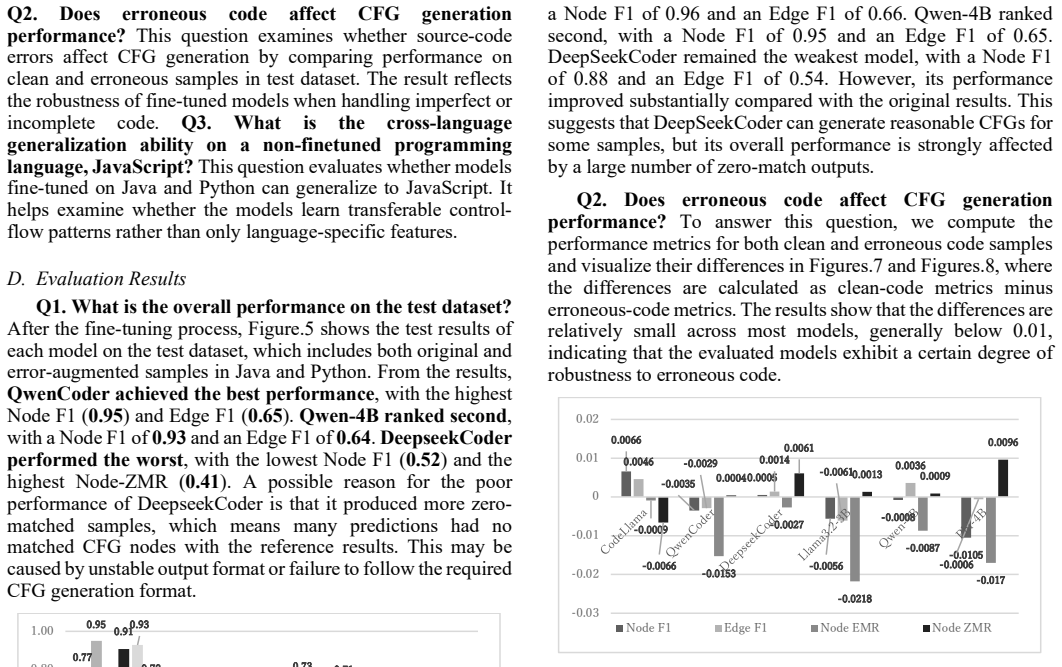
- [§III-D, Q2, Figures 7–8] §III-D (Dataset Construction) and Q2 (Figures 7–8): The central claim that models work “particularly when the input code is incomplete or erroneous” (Abstract, §V) rests on the unvalidated premise that the four injected error types leave control-flow structure unchanged, so every erroneous variant re-uses the clean-code digraph label. No manual audit, re-parsing attempt, or reachability check is reported. If a non-negligible fraction of edits actually remove branches, alter statement order, or change reachability, then (a) a large portion of the 13 331 training targets is incorrect, (b) models are rewarded for ignoring real structural change, and (c) the near-zero clean–erroneous deltas become uninterpretable. This assumption is load-bearing for both the robustness narrative and the claimed advantage over parser-based generators; it needs either empirical validation on a sampled subset o
- [§IV, Related Work §II] §IV Evaluation: There is no quantitative comparison against traditional CFG generators (Soot, Spoon, Py2CFG, or the authors’ own Tree-sitter converter) on the clean subset, nor against zero-shot/few-shot large LLMs or the chain-of-thought pipeline of Huang et al. [6] that the related-work section itself cites. Without these baselines it is impossible to judge whether the reported Node F1 ≈ 0.95 / Edge F1 ≈ 0.65 constitutes an advance, a parity result, or a regression, or whether the models truly succeed where parsers fail. At minimum, success/failure rates of a conventional tool on the same clean and (where possible) erroneous test items should be reported.
- [§IV-B, Figures 5–6, 9] §IV-B/D and Figures 5–6, 9: Edge-level F1 remains substantially lower than node-level F1 across all models (best Edge F1 0.65–0.66 after ZMR removal; JavaScript Edge F1 ≈ 0.34–0.40). Because a CFG’s primary semantic content is the control-flow edges, the headline “promising results” overstate structural fidelity when edge recovery is only moderate and EMR is low. The paper should either elevate edge metrics as the primary success criterion or provide a qualitative analysis of the dominant edge-error modes (missing true branches, spurious edges, incorrect loop back-edges).
- [§III-D, §IV-A] §III-D / §IV-A: All ground-truth labels are produced by a single automatic AST-to-CFG pipeline run exclusively on clean code. Consequently the evaluation largely measures how well the fine-tuned models imitate that particular converter rather than independently correct CFG semantics. Combined with the shared-label error regime, this weakens claims of general CFG generation capability and of superiority on imperfect inputs. A small human-validated or multi-tool consensus subset would strengthen the evaluation.
minor comments (5)
- [Abstract, §I] Abstract and §I: “programming language not included in the fine-tuning data” is missing an article; several sentences contain doubled spaces or hyphenation artifacts (e.g., “syntax -error-free”, “unifi ed”).
- [§III-B] Figure 1–4 captions and body text refer to “Figure.1”, “Figure .3” inconsistently; the digraph example in Figure 4 is hard to parse without line breaks or syntax highlighting.
- [§IV-A] §IV-A: Exact train/test split sizes per language and the precise error-injection operators (e.g., which symbols are deleted, how incompleteness is realized) are not specified beyond high-level categories; reproducibility would benefit from a short appendix or release of the generation scripts.
- [§III-E, Figures 5–9] Model naming is inconsistent across text and figures (QwenCoder vs Qwen2.5-Coder, Qwen-4B vs Qwen3-4B, Phi-4B vs Phi-4-mini-3.8B). Align names with the Hugging Face identifiers used.
- [§II] Related-work discussion of Huang et al. [6] correctly notes cost limitations but does not clarify whether any of the same incomplete-code scenarios were re-used; a one-sentence positioning would help.
Circularity Check
Mild construction-level circularity only in the robustness (erroneous-code) evaluation: shared CFG labels are assigned by design, so clean-vs-erroneous metric gaps partly reflect that protocol rather than independent verification.
-
other
[§III-D Dataset Construction (error augmentation); Q2 evaluation and Figures 7–8]
"Importantly, each erroneous variant shares the same CFG label as its original clean sample because these minor errors are designed not to change the intended control-flow structure. This strategy simulates real-world development scenarios… By introducing such samples into the training data, the model is encouraged to learn the intended control-flow semantics…"
The ground-truth CFGs used both for training and for the clean-versus-erroneous metric comparison are forced to be identical by the authors’ construction. Therefore any successful mapping of both clean and noisy inputs onto that common target necessarily produces small performance differences; the reported robustness (and the Abstract/§V claim that the approach works “particularly when the input code is incomplete or erroneous”) partly measures fidelity to this shared-label regime rather than an independently verified preservation of control flow under the injected faults.
full rationale
This is an empirical fine-tuning paper, not a first-principles derivation. The main results (node/edge F1, EMR/ZMR after supervised instruction tuning of six lightweight LLMs) are ordinary supervised-learning scores against automatically generated digraph labels; that is standard and not definitional circularity. The sole mild circularity arises in the error-augmentation protocol of §III-D and the Q2 comparison that rests on it: each of the four injected error types is deliberately paired with exactly the same CFG that Tree-sitter produced for the clean original, so the evaluation targets for clean and erroneous inputs are identical by construction. Consequently the near-zero clean–erroneous deltas reported in Figures 7–8 are partly forced by the shared-label design (any model that maps both inputs to the common target will look robust). The paper supplies no independent check that the injected faults truly leave control-flow structure unchanged. This does not collapse the overall claim that the models can emit the authors’ digraph format, nor does it involve self-citation, uniqueness theorems, or fitted parameters renamed as predictions; it is therefore scored only 2. No other load-bearing steps reduce to their inputs by construction.
Assumptions & free parameters
free parameters (3)
- training_epochs
- error_augmentation_types_and_count
- unified_digraph_schema_choices
assumptions (4)
- domain assumption Tree-sitter AST traversal following common AST-to-CFG rules yields correct ground-truth CFGs for clean LeetCode solutions.
- ad hoc to paper Injected minor errors do not change the intended control-flow structure, so clean and erroneous samples share the same CFG label.
- domain assumption Supervised instruction fine-tuning of ~3–7B models is a valid way to induce structured CFG generation from source text.
- domain assumption Node/edge set matching (Precision/Recall/F1) plus EMR/ZMR adequately measures CFG quality for the stated claims.
invented entities (1)
-
Unified digraph-style CFG textual schema (method_name, id/label/shape nodes, from->to edges)
Cite this review
Pith. "Pith review of Finetuning Lightweight LLMs for Control Flow Graph Generation." pith.science (2026). https://pith.science/paper/UU6WFNTC
@misc{pith2026260704582,
  author       = {Pith},
  title        = {Pith review of: Finetuning Lightweight LLMs for Control Flow Graph Generation},
  year         = {2026},
  howpublished = {\url{https://pith.science/paper/UU6WFNTC}},
  note         = {Machine review of arXiv:2607.04582}
}
read the original abstract
Control Flow Graph (CFG) is an important program representations for software analysis, code understanding, and software maintenance. Traditional CFG generation techniques mainly rely on bytecode or abstract syntax trees. However, these approaches usually require complete, compilable, and syntax error-free code, which limits their applicability to incomplete or erroneous code. Furthermore, they often depend on language specific tools, making it difficult to support multiple programming languages in a unified manner. To address these limitations, this paper investigates the use of fine-tuned lightweight large language models (LLMs) for CFG generation. We first design a unified CFG output format and a task-specific fine-tuning prompt for CFG generation. Then, we construct a dataset based on an existing LeetCode dataset through automatic CFG generation and error augmentation. We evaluate the proposed approach on six lightweight LLM models, including three code-specific LLMs: CodeLlama, QwenCoder, and DeepSeekCoder; and three general purpose LLMs: Llama3.2-3B, Qwen-4B, and Phi-4B. The experimental results show that, through fine-tuning, lightweight LLMs achieve promising results for CFG generation, particularly when the input code is incomplete or erroneous. It also demonstrates cross-language generalization capability on programming language not included in the fine-tuning data.
Figures


Figures from the paper (4 more)


Reference graph
Works this paper leans on
-
[6]
Spoon: A library for implementing analyses and transformations of Java source code,
R. Pawlak, M. Monperrus, N. Petitprez, C. Noguera, and L. Seinturier, “Spoon: A library for implementing analyses and transformations of Java source code,” Softw. Pract. Exp., vol. 46, no. 9, pp. 1155–1179, 2016
2016
-
[1]
for Python, both of which construct CFGs from parsed syntax trees. These tools have significantly advanced CFG construction by improving automation and supporting multiple programming languages. However, existing CFG generation approaches still suffer from several practical limitations. For bytecode -based approaches, source code must be complete and comp...
-
[2]
Control flow analysis,
F. E. Allen, “Control flow analysis,” SIGPLAN Not., vol. 5, no. 7, pp. 1– 19, 1970
1970
-
[3]
Constructing more complete control flow graphs utilizing directed gray-box fuzzing,
K. Zhu, Y. Lu, H. Huang, L. Yu, and J. Zhao, “Constructing more complete control flow graphs utilizing directed gray-box fuzzing,” Appl. Sci., vol. 11, no. 3, Art. no. 1351, 2021
2021
-
[4]
WALA: Static analysis framework for Java
IBM, “WALA: Static analysis framework for Java.” [Online]. Available: https://sourceforge.net/projects/wala/ [Accessed: Jan. 5, 2026]
2026
-
[5]
Soot: A Java bytecode optimization framework,
R. Vallée-Rai, P. Co, E. Gagnon, L. Hendren, P. Lam, and V. Sundaresan, “Soot: A Java bytecode optimization framework,” in CASCON First Decade High Impact Papers, 2010, pp. 214–224
2010
-
[7]
Q. Huang, Z. Zou, Z. Xing, Z. Zuo, X. Xu, and Q. Lu, “AI chain on large language model for unsupervised control flow graph generation for statically-typed partial code,” arXiv preprint arXiv:2306.00757, 2023
arXiv 2023
-
[8]
A control flow graph generation method for Java projects,
H. Tran and P. Hung, “A control flow graph generation method for Java projects,” VNU J. Sci.: Comput. Sci. Commun. Eng., vol. 40, 2024
2024
Show all 32 references
-
[9]
Large language models for software engineering: A systematic literature review,
X. Hou, Y. Zhao, Y. Liu, Z. Yang, K. Wang, L. Li, X. Luo, D. Lo, J. Grundy, and H. Wang, “Large language models for software engineering: A systematic literature review,” ACM Trans. Softw. Eng. Methodol., 2024
2024
-
[10]
Survey of hallucination in natural language generation,
Z. Ji, N. Lee, R. Frieske, T. Yu, D. Su, Y. Xu, E. Ishii, Y. J. Bang, A. Madotto, and P. Fung, “Survey of hallucination in natural language generation,” ACM Comput. Surv., vol. 55, no. 12, pp. 1–38, 2023
2023
-
[11]
Faithful reasoning using large language models,
A. Creswell and M. Shanahan, “Faithful reasoning using large language models,” arXiv preprint arXiv:2208.14271, 2022
2022 arXiv
-
[12]
ReAct: Synergizing reasoning and acting in language models,
S. Yao, J. Zhao, D. Yu, N. Du, I. Shafran, K. Narasimhan, and Y. Cao, “ReAct: Synergizing reasoning and acting in language models,” arXiv preprint arXiv:2210.03629, 2022
2022 arXiv
-
[13]
GraphCodeBERT: Pre -training code representations with data flow,
D. Guo, S. Ren, S. Lu, F. Zhang, D. Tang, S. Liu, L. Zhou, N. Duan, A. Svyatkovskiy, S. Fu, et al., “GraphCodeBERT: Pre -training code representations with data flow,” arXiv preprint arXiv:2009.08366, 2020
2009 arXiv
-
[14]
Capturing source code semantics via tree- based convolution over API-enhanced AST,
L. Chen, W. Ye, and S. Zhang, “Capturing source code semantics via tree- based convolution over API-enhanced AST,” in Proc. 16th ACM Int. Conf. Comput. Frontiers, 2019, pp. 174–182
2019
-
[15]
Detecting code clones with graph neural network and flow-augmented abstract syntax tree,
W. Wang, G. Li, B. Ma, X. Xia, and Z. Jin, “Detecting code clones with graph neural network and flow-augmented abstract syntax tree,” in Proc. IEEE 27th Int. Conf. Softw. Anal., Evol. Reeng. (SANER), 2020, pp. 261–271
2020
-
[16]
Deep code comment generation,
X. Hu, G. Li, X. Xia, D. Lo, and Z. Jin, “Deep code comment generation,” in Proc. 26th Conf. Program Comprehension, 2018, pp. 200–210
2018
-
[17]
Supervised deep features for software functional clone detection by exploiting lexical and syntactical information in source code,
H. Wei and M. Li, “Supervised deep features for software functional clone detection by exploiting lexical and syntactical information in source code,” in Proc. 26th Int. Joint Conf. Artif. Intell. (IJCAI), 2017, pp. 3034–3040
2017
-
[18]
ModularTree network for source code representation learning,
W. Wang, G. Li, S. Shen, X. Xia, and Z. Jin, “ModularTree network for source code representation learning,” ACM Trans. Softw. Eng. Methodol., vol. 29, pp. 1–23, 2020
2020
-
[19]
A novel neural source code representation based on abstract syntax tree,
J. Zhang, X. Wang, H. Zhang, H. Sun, K. Wang, and X. Liu, “A novel neural source code representation based on abstract syntax tree,” in Proc. IEEE/ACM 41st Int. Conf. Softw. Eng. (ICSE), 2019, pp. 783–794
2019
-
[20]
Evaluating large language models trained on code,
M. Chen, J. Tworek, H. Jun, Q. Yuan, H. Pondéde, O. Pinto, J. Kaplan, H. Edwards, Y. Burda, N. Joseph, G. Brockman, et al., “Evaluating large language models trained on code,” arXiv preprint arXiv:2107.03374, 2021
2021 arXiv
-
[21]
Code Llama: Open foundation models for code,
B. Rozière et al., “Code Llama: Open foundation models for code,” arXiv preprint arXiv:2308.12950, 2023
2023 arXiv
-
[22]
Qwen2.5 -Coder technical report,
B. Hui et al., “Qwen2.5 -Coder technical report,” arXiv preprint arXiv:2409.12186, 2024
2024 arXiv
-
[23]
DeepSeek -Coder: When the large language model meets programming— The rise of code intelligence,
D. Guo et al., “DeepSeek -Coder: When the large language model meets programming— The rise of code intelligence,” arXiv preprint arXiv:2401.14196, 2024
2024 arXiv
-
[24]
Graphviz—Open source graph drawing tools,
J. Ellson, E. R. Gansner, E. Koutsofios, S. C. North, and G. Woodhull, “Graphviz—Open source graph drawing tools,” in Graph Drawing. Berlin, Germany: Springer, 2001, pp. 483–484
2001
-
[25]
Available: https://py2cfg.readthedocs.io/ [Accessed: Jan
Py2CFG [Online]. Available: https://py2cfg.readthedocs.io/ [Accessed: Jan. 5, 2026]
2026
-
[26]
Claude Code
Anthropic, “Claude Code.” [Online]. Available: https://www.anthropic.com/product/claude-code [Accessed: Jan. 5, 2026]
2026
-
[27]
greengerong/leetcode dataset
Hugging Face, “greengerong/leetcode dataset.” [Online]. Available: https://huggingface.co/datasets/greengerong/leetcode [Accessed: Jan. 5, 2026]
2026
-
[28]
Available: https://tree -sitter.github.io/](https://tree- sitter.github.io/
Tree-sitter, [Online]. Available: https://tree -sitter.github.io/](https://tree- sitter.github.io/. [Accessed: Jan. 5, 2026]
2026
-
[29]
[Online]
Unsloth. [Online]. Available: https://github.com/unslothai [Accessed: Jan. 5, 2026]
2026
-
[30]
Llama 3.2
Meta, “Llama 3.2.”. [Online]. Available: https://github.com/meta - llama/llama-models/blob/main/models/llama3_2 [Accessed: Jan. 5, 2026]
2026
-
[31]
Phi -4-mini-instruct
Microsoft, “Phi -4-mini-instruct.”. [Online]. Available: https://huggingface.co/microsoft/Phi-4-mini-instruct [Accessed: Jan. 5, 2026]
2026
-
[32]
Qwen3 -4B
Qwen, “Qwen3 -4B.”. [Online]. Available: https://huggingface.co/Qwen/Qwen3-4B [Accessed: Jan. 5, 2026].. 0.69 0.34 0.15 0.26 0.72 0.38 0.22 0.07 0.73 0.40 0.14 0.47 0.69 0.38 0.18 0.06 0.70 0.37 0.20 0.06 0.70 0.36 0.17 0.17 0.00 0.20 0.40 0.60 0.80 Node F1 Edge F1 Node-EMR No...
2026
Reviewed July 11, 2026 · model on record in the stance chip above.
Discussion (0). Sign in to comment.