REVIEW 2 major objections 5 minor 100 references
A continuous-time Gaussian-process odometry system that fuses DVL, stereo vision and IMU outperforms state-of-the-art underwater SLAM while using only short-term visual links.
Reviewed by Pith at T0; open to challenge. T0 means a machine referee read the full paper against a public rubric. the ladder, T0–T4 →
T0 review · grok-4.5
2026-07-11 16:22 UTC pith:YZD7Q4DH
load-bearing objection Solid first continuous-time GP fusion of async DVL+stereo+IMU with a learned frontend that actually works underwater; real gains on photogrammetric data despite only short-term associations. the 2 major comments →
DIVO: Continuous-time DVL-Inertial-Visual Odometry for Unmanned Underwater Vehicles
The pith
A machine-rendered reading of the paper's core claim, the machinery that carries it, and where it could break.
Core claim
The authors establish that a white-noise-on-acceleration Gaussian-process continuous-time estimator, tightly coupled with SuperPoint–LightGlue visual tracking and raw DVL velocity factors, yields higher accuracy, full trajectory coverage and greater robustness than contemporary visual-inertial and acoustic-visual-inertial SLAM systems on real subsea inspection sequences, despite forming only short-term visual associations.
What carries the argument
Continuous-time trajectory estimation via a white-noise-on-acceleration Gaussian process on SE(3), which supplies both a motion prior residual and closed-form interpolation that lets asynchronous DVL measurements be evaluated at any intermediate time without adding extra states.
Load-bearing premise
A single fixed power-spectral-density matrix for the white-noise-on-acceleration prior is assumed adequate for the full range of ROV dynamics encountered, even though the authors note that high variation makes data-driven tuning difficult.
What would settle it
On a new ROV trajectory whose velocity profile differs markedly from the quarry sequences (for example aggressive hovering or high-speed transit), replace the fixed Q with a badly mismatched constant and check whether absolute trajectory error and coverage still beat the same baselines.
Editorial analysis
A structured set of objections, weighed in public.
Referee Report
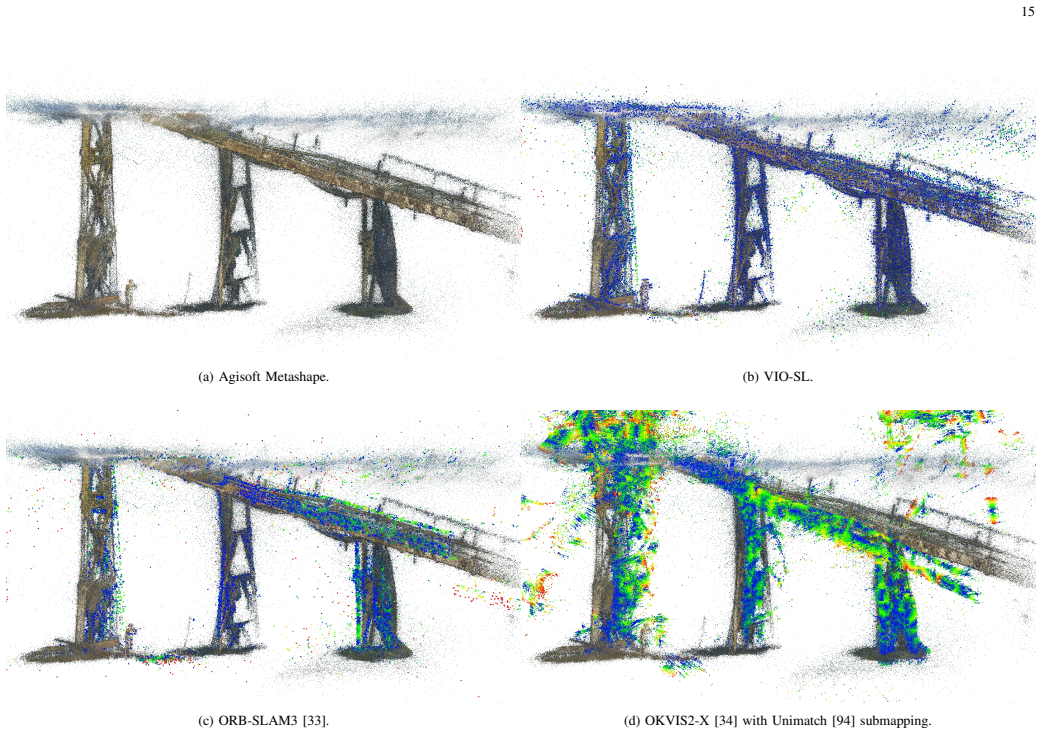
Summary. The paper presents DIVO, a continuous-time DVL-inertial-visual odometry system for UUVs that fuses asynchronous DVL, stereo camera, and IMU measurements via a Gaussian-process white-noise-on-acceleration trajectory prior. States are defined on SE2(3) with angular velocity and IMU biases (Eq. 22); IMU measurements are preintegrated, DVL velocities are residualized at arbitrary times via GP interpolation of body-centric velocity (Eqs. 49–51b), and visual features are tracked with SuperPoint+LightGlue (or KLT) and anchored in a short sliding window. The system is evaluated in Monte-Carlo simulation (consistency via NEES, accuracy vs. DIO/VIO ablations) and on four real freshwater ROV inspection sequences with photogrammetric ground truth, where both the visual-inertial (VIO-SL) and full DIVO variants report higher trajectory coverage and lower absolute/relative errors than carefully tuned ORB-SLAM3, OKVIS2-X, AQUA-SLAM, and MSCKF-DVIO, despite using only short-term visual associations.
Significance. If the empirical ranking holds, the work is a solid systems contribution to underwater multi-sensor odometry. It is the first GP continuous-time formulation that cleanly absorbs asynchronous DVL beams alongside stereo-inertial factors, and it demonstrates that a modern learned frontend (SuperPoint+LightGlue) can substantially improve short-term association robustness under turbidity, marine snow, and low texture—enough to outperform non-causal loop-closing baselines on coverage and accuracy. The modular continuous-time residual structure is a practical engineering advantage for future sensor additions. Strengths include Monte-Carlo consistency checks, photogrammetric ground truth, and explicit comparison against open-source SOTA under documented parameter retuning. The fixed-Q WNOA prior and best-of-runs reporting are limitations but do not erase the demonstrated gains.
major comments (2)
- §IV-E and §V-C: All real-data results appear to report the best of multiple runs per algorithm (explicitly stated for baselines; implied for DIVO). Combined with the unreleased Quarry dataset and code, this makes the ranking in Tables III–IV and Figs. 13–18 difficult to reproduce or to assess for variance. At minimum, report mean/median ± std over a fixed number of runs (or seeds) for every method, and state the exact number of trials; ideally release the sequences and evaluation scripts so the coverage/ATE claims can be independently verified.
- §III-A, §IV-E: The WNOA power-spectral-density matrix Q is fixed for all experiments and left untuned because “high variation vehicle dynamics” make data-driven calibration difficult. While the authors correctly flag this as future work, the central claim that DIVO is “adaptable to different environments without reconfiguration” rests partly on this fixed prior. A short sensitivity study (or at least reporting the numerical Q used and the effect of scaling it by 0.1×/10× on the four sequences) would bound how load-bearing the fixed-Q assumption is for the reported ranking versus AQUA-SLAM/ORB-SLAM3.
minor comments (5)
- §V-B / Table III–IV: Clarify whether the proposed system’s coverage and ATE numbers are also best-of-N or single-run; the text currently only states this practice for the baselines.
- Fig. 7 and §IV-D.3: The continuous-time DVL residual is elegant; a one-sentence note on how invalid beams (red markers) are simply dropped, and whether partial-beam least-squares (instead of full four-beam velocity) was considered, would help readers who work with sparse bottom-lock.
- §II-B: The claim that SuperPoint+LightGlue generalizability to subsea “still remains unexplored” is slightly overstated given SuperVINS and related works; rephrase to “underexplored on real subsea inspection data with metric ground truth.”
- Notation: The extended pose Tab ∈ SE2(3) (Eq. 21) and the ordinary pose Tab ∈ SE(3) share the same symbol; a brief typographic distinction would reduce cognitive load when reading the GP residual linearization (Eq. 46).
- §V-C.1: State the approximate water depth / turbidity range of the Quarry sequences so readers can judge how representative the “marine snow” and low-visibility conditions are.
Circularity Check
No circularity: standard continuous-time GP residuals and empirical SOTA comparisons on external photogrammetric GT.
full rationale
This is an engineering systems paper whose core claims are (i) a continuous-time GP (WNOA) backend that fuses asynchronous DVL/IMU/stereo measurements via standard residuals (Eqs. 13, 47–52) and GP interpolation (Eqs. 17–19), and (ii) empirical outperformance of open-source baselines on real ROV data with independent Metashape ground truth. The GP motion prior, IMU preintegration, and DVL residual are taken from the literature (Anderson/Barfoot, Forster et al., etc.) and specialized to the SE2(3) state without introducing fitted constants that are later re-presented as predictions. Q is held fixed (explicitly noted as future work). Visual frontend (SuperPoint+LightGlue) and short-term associations are evaluated against external algorithms (ORB-SLAM3, OKVIS2-X, AQUA-SLAM, MSCKF-DVIO) on held-out sequences; no self-citation supplies a uniqueness theorem or ansatz that forces the reported ATE/RTE rankings. Simulation NEES and Monte-Carlo tables further corroborate consistency under the stated model. The derivation chain is therefore self-contained and non-circular.
Axiom & Free-Parameter Ledger
free parameters (4)
- WNOA power spectral density Q =
diag(100,100,100,10,10,10)
- sliding-window length =
3 s
- disparity threshold dn and min matches mn =
10 px / 10
- visual feature noise =
2 px
axioms (4)
- domain assumption Vehicle motion obeys a white-noise-on-acceleration (WNOA) stochastic differential equation on SE(3).
- domain assumption IMU and DVL measurement noises are zero-mean Gaussian and independent; biases are random-walk.
- domain assumption Earth rotation and Coriolis terms arising from the DVL lever arm may be neglected.
- domain assumption Photogrammetric poses produced by Agisoft Metashape after manual outlier culling constitute metric ground truth.
read the original abstract
This paper presents a novel acoustic-visual-inertial odometry solution leveraging a continuous-time trajectory estimation framework for unmanned underwater vehicles. Underwater environments present unique challenges for visual localization and mapping, such as light attenuation, illumination variance, and the presence of particulate matter. This motivates the use of additional sensing modalities and a visual tracking pipeline that is robust to diverse subsea conditions. The proposed system is the first continuous-time trajectory estimation framework based on Gaussian processes to fuse asynchronous measurements from a Doppler velocity log, a stereo camera, and an inertial measurement unit. Additionally, a novel visual frontend is proposed, incorporating learning-based feature extraction and matching that is robust to the specific challenges that subsea environments present. The proposed framework enables seamless integration of additional sensor modalities in continuous-time and is adaptable to different environments without reconfiguration. The proposed system is extensively tested on real-world underwater inspection datasets, where it outperforms state-of-the-art visual-inertial and acoustic-visual-inertial SLAM algorithms in accuracy, robustness, and trajectory coverage. Notably, the proposed system outperforms the state-of-the-art despite only forming short-term visual data associations.
Figures




Reference graph
Works this paper leans on
-
[1]
AUV navigation and local- ization: A review,
L. Paull, S. Saeedi, M. Seto, and H. Li, “AUV navigation and local- ization: A review,” IEEE Journal of Oceanic Engineering , vol. 39, no. 1, pp. 131–149, 2014
2014
-
[2]
An ROV stereovision system for ship-hull inspection,
S. Negahdaripour and P . Firoozfam, “An ROV stereovision system for ship-hull inspection,” IEEE Journal of Oceanic Engineering , vol. 31, no. 3, pp. 551–564, 2006
2006
-
[3]
Visually augmented navigation for autonomous underwater vehicles,
R. M. Eustice, O. Pizarro, and H. Singh, “Visually augmented navigation for autonomous underwater vehicles,” IEEE Journal of Oceanic Engineering , vol. 33, no. 2, pp. 103–122, 2008
2008
-
[4]
Large area 3-D reconstruc- tions from underwater optical surveys,
O. Pizarro, R. M. Eustice, and H. Singh, “Large area 3-D reconstruc- tions from underwater optical surveys,” IEEE Journal of Oceanic Engineering, vol. 34, no. 2, pp. 150–169, 2009
2009
-
[5]
ORB-SLAM: A versatile and accurate monocular SLAM system,
R. Mur-Artal, J. M. M. Montiel, and J. D. Tardós, “ORB-SLAM: A versatile and accurate monocular SLAM system,” IEEE Transactions on Robotics , vol. 31, no. 5, pp. 1147–1163, 2015
2015
-
[6]
VINS-Mono: A robust and versatile monocular visual-inertial state estimator,
T. Qin, P . Li, and S. Shen, “VINS-Mono: A robust and versatile monocular visual-inertial state estimator,” IEEE Transactions on Robotics, vol. 34, no. 4, pp. 1004–1020, 2018
2018
-
[7]
Direct sparse odometry,
J. Engel, V . Koltun, and D. Cremers, “Direct sparse odometry,” IEEE Transactions on Pattern Analysis and Machine Intelligence , vol. 40, no. 3, pp. 611–625, 2018
2018
-
[8]
ORBSLAM2 and point cloud processing towards au- tonomous underwater robot navigation,
F. Hidalgo, “ORBSLAM2 and point cloud processing towards au- tonomous underwater robot navigation,” in Proc. Global Oceans 2020: Singapore - U.S. Gulf Coast , pp. 1–4
2020
-
[9]
M. Singh, M. Dharmadhikari, and K. Alexis, “Ariel Explores: Vision- based underwater exploration and inspection via generalist drone- level autonomy,” 2025. arXiv: 2507.10003 [cs.RO]
Pith/arXiv arXiv 2025
-
[10]
Experimental comparison of open source visual- inertial-based state estimation algorithms in the underwater domain,
B. Joshi et al., “Experimental comparison of open source visual- inertial-based state estimation algorithms in the underwater domain,” in Proc. 2019 IEEE/RSJ International Conference on Intelligent Robots and Systems , pp. 7227–7233
2019
-
[11]
SVIn2: An underwater SLAM system using Sonar, visual, inertial, and depth sensor,
S. Rahman, A. Q. Li, and I. Rekleitis, “SVIn2: An underwater SLAM system using Sonar, visual, inertial, and depth sensor,” in Proc. 2019 IEEE/RSJ International Conference on Intelligent Robots and Systems, pp. 1861–1868
2019
-
[12]
TURTLMap: Real-time localization and dense mapping of low- texture underwater environments with a low-cost unmanned under- water vehicle,
J. Song, O. Bagoren, R. Andigani, A. Sethuraman, and K. A. Skinner, “TURTLMap: Real-time localization and dense mapping of low- texture underwater environments with a low-cost unmanned under- water vehicle,” in Proc. 2024 IEEE/RSJ International Conference on Intelligent Robots and Systems , pp. 1191–1198
2024
-
[13]
Invariant extended Kalman filtering for underwater navigation,
E. R. Potokar, K. Norman, and J. G. Mangelson, “Invariant extended Kalman filtering for underwater navigation,” IEEE Robotics and Automation Letters , vol. 6, no. 3, pp. 5792–5799, 2021. 19
2021
-
[14]
Uncertainty-aware acoustic localization and mapping for underwater robots,
J. Song, O. Bagoren, and K. A. Skinner, “Uncertainty-aware acoustic localization and mapping for underwater robots,” in Proc. OCEANS 2023 - Limerick , pp. 1–9
2023
-
[15]
Auv localisation: A review of passive and active techniques,
F. Maurelli, S. Krupiski, X. Xiang, and Y . Petillot, “Auv localisation: A review of passive and active techniques,” International Journal of Intelligent Robotics and Applications , vol. 6, no. 2, pp. 246–269, 2022
2022
-
[16]
Tightly coupled, graph-based DVL/IMU fusion and decoupled mapping for SLAM-centric maritime infrastructure inspection,
A. Thoms, G. Earle, N. Charron, and S. Narasimhan, “Tightly coupled, graph-based DVL/IMU fusion and decoupled mapping for SLAM-centric maritime infrastructure inspection,” IEEE Journal of Oceanic Engineering , vol. 48, no. 3, pp. 663–676, 2023
2023
-
[17]
AQUA-SLAM: Tightly-coupled underwater acoustic-visual-inertial SLAM with sensor calibration,
S. Xu, K. Zhang, and S. Wang, “AQUA-SLAM: Tightly-coupled underwater acoustic-visual-inertial SLAM with sensor calibration,” IEEE Transactions on Robotics , vol. 41, pp. 2785–2803, 2025
2025
-
[18]
Tightly-coupled visual-DVL- inertial odometry for robot-based ice-water boundary exploration,
L. Zhao, M. Zhou, and B. Loose, “Tightly-coupled visual-DVL- inertial odometry for robot-based ice-water boundary exploration,” in 2023 IEEE/RSJ International Conference on Intelligent Robots and Systems (IROS) , Accepted, 2023
2023
-
[19]
On Lie group IMU and linear velocity preintegration for autonomous navigation considering the Earth rotation compensation,
P . Vial, J. Solà, N. Palomeras, and M. Carreras, “On Lie group IMU and linear velocity preintegration for autonomous navigation considering the Earth rotation compensation,” IEEE Transactions on Robotics, vol. 41, pp. 1346–1364, 2025
2025
-
[20]
Continuous-time state estimation methods in robotics: A survey,
W. Talbot et al., “Continuous-time state estimation methods in robotics: A survey,” IEEE Transactions on Robotics , vol. 41, pp. 4975–4999, 2025
2025
-
[21]
Batch continuous-time trajectory estimation as exactly sparse gaussian process regression,
T. D. Barfoot, C. H. Tong, and S. Särkkä, “Batch continuous-time trajectory estimation as exactly sparse gaussian process regression,” in Proc. Robotics: Science and Systems , Berkeley, USA, Jul. 2014
2014
-
[22]
Full STEAM ahead: Exactly sparse Gaussian process regression for batch continuous-time trajectory esti- mation on SE(3),
S. Anderson and T. D. Barfoot, “Full STEAM ahead: Exactly sparse Gaussian process regression for batch continuous-time trajectory esti- mation on SE(3),” in Proc. 2015 IEEE/RSJ International Conference on Intelligent Robots and Systems , pp. 157–164
2015
-
[23]
SuperPoint: Self- Supervised Interest Point Detection and Description,
D. DeTone, T. Malisiewicz, and A. Rabinovich, “SuperPoint: Self- Supervised Interest Point Detection and Description,” in 2018 IEEE/CVF Conference on Computer Vision and Pattern Recognition Workshops (CVPRW) , Salt Lake City, UT, USA: IEEE, Jun. 2018, pp. 337–33 712
2018
-
[24]
LightGlue: Local Feature Matching at Light Speed,
P . Lindenberger, P .-E. Sarlin, and M. Pollefeys, “LightGlue: Local Feature Matching at Light Speed,” in 2023 IEEE/CVF International Conference on Computer Vision (ICCV) , Paris, France: IEEE, Oct. 1, 2023
2023
-
[25]
Doppler velocity log (DVL) navigation for observation- class ROVs,
J. Snyder, “Doppler velocity log (DVL) navigation for observation- class ROVs,” in Proc. OCEANS 2010 MTS/IEEE SEATTLE , pp. 1–9
2010
-
[26]
A novel DVL aided inertial navigation strategy for long-endurance robust positioning of AUVs,
S. Pan, X. Xu, Y . Y ao, L. Zhang, and M. Xia, “A novel DVL aided inertial navigation strategy for long-endurance robust positioning of AUVs,” IEEE Transactions on Intelligent V ehicles , vol. 10, no. 3, pp. 1623–1637, 2025
2025
-
[27]
A survey of underwater vehicle navigation: Recent advances and new challenges,
J. C. Kinsey, R. M. Eustice, and L. L. Whitcomb, “A survey of underwater vehicle navigation: Recent advances and new challenges,” in Proc. IF AC Conference of Manoeuvering and Control of Marine Craft, 2006
2006
-
[28]
A SINS/DVL/USBL integrated navigation and posi- tioning IoT system with multiple sources fusion and federated Kalman filter,
Q. Luo et al., “A SINS/DVL/USBL integrated navigation and posi- tioning IoT system with multiple sources fusion and federated Kalman filter,” Journal of Cloud Computing , vol. 11, no. 18, 2022
2022
-
[29]
Inertial navigation system/Doppler velocity log (INS/DVL) fusion with partial DVL measurements,
A. Tal, I. Klein, and R. Katz, “Inertial navigation system/Doppler velocity log (INS/DVL) fusion with partial DVL measurements,” Sensors, vol. 17, no. 2, 2017
2017
-
[30]
Open- VINS: A research platform for visual-inertial estimation,
P . Geneva, K. Eckenhoff, W. Lee, Y . Y ang, and G. Huang, “Open- VINS: A research platform for visual-inertial estimation,” in Proc. 2020 IEEE International Conference on Robotics and Automation , Paris, France
2020
-
[31]
Keyframe-based visual-inertial odometry using nonlinear optimiza- tion,
S. Leutenegger, S. Lynen, M. Bosse, R. Siegwart, and P . Furgale, “Keyframe-based visual-inertial odometry using nonlinear optimiza- tion,” The International Journal of Robotics Research , vol. 34, no. 3, pp. 314–334, 2015
2015
-
[32]
Dense Monocular Depth Estimation in Complex Dynamic Scenes,
R. Ranftl, V . Vineet, Q. Chen, and V . Koltun, “Dense Monocular Depth Estimation in Complex Dynamic Scenes,” in 2016 IEEE Conference on Computer Vision and Pattern Recognition (CVPR) , Las V egas, NV , USA: IEEE, Jun. 2016, pp. 4058–4066
2016
-
[33]
ORB-SLAM3: An Accurate Open-Source Library for Visual, Visual-Inertial and Multi-Map SLAM,
C. Campos, R. Elvira, J. J. G. Rodríguez, J. M. M. Montiel, and J. D. Tardós, “ORB-SLAM3: An Accurate Open-Source Library for Visual, Visual-Inertial and Multi-Map SLAM,” IEEE Transactions on Robotics, vol. 37, no. 6, pp. 1874–1890, Dec. 2021
2021
-
[34]
OKVIS2- X: Open Keyframe-Based Visual-Inertial SLAM Configurable With Dense Depth or LiDAR, and GNSS,
S. Boche, J. Jung, S. B. Laina, and S. Leutenegger, “OKVIS2- X: Open Keyframe-Based Visual-Inertial SLAM Configurable With Dense Depth or LiDAR, and GNSS,” IEEE Transactions on Robotics , vol. 41, pp. 6064–6083, 2025
2025
-
[35]
Good features to track,
J. Shi and Tomasi, “Good features to track,” in Proc. 1994 IEEE Conference on Computer Vision and Pattern Recognition , pp. 593– 600
1994
-
[36]
An iterative image registration technique with an application to stereo vision,
B. D. Lucas and T. Kanade, “An iterative image registration technique with an application to stereo vision,” in Proc. 7th International Joint Conference on Artificial Intelligence - V olume 2 , ser. IJCAI’81, V an- couver, BC, Canada: Morgan Kaufmann Publishers Inc., pp. 674–679
-
[37]
Disk: Learning local features with policy gradient,
P . Tyszkiewicz Michaand Fua and E. Trulls, “Disk: Learning local features with policy gradient,” in Advances in Neural Information Processing Systems , H. Larochelle, M. Ranzato, R. Hadsell, M. Balcan, and H. Lin, Eds., vol. 33, Curran Associates, Inc., 2020, pp. 14 254–14 265
2020
-
[38]
XFeat: Accelerated Features for Lightweight Image Matching,
G. Potje, F. Cadar, A. Araujo, R. Martins, and E. R. Nascimento, “XFeat: Accelerated Features for Lightweight Image Matching,” in 2024 IEEE/CVF Conference on Computer Vision and Pattern Recog- nition (CVPR) , Seattle, W A, USA: IEEE, Jun. 16, 2024, pp. 2682– 2691
2024
-
[39]
Super- Glue: Learning Feature Matching With Graph Neural Networks,
P .-E. Sarlin, D. DeTone, T. Malisiewicz, and A. Rabinovich, “Super- Glue: Learning Feature Matching With Graph Neural Networks,” in 2020 IEEE/CVF Conference on Computer Vision and Pattern Recog- nition (CVPR) , Seattle, W A, USA: IEEE, Jun. 2020, pp. 4937–4946
2020
-
[40]
OmniGlue: Generalizable Feature Matching with Foundation Model Guidance,
H. Jiang, A. Karpur, B. Cao, Q. Huang, and A. Araujo, “OmniGlue: Generalizable Feature Matching with Foundation Model Guidance,” in 2024 IEEE/CVF Conference on Computer Vision and Pattern Recognition (CVPR) , Seattle, W A, USA: IEEE, Jun. 16, 2024, pp. 19 865–19 875
2024
-
[41]
SuperVINS: A Real- Time Visual-Inertial SLAM Framework for Challenging Imaging Conditions,
H. Luo, Y . Liu, C. Guo, Z. Li, and W. Song, “SuperVINS: A Real- Time Visual-Inertial SLAM Framework for Challenging Imaging Conditions,” IEEE Sensors Journal , vol. 25, no. 13, pp. 26 042– 26 050, Jul. 1, 2025
2025
-
[42]
The EuRoC micro aerial vehicle datasets,
M. Burri et al., “The EuRoC micro aerial vehicle datasets,” The International Journal of Robotics Research , vol. 35, no. 10, pp. 1157– 1163, Sep. 2016
2016
-
[43]
SupAtten-SLAM: SuperPoint V ariant Network Visual SLAM Based on Multiattention Mechanism,
S. Li, F. Zhang, V . G. Menon, X. Wang, and Y . Hu, “SupAtten-SLAM: SuperPoint V ariant Network Visual SLAM Based on Multiattention Mechanism,” IEEE Sensors Journal , vol. 25, no. 20, pp. 38 902– 38 915, Oct. 15, 2025
2025
-
[44]
ORB-SLAM2: An open-source SLAM system for monocular, stereo and RGB-D cameras,
R. Mur-Artal and J. D. Tardós, “ORB-SLAM2: An open-source SLAM system for monocular, stereo and RGB-D cameras,” IEEE Transactions on Robotics , vol. 33, no. 5, pp. 1255–1262, 2017
2017
-
[45]
Towards Better Gen- eralization: Joint Depth-Pose Learning Without PoseNet,
W. Zhao, S. Liu, Y . Shu, and Y .-J. Liu, “Towards Better Gen- eralization: Joint Depth-Pose Learning Without PoseNet,” in 2020 IEEE/CVF Conference on Computer Vision and Pattern Recognition (CVPR), Seattle, W A, USA: IEEE, Jun. 2020, pp. 9148–9158
2020
-
[46]
Visual Odom- etry Revisited: What Should Be Learnt?
H. Zhan, C. S. Weerasekera, J.-W. Bian, and I. Reid, “Visual Odom- etry Revisited: What Should Be Learnt?” In 2020 IEEE International Conference on Robotics and Automation (ICRA) , Paris, France: IEEE, May 2020, pp. 4203–4210
2020
-
[47]
Monocular Vi- sual Simultaneous Localization and Mapping: (R)Evolution From Geometry to Deep Learning-Based Pipelines,
O. Álvarez-Tuñón, Y . Brodskiy, and E. Kayacan, “Monocular Vi- sual Simultaneous Localization and Mapping: (R)Evolution From Geometry to Deep Learning-Based Pipelines,” IEEE Transactions on Artificial Intelligence , vol. 5, no. 5, pp. 1990–2010, May 2024
1990
-
[48]
Real-time SLAM with piecewise- planar surface models and sparse 3D point clouds,
P . Ozog and R. M. Eustice, “Real-time SLAM with piecewise- planar surface models and sparse 3D point clouds,” in Proc. 2013 IEEE/RSJ International Conference on Intelligent Robots and Sys- tems, pp. 1042–1049
2013
-
[49]
Real-time visual SLAM for autonomous underwater hull inspection using visual saliency,
A. Kim and R. M. Eustice, “Real-time visual SLAM for autonomous underwater hull inspection using visual saliency,” IEEE Transactions on Robotics , vol. 29, no. 3, pp. 719–733, 2013
2013
-
[50]
SVO: Semidirect visual odometry for monocular and multicamera systems,
C. Forster, Z. Zhang, M. Gassner, M. Werlberger, and D. Scaramuzza, “SVO: Semidirect visual odometry for monocular and multicamera systems,”IEEE Transactions on Robotics, vol. 33, no. 2, pp. 249–265, 2017
2017
-
[51]
Iterated extended Kalman filter based visual-inertial odometry using direct photometric feedback,
M. Bloesch, M. Burri, S. Omari, M. Hutter, and R. Siegwart, “Iterated extended Kalman filter based visual-inertial odometry using direct photometric feedback,” The International Journal of Robotics Research, vol. 36, no. 10, pp. 1053–1072, 2017
2017
-
[52]
Online Refractive Camera Model Calibra- tion in Visual Inertial Odometry,
M. Singh and K. Alexis, “Online Refractive Camera Model Calibra- tion in Visual Inertial Odometry,” in 2024 IEEE/RSJ International Conference on Intelligent Robots and Systems (IROS) , Abu Dhabi, United Arab Emirates: IEEE, Oct. 14, 2024, pp. 12 609–12 616
2024
-
[53]
Robust underwater visual SLAM fusing acoustic sensing,
E. V argas et al., “Robust underwater visual SLAM fusing acoustic sensing,” in Proc. 2021 IEEE International Conference on Robotics and Automation , pp. 2140–2146
2021
-
[54]
Tightly-coupled visual-DVL fusion for accurate localization of underwater robots,
Y . Huang et al., “Tightly-coupled visual-DVL fusion for accurate localization of underwater robots,” in Proc. 2023 IEEE/RSJ Interna- tional Conference on Intelligent Robots and Systems , pp. 8090–8095. 20
2023
-
[55]
SurfSLAM: Sim-to-Real Underwater Stereo Re- construction For Real-Time SLAM
O. Bagoren et al. “SurfSLAM: Sim-to-Real Underwater Stereo Re- construction For Real-Time SLAM.” arXiv: 2601.10814 [cs], pre- published
-
[56]
J. Johnson, J. Mangelson, T. Barfoot, and R. Beard, “Continuous-time trajectory estimation: A comparative study between Gaussian process and spline-based approaches,” 2024. arXiv: 2402.00399 [cs.RO]
Pith/arXiv arXiv 2024
-
[57]
Continuous- time estimation of attitude using B-splines on Lie groups,
H. Sommer, J. R. Forbes, R. Siegwart, and P . Furgale, “Continuous- time estimation of attitude using B-splines on Lie groups,” Journal of Guidance, Control, and Dynamics , vol. 39, no. 2, pp. 242–261, 2016
2016
-
[58]
Continuous-time visual-inertial odometry for event cameras,
E. Mueggler, G. Gallego, H. Rebecq, and D. Scaramuzza, “Continuous-time visual-inertial odometry for event cameras,” IEEE Transactions on Robotics , vol. 34, no. 6, pp. 1425–1440, 2018
2018
-
[59]
CLINS: Continuous- time trajectory estimation for LiDAR-inertial system,
J. Lv, K. Hu, J. Xu, Y . Liu, X. Ma, and X. Zuo, “CLINS: Continuous- time trajectory estimation for LiDAR-inertial system,” in Proc. 2021 IEEE/RSJ International Conference on Intelligent Robots and Sys- tems, 2021, pp. 6657–6663
2021
-
[60]
Continuous-time Radar-inertial and LiDAR-inertial odometry using a Gaussian process motion prior,
K. Burnett, A. P . Schoellig, and T. D. Barfoot, “Continuous-time Radar-inertial and LiDAR-inertial odometry using a Gaussian process motion prior,” IEEE Transactions on Robotics , vol. 41, pp. 1059– 1076, 2025
2025
-
[61]
GNSS/- multisensor fusion using continuous-time factor graph optimization for robust localization,
H. Zhang, C.-C. Chen, H. V allery, and T. D. Barfoot, “GNSS/- multisensor fusion using continuous-time factor graph optimization for robust localization,” IEEE Transactions on Robotics , vol. 40, pp. 4003–4023, 2024
2024
-
[62]
Picking up speed: Continuous-time LiDAR-only odometry using Doppler velocity measurements,
Y . Wu et al., “Picking up speed: Continuous-time LiDAR-only odometry using Doppler velocity measurements,” IEEE Robotics and Automation Letters , vol. 8, no. 1, pp. 264–271, 2023
2023
-
[63]
The numerical evaluation of B-splines*,
M. G. Cox, “The numerical evaluation of B-splines*,” IMA Journal of Applied Mathematics , vol. 10, no. 2, pp. 134–149, Oct. 1972
1972
-
[64]
Continuous-time batch estimation using temporal basis functions,
P . Furgale, T. D. Barfoot, and G. Sibley, “Continuous-time batch estimation using temporal basis functions,” in Proc. 2012 IEEE In- ternational Conference on Robotics and Automation , pp. 2088–2095
2012
-
[65]
A spline-based tra- jectory representation for sensor fusion and rolling shutter cameras,
A. Patron-Perez, S. Lovegrove, and G. Sibley, “A spline-based tra- jectory representation for sensor fusion and rolling shutter cameras,” Int. J. Comput. Vision , vol. 113, no. 3, pp. 208–219, Jul. 2015
2015
-
[66]
Continuous-time radar- inertial odometry for automotive radars,
Y . Z. Ng, B. Choi, R. Tan, and L. Heng, “Continuous-time radar- inertial odometry for automotive radars,” in Proc. 2021 IEEE/RSJ International Conference on Intelligent Robots and Systems , 2021, pp. 323–330
2021
-
[67]
A white-noise-on-jerk motion prior for continuous-time trajectory estimation on SE(3),
T. Y . Tang, D. J. Y oon, and T. D. Barfoot, “A white-noise-on-jerk motion prior for continuous-time trajectory estimation on SE(3),” IEEE Robotics and Automation Letters , vol. 4, no. 2, pp. 594–601, 2019
2019
-
[68]
A data-driven motion prior for continuous-time trajectory estimation on SE(3),
J. N. Wong, D. J. Y oon, A. P . Schoellig, and T. D. Barfoot, “A data-driven motion prior for continuous-time trajectory estimation on SE(3),” IEEE Robotics and Automation Letters , vol. 5, no. 2, pp. 1429–1436, 2020
2020
-
[69]
Are we ready for radar to replace LiDAR in all-weather mapping and localization?
K. Burnett, Y . Wu, D. J. Y oon, A. P . Schoellig, and T. D. Barfoot, “Are we ready for radar to replace LiDAR in all-weather mapping and localization?” IEEE Robotics and Automation Letters , vol. 7, no. 4, pp. 10 328–10 335, 2022
2022
-
[70]
State estimation for continuum multirobot systems on SE(3),
S. Lilge, T. Barfoot, and J. Burgner-Kahrs, “State estimation for continuum multirobot systems on SE(3),” IEEE Transactions on Robotics, vol. 41, pp. 905–925, 2025
2025
-
[71]
A micro Lie theory for state estimation in robotics,
J. Solà, J. Deray, and D. Atchuthan, “A micro Lie theory for state estimation in robotics,” CoRR, vol. abs/1812.01537, 2018. arXiv: 1812.01537
Pith/arXiv arXiv 2018
-
[72]
T. D. Barfoot, State Estimation for Robotics: Second Edition , 2nd ed. Cambridge University Press, 2023
2023
-
[73]
Groves, Principles of GNSS, Inertial, and Multisensor Integrated Navigation Systems, Second Edition , 2nd ed
P . Groves, Principles of GNSS, Inertial, and Multisensor Integrated Navigation Systems, Second Edition , 2nd ed. Artech, 2013
2013
-
[74]
The invariant extended kalman filter as a stable observer,
A. Barrau and S. Bonnabel, “The invariant extended kalman filter as a stable observer,” IEEE Transactions on Automatic Control , vol. 62, no. 4, pp. 1797–1812, 2017
2017
-
[75]
Associating uncertainty to extended poses for on Lie group IMU preintegration with rotating Earth,
M. Brossard, A. Barrau, P . Chauchat, and S. Bonnabel, “Associating uncertainty to extended poses for on Lie group IMU preintegration with rotating Earth,” IEEE Transactions on Robotics , vol. 38, no. 2, pp. 998–1015, 2022
2022
-
[76]
Absolute triangulation algorithms for space exploration,
S. Henry and J. A. Christian, “Absolute triangulation algorithms for space exploration,” Journal of Guidance, Control, and Dynamics , vol. 46, no. 1, pp. 21–46, 2023
2023
-
[77]
Direct Linear Transformation from Comparator Coordinates into Object Space Coordinates in Close- Range Photogrammetry,
Y . Abdel-Aziz and H. Karara, “Direct Linear Transformation from Comparator Coordinates into Object Space Coordinates in Close- Range Photogrammetry,” Photogrammetric Engineering & Remote Sensing, vol. 81, no. 2, pp. 103–107, Feb. 1, 2015
2015
-
[78]
A General OptimisationBased Framework for Global Pose Estimation With Multiple Sensors,
T. Qin, S. Cao, J. Pan, and S. Shen, “A General OptimisationBased Framework for Global Pose Estimation With Multiple Sensors,” IET Cyber-Systems and Robotics , vol. 7, no. 1, e70023, Jan. 2025
2025
-
[79]
An efficient solution to the five-point relative pose problem,
D. Nister, “An efficient solution to the five-point relative pose problem,” IEEE Transactions on Pattern Analysis and Machine In- telligence, vol. 26, no. 6, pp. 756–770, 2004
2004
-
[80]
Random sample consensus: A paradigm for model fitting with applications to image analysis and automated cartography,
M. A. Fischler and R. C. Bolles, “Random sample consensus: A paradigm for model fitting with applications to image analysis and automated cartography,” Commun. ACM, vol. 24, no. 6, pp. 381–395, Jun. 1981
1981
discussion (0)
Sign in with ORCID, Apple, or X to comment. Anyone can read and Pith papers without signing in.