REVIEW 2 major objections 5 minor 33 references
Weak electromagnetic effects of collisionless trapped-electron modes come from particle dynamics that cancel currents and drop the Alfvén branch.
Reviewed by Pith at T0; open to challenge. T0 means a machine referee read the full paper against a public rubric. the ladder, T0–T4 →
T0 review · grok-4.5
2026-07-11 13:47 UTC pith:AVOFXK4G
load-bearing objection Clean analytic explanation of why CTEMs stay essentially electrostatic: trapped-electron current cancels at leading order and ion transit is weak, so the SAW branch drops out of the vorticity equation. the 2 major comments →
On the electromagnetic effects of collisionless trapped-electron modes
The pith
A machine-rendered reading of the paper's core claim, the machinery that carries it, and where it could break.
Core claim
The weak electromagnetic effects of CTEMs originate from particle dynamics: bounce dynamics cancels the leading-order kinetic and fluid-like contributions to the trapped-electron parallel current, the subdominant ion transit resonance renders the ion parallel current negligible, and the resulting dominance of the passing-electron fluid-like current removes the magnetic-perturbation part of the inertia-charge-uncovering term, thereby decoupling the CTEM from the shear Alfvén wave branch.
What carries the argument
The cancellation identity for the trapped-electron parallel current (kinetic plus fluid-like pieces sum to zero at leading order because the bounce-averaged kinetic compression is constant along the orbit) together with the reduced Ampère’s-law model that retains only the passing-electron fluid-like current.
Load-bearing premise
The frequency ordering that places the mode frequency well above the ion transit frequency and well below the trapped-electron bounce frequency, so that ion transit resonance can be dropped and the bounce average for trapped electrons is valid.
What would settle it
A linear gyrokinetic eigenmode calculation or simulation at parameters that violate the frequency ordering (for example longer wavelength or higher ion temperature) in which a non-negligible ion parallel current or residual trapped-electron current reappears and the growth rate begins to show strong β sensitivity comparable to that of the ion-temperature-gradient mode.
Editorial analysis
A structured set of objections, weighed in public.
Referee Report
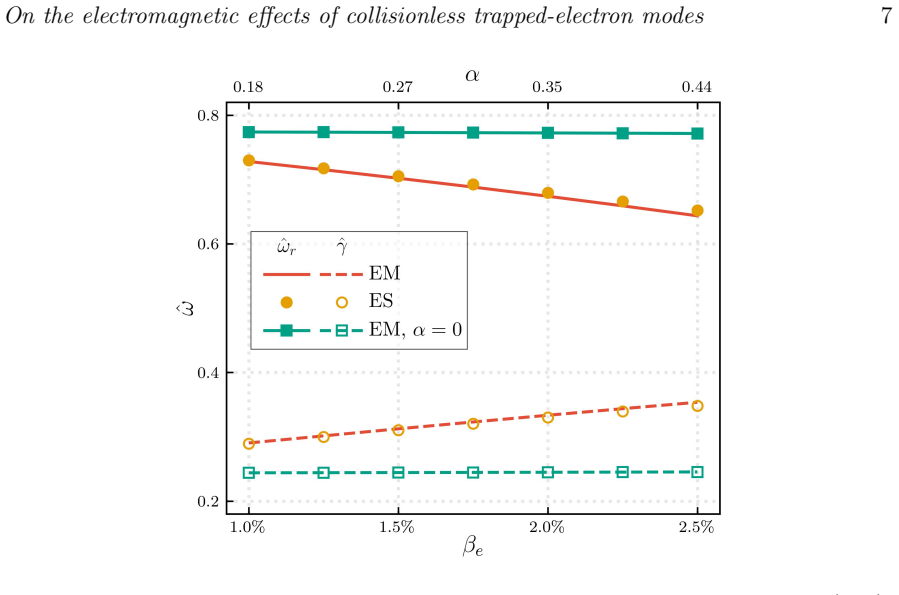
Summary. The manuscript develops a linear electromagnetic gyrokinetic theory for the collisionless trapped-electron mode (CTEM) in a large-aspect-ratio, low-β tokamak. It argues that the well-known weak electromagnetic sensitivity of CTEMs originates in particle dynamics: the kinetic and fluid-like contributions to the trapped-electron parallel current cancel at leading order by bounce dynamics (Eq. 20), the ion parallel current is negligible because the ion transit resonance is subdominant under the stated frequency ordering (Eq. 11), and the resulting parallel current is therefore dominated by the fluid-like response of passing electrons. These features cause the inertia-charge-uncovering term associated with the magnetic perturbation to vanish in the gyrokinetic vorticity equation, eliminating the shear-Alfvén-wave branch from the CTEM eigenmode system (Eq. 33) and thereby rendering electromagnetic effects subdominant. The claim is supported by solutions of the full integro-differential eigenmode equations, by reduced models that replace the vorticity equation with parallel Ampère’s law while selectively retaining current channels (Eqs. 21–22), by an explicit residual bounce-harmonic estimate (Eq. 29), and by GEM particle-in-cell diagnostics of the parallel currents (Figs. 5–6). A contrast with the ITG case is used to highlight the essential role of ion parallel dynamics in electromagnetic coupling.
Significance. If the result holds, the paper supplies a clear, first-principles explanation for a long-standing discrepancy between ITG and CTEM electromagnetic behavior that has been observed in gyrokinetic simulations but not previously derived. The particle-dynamics argument is transparent, the reduced Ampère formulation is practically useful, and the combination of analytic cancellation, residual-harmonic estimates, eigenmode comparisons, and direct current diagnostics constitutes a solid contribution to tokamak microinstability theory. The explicit contrast with ITG electromagnetic coupling (Sec. 3.5) is particularly clarifying for the community.
major comments (2)
- Sec. 3.5 and Eq. (33): The central decoupling claim rests on ICU_Ψ vanishing at leading order under the frequency ordering of Eq. (11). The residual trapped-electron current from nonzero bounce harmonics is estimated in Eq. (29) and shown numerically to be small (Fig. 6), but no analytic scaling of that residual (or of a residual ion-transit contribution) with β_e, k_θ ho_ti, or ε is given for the ICU_Ψ channel itself. A short scaling estimate of the size of the residual ICU_Ψ relative to the FLB term would make the “subdominant” conclusion more precise and would clarify how far the ordering can be stretched before electromagnetic coupling reappears.
- Figs. 1–4 and the GEM diagnostics use essentially a single Cyclone-like parameter point (plus a β_e scan at fixed other parameters). The analytic argument is general within Eq. (11), but the quantitative claim that magnetic-perturbation effects remain negligible would be more robust if the full-EM versus ES comparison were repeated for at least one additional point that still satisfies the ordering (e.g., different s or η_e). This is not required to accept the particle-dynamics mechanism, but it is load-bearing for the breadth of the “weak electromagnetic effects” statement in the abstract and conclusions.
minor comments (5)
- Throughout: the typesetting of Ampère (appearing as Amp` ere) should be corrected in the production version.
- Eq. (11) and Sec. 2: it would help the reader if the authors briefly stated the practical range of k_θ ho_ti and ε_n for which the ordering is expected to hold in present-day and reactor-relevant discharges, even if only by reference to standard CTEM literature.
- Fig. 2 and Fig. 4: the eigenmode structures of Φ∥ and Ψ are shown only for η ≥ 0; a short remark that even parity was verified (or a half-panel for η < 0) would remove any ambiguity for readers less familiar with ballooning parity of CTEMs.
- Sec. 3.4: the GEM geometry uses concentric circular surfaces while the analytic model retains the (s, α) Shafranov-shift model. A one-sentence acknowledgment that the comparison is therefore qualitative for the α effect would be useful.
- References: the self-citation cluster (Chen & Chen 2018–2022) correctly supplies the bounce-kinetic formalism; no change needed, but ensuring that the bounce-average operator (Eq. 14) is fully defined for a first-time reader of those papers would improve accessibility.
Circularity Check
No significant circularity: the cancellation, vanishing ICU_Ψ, and SAW decoupling follow from the gyrokinetic equation plus the stated frequency ordering, not from a fit or a self-citation that already contains the target claim.
full rationale
The load-bearing chain is: (i) standard electromagnetic gyrokinetic equation and quasineutrality/vorticity (Eqs. 3–10, citing Chen & Hasegawa 1991); (ii) the CTEM frequency ordering (Eq. 11) that drops ion transit resonance and justifies bounce averaging; (iii) leading-order compressions (Eqs. 12–13); (iv) the explicit cancellation R_k,te + R_f,te ≃ 0 because ∂_η δK_te^(0) = 0 (Eq. 20); (v) consequent vanishing of ICU_Ψ so that the vorticity equation reduces to FLB + ICU2,pe + MPC_pe = 0 and cannot recover the SAW dispersion (Eqs. 31–33). None of these steps is definitional of the conclusion, none is a parameter fitted to the same data that is later “predicted,” and none imports a uniqueness theorem that already asserts the result. Self-citations (Chen & Chen 2018–2022, 2025) supply the published bounce-kinetic formalism used as a tool; they do not pre-state the electromagnetic-current cancellation or the SAW decoupling that constitute the paper’s claim. The reduced Ampère models (Eqs. 21–22), residual-harmonic estimate (Eq. 29), and GEM current diagnostics (Figs. 5–6) are independent consistency checks, not circular closures. Score 1 only for the ordinary presence of author self-citations that are not load-bearing for the central claim.
Axiom & Free-Parameter Ledger
axioms (4)
- domain assumption Low-frequency electromagnetic fluctuations in low-β plasmas are described by δϕ and δA∥ only; compressional δB∥ is neglected (β ∼ O(ε²)).
- domain assumption Frequency ordering ω_ti < ω_di,n ∼ ω ∼ ⟨ω_de,n⟩_T ≪ ω_be < ω_te (Eq. 11).
- domain assumption Background distributions are local Maxwellians; equilibrium is the (s,α) model with shifted circular surfaces.
- standard math Ballooning representation and straight-field-line coordinates are valid for the eigenmodes.
Cite this review
Pith. "Pith review of On the electromagnetic effects of collisionless trapped-electron modes." pith.science (2026). https://pith.science/paper/AVOFXK4G
@misc{pith2026260704769,
  author       = {Pith},
  title        = {Pith review of: On the electromagnetic effects of collisionless trapped-electron modes},
  year         = {2026},
  howpublished = {\url{https://pith.science/paper/AVOFXK4G}},
  note         = {Machine review of arXiv:2607.04769}
}
read the original abstract
We present a linear gyrokinetic theory for the electromagnetic collisionless trapped-electron mode (CTEM). It is found that the weak electromagnetic effects of CTEMs originate from the particle dynamics. Theoretical analysis reveals that the kinetic and fluid-like components of the trapped-electron parallel current cancel at leading order. The ion parallel current is also negligible due to the weak ion transit resonance. Consequently, the perturbed parallel current in the electromagnetic CTEM is dominated by passing electrons. We demonstrate that these characteristics of particle dynamics decouple the CTEM from the shear Alfv\'en wave branch, rendering the electromagnetic effects subdominant. Both eigenmode analyses and gyrokinetic simulations validate these findings.
Figures


Reference graph
Works this paper leans on
-
[1]
Horton W. 1999Rev. Mod. Phys.71735
-
[2]
and Dong J.Q
Kim J.Y., Horton W. and Dong J.Q. 1993Phys. Fluids B54030
-
[3]
and Lin Z
Holod I. and Lin Z. 2013Phys. Plasmas20032309
-
[4]
2005Phys
Candy J. 2005Phys. Plasmas12072307
-
[5]
and Jenko F
Pueschel M.J., Kammerer M. and Jenko F. 2008Phys. Plasmas15102310
-
[6]
and Candy J
Belli E.A. and Candy J. 2010Phys. Plasmas17112314
-
[7]
and Rutherford P.H
Adam J.C., Tang W.M. and Rutherford P.H. 1976Phys. Fluids19561
-
[8]
and Tsang K.T
Catto P.J. and Tsang K.T. 1978Phys. Fluids211381
-
[9]
1978Nucl
Tang W.M. 1978Nucl. Fusion181089
-
[10]
and Chen L
Cheng C.Z. and Chen L. 1981Nucl. Fusion21403
-
[11]
and Chen L
Chen H. and Chen L. 2018Plasma Phys. Control. Fusion60055011
-
[12]
and Chen L
Chen H. and Chen L. 2019Nucl. Fusion59074003
-
[13]
and Chen L
Chen H. and Chen L. 2022Phys. Rev. Lett.128025003
-
[14]
Fusion62036027
Yao Y.et al2022Nucl. Fusion62036027
-
[15]
Fusion62086031
Yao Y.et al2022Nucl. Fusion62086031
-
[16]
and Hasegawa A
Chen L. and Hasegawa A. 1991J. Geophys. Res.961503
-
[17]
Phys.7261
Chen H.et al2024Commun. Phys.7261
-
[18]
and Chen L
Zonca F. and Chen L. 2006Plasma Phys. Control. Fusion48537
-
[19]
and Chen L
Chen H. and Chen L. 2021Phys. Plasmas28052103
-
[20]
and Taylor J.B
Connor J.W., Hastie R.J. and Taylor J.B. 1978Phys. Rev. Lett.40396
-
[21]
and Taylor J.B
Connor J.W., Hastie R.J. and Taylor J.B. 1979Proc. R. Soc. London Ser. A3651
-
[22]
and Briguglio S
Romanelli F. and Briguglio S. 1990Phys. Fluids B2754
-
[23]
1989Phys
Romanelli F. 1989Phys. Fluids B11018
-
[24]
and Rewoldt G
Coppi B. and Rewoldt G. 1974Phys. Rev. Lett.331329
-
[25]
Chen H. 2022J. Comput. Appl. Math.402113796
-
[26]
Fusion65056022
Li Z.et al2025Nucl. Fusion65056022
-
[27]
and Zonca F
Dong J.Q., Chen L. and Zonca F. 1999Nucl. Fusion391041
-
[28]
and Chen W
Chen H. and Chen W. 2025Nucl. Fusion65036028
-
[29]
and Zonca F
Chen L. and Zonca F. 2016Rev. Mod. Phys.88015008
-
[30]
and Parker S.E
Chen Y. and Parker S.E. 2003J. Comput. Phys.189463 On the electromagnetic effects of collisionless trapped-electron modes17
-
[31]
and Parker S.E
Chen Y. and Parker S.E. 2007J. Comput. Phys.220839
-
[32]
Plasmas7969
Dimits A.M.et al2000Phys. Plasmas7969
-
[33]
Plasmas23072503
G¨ orler T.et al2016Phys. Plasmas23072503
discussion (0)
Sign in with ORCID, Apple, or X to comment. Anyone can read and Pith papers without signing in.