REVIEW 3 major objections 5 minor 61 references
Quasi mono-energetic, relativistic electron acceleration in a femtosecond, high intensity laser excited solid magnet
T0 review · 3 major / 5 minor · reviewed 2026-07-11 · grok-4.5
Pith's one-line read Intense lasers on magnetized overdense plasmas produce directional quasi-monoenergetic MeV electrons via Bernstein-wave Landau damping at a record 3.6 MeV/µm gradient.
desk verdict Solid PIC result: post-laser QME MeV peaks appear only when the thermal population can hit the relativistic cyclotron resonance; EBW identification is still circumstantial, and the experiment shows only enhanced flux, not the monoenergetic spectrum. read the letter →
The pith
A machine-rendered reading of the paper's core claim, the machinery that carries it, and where it could break.
The reading
What carries the argument
Electron Bernstein waves (electrostatic warm-plasma modes that can propagate in overdense magnetized plasma): they are excited at the vacuum-plasma interface by the laser, then Landau-damp, transferring energy only to electrons whose energy satisfies the harmonic cyclotron resonance u_L / ω_ce,R = n.
What would settle it
Repeat the 2 kT simulation with a density scale length or laser polarization that suppresses the short-wavelength surface oscillations while still allowing a thermal population that satisfies the resonance condition; if the monoenergetic peaks disappear, the Bernstein-wave identification fails.
Extended reading notes
Core claim
Two-dimensional particle-in-cell simulations of a p-polarized laser (a0 ≈ 6) incident on a 100 nc plasma with a few-kilotesla surface-normal magnetic field produce clear quasi-monoenergetic peaks at ~2 MeV with 6.7 percent spread and ~1.54 pC/µm residual charge after the laser has exited; the peaks sit at integer values of the relativistically corrected gyroradius-to-wavelength ratio and arise from surface-excited electron Bernstein waves that Landau-damp into resonant electrons, yielding an acceleration gradient of 3.6 MeV/µm—the highest reported to date.
Load-bearing premise
The residual short-wavelength in-plane electric oscillations and the positive fluctuating energy-transfer rate are taken to be electron Bernstein waves undergoing Landau damping, even though the full wave dispersion and phase-velocity match to the resonant electrons are not demonstrated.
Editorial extensions
If this is right
- High-flux MeV electron beams become available from plasmas whose density is orders of magnitude above the critical density, removing the charge bottleneck of underdense accelerators.
- Electron peak energy is tunable simply by changing the applied (or self-generated) magnetic-field strength.
- Ordinary permanent magnets suffice because laser-driven dynamo amplification reaches the required kilotesla fields, making the scheme table-top accessible.
- Electron Bernstein waves become a controllable intermediary for depositing laser energy into dense plasmas, useful for fast-ignition and other high-energy-density applications.
- Acceleration gradients exceeding 3 MeV/µm can be realized over sub-micron distances, enabling compact high-gradient sources.
Reading between the lines
- Optimizing the density gradient and sheath thickness should increase Bernstein-wave amplitude and therefore both the monoenergetic charge and the peak energy beyond the present proof-of-principle values.
- Time-resolved electron spectrometers on existing 100 TW-class lasers could capture the transient spectral peaks and thereby confirm or refute the post-laser timing predicted by the simulations.
- The same surface-mode coupling may also open a path to monoenergetic ion beams if the magnetic-field geometry is reoriented to resonate with ion Bernstein modes.
- Because the acceleration occurs at the surface, the scheme can be combined with existing magnetic collimation techniques to reduce beam divergence for transport through solid targets.
Editorial analysis
A structured set of objections, weighed in public.
Referee Report
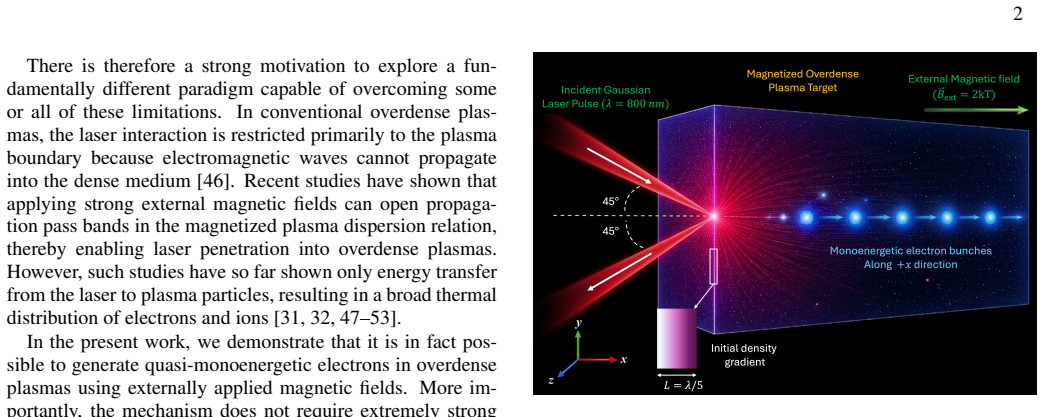
Summary. The manuscript reports 2D3V OSIRIS PIC simulations of a p-polarized a0=6.1, 800 nm laser incident at 45° on a 100 nc overdense target with an external B field normal to the surface. For Bext=2 kT (but not 0 or 20 kT), quasi-monoenergetic peaks near 2 MeV with ~6.7% energy spread appear after the laser has left the domain, superimposed on a thermal background; residual peak charge is estimated at 1.54 pC/μm and the acceleration gradient at 3.6 MeV/μm. Peak locations satisfy the relativistic cyclotron-harmonic condition re/λ=n (Eq. 1). The authors attribute the peaks to excitation of electron Bernstein waves at the plasma–vacuum interface and their subsequent Landau damping, supported by residual short-wavelength in-plane E after sheath subtraction (Fig. 7b), positive ⟨δJ⊥·δE⊥⟩ during peak formation (Fig. 8), and surface-crossing energy jumps of tracked resonant electrons (Fig. 6). A companion experiment with a ~0.1 T Nd permanent-magnet target (claimed dynamo-amplified to ~kT) shows enhanced directional electron emission and rear-side transmission relative to a non-magnetic target, but does not resolve monoenergetic features.
Significance. If the EBW-mediated mechanism is confirmed, the work opens a genuinely new acceleration channel that operates at densities ~10^6 times higher than conventional LWFA/PWFA, with a claimed gradient an order of magnitude larger than the underdense benchmarks listed in Table I. The B- and intensity-dependent appearance of the peaks (2 kT yes; 4 kT only after raising a0) is a clean, falsifiable prediction that already strengthens the resonance interpretation. The experimental demonstration that modest permanent-magnet seeds can produce enhanced MeV electron emission and rear-side transmission is practically useful and places the regime within reach of existing table-top lasers. These elements—parameter-scan consistency, quantitative residual-charge extraction, and a concrete experimental path—constitute real strengths even if the wave identification remains incomplete.
major comments (3)
- Section III, Figs. 7–8 and Eq. 1: The central claim that the post-laser ~2 MeV peaks arise from Landau damping of electron Bernstein waves rests on circumstantial evidence (residual short-wavelength δE⊥ after sheath subtraction, positive ⟨δJ⊥·δE⊥⟩ during peak emergence, and re/λ=n). The manuscript never extracts the (ω,k) spectrum of the residual field, never checks whether those modes satisfy the warm-plasma EBW dispersion for the local Bext, ne and Te, and never compares the wave phase velocity to the parallel velocities of the electrons that form the spectral peaks. Without that match the same signatures could be produced by sheath fluctuations, surface waves or numerical noise. A dispersion or phase-velocity comparison is load-bearing for the EBW identification and should be supplied or the claim softened.
- Section IV and the dynamo axiom: The experimental feasibility argument equates the ~0.1 T permanent-magnet target (claimed dynamo-amplified to ~2 kT) with the 2 kT PIC case. The manuscript cites only an arXiv preprint for the amplification and does not show in-situ B measurements or time-resolved spectra that would confirm the monoenergetic peaks. The experiment therefore supports enhanced heating and transport but does not yet corroborate the resonant-acceleration mechanism. Either additional diagnostics or a clearer separation of the experimental claim from the EBW claim is required.
- Table I and the gradient claim: The acceleration length of 538 nm used to obtain 3.6 MeV/μm is not derived from a measured energy-gain path length of the tracked electrons (Fig. 6 shows discrete surface crossings). The comparison with multi-cm LWFA/PWFA stages is therefore not on equal footing. The length and the resulting “highest till date” statement need explicit justification or qualification.
minor comments (5)
- Fig. 4: The Gaussian background subtraction used to extract residual QME charge is not uniquely defined; a short sensitivity test (varying fit window or functional form) would strengthen the 1.54 pC/μm and 6.68% numbers.
- Abstract and Introduction: “highest till date” and “millions (×10^6) of times higher” should be cross-checked against the precise numbers in Table I and the density ratio 100 nc.
- Simulation details: The immobile-ion assumption and the precise density-ramp formula should be stated more prominently; both affect sheath structure and possible surface modes.
- Typographical: “SIMULA TION”, “OBSERV A TIONS”, and occasional double commas appear in the text; a careful proof-read is needed.
- Fig. 2 caption: times are given as 64 fs, 68 fs, 72 fs while the text also mentions 74 fs; consistency would help.
Circularity Check
Minor self-citation supplies the experimental motivation for Bext~2 kT; the PIC resonance matching and residual-peak quantification are independent post-hoc observations, not forced by construction.
-
self citation load bearing
[Section IV (Experimental Feasibility), paragraph on dynamo amplification and motivation for Bext]
"Remarkably, the interaction was found to trigger a dynamo-like amplification of the magnetic field by nearly four orders of magnitude, resulting in self-generated magnetic fields approaching 2 kT [54]. This observation demonstrates that kilotesla-scale magnetic fields can emerge naturally during laser–target interactions, even when starting from relatively modest seed fields. Indeed, this experimental finding served as one of the primary motivations for choosing external magnetic fields of the order of a few kilotesla in our simulations."
The practical accessibility of the simulation parameter Bext ≈ 2 kT (the value that places the cyclotron-harmonic resonance inside the observed thermal spectrum and thereby produces the quasi-monoenergetic peaks) is justified solely by citation [54], whose author list overlaps substantially with the present paper. The experimental feasibility claim in the abstract and conclusions therefore rests on this self-citation rather than on an independent external measurement.
full rationale
The core derivation chain is observational and non-circular. PIC runs with chosen Bext and a0 produce broad spectra; later-time peaks are measured, then noticed to satisfy re/λ = n (Eq. 1, Fig. 3). This is pattern matching after the fact, subsequently tested by changing Bext to 4 kT (peak disappears) and raising a0 (peak reappears at the predicted energy). Residual monoenergetic charge is obtained by subtracting a fitted thermal Gaussian (Fig. 4), but the fit is used only for quantification, not as a prediction of a related quantity. EBW attribution rests on residual δE⊥ structure and positive ⟨δJ⊥·δE⊥⟩ correlation (Figs. 7-8), which is circumstantial but not definitional. The sole circularity-adjacent element is the load-bearing self-citation that justifies experimental accessibility of the key simulation parameter B~2 kT; without it the feasibility claim weakens, yet the simulation results themselves stand independently. No self-definitional loop, no fitted-input-as-prediction, no uniqueness theorem, and no ansatz smuggled via citation appear in the acceleration mechanism.
Assumptions & free parameters
free parameters (4)
- External B field strength Bext (simulation cases) =
2 kT (primary QME case)
- Laser normalized amplitude a0 =
6.1 (primary); 10 (4 kT recovery)
- Density scale length L of front ramp =
12 c/ωpe
- Broad thermal Gaussian background used to extract residual QME charge =
local Gaussian fits (Fig. 4)
assumptions (5)
- domain assumption Ions form a fixed neutralizing background (immobile ions) throughout the interaction.
- domain assumption 2D3V geometry with p-polarized 45° incidence and absorbing boundaries adequately captures the 3D surface-wave and electron-transport physics.
- domain assumption Electron Bernstein waves exist and can be driven at the overdense magnetized surface under these laser conditions, and Landau damping is the dominant energy-transfer channel to resonant electrons.
- ad hoc to paper A ~0.1 T permanent-magnet seed is dynamo-amplified to ~2 kT during the laser interaction, placing the experiment in the same regime as the 2 kT PIC case.
- domain assumption Resonance condition νL γ / ωce = n with v≈c correctly locates the monoenergetic peaks.
Cite this review
Pith. "Pith review of Quasi mono-energetic, relativistic electron acceleration in a femtosecond, high intensity laser excited solid magnet." pith.science (2026). https://pith.science/paper/RZHUO5PW
@misc{pith2026260704994,
  author       = {Pith},
  title        = {Pith review of: Quasi mono-energetic, relativistic electron acceleration in a femtosecond, high intensity laser excited solid magnet},
  year         = {2026},
  howpublished = {\url{https://pith.science/paper/RZHUO5PW}},
  note         = {Machine review of arXiv:2607.04994}
}
read the original abstract
The interaction of ultraintense lasers with magnetized overdense plasmas reveals a fundamentally new regime of laser-driven particle acceleration. Particle-in-cell simulations demonstrate the generation of directional, quasi-monoenergetic electrons in the MeV energy range superimposed on a broad thermal electron background with the estimated acceleration gradient of 3.6 MeV/{\mu}m, which is the highest till date. In contrast to conventional laser-plasma accelerators, which rely on underdense plasmas and are therefore constrained to relatively low plasma densities and limited beam charge, the present scheme operates in plasmas with densities orders of magnitude higher, opening new possibilities for the generation of high-flux energetic electron beams. A central result of this work is the demonstration of the excitation of electron Bernstein waves during relativistic laser interaction with magnetized overdense plasmas. The subsequent Landau damping of these electrostatic warm-plasma modes selectively transfers energy to resonant electrons, leading to the emergence of quasi-monoenergetic spectral peaks at energies that can be tuned through the applied magnetic field. To support the simulation results, we experimentally demonstrate the directional emission of energetic electrons from a simple permanent-magnet target irradiated by an ultraintense laser pulse, highlighting the practical feasibility of controlled electron-beam generation in dense plasma environments. These findings establish electron Bernstein waves as an efficient mediator of laser energy coupling in overdense plasmas and introduce a new paradigm for controlled particle acceleration and energy deposition in high-energy-density plasma systems.
Figures


Figures from the paper (6 more)


Reference graph
Works this paper leans on
-
[1]
P. P. Rajeev, P. Taneja, P. Ayyub, A. S. Sandhu, and G. R. Ku- mar, Phys. Rev. Lett.90, 115002 (2003)
2003
-
[2]
M. A. Purvis, V . N. Shlyaptsev, R. Hollinger, C. Bargsten, A. Pukhov, A. Prieto, Y . Wang, B. M. Luther, L. Yin, S. Wang, and J. J. Rocca, Nature Photonics7, 796 (2013)
2013
-
[3]
Kahaly, S
S. Kahaly, S. K. Yadav, W. M. Wang, S. Sengupta, Z. M. Sheng, A. Das, P. K. Kaw, and G. R. Kumar, Phys. Rev. Lett.101, 145001 (2008)
2008
-
[4]
A. D. Lad, Y . Mishima, P. K. Singh, B. Li, A. Adak, G. Chat- terjee, P. Brijesh, M. Dalui, M. Inoue, J. Jha,et al., Scientific Reports12, 16818 (2022)
2022
-
[5]
A. Macchi, Physics of Plasmas25, 031906 (2018), https://pubs.aip.org/aip/pop/article- pdf/doi/10.1063/1.5013321/16153003/031906_1_online.pdf
work page doi:10.1063/1.5013321/16153003/031906_1_online.pdf 2018
-
[6]
Fedeli, A
L. Fedeli, A. Sgattoni, G. Cantono, D. Garzella, F. Réau, I. Prencipe, M. Passoni, M. Raynaud, M. Kv ˇetoˇn, J. Proska, A. Macchi, and T. Ceccotti, Phys. Rev. Lett.116, 015001 (2016)
2016
-
[7]
Green, V
J. Green, V . Ovchinnikov, R. Evans, K. Akli, H. Azechi, F. Beg, C. Bellei, R. Freeman, H. Habara, R. Heathcote,et al., Physical review letters100, 015003 (2008)
2008
-
[8]
R. P. Drake,High Energy Density Physics(Springer-Verlag Berlin Heidelberg, 2006)
2006
Show all 61 references
-
[9]
E. S. Weibel, Phys. Rev. Lett.2, 83 (1959)
1959
-
[10]
Califano, D
F. Califano, D. Del Sarto, and F. Pegoraro, Phys. Rev. Lett.96, 105008 (2006)
2006
-
[11]
Califano, N
F. Califano, N. Attico, F. Pegoraro, G. Bertin, and S. V . Bu- lanov, Phys. Rev. Lett.86, 5293 (2001)
2001
-
[12]
Yabuuchi, A
T. Yabuuchi, A. Das, G. Kumar, H. Habara, P. Kaw, R. Kodama, K. Mima, P. Norreys, S. Sengupta, and K. Tanaka, New Journal of Physics11, 093031 (2009)
2009
-
[13]
V . T. Tikhonchuk, Physics of Plasmas9, 1416 (2002), https://pubs.aip.org/aip/pop/article- pdf/9/4/1416/12549704/1416_1_online.pdf
2002
-
[14]
Manclossi, J
M. Manclossi, J. J. Santos, D. Batani, J. Faure, A. Debayle, V . T. Tikhonchuk, and V . Malka, Phys. Rev. Lett.96, 125002 (2006)
2006
-
[15]
Z. M. Sheng, Y . Sentoku, K. Mima, J. Zhang, W. Yu, and J. Meyer-ter Vehn, Phys. Rev. Lett.85, 5340 (2000)
2000
-
[16]
Tabak, J
M. Tabak, J. Hammer, M. E. Glinsky, W. L. Kruer, S. C. Wilks, J. Woodworth, E. M. Campbell, M. D. Perry, and R. J. Mason, Physics of Plasmas1, 1626 (1994), https://pubs.aip.org/aip/pop/article- pdf/1/5/1626/12286966/1626_1_online.pdf
1994
-
[17]
T. Gong, H. Habara, K. Sumioka, M. Yoshimoto, Y . Hayashi, S. Kawazu, T. Otsuki, T. Matsumoto,et al., Nature Communi- cations10, 5614 (2019)
2019
-
[18]
Vauzour, J
B. Vauzour, J. J. Santos, A. Debayle, S. Hulin, H.-P. Schlen- voigt, X. Vaisseau, D. Batani, S. D. Baton, J. J. Honrubia, P. Nicolaï, F. N. Beg,et al., Phys. Rev. Lett.109, 255002 (2012)
2012
-
[19]
Chatterjee, P
G. Chatterjee, P. K. Singh, S. Ahmed, A. P. L. Robinson, A. D. Lad, S. Mondal, V . Narayanan, I. Srivastava, N. Koratkar, J. Pasley, A. K. Sood, and G. R. Kumar, Phys. Rev. Lett.108, 235005 (2012)
2012
-
[20]
P. K. Singh, I. Chakraborty, G. Chatterjee, A. Adak, A. D. Lad, P. Brijesh, P. Ayyub, and G. R. Kumar, Phys. Rev. ST Accel. Beams16, 063401 (2013)
2013
-
[21]
A. R. Bell and R. J. Kingham, Phys. Rev. Lett.91, 035003 (2003)
2003
-
[22]
S. Kar, A. P. L. Robinson, D. C. Carroll, O. Lundh, K. Markey, P. McKenna, P. Norreys, and M. Zepf, Phys. Rev. Lett.102, 055001 (2009)
2009
-
[23]
Ramakrishna, S
B. Ramakrishna, S. Kar, A. P. L. Robinson, D. J. Adams, K. Markey, M. N. Quinn, X. H. Yuan, P. McKenna, K. L. Lan- caster, J. S. Green, R. H. H. Scott, P. A. Norreys, J. Schreiber, and M. Zepf, Phys. Rev. Lett.105, 135001 (2010)
2010
-
[24]
A. P. L. Robinson, M. H. Key, and M. Tabak, Phys. Rev. Lett. 108, 125004 (2012)
2012
-
[25]
S. K. Yadav, A. Das, P. Kaw, and S. Sengupta, Physics of Plas- mas16(2009)
2009
-
[26]
Cai, S.-p
H.-b. Cai, S.-p. Zhu, and X. T. He, Physics of Plas- mas20, 072701 (2013), https://pubs.aip.org/aip/pop/article- pdf/doi/10.1063/1.4812631/16032160/072701_1_online.pdf
2013 doi
-
[27]
Bailly-Grandvaux, J
M. Bailly-Grandvaux, J. J. Santos, C. Bellei, P. Forestier- Colleoni, S. Fujioka, L. Giuffrida, J. J. Honrubia, D. Batani, R. Bouillaud, M. Chevrot, J. E. Cross,et al., Nature Communi- cations9, 102 (2018)
2018
-
[28]
W.-M. Wang, P. Gibbon, Z.-M. Sheng, and Y .-T. Li, Phys. Rev. Lett.114, 015001 (2015)
2015
-
[29]
Sakata, S
S. Sakata, S. Lee, H. Morita, T. Johzaki, H. Sawada, Y . Iwasa, K. Matsuo, K. F. F. Law, A. Yao, and orthers, Nature Commu- nications9, 3937 (2018)
2018
-
[30]
Das, Reviews of Modern Plasma Physics4, 10 (2020)
A. Das, Reviews of Modern Plasma Physics4, 10 (2020)
2020
-
[31]
Maity, L
S. Maity, L. P. Goswami, A. Vashistha, D. Mandal, and A. Das, Phys. Rev. E105, 055209 (2022). 10
2022
-
[32]
Vashistha, D
A. Vashistha, D. Mandal, A. Kumar, C. Shukla, and A. Das, New Journal of Physics22, 063023 (2020)
2020
-
[33]
L. P. Goswami, S. Maity, D. Mandal, A. Vashistha, and A. Das, Plasma Physics and Controlled Fusion63, 115003 (2021)
2021
-
[34]
Modena, Z
A. Modena, Z. Najmudin, A. Dangor, C. Clayton, K. Marsh, C. Joshi, V . Malka, C. Darrow, C. Danson, D. Neely,et al., nature377, 606 (1995)
1995
-
[35]
S. P. Mangles, C. Murphy, Z. Najmudin, A. G. R. Thomas, J. Collier, A. E. Dangor, E. Divall, P. Foster, J. Gallacher, C. Hooker,et al., Nature431, 535 (2004)
2004
-
[36]
Geddes, C
C. Geddes, C. Toth, J. Van Tilborg, E. Esarey, C. Schroeder, D. Bruhwiler, C. Nieter, J. Cary, and W. Leemans, Nature431, 538 (2004)
2004
-
[37]
Faure, Y
J. Faure, Y . Glinec, A. Pukhov, S. Kiselev, S. Gordienko, E. Lefebvre, J.-P. Rousseau, F. Burgy, and V . Malka, Nature 431, 541 (2004)
2004
-
[38]
Pukhov and J
A. Pukhov and J. Meyer-ter Vehn, Applied Physics B74, 355 (2002)
2002
-
[39]
Zhang, D
C. Zhang, D. Storey, A. Knetsch, B. D. O’Shea, R. Ariniello, G. J. Cao, S. Corde, T. N. Dalichaouch, C. Emma, O. G. Finnerud,et al., Nature Communications16, 10719 (2025)
2025
-
[40]
Andreev, S
N. Andreev, S. Kuznetsov, and I. Pogorelsky, Physical Review Special Topics-Accelerators and Beams3, 021301 (2000)
2000
-
[41]
F. S. Tsung, W. Lu, M. Tzoufras, W. B. Mori, C. Joshi, J. Vieira, L. Silva, and R. Fonseca, Physics of Plasmas13(2006)
2006
-
[42]
Krushelnick, Z
K. Krushelnick, Z. Najmudin, S. P. Mangles, A. G. R. Thomas, M. Wei, B. Walton, A. Gopal, E. Clark, A. E. Dangor, S. Frit- zler,et al., Physics of plasmas12(2005)
2005
-
[43]
H. T. Kim, K. H. Pae, H. J. Cha, I. J. Kim, T. J. Yu, J. H. Sung, S. K. Lee, T. M. Jeong, and J. Lee, Phys. Rev. Lett.111, 165002 (2013)
2013
-
[44]
X. Wang, R. Zgadzaj, N. Fazel, Z. Li, S. Yi, X. Zhang, W. Hen- derson, Y .-Y . Chang, R. Korzekwa, H.-E. Tsai,et al., Nature communications4, 1988 (2013)
1988
-
[45]
J. Shaw, M. Ambat, K. Miller, R. Boni, I. LaBelle, W. Mori, J. Pigeon, A. Rigatti, I. Settle, L. Mack,et al., Physics of Plas- mas32(2025)
2025
-
[46]
F. F. Chenet al.,Introduction to plasma physics and controlled fusion, V ol. 1 (Springer, 1984)
1984
-
[47]
Dhalia, R
T. Dhalia, R. Juneja, L. P. Goswami, S. Maity, and A. Das, Journal of Physics D: Applied Physics56, 395201 (2023)
2023
-
[48]
Dhalia, R
T. Dhalia, R. Juneja, and A. Das, Journal of Plasma Physics91, E154 (2025)
2025
-
[49]
Dhalia, R
T. Dhalia, R. Juneja, and A. Das, High Power Laser Science and Engineering14, e9 (2026)
2026
-
[50]
Juneja, T
R. Juneja, T. Dhalia, L. P. Goswami, S. Maity, D. Mandal, and A. Das, Plasma Physics and Controlled Fusion65, 095005 (2023)
2023
-
[51]
Kumar, C
A. Kumar, C. Shukla, D. Verma, A. Das, and P. Kaw, Plasma Physics and Controlled Fusion61, 065009 (2019)
2019
-
[52]
Mandal, A
D. Mandal, A. Vashistha, and A. Das, Scientific Reports11, 1 (2021)
2021
-
[53]
Dhalia, R
T. Dhalia, R. Juneja, and A. Das, Physical Review E110, 065213 (2024)
2024
-
[54]
Choudhary, T
A. Choudhary, T. Dhalia, S. Dam, A. Parab, S. Rakeeb, C. Aparajit, A. D. Lad, Y . M. Ved, K. Subramanian, A. Das, et al., arXiv preprint arXiv:2504.15094 (2025)
2025 arXiv
-
[55]
I. B. Bernstein, Physical Review109, 10 (1958)
1958
-
[56]
Laqua, H
H. Laqua, H. Maassberg, F. V olpe, W.-A. team,et al., Nuclear fusion43, 1324 (2003)
2003
-
[57]
R. A. Fonseca, L. O. Silva, F. S. Tsung, V . K. Decyk, W. Lu, C. Ren, W. B. Mori, S. Deng, S. Lee, T. Katsouleas,et al., in International Conference on Computational Science(Springer,
-
[58]
R. G. Hemker,Particle-in-cell modeling of plasma-based accel- erators in two and three dimensions(University of California, Los Angeles, 2000)
2000
-
[59]
H. P. Laqua, Plasma Phys. Control. Fusion49, R1 (2007)
2007
-
[60]
Leemans, A
W. Leemans, A. Gonsalves, H.-S. Mao, K. Nakamura, C. Benedetti, C. Schroeder, C. Tóth, J. Daniels, D. Mittelberger, S. Bulanov,et al., Physical review letters113, 245002 (2014)
2014
-
[61]
Salehi, M
F. Salehi, M. Le, L. Railing, M. Kolesik, and H. Milchberg, Physical Review X11, 021055 (2021)
2021
Reviewed July 11, 2026 · model on record in the stance chip above.
Discussion (0). Continue with ORCID to comment.