FUSE: FK-Steered Multi-Modal Flow Matching for Efficient Simulation-Based Posterior Estimation
Reviewed by Pith T0 review T1 audit T2 compute T3 formal T4 kernel 2026-07-07 21:22 UTCglm-5.2pith:ZRLYPFMIrecord.jsonopen to challenge →
The pith
FUSE adapts a multimodal diffusion transformer for flow-matching-based posterior estimation and adds inference-time likelihood-guided particle resampling, achieving state-of-the-art posterior fidelity on SBI benchmarks and real-world exoplanet orbital estimation.
A machine-rendered reading of the paper's core claim, the machinery that carries it, and where it could break.
Core claim
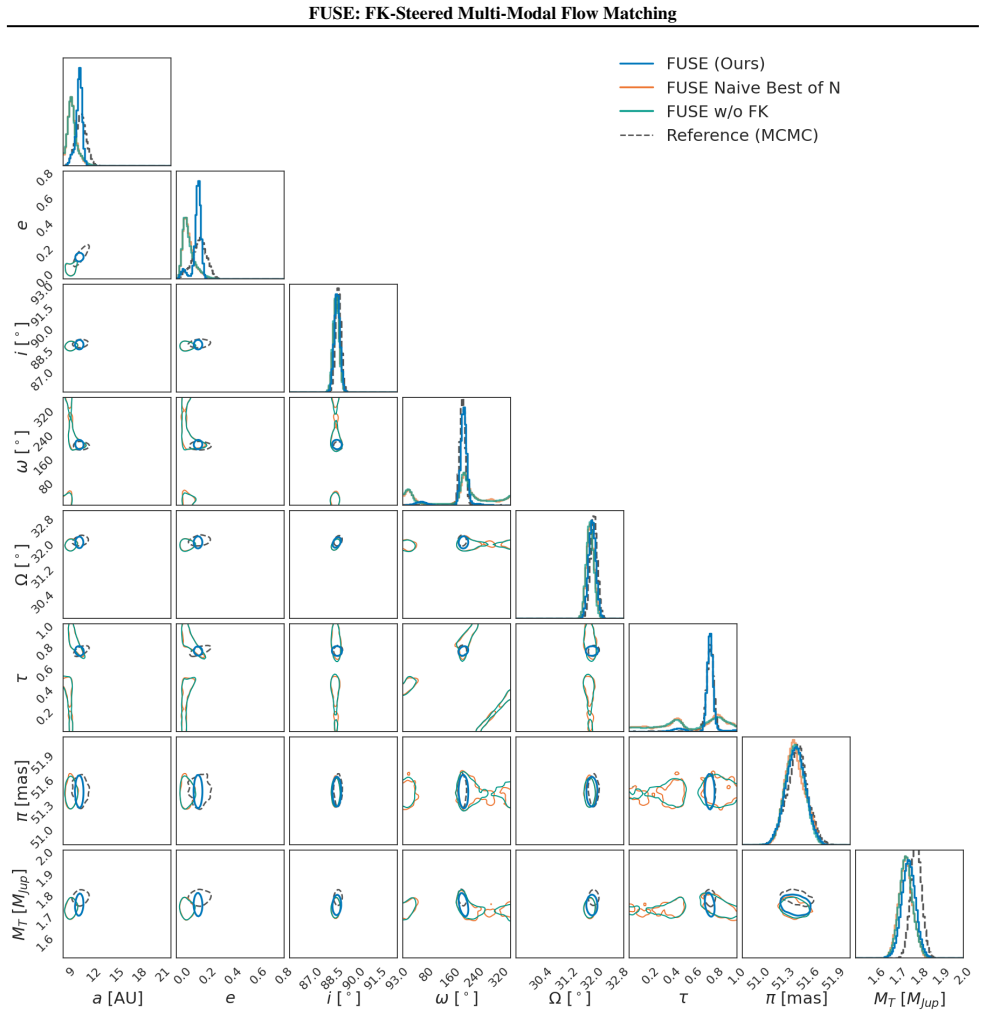
FUSE outperforms state-of-the-art neural SBI baselines (NPE, FMPE, Simformer) on the SBIBM benchmark across seven metrics at 10^5 simulations, and on the real-world β Pictoris b exoplanet orbital estimation task, FUSE with FK-steering recovers complex parameter degeneracies that baselines fail to capture, achieving a Mode L2 Distance of 3.85 versus 75.74 (NPE) and 132.41 (FMPE), while completing inference in ~3 minutes versus ~8.5 hours for PTMCMC.
Load-bearing premise
The FK-steering mechanism depends on the denoised proxy θ̂_t = θ_t − t·v_ϕ(θ_t, t, x) being a faithful approximation of E[θ_0 | θ_t, x] (Eq. 11, §4.3). This proxy is exact only when v_ϕ equals the optimal conditional velocity (Appendix I.2, Eq. 37). When the learned velocity field is imperfect—which is the regime where FK-steering is most needed—the proxy can produce misleading likelihood scores, potentially steering particles toward wrong regions. The paper acknowledges this is a 'tractable likelihood-guided correction rather than an exact posterior sampler' but does not empirically characterize how proxy error degrades FK performance, nor does it evaluate FK-steering across all 10 benchmark tasks (only SLCP and the exoplanet task).
Figures


read the original abstract
Simulation-Based Inference (SBI) is critical for scientific discovery, with generative models offering a promising path toward efficient inference. However, existing methods struggle with effective multimodal modeling. They often rely on brute-force fusion strategies that ignore the structural disparities between parameters and observations, thus limiting estimation fidelity. In this work, we introduce FUSE (Feynman-Kac steered mUlti-modal flow matching for efficient Simulation-based posterior Estimation). Unlike prior work, FUSE employs a dual-track architecture that preserves the distinct features of multimodal inputs while facilitating dynamic interaction. Additionally, we propose an FK-steered sampling strategy that leverages intermediate observation likelihoods to guide the generative trajectories, effectively improving the sample quality during inference. Our approach outperforms state-of-the-art baselines on standard SBI benchmarks, producing posteriors that closely match ground-truth MCMC. Furthermore, in a real-world exoplanet orbital estimation task, FUSE successfully resolves complex parameter degeneracies that challenge existing methods, highlighting its potential to accelerate complex scientific discoveries in astrophysics and beyond.
Editorial analysis
A structured set of objections, weighed in public.
Axiom & Free-Parameter Ledger
free parameters (6)
- λ (FK scaling factor) =
not explicitly stated
- α (noise scale) =
0.3
- B (beam width / particle count) =
8
- K (tokens per parameter) =
2
- D (hidden dimension) =
128 (benchmark), 256 (exoplanet)
- Resampling schedule =
every 5 steps, step 20-200
axioms (4)
- domain assumption The learned velocity field v_ϕ approximates the optimal conditional velocity well enough that the denoised proxy θ̂_t = θ_t − t·v_ϕ(θ_t, t, x) is a meaningful estimate of E[θ_0 | θ_t, x]
- domain assumption The simulator likelihood p(x|θ) and prior p(θ) are available and tractable to evaluate at inference time
- standard math The rectified flow interpolation θ_t = (1−t)θ_0 + tϵ with constant velocity target ϵ−θ_0 is an appropriate transport for posterior estimation
- domain assumption Multinomial resampling with stochastic rejuvenation sufficiently mitigates particle depletion for finite B
Reference graph
Works this paper leans on
-
[1]
URL https://openaccess.thecvf.co m/content/CVPR2023/html/Bao_All_Are_ Worth_Words_A_ViT_Backbone_for_Diffu sion_Models_CVPR_2023_paper.html. Blunt, S., Wang, J. J., Angelo, I., Ngo, H., Cody, D., De Rosa, R. J., Graham, J. R., Hirsch, L., Nagpal, V ., Nielsen, E. L., Pearce, L., Rice, M., and Tejada, R. or- bitize!: A comprehensive orbit-fitting software ...
-
[2]
In: 2023 IEEE/CVF Conference on Com-puter Vision and Pattern Recognition (CVPR)
doi: 10.1109/CVPR52729.2023.01764. URL https://openaccess.thecvf.com/conten t/CVPR2023/html/Brooks_InstructPix2P ix_Learning_To_Follow_Image_Editing_ Instructions_CVPR_2023_paper.html. Chen, J., Yu, J., Ge, C., Yao, L., Xie, E., Wu, Y ., Wang, Z., Kwok, J., Luo, P., Lu, H., and Li, Z. PixArt-α: Fast training of diffusion transformer for photorealistic tex...
-
[3]
URL https://ojs.aaai.org/index.php/AAA I/article/view/30018
doi: 10.1609/aaai.v38i18.30018. URL https://ojs.aaai.org/index.php/AAA I/article/view/30018. Cuturi, M. Sinkhorn distances: Lightspeed computation of optimal transport. InAdvances in Neural Information Processing Systems, volume 26, 2013. URL https: //papers.nips.cc/paper_files/paper/2 013/hash/af21d0c97db2e27e13572cbf59e b343d-Abstract.html. Dax, M., Gre...
-
[4]
URL https: //doi.org/10.1007/978-1-4684-9393-1
doi: 10.1007/978-1-4684-9393-1. URL https: //doi.org/10.1007/978-1-4684-9393-1. Dhariwal, P. and Nichol, A. Diffusion Models Beat GANs on Image Synthesis. InAdvances in Neural Information Processing Systems, volume 34, pp. 8780–8794. Curran Associates, Inc., 2021. URL https://proceeding s.neurips.cc/paper/2021/hash/49ad23d 1ec9fa4bd8d77d02681df5cfa-Abstra...
-
[5]
Classifier-Free Diffusion Guidance
doi: 10.1086/670067. URL https://doi.or g/10.1086/670067. Geffner, T., Papamakarios, G., and Mnih, A. Composi- tional score modeling for simulation-based inference. InProceedings of the 40th International Conference on Machine Learning, volume 202 ofProceedings of Ma- chine Learning Research. PMLR, 2023. URL https: //proceedings.mlr.press/v202/geffner 23a...
work page internal anchor Pith review Pith/arXiv arXiv doi:10.1086/670067 2023
-
[6]
Rectified Flow: A Marginal Preserving Approach to Optimal Transport
URL https://openreview.net/forum ?id=PqvMRDCJT9t. Liu, J., Liu, G., Liang, J., Li, Y ., Liu, J., Wang, X., Wan, P., Zhang, D., and Ouyang, W. Flow-GRPO: Training flow matching models via online RL. InAdvances in Neural Information Processing Systems, volume 38, 2025. URL https://proceedings.neurips.cc/paper _files/paper/2025/hash/3a10c46572628 d58cb44fb70...
work page internal anchor Pith review Pith/arXiv arXiv doi:10.1073/pnas.0306899100 2025
-
[7]
URL https://openaccess.thecvf.co m/content/ICCV2023/html/Peebles_Scal able_Diffusion_Models_with_Transform ers_ICCV_2023_paper.html. Radford, A., Kim, J. W., Hallacy, C., Ramesh, A., Goh, G., Agarwal, S., Sastry, G., Askell, A., Mishkin, P., Clark, J., Krueger, G., and Sutskever, I. Learning transferable visual models from natural language supervision. In...
-
[8]
Ruth, M.Exoplanet Orbital Characterization Using Simulation-Based Inference
URL https://openaccess.thecvf.co m/content/CVPR2023/html/Ruiz_DreamBo oth_Fine_Tuning_Text-to-Image_Diffusi on_Models_for_Subject-Driven_Generati on_CVPR_2023_paper.html. Ruth, M.Exoplanet Orbital Characterization Using Simulation-Based Inference. PhD thesis, University of Li`ege, Li`ege, Belgium, June 2024. URL https://ma theo.uliege.be/handle/2268.2/203...
work page 2024
-
[9]
Song, J., Meng, C., and Ermon, S
URL https://proceedings.mlr.pres s/v267/singhal25b.html. Song, J., Meng, C., and Ermon, S. Denoising diffusion implicit models. InInternational Conference on Learning Representations, 2021a. URL https://openrevi ew.net/forum?id=St1giarCHLP. Song, Y ., Sohl-Dickstein, J., Kingma, D. P., Kumar, A., Er- mon, S., and Poole, B. Score-based generative modeling ...
-
[10]
Joint Multimodal Learning with Deep Generative Models
arXiv:1611.01891 [stat]. Tavar´e, S., Balding, D. J., Griffiths, R. C., and Donnelly, P. Inferring Coalescence Times From DNA Sequence Data.Genetics, 145(2):505–518, February 1997. ISSN 1943-2631. doi: 10.1093/genetics/145.2.505. URL 13 FUSE: FK-Steered Multi-Modal Flow Matching https://academic.oup.com/genetics/ar ticle/145/2/505/6018089. Tejero-Cantero,...
work page internal anchor Pith review Pith/arXiv arXiv doi:10.1093/genetics/145.2.505 1997
-
[11]
URL https: //doi.org/10.21105/joss.02505
doi: 10.21105/joss.02505. URL https: //doi.org/10.21105/joss.02505. V ousden, W. D., Farr, W. M., and Mandel, I. Dynamic temperature selection for parallel tempering in Markov chain Monte Carlo simulations.Monthly Notices of the Royal Astronomical Society, 455(2):1919–1937, January
-
[12]
doi: 10.1093/mnras/stv2422. Wang, Q., Kulkarni, S. R., and Verd ´u, S. Divergence es- timation for multidimensional densities via k-nearest- neighbor distances.IEEE Transactions on Information Theory, 55(5):2392–2405, 2009. doi: 10.1109/TIT.2009 .2016060. Wildberger, J., Dax, M., Buchholz, S., Green, S. R., Macke, J. H., and Sch ¨olkopf, B. Flow matching ...
-
[13]
To ensure numerical stability across different tasks, we normalize C by the maximum squared distance found within the reference samples. The distance is then obtained by solving an entropy-regularized optimal transport problem: Sε = X i,j PijCij,(33) where P is the optimal coupling matrix and ε is the regularization parameter. In our implementation, we so...
discussion (0)
Sign in with ORCID, Apple, or X to comment. Anyone can read and Pith papers without signing in.