A Distributional Framework for Generative Modeling of Molecular Crystals
Reviewed by Pith2026-07-07 20:33 UTCglm-5.2pith:2WU3N3VXopen to challenge →
The pith
Generative model samples Boltzmann distribution of molecular crystals
A machine-rendered reading of the paper's core claim, the machinery that carries it, and where it could break.
Core claim
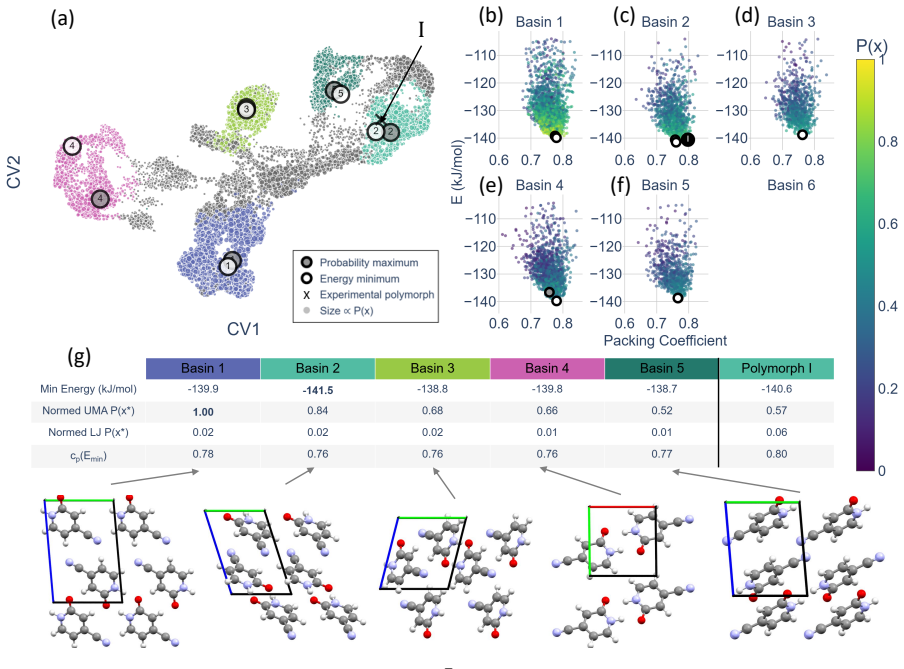
By training a diffusion-sampler GFlowNet on a canonical crystal parameterization with Boltzmann rewards, the authors produce a sampled distribution over molecular crystal structures where known polymorphs are recovered as basin maxima and previously unreported packing modes are identified with basin probabilities competitive with or exceeding the experimental structures, as observed for both MIPCAS (P-1) and NEHZOR (P21/c) under the UMA potential. The distributional view reveals that basins with higher minimum energies can still carry higher thermodynamic probability than lower-energy basins due to a larger configurational density of states, a distinction invisible to standard ranked-list晶体C
What carries the argument
The framework rests on three components: (1) a canonical 12-parameter crystal representation (box vectors, centroid position, rotation vector) reduced to the asymmetric unit and mapped to a bounded latent space with Jacobian corrections for volume and orientation; (2) a diffusion-sampler GFlowNet trained via a three-stage protocol (MLE support expansion, backward TB thermalization on a noised prior, forward-backward TB global equilibration) using a Huber-type trajectory balance loss; (3) a distributional analysis pipeline using radial distribution function earth mover's distance (RDF EMD) to define a kernel density estimate P(x), hill-climbing to find probability maxima, and Gaussian basin-7
If this is right
- The distributional framework could replace ranked-list CSP outputs with thermodynamic probability maps, enabling direct comparison of basin weights under different energy functions and identification of packing modes that are thermodynamically competitive but not energy-minimal.
- Swapping energy functions (LJ vs UMA vs future machine-learned potentials) becomes a tool for understanding how specific physical interactions (hydrogen bonding, dispersion, sterics) reshape the crystal landscape, rather than merely re-ranking structures.
- The three-stage training protocol (support expansion, prior thermalization, global equilibration) may transfer to other rugged, high-dimensional Boltzmann sampling problems beyond molecular crystals.
- Conditional generalization to multiple molecules and space groups in a single model, combined with flexible intramolecular degrees of freedom, could yield an efficient lead generator and probability density estimator across broad chemical spaces.
- The separation of mode discovery (classical optimization) from distributional equilibration (GFlowNet) acknowledges the complementary strengths of each approach and suggests hybrid pipelines as a practical path forward.
Where Pith is reading between the lines
- The claim that basin 1 of MIPCAS is thermodynamically preferred over the experimental structure in basin 2 depends critically on the GFlowNet having converged sufficiently to approximate Boltzmann weights; the paper itself acknowledges systematic over-weighting of high-energy states and reports Pearson correlations only on the top 99% of samples, suggesting the quantitative basin rankings should b
- The kernel density bandwidth (sigma = d_cut/3, d_cut at 15% quantile) and basin assignment threshold (normalized weight > 0.8) are heuristic choices that could affect which packing modes are identified and how probability mass is partitioned; sensitivity analysis on these parameters would strengthen the robustness of the basin rankings.
- If the framework is extended to flexible molecules (Z' > 1 or multiple conformers), the dimensionality increase may substantially worsen GFlowNet convergence, and the separation of mode discovery from equilibration may need to be revisited.
- The comparison between LJ and UMA distributions being nearly disjoint for MIPCAS raises the question of whether the framework could be used to benchmark energy functions themselves: if an experimental polymorph falls in a low-probability region under a given potential, that potential may be missing key physics for that system.
Load-bearing premise
The quantitative basin probability rankings that predict new thermodynamically preferred packing modes depend on the GFlowNet having converged closely enough to the true Boltzmann distribution, but the paper acknowledges systematic over-weighting of high-energy states and reports convergence metrics only on the top 99% of samples, without error bars or sensitivity analysis on the basin probability comparisons.
What would settle it
Train the GFlowNet to convergence on a system where the free energy ranking of polymorphs is known from independent methods (e.g., quasi-harmonic vibrational free energy calculations). If the basin probabilities from MXtalGFlow disagree with the known thermodynamic ranking, or if the predicted new preferred packing modes are destabilized upon DFT-level refinement, the distributional claims about thermodynamic preference are not reliable.
Figures




read the original abstract
Molecular crystals are a highly polymorphic class of materials, with a single molecule commonly crystallizing via multiple packing patterns, making structure and property prediction very challenging. Crystal structure prediction typically comprises the production of sets of promising candidate structures, each considered in isolation rather than as samples in a thermodynamic distribution. Likewise, modern generative approaches to this problem, despite naturally sampling distributions of crystals, lack a concrete formulation of the distributions being sampled. Two components are required to impart meaning to the distributions of crystals generated under such models: a canonical parameterization, and a loss function which equilibrates the generated samples to some target distribution. We develop such a parameterization, and train energy-based generative flow networks (GFlowNets) to approximate the Boltzmann distribution over crystal structures for target molecules and space groups. Combined, these components comprise our MXtalGFlow framework for molecular crystal modeling. Going beyond sampling disconnected sets of low-energy structures, MXtalGFlow yields a thermodynamic distribution over crystal structures. We sample and analyze distributions of crystals for two molecules, each under two energy functions, a Lennard-Jones potential and the Universal Model for Atoms. We characterize the local structural basins about the known polymorphs, and identify additional as-yet un-reported packing modes with competitive probabilities to the known experimental structures. With MXtalGFlow, we illustrate how to define and train a model to sample a thermodynamically meaningful distribution of molecular crystals, and analyze such a distribution to glean useful information.
Editorial analysis
A structured set of objections, weighed in public.
Referee Report
Summary. The manuscript presents MXtalGFlow, a framework for generative modeling of molecular crystal structures that combines a canonical crystal parameterization with energy-based GFlowNet training. The central claim is that the sampled distribution approximates the Boltzmann distribution over crystal structures, enabling thermodynamically meaningful comparison of structural basins. The authors demonstrate the approach on two molecular systems (MIPCAS and NEHZOR) under two energy functions (Lennard-Jones and UMA), recovering known experimental polymorphs and identifying new competitive packing modes. The framework rests on three pillars: a physically grounded parameterization, a three-phase GFlowNet training protocol, and distributional analysis via RDF-EMD-based probability density estimation.
Significance. The conceptual contribution is timely and well-motivated: framing molecular crystal structure prediction as distributional sampling rather than enumeration of disconnected candidates is a meaningful shift. The canonical parameterization (Section 4.1) is a solid building block, and the three-phase training protocol (Section 4.5) addresses real practical difficulties in GFlowNet convergence on rugged landscapes. The comparison of crystal distributions under different energy functions (Section 2.5) is illustrative. However, the quantitative basin thermodynamic predictions that constitute the most novel claims rest on un-reweighted sample densities from imperfectly converged models, which limits the reliability of the central results as currently presented.
major comments (4)
- Section 2.6, panel (g) discussion and Figure 6 panel (f): The claim that 'basin 1 is slightly thermodynamically preferred over the known experimental structure in basin 2' (for MIPCAS) and that 'basins 1 and 2 are thermodynamically preferred compared to the known polymorphs' (for NEHZOR) rests on comparing peak probability densities P(x*) across basins. However, P(x) as defined in Eq. (4) is a KDE over raw model samples without importance reweighting, and the paper explicitly acknowledges that 'GFN models of this type tend to over-weight higher energy states systematically' (Section 2.5). The paper states: 'We omit manual sample reweighting and, instead, present the learned distributions as they are.' This means the basin probability comparisons directly inherit the model's convergence errors. Since the differences are described as 'slightly' preferred, even modest systematic bias could翻
- Section 2.3, Eq. (4): P(x*) is the peak density, not the integrated basin probability. Basins with different shapes or widths could have high peak density but low total thermodynamic weight. The paper does not report integrated basin probabilities, which would be the more appropriate thermodynamic quantity. This is a load-bearing distinction for the claim that certain basins are 'thermodynamically preferred.'
- Section 2.3, Eq. (4) and surrounding text: The KDE parameters (sigma = d_cut/3, d_cut at 15% quantile) and the basin assignment threshold (0.8) are heuristic choices. No sensitivity analysis is provided to show that the basin probability rankings are robust to these choices. Given that the thermodynamic preference claims are described as marginal ('slightly preferred'), the absence of error bars or sensitivity analysis on these parameters undermines the reliability of the quantitative predictions.
- Figure S7 and Section S7: The TB parity plots show visible deviation from the diagonal, and Pearson correlations are reported only on the top 99% of samples by reward. The paper should more transparently report the full convergence metrics (including the full-sample correlations) and discuss quantitatively how the residual convergence error propagates into the basin probability estimates.
minor comments (5)
- Section 2.1: The phrase 'specifically specifically' appears to be a typo in the first paragraph of Section 2.2.
- Section 2.3: The definition of d_step and the scanning procedure over increasing d_step could be described more precisely — it is unclear what 'stable plateau' means quantitatively.
- Figure 5, panel (g): The table would benefit from explicit numerical values for the integrated basin probabilities (or at least basin sample counts) in addition to peak densities.
- Section 4.4: The LJ stiffness factor k=2.5 is stated without justification; a brief comment on sensitivity to this choice would help.
- The paper would benefit from a clearer statement upfront (e.g., in the abstract or introduction) that the thermodynamic preference claims are conditional on the GFlowNet having converged, and that this convergence is imperfect.
Simulated Author's Rebuttal
We thank the referee for a careful and constructive reading of our manuscript. The referee correctly identifies that the most novel quantitative claims—basin thermodynamic preferences—rest on analysis choices and convergence levels that warrant greater scrutiny than we provided. We address each comment below and outline concrete revisions.
read point-by-point responses
-
Referee: Basin probability comparisons use un-reweighted sample densities from imperfectly converged models; marginal differences ('slightly preferred') could be flipped by systematic bias.
Authors: The referee is correct that our basin probability comparisons inherit the model's convergence errors, and that the differences we report for MIPCAS are described as marginal. We acknowledge that presenting these as thermodynamic predictions without error quantification or reweighting overstates the reliability of the result. We will revise the manuscript in two ways. First, we will implement importance reweighting of samples using the trajectory balance residual as an importance weight estimator (following the approach in the Boltzmann Generator literature, Ref. [9]), and re-evaluate the basin probability rankings under reweighting. If the marginal preference for basin 1 over basin 2 in MIPCAS does not survive reweighting, we will report that explicitly and soften the claim accordingly. Second, we will reframe the language throughout: rather than stating that basins are 'thermodynamically preferred,' we will state that the sampled distribution suggests competitive probability density, subject to the convergence limitations we document. The NEHZOR case, where basins 1 and 2 have substantially higher probability densities than the polymorph basins, is more robust to modest bias, but we will still apply reweighting and report both raw and reweighted results. revision: yes
-
Referee: P(x*) is peak density, not integrated basin probability; basins with different shapes could have high peak but low total thermodynamic weight.
Authors: This is a valid and important distinction. We used peak density P(x*) as a computationally convenient proxy, but the referee is right that integrated basin probability is the more appropriate thermodynamic quantity. We will add integrated basin probabilities to the summary tables in Figures 5(g) and 6(f), computed by summing the normalized P(x) over all samples assigned to each basin (using the Gaussian basin membership weights already defined in Section 2.3). We will report both peak density and integrated probability, and we will base our thermodynamic preference claims on the integrated quantities. If the rankings change when using integrated probabilities rather than peak densities, we will report that transparently. revision: yes
-
Referee: KDE parameters (sigma, d_cut) and basin assignment threshold (0.8) are heuristic; no sensitivity analysis provided.
Authors: We agree that a sensitivity analysis is needed, particularly given that the MIPCAS preference is described as marginal. We will add a sensitivity analysis varying d_cut (at the 10%, 15%, and 20% quantiles), sigma (at d_cut/2, d_cut/3, and d_cut/4), and the basin assignment threshold (at 0.7, 0.8, and 0.9). We will report how the basin probability rankings and integrated basin probabilities change across these parameter choices. This will be included as a new supplementary figure and discussed in the main text. If the marginal MIPCAS result is not robust to these variations, we will state so explicitly. revision: yes
-
Referee: TB parity plots show deviation from diagonal; correlations reported only on top 99% of samples; should report full-sample metrics and discuss error propagation.
Authors: The referee is right that reporting convergence metrics only on the top 99% of samples by reward gives an incomplete picture. We will add the full-sample Pearson correlations to Figure S7 and the accompanying text, alongside the top-99% values, so that readers can assess the degree of residual convergence error. We will also add a quantitative discussion of how the TB residual (the deviation from the diagonal) propagates into basin probability estimates. Specifically, we will estimate the effective error on basin probability ratios by propagating the per-sample TB residuals through the KDE-based probability density, giving approximate error bars on the integrated basin probabilities. These error bars will be included in the revised summary tables. revision: yes
Circularity Check
No significant circularity; one minor self-citation for parameterization tooling that is not load-bearing for the central thermodynamic claims.
full rationale
The paper's derivation chain is largely non-circular. The GFlowNet is trained on an external energy function (UMA from [15,16] or a standard Lennard-Jones potential), and the prior distribution is constructed from classical local optimization on that same external energy — neither is defined in terms of the paper's outputs. The parameterization scheme is adopted from the authors' own prior work [17, 18], but these are tooling/parameterization papers providing a coordinate mapping, not theoretical results that determine the basin rankings. The central quantitative claim — that certain basins are 'thermodynamically preferred' (Section 2.6, panel g) — is an output of the trained model's sampled distribution (Eq. 4 KDE over GFlowNet samples), not a quantity that is defined in terms of itself. The acknowledged imperfect convergence ('GFN models of this type tend to over-weight higher energy states systematically,' Section 2.5) and the absence of error bars or sensitivity analysis on the KDE parameters are correctness and robustness concerns, not circularity: the model's output is not equivalent to its input by construction. No step in the chain exhibits self-definitional equivalence, fitted-input-renamed-as-prediction, or a self-citation chain that forces the conclusion. The self-citation to [17, 18] for parameterization is minor and does not bear on the thermodynamic basin comparison claims.
Axiom & Free-Parameter Ledger
free parameters (10)
- kBT =
2.5 kJ/mol
- dcut =
15% quantile of all-to-all RDF EMD
- sigma (bandwidth) =
dcut/3
- dstep =
scanned until plateau
- energy filter threshold =
15 kBT above minimum
- LJ stiffness k =
2.5
- reward clip Rrange =
100
- Huber loss beta =
10
- packing coefficient bounds =
0.55-0.95
- basin assignment threshold =
0.8
axioms (5)
- standard math GFlowNet trajectory balance loss converges to the Boltzmann distribution when the model has full support and TB loss reaches zero (Eqs. 2-3).
- domain assumption Rigid molecule approximation: intramolecular degrees of freedom are frozen and Z'=1.
- domain assumption Fixed space group: the model generates crystals within a single pre-specified space group.
- ad hoc to paper The prior dataset (constructed from classical local optimization) covers all low-energy packing modes.
- ad hoc to paper P(x) as defined in Eq. 4 is a meaningful proxy for relative basin thermodynamic probability.
invented entities (3)
-
MXtalGFlow framework
no independent evidence
-
Three-phase training protocol (expand support, thermalize on prior, global equilibration)
no independent evidence
-
RDF EMD-based probability density P(x) and hill-climbing basin identification
no independent evidence
Reference graph
Works this paper leans on
-
[1]
Oxtal: An all-atom diffusion model for organic crystal structure prediction,
E. Jin, A. C. Nica, M. Galkin, J. Rector-Brooks, K. L. K. Lee, S. Miret, F. H. Arnold, M. Bronstein, A. J. Bose, A. Tong, and C.-H. Liu, “Oxtal: An all-atom diffusion model for organic crystal structure prediction,” 12 2025
work page 2025
-
[2]
PackFlow: Generative Molecular Crystal Structure Prediction via Reinforcement Learning Alignment,
A. Subramanian, E. Pan, J. Nam, M. Weiler, S. Qu, C. W. Park, T. S. Jaakkola, E. Olivetti, and R. Gomez-Bombarelli, “PackFlow: Generative Molecular Crystal Structure Prediction via Reinforcement Learning Alignment,”arXiv, 2026
work page 2026
-
[3]
MolCrystalFlow: Molecular Crystal Structure Prediction via Flow Matching,
C. Zeng, H. W. Sullivan, T. Egg, M. M. Martirossyan, P. Höllmer, J. Jin, R. G. Hennig, A. Roitberg, S. Martiniani, E. B. Tadmor, and M. Liu, “MolCrystalFlow: Molecular Crystal Structure Prediction via Flow Matching,”Open MIND, pp. 1–20, 2 2026
work page 2026
-
[4]
Orgflow: Generative modeling of organic crystal structures from molecular graphs,
M. Vahediahmar, M. A. McDonald, and F. Liu, “Orgflow: Generative modeling of organic crystal structures from molecular graphs,”arXiv preprint arXiv:2602.20195, 2 2026
-
[5]
Fast Organic Crystal Structure Prediction with Unit Cell Flow Matching
A. Lo, L. Mucko, A. H. Cheng, A. Cai, A. J. Price, W. Matusik, and A. Aspuru-Guzik, “Fast organic crystal structure prediction with unit cell flow matching,”arXiv preprint arXiv:2606.03199, 6 2026
work page internal anchor Pith review Pith/arXiv arXiv 2026
-
[6]
Bernstein,Polymorphism in molecular crystals, vol
J. Bernstein,Polymorphism in molecular crystals, vol. 30. Oxford University Press, 5 2020
work page 2020
-
[7]
Generative models for crystalline materials,
H. Metni, L. Ruple, L. N. Walters, L. Torresi, J. Teufel, H. Schopmans, J. Östreicher, Y. Zhang, M. Neubert, Y. Koide,et al., “Generative models for crystalline materials,”Advanced Materials, vol. 38, p. e23620, 2 2026
work page 2026
-
[8]
Vector field oriented diffusion model for crystal material generation,
A. Klipfel, Y. Fregier, A. Sayede, and Z. Bouraoui, “Vector field oriented diffusion model for crystal material generation,” inProceedings of the Thirty-Eighth AAAI Conference on Artificial Intelligence and Thirty-Sixth Conference on Innovative Applications of Artificial Intelligence and Fourteenth Symposium on Educational Advances in Artificial Intellige...
work page 2024
-
[9]
Boltzmann generators: Sampling equilibrium states of many-body systems with deep learning,
F. Noé, S. Olsson, J. Köhler, and H. Wu, “Boltzmann generators: Sampling equilibrium states of many-body systems with deep learning,”Science, vol. 365, p. eaaw1147, 9 2019
work page 2019
-
[10]
Y. Bengio, S. Lahlou, T. Deleu, E. J. Hu, M. Tiwari, and E. Bengio, “Gflownet foundations,”Journal of Machine Learning Research, vol. 24, no. 210, pp. 1–55, 2023
work page 2023
-
[11]
Flow network based generative models for non-iterative diverse candidate generation,
E. Bengio, M. Jain, M. Korablyov, D. Precup, and Y. Bengio, “Flow network based generative models for non-iterative diverse candidate generation,”Advances in neural information processing systems, vol. 34, pp. 27381–27394, 6 2021
work page 2021
-
[12]
A theory of continuous generative flow networks
S. Lahlou, T. Deleu, P. Lemos, D. Zhang, A. Volokhova, A. Hernandez-Garcia, L. N. Ezzine, Y. Bengio, and N. Malkin, “A theory of continuous generative flow networks,” inInternational Conference on Machine Learning(A. Krause, E. Brunskill, K. Cho, B. Engelhardt, S. Sabato, and J. Scarlett, eds.), vol. abs/2301.12594, pp. 18269–18300, PMLR, Cornell Universi...
work page internal anchor Pith review Pith/arXiv arXiv 2023
-
[13]
Biological sequence design with gflownets,
M. Jain, E. Bengio, A. Hernandez-Garcia, J. Rector-Brooks, B. F. Dossou, C. A. Ekbote, J. Fu, T. Zhang, M. Kilgour, D. Zhang,et al., “Biological sequence design with gflownets,” inInternational Conference on Machine Learning(K. Chaudhuri, S. Jegelka, L. Song, C. Szepesvári, G. Niu, and S. Sabato, eds.), vol. 162, pp. 9786–9801, PMLR, Cornell University, 3...
work page 2022
-
[14]
Unifying Generative Models with GFlowNets and Beyond
D. Zhang, R. T. Chen, N. Malkin, and Y. Bengio, “Unifying generative models with gflownets and beyond,”arXiv preprint arXiv:2209.02606, 9 2022
work page internal anchor Pith review Pith/arXiv arXiv 2022
-
[15]
Uma: A family of universal models for atoms,
B. M. Wood, M. Dzamba, X. Fu, M. Gao, M. Shuaibi, L. Barroso-Luque, K. Abdelmaqsoud, V. Gharakhanyan, J. R. Kitchin, D. S. Levine,et al., “Uma: A family of universal models for atoms,” arXiv preprint arXiv:2506.23971, vol. abs/2506.23971, 6 2025
-
[16]
Open Molecular Crystals 2025 (OMC25) Dataset and Models
V. Gharakhanyan, L. Barroso-Luque, Y. Yang, M. Shuaibi, K. Michel, D. S. Levine, M. Dzamba, X. Fu, M. Gao, X. Liu,et al., “Open molecular crystals 2025 (omc25) dataset and models,”arXiv preprint arXiv:2508.02651, 8 2025
work page internal anchor Pith review Pith/arXiv arXiv 2025
-
[17]
M. Kilgour, M. E. Tuckerman, and J. Rogal, “Multi-type point cloud autoencoder: a complete equivariant embedding for molecule conformation and pose,”Machine Learning: Science and Technology, vol. 6, p. 035055, 8 2025
work page 2025
-
[18]
Mxtaltools: A toolkit for machine learning on molecular crystals,
M. Kilgour, M. E. Tuckerman, and J. Rogal, “Mxtaltools: A toolkit for machine learning on molecular crystals,”Journal of Chemical Information and Modeling, vol. 66, no. 7, pp. 3402–3408, 2026. PMID: 41875147
work page 2026
-
[19]
Spglib: a software library for crystal symmetry search,
A. Togo, K. Shinohara, and I. Tanaka, “Spglib: a software library for crystal symmetry search,” Science and Technology of Advanced Materials: Methods, vol. 4, p. 2384822, 8 2024
work page 2024
-
[20]
Improved off-policy training of diffusion samplers,
M. Sendera, M. Kim, S. Mittal, P. Lemos, L. Scimeca, J. Rector-Brooks, A. Adam, Y. Bengio, and N. Malkin, “Improved off-policy training of diffusion samplers,”Advances in Neural Information Processing Systems, vol. 37, pp. 81016–81045, 2 2024
work page 2024
-
[21]
Stable-GFlowNet: Toward Diverse and Robust LLM Red-Teaming via Contrastive Trajectory Balance,
M. Kwon, S. Baek, M. Kim, J. Yu, D. Han, and J. Kim, “Stable-GFlowNet: Toward Diverse and Robust LLM Red-Teaming via Contrastive Trajectory Balance,”arXiv, 5 2026
work page 2026
-
[22]
Learning Shortest Paths with Generative Flow Networks,
N. Morozov, I. Maksimov, D. Tiapkin, and S. Samsonov, “Learning Shortest Paths with Generative Flow Networks,”arXiv, 3 2026
work page 2026
-
[23]
Evaluating GFlowNet from partial episodes for stable and flexible policy-based training,
P. Niu, S. Wu, and X. Qian, “Evaluating GFlowNet from partial episodes for stable and flexible policy-based training,”arXiv, vol. abs/2603.01047, 3 2026
-
[24]
Partial GFlowNet: Accelerating Convergence in Large State Spaces via Strategic Partitioning,
X. Yu, X. Wang, R. Zhu, Y. Zhang, and Y. Wang, “Partial GFlowNet: Accelerating Convergence in Large State Spaces via Strategic Partitioning,”Open MIND, 2 2026
work page 2026
-
[25]
Con- trolling Exploration-Exploitation in GFlowNets via Markov Chain Perspectives,
L. Chen, S. Drapeau, F. Shao, X. Zhu, B. Xue, Y. Song, M. Laurière, and Z. Lin, “Con- trolling Exploration-Exploitation in GFlowNets via Markov Chain Perspectives,”Open MIND, vol. abs/2602.01749, 2 2026
-
[26]
Loss-Guided Auxiliary Agents for Overcoming Mode Collapse in GFlowNets,
I. Malek, A. Sharma, and S. Lahlou, “Loss-Guided Auxiliary Agents for Overcoming Mode Collapse in GFlowNets,”arXiv, 5 2025
work page 2025
-
[27]
Thompson sampling for improved exploration in GFlowNets,
J. Rector-Brooks, K. Madan, M. Jain, M. Korablyov, C.-H. Liu, S. Chandar, N. Malkin, and Y. Bengio, “Thompson sampling for improved exploration in GFlowNets,”arXiv, 6 2023
work page 2023
-
[28]
Reducing overprediction of molecular crystal structures via threshold clustering,
P. W. Butler and G. M. Day, “Reducing overprediction of molecular crystal structures via threshold clustering,”Proceedings of the National Academy of Sciences, vol. 120, p. e2300516120, 5 2023
work page 2023
-
[29]
S. Yang and G. M. Day, “Exploration and optimization in crystal structure prediction: Combining basin hopping with quasi-random sampling,”Journal of Chemical Theory and Computation, vol. 17, pp. 1988–1999, 2 2021
work page 1988
-
[30]
S. Yang and G. M. Day, “Global analysis of the energy landscapes of molecular crystal structures by applying the threshold algorithm,”Communications Chemistry, vol. 5, p. 86, 7 2022
work page 2022
-
[31]
Compack: a program for identifying crystal structure similarity using distances,
J. A. Chisholm and S. Motherwell, “Compack: a program for identifying crystal structure similarity using distances,”Applied Crystallography, vol. 38, no. 1, pp. 228–231, 2005
work page 2005
-
[32]
J. Hoja, A. M. Reilly, and A. Tkatchenko, “First-principles modeling of molecular crystals: structures and stabilities, temperature and pressure,”Wiley Interdisciplinary Reviews: Computational Molecular Science, vol. 7, p. e1294, 1 2017. 16
work page 2017
-
[33]
UMAP: Uniform Manifold Approximation and Projection for Dimension Reduction
L. McInnes, J. Healy, and J. Melville, “Umap: Uniform manifold approximation and projection for dimension reduction,”arXiv preprint arXiv:1802.03426, 2 2018
work page internal anchor Pith review Pith/arXiv arXiv 2018
-
[34]
Space Group Conditional Flow Matching,
O. Puny, Y. Lipman, and B. K. Miller, “Space Group Conditional Flow Matching,”arXiv, 2025
work page 2025
-
[35]
Space Group Equivariant Crystal Diffusion,
R. Chang, A. Pak, A. Guerra, N. Zhan, N. Richardson, E. Ertekin, and R. P. Adams, “Space Group Equivariant Crystal Diffusion,”arXiv, 5 2025
work page 2025
-
[36]
Crystal-GFN: sampling crystals with desirable properties and constraints,
A. Hernandez-Garcia, A. Duval, A. Volokhova, Y. Bengio, D. Sharma, P. L. Carrier, Y. Benabed, M. Koziarski, and V. Schmidt, “Crystal-GFN: sampling crystals with desirable properties and constraints,”arXiv, 10 2023
work page 2023
-
[37]
Solid-solid phase transitions between crystalline polymorphs of organic materials,
I. B. Rietveld, “Solid-solid phase transitions between crystalline polymorphs of organic materials,” Current Pharmaceutical Design, vol. 29, pp. 445–461, 2 2023
work page 2023
-
[38]
Phase transformations in solids,
M. J. Buerger, “Phase transformations in solids,”John Wiley, p. 183, 1951
work page 1951
-
[39]
T. Hahn, U. Shmueli, and J. W. Arthur,International tables for crystallography, vol. 1. Reidel Dordrecht, 1983
work page 1983
-
[40]
The cambridge structural database,
C. R. Groom, I. J. Bruno, M. P. Lightfoot, and S. C. Ward, “The cambridge structural database,” Acta Crystallographica Section B: Structural Science, Crystal Engineering and Materials, vol. 72, pp. 171–179, 4 2016
work page 2016
-
[41]
A unified algorithm for determining the reduced (niggli) cell,
I. Křivy and B. Gruber, “A unified algorithm for determining the reduced (niggli) cell,”Foundations of Crystallography, vol. 32, pp. 297–298, 3 1976
work page 1976
-
[42]
Topological crystal structure prediction,
M. Tuckerman and N. Galanakis, “Topological crystal structure prediction,”Research Square, 9 2023
work page 2023
-
[43]
The classical equation of state of gaseous helium, neon and argon,
R. A. Buckingham, “The classical equation of state of gaseous helium, neon and argon,”Proceedings of the Royal Society of London. Series A. Mathematical and Physical Sciences, vol. 168, pp. 264–283, 10 1938
work page 1938
-
[44]
I. G. Kaplanet al.,Intermolecular interactions: physical picture, computational methods and model potentials, vol. 367. Wiley Online Library, 2006
work page 2006
-
[45]
What has scripting ever done for us? the csd python application programming interface (api),
R. A. Sykes, N. T. Johnson, C. J. Kingsbury, J. Harter, A. G. Maloney, I. J. Sugden, S. C. Ward, I. J. Bruno, S. A. Adcock, P. A. Wood,et al., “What has scripting ever done for us? the csd python application programming interface (api),”Applied Crystallography, vol. 57, pp. 1235–1250, 7 2024
work page 2024
-
[46]
Generating uniform incremental grids on so (3) using the hopf fibration,
A. Yershova, S. Jain, S. M. Lavalle, and J. C. Mitchell, “Generating uniform incremental grids on so (3) using the hopf fibration,”The International journal of robotics research, vol. 29, no. 7, pp. 801–812, 2010. 17 S1 Model Details Our GFlowNet model follows closely the implementation in [20]. A forward SDE step is integrated from a constant initial sta...
work page 2010
discussion (0)
Sign in with ORCID, Apple, or X to comment. Anyone can read and Pith papers without signing in.