Excitation spectra and rank tomography of linear matrix product tangent spaces
Reviewed by Pith T0 review T1 audit T2 compute T3 formal T4 kernel 2026-07-07 20:21 UTCglm-5.2pith:SZ4C25N4record.jsonopen to challenge →
The pith
Particle-resolved ranks reveal why MPS tangent spaces miss some excitations
A machine-rendered reading of the paper's core claim, the machinery that carries it, and where it could break.
Core claim
The particle-resolved Schmidt rank (PRSR) distribution — the rank of each particle-number block in every bipartition of the ground state — is the hidden variable controlling tangent-space expressivity. The coarse bond dimension, which sums PRSR values across particle sectors, is an insufficient descriptor: states with the same bond dimension but different PRSR profiles yield tangent spaces of different sector-by-sector dimension, and hence different spectral accuracy. The parametric deficiency δ_M = d_target_M − dim(T_proj_M) measures exactly how many independent directions are missing in sector M, and this quantity predicts whether excitations in that sector will be accurately captured or近似
What carries the argument
Particle-resolved Schmidt rank (PRSR) distribution: for each bipartition cut ℓ and each particle number m on the left side, r_ℓ(m) = rank(Ψ_ℓ^(m)), where Ψ_ℓ^(m) is the coefficient matrix of the ground-state block with m particles left of the cut. The ordinary bond dimension D_ℓ = Σ_m r_ℓ(m) is the sum of these particle-resolved ranks, so PRSR is a refinement of bond dimension that is invisible at the coarse level but determines tangent-space structure.
If this is right
- The PRSR distribution provides a diagnostic that can be computed from any MPS ground state to predict, before running the tangent-space spectral calculation, which excitation sectors will be accurately captured and which will suffer from parametric deficiency.
- The concept of rank tomography generalizes beyond particle-number sectors: any conserved quantum number that decomposes the Hilbert space into sectors could be used to define analogous resolved-rank profiles, extending the diagnostic to systems with other symmetries.
- The authors identify rank frustration — combinatorial constraints on maximal bond dimensions in fixed-particle-number sectors — as a structural limitation of the linear tangent-space ansatz, and suggest that a second-order (double tangent) extension could overcome it.
- The method applies to any Hamiltonian with an efficient matrix product operator representation, not just the Bose–Hubbard model, making it a general tool for finite-system spectroscopy.
Where Pith is reading between the lines
- If the PRSR distribution is the true determinant of tangent-space expressivity, then optimizing ground-state MPS variational calculations to maximize PRSR in target excitation sectors — rather than merely maximizing bond dimension — could improve spectral accuracy at lower computational cost.
- The sector-dependent accuracy jumps observed at ground-state particle-number crossings suggest that the PRSR profile could serve as an order parameter or diagnostic for phase transitions in finite systems, since it changes discontinuously even when the coarse bond dimension does not.
- The parametric deficiency framework could be extended to mixed states or finite-temperature calculations, where the relevant decomposition might be by energy or symmetry sectors rather than particle number, potentially yielding analogous resolved-rank diagnostics for density-matrix renormalization group methods.
Load-bearing premise
The method assumes that the tangent space is adapted to the particle-number decomposition, meaning each particle-number component of a tangent vector is itself a valid tangent vector. This can fail if the ground state is computed with a symmetry-breaking term that the tangent-space calculation does not include, and the paper does not rigorously justify that this adaptation holds in the U(1)-broken examples it presents.
What would settle it
Compute the PRSR distribution and parametric deficiency for a system where the tangent-space method is known to fail spectrally; if the deficiency does not correlate with the sectors where errors are largest, the explanatory claim of PRSR is undermined.
Figures



read the original abstract
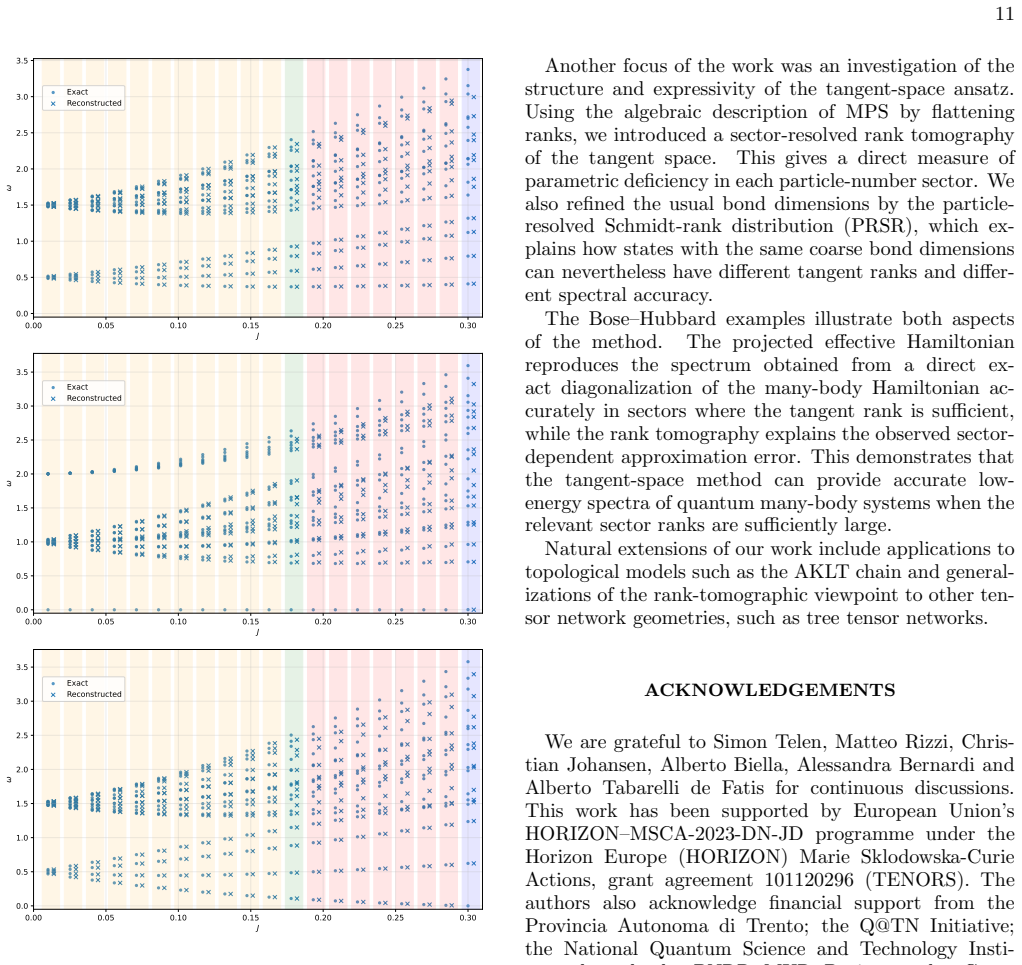
We formulate a tangent-space method for algebraic varieties of matrix product states (MPS) to study excitation spectra of non-uniform quantum many-body systems with open boundary conditions. We further introduce a rank tomography of the MPS tangent space, which characterizes its expressivity in terms of particle-sector rank profiles of the underlying MPS variety. Using the Bose--Hubbard model as a benchmark, we illustrate that the method reproduces low-lying excitations and captures finite-size precursors of the Mott-insulator to superfluid transition.
Editorial analysis
A structured set of objections, weighed in public.
Referee Report
Summary. The manuscript formulates a linear MPS tangent-space method for computing excitation spectra of finite, non-uniform quantum many-body systems with open boundary conditions, using the algebraic-geometric framework of MPS varieties. The tangent space is defined on the smooth full-rank stratum, gauge redundancy is removed via Hermiticity conditions (Proposition 7), and the resulting generalized eigenvalue problem yields excitation energies. The paper further introduces a 'rank tomography' framework: the particle-resolved Schmidt rank (PRSR) distribution refines the coarse bond dimension into particle-sector-resolved ranks, and the parametric deficiency quantifies missing tangent-space directions per particle sector. The Bose-Hubbard model on N=10 sites serves as the benchmark, with exact diagonalization comparison showing ~1e-5 accuracy at D=8 for low-lying modes. The framework is mathematically self-contained, with proofs of Propositions 5-7 provided in the Appendix.
Significance. The paper makes two distinct contributions. First, it provides a clean algebraic-geometric formulation of the MPS tangent-space excitation method for OBC systems, with rigorous definitions of the MPS variety, tangent space, and gauge removal (Propositions 5-7, with proofs). Second, the rank tomography framework — PRSR distribution and parametric deficiency — offers a novel diagnostic tool that explains sector-dependent approximation errors in terms of the internal particle-resolved structure of the ground state. The observation that two states with identical bond dimensions can have different PRSR profiles and hence different tangent ranks is a concrete, falsifiable insight. The Bose-Hubbard benchmarks, including the N=3 exact-recovery consistency check (Appendix VII.E, machine precision), support the framework's validity. The computational cost analysis (Appendix VII.D) is a useful addition for practitioners. The work is primarily conceptual/methodological; the system sizes tested (N=10, D<=9) are small, and the method's competitiveness against established approaches (e.g., correlation matrix or post-MPS methods) for larger systems is not demonstrated.
major comments (1)
- [Section V.A, paragraph containing 'From now, we only consider tangent spaces that are adapted'] The adapted tangent-space assumption (P_M T ⊆ T for all M) is stated without formal proof. The block-structure analysis in Section V.B and Appendix VII.B provides strong evidence that this holds for U(1)-symmetric MPS ground states, since the selection rule m'=m+n on ground-state tensors propagates to tangent variations in the same sector. However, the paper does not explicitly state that this block structure constitutes a proof of adaptation, nor does it clarify whether adaptation is guaranteed for all U(1)-symmetric MPS or only generically. A brief remark connecting the block decomposition of Section V.B to the adaptation condition would close this gap. This is load-bearing because the entire parametric deficiency framework (Section V.A) and the PRSR-to-tangent-rank mapping (Section V.B) presuppose adaptation.
minor comments (7)
- [Figure 3 (top)] The panel showing ground-state energies and off-diagonal coherence (middle) uses a dual y-axis that is somewhat hard to parse. Clarifying which axis corresponds to which quantity, or splitting into separate panels, would improve readability.
- [Figure 4] The y-axis label appears truncated as '| exact|' in the rendered figure. It should read '|ω - ω_exact|' or similar.
- [Reference [11]] Listed as 'unpublished manuscript.' If this reference is essential to the claims (e.g., the ideal-theoretic equations for the MPS variety cited in Section II.B), the authors should note its status more explicitly or remove it if non-essential.
- [Section V.B, Eqs. (10)-(11)] The notation M_j^n(m,m') and its relation to M_j^n(m) in the subsequent display could be unified. Currently the reader must infer that M_j^n(m) is the restriction of M_j^n(m,m') to the block with m'=m+n. Stating this explicitly would help.
- [Appendix VII.D] The scaling O(N^3 w d^4 D^8) is stated for uniform d and D, but the benchmarks use a bond pattern D=[3,8,...,8,3]. A brief remark on how the non-uniform pattern affects the practical scaling would help readers assess applicability to larger systems.
- [Section IV] The statement that the method 'accurately reproduces the low-lying excitation energies across the ground-state particle-number sector crossing' could note that the accuracy degrades significantly for D<=5 near J~0.18 (visible in Figure 4), to set appropriate expectations.
- [Title] The title uses 'rank tomography of linear matrix product tangent spaces.' The word 'tomography' may suggest a measurement protocol to some readers; 'rank analysis' or 'rank characterization' might be more precise, though this is a matter of preference.
Simulated Author's Rebuttal
We thank the referee for the careful reading and the constructive recommendation. The referee raises one major comment concerning the adapted tangent-space assumption in Section V.A. We address it below.
read point-by-point responses
-
Referee: The adapted tangent-space assumption (P_M T ⊆ T for all M) is stated without formal proof. The block-structure analysis in Section V.B and Appendix VII.B provides strong evidence that this holds for U(1)-symmetric MPS ground states, since the selection rule m'=m+n on ground-state tensors propagates to tangent variations in the same sector. However, the paper does not explicitly state that this block structure constitutes a proof of adaptation, nor does it clarify whether adaptation is guaranteed for all U(1)-symmetric MPS or only generically. A brief remark connecting the block decomposition of Section V.B to the adaptation condition would close this gap.
Authors: We agree with the referee that the connection between the block decomposition and the adaptation condition should be made explicit. In the revised manuscript, we will add a remark (or a short proposition with proof sketch) in Section V.A that closes this gap. The argument is as follows. For a U(1)-symmetric MPS ground state, the local tensors satisfy the selection rule m' = m + n, which means each ground-state tensor M_j^n maps virtual sector m+n to virtual sector m. A general tangent variation δM_j^n decomposes into blocks δM_j^n(m, m') characterized by the excess particle number ΔM := m' - m - n. The key observation is that the Hermiticity conditions of Proposition 7, which define the horizontal tangent space, couple only blocks sharing the same ΔM. This is because the products (δM_i^{j_i})* M_i^{j_i} and M_{i+1}^{j_{i+1}} (δM_{i+1}^{j_{i+1}})* appearing in Y_i involve the ground-state tensors (which have ΔM = 0), so the resulting matrices on each virtual bond are block-diagonal in ΔM. Consequently, the Hermiticity conditions decouple across ΔM sectors, and the horizontal parameter tangent space decomposes as a direct sum over ΔM. Since the differential map DΦ is built from ground-state tensors obeying the selection rule, it preserves this decomposition, and the SVD compression step also respects it (tangent vectors in different particle-number sectors of the Hilbert space are linearly independent). Therefore P_M T ⊆ T for all M, i.e., the tangent space is adapted. This argument does not require any genericity assumption: it holds for all U(1)-symmetric MPS ground states, as it follows directly from the symmetry-imposed selection rule. We note that the adaptation condition can fail if the ground state is computed with a U(1)-broken Hamiltonian (e.g., η ≠ 0) while the谱 revision: yes
Circularity Check
No significant circularity found; the derivation is self-contained with one minor self-citation used as background rather than load-bearing support.
full rationale
The paper's central derivation chain is self-contained. The tangent-space method (Section III) follows from the TDVP Lagrangian (Eq. 3) and the MPS variety structure (Section II) without circular assumptions. The generalized eigenvalue problem (Eq. 5) is derived by projecting H' onto the horizontal tangent space, which is constructed from the ground-state MPS tensors via the differential DpΦD,d. No step reduces to its own inputs by construction. The PRSR distribution (Section V.B) is a decomposition of known bond dimensions into particle-number blocks (Eq. 9), not a fitted parameter renamed as a prediction. The parametric deficiency δ_M^par is defined as d_M^target - dim(T_M^proj), where dim(T_M^proj) = rank(P_M U) is computed from the tangent basis, not fitted to spectral errors. The spectral benchmarks (Figures 3-5) are validated against exact diagonalization, an independent external benchmark. The self-citation [10] (Rosana and Schmidt, on degree of tensor train varieties) is used only as background on MPS variety properties and does not load-bear any central claim. The adapted tangent-space assumption (Section V.A) is a stated hypothesis with explicit acknowledgment of when it fails, not a circular definition. The block structure analysis (Section V.B, Appendix VII.B) provides independent algebraic evidence for adaptation via the selection rule m'=m+n. No fitted-input-as-prediction, no self-definitional reduction, and no uniqueness theorem invoked to force conclusions were found. Score 1 reflects the minor self-citation that is not load-bearing but present in the background literature review.
Axiom & Free-Parameter Ledger
free parameters (2)
- Bond dimension D =
8 (for N=10 benchmark)
- SVD truncation threshold =
1e-10
axioms (3)
- domain assumption The MPS tangent space is adapted to the particle-number decomposition.
- standard math The ground state is a stationary point of the Rayleigh-Ritz quotient on the MPS manifold.
- standard math The full-rank MPS stratum is a smooth manifold.
Reference graph
Works this paper leans on
-
[1]
Proof Prop. 6 Proof.By Proposition 5,V D,d is cut out by homoge- neous minors of the flattenings and is a projective al- gebraic variety. For fixedk, insideV D,d the condition rank(T (k)) =D k is equivalent to saying that at least one Dk ×D k minor ofT (k) is non-zero. Equivalently, it is the complement of the closed condition rank(T (k))≤D k −1. Hence, {...
-
[2]
7 Proof.Let ( ˙M , ˙C)∈ker(D pΦD,d) be a vertical tangent vector inT pPD,d
Proof Prop. 7 Proof.Let ( ˙M , ˙C)∈ker(D pΦD,d) be a vertical tangent vector inT pPD,d. Since we work with the Frobenius metric on the Stiefel factors and the Fubini–Study metric on the normalized horizontal slice of the projective factor, the orthogonality condition splits as N−1X i=1 diX ji=1 Re tr (δM i ji)∗ ˙M i ji + dNX jN=1 Re tr (δCjN )∗ ˙CjN = 0. ...
-
[3]
The density-matrix renormalization group in the age of matrix product states
U. Schollw¨ ock, The density-matrix renormalization group in the age of matrix product states, Ann. Phys.326, 96 (2011), arXiv:1008.3477 [cond-mat.str-el]
work page internal anchor Pith review Pith/arXiv arXiv 2011
-
[4]
J. M. Landsberg,Tensors: Geometry and Applications, Graduate Studies in Mathematics, Vol. 128 (American Mathematical Society, Providence, RI, 2012) pp. xx+439
work page 2012
-
[5]
I. V. Oseledets, Tensor-train decomposition, SIAM J. Sci. Comput.33, 2295 (2011)
work page 2011
-
[6]
J. Haegeman, J. I. Cirac, T. J. Osborne, I. Pizorn, H. Ver- schelde, and F. Verstraete, Time-dependent variational principle for quantum lattices, Phys. Rev. Lett.107, 070601 (2011)
work page 2011
-
[7]
J. Haegeman, M. Mari¨ en, T. J. Osborne, and F. Ver- straete, Geometry of matrix product states: Metric, par- allel transport, and curvature, J. Math. Phys.55, 021902 (2014)
work page 2014
-
[8]
M. Van Damme, R. Vanhove, J. Haegeman, F. Ver- straete, and L. Vanderstraeten, Efficient matrix prod- uct state methods for extracting spectral information on rings and cylinders, Phys. Rev. B104, 115142 (2021)
work page 2021
-
[9]
M. P. A. Fisher, P. B. Weichman, G. Grinstein, and D. S. Fisher, Boson localization and the superfluid-insulator transition, Phys. Rev. B40, 546 (1989)
work page 1989
-
[10]
C. J. Hillar and L.-H. Lim, Most tensor problems are NP-hard, J. ACM60, Art. 45, 39 (2013)
work page 2013
-
[11]
A. Bernardi, C. De Lazzari, and F. Gesmundo, Dimen- sion of tensor network varieties, Commun. Contemp. Math.25, Paper No. 2250059, 31 (2023)
work page 2023
-
[12]
Degree of tensor train varieties via integral geometry
A. Rosana and O. T. P. Schmidt, Degree of tensor train varieties via integral geometry (2026), arXiv:2606.11847 [math.AG]
work page internal anchor Pith review Pith/arXiv arXiv 2026
-
[13]
S. Ho¸ sten, N. C. Paul, O. T. P. Schmidt, and D. Skurt, Equations and Gr¨ obner basis of tree tensor networks (2026), unpublished manuscript
work page 2026
-
[14]
Numerical Algebraic Geometry for Energy Computations on Tensor Train Varieties
V. Borovik, H. Friedman, S. Ho¸ sten, and M. Pfef- fer, Numerical algebraic geometry for energy computa- tions on tensor train varieties (2025), arXiv:2512.06939 [math.AG]
work page internal anchor Pith review Pith/arXiv arXiv 2025
-
[15]
P. Kramer and M. Saraceno,Geometry of the Time- Dependent Variational Principle in Quantum Mechan- ics, Lecture Notes in Physics, Vol. 140 (Springer, Berlin, 1981)
work page 1981
- [16]
-
[17]
X. Yuan, S. Endo, Q. Zhao, Y. Li, and S. C. Benjamin, Theory of variational quantum simulation, Quantum3, 191 (2019)
work page 2019
-
[18]
S. R. White, Density matrix formulation for quantum renormalization groups, Phys. Rev. Lett.69, 2863 (1992)
work page 1992
discussion (0)
Sign in with ORCID, Apple, or X to comment. Anyone can read and Pith papers without signing in.