Forecasting Realized Volatility with Time Series Foundation Models: A Comparison with Econometric Benchmarks
pith:7OQHOGA6reviewed 2026-07-07 19:24 UTCmodel glm-5.2open to challenge →
The pith
Only one foundation model beats Log-HAR for volatility forecasting
A machine-rendered reading of the paper's core claim, the machinery that carries it, and where it could break.
Core claim
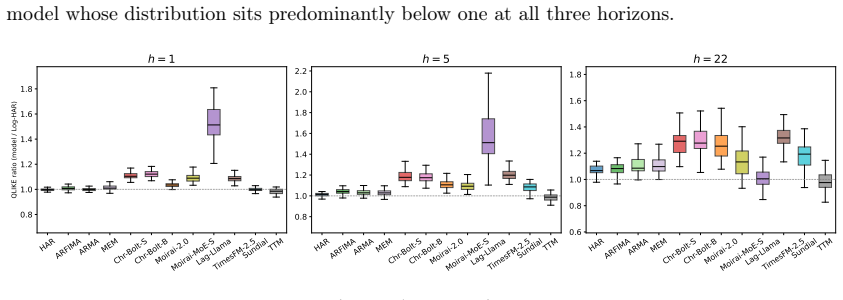
The paper's central object is the QLIKE loss ratio: each model's per-asset forecast loss divided by Log-HAR's loss on the same asset, then averaged equally across all 50 assets. This aggregation, unlike pooled-mean losses that are dominated by a few high-volatility series, reveals that only TTM consistently beats the Log-HAR benchmark, and narrowly. The Mincer-Zarnowitz recalibration then decomposes that edge into a calibration component (correct forecast level and scale, shared by several models) and an information component (genuine predictive content about volatility dynamics), with the informational advantage surviving only at the 22-day horizon. The mechanism carrying the argument is tw
What carries the argument
The paper's argument turns on three formal tools. First, per-asset QLIKE loss ratios relative to Log-HAR, averaged equally across assets, replace pooled-mean losses that are distorted by outlier series. Second, the Model Confidence Set (MCS) of Hansen et al. (2011), using a Tmax statistic with a moving-block bootstrap, identifies the subset of models that cannot be statistically distinguished from the best at each asset. Third, recursive Mincer-Zarnowitz regressions decompose forecast accuracy into calibration (level and scale alignment) and information (genuine predictive content about future volatility dynamics), applied symmetrically to all 17 models. The TSFMs themselves are evaluated in
If this is right
- Practitioners should not treat foundation models as a uniform class that automatically improves on econometric benchmarks; architecture selection within the TSFM family is the first-order decision.
- A simple equal-weight average of the best foundation model (TTM) and the best econometric benchmark (Log-HAR) provides a robust, no-tuning forecast that enters the Model Confidence Set for nearly all assets, sidestepping the model-selection problem.
- Mincer-Zarnowitz recalibration can recover predictive signal hidden by level and scale bias in underperforming foundation models, suggesting that raw zero-shot outputs from several TSFMs carry useful information that affine correction exposes.
- The finding that the smallest model (under 1M parameters) is the only consistent winner raises questions about whether pretraining scale and parameter count are the right objectives for time series foundation models, or whether architecture and training-data composition matter more.
Where Pith is reading between the lines
- If TTM's advantage at the monthly horizon reflects genuine long-memory capture rather than calibration, fine-tuning TTM specifically on realized volatility series could widen the gap with Log-HAR at all horizons, an extension the author flags but does not test.
- The wide dispersion across TSFM architectures suggests that the pretraining corpus composition (what types of time series the model has seen) may be more predictive of financial-volatility performance than model size or architectural family, which could be tested by pretraining identical architectures on different domain mixtures.
- The result that a sub-1M-parameter model outperforms models with 100-200M parameters on volatility forecasting may indicate that realized volatility's statistical properties (positive, mean-reverting, long-memory) are sufficiently close to common pretraining domains that a lightweight architecture can capture them, while larger models overfit or misallocate capacity.
- The MZ recalibration result — that several TSFMs carry hidden predictive information masked by scale bias — implies that a systematic post-hoc calibration layer applied to any zero-shot TSFM could substantially narrow the gap with tuned benchmarks, a practical pipeline improvement the paper does not explicitly propose.
Load-bearing premise
The conclusion that TTM is the sole foundation model to consistently beat Log-HAR depends on the choice of the QLIKE loss function and the equal-weighted per-asset loss-ratio aggregation. Under MSE, TTM's dominance is less pronounced, and a different loss function or aggregation scheme could reorder the rankings.
What would settle it
Re-run the full evaluation under MSE loss ratios (instead of QLIKE) with the same equal-weight per-asset aggregation. If TTM no longer beats Log-HAR at every horizon under MSE, the claim that it is the sole consistent winner is metric-specific. Alternatively, if a different aggregation scheme (e.g., weighted by liquidity or trading volume) produces a different sole winner, the ranking is an artifact of the equal-weight choice.
Figures



read the original abstract
We ask whether pretrained time series foundation models (TSFMs) improve on established econometric benchmarks for forecasting realized volatility. Using the VOLARE dataset, we conduct the first systematic comparison of nine zero-shot TSFMs against eight econometric specifications, including the Heterogeneous Autoregressive (HAR) family, across 50 assets in equities, foreign exchange, and futures, and three forecast horizons, with formal pairwise and multi-model forecast-comparison tests. Foundation models do not deliver a uniform gain. Pooled losses favor them, but the advantage is concentrated in a few outlier assets; averaging each asset's loss ratio to a well-specified Log-HAR benchmark, so that no single asset dominates, only one small model, Tiny Time Mixers (TTM), beats the benchmark at every horizon, and by a narrow margin. The other foundation models do not improve on Log-HAR, and the econometric benchmarks remain competitive throughout. A Mincer--Zarnowitz recalibration, which removes level and scale bias from every forecast, shows that much of the short-horizon advantage reflects better-scaled forecasts rather than better prediction of volatility dynamics, and only at the monthly horizon does a genuine informational gain remain. Because this edge is thin and even TTM is not best on every asset, a simple equal-weight average of TTM and Log-HAR matches the best single model and enters the Model Confidence Set for 98 to 100\% of assets, more often than either component alone, so a forecaster need not identify the best model for each asset in advance. Our most durable finding is that performance varies so much across foundation-model architectures that choosing the right architecture matters more than the broader choice between foundation and econometric models.
Editorial analysis
A structured set of objections, weighed in public.
Referee Report
Summary. This paper conducts a systematic zero-shot comparison of nine time series foundation models (TSFMs) against eight econometric benchmarks for forecasting realized volatility, using the VOLARE dataset across 50 assets (equities, FX, futures) and three horizons (h=1, 5, 22). The evaluation employs a walk-forward scheme with a 1,000-day rolling window, Diebold-Mariano (DM) tests, Model Confidence Set (MCS) analysis, Mincer-Zarnowitz (MZ) regressions, and Giacomini-Rossi (GR) fluctuation tests. The central finding is that most TSFMs do not improve on a well-specified Log-HAR benchmark under equal-weighted loss ratios. Only Tiny Time Mixers (TTM) beats Log-HAR at every horizon, by a narrow margin of 1.3-1.8% in average QLIKE loss ratios. An MZ recalibration shows that TTM's short-horizon edge is largely a calibration effect, while a genuine informational advantage remains at the monthly horizon. A simple equal-weight combination of TTM and Log-HAR enters the MCS for 98-100% of assets.
Significance. The paper addresses a timely and well-defined question: whether pretrained TSFMs can compete with established econometric models for realized volatility forecasting. The empirical design is thorough, the first multi-model, multi-asset evaluation of its kind for this target. Strengths include the use of formal forecast comparison tests (DM, MCS, GR), a symmetric MZ recalibration applied to all models, an honest assessment of contamination risk, and publicly available replication code. The finding that architecture choice matters more than the foundation-vs-econometric distinction is a durable and practically useful contribution. The MZ decomposition separating calibration from informational content is a particularly insightful analytical choice.
major comments (2)
- §5.1, Tab. 6 and §6, Tab. 8: The paper's headline claim that TTM 'beats' Log-HAR at every horizon rests on average QLIKE loss ratios of 0.982, 0.986, and 0.987. However, the paper does not report a formal panel-level (cross-sectional) significance test for whether these averages are significantly below 1.0. The MCS results in Tab. 8 show that both TTM (98% inclusion at h=1) and Log-HAR (86% inclusion at h=1) are frequently co-included, suggesting they are statistically indistinguishable on most individual assets. The DM win rates in Tab. 8 are pooled across 16 opponents (800 tests), not isolated to TTM vs. Log-HAR. Without either a cross-sectional t-test on the per-asset loss differentials or the isolated TTM-vs-Log-HAR DM win count, the language of 'beats' and 'beats at every horizon' overstates what the statistics demonstrate. The authors should either add a panel-level test or soften
- §4.4, Eq. (9) and surrounding text: The QLIKE loss is evaluated on the variance scale by squaring the volatility forecast (dRV_t = sigma_hat^2_t), while the conditional mean is extracted as the point forecast. The authors acknowledge a Jensen term (footnote 6) but state that the conditional mean 'nonetheless remains preferable to the conditional median.' This is a non-trivial approximation. Since QLIKE is the primary evaluation metric and the basis for the central claim, a brief sensitivity check or at least a more formal justification that this Jensen gap does not systematically bias the TSFM-vs-econometric comparison (e.g., do TSFMs with heavier-tailed predictive distributions suffer larger Jensen gaps?) would strengthen the analysis.
minor comments (6)
- §4.1.1, Eq. (1): The HAR model is defined on the volatility scale (sigma), while the augmented variants (HAR-J, HAR-RS, HARQ) in Eqs. (2)-(4) are defined on the variance scale (RV). The text explains this transition, but a brief clarifying note in the equation captions or at the start of §4.1.1 would improve readability.
- Tab. 1: The equity panel reports cross-sectional averages but does not specify whether the kurtosis and skewness are also averaged. Given the extreme kurtosis values in the FX and futures panels (e.g., 3,550 for Crude Oil), clarifying the aggregation method for the equity panel would be helpful.
- Fig. 3: The y-axis labels are difficult to read. The critical-value bands (±2.80) are mentioned in the caption but not clearly marked in some panels. Improving the annotation would aid interpretation.
- §7, Tab. 11: The MZ-corrected QLIKE values differ from the original values in Tab. 5 due to the 252-day warm-up window. While footnote 11 explains this, adding a column in Tab. 11 showing the number of observations used for the corrected evaluation would make the comparison more transparent.
- §4.2.2: The context window for TTM and Moirai-MoE is 512 days, while other TSFMs use 1,000 days. Tab. 14 shows TTM performs best at 512. While this is an architectural constraint, a brief discussion of whether the 512-day window could be an advantage (e.g., less overfitting to stale regimes) rather than a limitation would add nuance.
- Typo in §5.1: 'The level HAR variants HAR-RS and HARQ produce inflated QLIKE on futures' — 'level' should likely be 'level-scale' or simply 'The HAR variants'.
Simulated Author's Rebuttal
We thank the referee for a careful and constructive report. Both major comments identify genuine gaps in the statistical evidence supporting our headline claim. We address each below and indicate the revisions we will make.
read point-by-point responses
-
Referee: §5.1, Tab. 6 and §6, Tab. 8: The paper's headline claim that TTM 'beats' Log-HAR at every horizon rests on average QLIKE loss ratios of 0.982, 0.986, and 0.987. However, the paper does not report a formal panel-level (cross-sectional) significance test for whether these averages are significantly below 1.0. The MCS results show that both TTM and Log-HAR are frequently co-included, suggesting they are statistically indistinguishable on most individual assets. The DM win rates are pooled across 16 opponents, not isolated to TTM vs. Log-HAR. Without either a cross-sectional t-test on the per-asset loss differentials or the isolated TTM-vs-Log-HAR DM win count, the language of 'beats' and 'beats at every horizon' overstates what the statistics demonstrate.
Authors: The referee is correct. Our headline claim that TTM 'beats' Log-HAR at every horizon is supported by the average loss ratios in Tab. 6 and the MCS inclusion rates in Tab. 8, but we do not report a formal panel-level test for whether the per-asset loss ratios are jointly significantly below one, nor do we isolate the TTM-vs-Log-HAR pairwise DM comparison. The DM win rates in Tab. 8 are pooled across 16 opponents (800 tests per model), so they do not directly answer whether TTM significantly outperforms Log-HAR on a meaningful share of individual assets. The MCS co-inclusion rates the referee cites (TTM 98%, Log-HAR 86% at h=1) do suggest that the two models are frequently statistically indistinguishable at the asset level, which is consistent with the narrow margin (1.3–1.8%) we report. We agree that the language 'beats' and 'beats at every horizon' overstates what the existing statistics demonstrate without the isolated comparison. We will make two changes in the revision. First, we will add the isolated TTM-vs-Log-HAR pairwise DM results: for each of the 50 assets, we will report the DM test statistic and p-value for the QLIKE loss differential between TTM and Log-HAR, along with the count of assets where TTM achieves significantly lower QLIKE at the 5% level (and the reverse count). Second, we will add a cross-sectional t-test on the per-asset loss-ratio differentials (i.e., testing whether the mean of the 50 per-asset QLIKE ratios is significantly below 1.0), with a Newey–West variance to account for any cross-sectional dependence. We expect these tests to confirm that the edge is statistically detectable but narrow—consistent with the MCS co-inclusion pattern—and we will adjust the language accordingly. Specifically, we will replace 'beats Log-HAR at every horizon'' revision: no
-
Referee: §4.4, Eq. (9) and surrounding text: The QLIKE loss is evaluated on the variance scale by squaring the volatility forecast (dRV_t = sigma_hat^2_t), while the conditional mean is extracted as the point forecast. The authors acknowledge a Jensen term (footnote 6) but state that the conditional mean 'nonetheless remains preferable to the conditional median.' This is a non-trivial approximation. Since QLIKE is the primary evaluation metric and the basis for the central claim, a brief sensitivity check or at least a more formal justification that this Jensen gap does not systematically bias the TSFM-vs-econometric comparison would strengthen the analysis.
Authors: The referee raises a legitimate concern. The QLIKE-optimal forecast is E[RV_{t+h} | F_t], the conditional mean of the variance, but we construct the variance forecast by squaring the conditional mean of the volatility, sigma_hat^2, which differs from E[sigma^2] by a Jensen term equal to the conditional variance of the volatility forecast. This term is model-specific: models whose predictive distributions have higher conditional variance (heavier tails) will have larger Jensen gaps, so the approximation could in principle bias the comparison if TSFMs and econometric models differ systematically in their predictive dispersion. Our defense in the manuscript is limited to two points: (i) the conditional mean is still preferable to the conditional median, which carries an additional bias, and (ii) we apply the same point-forecast construction to all 17 models. These points show the treatment is symmetric but do not establish that the Jensen gap is negligible or uniform across models. We agree this needs to be addressed more rigorously. In the revision we will add a brief sensitivity analysis. Specifically, for the subset of TSFMs that expose full predictive distributions (Lag-Llama, Toto, Sundial, Moirai-MoE, and the quantile-output models), we will compute E[sigma^2] directly from the predictive distribution—by integrating the quantile function or computing the second moment of the sampled trajectories—and compare the resulting QLIKE against the squared-mean construction. For models that output only a point forecast (TTM) or a mean plus quantiles without a full distribution (TimesFM 2.5, Chronos-Bolt), the squared-mean construction is the only available option, so the sensitivity check will cover the models where the Jensen gap is potentially largest. We will also add a few revision: no
-
Referee: REFEREE RECOMMENDATION: minor_revision
Authors: We thank the referee for the recommendation and for the constructive tone of the report. The suggested revisions are well-targeted and will strengthen the statistical foundations of the paper without changing its central message. We will implement both sets of changes in the revised manuscript. revision: no
Circularity Check
No circularity found: empirical comparison with standard evaluation methods and no self-referential derivation chain
full rationale
This paper is a purely empirical comparison of zero-shot TSFMs against econometric benchmarks for realized volatility forecasting. There is no theoretical derivation chain, no fitted constants presented as predictions, and no self-referential argument structure. The key methodological choices are all standard and externally grounded: (1) The Log-HAR benchmark is estimated on rolling 1000-day windows and evaluated out-of-sample; TSFMs are zero-shot with no fitting to target data. (2) The average QLIKE loss ratios in Tab. 6 normalize each asset by Log-HAR's own QLIKE, which is explicitly noted as '1.000 by construction' — this is a standard normalization, not circular reasoning. (3) The MZ recalibration uses expanding windows with strictly prior data and applies the affine correction symmetrically to all 17 models, so no model is privileged. (4) The MCS, DM tests, and GR fluctuation tests use established methodologies (Hansen et al. 2011; Diebold-Mariano 1995; Giacomini-Rossi 2010) with no modification that would force the conclusion. (5) The forecast combination (equal-weight TTM + Log-HAR) is a standard Bates-Granger exercise. The only self-citation is Brini and Toscano (2025), listed among machine learning methods in the literature review; it is not load-bearing for any claim in the paper. The paper's conclusions follow from out-of-sample forecast losses computed on data the models did not see during estimation, with standard statistical tests applied uniformly.
Axiom & Free-Parameter Ledger
axioms (4)
- domain assumption The QLIKE loss function is the appropriate primary metric for evaluating volatility forecasts, justified by its proxy-robustness property (Patton, 2011).
- domain assumption The 5-minute sampling frequency for realized variance is the appropriate bias-variance compromise against microstructure noise.
- domain assumption The 1,000-day rolling estimation window is sufficiently long to limit sensitivity to individual volatility spikes and standard for HAR models.
- domain assumption No TSFM in the study was trained on realized volatility or intraday-derived statistics, so zero-shot performance reflects transfer of general temporal structure.
Reference graph
Works this paper leans on
-
[1]
Granger, C. W. J. and Joyeux, Roselyne , title =. Journal of Time Series Analysis , volume =. 1980 , doi =
work page 1980
-
[2]
Journal of Time Series Analysis , volume =
Geweke, John and Porter-Hudak, Susan , title =. Journal of Time Series Analysis , volume =. 1983 , doi =
work page 1983
-
[3]
Hosking, Jonathan R. M. , title =. Biometrika , volume =. 1981 , doi =
work page 1981
-
[4]
Newey, Whitney K. and West, Kenneth D. , title =. Econometrica , volume =
-
[5]
Journal of Machine Learning Research , volume=
Exploring the Limits of Transfer Learning with a Unified Text-to-Text Transformer , author=. Journal of Machine Learning Research , volume=
-
[6]
Andersen, Torben G. and Bollerslev, Tim , title =. International Economic Review , year =
-
[7]
and Bollerslev, Tim and Diebold, Francis X
Andersen, Torben G. and Bollerslev, Tim and Diebold, Francis X. and Labys, Paul , title =. Journal of the American Statistical Association , year =
-
[8]
and Bollerslev, Tim and Diebold, Francis X
Andersen, Torben G. and Bollerslev, Tim and Diebold, Francis X. and Ebens, Heiko , title =. Journal of Financial Economics , year =
-
[9]
and Bollerslev, Tim and Diebold, Francis X
Andersen, Torben G. and Bollerslev, Tim and Diebold, Francis X. and Labys, Paul , title =. Econometrica , year =
-
[10]
Barndorff-Nielsen, Ole E. and Shephard, Neil , title =. Journal of the Royal Statistical Society: Series B (Statistical Methodology) , year =
-
[11]
Barndorff-Nielsen, Ole E. and Shephard, Neil , title =. Journal of Financial Econometrics , year =
-
[12]
Barndorff-Nielsen, Ole E. and Shephard, Neil , title =. Econometrica , year =
-
[13]
and Hansen, Peter Reinhard and Lunde, Asger and Shephard, Neil , title =
Barndorff-Nielsen, Ole E. and Hansen, Peter Reinhard and Lunde, Asger and Shephard, Neil , title =. Econometrica , year =
- [14]
-
[15]
Journal of Financial Econometrics , year =
Corsi, Fulvio , title =. Journal of Financial Econometrics , year =
-
[16]
and Bollerslev, Tim and Diebold, Francis X
Andersen, Torben G. and Bollerslev, Tim and Diebold, Francis X. , title =. Review of Economics and Statistics , year =
-
[17]
Patton, Andrew J. and Sheppard, Kevin , title =. Review of Economics and Statistics , year =
-
[18]
and Quaedvlieg, Rogier , title =
Bollerslev, Tim and Patton, Andrew J. and Quaedvlieg, Rogier , title =. Journal of Econometrics , year =
-
[19]
Threshold Bipower Variation and the Impact of Jumps on Volatility Forecasting , journal =
Corsi, Fulvio and Pirino, Davide and Ren\`. Threshold Bipower Variation and the Impact of Jumps on Volatility Forecasting , journal =. 2010 , volume =
work page 2010
-
[20]
and Kinnebrock, Silja and Shephard, Neil , title =
Barndorff-Nielsen, Ole E. and Kinnebrock, Silja and Shephard, Neil , title =. Volatility and Time Series Econometrics: Essays in Honor of Robert F. Engle , editor =. 2010 , pages =
work page 2010
-
[21]
and Quaedvlieg, Rogier , title =
Bollerslev, Tim and Li, Jia and Patton, Andrew J. and Quaedvlieg, Rogier , title =. Econometrica , year =
-
[22]
and Quaedvlieg, Rogier , title =
Bollerslev, Tim and Patton, Andrew J. and Quaedvlieg, Rogier , title =. Journal of Financial Econometrics , year =
-
[23]
Clements, Adam and Preve, Daniel P. A. , title =. Journal of Banking & Finance , year =
- [24]
-
[25]
International Journal of Forecasting , year =
Wilms, Ines and Rombouts, Jeroen and Croux, Christophe , title =. International Journal of Forecasting , year =
-
[26]
Journal of Applied Econometrics , year =
Hansen, Peter Reinhard and Huang, Zhuo and Shek, Howard Howan , title =. Journal of Applied Econometrics , year =
-
[27]
Journal of Business & Economic Statistics , year =
Hansen, Peter Reinhard and Huang, Zhuo , title =. Journal of Business & Economic Statistics , year =
-
[28]
Liu, Lily Y. and Patton, Andrew J. and Sheppard, Kevin , title =. Journal of Econometrics , year =
-
[29]
Lipman, Yaron and Chen, Ricky T. Q. and Ben-Hamu, Heli and Nickel, Maximilian and Le, Matthew , title =. International Conference on Learning Representations (ICLR) , year =
-
[30]
Annual Review of Financial Economics , year =
Ghysels, Eric and Plazzi, Alberto and Valkanov, Rossen and Rubia, Antonio and Dossani, Asad , title =. Annual Review of Financial Economics , year =
-
[31]
Advances in Neural Information Processing Systems (NeurIPS) , year =
Gruver, Nate and Finzi, Marc and Qiu, Shikai and Wilson, Andrew Gordon , title =. Advances in Neural Information Processing Systems (NeurIPS) , year =
-
[32]
and Gupta, Vinayak and Althoff, Tim and Hartvigsen, Thomas , title =
Tan, Mingtian and Merrill, Mike A. and Gupta, Vinayak and Althoff, Tim and Hartvigsen, Thomas , title =. Advances in Neural Information Processing Systems (NeurIPS) , year =
-
[33]
Bates, John M. and Granger, Clive W. J. , title =. Operational Research Quarterly , year =
-
[34]
Handbook of Economic Forecasting , editor =
Timmermann, Allan , title =. Handbook of Economic Forecasting , editor =. 2006 , volume =
work page 2006
-
[35]
Journal of Applied Econometrics , year =
Shephard, Neil and Sheppard, Kevin , title =. Journal of Applied Econometrics , year =
-
[36]
Journal of Applied Econometrics , year =
Noureldin, Diaa and Shephard, Neil and Sheppard, Kevin , title =. Journal of Applied Econometrics , year =
-
[37]
Corsi, Fulvio and Ren\`. Discrete-Time Volatility Forecasting with Persistent Leverage Effect and the Link with Continuous-Time Volatility Modeling , journal =. 2012 , volume =
work page 2012
-
[38]
Campbell, John Y. and Thompson, Samuel B. , title =. Review of Financial Studies , year =
-
[39]
Journal of Econometrics , year =
Archakov, Ilya and Hansen, Peter Reinhard and Lunde, Asger , title =. Journal of Econometrics , year =
-
[40]
and Bollerslev, Tim and Mikkelsen, Hans Ole , title =
Baillie, Richard T. and Bollerslev, Tim and Mikkelsen, Hans Ole , title =. Journal of Econometrics , year =
-
[41]
Gatheral, Jim and Jaisson, Thibault and Rosenbaum, Mathieu , title =. Quantitative Finance , year =
-
[42]
Kabir and Pappas, Vasileios and Tsionas, Mike , title =
Izzeldin, Marwan and Hassan, M. Kabir and Pappas, Vasileios and Tsionas, Mike , title =. Quantitative Finance , year =
- [43]
-
[44]
Journal of Applied Econometrics , year =
Chiriac, Roxana and Voev, Valeri , title =. Journal of Applied Econometrics , year =
-
[45]
and Hansen, Peter Reinhard and Lunde, Asger and Shephard, Neil , title =
Barndorff-Nielsen, Ole E. and Hansen, Peter Reinhard and Lunde, Asger and Shephard, Neil , title =. Journal of Econometrics , year =
-
[46]
Journal of Business & Economic Statistics , year =
Lunde, Asger and Shephard, Neil and Sheppard, Kevin , title =. Journal of Business & Economic Statistics , year =
-
[47]
Bauer, Gregory H. and Vorkink, Keith , title =. Journal of Econometrics , year =
-
[48]
Callot, Laurent A. F. and Kock, Anders B. and Medeiros, Marcelo C. , title =. Journal of Applied Econometrics , year =
-
[49]
International Journal of Forecasting , year =
Vassallo, Danilo and Buccheri, Giuseppe and Corsi, Fulvio , title =. International Journal of Forecasting , year =
-
[50]
Opschoor, Anne and Janus, Pawel and Lucas, Andr\'. New. Journal of Business & Economic Statistics , year =
-
[51]
Journal of Financial Econometrics , year =
Zhang, Chao and Pu, Xingyue and Cucuringu, Mihai and Dong, Xiaowen , title =. Journal of Financial Econometrics , year =
-
[52]
Hautsch, Nikolaus and Kyj, Lada M. and Oomen, Roel C. A. , title =. Journal of Applied Econometrics , year =
-
[53]
Journal of Financial Econometrics , year =
Bucci, Andrea , title =. Journal of Financial Econometrics , year =
-
[54]
Moreno-Pino, Fernando and Zohren, Stefan , title =. Quantitative Finance , year =
-
[55]
Journal of Financial Econometrics , year =
Christensen, Kim and Siggaard, Mathias and Veliyev, Bezirgen , title =. Journal of Financial Econometrics , year =
-
[56]
Journal of Financial Econometrics , year =
Zhang, Chao and Zhang, Yihuang and Cucuringu, Mihai and Qian, Zhongmin , title =. Journal of Financial Econometrics , year =
-
[57]
Journal of Risk and Financial Management , year =
Luong, Chuong and Dokuchaev, Nikolai , title =. Journal of Risk and Financial Management , year =
-
[58]
Expert Systems with Applications , year =
Kim, Hyun Young and Won, Chang Hyun , title =. Expert Systems with Applications , year =
-
[59]
Journal of Empirical Finance , year =
Branco, Rafael and Rubesam, Alexandre and Zevallos, Mauricio , title =. Journal of Empirical Finance , year =
-
[60]
International Journal of Forecasting , year =
Brini, Alessio and Toscano, Giacomo , title =. International Journal of Forecasting , year =
-
[61]
Expert Systems with Applications , year =
Souto, Hugo Gobato and Moradi, Amir , title =. Expert Systems with Applications , year =
-
[62]
Realised Volatility Forecasting: Machine Learning via Financial Word Embedding
Rahimikia, Eghbal and Zohren, Stefan and Poon, Ser-Huang , title =. arXiv preprint arXiv:2108.00480 , year =
work page internal anchor Pith review Pith/arXiv arXiv
-
[63]
Vaswani, Ashish and Shazeer, Noam and Parmar, Niki and Uszkoreit, Jakob and Jones, Llion and Gomez, Aidan N. and Kaiser,. Attention Is All You Need , booktitle =. 2017 , note =
work page 2017
-
[64]
Hu, Edward J. and Shen, Yelong and Wallis, Phillip and Allen-Zhu, Zeyuan and Li, Yuanzhi and Wang, Shean and Wang, Lu and Chen, Weizhu , title =. Proceedings of the International Conference on Learning Representations (ICLR) , year =
-
[65]
arXiv preprint arXiv:2407.00890 , year =
Carriero, Andrea and Pettenuzzo, Davide and Shekhar, Shubhranshu , title =. arXiv preprint arXiv:2407.00890 , year =
-
[66]
and Wang, Hao and Mahoney, Michael W
Ansari, Abdul Fatir and Stella, Lorenzo and Turkmen, Caner and Zhang, Xiyuan and Mercado, Pedro and Shen, Huibin and Shchur, Oleksandr and Rangapuram, Syama Sundar and Pineda Arango, Sebastian and Kapoor, Shubham and Zschiegner, Jasper and Maddix, Danielle C. and Wang, Hao and Mahoney, Michael W. and Torkkola, Kari and Wilson, Andrew Gordon and Bohlke-Sch...
-
[67]
Chronos-2: From Univariate to Universal Forecasting
Ansari, Abdul Fatir and Shchur, Oleksandr and K\". arXiv preprint arXiv:2510.15821 , year =
work page internal anchor Pith review Pith/arXiv arXiv
-
[68]
Proceedings of the 41st International Conference on Machine Learning (ICML) , pages =
Das, Abhimanyu and Kong, Weihao and Sen, Rajat and Zhou, Yichen , title =. Proceedings of the 41st International Conference on Machine Learning (ICML) , pages =. 2024 , volume =
work page 2024
-
[69]
Proceedings of the 41st International Conference on Machine Learning (ICML) , pages =
Woo, Gerald and Liu, Chenghao and Kumar, Akshat and Xiong, Caiming and Savarese, Silvio and Sahoo, Doyen , title =. Proceedings of the 41st International Conference on Machine Learning (ICML) , pages =. 2024 , volume =
work page 2024
-
[70]
arXiv preprint arXiv:2511.11698 , year =
Liu, Chenghao and Aksu, Taha and Liu, Juncheng and Liu, Xu and Yan, Hanshu and Pham, Quang and Savarese, Silvio and Sahoo, Doyen and Xiong, Caiming and Li, Junnan , title =. arXiv preprint arXiv:2511.11698 , year =
-
[71]
Advances in Neural Information Processing Systems (NeurIPS) , year =
Liu, Xu and Liu, Juncheng and Woo, Gerald and Aksu, Taha and Liang, Yuxuan and Zimmermann, Roger and Liu, Chenghao and Savarese, Silvio and Xiong, Caiming and Sahoo, Doyen , title =. Advances in Neural Information Processing Systems (NeurIPS) , year =
-
[72]
Lag-Llama: Towards Foundation Models for Probabilistic Time Series Forecasting , booktitle =
Rasul, Kashif and Ashok, Arjun and Williams, Andrew Robert and Ghonia, Hena and Bhagwatkar, Rishika and Khorasani, Arian and Darvishi Bayazi, Mohammad Javad and Adamopoulos, George and Riachi, Roland and Hassen, Nadhir and Bilo. Lag-Llama: Towards Foundation Models for Probabilistic Time Series Forecasting , booktitle =. 2024 , note =
work page 2024
-
[73]
Proceedings of the 41st International Conference on Machine Learning (ICML) , year =
Goswami, Mononito and Szafer, Konrad and Choudhry, Arjun and Cai, Yifu and Li, Shuo and Dubrawski, Artur , title =. Proceedings of the 41st International Conference on Machine Learning (ICML) , year =
-
[74]
Garza, Azul and Challu, Cristian and Mergenthaler-Canseco, Max , title =. arXiv preprint arXiv:2310.03589 , year =
work page internal anchor Pith review Pith/arXiv arXiv
-
[75]
Toto: Time Series Optimized Transformer for Observability , journal =
Cohen, Ben and Khwaja, Emaad and Wang, Kan and Masson, Charles and Ram\'. Toto: Time Series Optimized Transformer for Observability , journal =
-
[76]
Ekambaram, Vijay and Jati, Arindam and Dayama, Pankaj and Mukherjee, Sumanta and Nguyen, Nam H. and Gifford, Wesley M. and Reddy, Chandra and Kalagnanam, Jayant , title =. Advances in Neural Information Processing Systems (NeurIPS) , year =
-
[77]
Proceedings of the 41st International Conference on Machine Learning (ICML) , year =
Liu, Yong and Zhang, Haoran and Li, Chenyu and Huang, Xiangdong and Wang, Jianmin and Long, Mingsheng , title =. Proceedings of the 41st International Conference on Machine Learning (ICML) , year =
-
[78]
Proceedings of the International Conference on Learning Representations (ICLR) , year =
Liu, Yong and Qin, Guo and Huang, Xiangdong and Wang, Jianmin and Long, Mingsheng , title =. Proceedings of the International Conference on Learning Representations (ICLR) , year =
-
[79]
Sundial: A Family of Highly Capable Time Series Foundation Models
Liu, Yong and Qin, Guo and Shi, Zhiyuan and Chen, Zhi and Yang, Caiyin and Huang, Xiangdong and Wang, Jianmin and Long, Mingsheng , title =. arXiv preprint arXiv:2502.00816 , year =
work page internal anchor Pith review Pith/arXiv arXiv
-
[80]
Advances in Neural Information Processing Systems (NeurIPS) , year =
Dooley, Samuel and Khurana, Gurnoor Singh and Mohapatra, Chirag and Naidu, Siddartha and White, Colin , title =. Advances in Neural Information Processing Systems (NeurIPS) , year =
discussion (0)
Sign in with ORCID, Apple, or X to comment. Anyone can read and Pith papers without signing in.