REVIEW 3 major objections 9 minor 29 references
Magnetotransport and electronic band structure of EuNi$_2$As$_2$ antiferromagnet
T0 review · 3 major / 9 minor · reviewed 2026-07-07 · glm-5.2
Pith's one-line read EuNi2As2 helical antiferromagnet shows metamagnetic magnetoresistance but no topological Hall effect
desk verdict Solid magnetotransport characterization of EuNi₂As₂; DFT-experiment agreement is overstated and has an internal inconsistency worth flagging. read the letter →
The pith
A machine-rendered reading of the paper's core claim, the machinery that carries it, and where it could break.
The reading
What carries the argument
The de Gennes–Friedel model relates the field-dependent resistivity of a paramagnet to its magnetization through ρ_xx(H) ∝ [1 − M²(H)], where M(H) is approximated by the Brillouin function. This mechanism carries the analysis of negative magnetoresistance above the Néel temperature. The LSDA+U band-structure calculations, with the Hubbard U parameter set to 5 eV based on lowest total energy, provide the complementary electronic-structure picture: the helical antiferromagnetic order lifts band degeneracies and shifts Eu-4f states from above to below the Fermi level, while Ni-3d states dominate the conductivity at E_F.
What would settle it
If spectroscopic measurements (e.g., ARPES or resonant photoemission) showed Eu-4f level positions inconsistent with U=5 eV calculations, or if Hall measurements in the H⊥c configuration on appropriately prepared samples revealed a topological Hall signal comparable to the ordinary Hall resistivity, the central claims about band structure and the absence of observable THE would need revision.
Extended reading notes
Core claim
The central finding is that EuNi₂As₂, despite possessing the helical magnetic structure that in closely related compounds produces a topological Hall effect, is too metallic for that topological signal to be detected. The carrier concentration of ~10²² cm⁻³ produces an ordinary Hall resistivity so large that the expected topological contribution (~10⁻⁷ Ω·cm) falls below experimental sensitivity. The magnetoresistance anomalies that might otherwise be attributed to Berry curvature effects from spin chirality are instead shown to correspond directly to metamagnetic transitions in the magnetization. Above T_N, the negative magnetoresistance follows the de Gennes–Friedel spin-disorder-scattering
Load-bearing premise
The DFT calculations rely on a Hubbard U parameter of 5 eV, chosen because it gives the lowest total energy among values tested from 5 to 8 eV. No spectroscopic data exist to independently verify where the Eu-4f states actually sit relative to the Fermi level, so the calculated band positions, magnetic moments, and screening lengths depend on this unvalidated parameter choice. The paper states that band structures near E_F were nearly identical across U values, which partly缓解
Editorial extensions
If this is right
- The result suggests a materials-design principle: to observe topological Hall effects in helical antiferromagnets, low carrier concentrations (semimetallic rather than metallic) may be necessary, which is consistent with the ~10¹⁹ cm⁻³ carrier densities in Eu-based compounds where THE has been detected.
- The de Gennes–Friedel model fitting provides a quantitative way to separate spin-disorder scattering from other magnetoresistance mechanisms in Eu-based helical antiferromagnets, which could be applied to the broader family of 1:2:2 europium compounds.
- The strong band-structure reconstruction upon magnetic ordering, despite minimal DOS change at E_F, suggests that transport properties sensitive to band topology (rather than total carrier density) could still differ significantly between magnetic phases — a question that angle-resolved photoemission or quantum oscillation measurements could address.
- The Dirac-like cones observed near E_F in the helical AFM phase warrant investigation via magnetotransport in thinner or differently contacted samples, or via techniques less sensitive to carrier concentration than Hall resistivity.
Signed reviews
Editorial analysis
A structured set of objections, weighed in public.
Referee Report
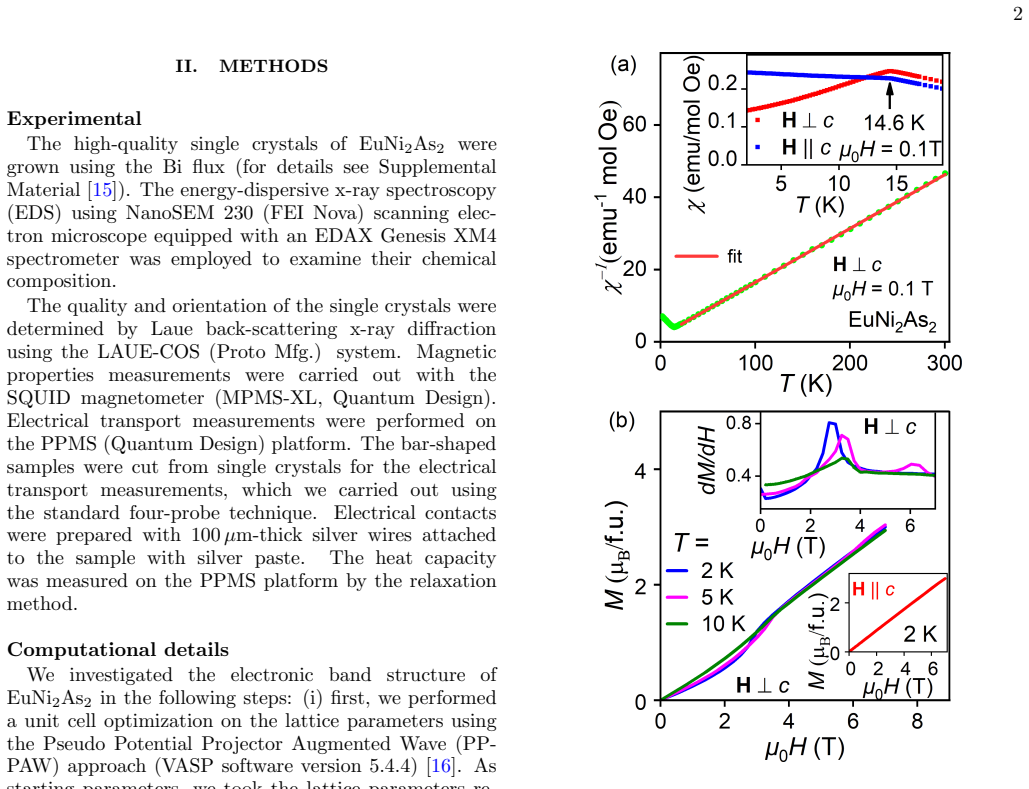
Summary. This paper reports magnetotransport measurements and DFT electronic structure calculations for single crystals of EuNi2As2, a helical antiferromagnet (TN = 14.6 K) with the ThCr2Si2-type structure. The authors measure magnetization, longitudinal resistivity, Hall resistivity, and heat capacity. Key experimental findings include: (i) metamagnetic transitions in M(H) for H⊥c that are reflected as anomalies in magnetoresistance; (ii) negative MR above TN that is well fitted by the de Gennes-Friedel spin-disorder-scattering model using a Brillouin-function approximation; (iii) Hall carrier concentrations of order 10^22 cm^-3 indicating metallic behavior, with multi-band conductivity below TN and single-band above; and (iv) absence of a topological Hall effect, attributed to the high carrier concentration. The DFT calculations (LSDA+U, ELK code, U = 5 eV, J = 0.8 eV) show strong band-structure changes upon magnetic ordering, with DOS at EF changing from 3.3 (paramagnetic) to 6.13 states/(eV f.u.) (helical AFM). The paper also discusses Hubbard-correction effects on magnetic moments and 4f screening lengths.
Significance. The paper provides a useful experimental and computational characterization of EuNi2As2, a metallic helical antiferromagnet in a family (Eu-based 1:2:2 compounds) where topological Hall effects have been prominent. The de Gennes-Friedel model fits to paramagnetic-state MR are a genuine strength, using an established physical mechanism with physically reasonable parameters (Table S1). The systematic U-variation study (Table I) showing modest variation in N(EF) across U = 5–8 eV is commendable, as is the use of the experimentally determined propagation vector k = (0,0,0.92) in the DFT. The paper is honest about the limitations (thin crystals preventing the key Hall geometry, metallic carrier density obscuring THE). The work is a solid contribution to the characterization of this compound, though the DFT-experiment comparison is weaker than claimed (see major comments).
major comments (3)
- §V and Table I: There is an unexplained internal inconsistency in N(EF) values. The text states N(EF) = 6.13 states/(eV f.u.) for the helical AFM phase (U = 5 eV), while Table I lists N(EF) = 2.708 states/(eV f.u.) for U = 5 eV. If these differ by a normalization convention (e.g., per-spin vs. total, or per-unit-cell vs. per-formula-unit), this must be explicitly stated. As it stands, a reader cannot determine which value is correct, and the claim that DOS changes 'by a factor smaller than two' between phases depends on which Table I value is used. If 2.708 is the correct AFM value, the ratio to the paramagnetic value (3.3) is 0.82, i.e., a decrease rather than an increase, which would contradict the text. This discrepancy is load-bearing for the central DFT claim and must be resolved.
- §V and Supplemental §S2: The claim of 'agreement' between DFT DOS at EF and experimental data is overstated. The Sommerfeld coefficient γ = 31 mJ/mol/K^2 yields N(EF) ≈ 14 states/(eV f.u.) (Supplemental §S2), while the DFT values are 3.3 (paramagnetic) and 6.13 (AFM) states/(eV f.u.) — a factor of 2.3 to 4.2 below experiment. This discrepancy is not discussed. The abstract states the DOS change is 'in agreement with experimental Hall resistivity data,' but the link between total DOS and Hall carrier concentration is indirect (Hall measurements probe Fermi-surface velocities and curvatures across multiple bands, not just total DOS). The Hall n changes by ~1.56× between 10 and 50 K, while DFT DOS changes by ~1.86× — this is qualitative consistency, not quantitative agreement. The authors should temper the language from 'agreement' to 'qualitative consistency' and explicitly acknowledge the
- §V, last paragraph: The text states 'DOS(EF) in the paramagnetic and helical AFM phases changes from 3.3 to 6.13 states/(eV f.u.),' implying an increase upon ordering. However, the conclusion states 'the density of states at the Fermi level decreases only by a factor smaller than two,' implying a decrease. These two statements are contradictory. Please clarify whether N(EF) increases or decreases upon magnetic ordering and ensure consistency throughout.
minor comments (9)
- Abstract: 'Ourab-initiocalculations' — missing space and italic formatting. Also in the main text, 'ab-initio' is sometimes concatenated.
- §IV, paragraph on Hall resistivity: 'For higher temperatures, namely ≥4 K, linear fits...' — this should likely read '≥5 K' or 'above 4 K', since 4 K data are described as curvilinear in the preceding sentence.
- Fig. 2 caption: The color scheme is described as identical across panels (a-c), but it would help to state the angle values explicitly in the caption rather than only referring to the inset of (a).
- §III: The effective moment μeff = 7.33 μB is described as 'slightly lower' than the Eu2+ value of 7.94 μB. The discrepancy is ~7.7%, which is moderate; a brief comment on possible origins (crystal-field effects, mixed valence, etc.) would strengthen the discussion.
- Table I: The N(EF) column header uses 'state/(eV f.u.)' — should be 'states/(eV f.u.)' for consistency with the text.
- §V: 'It occurred, U=5 eV was the most suitable value' — 'occurred' is not standard English; consider 'It was found that.'
- Supplemental §S2: The formula N(EF) = 3γ/(2π^2 kB N) is written with N as Avogadro's number, but the same symbol N is used for N(EF). Consider using N_A for Avogadro's number to avoid ambiguity.
- Fig. 7 caption: The PDOS in (b) is described as 'sums of the identical spin-up and spin-down contributions' — clarify whether this applies only to the AFM phase or both panels.
- §IV: The compensation angle |θ| ≈ 65° at 5 K is an interesting observation. A brief comment on whether this angle has any relation to the helical pitch or crystallographic directions would be welcome.
Simulated Author's Rebuttal
We thank the referee for a careful reading and constructive comments. We acknowledge that the DFT–experiment comparison was overstated and that there are genuine inconsistencies in the N(EF) values that must be corrected. We address each comment below.
read point-by-point responses
-
Referee: §V and Table I: Unexplained internal inconsistency in N(EF) values. Text states 6.13 states/(eV f.u.) for helical AFM (U=5 eV), Table I lists 2.708. If normalization convention differs, must be stated explicitly. Load-bearing for central DFT claim.
Authors: The referee is correct that there is an inconsistency, and we are grateful for this observation. Upon checking our ELK output files, we find that the value 2.708 states/(eV f.u.) listed in Table I is the per-spin DOS (i.e., for one spin channel only), whereas the value 6.13 states/(eV f.u.) quoted in the text of §V is the total DOS summed over both spin channels, including the interstitial contribution. We acknowledge that this normalization difference was not stated in the manuscript and is a source of genuine confusion. We will revise the manuscript to use a single consistent convention (total DOS per formula unit, including interstitial contribution) throughout both the main text and Table I, and will explicitly state the convention used. We note that the paramagnetic value of 3.3 states/(eV f.u.) quoted in the text is also a total (both-spin) value. With consistent normalization, the DOS at EF does increase from 3.3 (paramagnetic) to approximately 6.13 (helical AFM) upon magnetic ordering, i.e., by a factor of approximately 1.86, which is indeed smaller than two. We will ensure all values in Table I are converted to the same convention and that the text and table are fully consistent. revision: yes
-
Referee: §V and Supplemental §S2: Claim of 'agreement' between DFT DOS and experiment is overstated. Sommerfeld γ=31 mJ/mol/K² gives N(EF)≈14 states/(eV f.u.), factor 2.3–4.2 below DFT values. Link between total DOS and Hall carrier concentration is indirect. Should temper language from 'agreement' to 'qualitative consistency'.
Authors: We agree with the referee that the language used was too strong. The DFT DOS values (3.3 and 6.13 states/(eV f.u.) for paramagnetic and AFM phases, respectively) are indeed substantially lower than the Sommerfeld-derived value of approximately 14 states/(eV f.u.). This discrepancy is not uncommon in Eu-based compounds, where electron–phonon coupling, spin fluctuations, and many-body renormalization effects can enhance the experimental γ well beyond the bare DFT value. However, we acknowledge that we did not discuss this discrepancy in the manuscript, and we should have. Furthermore, we agree that the link between total DOS and Hall carrier concentration is indirect: the Hall measurement probes Fermi-surface velocities and curvatures across multiple bands, not the total DOS. The observation that the Hall carrier concentration changes by a factor of approximately 1.56 between 10 and 50 K, while the DFT DOS changes by a factor of approximately 1.86, constitutes qualitative consistency at best. We will revise the abstract and the relevant passages in §V to replace 'in agreement with' with 'qualitatively consistent with' and will add an explicit discussion of the DFT–Sommerfeld discrepancy, including the likely role of many-body enhancement. revision: yes
-
Referee: §V last paragraph vs. conclusion: Text implies DOS increases upon ordering (3.3→6.13), but conclusion states 'decreases only by a factor smaller than two,' implying a decrease. Contradictory statements.
Authors: The referee is correct. This is a genuine error in the conclusion. The DOS at the Fermi level increases upon magnetic ordering (from 3.3 to 6.13 states/(eV f.u.)), as stated in §V. The word 'decreases' in the conclusion is incorrect and should read 'changes' or 'increases.' We will correct the conclusion to read: 'the density of states at the Fermi level changes only by a factor smaller than two' (or equivalently, 'increases by a factor smaller than two'). We thank the referee for catching this inconsistency. revision: yes
Circularity Check
No significant circularity found; derivation chains use externally established models and independently determined inputs.
full rationale
The paper's main derivation chains are not circular. (1) The de Gennes-Friedel spin-disorder model (Eq. S2) is an externally established physical model from de Gennes and Friedel [21], not a construct of the authors. Fitting three free parameters (a, m_T, t) per temperature to ρ_xx(H) data is standard phenomenological modeling; the fit is not presented as a first-principles prediction. (2) The DFT calculations use standard codes (VASP, ELK) with LSDA+U, and externally determined inputs: lattice parameters from neutron diffraction [13], propagation vector k=(0,0,0.92) from [13]. The choice U=5 eV is selected by lowest total energy among U=5–8 eV, a standard criterion. The comparison between DFT DOS(E_F) and Hall carrier concentrations is between independently computed and independently measured quantities — neither is defined in terms of the other. (3) Self-citations ([6], [7], [9], [14]) involve overlapping authors but are contextual references to related Eu-based compounds (EuCd2Sb2, EuZn2Sb2, EuIn2As2, EuFe(2-x)Ni2As2), not load-bearing premises for the present paper's central claims. None invoke a uniqueness theorem or ansatz from prior work by the same authors. The skeptic's concerns about overstated DFT-experiment agreement (factor 2.3–4.2 discrepancy between DFT and Sommerfeld N(E_F), Table I vs. text inconsistency) are correctness issues, not circularity — the DFT output is not defined in terms of the experimental data it is compared against. Score 1 reflects the presence of contextual self-citations that are not load-bearing.
Assumptions & free parameters
free parameters (6)
- U (Hubbard Coulomb potential) =
5 eV
- J (Hund's coupling) =
0.8 eV
- a (zero-field resistivity in dGF model) =
varies by T, e.g. 10.4915 µΩcm at 15 K
- m_T (magnetization scaling in dGF model) =
varies by T, e.g. 1.18 at 15 K
- t (saturation field in dGF model) =
varies by T, e.g. 30.6 T at 15 K
- p (Einstein/Debye weight in heat capacity) =
0.40(3)
assumptions (5)
- domain assumption Eu moments in EuNi2As2 are divalent Eu2+ (7.94 µB theoretical moment)
- domain assumption The helical magnetic structure with propagation vector k=(0,0,0.92) determined by neutron diffraction [13] is the correct ground-state structure
- standard math The de Gennes-Friedel model rho_xx ∝ [1 - M^2(H)] is valid for paramagnetic spin-disorder scattering
- domain assumption LSDA+U with FLL double-counting correction adequately treats Eu-4f electron correlations
- domain assumption The single-band Hall model rho_xy = µ0H/(en) is adequate for extracting carrier concentrations at T>=4 K
Cite this review
Pith. "Pith review of Magnetotransport and electronic band structure of EuNi$_2$As$_2$ antiferromagnet." pith.science (2026). https://pith.science/paper/LRVMARKJ
@misc{pith2026260705337,
  author       = {Pith},
  title        = {Pith review of: Magnetotransport and electronic band structure of EuNi$_2$As$_2$ antiferromagnet},
  year         = {2026},
  howpublished = {\url{https://pith.science/paper/LRVMARKJ}},
  note         = {Machine review of arXiv:2607.05337}
}
abstract
We investigated the magnetotransport properties of single-crystals of tetragonal van der Waals compound EuNi$_2$As$_2$, that orders antiferromagnetically below 14.6 K in an incommensurate helical structure. Metamagnetic transitions are revealed by the magnetization measured in the magnetic field applied transverse to the axis of the helix, and are clearly reflected in the magnetoresistance. Overall, the magnetoresistance is small, but shows complex changes with the temperature, the strength, and the angle of the applied magnetic field. In magnetically ordered state, magnetoresistance shows prominent anomalies related to the metamagnetic transitions. For temperatures above the N\'eel point the negative magnetoresistance can be modeled very well with de Gennes-Friedel mechanism of the spin-disorder-scattering reduction. Hall resistivity data indicate hole-dominated multi-band conductivity in antiferromagnetic state and single-band one above the N\'eel temperature, with carrier concentrations of the order of 10$^{22}$cm$^{-3}$. This metallic character of the compound seems to obscure the plausible topological contribution to the Hall resistivity. Our \textit{ab-initio} calculations of electronic band structure showed that the electronic structure changes very strongly upon magnetic ordering, but the density of states at the Fermi level differs by a factor smaller than two, in agreement with experimental Hall resistivity data. Meaningful changes in the density of states, magnetic moments, and screening length of Eu-4$f$ orbitals are discussed in terms of the effects of Hubbard corrections.
Figures


Figures from the paper (4 more)


Reference graph
Works this paper leans on
-
[1]
N. P. Armitage, E. J. Mele, and A. Vishwanath, Weyl and Dirac semimetals in three-dimensional solids, Rev. Mod. Phys.90, 015001 (2018)
work page 2018
-
[2]
X. Chen, S. Dong, and Z.-C. Wang, Recent advances in understanding and manipulating magnetic and electronic properties of EuM 2X2 (M=Zn, Cd;X=P, As), J. Phys.: Cond. Matt.37, 033001 (2025)
work page 2025
-
[3]
M. C. Rahn, J. R. Soh, S. Francoual, L. S. Veiga, J. Strempfer, J. Mardegan, D. Y. Yan, Y. F. Guo, Y. G. Shi, and A. T. Boothroyd, Coupling of magnetic order and charge transport in the candidate Dirac semimetal EuCd2As2, Phys. Rev. B97, 214422 (2018)
work page 2018
-
[4]
J. Z. Ma, S. M. Nie, C. J. Yi, J. Jandke, T. Shang, M. Y. Yao, M. Naamneh, L. Q. Yan, Y. Sun, A. Chik- ina, V. N. Strocov, M. Medarde, M. Song, Y. M. Xiong, G. Xu, W. Wulfhekel, J. Mesot, M. Reticcioli, C. Fran- chini, C. Mudry, M. M¨ uller, Y. G. Shi, T. Qian, H. Ding, and M. Shi, Spin fluctuation induced Weyl semimetal state in the paramagnetic phase of...
work page 2019
-
[5]
J. R. Soh, C. Donnerer, K. M. Hughes, E. Schierle, E. Weschke, D. Prabhakaran, and A. T. Boothroyd, Mag- netic and electronic structure of the layered rare-earth pnictide EuCd2Sb2, Phys. Rev. B98, 064419 (2018)
work page 2018
-
[6]
F. Gul, O. Pavlosiuk, T. Romanova, D. Kaczorowski, and P. Wi´ sniewski, Origin of the large topological Hall ef- fect in the EuCd2Sb2 antiferromagnet, Phys. Rev. B113, 085133 (2026)
work page 2026
- [7]
-
[8]
J. Yan, Z. Z. Jiang, R. C. Xiao, W. J. Lu, W. H. Song, X. B. Zhu, X. Luo, Y. P. Sun, and M. Yamashita, Field- induced topological Hall effect in antiferromagnetic axion insulator candidate EuIn2As2, Phys. Rev. Res.4, 013163 (2022)
work page 2022
Show all 29 references
-
[9]
Singh, J
K. Singh, J. Skolimowski, G. Cuono, R. M. Sattigeri, A. Ptok, O. Pavlosiuk, T. Romanova, T. Toli´ nski, P. Wi´ sniewski, C. Autieri, and D. Kaczorowski, Nature of field-induced transitions and hysteretic magnetore- sistance in the noncollinear antiferromagnet EuIn 2As2, Phys. ...
2025
-
[10]
J.-R. Soh, I. S´ anchez-Ram´ ırez, X. Yang, J. Sun, I. Zivkovic, J. A. Rodr´ ıguez-Velamaz´ an, O. Fabelo, A. Stunault, A. Bombardi, C. Balz, M. D. Le, H. C. Walker, J. H. Dil, D. Prabhakaran, H. M. Rønnow, F. de Juan, M. G. Vergniory, and A. T. Boothroyd, Weyl metallic state ...
2024
-
[11]
Roychowdhury, K
S. Roychowdhury, K. Samanta, P. Yanda, B. Malaman, M. Yao, W. Schnelle, E. Guilmeau, P. Constantinou, S. Chandra, H. Borrmann, M. G. Vergniory, V. Strocov, C. Shekhar, and C. Felser, Interplay between Magnetism and Topology: Large Topological Hall Effect in an An- tiferromagne...
2023
-
[12]
N. S. Sangeetha, V. Smetana, A. V. Mudring, and D. C. Johnston, Helical antiferromagnetic ordering in EuNi1.95As2 single crystals, Phys. Rev. B100, 094438 (2019)
2019
-
[13]
W. T. Jin, N. Qureshi, Z. Bukowski, Y. Xiao, S. Nandi, M. Babij, Z. Fu, Y. Su, and T. Br¨ uckel, Spiral magnetic ordering of the Eu moments in EuNi 2As2, Phys. Rev. B 99, 014425 (2019)
2019
-
[14]
V. H. Tran, T. L. Mai, M. Sahakyan, and Z. Bukowski, First-principles study on structural, magnetic and elec- tronic properties of EuFe(2−x)NixAs2 solid solutions, Low Temp. Phys.51, 1172 (2025)
2025
-
[15]
Supplemental Material contains results on: crystal growth and characterization, heat capacity, as well as 8 resistivities and de Gennes-Friedel modeling of magne- toresistance
-
[16]
Kresse and D
G. Kresse and D. Joubert, From ultrasoft pseudopoten- tials to the projector augmented-wave method, Phy. Rev. B59, 1758 (1999)
1999
-
[17]
J. P. Perdew, A. Ruzsinszky, G. I. Csonka, O. A. Vydrov, G. E. Scuseria, L. A. Constantin, X. Zhou, and K. Burke, Restoring the density-gradient expansion for exchange in solids and surfaces, Phys. Rev. Lett.100, 136406 (2008)
2008
-
[18]
Wimmer, H
E. Wimmer, H. Krakauer, M. Weinert, and A. J. Free- man, Full-potential self-consistent linearized-augmented- plane-wave method for calculating the electronic struc- ture of molecules and surfaces: O 2 molecule, Phys. Rev. B24, 864 (1981)
1981
-
[19]
An all-electron full-potential linearized augmented plane, ver
The ELK code. An all-electron full-potential linearized augmented plane, ver. 8.8.26, available under GNU Gen- eral Public License
-
[20]
J. P. Perdew and Y. Wang, Accurate and simple ana- lytic representation of the electron-gas correlation energy, Phys. Rev. B45, 13244 (1992)
1992
-
[21]
P. G. de Gennes and J. Friedel, Anomalies de r´ esistivit´ e dans certains m´ etaux magn´ ıques, J. Phys. Chem. Solids 4, 71 (1958)
1958
-
[22]
du Tr´ emolet de Lacheisserie, D
´E. du Tr´ emolet de Lacheisserie, D. Gignoux, and M. Schlenker, Magnetic Resistivity Magnetoresistance, and the Hall Effect, inMagnetism - Fundamentals, Ma- terials and Applications, edited by ´E. du Tr´ emolet de Lacheisserie, D. Gignoux, and M. Schlenker (Springer, New York...
2002
-
[23]
Shang, Y
T. Shang, Y. Xu, D. J. Gawryluk, J. Z. Ma, T. Shiroka, M. Shi, and E. Pomjakushina, Anomalous Hall resistivity and possible topological Hall effect in the EuAl 4 antifer- romagnet, Phys. Rev. B103, L020405 (2021)
2021
-
[24]
Li, J.-X
W. Li, J.-X. Zhu, Y. Chen, and C. S. Ting, First- principles calculations of the electronic structure of iron- pnictide EuFe 2(As,P)2 superconductors: Evidence for antiferromagnetic spin order, Phys. Rev. B86, 155119 (2012)
2012
-
[25]
U. B. Paramanik, R. Prasad, C. Geibel, and Z. Hossain, Itinerant and local-moment magnetism in EuCr2As2 sin- gle crystals, Phys. Rev. B89, 144423 (2014)
2014
-
[26]
H. S. Jeevan, Z. Hossain, D. Kasinathan, H. Rosner, C. Geibel, and P. Gegenwart, High-temperature su- perconductivity in Eu 0.5K0.5Fe2As2, Phys. Rev. B78, 092406 (2008)
2008
-
[27]
Liechtenstein, V
A. Liechtenstein, V. I. Anisimov, and J. Zaanen, Density- functional theory and strong interactions: Orbital order- ing in Mott-Hubbard insulators, Phys. Rev. B52, R5467 (1995)
1995
-
[28]
M. R. Norman, Calculation of effective Coulomb inter- action for Pr 3+, U 4+, and UPt 3, Phys. Rev. B52, 1421 (1995)
1995
-
[29]
Bultmark, F
F. Bultmark, F. Cricchio, O. Gr˚ an¨ as, and L. Nordstr¨ om, Multipole decomposition of LDA+U energy and its appli- cation to actinide compounds, Phys. Rev. B80, 035121 (2009). 1 Supplemental Material Magnetotransport and electronic band structure of EuNi 2As2 antiferromagnet ...
2009
Reviewed July 7, 2026 · model on record in the stance chip above.
Discussion (0). Continue with ORCID to comment.