REVIEW 2 major objections 6 minor 134 references
Tracing the source of carbon oxides on the large moons of Uranus
T0 review · 2 major / 6 minor · reviewed 2026-07-11 · grok-4.5
Pith's one-line read Carbon oxides on Uranus's large moons are likely native ice shaped by radiation and seasons, not mainly made by radiation.
desk verdict Solid JWST inventory of CO2/CO on the Uranian moons that cleanly favors a dual (native + radiolytic) origin; the formation-pathway premise is the only soft spot and the authors already flag it. read the letter →
The pith
A machine-rendered reading of the paper's core claim, the machinery that carries it, and where it could break.
The reading
What carries the argument
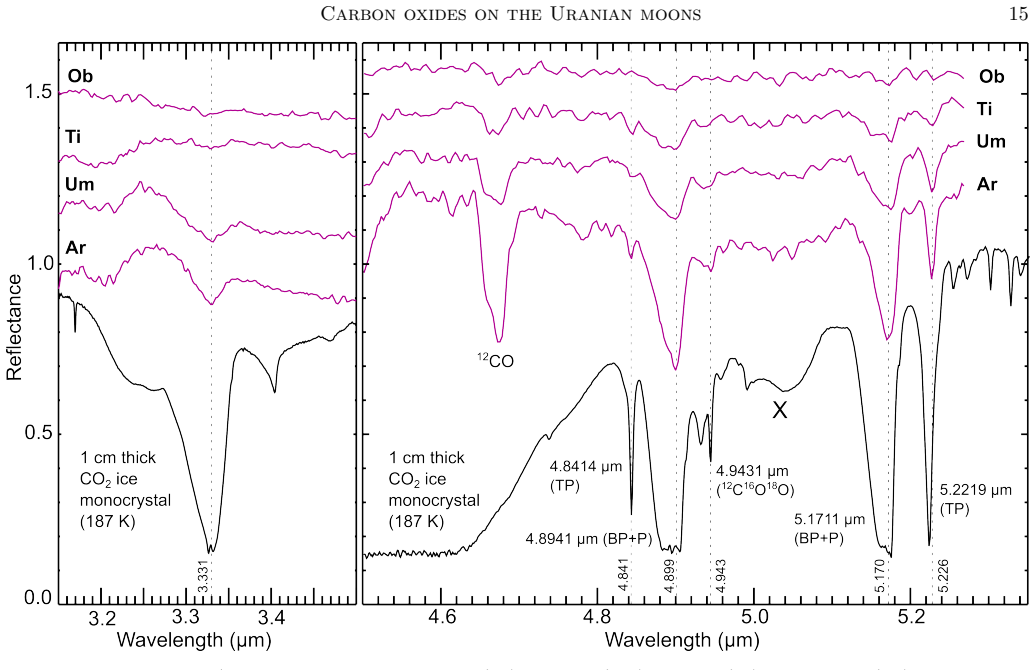
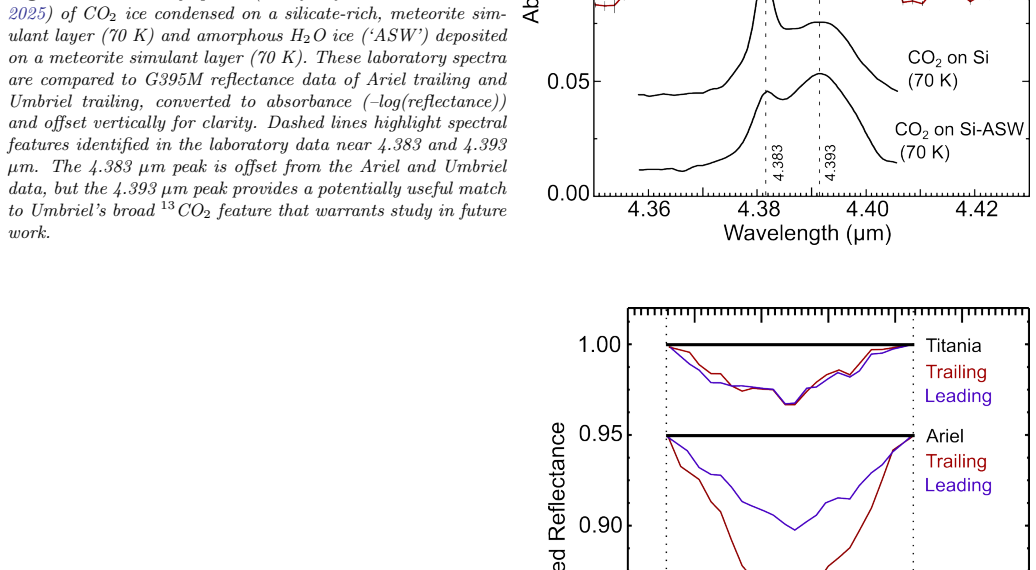
Comparison of JWST/NIRSpec G395M reflectance spectra (especially 12CO2 scattering peaks near 4.15–4.26 µm, multi-lobe 13CO2 bands near 4.35–4.43 µm, and biphonon/triphonon modes near 4.80–5.25 µm) to laboratory thick crystalline CO2 ice, CO2 clathrates, and carbonate spectra, used to distinguish deposit thickness and possible endogenic carriers from pure radiolytic products.
What would settle it
Laboratory radiolysis of carbon-bearing ice mixtures under Uranus-relevant temperatures and fluxes that successfully produce thick crystalline CO2 layers showing the same biphonon/triphonon and multi-lobe 13CO2 features, or spatially resolved maps from a future Uranus orbiter that show no association of CO2 with geologic vents or cold traps independent of magnetospheric exposure.
Extended reading notes
Core claim
Exposed carbon oxides on Ariel, Umbriel, Titania, and Oberon are potentially native material accreted from the Uranian subnebula, with surface distributions later shaped by charged-particle irradiation and seasonal sublimation-condensation cycles, rather than being produced mainly by radiolysis of mixed carbon-bearing regolith.
Load-bearing premise
The argument that thick crystalline CO2 deposits and clathrate-like multi-lobe bands are hard to grow by radiolysis of mixed icy regolith is what tips the balance toward a native source; if radiolysis can still build those deposits under Uranian conditions, the dual-origin conclusion weakens.
Editorial analysis
A structured set of objections, weighed in public.
Referee Report
Summary. This paper presents JWST/NIRSpec G395M (2.87–5.25 µm) reflectance spectra of the leading and trailing hemispheres of Ariel, Umbriel, Titania, and Oberon. Continuum-divided band and peak measurements, combined with overlays against laboratory spectra (INGMAR CO2 films, a thick monocrystal, CO2:H2O mixtures, clathrates, silicate-hosted CO2, and carbonates), are used to inventory crystalline CO2 features (12CO2 scattering peaks near 4.20/4.25 µm, multi-lobe 13CO2 structure near 4.38–4.41 µm, biphonon/triphonon modes near 4.90/5.17/5.23 µm), CO ice near 4.67 µm, and weaker candidates (4.02 µm carbonates; 4.40 µm 13CO2 clathrates; possible OCN−). Trailing-hemisphere and inner-moon concentration of CO2/CO is confirmed, consistent with prior ground-based CO2-triplet trends. The authors conclude that exposed carbon oxides are potentially native (accreted from the subnebula and/or interior-derived), with surface distributions shaped by charged-particle irradiation and seasonal sublimation–condensation cycles.
Significance. This is the first systematic JWST inventory of carbon-oxide spectral structure across all four large Uranian moons in the 2.9–5.3 µm window, substantially extending ground-based CO2-triplet work and the earlier Ariel-only NIRSpec study. The multi-feature comparison to thick crystalline CO2, clathrate, and carbonate laboratory data, the careful treatment of the unreliable 4.27 µm band, and the system-wide context (rings, ring moons, irregulars) constitute a durable observational contribution. The dual-origin framing is appropriately hedged as “potentially native” and will usefully guide future laboratory experiments and orbiter instrument priorities. Strengths include transparent continuum-division and Monte-Carlo area uncertainties, explicit secure/probable/tentative detection tiers, and direct lab overlays rather than model-only assignments.
major comments (2)
- [§3.3, §4.3] §3.3 and §4.3: The dual-origin claim that carbon oxides are “potentially native” rests in large part on the premise that multi-lobe 13CO2 structure (4.35–4.43 µm) and biphonon/triphonon modes (4.80–5.25 µm) require thick crystalline deposits that “may be difficult to form via radiolysis of carbon-bearing material mixed in icy regoliths.” The manuscript shows that these features match thick pure-CO2 laboratory spectra, but it does not cite quantitative radiolysis yields, crystallization/grain-growth timescales, or experiments under Uranian T/P/flux conditions that would demonstrate radiolytic CO2 cannot build such deposits. Because this premise is load-bearing for favoring a native component, either add supporting experimental constraints or reframe more explicitly as an open laboratory question (the paper already calls for future work; that call should be tied directly to this premise).
- [§3.1, Table 2, §3.3] §3.1, Table 2, and §3.3 (4.02 µm discussion): The 4.02 µm band is listed with interpretation certainty “Favored” for CO3 in carbonate minerals and is used as supporting evidence for interior-derived material. The text, however, notes the absence of the 3.4 µm carbonate complex, residual viability of H2CO3 and a shifted CO2 Christiansen feature, and that none of the CO2-dominated lab spectra reproduce the band. Given that the feature’s radial trend also differs from CO2/CO (strongest on Ariel then Titania, weakest on Umbriel), the “Favored” label overstates the case relative to the paper’s own evidence. Downgrade to “Ambiguous” or add a quantitative argument (band morphology metrics, temperature/mixing tests) that elevates carbonates above the alternatives before using the band as interior-origin support.
minor comments (6)
- [Figure 4] Figure 4 caption states “3σ uncertainties,” while several plotted points and the text discuss features at >2σ or with 1σ error bars elsewhere. Align caption, plotted error bars, and text consistently.
- [§2.1, Tables 3–5] Tables 3–5 report spectral contrast and areas with clear >3σ flags; consider adding a short note in §2.1 on how continuum windows were chosen (and whether alternate windows change any secure/probable classifications), since continuum placement is listed among free parameters.
- [§4.2] §4.2 working model of a porous µm-scale CO2 frost veneer over mm-scale compacted ice/clathrate is useful but should be labeled more clearly as a non-unique interpretive sketch; a single sentence noting which observables would falsify it (e.g., future spatially resolved mapping) would help.
- [Figure 6, §3.3] Figure 6: the laboratory Christiansen feature near 4.07 µm is marked “X” and discussed as absent in the G395M data; a brief quantitative upper limit on any residual 4.07 µm structure in the moon spectra would strengthen that comparison.
- [§4.1] Cross-hemispherical disk-area overlap (~26.7%, mostly >45°N) is well calculated in §4.1; consider stating the assumed limb-darkening or projected-area model more explicitly so the contamination bound can be reproduced.
- [Title, Table 2] Minor typographical/formatting issues from the draft (e.g., “T racing” title line, occasional missing spaces in species names, “mag. dipole?” in Table 2) should be cleaned in production.
Circularity Check
Observational spectral paper: new JWST features matched to independent laboratory spectra; prior self-cited trends used only for consistency, not as definitional inputs that force the dual-origin conclusion.
-
self citation load bearing
[§4.1 and Fig. 4e; also Abstract and §1]
"These results are consistent with the hemispherical and radial trends measured in ground-based reflectance data for the CO2 triplet band (shown here in Figure 4e; Grundy et al. 2003, 2006; Cartwright et al. 2015)."
The paper repeatedly invokes its own prior SpeX/IRTF measurements of the weak 2 µm CO2 triplet to corroborate the new JWST trailing-hemisphere concentration. This is ordinary self-citation of published observations, not a definitional or uniqueness claim that forces the dual-origin conclusion; the new 4.2–5.2 µm features and laboratory matches stand independently. Flagged only as the single minor self-citation instance.
full rationale
The paper is an observational analysis of JWST/NIRSpec reflectance spectra of the Uranian moons, with spectral feature assignments and thickness inferences drawn by direct comparison to external laboratory transmission/reflectance spectra of crystalline CO2 ice, CO2 clathrates, carbonates, and related species (Hansen 1997; Quirico & Schmitt 1997a,b; Bini et al. 1991; Dows & Schettino 1973; Oancea et al. 2012; Nyquist et al. 1997; Suhasaria et al. 2025; etc.). Band-area measurements and trailing/leading ratios are computed from the new data cubes via standard continuum division and trapezoidal integration; no free parameters are fitted to a subset of the present spectra and then re-labeled as predictions of closely related quantities. The dual-origin conclusion (native CO2 accreted or outgassed, with surface distributions later modified by magnetospheric irradiation and seasonal sublimation-condensation) is an interpretive synthesis that explicitly hedges (“potentially native”) and rests on (i) the laboratory requirement that multi-lobe 13CO2 and biphonon/triphonon modes appear only in thick crystalline deposits and (ii) the absence of common radiolytic markers such as H2O2. Prior ground-based CO2-triplet trends (many by overlapping authors) are cited solely for consistency with the new hemispheric and radial patterns; they do not enter the measurement pipeline or define the new spectral features. Self-citations therefore exist but are not load-bearing for the central claim, which remains independently constrained by the JWST data and external laboratory benchmarks. No self-definitional loop, fitted-input-as-prediction, uniqueness theorem imported from the authors, or ansatz smuggled via citation is present. Score 1 reflects only the minor, non-circular self-citation of prior observational trends.
Assumptions & free parameters
free parameters (2)
- linear-mixture scaling coefficients for CO2 ice + clathrate
- continuum windows for band-area measurements
assumptions (4)
- domain assumption Biphonon/triphonon modes and multi-lobe 13CO2 structure appear only in thick crystalline CO2 ice deposits
- domain assumption Radiolysis of mixed carbonaceous material in icy regolith cannot readily produce thick pure crystalline CO2 layers
- domain assumption 4.02 µm band morphology matches anhydrous carbonates better than CO2 Christiansen feature or H2CO3
- standard math Standard vibrational-mode assignments for 12CO2, 13CO2, CO and H2O ice
invented entities (1)
-
two-layer CO2 frost model (porous µm-scale veneer over mm-scale compacted ice/clathrate)
Cite this review
Pith. "Pith review of Tracing the source of carbon oxides on the large moons of Uranus." pith.science (2026). https://pith.science/paper/DY3WI3ZO
@misc{pith2026260705600,
  author       = {Pith},
  title        = {Pith review of: Tracing the source of carbon oxides on the large moons of Uranus},
  year         = {2026},
  howpublished = {\url{https://pith.science/paper/DY3WI3ZO}},
  note         = {Machine review of arXiv:2607.05600}
}
read the original abstract
The Uranian moons Ariel, Umbriel, Titania, and Oberon are enriched in CO2 mixed with CO, but the origin(s) of these carbon oxides, be they primarily native or radiolytic, remains uncertain. Using data collected by NIRSpec on the James Webb Space Telescope (JWST), we measured the spectral signature of CO2 and other carbon oxides to help disentangle these hypotheses. Through comparison to laboratory data, we find that many of the detected spectral features are consistent with CO2 ice, including 12CO2 scattering peaks (4.15 - 4.26 microns), multi-lobe 13CO2 bands (4.35 - 4.43 microns), and CO2 biphonon and triphonon modes (4.80 - 5.25 microns). Our measurements show that CO2 and CO are concentrated on the trailing hemispheres of the inner moons Ariel and Umbriel, potentially supporting a radiolytic production hypothesis, consistent with prior ground-based results. However, many of the identified spectral features are only observed in thick crystalline ice deposits measured in the laboratory, which may be difficult to form via radiolysis of carbon-bearing material mixed in icy regoliths. Similarly, the data exhibit weak 4.02 microns and 4.40 microns bands, hinting at the presence of carbonate minerals and 13CO2 clathrates, respectively, possibly formed in the interiors of these moons. Furthermore, JWST has revealed that CO2 is widespread at Uranus, present in its system of rings, ring moons, and irregular satellites, consistent with its largest moons accreting CO2 and other carbon oxides from the Uranian subnebula. We conclude that exposed carbon oxides are potentially native, with their surface distributions shaped by charged particle irradiation and seasonal sublimation-condensation cycles.
Figures


Figures from the paper (8 more)




Reference graph
Works this paper leans on
-
[1]
2014, Astrophysical Bulletin, 69, 211
Afanasiev, V., Rosenbush, V., & Kiselev, N. 2014, Astrophysical Bulletin, 69, 211
2014
-
[2]
2018, Icarus, 302, 175
Aoki, S., Sato, Y., Giuranna, M., et al. 2018, Icarus, 302, 175
2018
-
[3]
M., Roush, T
Bauer, J. M., Roush, T. L., Geballe, T. R., et al. 2002, Icarus, 158, 178
2002
-
[4]
2024, Space Science Reviews, 220, 49
Becker, T., Zolotov, M., Gudipati, M., et al. 2024, Space Science Reviews, 220, 49
2024
-
[5]
2015, Icarus, 247, 35
Beddingfield, C., Burr, D., & Emery, J. 2015, Icarus, 247, 35
2015
-
[6]
B., & Cartwright, R
Beddingfield, C. B., & Cartwright, R. J. 2021, Icarus, 114583
2021
-
[7]
A., & Patterson, G
Nordheim, T. A., & Patterson, G. W. 2025, The Planetary Science Journal, 6, 32
2025
-
[8]
J., & Castillo-Rogez, J
Cartwright, R. J., & Castillo-Rogez, J. C. 2023, The Planetary Science Journal, 4, 211
2023
Show all 134 references
-
[9]
F., Calvin, W
Bell, J. F., Calvin, W. M., Ockert-Bell, M. E., et al. 1996, Journal of Geophysical Research: Planets, 101, 9227
1996
-
[10]
2025, in Ice Giant System Seminar Series
Belyakov, M. 2025, in Ice Giant System Seminar Series
2025
-
[11]
2024, in AAS Division for Planetary Sciences meeting
Belyakov, M., & Brown, M. 2024, in AAS Division for Planetary Sciences meeting
2024
-
[12]
P., Sandford, S
Bernstein, M. P., Sandford, S. A., & Allamandola, L. J. 1997, The Astrophysical Journal, 476, 932
1997
-
[13]
t., & Whalley, E
Bertie, J. t., & Whalley, E. 1964, The Journal of Chemical Physics, 40, 1637
1964
-
[14]
1991, Physics Letters A, 157, 273
Bini, R., Salvi, P., Schettino, V., & Jodl, H.-J. 1991, Physics Letters A, 157, 273
1991
-
[15]
2021, Earth and Space Science, 8, e2021EA001844
Bishop, J., King, S., Lane, M., et al. 2021, Earth and Space Science, 8, e2021EA001844
2021
-
[16]
A., & Vance, S
Patthoff, D. A., & Vance, S. D. 2023, Icarus, 395, 115452
2023
-
[17]
C., & Landolt, A
Bohlin, R. C., & Landolt, A. U. 2015, The Astronomical Journal, 149, 122 B¨ oker, T., Beck, T., Birkmann, S., et al. 2023, Publications of the Astronomical Society of the Pacific, 135, 038001
2015
-
[18]
2022, The Astrophysical Journal, 941, 32
Boogert, A., Brewer, K., Brittain, A., & Emerson, K. 2022, The Astrophysical Journal, 941, 32
2022
-
[19]
E., Trumbo, S
Brown, M. E., Trumbo, S. K., Davis, M. R., & Chandra, S. 2025, The Planetary Science Journal, 6, 229
2025
-
[20]
2025, The Astrophysical Journal Letters, 982, L8
Brunetto, R., H´ enault, E., Cryan, S., et al. 2025, The Astrophysical Journal Letters, 982, L8
2025
-
[21]
G., Rocha, W
Brunken, N. G., Rocha, W. R., Van Dishoeck, E. F., et al. 2024, Astronomy & Astrophysics, 685, A27
2024
-
[22]
J., & Mosher, J
Buratti, B. J., & Mosher, J. A. 1991, Icarus, 90, 1
1991
-
[23]
Greenfield, P. e. a. . 2023, Zenodo, zenodo.org/records/8067394
2023
-
[24]
M., Johnson, R
Calvin, W. M., Johnson, R. E., & Spencer, J. R. 1996, Geophysical research letters, 23, 673
1996
-
[25]
1999, Science, 283, 2062
Carlson, R., Anderson, M., Johnson, R., et al. 1999, Science, 283, 2062
1999
-
[26]
G., De Sanctis, M
Carrozzo, F. G., De Sanctis, M. C., Raponi, A., et al. 2018, Science Advances, 4, e1701645
2018
-
[27]
2021, Planetary Science Journal, 2, 120
Cartwright, R., Beddingfield, C., Nordheim, T., et al. 2021, Planetary Science Journal, 2, 120
2021
-
[28]
J., DeColibus, R
Cartwright, R. J., DeColibus, R. A., Castillo-Rogez, J. C., et al. 2023, The Planetary Science Journal, 4, 42
2023
-
[29]
J., Emery, J
Cartwright, R. J., Emery, J. P., Pinilla-Alonso, N., et al. 2018, Icarus, 314, 210
2018
-
[30]
J., Emery, J
Cartwright, R. J., Emery, J. P., Rivkin, A. S., Trilling, D. E., & Pinilla-Alonso, N. 2015, Icarus, 257, 428
2015
-
[31]
J., Nordheim, T
Cartwright, R. J., Nordheim, T. A., DeColibus, R. A., et al. 2022, The Planetary Science Journal, 3, 8 Carbon oxides on the Uranian moons27
2022
-
[32]
J., Hibbitts, C
Cartwright, R. J., Hibbitts, C. A., Holler, B. J., et al. 2025, The Planetary Science Journal, 6, 125
2025
-
[33]
2011, Advances in Space Research, 47, 1633
Chen, Y.-J., Nuevo, M., Chu, C.-C., et al. 2011, Advances in Space Research, 47, 1633
2011
-
[34]
N., Brown, R
Clark, R. N., Brown, R. H., Cruikshank, D. P., & Swayze, G. A. 2019, Icarus, 321, 791
2019
-
[35]
N., Curchin, J
Clark, R. N., Curchin, J. M., Hoefen, T. M., & Swayze, G. A. 2009, Journal of Geophysical Research: Planets, 114
2009
-
[36]
J., Turner, D
Cohen, I. J., Turner, D. L., Kollmann, P., et al. 2023, Geophysical Research Letters, 50, e2022GL101998
2023
-
[37]
R., Fayolle, E
Cooke, I. R., Fayolle, E. C., & ¨Oberg, K. I. 2016, The Astrophysical Journal, 832, 5
2016
-
[38]
P., Roush, T
Cruikshank, D. P., Roush, T. L., Owen, T. C., et al. 1993, Science, 261, 742
1993
-
[39]
2025, The Astrophysical Journal, 993, 188
Cryan, S., Brunetto, R., Guilbert-Lepoutre, A., et al. 2025, The Astrophysical Journal, 993, 188
2025
-
[40]
2011, Icarus, 212, 950
Dartois, E. 2011, Icarus, 212, 950
2011
-
[41]
2010, Astronomy & Astrophysics, 514, A49
Dartois, E., Deboffle, D., & Bouzit, M. 2010, Astronomy & Astrophysics, 514, A49
2010
-
[42]
2009, Astronomy & Astrophysics, 504, 869 De Pr´ a, M
Dartois, E., & Schmitt, B. 2009, Astronomy & Astrophysics, 504, 869 De Pr´ a, M. N., H´ enault, E., Pinilla-Alonso, N., et al. 2025, Nature Astronomy, 9, 252 De Sanctis, M. C., Ammannito, E., Raponi, A., et al. 2015, Nature, 528, 241 De Sanctis, M. C., Raponi, A., Ammannito, E...
2009
-
[43]
A., Cartwright, R
DeColibus, R. A., Cartwright, R. J., Grundy, W. M., et al. 2026, The Planetary Science Journal, 7, 67
2026
-
[44]
A., Chanover, N
DeColibus, R. A., Chanover, N. J., & Cartwright, R. J. 2022, The Planetary Science Journal, 3, 119 —. 2023, The Planetary Science Journal, 4, 191
2022
-
[45]
2026, Journal of Geophysical Research: Planets, 131, e2025JE009282
Denton, C., Scully, J., Castillo-Rogez, J., et al. 2026, Journal of Geophysical Research: Planets, 131, e2025JE009282
2026
-
[46]
1986, Chemical physics letters, 126, 38
DiLella, D., & Tevault, D. 1986, Chemical physics letters, 126, 38
1986
-
[47]
A., & Schettino, V
Dows, D. A., & Schettino, V. 1973, The Journal of Chemical Physics, 58, 5009
1973
-
[48]
M., Mu˜ noz Caro, G
Escribano, R. M., Mu˜ noz Caro, G. M., Cruz-Diaz, G. A., Rodr´ ıguez-Lazcano, Y., & Mat´ e, B. 2013, Proceedings of the National Academy of Sciences, 110, 12899
2013
-
[49]
E., & Pimentel, G
Ewing, G. E., & Pimentel, G. C. 1961, The Journal of Chemical Physics, 35, 925
1961
-
[50]
Fink, U., & Sill, G. T. 1982, The infrared spectral properties of frozen volatiles (University of Arizona Press)
1982
-
[51]
2009, Planetary and Space Science, 57, 2053
Fray, N., & Schmitt, B. 2009, Planetary and Space Science, 57, 2053
2009
-
[52]
2001, Icarus, 154, 372
Gerakines, P., & Moore, M. 2001, Icarus, 154, 372
2001
-
[53]
H., & Hudson, R
Gerakines, P., Moore, M. H., & Hudson, R. L. 2000, Astronomy and Astrophysics, 357, 793
2000
-
[54]
A., Bray, J., Davis, A., & Richey, C
Gerakines, P. A., Bray, J., Davis, A., & Richey, C. 2005, The Astrophysical Journal, 620, 1140
2005
-
[55]
A., & Hudson, R
Gerakines, P. A., & Hudson, R. L. 2020, The Astrophysical Journal, 901, 52
2020
-
[56]
A., Materese, C
Gerakines, P. A., Materese, C. K., & Hudson, R. L. 2023, Monthly Notices of the Royal Astronomical Society, 522, 3145
2023
-
[57]
A., Yarnall, Y
Gerakines, P. A., Yarnall, Y. Y., & Hudson, R. L. 2022, Monthly Notices of the Royal Astronomical Society, 509, 3515
2022
-
[58]
2023, Accounts of Chemical Research, 56, 2241
Ghosh, J., Vishwakarma, G., Kumar, R., & Pradeep, T. 2023, Accounts of Chemical Research, 56, 2241
2023
-
[59]
R., & Waite, J
Glein, C. R., & Waite, J. H. 2020, Geophysical Research Letters, 47, e2019GL085885
2020
-
[60]
2005, Icarus, 177, 570
Gomis, O., & Strazzulla, G. 2005, Icarus, 177, 570
2005
-
[61]
2014, Astronomy & Astrophysics, 562, A46
Alvarez-Candal, A. 2014, Astronomy & Astrophysics, 562, A46
2014
-
[62]
J., & Greenberg, J
Grim, R. J., & Greenberg, J. M. 1987, Astrophysical
1987
-
[63]
321, Oct
Journal, Part 2-Letters to the Editor (ISSN 0004-637X), vol. 321, Oct. 1, 1987, p. L91-L96., 321, L91
1987
-
[64]
2002, Icarus, 155, 486
Grundy, W., Schmitt, B., & Quirico, E. 2002, Icarus, 155, 486
2002
-
[65]
2006, Icarus, 184, 543
Grundy, W., Young, L., Spencer, J., et al. 2006, Icarus, 184, 543
2006
-
[66]
2010, Icarus, 205, 594
Grundy, W., Young, L., Stansberry, J., et al. 2010, Icarus, 205, 594
2010
-
[67]
2003, Icarus, 162, 222
Grundy, W., Young, L., & Young, E. 2003, Icarus, 162, 222
2003
-
[68]
R., Hallbrucker, A., & Mayer, E
Hage, W., Liedl, K. R., Hallbrucker, A., & Mayer, E. 1998, Science, 279, 1332
1998
-
[69]
1986, Science, 233, 70
Hanel, R., Conrath, B., Flasar, F., et al. 1986, Science, 233, 70
1986
-
[70]
Hansen, G. B. 1997, Advances in Space Research, 20, 1613
1997
-
[71]
2012, Theory of Reflectance and Emittance Spectroscopy (Cambridge University Press)
Hapke, B. 2012, Theory of Reflectance and Emittance Spectroscopy (Cambridge University Press)
2012
-
[72]
2024, Journal of Geophysical Research: Planets, 129, e2023JE008236
Hedman, M., Tiscareno, M., Showalter, M., et al. 2024, Journal of Geophysical Research: Planets, 129, e2023JE008236
2024
-
[73]
1991, Icarus, 90, 14
Helfenstein, P., Hillier, J., Weitz, C., & Veverka, J. 1991, Icarus, 90, 14
1991
-
[74]
C., & Veverka, J
Helfenstein, P., Thomas, P. C., & Veverka, J. 1989, Nature, 338, 324 28Cartwright et al. H´ enault, E., Brunetto, R., Pinilla-Alonso, N., et al. 2025, A&A, 694, A126, doi: 10.1051/0004-6361/202452321
1989 doi
-
[75]
R., Filacchione, G., Paranicas, C., Schenk, P., & Scipioni, F
Hendrix, A. R., Filacchione, G., Paranicas, C., Schenk, P., & Scipioni, F. 2018, Icarus, 300, 103
2018
-
[76]
C., & Pimentel, G
Herr, K. C., & Pimentel, G. C. 1970, Science, 167, 47
1970
-
[77]
1958, Spectrochimica Acta, 10, 281
Hexter, R. 1958, Spectrochimica Acta, 10, 281
1958
-
[78]
2002, Journal of Geophysical Research: Planets, 107, 14
Greeley, R. 2002, Journal of Geophysical Research: Planets, 107, 14
2002
-
[79]
2000, Journal of Geophysical Research: Planets, 105, 22541
Hibbitts, C., McCord, T., & Hansen, G. 2000, Journal of Geophysical Research: Planets, 105, 22541
2000
-
[80]
2003, Journal of Geophysical Research: Planets, 108
Hibbitts, C., Pappalardo, R., Hansen, G., & McCord, T. 2003, Journal of Geophysical Research: Planets, 108
2003
-
[81]
2016, Icarus, 267, 255
Holler, B., Young, L., Grundy, W., & Olkin, C. 2016, Icarus, 267, 255
2016
-
[82]
2001, The Astrophysical Journal, 550, 1140
Hudson, R., Moore, M., & Gerakines, P. 2001, The Astrophysical Journal, 550, 1140
2001
-
[83]
E., Milligan, D
Jacox, M. E., Milligan, D. E., Moll, N. G., & Thompson, W. E. 1965, The Journal of Chemical Physics, 43, 3734
1965
-
[84]
A., et al
Jakobsen, P., Ferruit, P., de Oliveira, C. A., et al. 2022, Astronomy & Astrophysics, 661, A80
2022
-
[85]
2004, Jupiter: The Planet, Satellites and Magnetosphere, 485
Johnson, R., Carlson, R., Cooper, J., et al. 2004, Jupiter: The Planet, Satellites and Magnetosphere, 485
2004
-
[86]
1997, The Astrophysical Journal Letters, 480, L79
Johnson, R., & Jesser, W. 1997, The Astrophysical Journal Letters, 480, L79
1997
-
[87]
2021, Molecular Physics, 119, e1934581
Kazakov, K., & Vigasin, A. 2021, Molecular Physics, 119, e1934581
2021
-
[88]
2005, Astronomy & Astrophysics, 435, 587
Baragiola, R. 2005, Astronomy & Astrophysics, 435, 587
2005
-
[89]
D., Raut, U., Teolis, B
Mamo, B. D., Raut, U., Teolis, B. D., et al. 2025, The Planetary Science Journal, 6, 170
2025
-
[90]
2017, Icarus, 294, 201
Mangan, T., Salzmann, C., Plane, J., & Murray, B. 2017, Icarus, 294, 201
2017
-
[91]
J., et al
Markwardt, L., Wen Lin, H., Holler, B. J., et al. 2025, The Planetary Science Journal, 6, 154
2025
-
[92]
2009, The Astrophysical Journal, 701, 1347
Mastrapa, R., Sandford, S., Roush, T., Cruikshank, D., & Dalle Ore, C. 2009, The Astrophysical Journal, 701, 1347
2009
-
[93]
K., Rocha, W., Pontoppidan, K., et al
McClure, M. K., Rocha, W., Pontoppidan, K., et al. 2023, Nature Astronomy, 7, 1
2023
-
[94]
a., Carlson, R., Smythe, W., et al
McCord, T. a., Carlson, R., Smythe, W., et al. 1997, Science, 278, 271
1997
-
[95]
M., Sori, M
Menten, S. M., Sori, M. M., Bramson, A. M., Nordheim, T. A., & Cartwright, R. J. 2024, Journal of Geophysical Research: Planets, 129, e2024JE008376
2024
-
[96]
G., Clutter, D
Moll, N. G., Clutter, D. R., & Thompson, W. E. 1966, The Journal of Chemical Physics, 45, 4469
1966
-
[97]
2007, Journal of Geophysical Research: Planets, 112
Montmessin, F., Gondet, B., Bibring, J.-P., et al. 2007, Journal of Geophysical Research: Planets, 112
2007
-
[98]
1991, Spectrochimica Acta Part A: Molecular Spectroscopy, 47, 255
Moore, M., & Khanna, R. 1991, Spectrochimica Acta Part A: Molecular Spectroscopy, 47, 255
1991
-
[99]
I., Thomas, C., et al
Mousis, O., Lunine, J. I., Thomas, C., et al. 2009, The Astrophysical Journal, 691, 1780 National Academies of Sciences, Engineering, and Medicine. 2022
2009
-
[100]
A., Leugers, M
Nyquist, R. A., Leugers, M. A., & Putzig, C. L. 1997, The handbook of infrared and raman spectra of inorganic compounds and organic salts: a 4-volume set, Acad. Press
1997
-
[101]
2012, Icarus, 221, 900
Oancea, A., Grasset, O., Le Menn, E., et al. 2012, Icarus, 221, 900
2012
-
[102]
V., Johnson, R
Oza, A. V., Johnson, R. E., Schmidt, C. A., & Calvin, W. M. 2025, arXiv preprint arXiv:2504.04177
2025 arXiv
-
[103]
1999, The Astrophysical Journal, 513, 294
Pendleton, Y., Tielens, A., Tokunaga, A., & Bernstein, M. 1999, The Astrophysical Journal, 513, 294
1999
-
[104]
2015, Icarus, 250, 116
Peterson, G., Nimmo, F., & Schenk, P. 2015, Icarus, 250, 116
2015
-
[105]
2025, Astronomy & Astrophysics, 697, A53
Potapov, A., Linz, H., Bouwman, J., et al. 2025, Astronomy & Astrophysics, 697, A53
2025
-
[106]
2024, Nature Communications, 15
Protopapa, S., Raut, U., Wong, I., et al. 2024, Nature Communications, 15
2024
-
[107]
1997a, Near-IR optical constants of crystalline CO2 ice at 179K completed with 28K data, doi: https://doi.org/10.26302/SSHADE/ EXPERIMENT BS 20130215 001 —
Quirico, E., & Schmitt, B. 1997a, Near-IR optical constants of crystalline CO2 ice at 179K completed with 28K data, doi: https://doi.org/10.26302/SSHADE/ EXPERIMENT BS 20130215 001 —. 1997b, Icarus, 127, 354
-
[108]
2003, Chemical Physics, 288, 197
Aycard, J.-P. 2003, Chemical Physics, 288, 197
2003
-
[109]
Rauscher, B. J. 2023, doi: https://arxiv.org/abs/2306.03250
2023 arXiv
-
[110]
2013, The Astrophysical Journal, 772, 53
Raut, U., & Baragiola, R. 2013, The Astrophysical Journal, 772, 53
2013
-
[111]
2012, The Astrophysical Journal, 752, 159
Raut, U., Fulvio, D., Loeffler, M., & Baragiola, R. 2012, The Astrophysical Journal, 752, 159
2012
-
[112]
D., et al
Raut, U., Peterson, T., Mamo, B. D., et al. 2025, Condensed CO2 on the Uranian Moons: Erosion Timescales from Sublimation, Sputtering, and Implications for Internal Source., Tech. rep., Copernicus Meetings
2025
-
[113]
T., Toomey, D., Onaka, P., et al
Rayner, J. T., Toomey, D., Onaka, P., et al. 2003, Publications of the Astronomical Society of the Pacific, 115, 362
2003
-
[114]
1988, Astrophysical Journal, Part 1 (ISSN 0004-637X), vol
Sandford, S., Allamandola, L., Tielens, A., & Valero, G. 1988, Astrophysical Journal, Part 1 (ISSN 0004-637X), vol. 329, June 1, 1988, p. 498-510., 329, 498
1988
-
[115]
Schenk, P. M. 1991, Journal of Geophysical Research: Solid Earth, 96, 1887
1991
-
[116]
E., Denton, C
Scully, J. E., Denton, C. A., Castillo-Rogez, J. C., et al. 2025, The Planetary Science Journal, 6, 187 Carbon oxides on the Uranian moons29
2025
-
[117]
N., Rivkin, A
Sharkey, B. N., Rivkin, A. S., Cartwright, R. J., et al. 2025, arXiv preprint arXiv:2501.16484
2025 arXiv
-
[118]
A., Soderblom, L., Beebe, R., et al
Smith, B. A., Soderblom, L., Beebe, R., et al. 1986, Science, 233, 43
1986
-
[119]
Landis, M. E. 2017, Icarus, 290, 1
2017
-
[120]
2025, in American Astronomical Society Meeting Abstracts, Vol
Soto, C., Holler, B., & Cartwright, R. 2025, in American Astronomical Society Meeting Abstracts, Vol. 246, 202–01
2025
-
[121]
2024, Astronomy & Astrophysics, 681, L17
Souza-Feliciano, A., Holler, B., Pinilla-Alonso, N., et al. 2024, Astronomy & Astrophysics, 681, L17
2024
-
[122]
R., & Calvin, W
Spencer, J. R., & Calvin, W. M. 2002, The Astronomical Journal, 124, 3400
2002
-
[123]
2022, Icarus, 384, 115092
Prem, P. 2022, Icarus, 384, 115092
2022
-
[124]
2007, Memorie-Societa Astronomica Italiana, 78, 681
Strazzulla, G., Brucato, J., Palumbo, M., & Spinella, F. 2007, Memorie-Societa Astronomica Italiana, 78, 681
2007
-
[125]
2023, Astronomy & Astrophysics, 677, A18
Sturm, J., McClure, M., Bergner, J., et al. 2023, Astronomy & Astrophysics, 677, A18
2023
- [126]
-
[127]
1997, Introduction to error analysis, the study of uncertainties in physical measurements (MIT Press)
Taylor, J. 1997, Introduction to error analysis, the study of uncertainties in physical measurements (MIT Press)
1997
-
[128]
2026, Under Review
Tegler, S., Cartwright, R., Grundy, W., et al. 2026, Under Review
2026
-
[129]
K., & Brown, M
Trumbo, S. K., & Brown, M. E. 2023, Science, 381, 1308
2023
-
[130]
K., Brown, M
Trumbo, S. K., Brown, M. E., Bockel´ ee-Morvan, D., et al. 2023, Science Advances, 9, eadg3724 Van Broekhuizen, F., Keane, J., & Schutte, W. 2004, Astronomy & Astrophysics, 415, 425
2023
-
[131]
2023, Science, 381, 1305
Villanueva, G., Hammel, H., Milam, S., et al. 2023, Science, 381, 1305
2023
-
[132]
M., Jusko, P., et al
Vyjidak, A., Giuliano, B. M., Jusko, P., et al. 2026, arXiv preprint arXiv:2602.03651
2026
-
[133]
1977, Canadian Journal of Chemistry, 55, 3429
Whalley, E. 1977, Canadian Journal of Chemistry, 55, 3429
1977
-
[134]
2025, LPI Contributions, 3059, 7047
Wong, I., Holler, B., Protopapa, S., et al. 2025, LPI Contributions, 3059, 7047
2025
Reviewed July 11, 2026 · model on record in the stance chip above.
Discussion (0). Sign in to comment.