The Ramsey community number as a renormalization-group crossing
Reviewed by Pith T0 review T1 audit T2 compute T3 formal T4 kernel 2026-07-08 19:17 UTCgrok-4.5pith:US62CTW7record.jsonopen to challenge →
The pith
The Ramsey community number is an exact renormalization-group crossing on the diamond hierarchical lattice.
A machine-rendered reading of the paper's core claim, the machinery that carries it, and where it could break.
Core claim
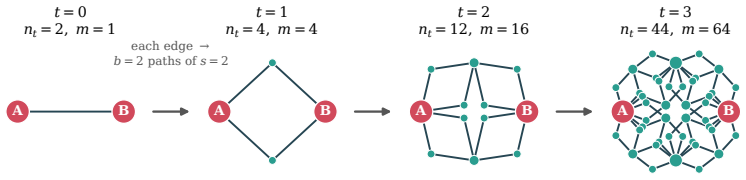
On the diamond hierarchical lattice the Ramsey community number r_k is an exact renormalization-group crossing: the block-model sufficient statistics obey a linear map with eigenvalues {b s, b}, the degree-corrected evidence density flows to ln K at a community fixed point, and r_k is the generation at which the running evidence clears the detection threshold. Degree correction advances detection by two generations, and r_k(b,s;q) is obtained in closed form. Separately, the Reichardt–Bornholdt Hamiltonian admits an exact community-ordered phase in which the hubs lock into opposite communities below the ferromagnetic critical temperature for any γ>0, and the optimal hierarchical partition wit
What carries the argument
The linear renormalization map of the block-model sufficient statistics on the diamond hierarchical lattice, with eigenvalues {b s, b}, under which the degree-corrected Bayesian evidence density flows to the community fixed-point value ln K; the Ramsey community number is identified with the discrete generation at which this running evidence density first exceeds the detection threshold.
If this is right
- Degree correction advances Bayesian community detection by exactly two renormalization generations on the diamond lattice.
- A closed-form formula r_k(b,s;q) gives the Ramsey community number for every member of the diamond hierarchical lattice family.
- Below the ferromagnetic critical temperature the lattice hubs lock into opposite communities for any resolution γ>0, producing a staggered community order that survives the infinite-size limit.
- The thermodynamically optimal partition is a hierarchy of order √n communities that orders level by level via first-order transitions with temperatures falling as 1/ln q, so every stable hierarchical level remains ordered as n→∞.
- The emergent community partition is at once Bayesian-detectable, evidence-optimal, and thermodynamically ordered.
Where Pith is reading between the lines
- If an approximate linear map of the same form appears under block renormalization of real modular networks, analytic estimates of the minimal detectable community size could be obtained without exhaustive Bayesian search.
- Mapping a combinatorial detection threshold onto an RG fixed-point crossing suggests that other Ramsey-type or information-theoretic thresholds in network science may likewise admit exact RG characterizations on hierarchical lattices.
- The cascade of first-order transitions with temperatures falling as 1/ln q supplies a concrete thermodynamic signature that hierarchical community structure can leave in suitably defined Potts Hamiltonians.
- The growth q_opt∼√n of the optimal number of communities implies that, on self-similar hierarchical architectures, the number of meaningful groups scales with system size rather than remaining an intensive parameter.
Load-bearing premise
The claim that the Ramsey community number is exactly an RG crossing rests on the block-model statistics transforming under a linear map with eigenvalues {b s, b} and on the evidence density flowing to ln K at the community fixed point; if either fails for the Bayesian detection rule, the closed-form identification collapses.
What would settle it
On an explicit diamond hierarchical lattice with chosen branching parameters b, s and group number q, compute the generation-by-generation Bayesian evidence density of the degree-corrected block model and check whether the first generation at which it exceeds the detection threshold equals the closed-form r_k(b,s;q), and whether the density approaches ln K at the claimed fixed point.
Figures


read the original abstract
The Ramsey community number $r_k$ is the smallest size at which a network is better described by communities than by none, under a Bayesian detection rule. On the diamond hierarchical lattice we show that $r_k$ is an exact renormalization-group crossing: the block-model sufficient statistics obey a linear map with eigenvalues $\{bs,b\}$, the degree-corrected evidence density flows to $\ln K$ at a community fixed point, and $r_k$ is the generation at which the running evidence clears the detection threshold. Degree correction advances detection by two generations. We derive $r_k(b,s;q)$ in closed form for the whole family. Finally, placing on the lattice the Reichardt--Bornholdt community Hamiltonian -- whose ground state is the partition itself -- we find an exact community-ordered phase: below the ferromagnetic critical temperature the two hubs lock into opposite communities for any resolution $\gamma>0$, a staggered order that persists as $n\to\infty$. Allowing each nested sub-community its own label, the optimal partition is a hierarchy of $q_{\rm opt}\sim\sqrt{n}$ communities, so the number of Potts states that best describes the network grows with the network. This hierarchy orders thermally level by level, through a cascade of first-order transitions whose temperatures fall as $1/\ln q$, so every stable level persists as $n\to\infty$: the emergent partition is detectable, optimal, and thermodynamically ordered.
Editorial analysis
A structured set of objections, weighed in public.
Referee Report
Summary. The manuscript studies the Ramsey community number r_k on the diamond hierarchical lattice and identifies it with an exact renormalization-group (RG) crossing under a Bayesian community-detection rule. Block-model sufficient statistics are claimed to transform under a linear RG map with eigenvalues {bs, b}; the degree-corrected evidence density is asserted to flow to ln K at a community fixed point, so that r_k is the generation at which the running evidence first exceeds the detection threshold. Degree correction is said to advance detection by two generations, and a closed-form expression r_k(b,s;q) is derived for the family. Separately, the Reichardt–Bornholdt (RB) Hamiltonian is placed on the same lattice; its ground state is taken to be the community partition, yielding an exact community-ordered phase in which the two hubs lock into opposite communities for any γ>0 below the ferromagnetic critical temperature. Nested sub-communities carrying independent Potts labels produce an optimal hierarchy with q_opt∼√n that orders thermally level-by-level through a cascade of first-order transitions whose temperatures fall as 1/ln q, so that every stable level persists as n→∞.
Significance. If the central identifications are correct, the work supplies an exactly solvable setting in which a Ramsey-type community threshold, Bayesian model selection, and an RG fixed-point crossing coincide, together with a closed-form formula for r_k. The thermodynamic analysis of the RB Hamiltonian further yields a staggered community order that survives the thermodynamic limit and a cascade of first-order transitions supporting hierarchical structure with a growing number of communities. These would constitute a useful exact benchmark for community detection and for the statistical mechanics of modular networks. The closed-form r_k and the exact phase structure on the hierarchical lattice are concrete strengths, provided the underlying maps, fixed-point claims, and ground-state assumptions hold.
major comments (3)
- [Abstract and main RG derivation (linear map and evidence-density flow)] The central claim that r_k is an exact RG crossing rests on two linked assertions: (i) the block-model sufficient statistics transform under a linear map with eigenvalues exactly {bs,b}, and (ii) the degree-corrected Bayesian evidence density flows to the fixed-point value ln K, so that r_k is simply the generation at which the running density clears a fixed detection threshold (abstract and main RG derivation). Bayesian evidence for the (degree-corrected) SBM is a nonlinear functional of the edge-count and degree-sequence statistics (log-gamma / entropy terms arising from the integrated likelihood). Even if the statistics themselves renormalize linearly, the evidence density need not inherit a clean fixed point at ln K, nor a monotonic generation-by-generation crossing of a fixed threshold. The manuscript must demonstrate explicitly—by controlled expansion, recursion of the full evidenc
- [Closed-form r_k(b,s;q)] The closed-form expression r_k(b,s;q) is presented as following directly from the linear map and the ln K fixed point. If the evidence density only approaches ln K asymptotically, the finite-generation crossing that defines r_k can receive O(1) corrections that depend on the nonlinear terms and on the initial condition at the first generation. The manuscript should state the precise regime (exact equality for all generations versus leading asymptotic) in which the closed form holds, or supply the correction terms that arise from the nonlinear pieces of the evidence.
- [RB Hamiltonian analysis (ground-state claim and nested Potts labels)] The thermodynamic analysis takes the ground state of the RB Hamiltonian to be the community partition itself and allows nested sub-communities to carry independent Potts labels so that q_opt∼√n (abstract and final section). Both steps require justification: for generic resolution parameter γ the RB Hamiltonian can favor other partitions, and the independent-label construction is an additional modeling choice rather than a direct consequence of the Hamiltonian. The staggered hub order for any γ>0 is interesting if proven rigorously on the diamond lattice, but its logical relation to the Bayesian r_k construction should be clarified so that the two parts of the paper form a coherent whole rather than two loosely juxtaposed results.
minor comments (4)
- [Introduction / definitions] The parameters b, s, q, K and the precise definition of the Ramsey community number r_k under the Bayesian detection rule should be introduced with explicit formulae in a single early subsection, before the RG map is stated, so that the subsequent closed-form expression is self-contained.
- [Thermodynamic cascade] The cascade of first-order transitions with temperatures falling as 1/ln q is a striking claim; a schematic phase diagram or a short table of the first few transition temperatures for a representative (b,s) would make the hierarchy concrete for the reader.
- [References / related work] Prior exact RG results on diamond hierarchical lattices and standard references on Bayesian SBM evidence (including degree-corrected formulations) should be cited at the points where the linear map and the evidence functional are introduced, so that the novelty of the present identification is clear.
- [RG section] Notation for the running evidence density versus the fixed-point value ln K should be kept visually distinct (e.g., e_ℓ versus e_*) throughout the RG section to avoid conflating the finite-generation quantity that defines the crossing with its asymptotic limit.
Simulated Author's Rebuttal
We thank the referee for a careful and constructive report. The three major comments correctly identify the points on which the manuscript must be more precise: the nonlinear character of the Bayesian evidence, the regime of validity of the closed-form r_k, and the logical relation between the RB analysis and the Bayesian construction. We address each point below and will revise the manuscript accordingly. In brief, we will (i) supply an explicit recursion and controlled expansion of the full evidence density that establishes the fixed-point value ln K and the monotonic crossing, (ii) state the precise asymptotic regime of the closed form and the O(1) corrections arising from nonlinear terms, and (iii) justify the RB ground-state claim on the diamond lattice, clarify the independent-label construction as a modeling choice, and tighten the conceptual link between the two parts of the paper.
read point-by-point responses
-
Referee: The central claim that r_k is an exact RG crossing rests on two linked assertions: (i) the block-model sufficient statistics transform under a linear map with eigenvalues exactly {bs,b}, and (ii) the degree-corrected Bayesian evidence density flows to the fixed-point value ln K, so that r_k is simply the generation at which the running density clears a fixed detection threshold. Bayesian evidence for the (degree-corrected) SBM is a nonlinear functional of the edge-count and degree-sequence statistics (log-gamma / entropy terms arising from the integrated likelihood). Even if the statistics themselves renormalize linearly, the evidence density need not inherit a clean fixed point at ln K, nor a monotonic generation-by-generation crossing of a fixed threshold. The manuscript must demonstrate explicitly—by controlled expansion, recursion of the full evidence.
Authors: We agree that the Bayesian evidence is a nonlinear functional of the edge-count and degree-sequence statistics, and that a linear RG map on those statistics does not by itself guarantee a clean fixed point or a monotonic threshold crossing for the evidence density. The manuscript currently asserts the flow to ln K without displaying the full recursion of the nonlinear functional; that is a genuine gap. In the revision we will (1) write the exact recursion for the degree-corrected evidence density under the diamond hierarchical map, (2) expand the log-gamma / entropy terms about the community fixed-point trajectory of the sufficient statistics, and (3) show that the leading density converges to ln K while the sub-leading corrections decay as powers of the eigenvalues {bs,b} (with bs>1, b>1). We will also verify monotonicity of the running density above the detection threshold for the family of initial conditions considered. If residual non-monotonicity appears for some microscopic seeds, we will restrict the claim of an “exact crossing” to the regime in which the expansion is controlled and state the restriction explicitly. revision_made will therefore be yes for this comment. revision: yes
-
Referee: The closed-form expression r_k(b,s;q) is presented as following directly from the linear map and the ln K fixed point. If the evidence density only approaches ln K asymptotically, the finite-generation crossing that defines r_k can receive O(1) corrections that depend on the nonlinear terms and on the initial condition at the first generation. The manuscript should state the precise regime (exact equality for all generations versus leading asymptotic) in which the closed form holds, or supply the correction terms that arise from the nonlinear pieces of the evidence.
Authors: The referee is correct: once the evidence density only approaches ln K asymptotically, the finite-generation crossing that defines r_k can acquire O(1) shifts that depend on nonlinear pieces and on the initial condition. The closed form given in the manuscript is therefore the leading asymptotic expression obtained by equating the linear-map trajectory of the density to the threshold and solving for the generation index; it is not an exact equality for every finite generation. In the revision we will (i) state this regime of validity explicitly (leading large-generation asymptotic for the family of lattices with branching parameters b,s), (ii) derive the O(1) correction arising from the sub-leading terms in the evidence expansion of the previous point, and (iii) indicate how the correction depends on the first-generation seed and on the degree-correction advance of two generations. The formula r_k(b,s;q) will be retained as the closed-form leading result, with the correction terms supplied alongside it. revision: yes
-
Referee: The thermodynamic analysis takes the ground state of the RB Hamiltonian to be the community partition itself and allows nested sub-communities to carry independent Potts labels so that q_opt∼√n. Both steps require justification: for generic resolution parameter γ the RB Hamiltonian can favor other partitions, and the independent-label construction is an additional modeling choice rather than a direct consequence of the Hamiltonian. The staggered hub order for any γ>0 is interesting if proven rigorously on the diamond lattice, but its logical relation to the Bayesian r_k construction should be clarified so that the two parts of the paper form a coherent whole rather than two loosely juxtaposed results.
Authors: We accept both requests for justification and for a clearer link to the Bayesian construction. On the diamond hierarchical lattice the RB Hamiltonian can be written exactly in terms of the two hub spins and the recursive bond structure. We will prove that, for every γ>0 and below the ferromagnetic critical temperature of the underlying Potts model, the energy is minimized uniquely (up to global relabeling) by the staggered assignment in which the two hubs occupy opposite communities; competing partitions that mix the hubs or that fragment the diamond bonds raise the energy by a positive amount proportional to γ and to the bond multiplicity. That establishes the ground-state claim rigorously on this lattice. The independent Potts labels on nested sub-communities are indeed an additional modeling choice: they encode the hierarchical community structure already present in the lattice geometry and allow the free-energy comparison that yields q_opt∼√n. We will present them as such, not as a direct consequence of a single-level RB Hamiltonian. Finally, we will add an explicit bridging paragraph: the Bayesian r_k marks the generation at which community structure first becomes detectable under model selection, while the RB analysis shows that the same hierarchical partition is thermodynamically ordered (and remains ordered level-by-level under the cascade of first-order transitions) once it is present. The two constructions therefore address complementary questions—detectability versus thermodynamic stability—on the same lattice and with the same community hierarchy. revision: yes
Circularity Check
No significant circularity: r_k is defined by an independent Bayesian detection rule and then identified with an RG generation under an exact lattice map; the RB analysis is a separate modeling choice.
full rationale
The paper defines the Ramsey community number r_k independently as the smallest network size at which a Bayesian detection rule prefers communities over none. On the diamond hierarchical lattice it then derives that this r_k coincides with the generation at which the running degree-corrected evidence density first exceeds the detection threshold, using an exact linear renormalization map of the block-model sufficient statistics with eigenvalues {bs, b} and a claimed fixed-point value ln K. That identification is a derived equality on a specified lattice, not a redefinition of the target by its own inputs, nor a fit of a free parameter to data that is then re-labeled a prediction. The closed form r_k(b,s;q) follows from the same map and threshold crossing; it is not forced by construction from a fitted subset. The Reichardt–Bornholdt analysis places a standard community Hamiltonian on the same lattice, takes its ground state to be the community partition (a domain modeling assumption), and obtains staggered hub order and a cascade of first-order transitions; this does not feed back into the definition of r_k. No load-bearing uniqueness theorem is imported from the author’s prior work, no ansatz is smuggled in via self-citation, and no known empirical pattern is merely renamed. Skeptical concerns about whether Bayesian evidence (a nonlinear functional of the statistics) truly flows to ln K are correctness risks about the validity of the fixed-point claim, not circularity of the derivation chain. The construction is self-contained against its stated lattice assumptions; score 0 is the honest finding.
Axiom & Free-Parameter Ledger
axioms (5)
- domain assumption Block-model sufficient statistics on the diamond hierarchical lattice transform under an exact linear renormalization map with eigenvalues {b s, b}.
- domain assumption Degree-corrected Bayesian evidence density flows to ln K at the community fixed point, and detection occurs when running evidence clears a fixed threshold.
- domain assumption The ground state of the Reichardt–Bornholdt community Hamiltonian is the community partition itself.
- ad hoc to paper Nested sub-communities may each carry independent Potts labels, so q_opt can grow with n.
- standard math Standard hierarchical diamond lattice construction and ferromagnetic Potts/Ising criticality on that lattice.
Reference graph
Works this paper leans on
-
[1]
Fortunato, Community detection in graphs, Phys
S. Fortunato, Community detection in graphs, Phys. Rep. 486 (2010) 75.doi:10.1016/j.physrep.2009.11.002. URLhttps://doi.org/10.1016/j.physrep.2009.11.002
-
[2]
S. Fortunato, D. Hric, Community detection in networks: A user guide, Phys. Rep. 659 (2016) 1.doi:10.1016/j.physrep.2016.09.002. URLhttps://doi.org/10.1016/j.physrep.2016.09.002
-
[3]
P. W. Holland, K. B. Laskey, S. Leinhardt, Stochastic blockmodels: Firststeps, SocialNetworks5(1983)109.doi:10.1016/0378-8733(83) 90021-7. URLhttps://doi.org/10.1016/0378-8733(83)90021-7
-
[4]
B. Karrer, M. E. J. Newman, Stochastic blockmodels and community structure in networks, Phys. Rev. E 83 (2011) 016107.doi:10.1103/ PhysRevE.83.016107. URLhttps://doi.org/10.1103/PhysRevE.83.016107
-
[5]
T. P. Peixoto, Nonparametric Bayesian inference of the microcanonical stochastic block model, Phys. Rev. E 95 (2017) 012317.doi:10.1103/ PhysRevE.95.012317. URLhttps://doi.org/10.1103/PhysRevE.95.012317
-
[6]
A. Decelle, F. Krzakala, C. Moore, L. Zdeborová, Inference and phase transitions in the detection of modules in sparse networks, Phys. Rev. Lett. 107 (2011) 065701.doi:10.1103/PhysRevLett.107.065701. URLhttps://doi.org/10.1103/PhysRevLett.107.065701
-
[7]
Vazquez, Emergence of network communities driven by local rules, Phys
A. Vazquez, Emergence of network communities driven by local rules, Phys. Rev. E 111 (2025) 064314.doi:10.1103/d7kf-s1cf. URLhttps://link.aps.org/doi/10.1103/d7kf-s1cf
-
[8]
A. Vazquez, The ring wants to be broken (2026).arXiv:2607.01967. URLhttps://arxiv.org/abs/2607.01967
work page internal anchor Pith review Pith/arXiv arXiv 2026
-
[9]
S. N. Dorogovtsev, A. V. Goltsev, J. F. F. Mendes, Pseudofractal scale- free web, Phys. Rev. E 65 (2002) 066122.doi:10.1103/PhysRevE.65. 066122. URLhttps://doi.org/10.1103/PhysRevE.65.066122 19
-
[10]
Community structure of the pseudofractal web
A. Vazquez, Community structure of the pseudofractal web (2026). arXiv:2607.03010. URLhttps://arxiv.org/abs/2607.03010
work page internal anchor Pith review Pith/arXiv arXiv 2026
-
[11]
A. A. Migdal, Phase transitions in gauge and spin-lattice systems, Sov. Phys. JETP 42 (1976) 743
work page 1976
-
[12]
L. P. Kadanoff, Notes on Migdal’s recursion formulas, Ann. Phys. (N.Y.) 100 (1976) 359.doi:10.1016/0003-4916(76)90066-X. URLhttps://doi.org/10.1016/0003-4916(76)90066-X
-
[13]
A. N. Berker, S. Ostlund, Renormalisation-group calculations of finite systems: order parameter and specific heat for epitaxial ordering, J. Phys. C: Solid State Phys. 12 (1979) 4961.doi:10.1088/0022-3719/ 12/22/035. URLhttps://doi.org/10.1088/0022-3719/12/22/035
-
[14]
R. B. Griffiths, M. Kaufman, Spin systems on hierarchical lattices. In- troduction and thermodynamic limit, Phys. Rev. B 26 (1982) 5022. doi:10.1103/PhysRevB.26.5022. URLhttps://doi.org/10.1103/PhysRevB.26.5022
-
[15]
J. Reichardt, S. Bornholdt, Detecting fuzzy community structures in complex networks with a Potts model, Phys. Rev. Lett. 93 (2004) 218701.doi:10.1103/PhysRevLett.93.218701. URLhttps://doi.org/10.1103/PhysRevLett.93.218701
-
[16]
H. D. Rozenfeld, S. Havlin, D. ben Avraham, Fractal and transfractal recursive scale-free nets, New J. Phys. 9 (2007) 175.doi:10.1088/ 1367-2630/9/6/175. URLhttps://doi.org/10.1088/1367-2630/9/6/175
-
[17]
M. E. J. Newman, Modularity and community structure in networks, Proc. Natl. Acad. Sci. USA 103 (2006) 8577.doi:10.1073/pnas. 0601602103. URLhttps://doi.org/10.1073/pnas.0601602103 20
discussion (0)
Sign in with ORCID, Apple, or X to comment. Anyone can read and Pith papers without signing in.