REVIEW 2 major objections 6 minor 21 references
Decentralized clustering protocol matches centralized federated learning accuracy
Reviewed by Pith at T0; open to challenge. T0 means a machine referee read the full paper against a public rubric. the ladder, T0–T4 →
T0 review · glm-5.2
2026-07-08 18:51 UTC pith:OMCJXPGJ
load-bearing objection Decent clustering protocol for FL in sensor networks, but the central accuracy claim is undermined by the absence of inter-cluster aggregation and untested non-IID data the 2 major comments →
FLAIR: Distributed Federated Learning with Dynamic Clustering
The pith
A machine-rendered reading of the paper's core claim, the machinery that carries it, and where it could break.
Core claim
The paper claims that independent in-cluster federated learning, organized through dynamic resource-aware clustering with verifiable elections, can match or exceed the accuracy of centralized federated learning in wireless sensor networks. The discovery rests on showing that clusters re-formed each round from a rotating set of resource-biased cluster heads can each converge to models competitive with globally aggregated ones, while gaining resilience to node failures and mobility. The protocol's resource score weights CPU, RAM, GPU, and bandwidth equally, and the cluster-head election threshold scales this score by a target cluster-head fraction and a round-modulation term inherited from LE.
What carries the argument
The protocol's core machinery is a two-phase round structure: (1) network clustering via probabilistic, resource-aware cluster-head election using a Verifiable Random Function, and (2) in-cluster federated learning via local training and simple averaging aggregation within each cluster. The election threshold T(n) = p * R_n / (1 - p * (r mod 1/p)) biases selection toward resource-rich nodes while maintaining LEACH-style rotational load balancing. No inter-cluster model exchange occurs.
Load-bearing premise
The protocol trains models independently within each cluster with no mechanism for clusters to exchange or globally aggregate their models, yet claims accuracy competitive with centralized federated learning. This works only if the data distribution across clusters is sufficiently uniform; the paper does not evaluate non-IID data partitions, which are the standard challenging regime for federated learning.
What would settle it
Run FLAIR on a dataset partitioned non-IID across clusters (e.g., label-skewed or feature-skewed partitions). If in-cluster-only training diverges significantly from centralized accuracy, the core claim of competitive performance collapses.
If this is right
- If in-cluster-only training matches centralized accuracy, then many federated learning deployments could eliminate global aggregation servers entirely, reducing infrastructure costs and eliminating single points of failure.
- The resource-aware election mechanism could be extended to optimize for energy consumption directly, since cluster-head duty is the most energy-intensive role in sensor networks.
- The verifiable randomness component suggests a path toward Byzantine-resilient federated learning in trustless multi-party settings, since election outcomes are publicly auditable.
- The protocol's resilience to 90% node failures, if robust, could enable federated learning in extreme environments such as disaster zones or military sensor networks where node attrition is expected.
Where Pith is reading between the lines
- The absence of inter-cluster model exchange means each cluster converges to a local optimum based only on its members' data. The reported competitive accuracy likely depends on data being approximately identically distributed across clusters. Under non-IID data partitions, which are common in real federated settings, in-cluster-only training would likely diverge from centralized performance.
- The use of logistic regression as the sole learning task leaves open whether the approach scales to deep neural networks, where the cost of model averaging and the sensitivity to data heterogeneity are both higher.
- A natural extension would be periodic inter-cluster model synchronization at a low frequency, which could preserve the resilience benefits while mitigating the non-IID divergence risk.
- The equal weighting of CPU, RAM, GPU, and bandwidth in the resource score is a design choice that may not be optimal; the sensitivity of results to these weights is not explored.
Editorial analysis
A structured set of objections, weighed in public.
Referee Report
Summary. The paper introduces FLAIR, a decentralized federated learning protocol for sensor networks that combines LEACH-style probabilistic cluster-head election with resource-aware scoring and verifiable randomness (VRF). The protocol operates in rounds: clusters form via a VRF-based election biased toward resource-rich nodes, then each cluster independently trains and aggregates a model using simple averaging (Eq. 3). The authors evaluate FLAIR in ns-3 against centralized FL (C-FL), GAIA, HEAL, and Gossip Learning across four scenarios: static networks, node dropouts up to 90%, mobility, and a smart farming application. FLAIR reports ~0.91 accuracy in static networks (vs. ~0.90 for C-FL), graceful degradation above 0.85 under extreme failures, <2% loss under mobility, and within 0.2% of centralized FL in the smart farming scenario.
Significance. The paper addresses a relevant problem at the intersection of WSN clustering and federated learning. The integration of VRF-based verifiable randomness into cluster-head election is a reasonable design choice for tamper-resistance in infrastructure-less settings. The ns-3 evaluation across four scenarios with multiple baselines is commendable in scope, and the resilience experiments (up to 90% node failure) are informative. However, the central accuracy claim rests on an unstated data-distribution assumption that undermines the comparison to centralized FL, and the absence of error bars or confidence intervals makes the reported ~1% accuracy margins difficult to interpret. The protocol design itself (Eqs. 1–2, Algorithms 1–3) is internally consistent and clearly specified.
major comments (2)
- Section 3.2 states 'No inter-cluster coordination is required,' and Algorithm 3 with Eq. (3) confirms that each cluster independently trains and aggregates with no global model synchronization. Yet the paper claims accuracy competitive with centralized FL (~0.91 vs. ~0.90, Figure 2). Without inter-cluster aggregation, each cluster converges to a local optimum based only on its members' data. The reported competitive accuracy can only hold if data is approximately i.i.d. across clusters, so that each cluster's local model approximates the global model. The paper does not specify how the Spambase dataset is partitioned across nodes (Section 4.1), nor does it evaluate non-IID data partitions, which is the standard challenging regime for federated learning. This is load-bearing for the central claim of 'superior performance.' The authors should either (a) explicitly state the data partition,
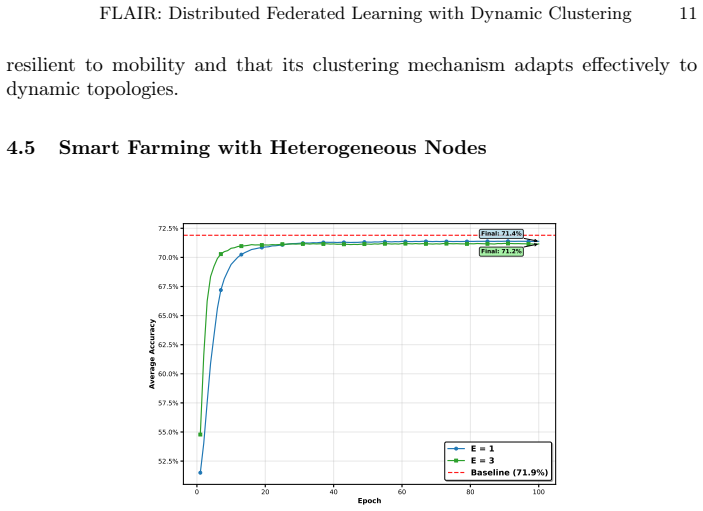
- Figure 2 reports FLAIR at ~0.91 vs. C-FL, HEAL, and Gossip at ~0.90 — a ~1% margin. Section 4.1 mentions 'each configuration was executed multiple times with different random seeds, and the reported curves correspond to the empirical mean,' but no error bars, standard deviations, or confidence intervals are shown in any figure. Without variance information, it is unclear whether the ~1% accuracy difference is statistically significant or within noise. This directly affects the claim of 'outperforming all baselines.' The authors should add error bars or confidence intervals to Figures 2–6 and report whether differences are statistically significant.
minor comments (6)
- Equation (1): the threshold T(n) = p·R_n / (1 - p·(r mod 1/p)) can exceed 1 when R_n is close to 1 and r mod (1/p) is small, since the denominator approaches 1 - p·(small value). Since T(n) is compared against x ~ Uniform(0,1), values of T(n) > 1 would make election deterministic. The authors should clarify whether T(n) is clamped to [0,1].
- Section 3.3, Step 1: the eligibility rule states a node is ineligible if it 'has not acted as one during the last 1/p rounds.' This phrasing is ambiguous — it should read 'has acted as CH during the last 1/p rounds' to correctly describe the exclusion condition. Also, Algorithm 1 does not show how the eligibility set G is maintained across rounds.
- Table 2: FLAIR is listed with 'E = 3' but no learning rate η is specified, while C-FL lists η = 0.01. The learning rate for FLAIR should be stated explicitly for reproducibility.
- The paper uses logistic regression on Spambase (binary classification). This is a relatively simple model and dataset. The authors should discuss whether the findings generalize to other model classes.
- References [10] (HEAL) and [16] (Kaggle dataset) are cited; HEAL is described as a 'hybrid approach with dynamically elected hubs' but the key distinction from FLAIR's own dynamic clustering is not discussed. The authors should clarify what FLAIR contributes beyond HEAL's hub-based approach.
- Section 4.4: 'five standard mobility models [1]' are referenced but not named in the text. The reader must consult reference [1] to identify them. Listing the model names in the text or in a table caption would improve readability.
Simulated Author's Rebuttal
We thank the referee for a careful and constructive review. Both major comments identify genuine gaps in our experimental presentation that we will address in the revised manuscript. Below we respond to each point.
read point-by-point responses
-
Referee: Section 3.2 states 'No inter-cluster coordination is required,' and Algorithm 3 with Eq. (3) confirms that each cluster independently trains and aggregates with no global model synchronization. Yet the paper claims accuracy competitive with centralized FL (~0.91 vs. ~0.90, Figure 2). Without inter-cluster aggregation, each cluster converges to a local optimum based only on its members' data. The reported competitive accuracy can only hold if data is approximately i.i.d. across clusters, so that each cluster's local model approximates the global model. The paper does not specify how the Spambase dataset is partitioned across nodes (Section 4.1), nor does it evaluate non-IID data partitions, which is the standard challenging regime for federated learning. This is load-bearing for the central claim of 'superior performance.' The authors should either (a) explicitly state the data partition,
Authors: The referee is correct on both counts. First, the data partitioning scheme is indeed unspecified in the current manuscript, and this is an omission we will fix. In our experiments, the Spambase dataset was randomly and uniformly distributed across the 100 nodes, which corresponds to an approximately IID partition. This is precisely why each cluster's independently trained model can approximate the global model and achieve accuracy competitive with centralized FL. We will state this explicitly in the revised Section 4.1. Second, the referee is right that this IID assumption is load-bearing for the accuracy comparison and that non-IID partitions are the standard challenging regime for federated learning. We acknowledge that under non-IID data distributions (e.g., label-skew or quantity-skew partitions), FLAIR's independent in-cluster training without inter-cluster aggregation would likely produce divergent local models and degraded accuracy relative to centralized FL. This is a fundamental limitation of the no-inter-cluster-coordination design choice: it trades global model consistency for decentralization and resilience. In the revision, we will: (a) explicitly state the IID data partition assumption and explain why it enables the competitive accuracy; (b) add a non-IID experiment using a Dirichlet-based label-skew partition to quantify the accuracy gap; and (c) temper the 'superior performance' language to clarify that the accuracy advantage holds under approximately IID conditions, while FLAIR's primary contributions lie in decentralization, resilience, and fault tolerance rather than accuracy gains over centralized FL. revision: yes
-
Referee: Figure 2 reports FLAIR at ~0.91 vs. C-FL, HEAL, and Gossip at ~0.90 — a ~1% margin. Section 4.1 mentions 'each configuration was executed multiple times with different random seeds, and the reported curves correspond to the empirical mean,' but no error bars, standard deviations, or confidence intervals are shown in any figure. Without variance information, it is unclear whether the ~1% accuracy difference is statistically significant or within noise. This directly affects the claim of 'outperforming all baselines.' The authors should add error bars or confidence intervals to Figures 2–6 and report whether differences are statistically significant.
Authors: The referee is correct. We ran multiple seeds and reported only the empirical mean without displaying variance, which makes it impossible to assess the statistical significance of the ~1% accuracy differences. This is a valid concern. We will add shaded confidence intervals (or error bars) to Figures 2–6 in the revised manuscript. We will also report standard deviations in the text and conduct pairwise significance tests (e.g., paired t-tests or Wilcoxon signed-rank tests) for the key comparisons in Experiment 1. We acknowledge that the ~1% margin between FLAIR and C-FL/HEAL/Gossip may not be statistically significant, and if that proves to be the case after the tests, we will revise the language accordingly — replacing 'outperforming all baselines' with a more precise statement such as 'achieving comparable accuracy to centralized FL while providing decentralization and resilience advantages.' The claims about convergence speed (e.g., 2.5× faster than GAIA) and resilience under extreme failures are based on larger effect sizes and should remain well-supported, but we will report variance for those results as well. revision: yes
Circularity Check
No circularity: FLAIR's protocol design is defined independently of its evaluation results, and accuracy claims are empirical measurements from ns-3 simulations against external baselines.
full rationale
The paper's derivation chain is self-contained and not circular. The protocol components (Eqs. 1-2 for cluster-head election, Algorithm 3 and Eq. 3 for in-cluster aggregation) are defined independently of the simulation results. The accuracy claims (~0.91 in static networks, >0.85 under 90% failures, <2% loss under mobility) are empirical measurements from ns-3 simulations benchmarked against external baselines (C-FL, GAIA, HEAL, Gossip), not quantities derived from the paper's own equations. The resource-aware scoring mechanism (Eq. 2) uses fixed equal weights (0.25 each) set a priori, not fitted to outcomes. Self-citation is limited to HEAL [10], authored by one co-author (Legheraba), but HEAL is used only as a comparison baseline, not as a load-bearing assumption or premise for FLAIR's design. The LEACH protocol [4] is cited as inspiration but is an external, independently published result. No prediction or first-principles result reduces to its inputs by construction. The reader's concern about the lack of inter-cluster synchronization and untested non-IID data partitions is a correctness risk (the competitive accuracy may not hold under non-IID conditions), not a circularity issue.
Axiom & Free-Parameter Ledger
free parameters (4)
- p (target CH fraction) =
not specified
- alpha, beta, gamma, delta (resource weights) =
0.25 each
- E (local epochs) =
1 and 3
- eta (learning rate) =
0.01
axioms (3)
- domain assumption Data is i.i.d. across nodes and clusters
- domain assumption VRF is available and computable on resource-constrained sensor nodes
- domain assumption Single-hop intra-cluster communication is sufficient
read the original abstract
Federated Learning (FL) offers a privacy-preserving framework for distributed machine learning, yet conventional centralized and hierarchical architectures present significant challenges in terms of scalability, resilience, and single points of failure, particularly in dynamic, infrastructure-less environments such as sensor networks. To address these limitations, we introduce FLAIR, a novel, fully decentralized FL protocol that integrates dynamic, resource-aware secure and self-organized clustering with in-cluster model training. FLAIR leverages a probabilistic, verifiable cluster-head election mechanism, which is enhanced to favor nodes with greater computational and communication capabilities, thereby ensuring both fairness and efficiency. Through comprehensive simulations in ns-3, we evaluate FLAIR against centralized, hierarchical, and gossip-based FL benchmarks across four demanding scenarios. The results demonstrate the superiority of our approach: in static 100-node networks, FLAIR achieves a final accuracy of approximately 0.91, outperforming all baselines. The protocol exhibits exceptional robustness, maintaining graceful degradation with accuracy above 0.85 even under 90% node failure rates. Furthermore, it shows strong resilience to mobility, with a performance loss of less than 2% compared to static deployments. In a realistic smart farming simulation, FLAIR's accuracy is within 0.2% of the centralized baseline, confirming its practical viability. These findings validate that FLAIR successfully combines the scalability of decentralized learning with the structural efficiency of clustering, presenting a robust and high performing solution for large-scale, heterogeneous IoT systems.
Figures



Reference graph
Works this paper leans on
-
[1]
Bai, F., Helmy, A.: A survey of mobility models. Wireless Adhoc Networks. Univer- sity of Southern California, USA206, 147 (2004) FLAIR: Distributed Federated Learning with Dynamic Clustering 13
work page 2004
-
[2]
In: Advances in Neural Information Processing Systems (NeurIPS) (2024)
De Vos, M., Farhadkhani, S., Guerraoui, R., Kermarrec, A.M., Pires, R., Sharma, R.: Epidemic learning: Boosting decentralized learning with randomized communication. In: Advances in Neural Information Processing Systems (NeurIPS) (2024)
work page 2024
-
[3]
IEEE Transactions on Wireless Communications 1(4), 660–670 (2002)
Heinzelman, W.B., Chandrakasan, A.P., Balakrishnan, H.: An application-specific protocol architecture for wireless microsensor networks. IEEE Transactions on Wireless Communications 1(4), 660–670 (2002)
work page 2002
-
[4]
In: Proceedings of the 33rd Annual Hawaii International Conference on System Sciences
Heinzelman, W.R., Chandrakasan, A., Balakrishnan, H.: Energy-efficient commu- nication protocol for wireless microsensor networks. In: Proceedings of the 33rd Annual Hawaii International Conference on System Sciences. pp. 10–pp. IEEE (2000)
work page 2000
-
[5]
UCI Ma- chine Learning Repository (1999),https://archive.ics.uci.edu/ml/datasets/ spambase
Hopkins, M., Reeber, E., Forman, G., Suermondt, J.: Spambase data set. UCI Ma- chine Learning Repository (1999),https://archive.ics.uci.edu/ml/datasets/ spambase
work page 1999
-
[6]
Hosmer Jr, D.W., Lemeshow, S., Sturdivant, R.X.: Applied logistic regression. John Wiley & Sons (2013)
work page 2013
-
[7]
In: 14th USENIX symposium on networked systems design and implementation (NSDI 17)
Hsieh, K., Harlap, A., Vijaykumar, N., Konomis, D., Ganger, G.R., Gibbons, P.B., Mutlu, O.: Gaia:{Geo-Distributed} machine learning approaching{LAN} speeds. In: 14th USENIX symposium on networked systems design and implementation (NSDI 17). pp. 629–647 (2017)
work page 2017
-
[8]
Foundations and Trends in Machine Learning14(1-2), 1–210 (2021)
Kairouz, P., McMahan, H.B., et al.: Advances and open problems in federated learning. Foundations and Trends in Machine Learning14(1-2), 1–210 (2021)
work page 2021
-
[9]
Peer-to-peer Federated Learning on Graphs
Lalitha, A.T.S., Shekhar, S., Javidi, T., Kairouz, P.: Peer-to-peer federated learning on graphs. arXiv preprint arXiv:1901.11173 (2019)
work page internal anchor Pith review Pith/arXiv arXiv 1901
-
[10]
Legheraba, M.A., Galkiewicz, S., Potop-Butucaru, M., Tixeuil, S.: Heal: Resilient and self-* hub-based learning. In: Proceedings of the 39th IEEE International Conference on Advanced Information Networking and Applications (AINA) (2025)
work page 2025
-
[11]
IEEE Communications Surveys & Tutorials22(3), 2031–2063 (2020)
Lim, W.Y.B., Luong, N.C., Hoang, D.T., Jiao, Y., Liang, Y.C., Yang, Q., Niyato, D., Miao, C.: Federated learning in mobile edge networks: A comprehensive survey. IEEE Communications Surveys & Tutorials22(3), 2031–2063 (2020)
work page 2031
-
[12]
In: Proceedings, IEEE Aerospace Conference
Lindsey, S., Raghavendra, C.S.: Pegasis: Power-efficient gathering in sensor infor- mation systems. In: Proceedings, IEEE Aerospace Conference. vol. 3, pp. 3–1125. IEEE (2002)
work page 2002
-
[13]
Proceedings of the 29th International Joint Conference on Artificial Intelligence (IJCAI) pp
Liu, Y., Kang, Y., Xing, C., Chen, T., Yang, Q.: Client-edge-cloud hierarchical federated learning. Proceedings of the 29th International Joint Conference on Artificial Intelligence (IJCAI) pp. 4651–4657 (2020)
work page 2020
-
[14]
IEEE Transactions on Industrial Informatics17(7), 5098–5107 (2020)
Lu, Y., Huang, X., Zhang, K., Maharjan, S., Zhang, Y.: Low-latency federated learning and blockchain for edge association in digital twin empowered 6g networks. IEEE Transactions on Industrial Informatics17(7), 5098–5107 (2020)
work page 2020
-
[15]
In: Artificial intelligence and statistics
McMahan, B., Moore, E., Ramage, D., Hampson, S., y Arcas, B.A.: Communication- efficient learning of deep networks from decentralized data. In: Artificial intelligence and statistics. pp. 1273–1282. PMLR (2017)
work page 2017
-
[16]
Nelakurthi, S.: Dataset for predicting watering the plants. https://www.kaggle.com/datasets/nelakurthisudheer/ dataset-for-predicting-watering-the-plants (2021), accessed: Septem- ber 24, 2025
work page 2021
-
[17]
Concurrency and Computation: Practice and Experience25(4), 556–571 (2013)
Ormándi, R., Hegedűs, I., Jelasity, M.: Gossip learning with linear models on fully distributed data. Concurrency and Computation: Practice and Experience25(4), 556–571 (2013)
work page 2013
-
[18]
and defences, experimental study and challenges
Rodríguez-Barroso, N., Jiménez-López, D., Luzón, M., Herrera, F., Martínez- Cámara, E.: Survey on federated learning threats: Concepts, taxonomy on attacks 14 Boutebicha et al. and defences, experimental study and challenges. Information Fusion90, 148–173 (2023)
work page 2023
-
[19]
International Journal of Electrical and Computer Engineering Systems 14(7), 733-742 (2023)
Swetha Priya, T.C., Sridevi, R.: Novel clustering techniques in wireless sensor networks – a survey. International Journal of Electrical and Computer Engineering Systems 14(7), 733-742 (2023)
work page 2023
-
[20]
Xiao, B., Yu, X., Ni, W., Wang, X., Poor, H.V.: Over-the-air federated learning: Status quo, open challenges, and future directions. Fundamental Research (2024)
work page 2024
-
[21]
IEEE Transactions on Mobile Computing 3(4), 366–379 (2004)
Younis, O., Fahmy, S.: Heed: A hybrid, energy-efficient, distributed clustering approach for ad hoc sensor networks. IEEE Transactions on Mobile Computing 3(4), 366–379 (2004)
work page 2004
discussion (0)
Sign in with ORCID, Apple, or X to comment. Anyone can read and Pith papers without signing in.