REVIEW 1 major objections 7 minor 50 references
Simplified quantum key distribution implementation secure in the presence of state preparation flaws
T0 review · 1 major / 7 minor · reviewed 2026-07-08 · glm-5.2
Pith's one-line read QKD stays secure at 151 km despite flawed state preparation
desk verdict Adaptation of loss-tolerant method to simplified three-state BB84 is correct and useful; decoy-state analysis has an unaddressed gap from intensity-encoding correlations read the letter →
The pith
A machine-rendered reading of the paper's core claim, the machinery that carries it, and where it could break.
The reading
What carries the argument
The POVM identity M0X = M0Z + M1Z − M1X (Eq. 8), which reconstructs the missing |+⟩ projection from available |0⟩, |1⟩, and |−⟩ measurements, enabling the loss-tolerant phase error rate estimation from characterized imperfect states in the simplified three-state BB84 protocol.
What would settle it
If the state preparation flaws drift between calibration and key exchange (e.g., due to temperature changes or bias voltage adjustments), the phase error rate computed from stale characterization data would be invalid, and the security claim would not hold.
Extended reading notes
Core claim
The key technical discovery is that the POVM identity M0X = M0Z + M1Z - M1X allows the loss-tolerant method to be applied to the simplified three-state BB84 protocol, which lacks a direct projection onto the |+⟩ state. By expressing the missing |+⟩ projection as a linear combination of the |0⟩, |1⟩, and |−⟩ projections that the passive measurement scheme does provide, the authors can compute all virtual yields needed for the phase error rate estimation from experimentally accessible statistics. This bridges two previously separate results: the simplified protocol's measurement scheme and the loss-tolerant method's handling of state preparation flaws. When applied to measured states with ~0.2
Load-bearing premise
The security analysis assumes that the state preparation flaws measured during calibration remain unchanged during the subsequent key exchange. If temperature drift, bias voltage changes, or other environmental factors shift the flaws between calibration and key exchange, the phase error rate estimate uses stale parameters.
Editorial extensions
If this is right
- QKD systems operating at high repetition rates can trade speed for provable security by characterizing state preparation flaws and incorporating them into the loss-tolerant analysis, rather than relying on unverified assumptions of perfect state preparation.
- The finding that assuming perfect states overestimates key rates by up to 40% suggests that published QKD performance figures without state characterization may be systematically optimistic.
- The observed correlations between intensity levels and bit encoding, arising from a single intensity modulator performing both tasks, indicate that future security analyses must handle multiple side-channels simultaneously rather than one at a time.
- The characterization method—using Bob's existing detectors with all bits revealed during calibration—requires no additional hardware, making implementation security accessible to existing QKD deployments.
Reading between the lines
- The characterization schemes discussed in Appendix B (replica receiver, bidirectional calibration) could enable periodic re-characterization during key exchange, which would address the SPF stability assumption if implemented as an interleaved calibration-key-exchange protocol.
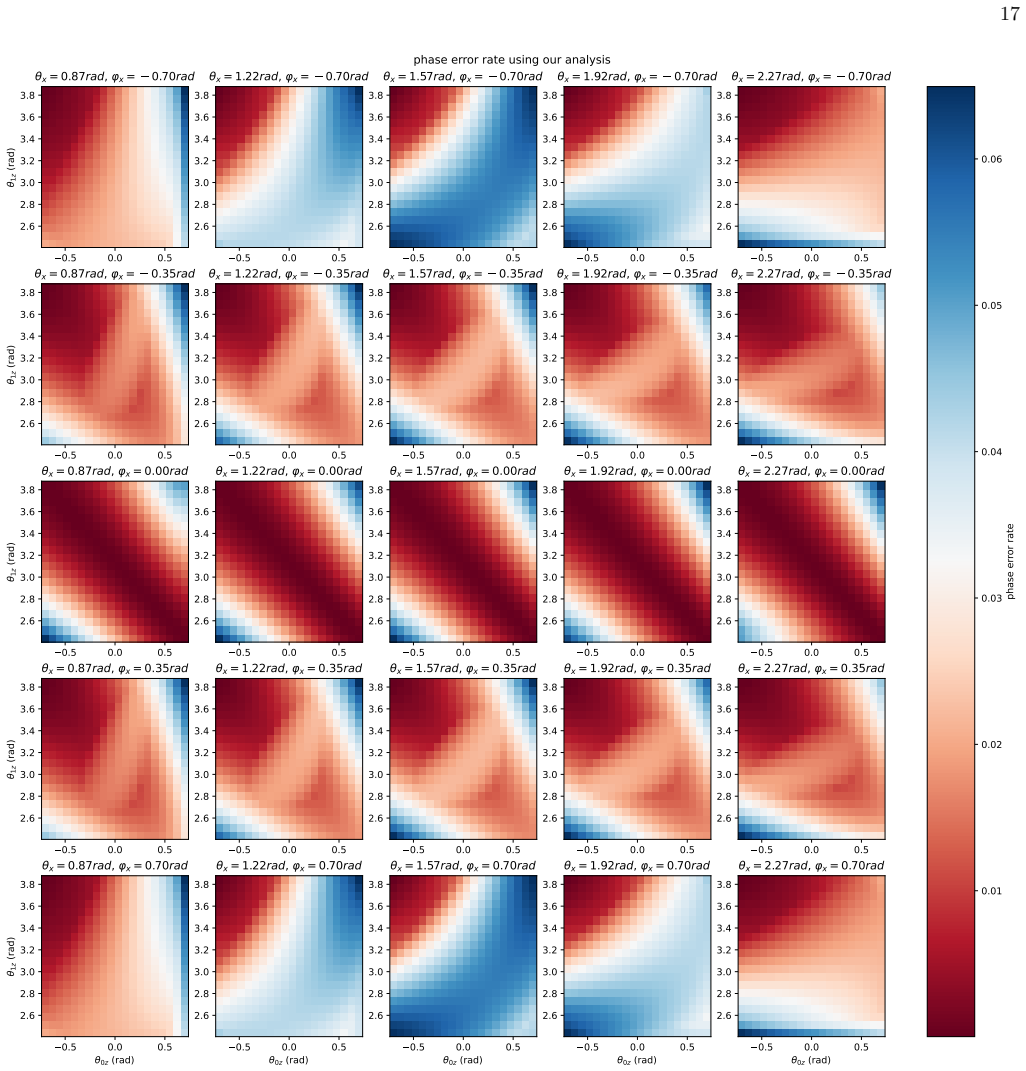
- The simulation results in Figs. 8-9 showing that phase error rate stays minimal when δθ0Z = δθ1Z suggest a design principle: engineering state preparation flaws to be symmetric across Z-basis states could minimize the security penalty without requiring perfect states.
- The matrix formalism (Eq. C18, qs = B^{-1}bs) being independent of Bob's basis choice probabilities suggests the security bound is robust to passive basis choice ratio optimization, allowing free tuning of pBZ for key rate without affecting the security guarantee.
Signed reviews
Editorial analysis
A structured set of objections, weighed in public.
Referee Report
Summary. This paper presents an implementation of a three-state BB84 protocol with time-bin encoding, one decoy state, and passive basis choice. The main contribution is adapting the loss-tolerant (LT) method of Tamaki et al. [12] to the simplified measurement scheme of Rusca et al. [20], enabling security analysis that incorporates measured state preparation flaws (SPFs) rather than assuming perfect state preparation. The key technical step is Eq. (8), which recovers the missing |+⟩ projection from available POVM elements via a linear combination. The authors demonstrate secret key exchange over 101.4 km, 112.6 km, and 151 km of ultra-low-loss fiber, showing that including SPFs increases the estimated phase error rate compared to the perfect-state assumption. The security proof is detailed in Appendix C and includes a sanity-check reduction to the perfect-state case (Eq. C49, matching [20]).
Significance. The paper makes a useful contribution to implementation security in QKD. The adaptation of the LT method to the simplified three-state protocol with passive basis choice is non-trivial: the protocol only provides access to the |−⟩ projection in the X basis, and the authors show how to recover the missing |+⟩ statistics using Eq. (8) and the side-bin Z-basis projections. The state characterization method is practical—it requires no setup modification beyond running the protocol with Bob revealing his bits during calibration. The reduction to the perfect-state case (§C.3, Eq. C49) provides a valuable consistency check. The experimental demonstration over 151 km with positive key rates under the LT analysis, and the quantitative comparison showing ~40% SKR reduction versus the perfect-state assumption, concretely illustrate the security cost of ignoring SPFs. The simulation plots in Figs. 8–11 provide intuition for how SPFs in different states affect the phase error rate.
major comments (1)
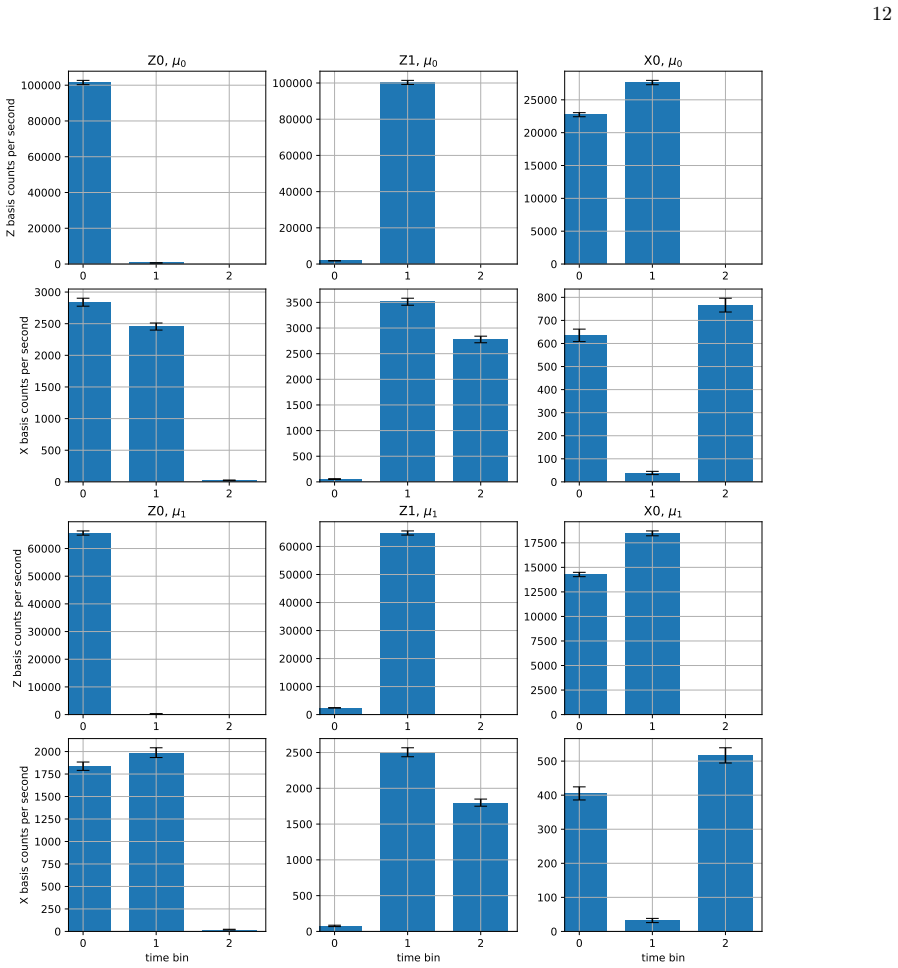
- §C.4, Eqs. (C54)–(C57): The decoy-state bounds use nominal mean photon numbers μ₀ = 0.5 and μ₁ = 0.23 for all encodings A ∈ {0Z, 1Z, 0X}. However, Fig. 3a and §IV show that the actual mean photon numbers μ_{k,A} depend on the encoding due to the single intensity modulator implementing both qubit and decoy encoding. The bounds in Eqs. (C54) and (C57) apply the factor e^{μ_k}/p_{μ_k} to raw counts n(exp)_{ti,a,μk} that are aggregated over encodings. If the actual μ_{k,A} deviates from the nominal μ_k for some encodings, the multi-photon contribution is misestimated, which propagates into the single-photon bounds s_Z and s_{Xside,Z} in Eq. (9), and thus into the final phase error rate ϕ_Z. The paper acknowledges the intensity-encoding correlations exist (§IV, §VII) and states 'we only consider SPFs,' but it does not explicitly address whether the decoy-state bounds themselves are affected.请
minor comments (7)
- §IV, Table I: The φ values for 0Z at 101.4 km differ significantly between μ₀ (0.5 rad) and μ₁ (1.9 rad). This large discrepancy is not discussed. A brief comment on whether this affects the analysis (which uses only μ₀ for the LT method) would help the reader.
- §V, Eq. (9): The finite-key correction γ depends on Q_X itself (through the (1−b)b factor in Eq. 10). It would help to clarify whether this is solved self-consistently or whether an upper bound on Q_X is used as input.
- §VI, Table II: The QBER_Z at 101.4 km (2.35%) is higher than at 112.6 km (1.89%), attributed to worse dispersion compensation. This is mentioned in the text but not in the table caption; a footnote or note would improve clarity.
- Appendix B, Eqs. (B2)–(B11): The characterization assumes dark counts are negligible. Given the 151 km channel (~25.7 dB loss) and dark count rate of 8 cps, a brief justification of this assumption at the longest distance would strengthen the analysis.
- §C.2.b, Eq. (C26): The states are written with φ = 0, but the measured φ values in Table I are non-zero (especially for 0Z). §VI mentions adjusting θ when φ > π/2, but the general treatment of non-zero φ in the security proof could be stated more explicitly, given that the LT method is stated to hold for arbitrary φ when states are linearly independent [12].
- Fig. 4: The y-axis label 'PA block number' could be confused with privacy amplification; clarifying that this refers to data blocks processed for parameter estimation would help.
- References: Several references are to 2025-dated works (e.g., [23], [26], [33], [34], [37], [38]). If these are not yet published, preprint identifiers should be included for traceability.
Simulated Author's Rebuttal
The referee raises a valid concern about whether the intensity-encoding correlations documented in our system (Fig. 3a, §IV) affect the decoy-state bounds in Eqs. (C54)–(C57), which use nominal mean photon numbers rather than encoding-dependent values. We acknowledge this is a genuine gap in the current analysis and will revise the manuscript to explicitly address it.
read point-by-point responses
-
Referee: §C.4, Eqs. (C54)–(C57): The decoy-state bounds use nominal mean photon numbers μ₀ = 0.5 and μ₁ = 0.23 for all encodings A ∈ {0Z, 1Z, 0X}. However, Fig. 3a and §IV show that the actual mean photon numbers μ_{k,A} depend on the encoding due to the single intensity modulator implementing both qubit and decoy encoding. The bounds in Eqs. (C54) and (C57) apply the factor e^{μ_k}/p_{μ_k} to raw counts n(exp)_{ti,a,μk} that are aggregated over encodings. If the actual μ_{k,A} deviates from the nominal μ_k for some encodings, the multi-photon contribution is misestimated, which propagates into the single-photon bounds s_Z and s_{Xside,Z} in Eq. (9), and thus into the final phase error rate ϕ_Z. The paper acknowledges the intensity-encoding correlations exist (§IV, §VII) and states 'we only consider SPFs,' but it does not explicitly address whether the decoy-state bounds themselves are affected.
Authors: The referee is correct that Eqs. (C54)–(C57) as written apply the decoy-state bounds using nominal mean photon numbers μ_k, while Fig. 3a shows that the actual μ_{k,A} depend on the encoding A. We agree that this is a gap in the current presentation: the manuscript acknowledges the intensity-encoding correlations in §IV and §VII but does not explicitly address their impact on the decoy-state analysis itself. We will revise the manuscript to address this point directly. Specifically, we will add a discussion in §C.4 clarifying the following: (1) The decoy-state bounds in Eqs. (C54) and (C57) are applied to the virtual counts n(vir)_{sx,jx,μk}, which are linear combinations of the experimental counts aggregated over encodings A ∈ {0Z, 1Z, 0X} via the matrix M. The nominal μ_k values are used in the e^{μ_k}/p_{μk} factors. (2) Because the actual μ_{k,A} deviate from the nominal μ_k by amounts δμ_{k,A} that are measured during characterization (Fig. 3a), the multi-photon contribution for each encoding is indeed misestimated if one uses μ_k directly. (3) We will quantify the magnitude of this effect using the measured deviations shown in Fig. 3a, which are at the level of a few percent, and assess whether the resulting bias in s_Z and s_{Xside,Z} is significant relative to the finite-key statistical corrections. (4) If the effect is non-negligible, we will either incorporate encoding-dependent μ_{k,A} into the bounds or, alternatively, use conservative (worst-case) μ values that bound the actual μ_{k,A} from above, ensuring the single-photon bounds remain valid. We note that the LT portion of the analysis (the phase error rate Q_X for single photons) is not directly affected by this issue, since it uses only the signal-level (μ₀) characterization data and does not rely on de revision: no
Circularity Check
No significant circularity; derivation chain is self-contained against external benchmarks
full rationale
The paper's central derivation chain is: (1) the loss-tolerant method of Tamaki et al. [12] — an external, independently published framework — provides the security structure for handling state preparation flaws; (2) Eq. (8), M0X = M0Z + M1Z − M1X, is a mathematical identity (|+⟩⟨+| = |0⟩⟨0| + |1⟩⟨1| − |−⟩⟨−|) that is trivially true by construction of the POVM elements, not a fitted relation; (3) state characterization parameters (θ, φ) are measured experimentally (Table I, Appendix B) and fed into the security analysis (Appendix C) to compute the phase error rate; (4) the decoy-state finite-key analysis from [22] extends the single-photon result to weak coherent pulses. The self-citations to [20] (Rusca et al., 2018) and [22] (Rusca et al., 2018) are to independently published, peer-reviewed papers whose results are externally verifiable — they do not create a circular dependency. The reduction to the perfect-state limit (Eq. C49) matching [20] is explicitly presented as a sanity check ('As a sanity check, let us calculate...'), not as a load-bearing derivation step. No parameter is fitted to a target quantity and then presented as a prediction. The phase error rates in Table II are computed from experimentally measured inputs (θ values from Table I, detection statistics), not from circular definitions. The concern raised by the skeptic about intensity-encoding correlations being ignored in the decoy-state analysis is a correctness/scope limitation, not a circularity issue — the paper explicitly acknowledges this limitation ('in this work we only consider SPFs'). Score 1 reflects the presence of self-citations to [20] and [22] that, while load-bearing for the protocol structure, are to independently published results and do not reduce the central claim to its own inputs by construction.
Assumptions & free parameters
free parameters (5)
- μ0 (signal intensity) =
0.5
- μ1 (decoy intensity) =
0.23
- pA_Z (Alice Z-basis probability) =
76.6-80.5% (varies by distance)
- pμ0 (signal probability) =
30.1-47.3% (varies by distance)
- V_Δτ (visibility factor) =
0.984
assumptions (5)
- domain assumption States lie on the X-Z plane of the Bloch sphere (φ=0) for the LT security proof
- domain assumption Dark counts are negligible relative to signal counts during state characterization
- ad hoc to paper SPFs remain constant between calibration and key exchange
- domain assumption Security against collective attacks is sufficient
- domain assumption Detector efficiencies are equal (Mf is the same for both bases)
Cite this review
Pith. "Pith review of Simplified quantum key distribution implementation secure in the presence of state preparation flaws." pith.science (2026). https://pith.science/paper/N6LL7MMZ
@misc{pith2026260706038,
  author       = {Pith},
  title        = {Pith review of: Simplified quantum key distribution implementation secure in the presence of state preparation flaws},
  year         = {2026},
  howpublished = {\url{https://pith.science/paper/N6LL7MMZ}},
  note         = {Machine review of arXiv:2607.06038}
}
read the original abstract
We present an implementation of a three-state BB84 protocol with time-bin encoding, one decoy state and a simplified measurement scheme that uses passive basis choice. Our system simplifies the state characterization with respect to previous iterations. We also adapt the loss-tolerant method to our protocol, thus dealing with the measured state preparation flaws. We compare the obtained phase error rate and secret key rate when including the state imperfections and when assuming perfect states. Our results highlight the importance of characterization and implementation security.
Figures


Figures from the paper (8 more)





Reference graph
Works this paper leans on
-
[20]
K.-i. Yoshino, M. Fujiwara, K. Nakata, T. Sumiya, T. Sasaki, M. Takeoka, M. Sasaki, A. Tajima, M. Koashi, and A. Tomita, “Quantum key distribution with an efficient countermeasure against correlated intensity fluctuations in optical pulses,” npj Quantum Information, vol. 4, p. 8, Feb. 2018
work page 2018
-
[12]
One decoy analysis The phase error rate so far was calculated assuming single photons. Following the finite-key analysis described in [22], this fictitious error rate should be upper-bounded for single photons. We denote this bound with QX. Then, the phase error rate,ϕ Z, is given by Eq. (9). To calculate it, one needs to estimate bounds for the vacuum an...
-
[1]
to generalize the security to phase-randomized weak-coherent pulses. Then, the final phase error rate, which we denote withϕ Z, is given by ϕZ = QX +γ(ϵ sec, QX , sZ, s(Xside, Z)),(9) where γ(a, b, c, d) = s (c+d)(1−b)b cdlog 2 log2 (c+d)21 2 cd(1−b)ba 2 ,(10) ϵsec is the secrecy parameter,s Z is a lower bound on the single-photon events in which Alice se...
-
[2]
and the LT analysis for a QC length of 101.4km as an example. The QBERZ at 101.4km is the highest because of a worse dispersion compensation. This is also the reason of the lower SKR compared to the QC length of 112.6km. The results displayed in Table II show that assuming perfect states leads to an overestimation of the SKR. Overall, the results highligh...
-
[3]
Let us also define the mean photon number setting asm∈ {µ 0, µ1}
Calculations Let us denote Alice’s chosen bit and basis withA∈ {0Z,1Z,0X}. Let us also define the mean photon number setting asm∈ {µ 0, µ1}. Then, her prepared states may be written as |ψA,m⟩=| √µm,A cos θA,m 2 ⟩ t0 |eiφA,m √µm,A sin θA,m 2 ⟩ t1 ,(B1) whereθ A,m andφ A,m are the polar and azimuthal angle in the Bloch sphere. In an ideal scenario, the bit ...
-
[4]
Characterization schemes One could use different schemes to perform the state characterization, as depicted in Fig. 7. We assume that it is all performed in a trusted area to which Eve has no access. For example, after building the transmitter and receiver in the same lab, one could connect them and directly characterize the SPFs. A VOA may be used such t...
work page 2000
-
[5]
Alice chooses the Z basis with probabilityp A Z
Original loss-tolerant method Tamakiet al.consider a three-state BB84 protocol described by the following steps: •Alice prepares imperfect states|ϕ jβ ⟩withjβ∈ {0Z,1Z,0X}. Alice chooses the Z basis with probabilityp A Z. The Bloch vectors of the states are given by (P jβ X , P jβ Y , P jβ Z ). •Bob chooses his measurement basis with probabilitiesp B Z and...
-
[6]
Adaptation to our protocol Bob’s POVM elements of the X basis in our protocol are given by Eqs. (4) to (7). We denote the experimental yields asY (exp) ti,jβ withi∈ {0,1,2}andjβ∈ {0Z,1Z,0X}, which is the joint probability of Bob getting a detection in time bint i in the X basis and Alice sending statejβ. SinceM t1 is the projection to|−⟩(except for a 1/2 ...
Show all 50 references
-
[7]
(C7) solve forq 1x|t witht∈ {Id, x, z}
With Eq. (C7) solve forq 1x|t witht∈ {Id, x, z}. To do so, let us define the vectors b1 = Y (exp) t1,0z Y (exp) t1,1z Y (exp) t1,0x andq s = qsx|Id qsx|x qsx|z withs∈ {0,1},(C13) and the matrix B=p B X /2 pA Z /2p A Z P 0Z X /2p A Z P 0Z Z /2 pA Z /2p ...
-
[8]
(C7) to (C12), solve forq 0x|t witht∈ {Id, x, z}
With Eqs. (C7) to (C12), solve forq 0x|t witht∈ {Id, x, z}. This can be done with the system of equations given by b0 =Bq 0,(C16) where we have defined b0 = 2Y (exp) t0,0z + 2Y (exp) t2,0z −Y (exp) t1,0z 2Y (exp) t0,1z + 2Y (exp) t2,1z −Y (exp) t1,1z 2Y (exp) t0,0x + 2Y (...
-
[9]
(C1) with the obtainedq sx|t
CalculateY (Z) sx,jx using Eq. (C1) with the obtainedq sx|t. Y (Z) 0x,0x =p B X T r[σ B;0x,vir] q0x|Id +P 0x,vir X q0x|x +P 0x,vir Z q0x|z ,(C19) Y (Z) 1x,0x =p B X T r[σ B;0x,vir] q1x|Id +P 0x,vir X q1x|x +P 0x,vir Z q1x|z ,(C20) Y (Z) 0x,1x =p B X T r[σ B;1x,vir] q0x|Id +P 1...
-
[10]
Calculate the phase error rate from the found virtual yields using Eq. (3). In Fig. 8, simulated phase error rates are plotted using this analysis. In each plot, the the X (Y) coordinates indicateθ 0z (θ1z) for a fixed imperfect X state. From left-most to the right-most plot,θ...
-
[11]
This should be the same as in [20], since we are following the same method of estimating the experimentally unavailable statistics
Reduction to perfect state preparation case As a sanity check, let us calculate the phase error rate with perfect state preparation. This should be the same as in [20], since we are following the same method of estimating the experimentally unavailable statistics. Using Eq. (C...
-
[13]
Quantum cryptography: Public key distribution and coin tossing,
G. Brassard and C. H. Bennett, “Quantum cryptography: Public key distribution and coin tossing,” inInternational conference on computers, systems and signal processing, pp. 175–179, 1984
1984
-
[14]
Quantum Key Distribution with High Loss: Toward Global Secure Communication,
W.-Y. Hwang, “Quantum Key Distribution with High Loss: Toward Global Secure Communication,”Physical Review Letters, vol. 91, p. 057901, Aug. 2003
2003
-
[15]
Decoy State Quantum Key Distribution,
H.-K. Lo, X. Ma, and K. Chen, “Decoy State Quantum Key Distribution,”Physical Review Letters, vol. 94, p. 230504, June 2005. Publisher: American Physical Society
2005
-
[16]
Beating the Photon-Number-Splitting Attack in Practical Quantum Cryptography,
X.-B. Wang, “Beating the Photon-Number-Splitting Attack in Practical Quantum Cryptography,”Physical Review Letters, vol. 94, p. 230503, June 2005
2005
-
[17]
Fast single-photon detectors and real-time key distillation enable high secret-key-rate quantum key distribution systems,
F. Gr¨ unenfelder, A. Boaron, G. V. Resta, M. Perrenoud, D. Rusca, C. Barreiro, R. Houlmann, R. Sax, L. Stasi, S. El- Khoury, E. H¨ anggi, N. Bosshard, F. Bussi` eres, and H. Zbinden, “Fast single-photon detectors and real-time key distillation enable high secret-key-rate quan...
2023
-
[18]
High-rate quantum key distribution exceeding 110 Mb s–1,
W. Li, L. Zhang, H. Tan, Y. Lu, S.-K. Liao, J. Huang, H. Li, Z. Wang, H.-K. Mao, B. Yan, Q. Li, Y. Liu, Q. Zhang, C.-Z. Peng, L. You, F. Xu, and J.-W. Pan, “High-rate quantum key distribution exceeding 110 Mb s–1,”Nature Photonics, vol. 17, pp. 416–421, May 2023
2023
-
[19]
Practical challenges in quantum key distribution,
E. Diamanti, H.-K. Lo, B. Qi, and Z. Yuan, “Practical challenges in quantum key distribution,”npj Quantum Information, vol. 2, p. 16025, Nov. 2016. Publisher: Nature Publishing Group
2016
-
[21]
Performance and security of 5 GHz repetition rate polarization-based quantum key distribution,
F. Gr¨ unenfelder, A. Boaron, D. Rusca, A. Martin, and H. Zbinden, “Performance and security of 5 GHz repetition rate polarization-based quantum key distribution,”Applied Physics Letters, vol. 117, p. 144003, Oct. 2020
2020
-
[22]
A Review of Security Evaluation of Practical Quantum Key Distribution System,
S. Sun and A. Huang, “A Review of Security Evaluation of Practical Quantum Key Distribution System,”Entropy, vol. 24, p. 260, Feb. 2022. Publisher: Multidisciplinary Digital Publishing Institute
2022
-
[23]
Implementation Security in Quantum Key Dis- tribution,
V. Zapatero, A. Navarrete, and M. Curty, “Implementation Security in Quantum Key Dis- tribution,”Advanced Quantum Technologies, vol. 8, no. 2, p. 2300380, 2025. eprint: https://advanced.onlinelibrary.wiley.com/doi/pdf/10.1002/qute.202300380
2025 doi
-
[24]
Loss-tolerant quantum cryptography with imperfect sources,
K. Tamaki, M. Curty, G. Kato, H.-K. Lo, and K. Azuma, “Loss-tolerant quantum cryptography with imperfect sources,” Physical Review A, vol. 90, p. 052314, Nov. 2014. Publisher: American Physical Society
2014
-
[25]
Experimental quantum key distribution with source flaws,
F. Xu, K. Wei, S. Sajeed, S. Kaiser, S. Sun, Z. Tang, L. Qian, V. Makarov, and H.-K. Lo, “Experimental quantum key distribution with source flaws,”Physical Review A, vol. 92, p. 032305, Sept. 2015. Publisher: American Physical Society
2015
-
[26]
Quantum key distribution with flawed and leaky sources,
M. Pereira, M. Curty, and K. Tamaki, “Quantum key distribution with flawed and leaky sources,”npj Quantum Informa- tion, vol. 5, p. 62, July 2019
2019
-
[27]
Quantum key distribution with correlated sources,
M. Pereira, G. Kato, A. Mizutani, M. Curty, and K. Tamaki, “Quantum key distribution with correlated sources,”Science Advances, vol. 6, p. eaaz4487, Sept. 2020
2020
-
[28]
Security of quantum key distribution with intensity correlations,
V. Zapatero, A. Navarrete, K. Tamaki, and M. Curty, “Security of quantum key distribution with intensity correlations,” Quantum, vol. 5, p. 602, Dec. 2021
2021
-
[29]
Security of Decoy-State Quantum Key Distribution with Correlated Intensity Fluctuations,
X. Sixto, V. Zapatero, and M. Curty, “Security of Decoy-State Quantum Key Distribution with Correlated Intensity Fluctuations,”Physical Review Applied, vol. 18, p. 044069, Oct. 2022
2022
-
[30]
Security of quantum key distribution with imperfect phase randomisation,
G. Curr´ as-Lorenzo, S. Nahar, N. L¨ utkenhaus, K. Tamaki, and M. Curty, “Security of quantum key distribution with imperfect phase randomisation,”Quantum Science and Technology, vol. 9, p. 015025, Dec. 2023. Publisher: IOP Publishing
2023
-
[31]
Security framework for quantum key distribution with imperfect sources,
G. Curr´ as-Lorenzo, M. Pereira, G. Kato, M. Curty, and K. Tamaki, “Security framework for quantum key distribution with imperfect sources,”Optica Quantum, vol. 3, pp. 525–534, Dec. 2025
2025
-
[32]
Security proof for a simplified Bennett-Brassard 1984 quantum-key-distribution protocol,
D. Rusca, A. Boaron, M. Curty, A. Martin, and H. Zbinden, “Security proof for a simplified Bennett-Brassard 1984 quantum-key-distribution protocol,”Physical Review A, vol. 98, p. 052336, Nov. 2018
1984
-
[33]
Secure Quantum Key Distribution over 421 km of Optical Fiber,
A. Boaron, G. Boso, D. Rusca, C. Vulliez, C. Autebert, M. Caloz, M. Perrenoud, G. Gras, F. Bussi` eres, M.-J. Li, D. Nolan, A. Martin, and H. Zbinden, “Secure Quantum Key Distribution over 421 km of Optical Fiber,”Physical Review Letters, vol. 121, p. 190502, Nov. 2018
2018
-
[34]
Finite-key analysis for the 1-decoy state QKD protocol,
D. Rusca, A. Boaron, F. Gr¨ unenfelder, A. Martin, and H. Zbinden, “Finite-key analysis for the 1-decoy state QKD protocol,”Applied Physics Letters, vol. 112, p. 171104, Apr. 2018
2018
-
[35]
Influence of laser chirp and interferometer delay and imbalance on the performance of a time-bin BB84 quantum key distribution system,
L. Millet, A. Boaron, R. Thew, and G. Boso, “Influence of laser chirp and interferometer delay and imbalance on the performance of a time-bin BB84 quantum key distribution system,”Applied Physics Letters, vol. 127, p. 044001, July 2025
2025
-
[36]
An FPGA-Based 4 Mbps Secret Key Distillation Engine for Quantum Key Distribution Systems,
J. Constantin, R. Houlmann, N. Preyss, N. Walenta, H. Zbinden, P. Junod, and A. Burg, “An FPGA-Based 4 Mbps Secret Key Distillation Engine for Quantum Key Distribution Systems,”Journal of Signal Processing Systems, vol. 86, pp. 1–15, Jan. 2017
2017
-
[37]
Simple 2.5 GHz time-bin quantum key distribution,
A. Boaron, B. Korzh, R. Houlmann, G. Boso, D. Rusca, S. Gray, M.-J. Li, D. Nolan, A. Martin, and H. Zbinden, “Simple 2.5 GHz time-bin quantum key distribution,”Applied Physics Letters, vol. 112, Apr. 2018. Publisher: AIP Publishing
2018
-
[38]
Cross polarization correlations in chip based qkd
T. Xing, A. Navarrete, Y. Du, Z. Zhao, D. Trefilov, Z. Chen, Q. Peng, X. Hua, X. Xiao, V. Makarov, K. Wei, M. Curty, and A. Huang, “Cross polarization correlations in chip based qkd.” submitted to npj Quantum information (2025)
2025
-
[39]
Weighted sums of certain dependent random variables,
K. Azuma, “Weighted sums of certain dependent random variables,”Tohoku Mathematical Journal, vol. 19, pp. 357–367, Jan. 1967. 24
1967
-
[40]
Unconditional Security of a Three State Quantum Key Distribution Protocol,
J.-C. Boileau, “Unconditional Security of a Three State Quantum Key Distribution Protocol,”Physical Review Letters, vol. 94, no. 4, 2005
2005
-
[41]
Unconditional security of the Bennett 1992 quantum- key-distribution scheme with a strong reference pulse,
K. Tamaki, N. L¨ utkenhaus, M. Koashi, and J. Batuwantudawe, “Unconditional security of the Bennett 1992 quantum- key-distribution scheme with a strong reference pulse,”Physical Review A, vol. 80, p. 032302, Sept. 2009
1992
-
[42]
Unknown quantum states: The quantum de Finetti representation,
C. M. Caves, C. A. Fuchs, and R. Schack, “Unknown quantum states: The quantum de Finetti representation,”Journal of Mathematical Physics, vol. 43, pp. 4537–4559, Sept. 2002
2002
-
[43]
A de Finetti representation for finite symmetric quantum states,
R. K¨ onig and R. Renner, “A de Finetti representation for finite symmetric quantum states,”Journal of Mathematical Physics, vol. 46, p. 122108, Dec. 2005
2005
-
[44]
Gr¨ unenfelder,Performance, Security and Network Integration of Simplified BB84 Quantum Key Distribution
F. Gr¨ unenfelder,Performance, Security and Network Integration of Simplified BB84 Quantum Key Distribution. PhD thesis, Universit´ e de Gen` eve, Oct. 2022
2022
-
[45]
Intensity correlations in decoy-state BB84 quantum key distribution systems,
D. Trefilov, X. Sixto, V. Zapatero, A. Huang, M. Curty, and V. Makarov, “Intensity correlations in decoy-state BB84 quantum key distribution systems,”Optica Quantum, vol. 3, pp. 417–431, Oct. 2025
2025
-
[46]
Modeling and Characterization of Arbitrary Order Pulse Correlations for Quantum Key Distribution,
A. Agulleiro, F. Gr¨ unenfelder, M. Pereira, G. Curr´ as-Lorenzo, H. Zbinden, M. Curty, and D. Rusca, “Modeling and Characterization of Arbitrary Order Pulse Correlations for Quantum Key Distribution,” June 2025. arXiv:2506.18684 [quant-ph] version: 1
2025 arXiv
-
[47]
Evaluation of quantum key distribution systems against injection-locking attacks,
J. Wiesemann, F. Gr¨ unenfelder, A. Bl´ azquez Co´ ıdo, N. Walenta, and D. Rusca, “Evaluation of quantum key distribution systems against injection-locking attacks,”APL Photonics, vol. 10, p. 066112, June 2025
2025
-
[48]
Characterization of intensity correlation via single-photon detection in quantum key distribution,
T. Xing, J. Liu, L. Zhang, M.-Y. Wang, Y.-H. Li, R. Liu, Q. Peng, D. Wang, Y. Wang, H. Liu, W. Li, Y. Cao, and A. Huang, “Characterization of intensity correlation via single-photon detection in quantum key distribution,”Optics Express, vol. 32, p. 31767, Aug. 2024
2024
-
[49]
Characterising higher-order phase correlations in gain-switched laser sources with application to quantum key distribution,
A. Marcomini, G. Curr´ as-Lorenzo, D. Rusca, A. Valle, K. Tamaki, and M. Curty, “Characterising higher-order phase correlations in gain-switched laser sources with application to quantum key distribution,”EPJ Quantum Technology, vol. 12, p. 38, Mar. 2025
2025
-
[50]
Loss-tolerant quantum key distribution with detection efficiency mismatch,
A. Marcomini, A. Mizutani, F. Gr¨ unenfelder, M. Curty, and K. Tamaki, “Loss-tolerant quantum key distribution with detection efficiency mismatch,”Quantum Science and Technology, vol. 10, p. 035002, Apr. 2025
2025
Reviewed July 8, 2026 · model on record in the stance chip above.
Discussion (0). Continue with ORCID to comment.