REVIEW 3 major objections 6 minor 47 references
Deep-learning Hamiltonian reveals twist-tunable flat bands and nonlinear photocurrents in SrTiO3 moire bilayers
T0 review · 3 major / 6 minor · reviewed 2026-07-08 · glm-5.2
Pith's one-line read Twisting SrTiO₃ bilayers flattens bands and boosts nonlinear photocurrents
desk verdict DeepH-E3 applied to twisted SrTiO3 bilayers: flat-band predictions at small angles lack DFT validation where it matters most read the letter →
The pith
A machine-rendered reading of the paper's core claim, the machinery that carries it, and where it could break.
The reading
What carries the argument
DeepH-E3 neural network that learns DFT Hamiltonian matrix elements from sliding untwisted bilayer data and predicts them for large twisted supercells; HopTB package for computing response functions from the predicted tight-binding Hamiltonians; commensurate twist-angle construction via integer pairs (n,m) with θ = 2 arctan(n/m).
What would settle it
Compute direct DFT band structures for at least one small-angle twisted bilayer (e.g., θ ≈ 12°–15°) and compare valence-band bandwidths and band-edge features with DeepH-E3 predictions. If the DFT bandwidths differ from the predicted few-meV values by more than a factor of 2–3, the flat-band claim at small angles is not supported.
Extended reading notes
Core claim
The central discovery is a decoupling between twist-angle sensitivity of different physical responses in bilayer SrTiO₃: linear optical absorption and spin Hall conductivity are essentially insensitive to twisting (over 53.13°–22.62°), while second-harmonic generation and shift current are strongly enhanced and show systematic twist-angle dependence. This means twist engineering in oxide moiré systems selectively tunes nonlinear optoelectronic properties without broadly disrupting the underlying electronic structure. The shift current, in particular, increases from roughly 4 µA/V² at 53.13° to about 12.5 µA/V² at 22.62°, demonstrating that the moiré perturbation amplifies nonlinear photocar-
Load-bearing premise
The DeepH-E3 model is trained only on untwisted sliding bilayer configurations (126 atoms) and validated against direct DFT at a single twist angle (28.07°, 408 atoms). The smallest-angle structures where flat bands emerge—such as the 2380-atom (1,13) cell at 8.80°—have no direct DFT band-structure comparison, so the flat-band and optical-response predictions at those angles depend entirely on the model extrapolating correctly to atomic environments not present in the
Editorial extensions
If this is right
- If flat bands in SrTiO₃ moiré bilayers reach the meV scale at small angles, electron-electron interactions could dominate, potentially enabling correlated phases (Mott insulators, superconductivity) analogous to magic-angle graphene but in an oxide platform with richer lattice-orbital-charge coupling.
- The strong twist-dependent shift current suggests twisted oxide bilayers could serve as tunable bulk photovoltaic devices, where photocurrent direction and magnitude are controlled by twist angle and photon energy.
- The finding that linear optical response is nearly twist-invariant while nonlinear responses are strongly enhanced implies that twisted oxides could serve as platforms for nonlinear photonics without sacrificing optical transparency or dielectric stability.
- The DeepH-E3 workflow demonstrated here could be applied to other complex oxide moiré systems (e.g., BaTiO₃, LaAlO₃) where ferroelectric, magnetic, or orbital ordering degrees of freedom add further tunability.
Reading between the lines
- If the flat-band mechanism is indeed electrostatic/orbital-hybridization-driven rather than hopping-interference-driven as in graphene, then flat bands might appear at larger twist angles in oxides than in van der Waals materials, because the moiré potential acts through local field modulation rather than requiring a specific magic angle for hopping cancellation.
- The non-monotonic bandwidth variations across commensurate angles suggest that the specific stacking geometry matters more than the twist angle alone, implying that strain engineering or lattice relaxation could provide additional knobs beyond twist angle for band flattening.
- If the model's transferability holds at small angles, the coexistence of flat valence bands with the oxide's intrinsic spin-orbit coupling could produce topological flat bands with nontrivial spin texture—a regime not accessible in graphene moiré systems.
Signed reviews
Editorial analysis
A structured set of objections, weighed in public.
Referee Report
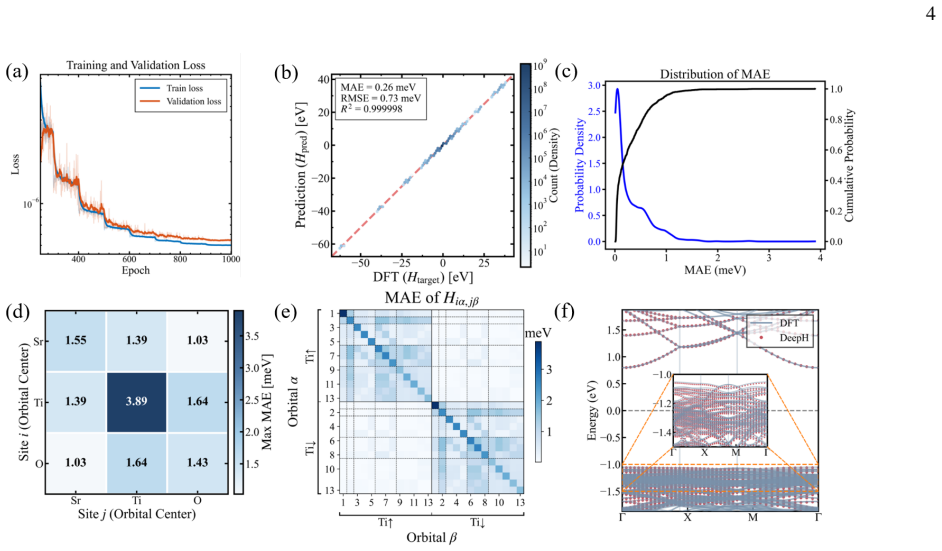
Summary. This manuscript applies the DeepH-E3 equivariant neural-network framework to predict DFT-quality Hamiltonians for twisted bilayer SrTiO3 across commensurate twist angles from 53.13° to 8.80°. The model is trained on 623 sliding configurations of untwisted 3×3 supercells (126 atoms) and validated against direct DFT at θ=28.07° (408 atoms), achieving sub-meV Hamiltonian MAE and excellent band-structure agreement. Using the predicted Hamiltonians, the authors report systematic valence-band flattening at small twist angles (bandwidths reaching a few meV) and compute dielectric responses, SHG, shift current, and spin Hall conductivity via the HopTB package. The central claims are that twisting flattens valence bands and enhances nonlinear optical responses while leaving linear dielectric and spin Hall responses nearly unchanged.
Significance. The application of deep-learning Hamiltonian methods to complex oxide moiré systems is timely and addresses a genuine computational bottleneck—twisted SrTiO3 supercells reach 2380 atoms, making direct DFT impractical. The Hamiltonian-level validation at θ=28.07° is thorough (MAE 0.26 meV, R²=0.999998), and the use of externally validated tools (DeepH-E3, HopTB) with first-principles training data provides a non-circular workflow. The falsifiable prediction of twist-angle-dependent shift current enhancement and the identification of nearly flat valence bands at small angles are concrete contributions. The optical-response calculations cover a broad range of quantities (dielectric, SHG, shift current, SHC) and the finding that nonlinear responses are more sensitive to twisting than linear ones is a useful design principle for oxide moiré materials.
major comments (3)
- §II, paragraph on active learning: The text states that 'an active learning scheme is employed to iteratively improve model transferability,' but no details are given on what this entailed—whether any twisted structures were added to the training set, whether it operated only within the sliding-configuration space, or what selection criterion was used. This is load-bearing because the central flat-band claims at small angles (8.80°–15°) depend entirely on the model's transferability from untwisted sliding configurations to commensurate twisted structures with radically different periodicities. The authors should clarify the active-learning protocol and, if no twisted structures were included in training, explicitly acknowledge the extrapolation risk.
- §III.B and Fig. S2: Direct DFT band-structure validation is provided in the main text for only one twist angle (θ=28.07°, Fig. 3f). Fig. S2 is cited for 'additional band-structure validations at other twist angles,' but the main text does not specify which angles are covered or whether any small-angle structures (where flat bands emerge) are included. Given that the Ti–Ti interaction channel shows the largest MAE (3.89 meV, Fig. 3d) and Ti-centered states dominate the band edge, even modest error growth at small angles could affect the meV-scale bandwidths reported in Fig. 5. At minimum, the authors should state in the main text which angles are validated in Fig. S2 and whether any fall in the flat-band regime; ideally, one small-angle DFT comparison (even partial band structure) would substantially strengthen the central claim.
- §III.C, Fig. 5 and §III.C paragraph on non-monotonicity: The authors acknowledge that bandwidth variations across commensurate angles are 'not perfectly monotonic' and attribute this to discrete commensurate stacking geometry. However, an alternative explanation—model error growing at small angles—is not discussed. The smallest-angle structures (e.g., (1,13) at 8.80°, 2380 atoms) have no direct DFT comparison, and the moiré-period local stacking environments at small angles sample longer-range modulations that may be less well represented in the 3×3 sliding training set. A brief discussion of error propagation from Hamiltonian MAE to bandwidth uncertainty, or a sensitivity check, would help distinguish genuine physics from model artifacts.
minor comments (6)
- §III.C, Eqs. (1)–(2): The two-regime definition of 'reported hole mass' (parabolic fit vs. bandwidth-derived flatness scale) is somewhat unusual. The switch at W_v = 30 meV is motivated but the threshold choice is not justified. A sentence explaining why 30 meV is the natural boundary would help readers interpret Fig. 5(b).
- §III.D: The broadening parameter η = 0.1 eV is noted as uniform across all response calculations. Given that the flat-band bandwidths at small angles are only a few meV, this broadening is orders of magnitude larger than the features being predicted. While the response calculations are limited to 53.13°–22.62° where bands are more dispersive, a comment on the relationship between η and the energy scales of interest would be useful.
- §II: The interlayer distance is fixed at 3.2 Å, cited as consistent with BaTiO3 studies (Ref. 26). SrTiO3 has a different lattice constant and polarizability; a brief justification for transferring this value, or a note on sensitivity, would strengthen the structural model.
- Fig. 4: The band structures are plotted along Γ–X–M–Γ for all ten configurations, but the moiré Brillouin zone changes shape with twist angle. Clarifying whether the path is in the moiré or primitive BZ, and how paths are standardized across angles, would aid interpretation.
- §III.D, Fig. 6(b): SHG is compared only between the untwisted bilayer and the (1,4) structure. Given that shift current is shown for four angles, extending SHG to at least one additional angle (or explaining why only one twisted case is shown) would be useful.
- Reference [31] is cited as an independent preprint on twisted SrTiO3 membranes reporting SHG near θ ≈ 36°. The citation is appropriate; noting whether the present calculations are consistent with that experimental/preprint observation would strengthen the connection.
Simulated Author's Rebuttal
We thank the referee for a careful and constructive report. The referee correctly identifies the central methodological concern: the flat-band claims at small twist angles depend on the transferability of a model trained only on untwisted sliding configurations. We address each major comment below and commit to revisions that clarify the active-learning protocol, specify which angles are validated in the Supplemental Material, and add an explicit discussion of extrapolation risk and error propagation. Where a direct small-angle DFT comparison is requested, we provide a partial response but are transparent about computational limitations.
read point-by-point responses
-
Referee: §II, active learning: The text mentions an active learning scheme but gives no details on what it entailed—whether twisted structures were added to training, whether it operated only within sliding-configuration space, or what selection criterion was used. The referee asks for clarification and, if no twisted structures were included in training, explicit acknowledgment of the extrapolation risk.
Authors: The referee is correct that the current manuscript text is insufficiently detailed on this point. To clarify: the active learning scheme operated entirely within the space of untwisted 3×3 sliding configurations. No twisted structures were included in the training set. The procedure involved iteratively predicting Hamiltonians for sliding configurations not yet in the training set, identifying those with the largest prediction uncertainty (estimated from model disagreement across training checkpoints), performing DFT calculations on those configurations, and adding them to the training set. This was repeated for several rounds until the validation error on held-out sliding configurations stabilized. The purpose was to ensure dense coverage of the local stacking environment space, since the physical rationale is that a twisted moiré supercell is locally approximated by a patchwork of sliding configurations. We agree that the extrapolation from untwisted sliding to commensurate twisted structures should be explicitly acknowledged as a limitation. We will revise §II to describe the active-learning protocol in detail and add a paragraph discussing the extrapolation risk, noting that the validation at θ=28.07° (Fig. 3f) and at additional angles in Fig. S2 provides the primary evidence that the transfer is reliable, but that the smallest-angle structures lack direct DFT confirmation. revision: yes
-
Referee: §III.B and Fig. S2: Direct DFT band-structure validation is provided in the main text only for θ=28.07°. Fig. S2 is cited for additional validations but the main text does not specify which angles are covered or whether any small-angle structures are included. The referee requests that the main text state which angles are validated in Fig. S2 and whether any fall in the flat-band regime, and ideally that one small-angle DFT comparison be provided.
Authors: We agree that the main text should specify which angles are covered in Fig. S2. Currently, Fig. S2 contains DFT vs. DeepH-E3 band-structure comparisons at θ=53.13° and θ=36.87°, in addition to the θ=28.07° comparison shown in the main text. None of these fall in the small-angle flat-band regime (θ≲15°). We will state this explicitly in the revised main text. Regarding the referee's suggestion of a small-angle DFT comparison: we have attempted DFT calculations for the (1,7) structure (θ=21.79°, 1140 atoms), which is the smallest-angle structure for which a full DFT calculation is still feasible on our computational resources. We will include this comparison in the revised Supplemental Material. For the smallest-angle structures such as (1,13) at 8.80° (2380 atoms), a full DFT band-structure calculation is not currently feasible—this is precisely the computational bottleneck that motivates the machine-learning approach. We acknowledge this gap honestly and will note it explicitly in the revised text. We note that the θ=28.07° validation already tests transferability to a structure with 408 atoms and a moiré period substantially larger than the 3×3 training cell, and the excellent agreement there (including fine moiré-induced band splittings) provides evidence that the local-stacking transferability assumption holds at least to this scale. revision: partial
-
Referee: §III.C, Fig. 5: The authors attribute non-monotonic bandwidth variations to discrete commensurate stacking geometry but do not discuss the alternative explanation of model error growing at small angles. The referee requests a discussion of error propagation from Hamiltonian MAE to bandwidth uncertainty, or a sensitivity check.
Authors: This is a fair point. We agree that the alternative explanation—model error growing at small angles—should be explicitly discussed and not simply dismissed. We will add a discussion paragraph in §III.C addressing this. Specifically, we will note the following: (1) The Ti–Ti channel has the largest MAE (3.89 meV), and Ti-centered states dominate the valence-band edge, so this is the most relevant error channel for the bandwidth claims. (2) The reported VBM bandwidths at the smallest angles are on the order of a few meV, which is comparable to the Ti–Ti MAE, meaning that model error could in principle affect the quantitative bandwidth values at the smallest angles. (3) However, the qualitative trend—systematic bandwidth reduction with decreasing twist angle—is robust across the full series of commensurate angles and is consistent with the physical expectation that a longer moiré period produces stronger localization of band-edge states. (4) The non-monotonic variations are also present at intermediate angles (15°–20°) where bandwidths are still 10–30 meV, well above the model error scale, suggesting that commensurate-geometry effects are genuine and not artifacts. We will add a caveat that the quantitative bandwidth values at the smallest angles (e.g., (1,13) at 8.80°) carry uncertainty at the meV level due to the Ti–Ti channel error, and that the reported bandwidths should be understood as order-of-magnitude estimates in this regime rather than precise values. We will also add a brief sensitivity argument: perturbing the Ti–Ti hopping elements by their MAE would shift individual band energies by at most a few meV, which could broaden or narrow the apparent bandwidth by a comparable amount, but would not eliminate the overall flattening trend visible across the full angle revision: yes
- The smallest-angle structures (e.g., (1,13) at 8.80°, 2380 atoms) cannot be directly validated against DFT because the computational cost is prohibitive—this is the fundamental limitation that motivates the machine-learning approach. We can mitigate this by validating at the smallest feasible angle and by honest error analysis, but a direct DFT band-structure comparison at the smallest angles will not be possible without computational resources beyond those currently available.
Circularity Check
No circularity found; derivation chain is self-contained with externally developed tools and independent training data.
full rationale
The paper's derivation chain proceeds as follows: (1) DFT (OpenMX) calculations on untwisted bilayer sliding configurations (3×3 supercells, 126 atoms, 623 configurations) produce reference Hamiltonian matrices; (2) the DeepH-E3 neural network (Refs. 32–33, developed by He Li, Xiaoxun Gong, Yong Xu et al. — no author overlap with the present paper) is trained on these to predict Hamiltonians for commensurate twisted bilayers; (3) the predicted Hamiltonians are interfaced with the HopTB package (Refs. 42–44, developed by Chong Wang et al. — again no author overlap) to compute band structures and optical/transport response functions. At each stage, the inputs and outputs are distinct: the training data comes from untwisted structures, while the predictions concern twisted structures with different atomic environments. The single DFT band-structure validation at θ=28.07° (Fig. 3f) is an independent comparison, not a fitted target. The bandwidth and effective-mass formulas (Eqs. 1–2) are standard characterizations of the predicted band structures, not definitions that reduce to their own inputs. No uniqueness theorem is invoked, no ansatz is smuggled via self-citation, and no prediction is defined in terms of the quantity it claims to derive. The concern about model transferability to small-angle structures (where no DFT validation exists) is a correctness risk, not a circularity issue — the predictions are genuine extrapolations from the training set, not fitted values renamed as predictions.
Assumptions & free parameters
free parameters (4)
- Interlayer distance =
3.2 Å
- Broadening parameter η =
0.1 eV
- Learning rate =
1.25e-3
- Train/val/test split ratio =
3:1:1
assumptions (4)
- domain assumption DFT (PBE) with the specified pseudoatomic basis sets accurately describes the electronic structure of bilayer SrTiO3
- domain assumption A model trained on untwisted sliding bilayer configurations transfers accurately to twisted bilayer structures
- domain assumption Fixed interlayer distance of 3.2 Å is a reasonable approximation for all twist angles
- domain assumption Commensurate supercells with Γ-point sampling are sufficient for Hamiltonian prediction of large twisted structures
Cite this review
Pith. "Pith review of Deep-learning Hamiltonian reveals twist-tunable flat bands and nonlinear photocurrents in SrTiO3 moire bilayers." pith.science (2026). https://pith.science/paper/OANSNBZT
@misc{pith2026260706053,
  author       = {Pith},
  title        = {Pith review of: Deep-learning Hamiltonian reveals twist-tunable flat bands and nonlinear photocurrents in SrTiO3 moire bilayers},
  year         = {2026},
  howpublished = {\url{https://pith.science/paper/OANSNBZT}},
  note         = {Machine review of arXiv:2607.06053}
}
read the original abstract
The extension of moire physics to complex oxides offers new ways to manipulate electronic states, but the large oxide moire supercells make systematic first-principles calculations demanding. Here, we combine density functional theory with the E(3)-equivariant deep-learning Hamiltonian framework DeepH-E3 to investigate the twist-angle-dependent electronic structure and optical responses of twisted bilayer SrTiO3. The model is trained on untwisted bilayers with different interlayer-sliding configurations and then applied to commensurate twisted bilayers with twist angles from 8.80 degrees to 53.13 degrees. Compared with the untwisted bilayer, decreasing twist angle systematically flattens the valence bands and leads to nearly dispersionless bands at the smallest angles studied. Based on the predicted Hamiltonians, we evaluate the dielectric response, second-harmonic generation (SHG), shift current, and spin Hall conductivity. The dielectric response and spin Hall conductivity remain close to those of the untwisted bilayer, whereas the nonlinear optical responses are more strongly affected by twisting. SHG is strongly enhanced relative to the weak untwisted response, and the shift current shows a clear twist-angle dependence within the response-calculation range (53.13 degrees-22.62 degrees). These results show that twist engineering can control electronic and optoelectronic responses in oxide moire systems.
Figures


Figures from the paper (3 more)


Reference graph
Works this paper leans on
-
[1]
direction, where Ti atoms are octahedrally coordinated by oxygen to form TiO6 units. To investigate twist-induced effects, we construct twisted bilayer SrTiO3 based on commensurate supercells under pe- riodic boundary conditions. As illustrated in Fig. 2(b), the twist is introduced as a relative rotation between the two lay- ers around the out-of-plane ax...
-
[2]
Electronic-structure methods for twisted moir´e layers,
Stephen Carr, Shiang Fang, and Efthimios Kaxiras, “Electronic-structure methods for twisted moir´e layers,” Nature Reviews Materials5, 748–763 (2020)
work page 2020
-
[3]
Graphene bilayers with a twist,
Eva Y . Andrei and Allan H. MacDonald, “Graphene bilayers with a twist,” Nature Materials19, 1265–1275 (2020)
work page 2020
-
[4]
Moir ´e bands in twisted double-layer graphene,
Rafi Bistritzer and Allan H. MacDonald, “Moir ´e bands in twisted double-layer graphene,” Proceedings of the National Academy of Sciences108, 12233–12237 (2011)
work page 2011
-
[5]
Corre- lated insulator behaviour at half-filling in magic-angle graphene superlattices,
Yuan Cao, Valla Fatemi, Ahmet Demir, Shiang Fang, Spencer L. Tomarken, Jason Y . Luo, Javier D. Sanchez- Yamagishi, Kenji Watanabe, Takashi Taniguchi, Efthimios Kaxiras, Ray C. Ashoori, and Pablo Jarillo-Herrero, “Corre- lated insulator behaviour at half-filling in magic-angle graphene superlattices,” Nature556, 80–84 (2018)
work page 2018
-
[6]
Un- conventional superconductivity in magic-angle graphene super- lattices,
Yuan Cao, Valla Fatemi, Shiang Fang, Kenji Watanabe, Takashi Taniguchi, Efthimios Kaxiras, and Pablo Jarillo-Herrero, “Un- conventional superconductivity in magic-angle graphene super- lattices,” Nature556, 43–50 (2018)
work page 2018
-
[7]
Electronic corre- 8 lations in twisted bilayer graphene near the magic angle,
Youngjoon Choi, Jeannette Kemmer, Yang Peng, Alex Thom- son, Harpreet Arora, Robert Polski, Yiran Zhang, Hechen Ren, Jason Alicea, Gil Refael, Felix von Oppen, Kenji Watanabe, Takashi Taniguchi, and Stevan Nadj-Perge, “Electronic corre- 8 lations in twisted bilayer graphene near the magic angle,” Na- ture Physics15, 1174–1180 (2019)
work page 2019
-
[9]
Tuning superconductivity in twisted bilayer graphene,
Matthew Yankowitz, Shaowen Chen, Hryhoriy Polshyn, Yux- uan Zhang, K. Watanabe, T. Taniguchi, David Graf, Andrea F. Young, and Cory R. Dean, “Tuning superconductivity in twisted bilayer graphene,” Science363, 1059–1064 (2019)
work page 2019
Show all 47 references
-
[10]
Elec- tric field–tunable superconductivity in alternating-twist magic- angle trilayer graphene,
Zeyu Hao, A. M. Zimmerman, Patrick Ledwith, Eslam Khalaf, Danial Haie Najafabadi, Kenji Watanabe, Takashi Taniguchi, Ashvin Vishwanath, and Philip Kim, “Elec- tric field–tunable superconductivity in alternating-twist magic- angle trilayer graphene,” Science371, 1133–1138 (2021)
2021
-
[11]
Correlation-driven topo- logical phases in magic-angle twisted bilayer graphene,
Youngjoon Choi, Hyunjin Kim, Yang Peng, Alex Thom- son, Cyprian Lewandowski, Robert Polski, Yiran Zhang, Harpreet Singh Arora, Kenji Watanabe, Takashi Taniguchi, Ja- son Alicea, and Stevan Nadj-Perge, “Correlation-driven topo- logical phases in magic-angle twisted bilayer grap...
2021
-
[12]
Strongly correlated chern insulators in magic- angle twisted bilayer graphene,
Kevin P. Nuckolls, Myungchul Oh, Dillon Wong, Biao Lian, Kenji Watanabe, Takashi Taniguchi, B. Andrei Bernevig, and Ali Yazdani, “Strongly correlated chern insulators in magic- angle twisted bilayer graphene,” Nature588, 610–615 (2020)
2020
-
[13]
Electrical switching of magnetic order in an orbital chern insulator,
H. Polshyn, J. Zhu, M. A. Kumar, Y . Zhang, F. Yang, C. L. Tschirhart, M. Serlin, K. Watanabe, T. Taniguchi, A. H. Mac- Donald, and A. F. Young, “Electrical switching of magnetic order in an orbital chern insulator,” Nature588, 66–70 (2020)
2020
-
[14]
In- trinsic quantized anomalous hall effect in a moir ´e heterostruc- ture,
M. Serlin, C. L. Tschirhart, H. Polshyn, Y . Zhang, J. Zhu, K. Watanabe, T. Taniguchi, L. Balents, and A. F. Young, “In- trinsic quantized anomalous hall effect in a moir ´e heterostruc- ture,” Science367, 900–903 (2020)
2020
-
[15]
Correlated electronic phases in twisted bilayer transition metal dichalcogenides,
Lei Wang, En-Min Shih, Augusto Ghiotto, Lede Xian, Daniel A. Rhodes, Cheng Tan, Martin Claassen, Dante M. Kennes, Yusong Bai, Bumho Kim, Kenji Watanabe, Takashi Taniguchi, Xiaoyang Zhu, James Hone, Angel Rubio, Abhay N. Pasupathy, and Cory R. Dean, “Correlated electronic phase...
2020
-
[16]
Realization of nearly dispersionless bands with strong or- bital anisotropy from destructive interference in twisted bilayer mos2,
Lede Xian, Martin Claassen, Dominik Kiese, Michael M. Scherer, Simon Trebst, Dante M. Kennes, and Angel Ru- bio, “Realization of nearly dispersionless bands with strong or- bital anisotropy from destructive interference in twisted bilayer mos2,” Nature Communications12(2021), ...
2021 doi
-
[17]
Magic in twisted transition metal dichalcogenide bilay- ers,
Trithep Devakul, Valentin Cr ´epel, Yang Zhang, and Liang Fu, “Magic in twisted transition metal dichalcogenide bilay- ers,” Nature Communications12(2021), 10.1038/s41467-021- 27042-9
2021 doi
-
[18]
Correlated insulating states at fractional fillings of moir´e superlattices,
Yang Xu, Song Liu, Daniel A. Rhodes, Kenji Watanabe, Takashi Taniguchi, James Hone, Veit Elser, Kin Fai Mak, and Jie Shan, “Correlated insulating states at fractional fillings of moir´e superlattices,” Nature587, 214–218 (2020)
2020
-
[19]
Multiflat bands and strong correlations in twisted bilayer boron nitride: Doping-induced correlated insulator and superconductor,
Lede Xian, Dante M. Kennes, Nicolas Tancogne-Dejean, Mas- simo Altarelli, and Angel Rubio, “Multiflat bands and strong correlations in twisted bilayer boron nitride: Doping-induced correlated insulator and superconductor,” Nano Letters19, 4934–4940 (2019)
2019
-
[20]
Flat bands, strains, and charge distribution in twisted bilayer h-BN,
Niels R. Walet and Francisco Guinea, “Flat bands, strains, and charge distribution in twisted bilayer h-BN,” Physical Review B103(2021), 10.1103/physrevb.103.125427
2021 doi
-
[21]
Tuning colour centres at a twisted hexagonal boron nitride interface,
Cong Su, Fang Zhang, Salman Kahn, Brian Shevitski, Jing- wei Jiang, Chunhui Dai, Alex Ungar, Ji-Hoon Park, Kenji Watanabe, Takashi Taniguchi, Jing Kong, Zikang Tang, Wen- qing Zhang, Feng Wang, Michael Crommie, Steven G. Louie, Shaul Aloni, and Alex Zettl, “Tuning colour centr...
2022
-
[22]
Extremely flat band in antiferroelectric bilayer α-in2se3 with large twist-angle,
C F Li, W J Zhai, Y Q Li, Y S Tang, J H Zhang, P Z Chen, G Z Zhou, X M Cui, L Lin, Z B Yan, X K Huang, X P Jiang, and J-M Liu, “Extremely flat band in antiferroelectric bilayer α-in2se3 with large twist-angle,” New Journal of Physics23, 083019 (2021)
2021
-
[23]
Semiconductor moir ´e materials,
Kin Fai Mak and Jie Shan, “Semiconductor moir ´e materials,” Nature Nanotechnology17, 686–695 (2022)
2022
-
[24]
Emergent phenomena at oxide interfaces,
H. Y . Hwang, Y . Iwasa, M. Kawasaki, B. Keimer, N. Nagaosa, and Y . Tokura, “Emergent phenomena at oxide interfaces,” Na- ture Materials11, 103–113 (2012)
2012
-
[25]
Orbital physics in transition-metal oxides,
Y . Tokura and N. Nagaosa, “Orbital physics in transition-metal oxides,” Science288, 462–468 (2000)
2000
-
[26]
Freestanding crystalline oxide perovskites down to the monolayer limit,
Dianxiang Ji, Songhua Cai, Tula R. Paudel, Haoying Sun, Chunchen Zhang, Lu Han, Yifan Wei, Yipeng Zang, Min Gu, Yi Zhang, Wenpei Gao, Huaixun Huyan, Wei Guo, Di Wu, Zhengbin Gu, Evgeny Y . Tsymbal, Peng Wang, Yuefeng Nie, and Xiaoqing Pan, “Freestanding crystalline oxide perov...
2019
-
[27]
Moir´e polar vortex, flat bands, and lieb lattice in twisted bilayer batio3,
Seungjun Lee, D. J. P. de Sousa, Bharat Jalan, and Tony Low, “Moir´e polar vortex, flat bands, and lieb lattice in twisted bilayer batio3,” Science Advances10(2024), 10.1126/sci- adv.adq0293
2024 doi
-
[28]
Laalo 3/srtio3 heterointerface: 20 years and beyond,
Shunfeng Chen, Yuanjie Ning, Chi Sin Tang, Liang Dai, Shengwei Zeng, Kun Han, Jun Zhou, Ming Yang, Yan- qun Guo, Chuanbing Cai, Ariando Ariando, Andrew T. S. Wee, and Xinmao Yin, “Laalo 3/srtio3 heterointerface: 20 years and beyond,” Advanced Electronic Materials10(2024), 10.1...
2024 doi
-
[29]
Stoichiometric control of elec- tron mobility and 2d superconductivity at laalo 3-srtio3 inter- faces,
Gyanendra Singh, Roger Guzman, Guilhem Sa ¨ız, Wu Zhou, Jaume Gazquez, Fereshteh Masoudinia, Dag Winkler, Tord Claeson, Jordi Fraxedas, Nicolas Bergeal, Gervasi Herranz, and Alexei Kalaboukhov, “Stoichiometric control of elec- tron mobility and 2d superconductivity at laalo 3-...
2024 doi
-
[30]
Prediction of po- larization vortices, charge modulation, flat bands, and moir ´e magnetism in twisted oxide bilayers,
Naafis Ahnaf Shahed, Kartik Samanta, Mohamed Elekhtiar, Kai Huang, Chang-Beom Eom, Mark S. Rzchowski, Kirill D. Belashchenko, and Evgeny Y . Tsymbal, “Prediction of po- larization vortices, charge modulation, flat bands, and moir ´e magnetism in twisted oxide bilayers,” Physic...
2025 doi
-
[31]
Tear-and-stack twisted SrTiO 3 moir´e superlat- tices for precise interfacial reconstruction and polar topology,
Yingli Zhang, Jinxin Ge, Shengyao Su, Yuhao Li, Wenxi Zhang, Longji Lyu, Jiahao Song, Yuxin Liu, Yihan Lei, Haopeng Du, Gaokuo Zhong, Boyuan Huang, Jiangyu Li, and Changjian Li, “Tear-and-stack twisted SrTiO 3 moir´e superlat- tices for precise interfacial reconstruction and p...
2025 doi
-
[32]
Optical signature of moir ´e superlattices formed by twisted SrTiO3 membranes,
T. A. M. Ragib Shahriar, Fumikazu Murakami, Xing He, Konnor Koons, Xinyan Li, Bumseop Kim, Shihan Qin, Varun Harbola, Jochen Mannhart, Yimo Han, Rui- juan Xu, Shengxi Huang, Andrew M. Rappe, and Hanyu Zhu, “Optical signature of moir ´e superlattices formed by twisted SrTiO3 me...
-
[33]
Deep-learning 9 density functional theory hamiltonian for efficient ab initio electronic-structure calculation,
He Li, Zun Wang, Nianlong Zou, Meng Ye, Runzhang Xu, Xi- aoxun Gong, Wenhui Duan, and Yong Xu, “Deep-learning 9 density functional theory hamiltonian for efficient ab initio electronic-structure calculation,” Nature Computational Sci- ence2, 367–377 (2022)
2022
-
[34]
General framework for e(3)- equivariant neural network representation of density func- tional theory hamiltonian,
Xiaoxun Gong, He Li, Nianlong Zou, Runzhang Xu, Wen- hui Duan, and Yong Xu, “General framework for e(3)- equivariant neural network representation of density func- tional theory hamiltonian,” Nature Communications14(2023), 10.1038/s41467-023-38468-8
2023 doi
-
[36]
Generalizing deep learning electronic structure calcula- tion to the plane-wave basis,
Xiaoxun Gong, Steven G. Louie, Wenhui Duan, and Yong Xu, “Generalizing deep learning electronic structure calcula- tion to the plane-wave basis,” Nature Computational Science4, 752–760 (2024)
2024
-
[37]
A deep equivariant neural network approach for efficient hy- brid density functional calculations,
Zechen Tang, He Li, Peize Lin, Xiaoxun Gong, Gan Jin, Lixin He, Hong Jiang, Xinguo Ren, Wenhui Duan, and Yong Xu, “A deep equivariant neural network approach for efficient hy- brid density functional calculations,” Nature Communications 15(2024), 10.1038/s41467-024-53028-4
2024 doi
-
[38]
Deep- learning density functional perturbation theory,
He Li, Zechen Tang, Jingheng Fu, Wen-Han Dong, Nianlong Zou, Xiaoxun Gong, Wenhui Duan, and Yong Xu, “Deep- learning density functional perturbation theory,” Physical Re- view Letters132(2024), 10.1103/physrevlett.132.096401
2024 doi
-
[39]
Exotic electronic states in the world of flat bands: From theory to material,
Zheng Liu, Feng Liu, and Yong-Shi Wu, “Exotic electronic states in the world of flat bands: From theory to material,” Chi- nese Physics B23, 077308 (2014)
2014
-
[40]
Variationally optimized atomic orbitals for large- scale electronic structures,
T. Ozaki, “Variationally optimized atomic orbitals for large- scale electronic structures,” Physical Review B67(2003), 10.1103/physrevb.67.155108
2003 doi
-
[42]
Gen- eralized gradient approximation made simple,
John P Perdew, Kieron Burke, and Matthias Ernzerhof, “Gen- eralized gradient approximation made simple,” Physical review letters77, 3865 (1996)
1996
-
[43]
HopTB.jl: a tight-binding package for electronic and optical response calculations,
HopTB Developers, “HopTB.jl: a tight-binding package for electronic and optical response calculations,”https:// github.com/HopTB/HopTB.jl(2024), version 0.8.2
2024
-
[44]
First-principles calculation of nonlinear op- tical responses by wannier interpolation,
Chong Wang, Xiaoyu Liu, Lei Kang, Bing-Lin Gu, Yong Xu, and Wenhui Duan, “First-principles calculation of nonlinear op- tical responses by wannier interpolation,” Physical Review B96 (2017), 10.1103/physrevb.96.115147
2017 doi
-
[45]
First-principles calculation of optical responses based on nonorthogonal localized orbitals,
Chong Wang, Sibo Zhao, Xiaomi Guo, Xinguo Ren, Bing-Lin Gu, Yong Xu, and Wenhui Duan, “First-principles calculation of optical responses based on nonorthogonal localized orbitals,” New Journal of Physics21, 093001 (2019)
2019
-
[46]
Commensuration and interlayer coherence in twisted bilayer graphene,
E. J. Mele, “Commensuration and interlayer coherence in twisted bilayer graphene,” Physical Review B81(2010), 10.1103/physrevb.81.161405
2010 doi
-
[47]
Simplified lcao method for the periodic potential problem,
J. C. Slater and G. F. Koster, “Simplified lcao method for the periodic potential problem,” Physical Review94, 1498–1524 (1954)
1954
-
[49]
Second-order optical response in semiconductors,
J. E. Sipe and A. I. Shkrebtii, “Second-order optical response in semiconductors,” Physical Review B61, 5337–5352 (2000)
2000
-
[50]
First principles calculation of the shift current photovoltaic effect in ferro- electrics,
Steve M. Young and Andrew M. Rappe, “First principles calculation of the shift current photovoltaic effect in ferro- electrics,” Physical Review Letters109(2012), 10.1103/phys- revlett.109.116601
2012 doi
-
[51]
Power conversion efficiency exceeding the shock- ley–queisser limit in a ferroelectric insulator,
Jonathan E. Spanier, Vladimir M. Fridkin, Andrew M. Rappe, Andrew R. Akbashev, Alessia Polemi, Yubo Qi, Zongquan Gu, Steve M. Young, Christopher J. Hawley, Dominic Imbrenda, Geoffrey Xiao, Andrew L. Bennett-Jackson, and Craig L. Johnson, “Power conversion efficiency exceeding ...
2016
Reviewed July 8, 2026 · model on record in the stance chip above.
Discussion (0). Continue with ORCID to comment.