REVIEW 3 major objections 7 minor 29 references
Reviewed by Pith at T0; open to challenge.
T0 means a machine referee read the full paper against a public rubric. The mark states how deep the mechanical check went, never who wrote it. the ladder, T0–T4 →
T0 review · glm-5.2
Flow matching plus biometric selection cuts speech separation errors
2026-07-08 16:50 UTC pith:QD2BVGB3
load-bearing objection Well-engineered flow-matching separator with a novel best-of-N biometric selection criterion; competitive downstream results, but the SV evaluation has a selection-evaluation circularity that needs addressing. the 3 major comments →
Flow Matching-Based Speech Source Separation with Best-of-N Biometric Sampling
The pith
A machine-rendered reading of the paper's core claim, the machinery that carries it, and where it could break.
Core claim
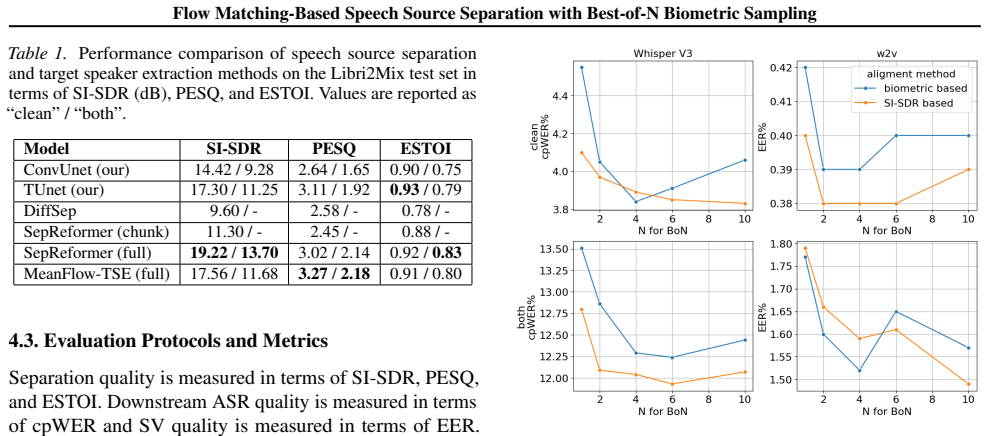
The central discovery is that a speaker-embedding model can serve as an effective reference-free verifier for generative speech separation. By generating N candidate separations from the same mixture and selecting the candidate whose two output channels have the most dissimilar speaker embeddings (lowest cosine similarity), the system approximates oracle-quality selection (which requires ground-truth references) without needing them. The biometric best-of-N criterion closely tracks the oracle SI-SDR-based selection curve as N increases, with both saturating around N=4. This means the sampling variance of flow-matching models, typically viewed as a drawback, can be exploited: more samples can
What carries the argument
The method has four interlocking components. First, conditional flow matching formulates two-speaker separation as a denoising task in the complex STFT domain, where the target is an ordered concatenation of both sources separated by a fixed non-speech spacer and the condition is the mixture duplicated in the same layout. Second, a frozen Wav2Vec 2.0-based speaker encoder extracts embeddings from each source to define a canonical ordering during training (the source closer to a reference embedding is placed first). Third, at inference, N independent stochastic separations are generated per chunk and the pair with the most dissimilar inter-channel speaker embeddings is selected. Fourth, for長長
Load-bearing premise
The frozen speaker encoder is assumed to produce reliable speaker embeddings from partially separated, potentially degraded speech outputs at inference time. The entire pipeline (source ordering during training, best-of-N candidate selection, and chunk-level channel alignment) depends on these embeddings being meaningful even when the generated separation quality is poor. If the speaker encoder fails on noisy or artifact-laden outputs, the ordering, selection, and alignment
What would settle it
Run the system on mixtures where one speaker is heavily masked or where the SNR between sources is highly asymmetric (e.g., -5 dB). If the speaker encoder produces unreliable embeddings for the dominated speaker, the best-of-N selection criterion (which relies on inter-channel embedding dissimilarity) and the chunk alignment (which relies on embedding clustering) would both degrade, potentially producing worse downstream ASR and speaker verification than a deterministic baseline that does not depend on biometric feedback.
If this is right
- Generative separators with biometric best-of-N selection could replace deterministic separators in practical ASR and speaker verification pipelines, especially for long-form audio where chunked processing is required.
- The principle of using a domain-specific pretrained encoder (here, speaker recognition) as an inference-time verifier for generative model outputs could transfer to other structured generation tasks where output quality is hard to measure directly but downstream task performance is the real objective.
- The gap between competitive signal-level metrics (SI-SDR, PESQ) and best-in-class downstream metrics (cpWER, EER) suggests that standard separation benchmarks may under-reward perceptual and semantic qualities that matter for real applications.
- Chunk-wise processing with biometric channel tracking provides a path to deploying flow-matching separators on streaming or real-time audio, where full-utterance models like SepReformer are inapplicable.
Where Pith is reading between the lines
- The reliance on a frozen speaker encoder creates a coupling between separation quality and verification quality: if the speaker encoder produces poor embeddings on degraded outputs, the selection, ordering, and alignment mechanisms all fail simultaneously with no fallback. This could be tested by injecting controlled artifacts into separated outputs and measuring embedding reliability.
- The best-of-N biometric criterion implicitly assumes that speaker distinctiveness correlates with overall separation quality. This could be tested on mixtures with three or more speakers, where pairwise dissimilarity may not select the globally best separation.
- The 1-second chunk size with 0.5-second hop is likely tuned for the Libri2Mix distribution; longer chunks might improve biometric embedding reliability at the cost of latency, and the optimal chunk size may vary with speaker overlap patterns and noise conditions.
- The saturation of best-of-N gains around N=4 suggests diminishing returns from additional inference compute, but this saturation point may shift with more challenging acoustic conditions or more speakers, where a single good candidate is less likely among few samples.
Editorial analysis
A structured set of objections, weighed in public.
Referee Report
Summary. This paper proposes a conditional flow-matching approach to two-speaker speech separation. The method formulates separation as a conditional generation task in the complex STFT domain, using a frozen speaker encoder to define a canonical source order during training. At inference, a best-of-N biometric sampling criterion selects the candidate pair whose output-channel speaker embeddings are most dissimilar, and a chunk-level alignment procedure enables processing of long recordings. The Transformer U-Net (TUnet) variant is evaluated on Libri2Mix and compared against DiffSep, SepReformer (full and chunked), and MeanFlow-TSE in terms of SI-SDR, PESQ, ESTOI, downstream ASR (cpWER via Whisper V3), and downstream SV (EER via Wav2Vec 2.0). The authors report that TUnet achieves the best downstream cpWER and EER among evaluated systems on the clean condition.
Significance. The paper introduces a practical combination of ideas—flow-matching-based separation, biometric source ordering, best-of-N inference-time selection, and chunk-level alignment—that is well-motivated for real-world deployment. The best-of-N biometric selection criterion (Eq. 3) is a falsifiable, parameter-light inference-time strategy that does not require ground-truth references, and the paper provides an oracle SI-SDR-based upper bound for comparison (Figure 2). The downstream evaluation on both ASR and SV is a useful contribution beyond standard separation metrics. The approach is built on the NVIDIA NeMo Toolkit, which aids reproducibility. However, the significance of the headline SV results is tempered by a selection-evaluation circularity concern (see Major Comments) that is acknowledged but not numerically resolved.
major comments (3)
- §5, Table 2 and Eq. (3): The best-of-N selection criterion (Eq. 3) selects the candidate pair minimizing cos(η(ŝ_A), η(ŝ_B)) using a frozen Wav2Vec 2.0 speaker encoder η (§3.3). The EER evaluation in Table 2 is then computed using a Wav2Vec 2.0-based SV system (§4.2). This creates a direct selection-evaluation circularity: the selection criterion optimizes for maximum inter-channel embedding distance in the same embedding family used to evaluate EER. A generated candidate with artifacts that push Wav2Vec 2.0 embeddings apart—without genuinely improving separation—would be selected by Eq. 3 and simultaneously score well on EER. The paper states that ablations with ResNet-34 and DistillWhisper-based SV backends show 'the same trend' (§5, last paragraph), but no numerical results are reported, making it impossible to assess whether the EER advantage and its magnitude persist when selection和
- Abstract and Table 2: The abstract claims 'lowest downstream automatic speech recognition and speaker verification error rates in all evaluated settings,' but Table 2 only reports the Libri2Mix clean condition. No downstream cpWER or EER results are shown for the 'both' condition. Table 1 reports separation metrics for both conditions, so the absence of downstream results for 'both' is a gap between the claim and the evidence. Either the claim should be qualified to match the evaluated settings, or downstream results for the 'both' condition should be added to Table 2.
- §5, last paragraph: The ablation with alternative downstream backends (Parakeet ASR, ResNet-34 and DistillWhisper-based SV models) is mentioned in a single sentence but no numbers are reported anywhere. Given that this ablation directly addresses the selection-evaluation circularity concern for the SV results, it should be reported with at least summary numbers (e.g., EER for TUnet under ResNet-34 and DistillWhisper backends, with the same Wav2Vec 2.0-based selection). Without these numbers, the reader cannot verify that the SV gains are not an artifact of the shared embedding space between the selection encoder and the evaluation backend.
minor comments (7)
- §4.1: The separator amplitude (0.5) and length (1000 samples / 62.5 ms) are stated but the rationale for these specific values is not discussed. A brief note on sensitivity or justification would help reproducibility.
- §4.2: The conditional dropout probability p_cond = 0.99 is reported, but it is unclear whether this means 99% of the time the condition is retained (1% dropped) or vice versa. The phrasing 'replacing c with zeros with probability 1−p_cond' in §3.2 suggests 1% dropout, which should be stated more clearly.
- Table 1: Several baselines (DiffSep, SepReformer chunk) report only the 'clean' condition with dashes for 'both'. It would be useful to note whether these values are unavailable or not computed.
- §3.2: The reference speaker embedding e_ref used for source ordering during training is mentioned but not fully specified. Is it a fixed global reference, a per-utterance reference, or sampled per batch? Clarifying this would aid understanding of the ordering procedure.
- Figure 2: The axis labels and legend are small. The top/bottom and left/right panel organization should be more clearly labeled (e.g., 'clean' vs. 'both' as panel titles rather than relying on caption text).
- §4.2: MeanFlow-TSE is described as addressing target speaker extraction, which is a different problem setting. The comparison is informative but the paper could more clearly flag this as a non-blind reference for readers unfamiliar with the distinction, perhaps by adding a footnote.
- The paper would benefit from a brief discussion of computational cost: the best-of-N procedure with N=4 requires 4x generation per chunk. Reporting wall-clock or RTF comparisons with baselines would strengthen the practical deployment framing.
Simulated Author's Rebuttal
We thank the referee for a careful and constructive review. The referee raises three major comments, all of which are legitimate. (1) The selection-evaluation circularity concern for the SV results is valid: the best-of-N selection criterion (Eq. 3) uses a Wav2Vec 2.0 speaker encoder, and the EER evaluation in Table 2 also uses a Wav2Vec 2.0-based SV system. We agree that numerical results from alternative SV backends are needed to resolve this concern and will add them. (2) The abstract overclaims by stating 'all evaluated settings' when Table 2 only covers the clean condition. We will either qualify the claim or add downstream results for the 'both' condition. (3) The ablation sentence mentioning ResNet-34 and DistillWhisper backends without numbers is insufficient given that it directly addresses the circularity concern. We will expand it into a proper table. All three points require revision, and we can address all of them.
read point-by-point responses
-
Referee: §5, Table 2 and Eq. (3): The best-of-N selection criterion (Eq. 3) selects the candidate pair minimizing cos(η(ŝ_A), η(ŝ_B)) using a frozen Wav2Vec 2.0 speaker encoder η (§3.3). The EER evaluation in Table 2 is then computed using a Wav2Vec 2.0-based SV system (§4.2). This creates a direct selection-evaluation circularity: the selection criterion optimizes for maximum inter-channel embedding distance in the same embedding family used to evaluate EER. A generated candidate with artifacts that push Wav2Vec 2.0 embeddings apart—without genuinely improving separation—would be selected by Eq. 3 and simultaneously score well on EER. The paper states that ablations with ResNet-34 and DistillWhisper-based SV backends show 'the same trend' (§5, last paragraph), but no numerical results are reported, making it impossible to assess whether the EER advantage and its magnitude persist when selection和
Authors: The referee correctly identifies a selection-evaluation circularity: the selection encoder η (Wav2Vec 2.0-based, Novoselov et al. 2022) and the EER evaluation backend (Wav2Vec 2.0, Khmelev et al. 2025) are from the same model family. We agree this is a genuine concern and that the current manuscript does not provide sufficient evidence to rule it out. In the revision, we will add a new table reporting EER for TUnet (and key baselines) under two alternative SV backends—ResNet-34 and DistillWhisper (Khmelev et al. 2026)—while keeping the Wav2Vec 2.0-based selection criterion unchanged. This cross-backend evaluation directly tests whether the EER advantage persists when the selection and evaluation embedding spaces are decoupled. We will also add an explicit discussion of the circularity concern in §5, acknowledging the shared model family and explaining why the cross-backend results mitigate it. We note that the ASR results (cpWER via Whisper V3) are not subject to this circularity, since the selection criterion operates purely on speaker embeddings and the ASR backend is a separate model. revision: yes
-
Referee: Abstract and Table 2: The abstract claims 'lowest downstream automatic speech recognition and speaker verification error rates in all evaluated settings,' but Table 2 only reports the Libri2Mix clean condition. No downstream cpWER or EER results are shown for the 'both' condition. Table 1 reports separation metrics for both conditions, so the absence of downstream results for 'both' is a gap between the claim and the evidence. Either the claim should be qualified to match the evaluated settings, or downstream results for the 'both' condition should be added to Table 2.
Authors: The referee is correct that the abstract's claim of 'all evaluated settings' is not supported by Table 2, which only covers the clean condition. This is an overclaim relative to the evidence presented. We will resolve this by adding downstream cpWER and EER results for the 'both' condition to Table 2, so that the claim is fully supported. If computational constraints prevent completing the 'both' condition downstream evaluation in time for revision, we will instead qualify the abstract to say 'in the clean condition' and note the gap explicitly. Our preference is to add the results. revision: yes
-
Referee: §5, last paragraph: The ablation with alternative downstream backends (Parakeet ASR, ResNet-34 and DistillWhisper-based SV models) is mentioned in a single sentence but no numbers are reported anywhere. Given that this ablation directly addresses the selection-evaluation circularity concern for the SV results, it should be reported with at least summary numbers (e.g., EER for TUnet under ResNet-34 and DistillWhisper backends, with the same Wav2Vec 2.0-based selection). Without these numbers, the reader cannot verify that the SV gains are not an artifact of the shared embedding space between the selection encoder and the evaluation backend.
Authors: We agree. Mentioning these ablation results without reporting any numbers is insufficient, especially given that they directly address the circularity concern raised in the first major comment. In the revision, we will expand the single sentence in §5 into a proper table (or at minimum a clearly structured paragraph with full numerical results) reporting EER for TUnet and relevant baselines under ResNet-34 and DistillWhisper SV backends, with the Wav2Vec 2.0-based selection criterion held fixed. We will also report cpWER under the Parakeet ASR backend. This will allow readers to verify that the downstream gains are not artifacts of the shared embedding space. revision: yes
Circularity Check
Partial selection-evaluation embedding overlap: best-of-N selection (Eq. 3) and EER evaluation both use Wav2Vec 2.0-family speaker encoders from self-citations, but the selection objective (inter-channel distance) is not identical to the EER metric, and the ASR results are independent.
specific steps
-
fitted input called prediction
[Eq. 3 (§3.3) and §4.2 / Table 2]
"i* = arg min_i cos(η(ŝ_c,A^(i)), η(ŝ_c,B^(i))) ... Source ordering, best-of-N selection, and chunk alignment use a frozen Wav2Vec 2.0-based speaker embedding model (Novoselov et al., 2022). ... speaker recognition performance with Wav2Vec 2.0 (Khmelev et al., 2025) system."
The best-of-N selection criterion (Eq. 3) selects the candidate pair that maximizes inter-channel dissimilarity in a Wav2Vec 2.0 embedding space (Novoselov et al., 2022, a self-citation — Novoselov is an author). The EER evaluation in Table 2 then measures speaker verification accuracy using another Wav2Vec 2.0-based SV system (Khmelev et al., 2025, also a self-citation — Khmelev is an author). A candidate whose generation artifacts push Wav2Vec 2.0 embeddings apart would be preferentially selected by Eq. 3 and could simultaneously score better on EER, since both selection and evaluation operate in the same embedding family. This is a partial circularity: the selection criterion is correlated with the evaluation metric by shared embedding space, though the objectives (inter-channel dissiml
-
self citation load bearing
[§4.2]
"Source ordering, best-of-N selection, and chunk alignment use a frozen Wav2Vec 2.0-based speaker embedding model (Novoselov et al., 2022). ... speaker recognition performance with Wav2Vec 2.0 (Khmelev et al., 2025) system."
Both the selection encoder (Novoselov et al., 2022) and the evaluation SV system (Khmelev et al., 2025) are self-cited works (Novoselov and Khmelev are both authors on the present paper). These are used as tools rather than theoretical claims, so the self-citation is not load-bearing in the sense of importing an unverified theorem. However, the fact that both the selection and evaluation components come from the same research group, and that no numerical results from alternative-backend ablations are reported (only 'the same trend' is claimed in §5), makes it impossible to fully rule out that the EER advantage is an artifact of shared embedding-space bias.
full rationale
The paper has a partial but not strict circularity. The best-of-N selection (Eq. 3) uses a Wav2Vec 2.0 speaker encoder from Novoselov et al. (2022, self-citation), and the EER evaluation uses a Wav2Vec 2.0 SV system from Khmelev et al. (2025, self-citation). The selection criterion maximizes inter-channel embedding dissimilarity, while EER measures speaker verification accuracy — these are related but not identical objectives, so the EER result is not forced by construction. The cpWER (ASR) results use Whisper V3 and are independent of the Wav2Vec 2.0 selection pipeline, so half of the headline claim is unaffected. The paper mentions ablations with ResNet-34 and DistillWhisper SV backends showing 'the same trend' but reports no numbers, making it impossible to verify whether the EER advantage persists under a different embedding space. The self-citations are for pretrained model tools, not theoretical claims or uniqueness theorems. Score 3 reflects: real partial overlap between selection and evaluation embedding families, compounded by self-citation, but not a strict reduction of output to input by construction.
Axiom & Free-Parameter Ledger
free parameters (4)
- N (best-of-N candidates) =
4
- Separator amplitude =
0.5
- p_cond (conditional dropout probability) =
0.99
- STFT parameters (hop, FFT length, magnitude power, scale factor) =
128/254 or 510/0.5/0.33
axioms (4)
- domain assumption The frozen speaker encoder produces meaningful embeddings from partially separated speech
- standard math Optimal-transport conditional flow matching is an appropriate generative framework for speech separation
- ad hoc to paper Minimizing inter-channel speaker embedding similarity selects better separations
- domain assumption 1-second chunks with 0.5-second hop preserve sufficient context for separation
read the original abstract
Single-channel speech separation remains challenging for real-world deployment due to source permutation ambiguity, sampling variability of generative models, and the difficulty of processing long recordings with chunk-wise inference. We address these issues with a conditional flow-matching-based method that produces an ordered two-source output conditioned on the mixture. A frozen speaker encoder defines the source order during training and is reused at inference for biometric best-of-$N$ candidate selection and chunk-level channel alignment. We evaluate separation quality on Libri2Mix benchmark using SI-SDR, PESQ, and ESTOI, and measure downstream impact using cpWER for automatic speech recognition and EER for speaker verification. The results show that the proposed Transformer U-Net variant is competitive with strong baselines in objective separation metrics and achieves the lowest downstream automatic speech recognition and speaker verification error rates in all evaluated settings.
Figures

Reference graph
Works this paper leans on
-
[1]
Araki, S. et al. 30+ years of source separation research: Achievements and future challenges. InICASSP 2025 – 2025 IEEE International Conference on Acoustics, Speech and Signal Processing (ICASSP), pp. 1–5,
work page 2025
-
[2]
Chen, M. et al. Evaluating large language models trained on code.arXiv preprint arXiv:2107.03374,
work page internal anchor Pith review Pith/arXiv arXiv
-
[3]
Choi, C., Kim, S., and Kim, H. J. Performance plateaus in inference-time scaling for text-to-image diffusion without external models. InICML 2025 Workshop on Methods and Opportunities at Small Scale,
work page 2025
-
[4]
Cobbe, K. et al. Training verifiers to solve math word problems.arXiv preprint arXiv:2110.14168,
work page internal anchor Pith review Pith/arXiv arXiv
-
[5]
Cornell, S. et al. The CHiME-8 DASR challenge for gen- eralizable and array agnostic distant automatic speech recognition and diarization. In8th International Work- shop on Speech Processing in Everyday Environments (CHiME 2024), pp. 1–6,
work page 2024
-
[6]
Cosentino, J. et al. LibriMix: An open-source dataset for generalizable speech separation.arXiv preprint arXiv:2005.11262,
work page internal anchor Pith review Pith/arXiv arXiv 2005
-
[7]
Desplanques, B., Thienpondt, J., and Demuynck, K. ECAPA-TDNN: Emphasized channel attention, propaga- tion and aggregation in TDNN based speaker verification. InINTERSPEECH 2020, pp. 3830–3834,
work page 2020
-
[8]
EDSep: An effective diffusion-based method for speech source separation
Dong, J., Wang, X., and Mao, Q. EDSep: An effective diffusion-based method for speech source separation. In ICASSP 2025 – 2025 IEEE International Conference on Acoustics, Speech and Signal Processing (ICASSP), pp. 1–5,
work page 2025
-
[9]
Juki´c, A. et al. Schr ¨odinger bridge for generative speech enhancement. InINTERSPEECH 2024, pp. 1175–1179,
work page 2024
-
[10]
Khmelev, N. et al. In search of optimal pretraining strategy for robust speaker recognition. InICASSP 2025 – 2025 IEEE International Conference on Acoustics, Speech and Signal Processing (ICASSP), pp. 1–5,
work page 2025
-
[11]
Kolbæk, M. et al. Multitalker speech separation with utterance-level permutation invariant training of deep re- current neural networks.IEEE/ACM Transactions on Audio, Speech, and Language Processing, 25(10):1901– 1913,
work page 1901
-
[12]
Ku, P. J. et al. Generative speech foundation model pretrain- ing for high-quality speech extraction and restoration. In ICASSP 2025 – 2025 IEEE International Conference on Acoustics, Speech and Signal Processing (ICASSP), pp. 1–5,
work page 2025
-
[13]
Kuchaiev, O. et al. NeMo: A toolkit for building ai applications using neural modules.arXiv preprint arXiv:1909.09577,
work page internal anchor Pith review Pith/arXiv arXiv 1909
-
[14]
Li, K. et al. Advances in speech separation: Tech- niques, challenges, and future trends.arXiv preprint arXiv:2508.10830,
work page internal anchor Pith review Pith/arXiv arXiv
-
[15]
Lipman, Y . et al. Flow matching for generative modeling. InarXiv preprint arXiv:2210.02747,
work page internal anchor Pith review Pith/arXiv arXiv
-
[16]
SepIt: Approaching a Single Channel Speech Separation Bound
Lutati, S., Nachmani, E., and Wolf, L. SepIt: Approaching a single channel speech separation bound.arXiv preprint arXiv:2205.11801,
work page internal anchor Pith review Pith/arXiv arXiv
-
[17]
Nagrani, A., Chung, J. S., and Zisserman, A. V oxCeleb: A large-scale speaker identification dataset. InINTER- SPEECH 2017, pp. 2616–2620,
work page 2017
-
[18]
Novoselov, S. et al. Robust speaker recognition with transformers using wav2vec 2.0.arXiv preprint arXiv:2203.15095,
work page internal anchor Pith review Pith/arXiv arXiv
-
[19]
Scheibler, R. et al. Diffusion-based generative speech source separation. InICASSP 2023 – 2023 IEEE International Conference on Acoustics, Speech and Signal Processing (ICASSP), pp. 1–5,
work page 2023
-
[20]
Scheibler, R. et al. Source separation by flow matching. In 2025 IEEE Workshop on Applications of Signal Process- ing to Audio and Acoustics (WASPAA), pp. 1–5,
work page 2025
- [21]
-
[22]
Shimizu, R., Jiang, X., and Mesgarani, N. MeanFlow-TSE: One-step generative target speaker extraction with mean flow.arXiv preprint arXiv:2512.18572,
-
[23]
MUSAN: A Music, Speech, and Noise Corpus
5 Flow Matching-Based Speech Source Separation with Best-of-N Biometric Sampling Snyder, D., Chen, G., and Povey, D. MUSAN: A music, speech, and noise corpus.arXiv preprint arXiv:1510.08484,
work page internal anchor Pith review Pith/arXiv arXiv
-
[24]
Wang, H. et al. Noise-robust speech separation with fast generative correction. InINTERSPEECH 2024, pp. 2165– 2169,
work page 2024
-
[25]
Wichern, G. et al. WHAM!: Extending speech separation to noisy environments. InINTERSPEECH 2019, pp. 1368– 1372,
work page 2019
-
[26]
Xie, E. et al. SANA 1.5: Efficient scaling of training- time and inference-time compute in linear diffusion trans- former.arXiv preprint arXiv:2501.18427,
work page internal anchor Pith review Pith/arXiv arXiv
-
[27]
Yakovlev, I. et al. Reshape dimensions network for speaker recognition. InINTERSPEECH 2024, pp. 3235–3239,
work page 2024
-
[28]
Yu, D. et al. Permutation invariant training of deep models for speaker-independent multi-talker speech separation. InICASSP 2017 – 2017 IEEE International Conference on Acoustics, Speech and Signal Processing (ICASSP), pp. 241–245,
work page 2017
-
[29]
Zhao, S. et al. MossFormer2: Combining transformer and RNN-free recurrent network for enhanced time-domain monaural speech separation. InICASSP 2024 – 2024 IEEE International Conference on Acoustics, Speech and Signal Processing (ICASSP), pp. 10356–10360,
work page 2024
discussion (0)
Sign in with ORCID, Apple, or X to comment. Anyone can read and Pith papers without signing in.