Leveraging Metrologically Useful States in Quantum Reservoir Networks
Reviewed by Pith T0 review T1 audit T2 compute T3 formal T4 kernel 2026-07-08 03:34 UTCglm-5.2pith:TJDDZ3BQrecord.jsonopen to challenge →
The pith
GHZ-enriched quantum reservoir predicts chaotic PDEs an order of magnitude better
A machine-rendered reading of the paper's core claim, the machinery that carries it, and where it could break.
Core claim
The central claim is that preparing a metrologically useful GHZ state at each timestep of a quantum reservoir network substantially improves the reservoir's performance on a chaotic time-series prediction task, and that this improvement is connected to the state's enhanced quantum Fisher information. The GHZ unitary is the key architectural addition: it biases the evolving quantum state toward a symmetric superposition that distributes amplitude more evenly across the computational basis, reducing sampling noise on rarely-visited basis states and, the authors argue, increasing the circuit's sensitivity to input-dependent parameter changes. The result is an order-of-magnitude RMSE reduction (
What carries the argument
GHZ state preparation unitary applied at each recurrent timestep of a 16-qubit quantum reservoir network, with weak measurement and reset on half the qubits preserving memory across timesteps; a convolutional autoencoder compresses 128-dimensional KS data to 4 latent dimensions before quantum processing.
If this is right
- If metrologically useful states genuinely enhance quantum reservoir computing, the same principle could extend to other entangled states known to achieve sub-shot-noise sensitivity, potentially opening a design space for reservoir circuits guided by QFI maximization rather than heuristic architecture search.
- The finding that the QRN generalizes better without regularization while classical ESNs require it suggests that quantum reservoirs may impose an implicit regularization through their physical dynamics, which could reduce hyperparameter tuning burdens in practice.
- The autoencoder-induced linearization of KS dynamics flagged by the authors implies that benchmarking quantum vs. classical models on latent-space predictions may systematically obscure or inflate differences, motivating direct comparisons in the original PDE space when qubit counts permit.
- The shot-scaling analysis suggests that GHZ-prepared reservoirs converge to stable output distributions faster, which if confirmed on hardware would reduce the measurement budget needed for near-term quantum ML applications.
Where Pith is reading between the lines
- The causal link between metrological sensitivity and prediction performance is hypothesized but not isolated: the GHZ circuit also adds an extra unitary layer per timestep, so increased circuit depth or altered dynamics could independently explain the gains. A controlled ablation matching circuit depth without GHZ symmetry would test this.
- The random-state-preparation baseline uses an efficient random circuit approximation rather than true Haar-random unitaries, so the comparison does not fully rule out the possibility that any sufficiently expressive state preparation would perform comparably.
- If the autoencoder is linearizing the dynamics, the latent-space prediction task may be substantially easier than the original PDE prediction, meaning the QRN's advantage over classical methods could shrink or disappear when evaluated on the full 128-dimensional system without dimensionality reduction.
Load-bearing premise
The paper assumes that the GHZ state's metrological sensitivity is causally responsible for the observed performance improvement, but this is not proven: the GHZ circuit also adds an extra unitary at each timestep, so the gain could stem from increased circuit depth or altered dynamics rather than metrological sensitivity per se, and the mixed-state QFI analysis meant to support the claim is described by the authors as inconclusive due to high variance.
What would settle it
Construct a QRN variant that matches the GHZ circuit's depth and gate count but uses a non-metrologically-useful entangled state (e.g., a generic entangled state with low QFI); if this variant matches the GHZ QRN's prediction accuracy, the metrological-sensitivity mechanism is not the operative cause.
Figures




read the original abstract
Interest in using quantum computers for the purpose of predicting chaotic partial differential equations (PDEs) has been growing with the advent of newer low-error quantum computers and robust simulation tools. In this paper, we present a method that utilizes a quantum reservoir network (QRN) to predict latent space representations of the high-dimensional chaotic 1-D Kuramoto-Sivashinksy (KS) system. This hybrid approach takes advantage of advancements in classical machine learning (ML) through the use of a classical autoencoder as well as techniques from quantum metrology through the use of a unitary that creates metrologically-useful states. Through rigorous simulation and analysis, we show that the proposed method outperforms alternative QRN implementations without this metrologically-useful state preparation, and also show better performance than classical echo-state networks when weight regularization is not used. Finally, we bring to light potential issues that can arise when using autoencoders within QRC pipelines.
Editorial analysis
A structured set of objections, weighed in public.
Referee Report
Summary. This paper presents a quantum reservoir network (QRN) augmented with a GHZ state preparation unitary for predicting latent-space representations of the 1-D Kuramoto-Sivashinsky (KS) chaotic PDE. The architecture combines a classical convolutional autoencoder (reducing 128 DOF to 4) with a 16-qubit QRN featuring input-dependent rotations, a reuploading block, and a GHZ unitary applied at each recurrent timestep. The authors report an order-of-magnitude RMSE improvement over a sparse QRN baseline and over no-GHZ and random-state-preparation variants, and show favorable comparison to classical echo-state networks (ESNs) in the unregularized setting. A QFI analysis is presented to connect the performance gain to the metrological properties of the GHZ state.
Significance. The empirical demonstration that GHZ state preparation consistently improves QRN performance across shot counts (Figure 7) is a useful contribution to the QRC literature, as is the transparent discussion of autoencoder-induced linearization of KS dynamics (Section 3.4). The shot-scaling comparison across four circuit variants is well-designed in principle. However, the paper's central causal claim—that metrological sensitivity is responsible for the improvement—is not substantiated by the evidence presented, and the headline RMSE comparison against classical baselines rests on a single QRN run versus averaged ESN runs. These issues significantly diminish the significance of the results as currently framed.
major comments (3)
- Section 2.1, GHZ Unitary: The paper's title and framing attribute the performance improvement to the metrological sensitivity of the GHZ state, but the evidence does not establish this causal link. The pure-state QFI result (Figure 8a) is nearly tautological—applying a GHZ unitary increases QFI by construction. The physically relevant test, mixed-state QFI after measurement and reset (Figure 8b, Eq. 7), is described as 'inconclusive' due to high variance. This is the test that would determine whether the metrological advantage survives the non-unitary reservoir dynamics, and it does not yield a usable result. The paper itself offers an alternative, non-metrological mechanism in Section 2.1: the GHZ unitary 'distributes amplitude more symmetrically across the computational basis,' producing a flatter output distribution that yields better-conditioned feature vectors. A simple control—a产品态
- Figure 9, caption: The QRN headline RMSE of 0.0162 is reported as a single best run ('computational complexity was prohibitively large and only allowed for the plotting of the best run'), while the classical ESN baselines are averaged over 10 seeds (Table 1, N_trials=10). This asymmetry undermines the quantitative comparison. Without variance estimates for the QRN, the reader cannot assess whether the QRN's advantage over the 8-node ESN is statistically meaningful or within run-to-run fluctuation. This is load-bearing for the claim of superior performance over classical methods.
- Section 3.2: The no-GHZ baseline removes the GHZ unitary but the GHZ variant also differs in that it applies an additional unitary at each timestep. The improvement could therefore stem from increased circuit depth or altered recurrent dynamics rather than from any metrological property of the GHZ state specifically. The random-state-prep comparison partially addresses this, but uses an 'efficient random circuit approximation' rather than true Haar-random unitaries, which the authors acknowledge. A control using a product-state superposition (e.g., Hadamard on each qubit) would isolate whether the benefit comes from entanglement/metrology or from distribution flattening, and is computationally cheap to implement.
minor comments (7)
- Section 2.1: 'We hypothesize that this symmetric state reduces the number of measurements needed to fully reconstruct our probability density function.' This hypothesis is never directly tested. The shot-scaling analysis in Figure 7 shows convergence behavior but does not isolate the measurement-efficiency claim.
- Section 3.4, Figure 10: The observation that linear regression outperforms both the QRN and ESNs at longer time horizons is striking and somewhat undercuts the motivation for using the QRN. The authors acknowledge this as a confound from autoencoder linearization, but it deserves more prominent discussion given that it affects the interpretation of all results in the paper.
- Equation (1): The notation for the weight tensor indices is slightly inconsistent with the surrounding text. The subscript structure W^{in}_{i,j,k,l} is introduced but the relationship between indices j,k,l and the qubit/gate/Euler-angle structure should be stated more explicitly.
- Figure 7: Error bars or variance bands are not shown for any circuit variant. Given that the random-state-prep results are averaged over multiple unitaries, some indication of spread would be informative.
- Section 3.3: The claim that 'the QRN generalizes better to the test data without any need for regularization' is strong given the single-run QRN data. Consider softening to reflect the uncertainty.
- Reference [3] is authored by Connerty (also an author on this manuscript). This prior-work relationship is disclosed via the citation but should be stated explicitly in the text for transparency.
- Typos: 'Reuploading' is misspelled as 're-euploading' in the Weight Initialization paragraph; 'genuine multipartite entanglement' in the Introduction is missing a space after 'of'.
Simulated Author's Rebuttal
We thank the referee for a careful and constructive report. The three major comments all identify legitimate weaknesses in the current framing of our results. We agree that (1) the causal link between metrological sensitivity and performance is not established by the evidence presented, (2) the QRN-vs-ESN comparison is asymmetric in its treatment of variance, and (3) a product-state control is needed to disentangle the contribution of entanglement/metrology from distribution flattening. We address each below and describe the revisions we will make.
read point-by-point responses
-
Referee: Section 2.1, GHZ Unitary: The paper's title and framing attribute the performance improvement to the metrological sensitivity of the GHZ state, but the evidence does not establish this causal link. The pure-state QFI result (Figure 8a) is nearly tautological—applying a GHZ unitary increases QFI by construction. The physically relevant test, mixed-state QFI after measurement and reset (Figure 8b, Eq. 7), is described as 'inconclusive' due to high variance. The paper itself offers an alternative, non-metrological mechanism: the GHZ unitary distributes amplitude more symmetrically across the computational basis, producing a flatter output distribution. A product-state control would isolate the mechanism.
Authors: The referee is correct that the current manuscript overstates the causal link between metrological sensitivity and the observed performance improvement. We concede the following: (a) the pure-state QFI result in Figure 8a is essentially confirmatory rather than evidentiary—applying a GHZ unitary increases QFI by construction, so this figure does not independently establish that metrological advantage is the operative mechanism in the reservoir setting. (b) The mixed-state QFI result (Figure 8b), which is the physically relevant test because it accounts for the non-unitary measurement-and-reset dynamics of the reservoir, is inconclusive due to high variance, as we acknowledged in the original text. (c) The manuscript itself offers an alternative, non-metrological mechanism in Section 2.1—namely, that the GHZ unitary distributes amplitude more symmetrically across the computational basis, yielding better-conditioned feature vectors—without testing this against a product-state control. We will revise the manuscript in two ways. First, we will soften the causal language throughout the paper (title, abstract, and main text) to accurately reflect what is and is not established. The title will be revised to remove the implication that metrological sensitivity is the demonstrated mechanism; a more accurate framing is that GHZ state preparation improves QRN performance and is motivated by metrological considerations, but the precise mechanism remains an open question. Second, we will add a product-state control (Hadamard on each qubit, producing a uniform product-state superposition) to the shot-scaling comparison in Section 3.2. This control is computationally cheap and directly tests whether the benefit comes from entanglement/metrology or from distribution flattening. If theH revision: no
-
Referee: Figure 9, caption: The QRN headline RMSE of 0.0162 is reported as a single best run, while the classical ESN baselines are averaged over 10 seeds (Table 1, N_trials=10). This asymmetry undermines the quantitative comparison. Without variance estimates for the QRN, the reader cannot assess whether the QRN's advantage over the 8-node ESN is statistically meaningful or within run-to-run fluctuation.
Authors: The referee is correct that the asymmetric treatment of variance between the QRN (single best run) and the ESN (averaged over 10 seeds) is a significant weakness in the quantitative comparison. We acknowledge that without variance estimates for the QRN, the reader cannot assess whether the advantage over the 8-node ESN is statistically meaningful. The computational cost of a single full QRN run at 960,000 shots over 5000 timesteps on a 16-qubit circuit was the limiting factor, but this does not excuse the absence of error bars or confidence intervals. We will address this in the revision by running the QRN with multiple independent random weight initializations (we estimate 5-10 seeds is feasible within our computational budget) and reporting the mean and standard deviation of the RMSE. We will update Figure 9 and its caption to present the QRN results with the same statistical treatment as the ESN baselines. If the computational budget does not permit 10 full seeds, we will report however many we can achieve and be transparent about the sample size. We will also add a note acknowledging this limitation explicitly in the text rather than burying it in the figure caption. revision: no
-
Referee: Section 3.2: The no-GHZ baseline removes the GHZ unitary but the GHZ variant also differs in that it applies an additional unitary at each timestep. The improvement could stem from increased circuit depth or altered recurrent dynamics rather than from any metrological property of the GHZ state specifically. The random-state-prep comparison partially addresses this, but uses an 'efficient random circuit approximation' rather than true Haar-random unitaries. A control using a product-state superposition (e.g., Hadamard on each qubit) would isolate whether the benefit comes from entanglement/metrology or from distribution flattening, and is computationally cheap to implement.
Authors: This is a well-taken point and is closely related to the first comment. We agree that the no-GHZ baseline does not fully control for the confound of additional circuit depth, since the GHZ variant applies an extra unitary at each timestep. The random-state-prep comparison was intended to address this by applying a comparable-depth unitary, but as the referee notes, it uses an efficient random circuit approximation rather than true Haar-random unitaries, which we acknowledged in the original text. The product-state superposition control (Hadamard on each qubit) that the referee suggests is the cleanest way to isolate whether the benefit comes from entanglement/metrology or from distribution flattening, and it is computationally cheap. We will implement this control and add it to the shot-scaling comparison in Section 3.2 (Figure 7) and to the decoded performance comparisons in Supplementary Note A. This will allow us to distinguish between three hypotheses: (1) the benefit comes from metrological sensitivity / entanglement (GHZ outperforms Hadamard product state), (2) the benefit comes from distribution flattening (Hadamard product state performs comparably to GHZ), or (3) the benefit comes from increased circuit depth alone (both GHZ and Hadamard outperform no-GHZ by similar margins). We will revise the discussion in Section 3.2 to present this three-way comparison and to draw conclusions accordingly. revision: no
Circularity Check
No significant circularity; one minor self-citation for baseline architecture and a near-tautological QFI diagnostic, but central claims are tested against independent baselines.
full rationale
The paper's central claim—that the GHZ-prepared QRN outperforms alternative implementations in RMSE on KS latent-space prediction—is tested against multiple baselines (no-GHZ QRN, Sparse QRN from [3], random-state-prep QRN, and classical ESNs) via direct simulation. The RMSE results are empirical measurements from simulation, not derived from fitted parameters or self-referential definitions. The self-citation to [3] (Connerty is an author on both) provides the baseline Sparse QRN architecture, but the improvement claim is grounded in the comparison runs, not in a result imported from [3]. The QFI analysis (Figure 8a) comes closest to being tautological: applying a GHZ state-preparation unitary and then computing high pure-state QFI is nearly guaranteed since GHZ states are known to have maximal QFI by construction. However, the paper presents this as a diagnostic observation rather than as a derivation or prediction, and it is honest that the physically relevant mixed-state QFI (Figure 8b) is 'inconclusive' due to high variance. The causal claim that metrological sensitivity is responsible for the RMSE improvement is under-supported (the skeptic correctly identifies distribution-flattening as an alternative mechanism), but this is a correctness/interpretation risk, not a circularity in the derivation chain. No step was found where a prediction reduces to its inputs by construction.
Axiom & Free-Parameter Ledger
free parameters (5)
- W_in =
sampled from U(-π/C, π/C), C=dn_c
- W_bias =
sampled from U(-π/(2n_c), π/(2n_c))
- W_hidden, W_in_hidden, W_entangle, W_in_entangle =
various uniform distributions
- Autoencoder parameters =
1,085,925 parameters
- Ridge regression alpha (ESN) =
0.1
axioms (4)
- standard math GHZ states provide Heisenberg-limited sensitivity in quantum metrology
- ad hoc to paper Similar metrological gains transfer from parameter estimation to machine learning feature extraction
- domain assumption The autoencoder faithfully preserves the dynamical structure of the KS system
- domain assumption Efficient random circuit approximation is a sufficient proxy for Haar-random unitaries
invented entities (1)
-
Metrologically-useful state preparation in QRN context
independent evidence
Reference graph
Works this paper leans on
-
[1]
Peter W. Shor. Polynomial-time algorithms for prime factorization and discrete logarithms on a quantum com- puter.SIAM Journal on Computing, 26(5):1484–1509, October 1997. ISSN 1095-7111. doi: 10.1137/ s0097539795293172. URL http://dx.doi.org/10. 1137/S0097539795293172
work page 1997
-
[2]
Lov K. Grover. A fast quantum mechanical algorithm for database search. InProceedings of the Twenty-Eighth An- nual ACM Symposium on Theory of Computing, STOC ’96, page 212–219, New York, NY , USA, 1996. Associa- tion for Computing Machinery. ISBN 0897917855. doi: 10.1145/237814.237866. URL https://doi.org/ 10.1145/237814.237866
-
[3]
Erik L. Connerty, Ethan N. Evans, Gerasimos Ange- latos, and Vignesh Narayanan. Predicting chaotic dy- namics on nisq hardware with quantum reservoir net- works.Communications Physics, May 2026. ISSN 2399-
work page 2026
-
[4]
URL https: //doi.org/10.1038/s42005-026-02652-1
doi: 10.1038/s42005-026-02652-1. URL https: //doi.org/10.1038/s42005-026-02652-1
-
[5]
‘the ‘echo state’ approach to analysing and train- ing recurrent neural networks,”german nat.Res
H Jaeger. ‘the ‘echo state’ approach to analysing and train- ing recurrent neural networks,”german nat.Res. Center Inf. Technol., GMD Rep, 148:43, 2001
work page 2001
-
[6]
Tanjung Krisnanda, Pengtao Song, Adrian Copetudo, Clara Yun Fontaine, Tomasz Paterek, Timothy C H Liew, and Yvonne Y Gao. Experimental demonstra- tion of enhanced quantum tomography via quantum reser- voir processing.Quantum Science and Technology, 10 (3):035041, June 2025. ISSN 2058-9565. doi: 10. 1088/2058-9565/addffe. URL https://doi.org/10. 1088/2058-...
work page 2025
-
[7]
Large-scale quantum reservoir learning with an analog quantum computer
Milan Kornjaˇca, Hong-Ye Hu, Chen Zhao, Jonathan Wurtz, Phillip Weinberg, Majd Hamdan, Andrii Zhdanov, Ser- gio H Cantu, Hengyun Zhou, Rodrigo Araiza Bravo, et al. Large-scale quantum reservoir learning with an analog quantum computer.arXiv:2407.02553, 2024
work page internal anchor Pith review Pith/arXiv arXiv 2024
-
[8]
Fangjun Hu, Saeed A. Khan, Nicholas T. Bronn, Gerasimos Angelatos, Graham E. Rowlands, Guilhem J. Ribeill, and Hakan E. Türeci. Overcoming the coherence time barrier in quantum machine learning on temporal data.Nature Communications, 15(1):7491, Aug 2024. ISSN 2041-1723. doi: 10.1038/s41467-024-51162-7. URL https://doi. org/10.1038/s41467-024-51162-7
-
[9]
Osama Ahmed, Felix Tennie, and Luca Magri. Robust quantum reservoir computers for forecasting chaotic dy- namics: generalized synchronization and stability.Pro- ceedings of the Royal Society A: Mathematical, Physical and Engineering Sciences, 481(2324):20250550, 10 2025. ISSN 1364-5021. doi: 10.1098/rspa.2025.0550. URL https://doi.org/10.1098/rspa.2025.0550
-
[10]
Feedback connections in quan- tum reservoir computing with mid-circuit measurements
Jakob Murauer, Rajiv Krishnakumar, Sabine Tornow, and Michaela Geierhos. Feedback connections in quan- tum reservoir computing with mid-circuit measurements. In2025 IEEE International Conference on Quantum Computing and Engineering (QCE), page 1646–1652. IEEE, August 2025. doi: 10.1109/qce65121.2025.00182. URL http://dx.doi.org/10.1109/QCE65121. 2025.00182
-
[11]
Kaito Kobayashi, Keisuke Fujii, and Naoki Ya- mamoto. Feedback-driven quantum reservoir com- puting for time-series analysis.PRX Quantum, 5: 040325, Nov 2024. doi: 10.1103/PRXQuantum.5. 040325. URL https://link.aps.org/doi/10. 1103/PRXQuantum.5.040325
-
[12]
Saud ˇCindrak, Brecht Donvil, Kathy Lüdge, and Lina Jaurigue. Enhancing the performance of quantum reser- voir computing and solving the time-complexity prob- lem by artificial memory restriction.Phys. Rev. Res., 6:013051, Jan 2024. doi: 10.1103/PhysRevResearch.6. 013051. URL https://link.aps.org/doi/10. 1103/PhysRevResearch.6.013051
-
[13]
Packet switching in quantum networks: A path to the quantum internet,
Philipp Pfeffer, Florian Heyder, and Jörg Schu- macher. Hybrid quantum-classical reservoir comput- ing of thermal convection flow.Phys. Rev. Res., 4: 033176, Sep 2022. doi: 10.1103/PhysRevResearch.4. 033176. URL https://link.aps.org/doi/10. 1103/PhysRevResearch.4.033176
-
[14]
Pere Mujal, Rodrigo Martínez-Peña, Gian Luca Giorgi, Miguel C. Soriano, and Roberta Zambrini. Time- series quantum reservoir computing with weak and pro- jective measurements.npj Quantum Information, 9 8 (1):16, Feb 2023. ISSN 2056-6387. doi: 10.1038/ s41534-023-00682-z. URL https://doi.org/10. 1038/s41534-023-00682-z
work page 2023
-
[15]
Quantum reservoir computing with repeated measurements on superconducting devices
Toshiki Yasuda, Yudai Suzuki, Tomoyuki Kubota, Kohei Nakajima, Qi Gao, Wenlong Zhang, Satoshi Shimono, Hen- dra I. Nurdin, and Naoki Yamamoto. Quantum reservoir computing with repeated measurements on superconduct- ing devices, 2023. URL https://arxiv.org/abs/ 2310.06706
work page internal anchor Pith review Pith/arXiv arXiv 2023
-
[16]
Feedback-enhanced quantum reservoir computing with weak measurements
Tomoya Monomi, Wataru Setoyama, and Yoshihiko Hasegawa. Feedback-enhanced quantum reservoir com- puting with weak measurements, 2025. URL https: //arxiv.org/abs/2503.17939
work page internal anchor Pith review Pith/arXiv arXiv 2025
-
[17]
Chuanzhou Zhu, Peter J. Ehlers, Hendra I. Nurdin, and Daniel Soh. Minimalistic and scalable quantum reser- voir computing enhanced with feedback.npj Quantum Information, 11(1):195, Nov 2025. ISSN 2056-6387. doi: 10.1038/s41534-025-01144-4. URL https://doi. org/10.1038/s41534-025-01144-4
-
[18]
Experimen- tal memory control in continuous-variable optical quan- tum reservoir computing.Nat
Iris Paparelle, Johan Henaff, Jorge García-Beni, Émilie Gillet, Daniel Montesinos, Gian Luca Giorgi, Miguel C So- riano, Roberta Zambrini, and Valentina Parigi. Experimen- tal memory control in continuous-variable optical quan- tum reservoir computing.Nat. Photonics, 20(4):413–420, March 2026
work page 2026
-
[19]
Mazen Ali and Matthias Kabel. Performance study of variational quantum algorithms for solving the poisson equation on a quantum computer.Phys. Rev. Appl., 20: 014054, Jul 2023. doi: 10.1103/PhysRevApplied.20. 014054. URL https://link.aps.org/doi/10. 1103/PhysRevApplied.20.014054
-
[20]
N. M. Guseynov, A. A. Zhukov, W. V . Pogosov, and A. V . Lebedev. Depth analysis of variational quan- tum algorithms for the heat equation.Phys. Rev. A, 107:052422, May 2023. doi: 10.1103/PhysRevA.107. 052422. URL https://link.aps.org/doi/10. 1103/PhysRevA.107.052422
-
[21]
Y .Y . Liu, Z. Chen, C. Shu, P. Rebentrost, Y .G. Liu, S.C. Chew, B.C. Khoo, and Y .D. Cui. A varia- tional quantum algorithm-based numerical method for solving potential and stokes flows.Ocean Engi- neering, 292:116494, 2024. ISSN 0029-8018. doi: https://doi.org/10.1016/j.oceaneng.2023.116494. URL https://www.sciencedirect.com/science/ article/pii/S00298...
-
[22]
Watts, Mudassir Moosa, Yilian Liu, and Peter L
Abhijat Sarma, Thomas W. Watts, Mudassir Moosa, Yilian Liu, and Peter L. McMahon. Quantum variational solving of nonlinear and multidimensional partial differential equa- tions.Phys. Rev. A, 109:062616, Jun 2024. doi: 10.1103/ PhysRevA.109.062616. URL https://link.aps. org/doi/10.1103/PhysRevA.109.062616
-
[23]
Josephine Hunout, Sylvain Laizet, and Lorenzo Iannucci. Variational quantum algorithm based on lagrange poly- nomial encoding to solve differential equations.Phys. Rev. A, 111:062404, Jun 2025. doi: 10.1103/PhysRevA. 111.062404. URL https://link.aps.org/doi/ 10.1103/PhysRevA.111.062404
-
[24]
Minjin Choi and Hoon Ryu. A variational quantum algo- rithm for tackling multi-dimensional poisson equations with inhomogeneous boundary conditions.New Jour- nal of Physics, 27(5):054510, may 2025. doi: 10.1088/ 1367-2630/add8b4. URL https://dx.doi.org/10. 1088/1367-2630/add8b4
work page 2025
-
[25]
Hui-Min Li, Zhi-Xi Wang, and Shao-Ming Fei. Varia- tional quantum algorithms for poisson equations based on the decomposition of sparse hamiltonians.Phys. Rev. A, 108:032418, Sep 2023. doi: 10.1103/PhysRevA.108. 032418. URL https://link.aps.org/doi/10. 1103/PhysRevA.108.032418
-
[26]
McDermott, and Juan José Mendoza-Arenas
Hirad Alipanah, Feng Zhang, Yongxin Yao, Richard Thompson, Nam Nguyen, Junyu Liu, Peyman Givi, Brian J. McDermott, and Juan José Mendoza-Arenas. Quan- tum dynamics simulation of the advection-diffusion equa- tion, 2025. URL https://arxiv.org/abs/2503. 13729
work page 2025
-
[27]
Zhixin Song, Robert Deaton, Bryan Gard, and Spencer H. Bryngelson. Incompressible navier–stokes solve on noisy quantum hardware via a hybrid quantum–classical scheme. Computers & Fluids, 288:106507, 2025. ISSN 0045-7930. doi: https://doi.org/10.1016/j.compfluid.2024.106507. URL https://www.sciencedirect.com/ science/article/pii/S0045793024003384
-
[28]
Yuan Chen, Abdul Khaliq, and Khaled M. Furati. Quan- tum recurrent neural networks with encoder-decoder for time-dependent partial differential equations, 2025. URL https://arxiv.org/abs/2502.13370
work page internal anchor Pith review Pith/arXiv arXiv 2025
-
[29]
Makoto Takagi, Ryuji Kokubo, Misato Kurosawa, Tsubasa Ikami, Yasuhiro Egami, Hiroki Nagai, Takahiro Kashikawa, Koichi Kimura, Yutaka Takita, and Yu Matsuda. Time- series forecasting for nonlinear high-dimensional system using hybrid method combining autoencoder and multi- parallelized quantum long short-term memory and gated re- current unit, 2025. URL ht...
work page internal anchor Pith review Pith/arXiv arXiv 2025
-
[30]
Yoshiki Kuramoto. Diffusion-induced chaos in reaction systems.Progress of Theoretical Physics Supplement, 64: 346–367, 02 1978. ISSN 0375-9687. doi: 10.1143/PTPS. 64.346. URL https://doi.org/10.1143/PTPS. 64.346
-
[31]
G.I. Sivashinsky. Nonlinear analysis of hydrodynamic in- stability in laminar flames—I. derivation of basic equations. Acta Astronautica, 4(11):1177–1206, 1977. ISSN 0094-
work page 1977
-
[32]
URL https://www.sciencedirect.com/ science/article/pii/0094576577900960
doi: https://doi.org/10.1016/0094-5765(77)90096-0. URL https://www.sciencedirect.com/ science/article/pii/0094576577900960. 9
-
[33]
Multipartite entanglement and high-precision metrology.Phys
Géza Tóth. Multipartite entanglement and high-precision metrology.Phys. Rev. A, 85:022322, Feb 2012. doi: 10.1103/PhysRevA.85.022322. URL https://link. aps.org/doi/10.1103/PhysRevA.85.022322
-
[34]
Activating hidden metrological usefulness
Géza Tóth, Tamás Vértesi, Paweł Horodecki, and Ryszard Horodecki. Activating hidden metrological usefulness. Phys. Rev. Lett., 125:020402, Jul 2020. doi: 10.1103/ PhysRevLett.125.020402. URL https://link.aps. org/doi/10.1103/PhysRevLett.125.020402
-
[35]
Buchanan, and Amir Barati Farimani
Zijie Li, Saurabh Patil, Francis Ogoke, Dule Shu, Wilson Zhen, Michael Schneier, John R. Buchanan, and Amir Barati Farimani. Latent neural PDE solver: A reduced-order modeling framework for partial differential equations.Journal of Computa- tional Physics, 524:113705, 2025. ISSN 0021-9991. doi: https://doi.org/10.1016/j.jcp.2024.113705. URL https://www.sc...
-
[36]
Katiana Kontolati, Somdatta Goswami, George Em Kar- niadakis, and Michael D. Shields. Learning nonlinear operators in latent spaces for real-time predictions of com- plex dynamics in physical systems.Nature Communi- cations, 15(1):5101, Jun 2024. ISSN 2041-1723. doi: 10.1038/s41467-024-49411-w. URL https://doi. org/10.1038/s41467-024-49411-w
-
[37]
D. Leibfried, M. D. Barrett, T. Schaetz, J. Britton, J. Chiaverini, W. M. Itano, J. D. Jost, C. Langer, and D. J. Wineland. Toward Heisenberg-limited spec- troscopy with multiparticle entangled states.Science, 304 (5676):1476–1478, 2004. doi: 10.1126/science.1097576. URL https://www.science.org/doi/abs/10. 1126/science.1097576
-
[38]
Géza Tóth and Iagoba Apellaniz. Quantum metrology from a quantum information science perspective.Jour- nal of Physics A: Mathematical and Theoretical, 47 (42):424006, oct 2014. doi: 10.1088/1751-8113/47/42/ 424006. URL https://dx.doi.org/10.1088/ 1751-8113/47/42/424006
-
[39]
Entanglement, non- linear dynamics, and the Heisenberg limit.Phys
Luca Pezzé and Augusto Smerzi. Entanglement, non- linear dynamics, and the Heisenberg limit.Phys. Rev. Lett., 102:100401, Mar 2009. doi: 10.1103/PhysRevLett. 102.100401. URL https://link.aps.org/doi/ 10.1103/PhysRevLett.102.100401
-
[40]
Vittorio Giovannetti, Seth Lloyd, and Lorenzo Mac- cone. Quantum metrology.Phys. Rev. Lett., 96: 010401, Jan 2006. doi: 10.1103/PhysRevLett.96. 010401. URL https://link.aps.org/doi/10. 1103/PhysRevLett.96.010401
-
[41]
Not all pure entangled states are useful for sub-shot-noise in- terferometry.Phys
Philipp Hyllus, Otfried Gühne, and Augusto Smerzi. Not all pure entangled states are useful for sub-shot-noise in- terferometry.Phys. Rev. A, 82:012337, Jul 2010. doi: 10.1103/PhysRevA.82.012337. URL https://link. aps.org/doi/10.1103/PhysRevA.82.012337
-
[42]
Deep residual learning for image recognition
Kaiming He, Xiangyu Zhang, Shaoqing Ren, and Jian Sun. Deep residual learning for image recognition. In 2016 IEEE Conference on Computer Vision and Pattern Recognition (CVPR), pages 770–778, 2016. doi: 10.1109/ CVPR.2016.90
work page 2016
-
[43]
Kuramoto-sivashinsky solver in JAX based on exponential time differencing (etd)
Felix Köhler. Kuramoto-sivashinsky solver in JAX based on exponential time differencing (etd). URL https://github.com/Ceyron/ machine-learning-and-simulation/blob/ main/english/fft_and_spectral_methods/ ks_solver_etd_in_jax.ipynb
-
[44]
Efficiency of produc- ing random unitary matrices with quantum circuits.Phys
Ludovic Arnaud and Daniel Braun. Efficiency of produc- ing random unitary matrices with quantum circuits.Phys. Rev. A, 78:062329, Dec 2008. doi: 10.1103/PhysRevA.78. 062329. URL https://link.aps.org/doi/10. 1103/PhysRevA.78.062329
-
[45]
Jonas Haferkamp. Random quantum circuits are approx- imate unitary t-designs in depth O(nt 5+o(1)).Quan- tum, 6:795, September 2022. ISSN 2521-327X. doi: 10. 22331/q-2022-09-08-795. URL https://doi.org/ 10.22331/q-2022-09-08-795
-
[46]
Fernando G. S. L. Brandão, Aram W. Harrow, and Michał Horodecki. Local random quantum circuits are approx- imate polynomial-designs.Communications in Mathe- matical Physics, 346(2):397–434, Sep 2016. ISSN 1432-
work page 2016
-
[47]
URL https: //doi.org/10.1007/s00220-016-2706-8
doi: 10.1007/s00220-016-2706-8. URL https: //doi.org/10.1007/s00220-016-2706-8
-
[48]
Random unitaries in extremely low depth.Science, 389(6755):92–96, 2025
Thomas Schuster, Jonas Haferkamp, and Hsin-Yuan Huang. Random unitaries in extremely low depth.Science, 389(6755):92–96, 2025. doi: 10.1126/science.adv8590. URL https://www.science.org/doi/abs/10. 1126/science.adv8590
-
[49]
Arthur E. Hoerl and Robert W. Kennard. Ridge regres- sion: Biased estimation for nonorthogonal problems.Tech- nometrics, 42(1):80–86, 2000. ISSN 00401706. URL http://www.jstor.org/stable/1271436
-
[50]
Bethany Lusch, J. Nathan Kutz, and Steven L. Brun- ton. Deep learning for universal linear embeddings of nonlinear dynamics.Nature Communications, 9(1): 4950, Nov 2018. ISSN 2041-1723. doi: 10.1038/ s41467-018-07210-0. URL https://doi.org/10. 1038/s41467-018-07210-0
work page 2018
-
[51]
Forecasting Sequential Data using Consistent Koopman Autoencoders
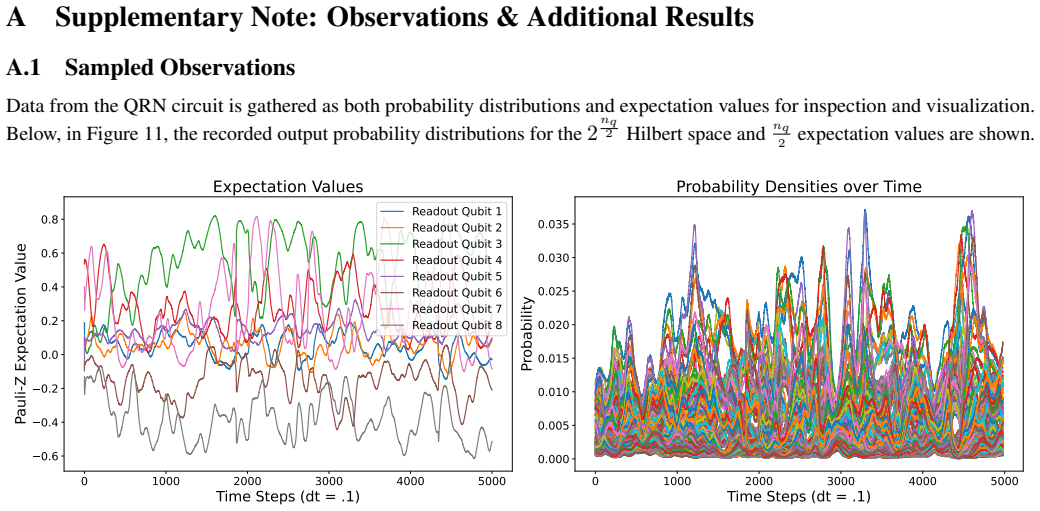
Omri Azencot, N. Benjamin Erichson, Vanessa Lin, and Michael W. Mahoney. Forecasting sequential data using consistent koopman autoencoders, 2020. URL https: //arxiv.org/abs/2003.02236. 10 A Supplementary Note: Observations & Additional Results A.1 Sampled Observations Data from the QRN circuit is gathered as both probability distributions and expectation ...
work page internal anchor Pith review Pith/arXiv arXiv 2020
discussion (0)
Sign in with ORCID, Apple, or X to comment. Anyone can read and Pith papers without signing in.