REVIEW 2 major objections 5 minor 300 references
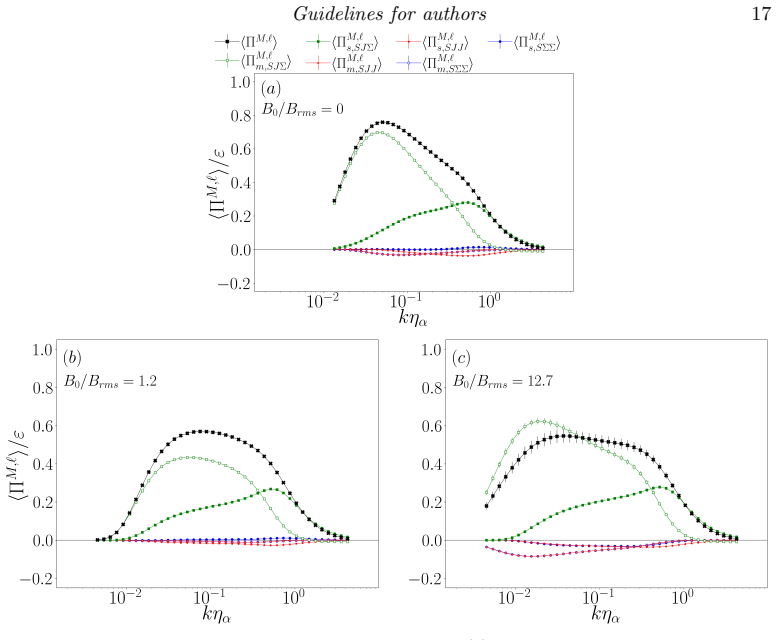
Current-sheet thinning still drives the energy cascade in MHD turbulence with a strong guide field; the guide field itself reverses energy conversion at small scales.
Reviewed by Pith at T0; open to challenge. T0 means a machine referee read the full paper against a public rubric. the ladder, T0–T4 →
T0 review · grok-4.5
2026-07-12 09:16 UTC pith:N5FIJ65J
load-bearing objection Solid controlled extension of their isotropic flux decomposition: current-sheet thinning still dominates under guide fields, plus a clean new split of the conversion term that reverses sign at small scales. the 2 major comments →
Energy transfer and conversion in Strongly Anisotropic Magnetohydrodynamic Turbulence
The pith
A machine-rendered reading of the paper's core claim, the machinery that carries it, and where it could break.
Core claim
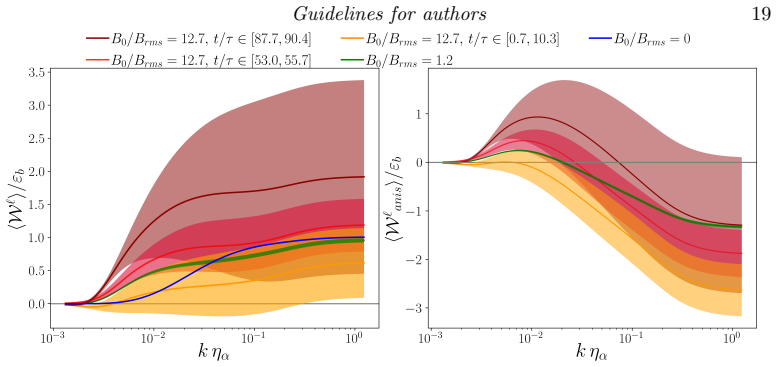
Even when a strong uniform magnetic field is imposed, current-sheet thinning remains the leading mechanism that transfers both kinetic and magnetic energy from large to small scales; the background-field contribution to kinetic–magnetic conversion acts as a nonlinear dynamo at large and intermediate scales and reverses to net magnetic-to-kinetic conversion at small scales.
What carries the argument
Exact Gaussian-filter decomposition of the four MHD energy subfluxes into single-scale and multi-scale contractions of strain, vorticity, magnetic shear and current; the same identities separate the resolved-scale conversion into isotropic and anisotropic (guide-field) parts.
Load-bearing premise
The strongest-guide-field run has not reached statistical stationarity, so every quantitative claim for that regime rests on the assumption that the chosen quasi-stationary intervals faithfully represent the long-time anisotropic state.
What would settle it
A statistically stationary simulation at the same strong guide-field strength in which the volume-averaged current-sheet-thinning subfluxes fall below the vortex-stretching or strain-self-amplification contributions, or in which the anisotropic conversion term remains positive down to the dissipation scale.
If this is right
- Subgrid-scale models for anisotropic MHD should keep current-sheet thinning as the leading cascade term and add an antidiffusive correction for large-scale kinetic-energy accumulation.
- Reduced MHD already retains the dominant cascade process once the guide field is strong enough to enforce progressive two-dimensionalisation.
- The scale-dependent sign change of guide-field-mediated conversion supplies a concrete diagnostic for distinguishing large-scale dynamo action from small-scale magnetic-to-kinetic back-reaction in spacecraft or laboratory data.
- Enhanced scale-independence of the individual subfluxes with increasing guide-field strength implies that spectral plateaus become more robust diagnostics of the inertial range in anisotropic plasmas.
Where Pith is reading between the lines
- Because current-sheet thinning survives the fully two-dimensional limit, any model that preserves magnetic shear and current should recover the correct cascade direction even if three-dimensional vortex stretching is omitted.
- The small-scale magnetic-to-kinetic reversal mediated by the guide field may set a natural floor on magnetic-energy accumulation and therefore on the saturation level of large-scale dynamos in strongly magnetized plasmas.
- The same decomposition applied to compressible or Hall-MHD data would test whether the dominance of current-sheet thinning is an incompressible ideal-MHD feature or a more universal plasma process.
Editorial analysis
A structured set of objections, weighed in public.
Referee Report
Summary. The paper extends an exact Gaussian-filter decomposition of MHD energy fluxes (previously applied to isotropic, zero-mean-field turbulence) to mechanically forced homogeneous MHD with weak and strong imposed background fields B0. Using three hyperdiffusive DNS datasets (B0/Brms = 0, 1.2, 12.7), it shows that current-sheet thinning (the single- and multi-scale SJΣ / JΣS terms) remains the dominant forward-cascade mechanism, while hydrodynamic-like vortex stretching and strain self-amplification stay suppressed. Subfluxes become more scale-independent with increasing B0, the Dynamo contribution is depleted, and a large-scale inverse Inertial contribution appears under strong anisotropy. Separately, the resolved-scale conversion is split into isotropic and anisotropic (B0-dependent) parts; the latter produces net kinetic-to-magnetic conversion at large/intermediate scales that reverses to magnetic-to-kinetic conversion at small scales.
Significance. If the results hold, they supply a concrete, filter-exact mechanistic picture of the energy cascade that survives into the strongly anisotropic regime relevant to solar wind, magnetospheres and fusion plasmas. The kinematic identities (Eqs. 2.19–2.20 and Appendix B) are parameter-free and reusable; the clean isolation of W_anis yields a falsifiable, scale-dependent conversion channel that is not visible in conventional spectral formulations. The work also indicates that reduced-MHD and SGS models can retain current-sheet thinning as the leading process while adding an antidiffusive term for large-scale kinetic-energy accumulation. Public DNS data further strengthen reproducibility.
major comments (2)
- §3 and Table 1 / Fig. 4: the strong-B0 run (C10, B0/Brms = 12.7) has not reached statistical stationarity; kinetic energy continues to grow and only quasi-stationary sampling intervals are used. All quantitative statements for that regime (scale-independence of subfluxes, magnitude of inverse Inertial transfer, late-time W_anis o −1, error-bar growth) rest on the assumption that these intervals represent the asymptotic anisotropic state. The paper should either (i) demonstrate that the leading subflux ordering is insensitive to the residual growth (e.g., by comparing the three intervals side-by-side for Π_M and Π_A) or (ii) clearly restrict the strongest claims to the stationary B0 = 0 and B0/Brms = 1.2 cases and treat C10 as qualitative support only.
- §5, Fig. 10 (top) and surrounding text: for the late-stage C10 interval the authors report ⟨Wℓ⟩/εb o 1.8 as ℓ o 0, while stationarity would require convergence to 1. The text acknowledges residual non-stationarity and large error bars, yet still draws quantitative conclusions about a “three-times-stronger” fluctuation dynamo. Either the late-stage data should be omitted from the quantitative conversion analysis or an explicit non-stationary budget (including the time derivative of magnetic energy) should be supplied so that the excess can be accounted for.
minor comments (5)
- Section ordering in the Introduction (p. 2) is inverted: the text announces “sec. 5 … conversion … In 4 we apply …”; renumber or reorder for sequential reading.
- Figure captions for Figs. 7–9 label the datasets inconsistently (A2 vs A3, B0 = 1 vs 1.2, B0 = 10 vs 12.7). Align captions with Table 1.
- Typographical slips: “nuemrical similations” (§3), “Visuaisations” (Fig. 3 caption), “when B0 becomeslargeenough” (p. 11), and the sign convention sentence for Wℓ (p. 3) that twice says “kinetic-to-magnetic”.
- Appendix B: the extra factor-of-two for the SJΣ and SΩS terms is mentioned but the corresponding Maxwell and Inertial definitions already include it; a one-sentence clarification would prevent double-counting confusion.
- A brief remark on whether the same leading-order current-sheet-thinning dominance survives under standard (α = 1) viscosity would strengthen the claim that the result is not an artefact of hyperdiffusion.
Circularity Check
No significant circularity: flux decompositions are kinematic identities from the Gaussian filter; DNS results and self-citations serve only as baseline comparison, not as inputs that force the anisotropic conclusions.
full rationale
The paper's central claims rest on two independent pillars: (1) exact kinematic identities for the SGS stresses and energy subfluxes that follow from the diffusion property of the Gaussian filter (eqs. 2.18–2.20 and the subsequent gradient decompositions in §§2.1–2.4 and Appendix B), and (2) direct numerical evaluation of those identities on three independent DNS datasets (A3, C1, C10). The identities hold for any sufficiently smooth solenoidal fields and do not encode the target physical conclusion (dominance of current-sheet thinning). The DNS data are generated by solving the forced MHD equations and are therefore external to the analytic decomposition. Self-citation of Capocci et al. (2025) is used solely to supply the isotropic baseline and the physical interpretation of the same subflux terms; it is not invoked as a uniqueness theorem or as a fitted parameter that forces the anisotropic results. The only soft point is the non-stationarity of the strong-guide-field run, which is a data-quality issue already flagged by the authors and does not constitute circular reasoning. Consequently the derivation chain is self-contained and the circularity score is minimal.
Axiom & Free-Parameter Ledger
free parameters (3)
- hyperviscosity exponent α =
5
- B0/Brms ratios =
0, 1.2, 12.7
- forcing wavenumber band =
[2.5,5.0]
axioms (3)
- standard math Gaussian filter yields an exact diffusion equation for filtered fields and an exact integral representation of SGS stresses (Eqs. 2.18–2.20).
- domain assumption Incompressible MHD equations with constant density and unit magnetic Prandtl number.
- ad hoc to paper Quasi-stationary intervals of the non-stationary strong-B0 run adequately represent the asymptotic anisotropic cascade.
read the original abstract
In homogeneous magnetohydrodynamic (MHD) turbulence without a background magnetic field driven by mechanical forces, an exact decomposition of the energy fluxes (D. Capocci et al., Journal of Plasma Physics, 91(1), E11 (2025)) has shown that current-sheet thinning is the dominant physical mechanism responsible for transferring energy from large to small scales. In contrast, mechanisms that are characteristic of hydrodynamic turbulence, such as vortex stretching and strain self-amplification, are strongly suppressed. Here, we extend this analysis to MHD turbulence in the presence of weak and strong imposed magnetic field, as previously driven by mechanical forces, and confirm that current-sheet thinning remains the leading process driving the energy cascade toward smaller scales in these more realistic configurations, and find enhanced scale invariance in the subfluxes. In addition to that, a decomposition of the contributions from the fluctuating and the background magnetic field to the conversion between kinetic and magnetic energies shows that the background-field-dependent contribution results in a nonlinear dynamo, that is an effective kinetic-to-magnetic conversion at large and intermediate scales. However, at small scales, it has the opposite effect, resulting in a net conversion of magnetic to kinetic energy.
Figures





Reference graph
Works this paper leans on
-
[1]
Saddoughi, S. G. , TITLE =. 1993 , JOURNAL =
1993
-
[2]
Saddoughi, S. G. and Veeravalli, S. V. , TITLE =. 1994 , Volume =. doi:10.1017/S0022112094001370 , KEYWORDS =
-
[3]
Sadek, M. and Aluie, H. , TITLE =. 2018 , Volume =. doi:10.1103/PhysRevFluids.3.124610 , KEYWORDS =
-
[4]
Sadhukhan, S. and Samuel, R. and Plunian, F. and Stepanov, R. and Samtaney, R. and Verma, M. K. , TITLE =. 2019 , Volume =. doi:10.1103/PhysRevFluids.4.084607 , KEYWORDS =
-
[5]
Saffman, P. G. , TITLE =. 1967 , Volume =
1967
-
[6]
Saffman, P. G. , TITLE =. 1971 , Volume =
1971
-
[7]
Saffman, P. G. , TITLE =. 1992 , Publisher = cup, Address =
1992
-
[8]
doi:10.1103/PhysRevLett.110.025004 , KEYWORDS =
Ion Kinetic Scale in the Solar Wind Observed , JOURNAL = prl, YEAR =. doi:10.1103/PhysRevLett.110.025004 , KEYWORDS =
-
[9]
doi:10.1088/0004-637X/803/2/107 , KEYWORDS =
Solar Wind Density Spectra around the Ion Spectral Break , JOURNAL = apj, YEAR =. doi:10.1088/0004-637X/803/2/107 , KEYWORDS =
-
[10]
doi:10.3847/0004-637X/825/2/121 , KEYWORDS =
Power Spectral Density of Fluctuations of Bulk and Thermal Speeds in the Solar Wind , JOURNAL = apj, YEAR =. doi:10.3847/0004-637X/825/2/121 , KEYWORDS =
-
[11]
doi:10.3847/1538-4357/abf6c9 , KEYWORDS =
Anisotropy of Magnetic Field and Velocity Fluctuations in the Solar Wind , JOURNAL = apj, YEAR = 2021, Volume =. doi:10.3847/1538-4357/abf6c9 , KEYWORDS =
-
[12]
Evolution of Magnetic Field Fluctuations and Their Spectral Properties within the Heliosphere:. 2023 , Volume =. doi:10.3847/2041-8213/acc531 , KEYWORDS =
-
[13]
Sagdeev, R. Z. and Galeev, A. A. , TITLE =. 1969 , Publisher=
1969
-
[14]
G. Sahoo and P. Perlekar and R. Pandit , TITLE =. 2011 , Volume =. doi:10.1088/1367-2630/13/1/013036 , KEYWORDS =
-
[15]
Sahoo, G. and Bonaccorso, F. and Biferale, L. , TITLE =. 2015 , Volume =. doi:10.1103/PhysRevE.92.051002 , KEYWORDS =
-
[16]
Sahoo, G. and. Helicity statistics in homogeneous and isotropic turbulence and turbulence models , JOURNAL = prF, YEAR =. doi:10.1103/PhysRevFluids.2.024601 , KEYWORDS =
-
[17]
Sahoo, G. and Alexakis, A. and Biferale, L. , TITLE =. 2017 , Volume =. doi:10.1103/PhysRevLett.118.164501 , KEYWORDS =
-
[18]
F. Sahraoui and G. Belmont and L. Rezeau , TITLE =. 2003 , JOURNAL = pop, Volume =. doi:10.1063/1.1564086 , Pages =
-
[19]
F. Sahraoui and G. Belmont and L. Rezeau and N. Cornilleau-. Anisotropic Turbulent Spectra in the Terrestrial Magnetosheath as Seen by the Cluster Spacecraft , YEAR =. doi:10.1103/PhysRevLett.96.075002 , EID =
-
[20]
F. Sahraoui , TITLE =. 2008 , JOURNAL = pre, Volume =. doi:10.1103/PhysRevE.78.026402 , EID =
-
[21]
F. Sahraoui and M. L. Goldstein and P. Robert and Yu. V. Khotyaintsev , TITLE =. 2009 , JOURNAL = prl, Volume =. doi:10.1103/PhysRevLett.102.231102 , KEYWORDS =
-
[22]
Sahraoui, F. and Belmont, G. and Goldstein, M. L. and Rezeau, L. , TITLE =. 2010 , Volume =. doi:10.1029/2009JA014724 , EID =
-
[23]
Sahraoui, F. and Goldstein, M. L. and Belmont, G. and Canu, P. and Rezeau, L. , TITLE =. 2010 , Volume =. doi:10.1103/PhysRevLett.105.131101 , KEYWORDS =
-
[24]
Sahraoui, F. and Belmont, G. and Goldstein, M. L. , TITLE =. 2012 , Volume =. doi:10.1088/0004-637X/748/2/100 , KEYWORDS =
-
[25]
Sahraoui, F. and Robert, P. and Goldstein, M. L. and Khotyaintsev, Yu. V. , TITLE =. 2013 , Volume =. doi:10.1103/PhysRevLett.111.149002 , KEYWORDS =
-
[26]
Sahraoui, F. and Hadid, L. and Huang, S. , TITLE =. 2020 , Volume =. doi:10.1007/s41614-020-0040-2 , KEYWORDS =
-
[27]
Fouad Sahraoui and Shiyong Huang , TITLE =. 2023 , Volume =. doi:10.3847/1538-4357/acf45b , KEYWORDS =
-
[28]
Saito, S. and Gary, S. P. and Li, H. and Narita, Y. , TITLE =. 2008 , Volume =. doi:10.1063/1.2997339 , KEYWORDS =
-
[29]
T. Sakaue and K. Shibata , TITLE =. doi:10.3847/1538-4357/ababa0 , KEYWORDS =
-
[30]
doi:10.3847/2041-8213/abd3a9 , KEYWORDS =
Takahito Sakaue and Kazunari Shibata , TITLE =. doi:10.3847/2041-8213/abd3a9 , KEYWORDS =
-
[31]
Sakshee, S. and Bandyopadhyay, R. and Banerjee, Supratik , TITLE =. doi:10.1093/mnras/stac1449 , KEYWORDS =
-
[32]
Computer Physics Reports , YEAR =
Sakurai, T , TITLE =. Computer Physics Reports , YEAR =
-
[33]
and Ishihara, Takashi , TITLE =
Sakurai, Y. and Ishihara, Takashi , TITLE =. 2023 , Volume =. doi:10.1103/PhysRevFluids.8.084606 , KEYWORDS =
-
[34]
C. Salem and A. Mangeney and S. D. Bale and P. Veltri and R. Bruno , TITLE =. Turbulence and nonlinear processes in astrophysical plasmas. 6th Annual International Astrophysics Conference , EDITOR =. 2007 , Publisher=. doi:10.1063/1.2778948 , KEYWORDS =
-
[35]
Salem, C. and Mangeney, A. and Bale, S. D. and Veltri, P. , TITLE =. 2009 , Volume =. doi:10.1088/0004-637X/702/1/537 , KEYWORDS =
-
[36]
Salem, C. S. and Howes, G. G. and Sundkvist, D. and Bale, S. D. and Chaston, C. C. and Chen, C. H. K. and Mozer, F. S. , TITLE =. 2012 , Volume =. doi:10.1088/2041-8205/745/1/L9 , KEYWORDS =
-
[37]
Salewski, M. and Gibson, J. F. and Schneider, T. M. , TITLE =. 2019 , Volume =. doi:10.1103/PhysRevE.100.031102 , KEYWORDS =
-
[38]
, TITLE =
Salmon, R. , TITLE =. 1983 , Volume =
1983
-
[39]
, TITLE =
Salmon, R. , TITLE =. 1988 , Volume =
1988
-
[40]
Salu, Y. and Knorr, G. , TITLE =. 1975 , Volume =. doi:10.1016/0021-9991(75)90063-7 , KEYWORDS =
-
[41]
Salu, Y. and D. C. Montgomery , TITLE =. 1977 , Volume =
1977
-
[42]
Salvesen, G. and Beckwith, K. and Simon, J. B. and. Quantifying energetics and dissipation in magnetohydrodynamic turbulence , JOURNAL = mnras, YEAR =. doi:10.1093/mnras/stt2281 , KEYWORDS =
-
[43]
Samanta, T. and Tian, H. and Nakariakov, V. M. , TITLE =. 2019 , Volume =. doi:10.1103/PhysRevLett.123.035102 , KEYWORDS =
-
[44]
O. San and A. E. Staples , TITLE =. 2012 , Volume =. doi:10.1016/j.compfluid.2012.04.006 , KEYWORDS =
-
[45]
R. S. Probabilistic transport models for plasma transport in the presence of critical thresholds:. 2005 , Volume =. doi:10.1063/1.1869499 , KEYWORDS =
-
[46]
The very slow solar wind:
Sanchez-. The very slow solar wind:. 2016 , DOI =
2016
-
[47]
C. R. Sangeetha and S. P. Rajaguru , TITLE =. 2016 , Volume =. doi:10.3847/0004-637X/824/2/120 , KEYWORDS =
-
[48]
Singular value decomposition methods for wave propagation analysis , JOURNAL =
Santol. Singular value decomposition methods for wave propagation analysis , JOURNAL =. 2003 , Volume =. doi:10.1029/2000RS002523 , KEYWORDS =
-
[49]
Sarfraz, M. and L\'opez, R. A. and Ahmed, S. and Yoon, P. H. , TITLE =. 2021 , Volume =. doi:10.1093/mnras/stab3291 , KEYWORDS =
-
[50]
Sari, J. W. and Valley, G. C. , TITLE =. 1976 , Volume =. doi:10.1029/JA081i031p05489 , KEYWORDS =
-
[51]
Saric, W. S. , TITLE =. 1994 , Volume =
1994
-
[52]
Sarkar, A. and Bhattacharjee, A. and Ebrahimi, F. , TITLE =. 2014 , Volume =. doi:10.1088/0004-637X/783/2/65 , KEYWORDS =
-
[53]
Sasa, S.-. Thermodynamic Entropy as a. 2016 , Volume =. doi:10.1103/PhysRevLett.116.140601 , KEYWORDS =
-
[54]
doi:10.3847/1538-4357/aafd33 , KEYWORDS =
Dissipation Scale Lengths of Solar Wind Turbulence , JOURNAL = apj, YEAR =. doi:10.3847/1538-4357/aafd33 , KEYWORDS =
-
[55]
doi:10.3847/1538-4357/abfcd1 , KEYWORDS =
Turbulent Proton Heating Rate in the Solar Wind from 5--45\,. doi:10.3847/1538-4357/abfcd1 , KEYWORDS =
-
[56]
Sato and T
T. Sato and T. Hayashi , TITLE =. 1979 , Volume =
1979
-
[57]
Sattin, F. and Escande, D. F. , TITLE =. 2014 , Volume =. doi:10.1103/PhysRevLett.112.095003 , KEYWORDS =
-
[58]
and Bieber, J
Saur, J. and Bieber, J. W. , TITLE =. 1999 , Volume =
1999
-
[59]
Saur, J. and Politano, H. and Pouquet, A. and Matthaeus, W. H. , TITLE =. 2002 , Volume =. doi:10.1051/0004-6361:20020305 , KEYWORDS =
-
[60]
V. L. Saveliev and M. A. Gorokhovski , TITLE =. 2005 , JOURNAL = pre, Volume =. doi:10.1103/PhysRevE.72.016302 , EID =
-
[61]
P. Schaefer and M. Gampert and N. Peters , TITLE =. 2012 , Volume =. doi:10.1063/1.3701380 , KEYWORDS =
-
[62]
Schaffner, D. A. and Wan, A. and Brown, M. R. , TITLE =. 2014 , Volume =. doi:10.1103/PhysRevLett.112.165001 , KEYWORDS =
-
[63]
D. A. Schaffner and M. R. Brown and V. S. Lukin , TITLE =. 2014 , Volume =. doi:10.1088/0004-637X/790/2/126 , KEYWORDS =
-
[64]
Hans Schamel , TITLE =. 2012 , Volume =. doi:10.1063/1.3682047 , KEYWORDS =
-
[65]
Schecter, D. A. and Dubin, D. H. E. and Fine, K. S. and Driscoll, C. F. , TITLE =. 1999 , Volume =
1999
-
[66]
Schekochihin, A. A. and Cowley, S. C. and Hammett, G. W. and Maron, J. L. and Mc. A model of nonlinear evolution and saturation of the turbulent. 2002 , Volume =
2002
-
[67]
A. A. Schekochihin and N. E. L. Haugen and A. Brandenburg and S. C. Cowley and J. L. Maron and J. C. Mc. The Onset of a Small-Scale Turbulent Dynamo at Low Magnetic. 2005 , Volume =
2005
-
[68]
Schekochihin, A. A. and Cowley, S. C. and Dorland, W. , TITLE =. 2007 , Volume =. doi:10.1088/0741-3335/49/5A/S16 , KEYWORDS =
-
[69]
A. A. Schekochihin and S. C. Cowley and T. A. Yousef , TITLE =. Computational Physics and New Perspectives in Turbulence , EDITOR =. 2008 , DOI =
2008
-
[70]
A. A. Schekochihin and S. C. Cowley , TITLE =. Magnetohydrodynamics:. 2007 , DOI =
2007
-
[71]
Schekochihin, A. A. and Cowley, S. C. and Dorland, W. and Hammett, G. W. and Howes, G. G. and Plunk, G. G. and Quataert, E. and Tatsuno, T. , TITLE =. 2008 , Volume =. doi:10.1088/0741-3335/50/12/124024 , KEYWORDS =
-
[72]
Schekochihin, A. A. and Cowley, S. C. and Dorland, W. and Hammett, G. W. and Howes, G. G. and Quataert, E. and Tatsuno, T. , TITLE =. 2009 , Volume =. doi:10.1088/0067-0049/182/1/310 , KEYWORDS =
-
[73]
A. A. Schekochihin and S. C. Cowley and F. Rincon and M. S. Rosin , TITLE =. 2010 , Volume =. doi:10.1111/j.1365-2966.2010.16493.x , KEYWORDS =
-
[74]
Schekochihin, A. A. and Nazarenko, S. V. and Yousef, T. A. , TITLE =. 2012 , Volume =. doi:10.1103/PhysRevE.85.036406 , KEYWORDS =
-
[75]
Schekochihin, A. A. and Parker, J. T. and Highcock, E. G. and Dellar, P. J. and Dorland, W. and Hammett, G. W. , TITLE =. 2016 , Volume =. doi:10.1017/S0022377816000374 , KEYWORDS =
-
[76]
Schekochihin, A. A. and Kawazura, Y. and Barnes, M. A. , TITLE =. 2019 , Volume =. doi:10.1017/S0022377819000345 , KEYWORDS =
-
[77]
Schekochihin, A. A. , TITLE =. 2022 , Volume =. doi:10.1017/S0022377822000721 , KEYWORDS =
-
[78]
Schep, T. J. and Pegoraro, F. and Kuvshinov, B. N. , TITLE =. 1994 , Volume =. doi:10.1063/1.870523 , KEYWORDS =
-
[79]
R. A. Scheper and A. B. Hassam , TITLE =. 1999 , Volume =. doi:10.1086/306702 , KEYWORDS =
-
[80]
Scherer, K. and Fichtner, H. , TITLE =. 2014 , Volume =. doi:10.1088/0004-637X/782/1/25 , KEYWORDS =
discussion (0)
Sign in with ORCID, Apple, or X to comment. Anyone can read and Pith papers without signing in.