REVIEW 3 major objections 4 minor 70 references
Flowcode shows that AI-generated flowcharts plus deliberate friction in explanations let novices understand and extend found creative code by writing it themselves instead of vibe-coding complete solutions.
Reviewed by Pith at T0; open to challenge. T0 means a machine referee read the full paper against a public rubric. the ladder, T0–T4 →
T0 review · grok-4.5
2026-07-10 22:42 UTC pith:XPQUZTMP
load-bearing objection Solid iterative design paper that ships usable multi-file flowchart + friction scaffolds for creative-coding remix; qualitative traces support engagement but not learning outcomes. the 3 major comments →
Flowcode: An AI-Powered Programming Environment for Scaffolding Iteration in Creative Computing Education
The pith
A machine-rendered reading of the paper's core claim, the machinery that carries it, and where it could break.
Core claim
When an LLM produces a hierarchical flowchart that maps high-level visual features onto the concrete multi-language code fragments that implement them, and when explanations are delivered one step at a time with blanks the learner must complete, novice creative coders can orient themselves in found projects, navigate across files, and iterate productively while still writing the critical lines themselves.
What carries the argument
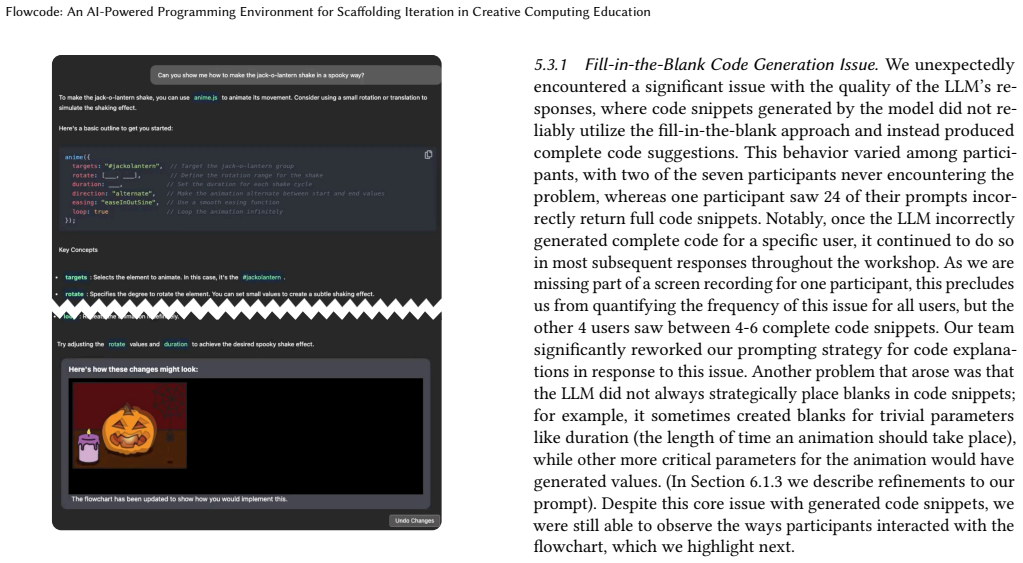
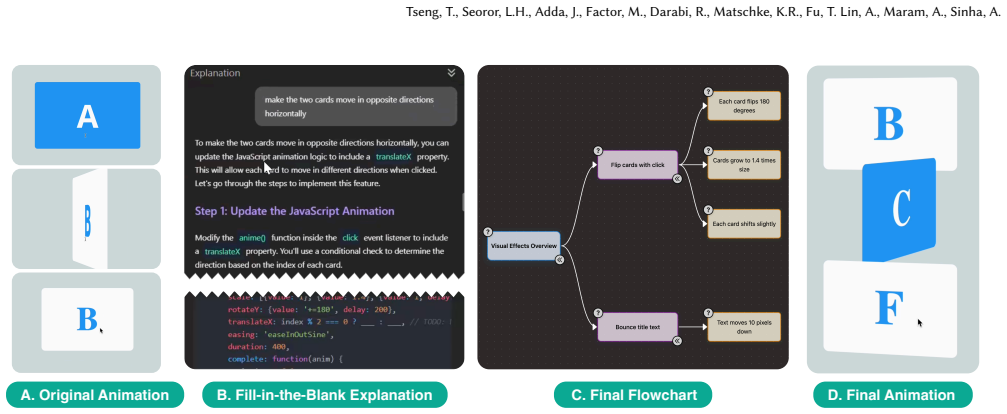
The dual mechanism of (1) an auto-generated multi-level flowchart whose nodes highlight corresponding HTML/CSS/JS lines and (2) step-by-step, fill-in-the-blank explanations that deliberately withhold complete solutions and require manual insertion.
Load-bearing premise
That the short interaction patterns and self-reported gains seen in a few dozen minutes of use will translate into lasting learning and reduced dependence on AI when students remix full projects over longer periods.
What would settle it
A longer controlled study in which half the beginners remix the same CodePen projects with Flowcode and half with an ordinary chat-plus-IDE setup; if the Flowcode group shows no measurable gain in independent code comprehension or feature implementation after several sessions, the central claim fails.
If this is right
- Creative-coding classrooms can adopt flowchart-plus-friction interfaces to keep students writing code while still receiving AI help.
- The same dual scaffolding can be applied to multi-file web or collaborative repositories where newcomers must understand code written by others.
- Removing auto-insertion and copy buttons becomes a practical design lever for any educational code assistant that wants to reduce vibe-coding.
- LLM prompts for pedagogical code generation can be engineered to place blanks on conceptually important parameters rather than trivial ones.
- Community galleries such as CodePen become more usable learning resources once every project can be unpacked into a navigable semantic flowchart.
Where Pith is reading between the lines
- The same friction pattern could transfer to non-creative domains such as introductory data-science notebooks where students currently paste full solutions.
- If the flowchart is regenerated after every substantial edit, it may serve as a live ‘diff’ that makes collaborative code reviews faster for mixed-experience teams.
- Persistent failure rates of ~20 % on fill-in-the-blank generation suggest that fine-tuning or retrieval-augmented prompting will be needed before the technique can be deployed at scale.
- Over longer horizons the flowchart itself may become a lightweight curriculum map that surfaces just-beyond-current concepts for adaptive scaffolding.
Editorial analysis
A structured set of objections, weighed in public.
Referee Report
Summary. The paper presents Flowcode, an AI-powered creative-coding environment that pairs an LLM-generated multi-level flowchart (linking semantic nodes to HTML/CSS/JS fragments) with a chat interface that deliberately introduces friction via progressive step-by-step reveals and fill-in-the-blank code snippets. The goal is to support novices in understanding found Anime.js animations and iterating on them by writing code themselves rather than vibe-coding complete solutions. Design is refined across a pilot workshop (n=7) and a think-aloud lab study (n=9); qualitative analysis of logs, screen recordings, and interviews shows participants using the flowchart for orientation/navigation and engaging the stepped explanations after Iteration-2 changes (manual flowchart updates, no auto-insert/copy button).
Significance. If the observed patterns hold, the work supplies concrete, transferable design patterns for pedagogically oriented code assistants in open-ended creative domains: semantic multi-file visualization plus engineered friction that prioritizes active code writing over solution dumping. Strengths include transparent iterative design, detailed interaction traces (Figure 5), explicit reporting of residual LLM failure rates (~22% full snippets for JS/CSS in Appendix A.4), and a clear focus on remixing community examples rather than closed exercises. These are useful contributions to HCI and computing-education research on productive AI use, even without controlled learning-outcome data.
major comments (3)
- [§6.3 Results / §7 Discussion] §6.3 and §7 frame the flowchart and friction features as enabling understanding and reducing vibe-coding. Evidence is limited to engagement logs (node clicks, next-step advances, blank fills), interaction traces (Figure 5), and post-session self-reports from short sessions. No direct measures of comprehension (e.g., explain-in-plain-English, re-implementation without the LLM), transfer, retention, or comparative reduction in full-solution pasting versus a baseline (plain ChatGPT or no-friction editor) are reported. The central educational claim therefore rests on interpretation of short-term use rather than outcome data; either add such measures or substantially qualify the “enable” language.
- [Appendix A.4 / §6.1.3] Appendix A.4 reports a 22–23% rate of full (non-blank) JS/CSS snippets even after the 2724-word prompt refinement. Because the friction mechanism depends on blanks that force active editing, this residual failure rate is load-bearing: it undercuts the claim that the interface reliably prevents vibe-coding. The paper notes the issue but does not analyze how often participants still received and used complete solutions, nor how this affected the observed “deeper engagement.” Quantify impact on the study data or strengthen the reliability discussion.
- [§5–§6 Study design / §8 Limitations] Both studies are single-condition design explorations (workshop n=7, lab n=9, total ~16 beginners, 40-minute main tasks). §8 correctly notes that patterns may differ over full project remixes, yet the abstract and discussion still present the features as scaffolding productive iteration. Without a control or longer-term deployment, claims about reduced LLM dependence and learning-oriented prompting shifts (e.g., P1 vignette) remain provisional. Either run a comparative condition or reframe contributions strictly as design insights from iterative prototyping.
minor comments (4)
- [Figure 5] Figure 5 caption and axis labels contain rendering artifacts (“이 5”, “P4-”); clean for camera-ready.
- [§5.3] §5.3: “using the it frequently” is a typo; several other small grammatical slips appear in results (e.g., “the Flowchart’s ability”).
- [§6.2] Lab sample is entirely female (explicitly noted); a brief sentence on implications for generalizability would be useful, especially given creative-coding diversity goals stated in the introduction.
- [§2] Related-work coverage of multi-file web animation communities and of other friction/guardrail systems is solid but could more explicitly contrast Flowcode’s visual modality against purely textual guardrails (CodeAid, CodeHelp).
Circularity Check
No circularity: empirical HCI design paper whose claims rest on observed user behavior, not on self-referential definitions, fitted parameters re-labeled as predictions, or load-bearing self-citation chains.
full rationale
Flowcode is a systems/HCI paper that iterates a programming environment (flowchart visualization + frictionful step-by-step fill-in-the-blank explanations) across a pilot workshop (n=7) and lab study (n=9), then reports qualitative themes and interaction logs. There are no equations, no fitted parameters presented as first-principles predictions, and no uniqueness theorems. Self-citations (e.g., Keyframer [57,58]) appear only in Related Work as prior creative-coding tools; they do not underwrite the central empirical claims about orientation, navigation, or reduced vibe-coding. Those claims are grounded in the two studies’ logs, think-alouds, and interviews. The paper is therefore self-contained against its own observational evidence; no step reduces by construction to its inputs. Score 0 is the correct honest finding.
Axiom & Free-Parameter Ledger
axioms (3)
- domain assumption Remixing found examples is a primary pathway by which novices learn creative coding and that multi-file HTML/CSS/JS projects are especially hard to orient within.
- domain assumption Thematic analysis of think-alouds, screen recordings and interaction logs from small convenience samples yields transferable design insights.
- domain assumption GPT-4o can be steered by long natural-language prompts to produce pedagogically useful fill-in-the-blank snippets and hierarchical flowcharts with acceptable reliability.
invented entities (1)
-
Flowcode (flowchart + friction chat environment)
no independent evidence
read the original abstract
Building upon found examples is a popular way people learn to code, especially in creative coding communities where sharing projects and remixing are common practices. But effectively doing so requires being able to 1) understand how existing code works, and 2) extend it by writing code that implements your own ideas, practices that can be challenging for new creative coders. We explored how to support these two processes through the design of Flowcode, a creative coding programming environment that integrates a flowchart for visualizing code structure and a chat interface tailored to support learning to code over vibe coding. We share how we iterated on the design of Flowcode over two studies with new creative coders, reflecting on the roles visualization and friction may play in enabling productive AI-use in computing education.
Figures




Reference graph
Works this paper leans on
-
[1]
[n. d.]. p5.js Community Sketches. https://p5js.org/sketches/
-
[2]
Tyler Angert, Miroslav Ivan Suzara, Jenny Han, Christopher Lawrence Pondoc, and Hariharan Subramonyam. 2023. Spellburst: A Node-based Interface for Exploratory Creative Coding with Natural Language Prompts.UIST(2023)
work page 2023
-
[3]
William Bares, Bill Manaris, and Renée McCauley. 2018. Gender equity in computer science through computing in the arts–a six-year longitudinal study. Computer Science Education28, 3 (2018), 191–210
work page 2018
-
[4]
Shraddha Barke, Michael B James, and Nadia Polikarpova. 2023. Grounded copilot: How programmers interact with code-generating models.Proceedings of the ACM on Programming Languages7, OOPSLA1 (2023), 85–111. doi:10.1145/ 3586030
work page 2023
-
[5]
Joel Brandt, Mira Dontcheva, Marcos Weskamp, and Scott R Klemmer. 2010. Example-centric programming: integrating web search into the development environment. InProceedings of the SIGCHI Conference on Human Factors in Computing Systems. 513–522
work page 2010
-
[6]
Joel Brandt, Philip J Guo, Joel Lewenstein, Mira Dontcheva, and Scott R Klemmer
-
[7]
InProceedings of the SIGCHI conference on human factors in computing systems
Two studies of opportunistic programming: interleaving web foraging, learning, and writing code. InProceedings of the SIGCHI conference on human factors in computing systems. 1589–1598
-
[8]
Virginia Braun and Victoria Clarke. 2006. Using thematic analysis in psy- chology.Qualitative Research in Psychology3, 2 (2006), 77–101. doi:10.1191/ 1478088706qp063oa
work page 2006
-
[9]
Peter Brusilovsky. 2001. WebEx: Learning from Examples in a Programming Course.. InWebNet, Vol. 1. 124–129
work page 2001
-
[10]
Teresa Busjahn and Carsten Schulte. 2013. The use of code reading in teaching programming. InProceedings of the 13th Koli Calling international conference on computing education research. 3–11
work page 2013
-
[11]
Mark Chen, Jerry Tworek, Heewoo Jun, Qiming Yuan, Henrique Ponde De Oliveira Pinto, Jared Kaplan, Harri Edwards, Yuri Burda, Nicholas Joseph, Greg Brockman, et al. 2021. Evaluating large language models trained on code. arXiv preprint arXiv:2107.03374(2021)
work page internal anchor Pith review Pith/arXiv arXiv 2021
-
[12]
Michelle Craig, Phill Conrad, Dylan Lynch, Natasha Lee, and Laura Anthony
-
[13]
Listening to early career software developers.J. Comput. Sci. Coll.33, 4 (2018), 138–149
work page 2018
-
[14]
Sayamindu Dasgupta, William Hale, Andrés Monroy-Hernández, and Ben- jamin Mako Hill. 2016. Remixing as a pathway to computational thinking. InProceedings of the 19th ACM conference on computer-supported cooperative work & social computing. 1438–1449
work page 2016
-
[15]
Nicholas Davis. 2013. Human-computer co-creativity: Blending human and computational creativity. InProceedings of the AAAI conference on artificial intelligence and interactive digital entertainment, Vol. 9. 9–12
work page 2013
-
[16]
Paul Denny, Stephen MacNeil, Jaromir Savelka, Leo Porter, and Andrew Luxton- Reilly. 2024. Desirable characteristics for AI teaching assistants in programming education. InProceedings of the 2024 on Innovation and Technology in Computer Science Education V. 1. 408–414
work page 2024
-
[17]
Francis Geng, Anshul Shah, Haolin Li, Nawab Mulla, Steve Swanson, Gerald Soosai Raj, Daniel Zingaro, and Leo Porter. 2026. Exploring student-AI interac- tions in vibe coding. InProceedings of the 28th Australasian Computing Education Conference. 45–54
work page 2026
-
[18]
Scarlett R Herring, Chia-Chen Chang, Jesse Krantzler, and Brian P Bailey. 2009. Getting inspired! Understanding how and why examples are used in creative design practice. InProceedings of the SIGCHI conference on human factors in computing systems. 87–96
work page 2009
-
[19]
Cruz Izu and Claudio Mirolo. 2020. Comparing small programs for equivalence: A code comprehension task for novice programmers. InProceedings of the 2020 ACM Conference on Innovation and Technology in Computer Science Education. 466–472
work page 2020
-
[20]
Hyoungwook Jin, Seonghee Lee, Hyungyu Shin, and Juho Kim. 2024. Teach ai how to code: Using large language models as teachable agents for program- ming education. InProceedings of the 2024 CHI Conference on Human Factors in Computing Systems. 1–28
work page 2024
-
[21]
Martin Jonsson and Jakob Tholander. 2022. Cracking the code: Co-coding with AI in creative programming education. InProceedings of the 14th Conference on Creativity and Cognition(Venice, Italy)(C&C ’22). Association for Computing Machinery, New York, NY, USA, 5–14. doi:10.1145/3527927.3532801
-
[22]
Enkelejda Kasneci, Kathrin Seßler, Stefan Küchemann, Maria Bannert, Daryna Dementieva, Frank Fischer, Urs Gasser, Georg Groh, Stephan Günnemann, Eyke Hüllermeier, et al. 2023. ChatGPT for good? On opportunities and challenges of large language models for education.Learning and individual differences103 (2023), 102274
work page 2023
-
[23]
Majeed Kazemitabaar, Justin Chow, Carl Ka To Ma, Barbara J Ericson, David Weintrop, and Tovi Grossman. 2023. Studying the effect of AI code generators on supporting novice learners in introductory programming. InProceedings of the 2023 CHI conference on human factors in computing systems. 1–23
work page 2023
-
[24]
Majeed Kazemitabaar, Runlong Ye, Xiaoning Wang, Austin Zachary Henley, Paul Denny, Michelle Craig, and Tovi Grossman. 2024. Codeaid: Evaluating a classroom deployment of an llm-based programming assistant that balances student and educator needs. InProceedings of the 2024 chi conference on human factors in computing systems. 1–20
work page 2024
-
[25]
Amy J Ko, Brad A Myers, Michael J Coblenz, and Htet Htet Aung. 2006. An exploratory study of how developers seek, relate, and collect relevant information during software maintenance tasks.IEEE Transactions on software engineering 32, 12 (2006), 971–987
work page 2006
-
[26]
Chinmay Kulkarni, Steven P Dow, and Scott R Klemmer. 2013. Early and repeated exposure to examples improves creative work. InDesign thinking research: Building innovation eco-systems. Springer, 49–62
work page 2013
-
[27]
Sam Lau and Philip Guo. 2023. From" Ban it till we understand it" to" Resistance is futile": How university programming instructors plan to adapt as more students use AI code generation and explanation tools such as ChatGPT and GitHub Copilot. InProceedings of the 2023 ACM Conference on International Computing Education Research-Volume 1. 106–121
work page 2023
-
[28]
Brian Lee, Savil Srivastava, Ranjitha Kumar, Ronen Brafman, and Scott R Klem- mer. 2010. Designing with interactive example galleries. InProceedings of the SIGCHI conference on human factors in computing systems. 2257–2266
work page 2010
-
[29]
Teemu Lehtinen, Aleksi Lukkarinen, and Lassi Haaranen. 2021. Students struggle to explain their own program code. InProceedings of the 26th ACM Conference on Innovation and Technology in Computer Science Education V. 1. 206–212
work page 2021
-
[30]
2021.Code as creative medium: a handbook for computational art and design
Golan Levin and Tega Brain. 2021.Code as creative medium: a handbook for computational art and design. MIT Press
work page 2021
-
[31]
Colleen M Lewis. 2023. Examples of unsuccessful use of code comprehen- sion strategies: A resource for developing code comprehension pedagogy. In Proceedings of the 2023 ACM Conference on International Computing Education Tseng, T., Seoror, L.H., Adda, J., Factor, M., Darabi, R., Matschke, K.R., Fu, T. Lin, A., Maram, A., Sinha, A. Research-Volume 1. 15–28
work page 2023
-
[32]
Mark Liffiton, Brad E Sheese, Jaromir Savelka, and Paul Denny. 2023. Codehelp: Using large language models with guardrails for scalable support in program- ming classes. InProceedings of the 23rd Koli calling international conference on computing education research. 1–11
work page 2023
-
[33]
Raymond Lister, Elizabeth S Adams, Sue Fitzgerald, William Fone, John Hamer, Morten Lindholm, Robert McCartney, Jan Erik Moström, Kate Sanders, Otto Seppälä, et al. 2004. A multi-national study of reading and tracing skills in novice programmers.Acm sigcse bulletin36, 4 (2004), 119–150
work page 2004
-
[34]
Rongxin Liu, Carter Zenke, Charlie Liu, Andrew Holmes, Patrick Thornton, and David J Malan. 2024. Teaching CS50 with AI: leveraging generative artificial intelligence in computer science education. InProceedings of the 55th ACM technical symposium on computer science education V. 1. 750–756
work page 2024
-
[35]
Vivian Liu, Rubaiat Habib Kazi, Li-Yi Wei, Matthew Fisher, Timothy Langlois, Seth Walker, and Lydia Chilton. 2025. Logomotion: Visually-grounded code synthesis for creating and editing animation. InProceedings of the 2025 CHI Conference on Human Factors in Computing Systems. 1–16
work page 2025
-
[36]
Emily Lovell and James Davis. 2021. Craft of Computing: Using a Novel Domain to Broaden Undergraduate Participation and Perceptions of Computing at the CS0 Level. In2021 IEEE Frontiers in Education Conference (FIE). IEEE, 1–9
work page 2021
-
[37]
Andrew M McNutt, Sam Cohen, and Ravi Chugh. 2025. Slowness, Politics, and Joy: Values That Guide Technology Choices in Creative Coding Classrooms. In Proceedings of the 2025 CHI Conference on Human Factors in Computing Systems. 1–16
work page 2025
-
[38]
Andrew M Mcnutt, Anton Outkine, and Ravi Chugh. 2023. A study of editor features in a creative coding classroom. InProceedings of the 2023 CHI Conference on Human Factors in Computing Systems. 1–15
work page 2023
-
[39]
Kasia Muldner, Jay Jennings, and Veronica Chiarelli. 2022. A review of worked examples in programming activities.ACM Transactions on Computing Education 23, 1 (2022), 1–35
work page 2022
-
[40]
Laurie Murphy, Renée McCauley, and Sue Fitzgerald. 2012. ’Explain in plain English’questions: implications for teaching. InProceedings of the 43rd ACM technical symposium on Computer Science Education. 385–390
work page 2012
-
[41]
Daye Nam, Andrew Macvean, Vincent Hellendoorn, Bogdan Vasilescu, and Brad Myers. 2024. Using an llm to help with code understanding. InProceedings of the IEEE/ACM 46th International Conference on Software Engineering. 1–13
work page 2024
-
[42]
Kush Patel, Seth Bernstein, Rayhona Nasimova, Paul Denny, Juho Leinonen, and Stephen MacNeil. 2026. Assessing the Role of Diversity in LLM Explanations for Enhancing Student Understanding. InProceedings of the 57th ACM Technical Symposium on Computer Science Education V. 2. 1469–1470
work page 2026
-
[43]
William Christopher Payne, Yoav Bergner, Mary Etta West, Carlie Charp, R Ben- jamin Shapiro, Danielle Albers Szafir, Edd V Taylor, and Kayla DesPortes. 2021. Danceon: Culturally responsive creative computing. InProceedings of the 2021 CHI conference on human factors in computing systems. 1–16
work page 2021
-
[44]
Adriana Picoral. 2026. Code Reading Instruction: Essential in the Age of Gen- erative AI. InProceedings of the 57th ACM Technical Symposium on Computer Science Education V. 2. 1727–1727
work page 2026
-
[45]
James Prather, Paul Denny, Juho Leinonen, Brett A Becker, Ibrahim Albluwi, Michelle Craig, Hieke Keuning, Natalie Kiesler, Tobias Kohn, Andrew Luxton- Reilly, et al. 2023. The robots are here: Navigating the generative ai revolution in computing education. InProceedings of the 2023 working group reports on innovation and technology in computer science edu...
work page 2023
-
[46]
James Prather, Brent N Reeves, Juho Leinonen, Stephen MacNeil, Arisoa S Randri- anasolo, Brett A Becker, Bailey Kimmel, Jared Wright, and Ben Briggs. 2024. The widening gap: The benefits and harms of generative ai for novice programmers. InProceedings of the 2024 ACM Conference on International Computing Education Research-Volume 1. 469–486
work page 2024
-
[47]
Yunhan Qiao, Md Istiak Hossain Shihab, and Christopher Hundhausen. 2026. A systematic literature review of the use of genai assistants for code comprehension: implications for computing education research and practice.ACM Transactions on Computing Education26, 2 (2026), 1–33
work page 2026
-
[48]
Casey Reas. 2028. The history of Processing. https://medium.com/processing- foundation/a-modern-prometheus-59aed94abe85
work page 2028
-
[49]
Mitchel Resnick and Eric Rosenbaum. 2013. Designing for tinkerability. InDesign, make, play. Routledge, 163–181
work page 2013
-
[50]
Martin P Robillard, Wesley Coelho, and Gail C Murphy. 2005. How effective developers investigate source code: An exploratory study.IEEE Transactions on software engineering30, 12 (2005), 889–903
work page 2005
-
[51]
Michael P Rogers, Hannah Miller Hillberg, and Christopher L Groves. 2024. Attitudes towards the use (and misuse) of ChatGPT: A preliminary study. In Proceedings of the 55th ACM Technical Symposium on Computer Science Education V. 1. 1147–1153
work page 2024
-
[52]
Sara Sáez-Velasco, Mario Alaguero-Rodríguez, Vanesa Delgado-Benito, and Sonia Rodríguez-Cano. 2024. Analysing the impact of generative AI in arts education: A cross-disciplinary perspective of educators and students in higher education. InInformatics, Vol. 11. MDPI, 37
work page 2024
-
[53]
Hauke Sandhaus, Qiuquan Gu, Maria Teresa Parreira, and Wendy Ju. 2025. Co- designing with transformers: Unpacking the complex role of GenAI in interactive system design education. InProceedings of the 2025 ACM Designing Interactive Systems Conference. 1228–1243
work page 2025
-
[54]
Anshul Shah, Thomas Rexin, Anya Chernova, Gonzalo Allen-Perez, William G Griswold, and Adalbert Gerald Soosai Raj. 2025. Needles in a Haystack: Student Struggles with Working on Large Code Bases. InProceedings of the 2025 ACM Conference on International Computing Education Research V. 1. 27–40
work page 2025
-
[55]
Simon, Mike Lopez, Ken Sutton, and Tony Clear. 2009. Surely we must learn to read before we learn to write!. InProceedings of the Eleventh Australasian Conference on Computing Education-Volume 95. 165–170
work page 2009
-
[56]
Simon and Susan Snowdon. 2014. Multiple-choice vs free-text code-explaining examination questions. InProceedings of the 14th Koli Calling International Con- ference on computing education research. 91–97
work page 2014
-
[57]
Blair Subbaraman, Shenna Shim, and Nadya Peek. 2023. Forking a sketch: How the openprocessing community uses remixing to collect, annotate, tune, and extend creative code. InProceedings of the 2023 ACM Designing Interactive Systems Conference. 326–342
work page 2023
-
[58]
Atiar Talukdar. 2026.Stack Overflow Is Dying. Here’s What Nobody’s Talking About. https://medium.com/@aayan.talukdar/stack-overflow-is-dying-heres- what-nobody-s-talking-about-e0646d45cc65 Medium article, accessed March 20, 2026
work page 2026
-
[59]
Tiffany Tseng, Ruijia Cheng, and Jeffrey Nichols. 2024. Keyframer: Empowering animation design using large language models.arXiv preprint arXiv:2402.06071 (2024)
work page internal anchor Pith review Pith/arXiv arXiv 2024
-
[60]
Tiffany Tseng, Ruijia Cheng, and Jeffrey Nichols. 2025. Keyframer: Empowering Animation Design using Large Language Models. InIEEE Symposium on Visual Languages and Human-Centric Computing (VL/HCC). https://arxiv.org/abs/2402. 06071
work page 2025
-
[61]
Anqi Wang, Zhizhuo Yin, Yulu Hu, Yuanyuan Mao, Lei Han, Xin Tong, Keqing Jiao, and Pan Hui. 2025. Pinning “Reflection” on the Agenda: Investigating Reflection in Human–LLM Co-Creation for Creative Coding. InCompanion Publication of the 2025 Conference on Computer-Supported Cooperative Work and Social Computing. 249–255
work page 2025
-
[62]
Wengran Wang, Archit Kwatra, James Skripchuk, Neeloy Gomes, Alexandra Milliken, Chris Martens, Tiffany Barnes, and Thomas Price. 2021. Novices’ learning barriers when using code examples in open-ended programming. In Proceedings of the 26th ACM Conference on Innovation and Technology in Computer Science Education V. 1. 394–400
work page 2021
-
[63]
Matthew Woerner, David Socha, and Mark Kochanski. 2023. Code reading: How students and professionals differ.Journal of Computing Sciences in Colleges39, 1 (2023), 28–37
work page 2023
-
[64]
Zoe J Wood, Paul Muhl, and Katelyn Hicks. 2016. Computational art: Introduc- ing high school students to computing via art. InProceedings of the 47th ACM Technical Symposium on Computing Science Education. 261–266
work page 2016
-
[65]
Dianna Xu, Aaron Cadle, Darby Thompson, Ursula Wolz, Ira Greenberg, and Deepak Kumar. 2016. Creative computation in high school. InProceedings of the 47th ACM Technical Symposium on Computing Science Education. 273–278
work page 2016
-
[66]
Dianna Xu, Ursula Wolz, Deepak Kumar, and Ira Greenburg. 2018. Updating introductory computer science with creative computation. InProceedings of the 49th ACM Technical Symposium on Computer Science Education. 167–172
work page 2018
-
[67]
Litao Yan, Alyssa Hwang, Zhiyuan Wu, and Andrew Head. 2024. Ivie: Lightweight anchored explanations of just-generated code. InProceedings of the 2024 CHI conference on human factors in computing systems. 1–15
work page 2024
-
[68]
Junran Yang, Andrew M McNutt, and Leilani Battle. 2024. Considering visu- alization example galleries. In2024 IEEE Symposium on Visual Languages and Human-Centric Computing (VL/HCC). IEEE, 329–343
work page 2024
-
[69]
Omran Zailuddin, Mohd Firdaus Naif, Nik Ashri Nik Harun, Haris Abadi Abdul Rahim, Azmul Fadhli Kamaruzaman, Muhammad Hawari Berahim, Mohd Hilmi Harun, and Yuhanis Ibrahim. 2024. Redefining creative education: a case study analysis of AI in design courses.Journal of Research in Innovative Teaching & Learning17, 2 (2024), 282–296
work page 2024
-
[70]
Yangtian Zi, Luisa Li, Arjun Guha, Carolyn Anderson, and Molly Q Feldman. 2025. “I Would Have Written My Code Differently’: Beginners Struggle to Understand LLM-Generated Code. InProceedings of the 33rd ACM International Conference on the Foundations of Software Engineering. 1479–1488. A Appendix A.1 Pilot Workshop Study Recruitment Details For our pilot ...
work page 2025
discussion (0)
Sign in with ORCID, Apple, or X to comment. Anyone can read and Pith papers without signing in.