Pith. sign in

REVIEW 1 major objections 4 minor 27 references

All edge-to-edge sphere tilings by kites and regular m-gons (m≥4) fall into four infinite earth-map families, two finite flip families, fourteen isolated Platonic-type tilings, and one Johnson solid.

Reviewed by Pith at T0; open to challenge. T0 means a machine referee read the full paper against a public rubric. the ladder, T0–T4 →

T0 review · grok-4.5

2026-07-10 21:05 UTC pith:VZGCT26H

load-bearing objection Solid complete classification of kite + regular m-gon (m≥4) spherical tilings; new infinite families and flip phenomena, case analysis holds up. the 1 major comments →

arxiv 2607.06798 v1 pith:VZGCT26H submitted 2026-07-07 math.CO math.MG

Dihedral Tilings of the Sphere by Kites and Regular Polygons

classification math.CO math.MG MSC 05B4552C2051M1051M2052B10
keywords spherical tilingsdihedral tilingsclassificationkitesregular polygonsearth-map tilingsanglewise vertex combinationflip modification
verification ladder T0 review T1 audit T2 compute T3 formal T4 reserved

The pith

A machine-rendered reading of the paper's core claim, the machinery that carries it, and where it could break.

This paper completely classifies every way to tile the sphere edge-to-edge using exactly two kinds of tiles: kites (with two pairs of equal adjacent sides) and regular polygons with four or more sides. The authors show that every such tiling belongs to one of a short list of families: four infinite "earth-map" constructions that can be enlarged by adding more time-zone strips, two finite families generated by independently flipping kite subdivisions of the truncated octahedron and truncated icosahedron, fourteen isolated tilings built from kite or triangular subdivisions of Platonic or rectified solids and their multi-edge graphs, and a single tiling obtained by subdividing the square pyramid. The classification rests on exhaustive analysis of admissible angle combinations at vertices, combined with spherical trigonometry that realises each combinatorial type geometrically. New phenomena appear: infinite families containing odd numbers of tiles, and finite families generated by sequences of local flips. The result extends the classical lists of Platonic, Archimedean and Johnson solids to a dihedral setting with two edge lengths.

Core claim

Every edge-to-edge dihedral spherical tiling by kites and regular m-gons (m≥4) is one of: the four infinite earth-map families (EM1–EM4), the two finite flip families obtained from kite-subdivided truncated octahedron and truncated icosahedron (P1, P2), fourteen isolated Platonic-type tilings (P3–P8), or the single kite subdivision of the square pyramid J1.

What carries the argument

Anglewise vertex combinations (AVCs) that list the only admissible angle multi-sets at each vertex; these are filtered by the Parity Lemma (even number of kite acute angles), Counting Lemmas relating angle frequencies, and spherical cosine-law identities that convert each surviving AVC into concrete edge lengths and angles realising a geometric tiling.

Load-bearing premise

The case split on the relative sizes of the two distinct kite angles, together with the claim that every admissible list of vertex types either leads to a contradiction or realises one of the listed geometric constructions, is exhaustive.

What would settle it

Exhibit a single edge-to-edge kite-plus-regular-m-gon tiling of the sphere whose vertex angle multi-sets do not match any of the AVCs that produce the families EM1–EM4, P1–P8 or the J1 subdivision, or show that one of those AVCs admits no spherical realisation.

Watch this falsifier — get emailed when new claim-graph text bears on it.

If this is right

  • Any future enumeration of spherical polyhedra with two edge lengths and two face types can begin from the listed earth-map, flip and Platonic constructions rather than from scratch.
  • The existence of infinite odd-order families supplies counter-examples to any claim that every monohedral or dihedral spherical tiling must have even face number.
  • Flip operations on kite subdivisions generate finite combinatorial families whose geometric realisations remain valid under continuous angle variation.
  • The same AVC-plus-trigonometry pipeline extends immediately to the remaining open case of kites plus equilateral triangles.

Where Pith is reading between the lines

These are editorial extensions of the paper, not claims the author makes directly.

  • The earth-map constructions suggest that analogous infinite families exist for other dihedral pairs (e.g., rhombi plus regular polygons) once the corresponding angle inequalities are solved.
  • The appearance of Herschel-graph skeletons inside EM1 links non-Hamiltonian polyhedral graphs to odd spherical tilings, offering a geometric source of further non-Hamiltonian examples.
  • Because the flip families arise from truncated Platonic solids, the same flip technique should produce finite dihedral families for every Archimedean solid that admits a kite subdivision of its regular faces.

Editorial analysis

A structured set of objections, weighed in public.

Desk editor's note, referee report, simulated authors' rebuttal, and a circularity audit.

Referee Report

1 major / 4 minor

Summary. The paper classifies all edge-to-edge dihedral spherical tilings whose prototiles are a kite (edge combination x^{2}y^{2}, angles βγ^{2}δ) and a regular m-gon (m≥4). The main theorem (Section 2) asserts that these tilings comprise four infinite earth-map families (EM1–EM4), two finite flip families generated by kite subdivisions of the truncated octahedron and truncated icosahedron (P1,P2), fourteen isolated Platonic-type tilings (P3–P8), and the single kite subdivision of the square pyramid J1. The argument proceeds by exhaustive case division on the relative sizes of the kite angles β and δ (Propositions 4.1–4.3), reduction of admissible anglewise vertex combinations (AVCs) via the Parity Lemma, Counting Lemma and spherical angle-sum inequalities, and explicit geometric realisation of every surviving AVC by closed-form solutions of the spherical cosine law (3.16) together with combinatorial constructions (kite subdivisions of Platonic/Archimedean solids, earth-map time zones, flip modifications).

Significance. A complete classification of this natural dihedral class fills a clear gap between the monohedral spherical tilings already treated by the authors and the regular-faced spherical polyhedra. The appearance of infinite families containing odd numbers of tiles, and of finite families generated by independent flips of kite clusters, are genuine new phenomena that contrast with the even-parity constraint for monohedral spherical tilings. Every listed family is accompanied by closed-form angle and edge-length formulae derived solely from the AVC linear systems and the spherical cosine law; the constructions are therefore parameter-free and immediately verifiable. The work also supplies a uniform combinatorial language (AVCs, legacy/derived faces, 2-edged multigraphs) that will be reusable for the remaining m=3 case announced for future work.

major comments (1)
  1. The computer enumeration that produces the 8924 members of the (P2) family (Proposition 4.2, AVC (4.17), m=5) is cited only as “a computer-aided result by the first author.” Because the enumeration is finite and the seed AVC is fully analytic, the combinatorial type list is not threatened; nevertheless the manuscript should either supply a short independent verification (e.g., an orbit-counting argument under the action of the rotation group of the truncated icosahedron) or deposit the enumeration code so that the exact count can be reproduced.
minor comments (4)
  1. Figures 20 and 30 are essential road-maps for the case analysis; their captions should explicitly list the terminal AVCs or contradictions reached by each branch so that a reader can navigate the long proofs without constant cross-reference.
  2. The interactive GeoGebra models are a valuable resource; a permanent archival link (or a short description of the model hierarchy) should be added to the final version so that the visualisations remain accessible after the arXiv version is superseded.
  3. A few typographical inconsistencies appear in the angle formulae (e.g., the exact expression for α in (4.8) versus the numerical value quoted immediately after). A uniform style for exact-versus-decimal presentation would improve readability.
  4. The brief discussion of the m=3 truncated-tetrahedron family in Section 5 is welcome but sits outside the stated scope; a single sentence clarifying that it is only an illustrative preview would prevent any impression that the main theorem already covers equilateral triangles.

Circularity Check

0 steps flagged

No significant circularity: exhaustive AVC case analysis plus spherical cosine law yields the listed families without fitted parameters or load-bearing self-definition.

full rationale

The derivation is a pure combinatorial-geometric classification. Admissible vertex types (AVCs) are reduced from the Parity Lemma, Counting Lemma, angle-sum inequalities and the existence of a degree-3 vertex (all proved in §3); surviving AVCs are solved by the linear system of vertex-angle equations together with the spherical cosine identity (3.16). Every listed family (EM1–EM4, P1–P8, J1) is either constructed explicitly from a closed-form solution of those equations or shown to be combinatorially impossible. Self-citations supply only background terminology and monohedral results whose statements do not encode the present dihedral list; the computer enumeration of 8924 flips of the (P2) seed is confined to a finite family already fixed by an analytic AVC and does not affect the combinatorial types. No free parameter is fitted to external data, no uniqueness theorem is imported as an external fact that forces the list, and no ansatz is smuggled via citation. The classification is therefore self-contained against its own combinatorial and geometric axioms.

Axiom & Free-Parameter Ledger

0 free parameters · 4 axioms · 2 invented entities

The work rests on standard spherical geometry, Euler’s formula, and combinatorial lemmas that follow from edge-matching of kites. No free parameters are fitted; the only domain assumptions are the classical restrictions that tiles are simple spherical polygons with angles and edges in (0,π) and that the tiling is edge-to-edge. Invented entities are merely convenient labels for the constructed families.

axioms (4)
  • standard math Spherical cosine law and angle sum inequalities for simple spherical polygons (edges, angles ∈ (0,π))
    Used throughout Section 3.3 to convert AVCs into numerical angle and edge values.
  • standard math Euler polyhedral formula and Dehn–Sommerville relations imply existence of a degree-3 vertex for m≥4
    Invoked repeatedly to guarantee a starting vertex of low degree (Section 3.2).
  • domain assumption Tiles are simple (non-self-intersecting) and the tiling is edge-to-edge
    Stated in the introduction and used to exclude non-simple or non-edge-to-edge configurations.
  • ad hoc to paper Parity Lemma: the number of γ-angles at any vertex is even
    Proved from the edge-type matching of the kite (Lemma 3.2); load-bearing for all subsequent AVC reductions.
invented entities (2)
  • Earth-map families (EM1–EM4) no independent evidence
    purpose: Label the infinite families obtained by repeating time-zone bands of kites and regular polygons
    Convenient nomenclature for the constructed infinite series; no independent physical existence claimed.
  • Canonical seeds and flip modifications of kite-subdivided truncated solids no independent evidence
    purpose: Generate the finite families (P1,P2) by independent orientation flips of kite clusters
    Descriptive device for enumerating combinatorially distinct members of a geometric family.

pith-pipeline@v1.1.0-grok45 · 49109 in / 2728 out tokens · 51125 ms · 2026-07-10T21:05:50.717070+00:00 · methodology

0 comments
read the original abstract

In this article, we study the edge-to-edge dihedral tilings of the sphere by kites and regular $m$-gons with $m\ge 4$. All such tilings have been identified and fully classified, using various combinatorial and geometric tools. New phenomena are observed among the tilings.

Figures

Figures reproduced from arXiv: 2607.06798 by Hoi Ping Luk, Kam Hang Cheng, Robert Barish.

Figure 1
Figure 1. Figure 1: Kite and regular m-gon where m ≥ 4 tiles. Another one is an infinite subfamily in a family, which consists of odd tilings. Here an odd tiling is one that consists of an odd number of tiles. The parity phenomenon in the monohedral counterparts is highlighted in [19]: an edge-to-edge spherical tiling by congruent polygons always has an even number of tiles. This phenomenon agrees with Gr¨unbaum’s theorem [12… view at source ↗
Figure 2
Figure 2. Figure 2: The first row – 3 time zones of (EM1), an alternative composition of a time zone, the Herschel graph; the second row – the first three tilings of the family In [PITH_FULL_IMAGE:figures/full_fig_p005_2.png] view at source ↗
Figure 3
Figure 3. Figure 3: (EM2) via a kite subdivision of the polar polygons in antiprisms In [PITH_FULL_IMAGE:figures/full_fig_p006_3.png] view at source ↗
Figure 4
Figure 4. Figure 4: (EM3) via a kite subdivision of the polar polygons in the prisms and the flip 2.2 Platonic type and Johnson-Zalgaller type The tilings of Platonic type or Johnson-Zalgaller type in this paper appear in finite families or in isolation. In [PITH_FULL_IMAGE:figures/full_fig_p006_4.png] view at source ↗
Figure 5
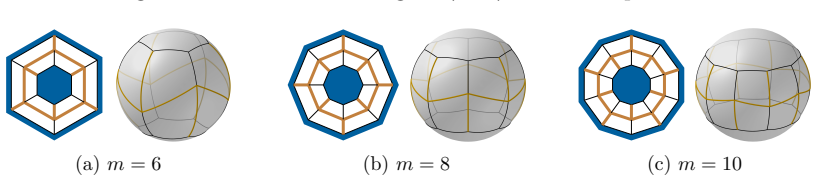
Figure 5. Figure 5: The first three tilings in (EM3) and their flip in 3D (a) m = 6 (b) m = 8 (c) m = 10 [PITH_FULL_IMAGE:figures/full_fig_p007_5.png] view at source ↗
Figure 6
Figure 6. Figure 6: The first three members of the (EM4) family with subdivided equatorial tiles subdivided into four kites. The kite subdivision is marked by the thick edges. The equatorial faces of the cube are deformed to hexagons, as shown in the 3D drawing next to it. In [PITH_FULL_IMAGE:figures/full_fig_p007_6.png] view at source ↗
Figure 7
Figure 7. Figure 7: The canonical seeds for generating (P1) and (P2) In [PITH_FULL_IMAGE:figures/full_fig_p007_7.png] view at source ↗
Figure 8
Figure 8. Figure 8: (P3) tiling via a kite subdivision of a pair of polar faces of the cube faces from the truncation. (a) Subdivided tT (b) Subdivided tC (c) Subdivided tO (d) Subdivided tD (e) Subdivided tI [PITH_FULL_IMAGE:figures/full_fig_p008_8.png] view at source ↗
Figure 9
Figure 9. Figure 9: (P4) tilings via kite subdivision of the derived faces of the truncated Platonic solids (a) Subdivided aT (b) Subdivided aC (c) Subdivided aO (d) Subdivided aD (e) Subdivided aI [PITH_FULL_IMAGE:figures/full_fig_p008_9.png] view at source ↗
Figure 10
Figure 10. Figure 10: (P5) via a kite subdivision of the (uncoloured) legacy faces in the rectified Platonic solids In [PITH_FULL_IMAGE:figures/full_fig_p008_10.png] view at source ↗
Figure 11
Figure 11. Figure 11: (P6) via a kite subdivision of the 2-edged multigraphs of the cube and the dodecahedron In [PITH_FULL_IMAGE:figures/full_fig_p009_11.png] view at source ↗
Figure 12
Figure 12. Figure 12: (P7) in the first row and (P8) in the second; the left (resp. the right) two tilings via subdividing the thickened 1-skeletons and the (uncoloured) faces from the octahedron (resp. the flipped octahedron) 9 [PITH_FULL_IMAGE:figures/full_fig_p009_12.png] view at source ↗
Figure 13
Figure 13. Figure 13: The thickened skeletons of the octahedron and the flipped octahedron [PITH_FULL_IMAGE:figures/full_fig_p010_13.png] view at source ↗
Figure 14
Figure 14. Figure 14: The kite subdivision of the square pyramid [PITH_FULL_IMAGE:figures/full_fig_p010_14.png] view at source ↗
Figure 15
Figure 15. Figure 15: Adjacent pairs of tiles; and δ 3 As per [PITH_FULL_IMAGE:figures/full_fig_p011_15.png] view at source ↗
Figure 16
Figure 16. Figure 16: The monohedral earth map tiling with βγ2 and that with γ 2 δ The argument for γ 2 δ is analogous and the tiling is given in Figure 16b. Lemma 3.4. Along the boundary of an m-gon with its angles specified by αˆ, if the angle arrangement of each αˆ at its vertex is either α|αˆ|β or γ|αˆ|γ, then m is divisible by 3. Proof. Without loss of generality, we may start at a vertex with angle arrangement γ|αˆ|γ on … view at source ↗
Figure 17
Figure 17. Figure 17: The boundary of an m-gon having angle arrangements α|αˆ|β or γ|αˆ|γ Lemma 3.5. Along the boundary of an m-gon with angles α, if the vertices have al￾ternating angle arrangements between θ|α|θ and φ|α|φ for distinct θ, φ ̸= α, then m is even [PITH_FULL_IMAGE:figures/full_fig_p012_17.png] view at source ↗
Figure 18
Figure 18. Figure 18: Alternating angle arrangements θ|α|θ and φ|α|φ around an m-gon Proof. The alternating angle arrangements along the boundary of an m-gon mean that the edges have alternating labels between θφ and φθ in the exterior. This induces a 2-edge colouring of the boundary and hence m is even. Globally, combinatorics of the tilings deduce the existence of vertices of a small degree. Let fm denote the number of m-gon… view at source ↗
Figure 19
Figure 19. Figure 19: Triangulation of the kite The spherical cosine law on the triangle with angles 1 2 β, γ, 1 2 δ implies cos x = cos 1 2 δ + cos 1 2 β cos γ sin 1 2 β sin γ , (3.14) cos y = cos 1 2 β + cos γ cos 1 2 δ sin γ sin 1 2 δ . (3.15) Combining (3.13) and (3.14), we deduce sin 1 2 β sin γ(1 − sin2 1 2 α + cos 2 m π) = sin2 1 2 α(cos 1 2 δ + cos 1 2 β cos γ), which is simplified as sin 1 2 β sin γ(1 + cos 2 m π) = s… view at source ↗
Figure 20
Figure 20. Figure 20: The workflow of the proof for Proposition 4.2; *a combinatorial tiling appears [PITH_FULL_IMAGE:figures/full_fig_p017_20.png] view at source ↗
Figure 21
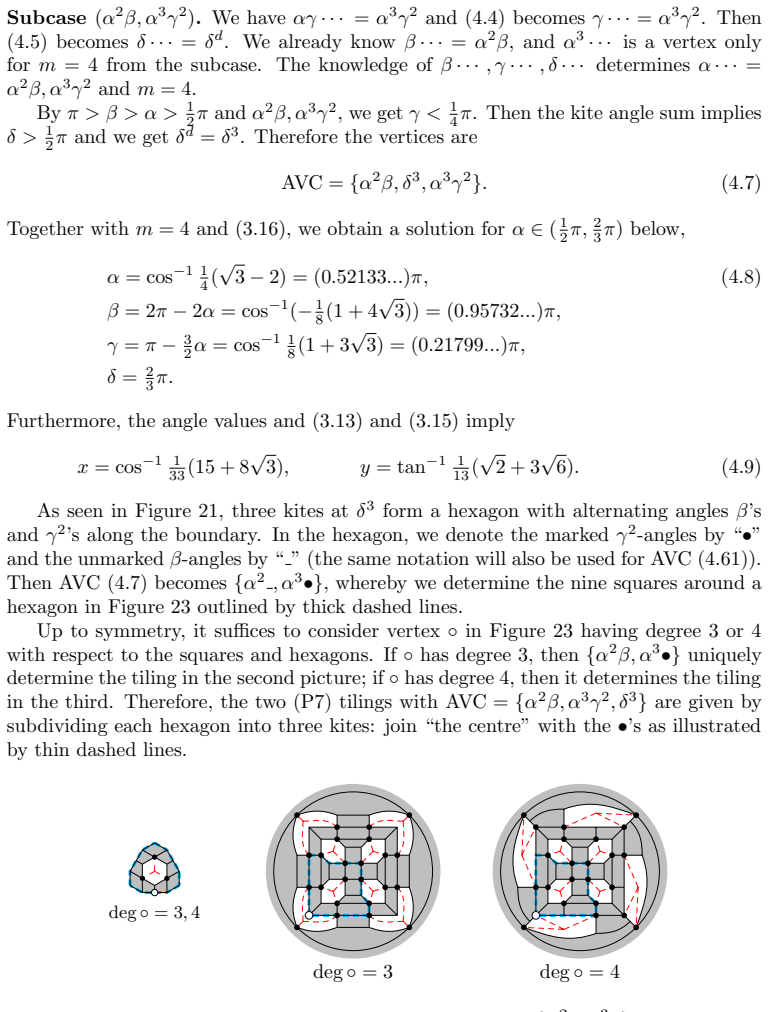
Figure 21. Figure 21: A hexagon centred at δ 3 Case (α 2β). The vertex angle sum of α 2β and α > 1 2 π and β > 2 3 π imply π > β > 2 3 π > α > 1 2 π. Then (3.1) implies 2 3 π > (1 − 2 m )π, and hence m = 4, 5. The vertex α 2β and β > α rule out αβ2 . Then (4.1) becomes β · · · = α 2β, βγc≥4 , αβγc . Notably, β 2 · · · is not a vertex, and hence the same for β|β · · · . Lemma 3.1 then rules out γ|γ · · · . Hence γ c , γc δ d (=… view at source ↗
Figure 22
Figure 22. Figure 22: The deductions of γ|α|γ for m = 4, 5 For m = 5, the arrangement γ|α|γ determines the angles in T1, T2, ..., T5 in Figure 22b. Knowing that α 3 · · · is not a vertex, the symmetry across T4, T2, T5 allows us to assume the top α2α4 · · · to be α 2β. Parity Lemma and (4.6) then imply |α|γ · · · γ|α| = α 2γ 2 , which now has to be a vertex, and it rules out αγ2 , α2γ 4 . Hence (4.6) becomes αγ · · · = α 2γ 2 … view at source ↗
Figure 23
Figure 23. Figure 23: The tilings by squares and hexagons with AVC = [PITH_FULL_IMAGE:figures/full_fig_p020_23.png] view at source ↗
Figure 24
Figure 24. Figure 24: The deduction around a regular pentagon for AVC = [PITH_FULL_IMAGE:figures/full_fig_p021_24.png] view at source ↗
Figure 25
Figure 25. Figure 25: Time zones of (EM3) with AVC = {α 2β, α2γ 2 , δd} If the α1|α2 · · · ’s in T1, T2 in Figure 25b are α 2β and α 2γ 2 respectively, then they determine T3, T4, T5. Next, α2γ3 · · · = α 2γ 2 determines T6, T7. Then α6γ5 · · · = α 2γ 2 determines T8, T9. The pattern in T5, T6, T7, T8 is the same as that in T1, T2, T3, T4. Therefore, we have two types of time zones given by AVC = {α 2β, α2γ 2 , δd}. Combinator… view at source ↗
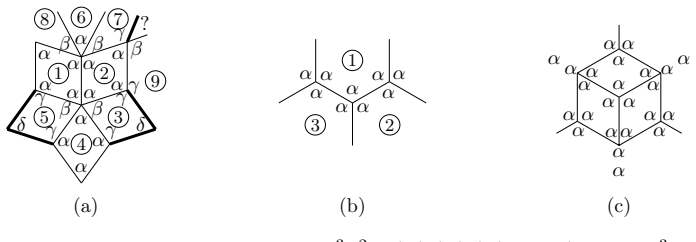
Figure 26
Figure 26. Figure 26: The deduction of γ 2 δ 2 and the underlying structure of tilings with AVC = {αβ2 , δ3 , αβγ2 , αγ4} 2γ > 2 3 π imply that they have angle sums > 2π, a contradiction. Therefore γ 2 δ 2 is not a vertex. Now it suffices to discuss δ · · · = δ 3 in the context of m = 4, 5. For m = 5, we must have 2 3 π > α > 3 5 π. The vertex angle sums of αβ2 , αβγ2 and δ 3 and (3.16) determine α = 2 cos−1 1 12 (9 − √ 5) = (… view at source ↗
Figure 27
Figure 27. Figure 27: The 14 tilings given by AVC (4.17) = {αβ2 , δ3 , αβγ2 , αγ4} For m = 5, up to isomorphism there are 8924 tilings via computer enumeration1 . The reasoning for the canonical seed is the same as that for m = 4. Subcase (αβ · · · = αβ2 ). The vertex αβ2 has a unique angle arrangement |α|β|β|. Then Lemma 3.1 implies that γ|γ · · · is a vertex. By (3.12) and αβ · · · = αβ2 , we know αγ · · · = α aγ c , αγc δ d… view at source ↗
Figure 28
Figure 28. Figure 28: Deductions in subsubcases with α 2γ 2 and with αγ2 δ d For m = 5, we claim that α 2γ 2 is a vertex if and only if one of αγ2 , αγ4 , αγ2 δ d is also a vertex; and this will lead to a contradiction. Given αβ · · · = αβ2 , if α 2γ 2 is not 1A computer-aided result by the first author. 24 [PITH_FULL_IMAGE:figures/full_fig_p024_28.png] view at source ↗
Figure 29
Figure 29. Figure 29: The deduction of δ δ and a combinatorial tiling with AVC = {αβ2 , αγ2 , γ2 δ 2} 2γ = β > δ, 2 3 π > α > 1 2 π. The inequalities refine (4.14) as follows. By δ > 1 2 π, we have δ d = δ 3 . By δ > α, we have 4γ + δ > α + 4γ = 2π ruling out γ 4 δ · · · . Then by 3 4 π > 2γ > 2 3 π and 3 4 π > δ > 1 2 π, we have γ 2 δ d = γ 2 δ 2 . By α, δ > 1 2 π and 2γ > 2 3 π, we have αγ2 δ d = αγ2 δ. By 2γ = β > δ, we hav… view at source ↗
Figure 30
Figure 30. Figure 30: The workflow of the proof of Proposition 4.3 [PITH_FULL_IMAGE:figures/full_fig_p027_30.png] view at source ↗
Figure 31
Figure 31. Figure 31: Kite subdivision of the equilateral square pyramid [PITH_FULL_IMAGE:figures/full_fig_p029_31.png] view at source ↗
Figure 32
Figure 32. Figure 32: The deduction of γ 2 δ d≥2 Subsubcase (αγ2 , γ2 δ d≥2 and β1β2 · · · = αβ2 ). The vertex αβ2 excludes α 2β 2 , α2β 3 , and with 2 3 π ≥ β it implies α ≥ 2 3 π ≥ β, which also excludes α 3β. Hence (4.26) becomes αβ · · · = αβ2 . Recall 2β > α and γ γ · · · = αγ2 , βb≥2γ 2 from the subcase. Hence γ γ · · · = αγ2 . Given γδ · · · = γ 2 δ d≥2 from the case and γ|γ · · · = γ 2 δ d≥2 from the subcase, together … view at source ↗
Figure 33
Figure 33. Figure 33: Kite subdivision by γ 2 δ 2 To verify the existence of the infinite family, we substitute β = γ = π − 1 2 α and δ = 1 2 α into (3.16) and get cos2 2 m π = (sin 1 2 α − cos 1 2 α) 2 = 1 − sin α. Then for each even integer m ≥ 6, there always exists a solution given by α = π − sin−1 (1 − cos2 2 m π) = π − sin−1 (sin2 2 m π). (4.31) This solution α always belongs to the interval ((1 − 2 m )π, π) because sin … view at source ↗
Figure 34
Figure 34. Figure 34: The deductions of α 2β 2 = |α|α|β|β| Subsubcase (αγ2 , γ2 δ d≥2 and β1β2 · · · = α 2β 3 ). The vertex α 2β 3 implies β = 2 3 (π−α). Recall β + δ > α from the case, which then implies 2π + 3δ > 5α. Then α > 1 2 π implies 3δ > α. Comparing it with the vertex angle sum of αγ2 determines γ 2 δ d≥2 = γ 2 δ 2 . Recall 2β > α from the subcase, α 2β 3 and (3.1) then imply 4 7 π > α > (1 − 2 m )π, and hence m = 4.… view at source ↗
Figure 35
Figure 35. Figure 35: The deductions of α|β|α and β 2γ 2 results in |γ11 δ7 δ8 γ12| · · · , which is γ 2 δ d≥2 and can only be γ 2 δ 2 as shown. However, β 2γ 2 , γ2 δ 2 imply β = δ, a contradiction. The deduction is independent of m and hence there is no tiling in this subsubcase. Subcase (αγ2 and ∄ γ 4 , γ2 δ d ). Recall αγ · · · = αγ2 and γδ · · · = γ 2 δ d and γ|γ · · · = γ 4 , γ2 δ d from the case. The subcase assumption … view at source ↗
Figure 36
Figure 36. Figure 36: The boundary of an m-gon and the boundary of an equilateral 2d-gon given by kite subdivision of the regular polygon with angles β¯d for d = 3, 4, 5 for m ∈ 3N and m ≥ 6. We determine the tilings by determining their primal tilings. The diminished neigh￾bourhood given by the incident kites of a δ d≥3 is an equilateral 2d-gon, centred at δ d≥3 as shown in Figure 36b. The 2d-gon can be deformed into a regula… view at source ↗
Figure 37
Figure 37. Figure 37: (P3) with primal tiling determined by ( ¯m, d) = (4, 4) and {α¯ 2β¯} where ¯α = β¯ The tiling with primal tiling given by the cube is (P3) as shown in [PITH_FULL_IMAGE:figures/full_fig_p034_37.png] view at source ↗
Figure 38
Figure 38. Figure 38: The deductions of α 3β 2 = |α|α|β|α|β| and α|α · · · = α 3 α 2β 2 has a unique angle arrangement |α|β|α|β|. Then α|α · · · can only be α 3 . The three incident tiles at an α 3 are illustrated in Figure 38b. Each adjacent vertex α|α · · · is also α 3 . The deduction repeats at each α|α · · · and results in a monohedral tiling by regular m-gons. The tiling is either given by the cube (Figure 38c) or by the … view at source ↗
Figure 39
Figure 39. Figure 39: The (EM1) tilings with AVC = {αγ2 , α2β 2 , δd}, a time zone (shaded) consists of three tiles, one equatorial square and two polar kites The vertex angle sums from AVC (4.43) imply β = π − α, γ = π − 1 2 α, δ = 2 d π. (4.44) Substituting the above equations into (3.16) gives cos 1 2 α sin 1 2 α = sin2 1 2 α(cos 1 d π + cos 1 2 π). 36 [PITH_FULL_IMAGE:figures/full_fig_p036_39.png] view at source ↗
Figure 40
Figure 40. Figure 40: The family of (P5) tilings with AVC ≡ {αγ2 , α2β 2 , δd} determined in two steps – step 1. construction by the underlying prototiles, a regular d-gon β d and a regular ¯m-gon α m¯ , and reduced AVC = {|α|β|α|β|}; step 2. kite subdivisions (marked by dashed lines) on one prototile throughout a tiling in step 1 Subsubcase (γ · · · = αγ2 and β · · · = α 3β). The assumption reduces (4.35) to α · · · = αγ2 , α… view at source ↗
Figure 41
Figure 41. Figure 41: The deduction of α 3β δ β γ γ δ β γ γ δ β γ γ δ β γ γ δ β γ γ δ β γ γ α α α α α α α α α α α α α α α α α α α α α α α α 1 2 3 4 5 6 7 8 · · · [PITH_FULL_IMAGE:figures/full_fig_p039_41.png] view at source ↗
Figure 42
Figure 42. Figure 42: The (EM2) tiling with AVC ≡ {αγ2 , α3β, δd}, a (shaded) time zone consists of two equatorial squares and two polar kites It remains to show the existence of a tiling for each d ≥ 4. By AVC (4.54), we have β = 2π − 3α, γ = π − 1 2 α, δ = 2 d π. (4.55) Substituting the above into (3.16) deduces sin 3 2 α sin 1 2 α = sin2 1 2 α(cos 1 d π + cos α). As sin 1 2 α ̸= 0 for α ∈ ( 1 2 π, 2 3 π), trigonometric iden… view at source ↗
Figure 19
Figure 19. Figure 19: With γ · · · = αγ2 and δ · · · = δ 4 , δ5 , the respective angle values determine AVC = {αγ2 , α3β 3 , δ4 }; (4.59) AVC = {αγ2 , α3β 3 , δ5 }. (4.60) In the absence of β|β · · · , every vertex in the above AVCs has a unique angle arrange￾ment. Therefore, it is straightforward to construct the two tilings—(P6) in [PITH_FULL_IMAGE:figures/full_fig_p040_19.png] view at source ↗
Figure 43
Figure 43. Figure 43: The (P6) tilings with AVC ≡ {αγ2 , α3β 3 , δd=4,5} determined in two steps – step 1. construction by the underlying prototiles, a regular d-gon with angles β d and a schematic 2-gon with angles α 2 , and AVC = {|α|β|α|β|α|β|}; step 2. kite subdivision (indicated by the dashed lines) on the regular d-gons Case (α 2γ 2 ). The kite angle sum and the vertex angle sum of α 2γ 2 and α > 1 2 π imply β + δ > 2α >… view at source ↗
Figure 44
Figure 44. Figure 44: The tilings by squares and hexagons with AVC = [PITH_FULL_IMAGE:figures/full_fig_p042_44.png] view at source ↗
Figure 45
Figure 45. Figure 45: The deduction of α 2β 2 = |α|α|β|β| In summary, none of β 4 , β5 , αβ3 , α2β 2 , α3β, β2γ 2 is a vertex, and (3.8) becomes β · · · = αβγ2 . Then Counting Lemma on β, γ deduces γ · · · = αβγ2 and the same lemma on γ, δ further implies δ · · · = δ 3 . By 2 3 π > α > 1 2 π and the above, we conclude α · · · = αβγ2 and obtain the same AVC (4.2). The tilings are the canonical seeds of the (P1), (P2) families. … view at source ↗
Figure 46
Figure 46. Figure 46: The deduction of β 3 Subcase (2γ > π). Recall α, δ > 1 2 π from the case. Then α, δ > 1 2 π and 2γ > π dismiss γ 4 , αγ4 , αγ2 δ d . Hence (4.22) becomes αγ · · · = αβbγ 2 , and (4.21) becomes γ|γ · · · = γ 2 δ d≥2 , and (3.10) becomes δ · · · = δ 3 . Hence δ 3 is a vertex. Given β ̸= δ, it implies δ = 2 3 π > β. Moreover, δ = 2 3 π and 2γ > π dismiss γ 2 δ d≥2 . Now γ|γ · · · is not a vertex, and Lemma 3… view at source ↗
Figure 47
Figure 47. Figure 47: The tilings via kite subdivision of the truncated tetrahedron [PITH_FULL_IMAGE:figures/full_fig_p046_47.png] view at source ↗
Figure 48
Figure 48. Figure 48: The neighbourhood of αβ2 Up to mirror symmetry, it suffices to consider two combinations of the four vertices below, (α1γ2γ5 · · · , α1γ3γ7 · · · , α8β4 · · · , α8β6 · · ·) = (αβ2 , αγ4 , αβγ2 , αβ2 ),(αβ2 , αγ4 , αβ2 , αβγ2 ). The former deduces the tiling in Figure 47b while the latter deduces the tiling in Figure 47c. Therefore we have all the tilings. In fact, without using the truncated tetrahedron, … view at source ↗
Figure 49
Figure 49. Figure 49: Canonical seeds for the families by kite-subdivided truncated Platonic solids [PITH_FULL_IMAGE:figures/full_fig_p048_49.png] view at source ↗

discussion (0)

Sign in with ORCID, Apple, or X to comment. Anyone can read and Pith papers without signing in.

Reference graph

Works this paper leans on

27 extracted references · 27 canonical work pages · 4 internal anchors

  1. [1]

    Adams, C

    C. Adams, C. Edgar, P. Hollander and L. Jacoby, The non-edge-to-edge tilings of the sphere by regular polygons.Discrete & Computational Geometry, 72:1029– 1085, 2024

  2. [2]

    Akama, E

    Y. Akama, E. X. Wang, M. Yan, Tilings of the sphere by congruent pentagons III: edge combinationa 5,Adv. in Math.394(2022), #107881

  3. [3]

    Akama, M

    Y. Akama, M. Yan, On deformed dodecahedron tiling,Australas. J. of Comb. 85(1)(2023), 1–14

  4. [4]

    Barnette, E

    D. Barnette, E. Jucoviˇ c, Hamiltonian circuits on 3-polytopes,Journal of Combi- natorial Theory, 9:54–59, 1970

  5. [5]

    H. M. Cheung, H. P. Luk, Dihedral tilings of the sphere by regular polygons and quadrilaterals II: regular polygons with high gonality and rhombi,preprint, 2023, arXiv:2403.07014

  6. [6]

    H. M. Cheung, H. P. Luk, M. Yan, Tilings of the sphere by congruent quadrilaterals or triangles,preprint, 2022,arXiv:2204.02736

  7. [7]

    H. M. Cheung, H. P. Luk, M. Yan, Tilings of the sphere by congruent pentagons IV: edge combinationa 4b,preprint, 2023,arXiv:2307.11453. 48

  8. [8]

    M. Deza, M. D. Sikiri´ c,Geometry of Chemical Graphs: Polycycles and Two-faced MapsCambridge University Press, 2008

  9. [9]

    J. A. Ellis-Monaghan, I. Moffatt, Chapter 1.1.4 Ribbon Graphs,Graphs on Sur- faces: Dualities, Polynomials, and Knots, SpringerBriefs in Mathematics, Springer, pp. 5–7, 2013

  10. [10]

    Gr¨ unbaum, N

    B. Gr¨ unbaum, N. W. Johnson, The faces of a regular-faced polyhedron,Journal of the London Mathematical Society1 (1965) 1:577–586

  11. [11]

    Johnson, Convex solids with regular faces,Canadian Journal of Mathematics 18 (1966), 169–200

    N. Johnson, Convex solids with regular faces,Canadian Journal of Mathematics 18 (1966), 169–200

  12. [12]

    Gr¨ unbaum, On polyhedra inE 3 having all faces congruent,Bull

    B. Gr¨ unbaum, On polyhedra inE 3 having all faces congruent,Bull. Research Council Israel8F(1960), 215–218

  13. [13]

    Higuchi, Combinatorial curvature for planar graphs,J

    Y. Higuchi, Combinatorial curvature for planar graphs,J. Graph Theory38(4) (2001), 220–229

  14. [14]

    H. H. Gao, N. Shi, M. Yan, Spherical tiling by 12 congruent pentagons,J. Comb. Theory Ser. A120(4)(2013), 744–776

  15. [15]

    H. P. Luk, H. M. Cheung, Rational angles and tilings of the sphere by congruent quadrilaterals,Ann. Comb.28(2024), 485–527

  16. [16]

    H. P. Luk, R. Nedela, C. Purcell, Tiling the sphere with regular polygons,preprint, 2025,arXiv:2512.05577

  17. [17]

    H. P. Luk, Dihedral tilings of the sphere by regular polygons and quadrilaterals I: squares and rhombi,Combinatorial Theory5(3)(2025)doi.org/10.5070/ C65365567

  18. [18]

    H. P. Luk, Dihedral tilings of the sphere by regular polygons and quadrilaterals: quadrilaterals with equal opposite edges,preprint, 2023,arXiv:2403.05938

  19. [19]

    H. P. Luk, A parity phenomenon of spherical tilings.Archiv der Mathematik(2026) doi.org/10.1007/s00013-026-02233-2

  20. [20]

    H. P. Luk, Odd tilings of the sphere and graphs of Herschel type,preprint, 2024

  21. [21]

    S. A. Robertson, Isometric folding of Riemannian manifolds,Proc. R. Soc. Edinb. 79(1977), 275–284

  22. [22]

    D. M. Y. Sommerville, Division of space by congruent triangles and tetrahedra, Proc. Royal Soc. Edinburgh43(1923), 85–116

  23. [23]

    Y. Ueno, Y. Agaoka, Classification of tilings of the 2-dimensional sphere by con- gruent triangles,Hiroshima Math. J.32(3)(2002), 463–540

  24. [24]

    Y. Ueno, Y. Agaoka, Examples of spherical tilings by congruent quadrangles, Math. Inform. Sci., Fac. Integrated Arts Sci., Hiroshima Univ.Ser. IV 27(2001), 135–144

  25. [25]

    E. X. Wang, M. Yan, Tilings of sphere by congruent pentagons I: edge combinations a2b2canda 3bc,Adv. in Math.394(2022), #107866

  26. [26]

    E. X. Wang, M. Yan, Tilings of sphere by congruent pentagons II: edge combination a3b2,Adv. in Math.394(2022), #107867

  27. [27]

    V. A. Zalgaller, Convex polyhedra with regular faces,Zap. Naucn. Sem. Leningrad. Otdel. Mat. Inst. Steklov. (LOMI)2, 220 (1967). 49