REVIEW 1 major objections 9 minor 149 references
Ancient star clusters were born far denser than today's young ones
Reviewed by Pith at T0; open to challenge. T0 means a machine referee read the full paper against a public rubric. the ladder, T0–T4 →
T0 review · glm-5.2
2026-07-09 21:40 UTC pith:E3IBTFHR
load-bearing objection Novel coupling of fast evolution + equilibrium models to infer GC initial conditions; headline density result is real but degenerate with uncertain BH kick physics the 1 major comments →
Fast Dynamical Modelling of Milky Way Globular Clusters -- I. Implications for Initial Cluster Densities
The pith
A machine-rendered reading of the paper's core claim, the machinery that carries it, and where it could break.
Core claim
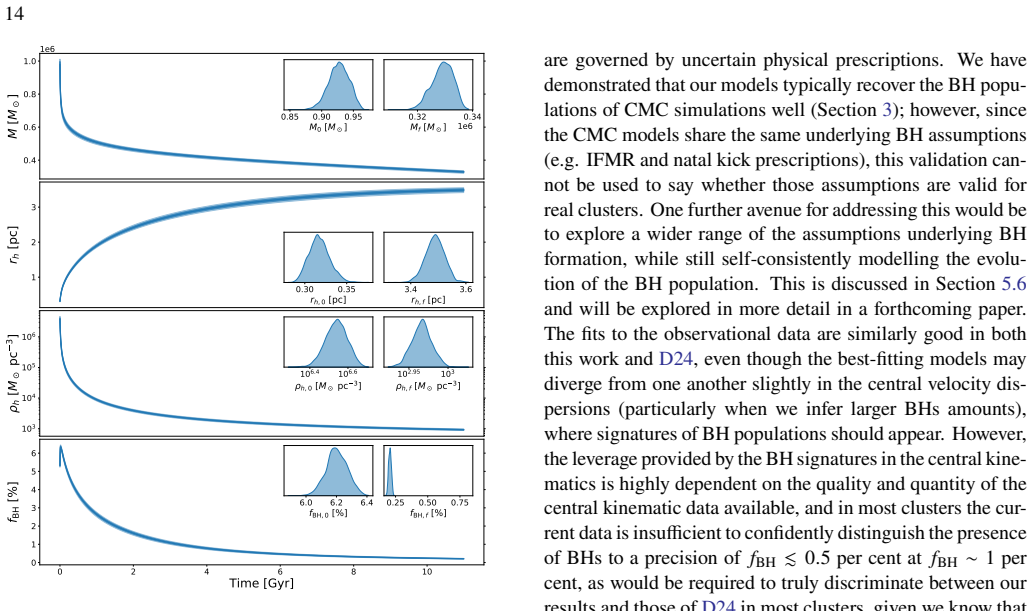
By coupling fast cluster evolution models with present-day equilibrium models fitted to observed kinematic and mass-function data, the authors infer that Milky Way globular clusters were born with half-mass densities around 10^6.4 solar masses per cubic parsec — far above local young massive clusters and consistent with high-redshift proto-globular clusters observed by JWST. The high densities arise from very compact initial radii (typically under 0.7 parsecs), and the same framework independently yields a bottom-light stellar initial mass function and small present-day black hole mass fractions (under ~1.5%).
What carries the argument
The coupling of two models: clusterBH, a semi-analytical code that evolves bulk cluster properties (total mass, half-mass radius, black hole mass fraction) from birth to the present using prescriptions for two-body relaxation, stellar evolution mass loss, tidal evaporation, and black-hole burning; and limepy, a multimass distribution-function-based equilibrium model that describes the present-day phase-space structure of stars and remnants. The free parameters of present-day mass and radius are replaced by their initial counterparts, so that present-day observations constrain birth conditions through the evolutionary bridge.
Load-bearing premise
The black hole natal kick prescription — a fallback-modulated Maxwellian with dispersion 265 km/s — is uncertain and shared with the simulation grid used for validation, so the high-density inference cannot be tested against models with different kick physics, and a roughly 40% change in kick strength could shift the inferred densities by an order of magnitude.
What would settle it
If a Milky Way globular cluster with well-constrained present-day properties were shown, through independent star-by-star modelling with different black hole kick prescriptions, to be consistent with significantly lower initial densities (e.g., below 10^5 solar masses per cubic parsec), the central high-density inference would be undermined.
If this is right
- If Milky Way globular clusters were born at ~10^6.4 solar masses per cubic parsec, the formation conditions of ancient clusters differ systematically from those of young massive clusters forming today, raising the question of whether cluster formation itself has evolved over cosmic time.
- The bottom-light IMF (~25% more black hole progenitors per unit mass than a canonical IMF) would shift predicted gravitational-wave merger rates and the expected mass distribution of merging black holes from globular cluster channels.
- The combination of high initial black hole fractions and small present-day fractions implies very efficient dynamical ejection of black holes over cluster lifetimes, constraining the internal dynamical processing that must have occurred.
- The consistency with high-redshift proto-GC densities suggests that JWST observations of lensed proto-clusters may be directly probing the birth environments of present-day globular clusters.
- The demonstrated degeneracy between kick strength and initial density means that tighter observational constraints on black hole natal kicks would directly tighten constraints on cluster birth densities.
Where Pith is reading between the lines
- If future electromagnetic or gravitational-wave observations tighten constraints on black hole natal kicks, the inferred initial densities could shift by up to an order of magnitude — potentially reconciling them with local young massive cluster densities if kicks turn out to be stronger than assumed.
- The bottom-light IMF, if universal among ancient globular clusters, would imply that stellar population synthesis models assuming a canonical IMF systematically overestimate low-mass stellar content and underestimate black hole formation rates in metal-poor environments.
- The method could be extended to globular clusters in other Local Group galaxies to test whether the high initial density is a universal feature of ancient clusters or specific to the Milky Way's formation environment.
- A hierarchical Bayesian treatment of the full surviving and dissolved cluster population could reveal whether the individual-cluster densities reported here trace a coherent parent distribution shaped by galaxy-scale formation conditions.
Editorial analysis
A structured set of objections, weighed in public.
Referee Report
Summary. This paper presents a novel framework for inferring the initial conditions of Milky Way globular clusters (GCs) by coupling the fast semi-analytical evolutionary models (clusterBH, updated in Fronimos Pouliasis et al. 2026) with multimass limepy equilibrium models. The method is validated against mock observations extracted from a grid of star-by-star Monte Carlo (CMC) simulations, demonstrating recovery of initial and present-day cluster properties (mass, half-mass radius, density, BH mass fraction) within quantified uncertainties. Applied to a sample of 35 MW GCs (from an initial 40, with 5 removed for various quality reasons), the authors infer a distribution of initial half-mass densities peaking at rho_h,0 ~ 10^{6.4} M_sun/pc^3, a bottom-light stellar IMF, and small present-day BH mass fractions (<1.5%). The implications for high-redshift proto-GC observations, IMBH formation, and gravitational-wave source rates are discussed. The paper is well-structured, the methodology is clearly described, and the validation effort is substantial.
Significance. The coupling of fast evolutionary models with equilibrium DF-based models to infer initial conditions from present-day observations is a genuine methodological advance. The validation against CMC mock observations (Section 3) is thorough and demonstrates the method's recovery power across a large parameter space. The transparency regarding the BH-kick degeneracy (Section 5.6, Figure 13) is commendable and strengthens the paper's credibility. The finding that inferred initial densities are consistent with high-redshift proto-GC observations (Section 5.1, Figure 12) provides a tangible cross-epoch link. The open-source software (GCfit, clusterBH) and the availability of fit results for all clusters enhance reproducibility.
major comments (1)
- Section 3 and Section 5.6: The validation in Section 3 fits mock observations from the CMC grid (Kremer et al. 2020b), but clusterBH was itself calibrated against the same CMC grid (F26). The CMC models share the same BH natal kick prescription (fallback-modulated Maxwellian, sigma=265 km/s, Fryer et al. 2012 rapid engine) and BH IFMR (Banerjee et al. 2020) as clusterBH. Therefore, the validation confirms that the method recovers initial conditions *given* a specific BH physics prescription, but cannot test whether that prescription is correct for real clusters. The authors acknowledge this in Section 5.6 and demonstrate a clear degeneracy: a ~40% change in kick strength can compensate an order-of-magnitude change in initial density (Figure 13). This means the headline quantitative result (rho_h,0 ~ 10^{6.4} M_sun/pc^3) is conditional on the assumed BH physics. The paper would be Strengt
minor comments (9)
- Abstract: states 'a sample of 40 MW GCs' but the final sample used is 35 (Section 4.1). The abstract should reflect the final sample size or clarify the reduction.
- Table 1: the prior on alpha_2 is listed as U(-1.0, alpha_1), but alpha_1 is the slope for lower masses (0.1-0.5 M_sun) and alpha_2 for higher masses (0.5-1.0 M_sun). Typically alpha_2 > alpha_1 for a bottom-light IMF. Please clarify whether the upper bound should be alpha_1 or if this is a typo.
- Section 2.2.1, Eq. (1): the limiting mass m_lim = 3 M_sun is chosen to 'capture only the BHs.' However, some stellar remnants (e.g., massive NSs or massive WDs) could exceed this threshold. Please justify this specific choice or note its limitations.
- Section 4.1: NGC 6624 is removed from the sample due to inability to fit, but no detail is given on why the models fail. A brief explanation would help readers understand whether other clusters with similar properties might encounter similar issues.
- Figure 9: the y-axis label for the lower panel reads 'MBH [M_sun]' but the values appear to be in units of 10^3 or 10^4 M_sun. Please verify the axis labels and units.
- Section 5.4: the claim that inferred initial surface densities 'clearly exceed' proposed maximum limits (~10^5 M_sun/pc^2) is significant but is stated without quantification. Providing the actual inferred surface density values or a comparison figure would strengthen this point.
- Section 5.2: the discussion of IMBH formation via runaway collisions references Vergara et al. (2026) and Rantala et al. (2026), but the uncertainties in the collision prescriptions (e.g., mass stripping vs. growth) are only briefly mentioned. A slightly more nuanced discussion of these uncertainties would be valuable.
- The reference to 'J. M. D. Kruijssen 2026' in the Introduction appears to be an encyclopedia entry. Please verify this is the intended citation and format.
- Throughout the paper, the notation for the effective galactocentric radius switches between R'_G and R'G. Please standardize.
Circularity Check
Validation is partially circular (clusterBH calibrated against CMC, then validated against CMC mocks), but central claims about real MW clusters are independently derived from observational data; the BH-physics degeneracy is explicitly acknowledged, not hidden.
specific steps
-
fitted input called prediction
[Section 3 (Validation) and Section 2.1 (clusterBH description)]
"These semi-analytical models were calibrated against a large grid of CMC cluster models (K. Kremer et al. 2020b), covering a range of initial conditions, and were able to reproduce the evolution of these star-by-star models to within about 10 per cent... We then fit the cBH+limepy models to these mock observations using the same priors as for the real clusters"
The clusterBH evolutionary models were calibrated against the CMC grid (F26). The validation in Section 3 then fits clusterBH+limepy to mock observations extracted from the same CMC grid. Recovering CMC initial conditions from CMC mock observations is partly expected by construction, since clusterBH was tuned to reproduce CMC evolution. However, this is only partial circularity: the validation tests the full inverse pipeline (including limepy equilibrium fitting and SSPtools mass function evolution, which were not part of the clusterBH calibration), and the mock observations are generated independently via cmctoolkit. The paper is transparent about the limitation: 'since the CMC models share the same underlying BH assumptions (e.g. IFMR and natal kick prescriptions), this validation cannot
full rationale
The paper's central quantitative claims (initial densities ~10^6.4 M_sun/pc^3, bottom-light IMF, small present-day BH fractions) are derived from fitting free parameters (M0, rh,0, alpha1, alpha2) to independent observational data (proper motions, LOS velocities, number densities, stellar mass functions) for 35 real MW GCs. No equation-level circularity exists where a prediction reduces to its input by construction. The BH retention fraction (Eq. 2) depends on v_esc,0 (Eq. 3), which depends on the free parameters M0 and rho_h,0 — these are inferred from data, not self-defined. The mass function evolution (Eqs. 4-6) uses clusterBH escape rates to connect IMF to PDMF, with IMF slopes as free parameters. The partial circularity is confined to the validation step: clusterBH was calibrated against CMC (F26), and Section 3 validates the fitting pipeline against CMC mocks. This tests the inverse problem (can you recover initial conditions from present-day observations?) but cannot test whether the BH physics prescriptions are correct, since CMC shares the same assumptions. The authors explicitly acknowledge this: 'this validation cannot be used to say whether those assumptions are valid for real clusters.' The degeneracy between initial density and BH natal kick strength (Section 5.6, Figure 13) is a parameter degeneracy transparently quantified and flagged for future work, not a circular derivation. Self-citations (F26, D23, D24) are methodological — describing tools used — not load-bearing for the central claims via unverified theorems.
Axiom & Free-Parameter Ledger
free parameters (14)
- phi_0_hat =
varies per cluster
- g =
varies per cluster
- log(r_a_hat) =
varies per cluster
- delta =
varies per cluster
- zeta =
varies per cluster
- eta =
varies per cluster
- M_0 =
0.01-6.81 x 10^6 M_sun
- r_h,0 =
0.05-1.7 pc
- alpha_1 =
~0.82 median
- alpha_2 =
~1.47 median
- F =
varies per cluster
- s2 =
varies per cluster
- d =
varies per cluster
- 7 clusterBH model parameters =
default/median values from F26
axioms (6)
- domain assumption Clusters remain in virial equilibrium throughout their evolution
- domain assumption BH natal kicks follow a fallback-modulated Maxwellian distribution with sigma = 265 km/s
- domain assumption The MW potential is well-approximated by a static singular isothermal sphere with v_circ = 220 km/s
- domain assumption The BH IFMR from SSE models (Banerjee et al. 2020) and rapid supernova scheme (Fryer et al. 2012) are valid
- ad hoc to paper clusterBH prescriptions extrapolate correctly to density regimes beyond the CMC calibration grid
- domain assumption The r_c - f_BH relationship from CMC models applies to real clusters
read the original abstract
We infer the initial conditions of Milky Way (MW) globular clusters (GCs) from present-day observations, through the coupling of recently updated rapid cluster evolution models with multimass equilibrium models. This novel method is validated by fitting to simulated observations of a large grid of star-by-star Monte Carlo models, demonstrating that we are able to recover cluster properties like the total mass, half-mass radius/density and black hole (BH) mass fraction, both initially and at the present day, across a large region of parameter space. We apply this framework to a sample of 40 MW GCs, fitting to a suite of observed radial profiles of number densities, proper motions, line-of-sight velocities and stellar mass functions. From these fits we infer a distribution of initial half-mass densities with a median and $1\sigma$ width, across our sample, of $\rho_{h,0} = 10^{6.4\pm0.9}\,{M_\odot pc^{-3}}$, higher than what is found for young massive clusters in the Local Universe and in line with young clusters at high redshift. We also find stellar initial mass functions that are bottom-light in comparison to canonical prescriptions, and relatively small present-day BH mass fractions ($\lesssim 1.5\%$). We discuss the implications of these initial cluster densities for observations of high-redshift proto-GCs, binary BH merger rates and intermediate-mass BHs (IMBHs) in GCs. Finally, we quantify how these densities may depend on assumptions typically made surrounding BH formation and natal kicks.
Figures




Reference graph
Works this paper leans on
-
[1]
1961 , month = feb, journal =
work page 1961
-
[2]
Michie, R. W. , year =. On the. Monthly Notices of the Royal Astronomical Society , volume =
-
[3]
1965 , month = feb, journal =
work page 1965
-
[4]
King, Ivan R. , year =. The Structure of Star Clusters. The Astronomical Journal , publisher =. doi:10.1086/109857 , annotation =
-
[5]
H. Monte. 1971 , month = oct, journal =. doi:10.1007/BF00649159 , annotation =
-
[6]
H. The. 1971 , month = nov, journal =. doi:10.1007/BF00649201 , annotation =
-
[7]
H. Two. 1975 , month = jan, booktitle =
work page 1975
-
[8]
Casertano, S. and Hut, P. , year =. Core Radius and Density Measurements in. The Astrophysical Journal , publisher =. doi:10.1086/163589 , keywords =
-
[9]
Dynamical Evolution of Globular Clusters , author =. 1987 , publisher =
work page 1987
-
[10]
doi:10.1086/117268 , keywords =
1995 , month = jan, volume =. doi:10.1086/117268 , keywords =
-
[11]
1996 , month = oct, volume =
work page 1996
-
[12]
doi:10.1086/316869 , keywords =
2000 , month = dec, volume =. doi:10.1086/316869 , keywords =
-
[13]
2001 , month = apr, volume =
work page 2001
-
[14]
2002 , month = jul, volume =
work page 2002
-
[15]
2002 , month = sep, volume =. doi:10.1086/341798 , keywords =
-
[16]
doi:10.1046/j.1365-8711.2003.06504.x , keywords =
Dynamical Evolution of Star Clusters in Tidal Fields , author =. 2003 , month = mar, journal =. doi:10.1046/j.1365-8711.2003.06286.x , keywords =
-
[17]
2003 , month = dec, volume =. doi:10.1046/j.1365-2966.2003.07275.x , keywords =
-
[18]
doi:10.1111/j.1365-2966.2004.07942.x , journal=
2004 , month = jul, volume =. doi:10.1111/j.1365-2966.2004.07914.x , keywords =
-
[19]
doi:10.1038/nature02448 , keywords =
2004 , month = apr, volume =. doi:10.1038/nature02448 , keywords =
-
[20]
doi:10.1086/430723 , keywords =
2005 , month = jul, volume =. doi:10.1086/430723 , keywords =
-
[21]
2005 , month = jul, volume =
work page 2005
-
[22]
2005 , month = may, volume =
work page 2005
-
[23]
2007 , month = jul, volume =
work page 2007
-
[24]
2007 , month = may, journal =
work page 2007
-
[25]
2007 , month = apr, volume =
work page 2007
-
[26]
2008 , month = sep, volume =
work page 2008
-
[27]
2008 , month = oct, volume =. doi:10.1111/j.1365-2966.2008.13702.x , keywords =
-
[28]
2009 , month = may, volume =
work page 2009
-
[29]
doi:10.1088/0004-637X/694/2/1498 , keywords =
2009 , month = apr, volume =. doi:10.1088/0004-637X/694/2/1498 , keywords =
-
[30]
, archivePrefix = "arXiv", eprint =
2010 , month = jan, volume =. doi:10.1111/j.1745-3933.2009.00777.x , keywords =
-
[31]
Portegies Zwart, Simon F. and McMillan, Stephen L. W. and Gieles, Mark , year =. Young. Annual Review of Astronomy and Astrophysics , volume =. doi:10.1146/annurev-astro-081309-130834 , keywords =
-
[32]
The Life Cycle of Star Clusters in a Tidal Field , author =. 2011 , month = jun, journal =. doi:10.1111/j.1365-2966.2011.18320.x , annotation =
-
[33]
Alexander, Poul E. R. and Gieles, Mark , year =. A Prescription and Fast Code for the Long-Term Evolution of Star Clusters:. Monthly Notices of the Royal Astronomical Society , volume =
-
[34]
doi:10.1088/0004-637X/749/1/91 , keywords =
2012 , month = apr, volume =. doi:10.1088/0004-637X/749/1/91 , keywords =
-
[35]
doi:10.1088/0004-637X/745/2/175 , keywords =
2012 , month = feb, volume =. doi:10.1088/0004-637X/745/2/175 , keywords =
-
[36]
2012 , month = oct, volume =
work page 2012
-
[37]
Dynamical Evolution of Black Hole Subsystems in Idealized Star Clusters , author =. 2013 , month = jul, journal =
work page 2013
-
[38]
2013 , month = mar, volume =
work page 2013
-
[39]
Giersz, Mirek and Heggie, Douglas C. and Hurley, Jarrod R. and Hypki, Arkadiusz , year =. Monthly Notices of the Royal Astronomical Society , volume =
-
[40]
Mocca Code for Star Cluster Simulations --
Hypki, Arkadiusz and Giersz, Mirek , year =. Mocca Code for Star Cluster Simulations --. Monthly Notices of the Royal Astronomical Society , volume =
-
[41]
Lamers, Henny J. G. L. M. and Baumgardt, Holger and Gieles, Mark , year =. The Evolution of the Global Stellar Mass Function of Star Clusters: An Analytic Description , shorttitle =. Monthly Notices of the Royal Astronomical Society , publisher =. doi:10.1093/mnras/stt808 , annotation =
-
[42]
doi:10.1051/0004-6361/201220307 , keywords =
2013 , month = apr, volume =. doi:10.1051/0004-6361/201220307 , keywords =
-
[43]
2013 , month = sep, volume =
work page 2013
-
[44]
doi:10.1088/0004-637X/775/2/134 , keywords =
2013 , month = oct, volume =. doi:10.1088/0004-637X/775/2/134 , keywords =
-
[45]
Alexander, Poul E. R. and Gieles, Mark and Lamers, Henny J. G. L. M. and Baumgardt, Holger , year =. A Prescription and Fast Code for the Long-Term Evolution of Star Clusters -. Monthly Notices of the Royal Astronomical Society , publisher =. doi:10.1093/mnras/stu899 , annotation =
-
[46]
doi:10.1093/mnras/stt2221 , keywords =
2014 , month = feb, volume =. doi:10.1093/mnras/stt2221 , keywords =
-
[47]
Gieles, Mark and Alexander, Poul E. R. and Lamers, Henny J. G. L. M. and Baumgardt, Holger , year =. A Prescription and Fast Code for the Long-Term Evolution of Star Clusters --. Monthly Notices of the Royal Astronomical Society , volume =
-
[48]
doi:10.1051/0004-6361/201423709 , keywords =
2014 , month = jul, volume =. doi:10.1051/0004-6361/201423709 , keywords =
-
[49]
doi:10.1093/mnras/stv1848 , keywords =
2015 , month = nov, volume =. doi:10.1093/mnras/stv1848 , keywords =
-
[50]
2015 , month = feb, volume =
work page 2015
-
[51]
2015 , month = apr, volume =
work page 2015
-
[52]
and Miocchi, Paolo and Vesperini, Enrico , year =
Alessandrini, Emiliano and Lanzoni, Barbara and Ferraro, Francesco R. and Miocchi, Paolo and Vesperini, Enrico , year =. Investigating the. The Astrophysical Journal , publisher =. doi:10.3847/1538-4357/833/2/252 , keywords =
-
[53]
doi:10.3847/0004-637X/831/2/187 , keywords =
2016 , month = nov, volume =. doi:10.3847/0004-637X/831/2/187 , keywords =
-
[54]
The Effect of Pair-Instability Mass Loss on Black-Hole Mergers , author =. 2016 , month = oct, journal =. doi:10.1051/0004-6361/201628980 , keywords =
-
[55]
doi:10.1093/mnras/stv2325 , keywords =
2016 , month = jan, volume =. doi:10.1093/mnras/stv2325 , keywords =
-
[56]
2016 , month = jun, volume =
work page 2016
-
[57]
2016 , month = jan, volume =
work page 2016
-
[58]
doi:10.1093/mnras/stv2733 , keywords =
2016 , month = feb, volume =. doi:10.1093/mnras/stv2733 , keywords =
-
[59]
doi:10.1103/PhysRevD.93.084029 , keywords =
2016 , month = apr, volume =. doi:10.1103/PhysRevD.93.084029 , keywords =
-
[60]
doi:10.1093/mnras/stw274 , keywords =
2016 , month = may, volume =. doi:10.1093/mnras/stw274 , keywords =
-
[61]
doi:10.1093/mnras/stw2488 , keywords =
2017 , month = jan, volume =. doi:10.1093/mnras/stw2488 , keywords =
-
[62]
doi:10.1093/mnras/stx1311 , keywords =
2017 , month = sep, volume =. doi:10.1093/mnras/stx1311 , keywords =
-
[63]
Repetto, Serena and Igoshev, Andrei P. and Nelemans, Gijs , year =. The. Monthly Notices of the Royal Astronomical Society , publisher =. doi:10.1093/mnras/stx027 , keywords =
-
[64]
2018 , month = oct, volume =
work page 2018
-
[65]
2018 , month = aug, volume =
work page 2018
-
[66]
2018 , month = sep, volume =
work page 2018
-
[67]
Balbinot, Eduardo and Gieles, Mark , year =. The Devil Is in the Tails: The Role of Globular Cluster Mass Evolution on Stream Properties , shorttitle =. Monthly Notices of the Royal Astronomical Society , publisher =. doi:10.1093/mnras/stx2708 , keywords =
-
[68]
doi:10.1146/annurev-astro-081817-051839 , keywords =
2018 , month = sep, volume =. doi:10.1146/annurev-astro-081817-051839 , keywords =
-
[69]
doi:10.1093/mnras/sty1057 , keywords =
2018 , month = aug, volume =. doi:10.1093/mnras/sty1057 , keywords =
-
[70]
Radiation Pressure Limits on the Star Formation Efficiency and Surface Density of Compact Stellar Systems , author =. 2018 , month = dec, journal =. doi:10.1093/mnras/sty2659 , keywords =
work page internal anchor Pith review doi:10.1093/mnras/sty2659 2018
-
[71]
and Bastian, Nate and Gieles, Mark and Crain, Robert A
Forbes, Duncan A. and Bastian, Nate and Gieles, Mark and Crain, Robert A. and Kruijssen, J. M. Diederik and Larsen, S. Globular Cluster Formation and Evolution in the Context of Cosmological Galaxy Assembly: Open Questions , shorttitle =. 2018 , month = feb, journal =. doi:10.1098/rspa.2017.0616 , keywords =
-
[72]
2018 , month = mar, volume =
work page 2018
-
[73]
2018 , month = feb, volume =
work page 2018
-
[74]
doi:10.1103/PhysRevD.98.123005 , keywords =
2018 , month = dec, volume =. doi:10.1103/PhysRevD.98.123005 , keywords =
-
[75]
doi:10.3847/1538-4357/aac9b9 , keywords =
2018 , month = jul, volume =. doi:10.3847/1538-4357/aac9b9 , keywords =
-
[76]
Antonini, Fabio and Gieles, Mark and Gualandris, Alessia , year =. Black Hole Growth through Hierarchical Black Hole Mergers in Dense Star Clusters: Implications for Gravitational Wave Detections , shorttitle =. Monthly Notices of the Royal Astronomical Society , publisher =. doi:10.1093/mnras/stz1149 , annotation =
-
[77]
Atri, P. and. Potential Kick Velocity Distribution of Black Hole. 2019 , month = nov, journal =. doi:10.1093/mnras/stz2335 , keywords =
-
[78]
2019 , month = feb, volume =
work page 2019
-
[79]
2019 , month = jun, volume =
work page 2019
-
[80]
2019 , month = dec, volume =
work page 2019
discussion (0)
Sign in with ORCID, Apple, or X to comment. Anyone can read and Pith papers without signing in.