REVIEW 4 major objections 8 minor 85 references
Plasmonic Cavity Quantum Dynamics under Linear Vibronic Coupling
T0 review · 4 major / 8 minor · reviewed 2026-07-09 · glm-5.2
Pith's one-line read Statistical LVC parameters predict plasmonic decay in 120-atom silver clusters
desk verdict LVC + ML-MCTDH workflow reaches 120-atom plasmonic clusters, but the largest systems lack parameter-level validation against the FP methods that are computationally available at those sizes. read the letter →
The pith
A machine-rendered reading of the paper's core claim, the machinery that carries it, and where it could break.
The reading
What carries the argument
The LVC Hamiltonian is a Taylor expansion of the diabatic potential energy surface to first order in dimensionless normal coordinates, with on-diagonal terms (kappa) describing how each excited state's potential shifts along each vibrational mode and off-diagonal terms (lambda) describing interstate coupling. The GRCDE method treats each coupling constant as a scalar target conditioned on features (electronic state energy, vibrational frequency, mode symmetry), uses kernel density estimation on a reference dataset from small clusters to estimate the conditional distribution, and takes its mean as the predicted parameter. The Hamiltonian is then propagated with the multilayer multiconfigurat
What would settle it
If the absorption spectrum or population dynamics of a 55- or 120-atom silver cluster computed with the GRCDE-sampled Hamiltonian disagreed significantly with experiment, or if the state-independence of normalized kappa parameters were shown to fail for a subset of modes or states that dominate the plasmonic response, the extrapolation strategy would be invalid.
Extended reading notes
Core claim
The central claim is that the first-order LVC coupling constants for plasmonic silver clusters converge to a state-independent statistical distribution as cluster size increases, and that this distribution, sampled via kernel density estimation from smaller-cluster first-principles data, is sufficient to construct accurate vibronic Hamiltonians for clusters of 100+ atoms. The resulting Hermitian Hamiltonians reproduce experimental absorption spectra and yield physically meaningful population dynamics for both bright and dark plasmonic states.
Load-bearing premise
The load-bearing premise is that the distribution of first-order vibronic coupling constants, normalized by vibrational frequency, is effectively independent of which specific plasmonic electronic state is considered once the cluster is large enough (roughly 20+ atoms). If this statistical independence breaks down for certain geometries, compositions, or size regimes, the machine-learned Hamiltonians for 55- and 120-atom clusters would not faithfully represent the true vibron
Editorial extensions
If this is right
- If the state-independence of normalized LVC parameters holds for other noble metals and alloy compositions, the same pipeline could model gold and mixed metal plasmonic nanoparticles without new first-principles gradient data for each target size.
- The Hermitian LVC framework could be extended to include coupling between the plasmonic cavity and nearby molecular emitters, enabling quantum dynamics simulations of polaritonic systems at the single-emitter level without phenomenological dissipation parameters.
- The statistical sampling approach could be combined with higher-order vibronic coupling terms (quadratic or cubic) to systematically improve accuracy for systems where the first-order approximation breaks down.
- The predicted ultrafast bright-state lifetimes of 10 to 20 fs for large clusters provide quantitative targets for ultrafast pump-probe experiments on size-selected silver nanoparticles.
Signed reviews
Editorial analysis
A structured set of objections, weighed in public.
Referee Report
Summary. This manuscript introduces the Python Plasmonic Cavity (PyPC) platform for parameterizing linear vibronic coupling (LVC) Hamiltonians to describe plasmonic excitations in silver nanoclusters. The approach combines first-principles (FP) calculations for small clusters with a generative machine-learning method (GRCDE) to extrapolate LVC parameters for larger systems. The authors demonstrate their workflow on Ag clusters ranging from 10 to 147 atoms, reporting reproduction of experimental absorption spectra and ultrafast population dynamics for bright and dark states. The work addresses a genuine methodological gap — the atomistic quantum dynamics of plasmonic nanoparticles in the 20–120 atom regime — and the combination of LVC Hamiltonians with ML-based parameter generation is a reasonable and potentially impactful strategy. However, the validation of the GRCDE-generated parameters for the largest clusters (Ag55, Ag120) is limited to qualitative spectral comparison, and a parameter-level cross-check against FP data at intermediate sizes, which appears feasible given the stated availability of TD-DFT+TB gradients, is not performed.
Significance. The manuscript tackles a real and difficult problem: extending fully quantum dynamical treatment of plasmonic excitations beyond the few-atom regime while retaining an atomistic, non-phenomenological description of non-radiative decay. The release of the PyPC code as an open-source tool (GitHub link provided) is a positive step for reproducibility. The identification of statistical regularities in LVC parameter distributions (e.g., the state-independence of κ/ω for larger clusters, the linear scaling of mode counts by irreducible representation) provides useful empirical foundations for the extrapolation strategy. The application to clusters with over 100 atoms and thousands of electronic states, propagated via ML-MCTDH, represents a meaningful scale-up compared to prior LVC studies.
major comments (4)
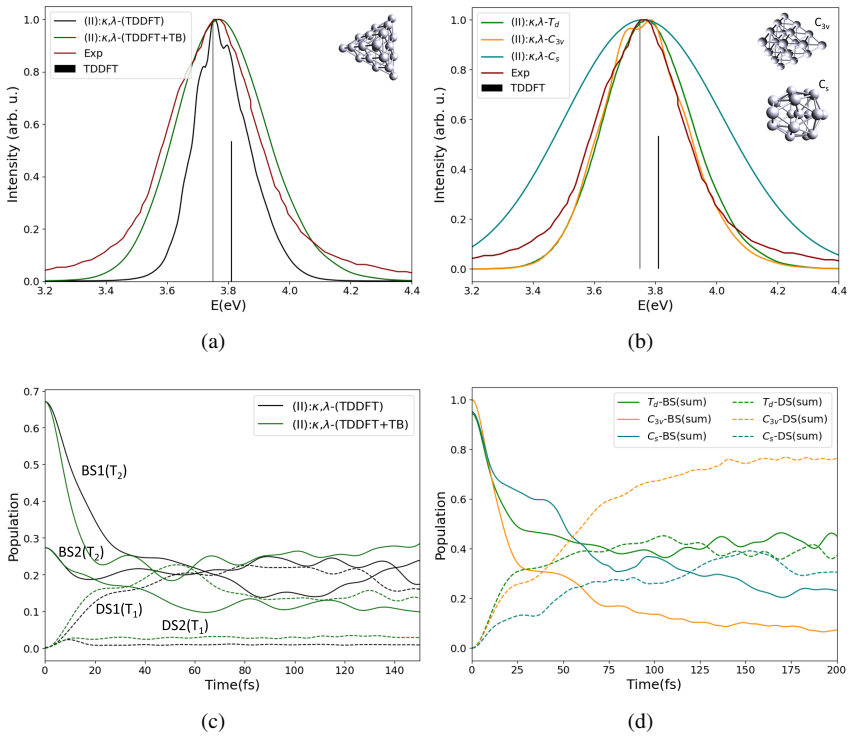
- §3.2, Figures 8a–b: The claim that the workflow 'successfully reproduces the experimental absorption spectra' of Ag55 and Ag120 rests entirely on GRCDE-generated LVC parameters (pipeline III) with validation limited to visual comparison of broad spectral features. No quantitative error metric (e.g., RMSE, spectral overlap, peak position error, linewidth error) is reported. Given that broad plasmonic absorption bands can be reproduced by multiple parameter sets — especially when damping is applied — the spectral agreement alone is necessary but not sufficient to validate the GRCDE-extrapolated Hamiltonian. The authors should provide at least one quantitative comparison metric between computed and experimental spectra for all clusters shown in Figs. 7–8.
- §3.2 and §2.3: For Ag55 and Ag120, the entire LVC Hamiltonian (both κ and λ) is GRCDE-generated with no parameter-level validation against FP data. The manuscript states (§2.3, citing Havenridge et al., Ref. 41) that analytical excited-state gradients are available within TD-DFT+TB, meaning κ parameters could in principle be computed directly for at least a subset of states and modes at these sizes. A direct comparison of GRCDE-predicted κ values against FP-computed κ values for, e.g., 5–10 electronic states and a subset of vibrational modes of Ag55 would substantially strengthen the claim that the GRCDE extrapolation is reliable. This check is absent and is the single most important missing validation.
- §2.2, Eq. (5): The GRCDE feature vector for predicting κ and λ consists of (electronic state energy, vibrational frequency, symmetry label). This is a low-dimensional descriptor set that does not include cluster-size-dependent features such as surface-to-volume ratio, local coordination number, or s–d transition character. If the coupling parameters depend on these omitted features, the extrapolation from Ag10/Ag20 training data to Ag55/Ag120 targets could be systematically biased. The authors should discuss whether such size-dependent descriptors were considered and why they were excluded, or provide evidence that the chosen features are sufficient.
- §3.1, Fig. 4: The load-bearing assumption that the distribution of normalized on-diagonal parameters (κ/ω) is independent of the specific plasmonic electronic state for sufficiently large clusters is supported by visual inspection of spectral densities J_n(ω) for Ag10, Ag20, and Ag56 (Figs. 4a–d). However, no quantitative test of this independence (e.g., a Kolmogorov–Smirnov test or variance ratio across states) is provided. Since this assumption underpins the entire GRCDE sampling strategy for κ, a quantitative justification — even a simple statistical test on the Ag20 or Ag56 data — would strengthen the extrapolation strategy.
minor comments (8)
- §2.1, Eq. (1): The notation mixes hats and plain symbols for operators (e.g., Q̂_i in the first term but Q_i elsewhere). Consistent operator notation would help reproducibility.
- §2.2: The kernel bandwidth used in the univariate KDE for GRCDE is not specified. Since this is a free parameter that affects the predicted coupling constants, its value (or selection procedure) should be reported.
- §2.5: The damping time τ = 150 fs is used for Ag10 spectra (Fig. 6) but the caption of Fig. 7 states that no damping function is applied. The rationale for applying or not applying damping should be clarified, and the τ value should be justified.
- Fig. 5: The panel labels (a), (b), (c) are referenced in the text but the distinction between 'full set' and 'reduced set' of parameters is not immediately clear from the figure legend. A more descriptive legend within the figure would help.
- §3.1: The statement 'the distribution of first-order LVC parameters turns out to be independent to the electronic state' is a key claim. The phrase 'turns out to be' should be replaced with a more precise statement of the evidence supporting this claim.
- Table S1 and Figures S2–S3 (referenced in §2.5) are mentioned as detailing efficiency and scalability but are in the Supporting Information. A brief summary of the scaling in the main text would be helpful.
- §3.2: The population dynamics for Ag55 and Ag120 (Figs. 8c–d) show summed bright and dark state populations but do not identify individual dark states. Given that the paper claims to 'effectively capture the dynamics of dark states,' showing at least one individual dark-state trajectory would strengthen this claim.
- The reference list contains an arXiv preprint stamp date of 8 Jul 2026, which appears to be a typographical error in the preprint stamp.
Circularity Check
No significant circularity: the GRCDE-extrapolated Hamiltonians for Ag55/Ag120 are validated against independent experimental spectra, not against their own training data.
full rationale
The paper's central claim is that LVC Hamiltonians parameterized via GRCDE (trained on Ag10/Ag20/Ag56 FP data) reproduce experimental absorption spectra of Ag55 and Ag120. This is not circular: the training data (small clusters) and the validation targets (experimental spectra of larger clusters) are distinct. The GRCDE method (§2.2) uses feature vectors (electronic state energy, vibrational frequency, symmetry label) to predict coupling constants κ and λ for larger systems — these predictions are then tested against external experimental observables (absorption linewidths and peak positions from Refs 53, 69), not against the training data itself. The key statistical assumption — that κ/ω distributions become state-independent for large clusters (§3.1) — is an empirical observation from FP data on Ag10–Ag56, not a definition that forces the result. For Ag10, the paper does perform a direct cross-check: GRCDE-generated λ values (pipeline II) are compared against FP-computed λ values, showing 'satisfactory agreement' (Fig. 6b–c). The two minor concerns that prevent a score of 0 are: (1) for Ag55/Ag120, no parameter-level validation against FP data is performed, even though TD-DFT+TB gradients are computable at these sizes (§2.3); spectral agreement alone is a weaker validation since broad features can be reproduced by multiple parameter sets. (2) The state-independence assumption is supported only by the authors' own FP calculations on Ag10–Ag56 without external corroboration. However, neither of these constitutes circularity in the strict sense — the predictions are tested against independent experimental data, and the assumptions, while unverified for the largest systems, are empirical claims rather than definitions. The derivation is self-contained against external benchmarks.
Assumptions & free parameters
free parameters (3)
- Damping time τ =
150 fs
- GRCDE Kernel Bandwidth =
Not specified in main text
- Threshold for λ values =
Not specified
assumptions (3)
- domain assumption The LVC model (first-order Taylor expansion) is sufficient to capture the essential vibronic physics of plasmonic excitations in silver nanoclusters.
- ad hoc to paper For sufficiently large clusters, the distribution of normalized LVC parameters (κ/ω) is independent of the specific plasmonic electronic state.
- domain assumption TD-DFT+TB provides sufficiently accurate excited-state gradients and non-adiabatic couplings for parameterizing the LVC Hamiltonian of silver nanoclusters.
invented entities (2)
-
PyPC (Python Plasmonic Cavity) platform
independent evidence
-
GRCDE (Generative Regression by Conditional Density Estimation)
independent evidence
Cite this review
Pith. "Pith review of Plasmonic Cavity Quantum Dynamics under Linear Vibronic Coupling." pith.science (2026). https://pith.science/paper/EWWMETT3
@misc{pith2026260707131,
  author       = {Pith},
  title        = {Pith review of: Plasmonic Cavity Quantum Dynamics under Linear Vibronic Coupling},
  year         = {2026},
  howpublished = {\url{https://pith.science/paper/EWWMETT3}},
  note         = {Machine review of arXiv:2607.07131}
}
read the original abstract
Modeling the quantum dynamics of plasmonic excitations -- collective oscillations of free electrons interacting with light -- remains a significant theoretical challenge, particularly due to the need to accurately describe their quantum nature and the role of non-radiative decay channels. At the same time, a reliable theoretical framework is essential for advancing applications ranging from materials design to the development of new quantum optical platforms for quantum technologies. In this work, we address these challenges by introducing a Hermitian formalism based on the linear vibronic coupling (LVC) model for the description of plasmonic excitations in metallic nanostructures. This is parameterized through first-principles calculations -- including but not limited to, the full DFT ground state with tight-binding excited states -- and machine learning techniques using a newly implemented automated platform named Python Plasmonic Cavity (PyPC). The effectiveness of this workflow is demonstrated by successfully reproducing the experimental absorption spectra and vibronic broadening of plasmonic silver nanoparticles containing more than a hundred atoms. Additionally, the population dynamics of plasmonic states are investigated, showing that the LVC model accurately predicts ultrafast lifetimes for bright states and effectively captures the dynamics of dark states.
Figures


Figures from the paper (5 more)



Reference graph
Works this paper leans on
-
[1]
Plasmonics: fundamentals and applications , pages=
Localized surface plasmons , author=. Plasmonics: fundamentals and applications , pages=. 2007 , publisher=
work page 2007
-
[2]
Physical Review Letters , volume=
Generalized Gradient Approximation Made Simple , author=. Physical Review Letters , volume=. 1996 , publisher=
work page 1996
-
[3]
Quantum plasmonics: nonlinear effects in the field enhancement of a plasmonic nanoparticle dimer , author=. Nano letters , volume=. 2012 , publisher=
work page 2012
-
[4]
Nature communications , volume=
Nonlinear plasmon-exciton coupling enhances sum-frequency generation from a hybrid metal/semiconductor nanostructure , author=. Nature communications , volume=. 2020 , publisher=
work page 2020
-
[5]
Advances in Optics and Photonics , volume=
Quantum plasmonics: new opportunity in fundamental and applied photonics , author=. Advances in Optics and Photonics , volume=. 2018 , publisher=
work page 2018
-
[6]
Multiparticle quantum plasmonics , author=. Nanophotonics , volume=. 2020 , publisher=
work page 2020
-
[7]
Nature communications , volume=
Strong coupling and induced transparency at room temperature with single quantum dots and gap plasmons , author=. Nature communications , volume=. 2018 , publisher=
work page 2018
-
[8]
Room-temperature strong coupling between a single quantum dot and a single plasmonic nanoparticle , author=. Nano Letters , volume=. 2022 , publisher=
work page 2022
Show all 85 references
-
[9]
Nature communications , volume=
Vacuum Rabi splitting of a dark plasmonic cavity mode revealed by fast electrons , author=. Nature communications , volume=. 2020 , publisher=
2020
-
[10]
Chemical reviews , volume=
Surface-enhanced infrared spectroscopy using resonant nanoantennas , author=. Chemical reviews , volume=. 2017 , publisher=
2017
-
[11]
Angewandte Chemie International Edition , volume=
Surface-Enhanced raman spectroscopy: Concepts and chemical applications , author=. Angewandte Chemie International Edition , volume=. 2014 , publisher=
2014
-
[12]
Plasmonics , volume=
Plasmon-enhanced fluorescence biosensors: a review , author=. Plasmonics , volume=. 2014 , publisher=
2014
-
[13]
Nature , volume=
Vacuum Rabi splitting with a single quantum dot in a photonic crystal nanocavity , author=. Nature , volume=. 2004 , publisher=
2004
-
[14]
Chemical reviews , volume=
Plasmons in strongly coupled metallic nanostructures , author=. Chemical reviews , volume=. 2011 , publisher=
2011
-
[15]
Physical Review A , volume=
Hybridization of plasmonic antenna and cavity modes: Extreme optics of nanoparticle-on-mirror nanogaps , author=. Physical Review A , volume=. 2015 , publisher=
2015
-
[16]
Science , volume=
Probing the ultimate limits of plasmonic enhancement , author=. Science , volume=. 2012 , publisher=
2012
-
[17]
Chemical Reviews , volume=
Molecular polaritons for chemistry, photonics and quantum technologies , author=. Chemical Reviews , volume=. 2024 , publisher=
2024
-
[18]
ACS nano , volume=
Plasmon energy transfer in hybrid nanoantennas , author=. ACS nano , volume=. 2020 , publisher=
2020
-
[19]
Physical Chemistry Chemical Physics , volume=
Highly efficient surface hopping dynamics using a linear vibronic coupling model , author=. Physical Chemistry Chemical Physics , volume=. 2019 , publisher=
2019
-
[20]
Journal of chemical theory and computation , volume=
Efficient calculation of electronic absorption spectra by means of intensity-selected time-dependent density functional tight binding , author=. Journal of chemical theory and computation , volume=. 2015 , publisher=
2015
-
[21]
Advances in chemical physics , pages=
Multimode molecular dynamics beyond the Born-Oppenheimer approximation , author=. Advances in chemical physics , pages=. 1984 , publisher=
1984
-
[22]
The Journal of Physical Chemistry C , volume=
TD-DFT+ TB: An efficient and fast approach for quantum plasmonic excitations , author=. The Journal of Physical Chemistry C , volume=. 2020 , publisher=
2020
-
[23]
Acs Photonics , volume=
Plasmonic cavity coupling , author=. Acs Photonics , volume=. 2018 , publisher=
2018
-
[24]
ACS Photonics , volume=
On quantum efficiency measurements and plasmonic antennas , author=. ACS Photonics , volume=. 2021 , publisher=
2021
-
[25]
The Journal of Chemical Physics , volume=
Analytical excited state gradients for time-dependent density functional theory plus tight binding (TDDFT+ TB) , author=. The Journal of Chemical Physics , volume=. 2023 , publisher=
2023
-
[26]
Chemical Physics Letters , volume=
The multi-configurational time-dependent Hartree approach , author=. Chemical Physics Letters , volume=. 1990 , publisher=
1990
-
[27]
Physics reports , volume=
The multiconfiguration time-dependent Hartree (MCTDH) method: a highly efficient algorithm for propagating wavepackets , author=. Physics reports , volume=. 2000 , publisher=
2000
-
[28]
2009 , publisher=
Multidimensional quantum dynamics: MCTDH theory and applications , author=. 2009 , publisher=
2009
-
[29]
G. A. Worth and M. H. Beck and A. J. The Heidelberg MCTDH Package: A set of programs for multi-dimensional quantum dynamics , howpublished=
-
[30]
The Journal of Chemical Physics , volume=
Multilayer multiconfiguration time-dependent Hartree method: Implementation and applications to a Henon--Heiles Hamiltonian and to pyrazine , author=. The Journal of Chemical Physics , volume=. 2011 , publisher=
2011
-
[31]
Chemical Physics , volume=
Towards a systematic convergence of multi-layer (ML) multi-configuration time-dependent Hartree nuclear wavefunctions: The ML-spawning algorithm , author=. Chemical Physics , volume=. 2017 , publisher=
2017
-
[32]
The Journal of Chemical Physics , volume=
Regularizing the MCTDH equations of motion through an optimal choice on-the-fly (ie, spawning) of unoccupied single-particle functions , author=. The Journal of Chemical Physics , volume=. 2020 , publisher=
2020
-
[33]
Dirac, Paul A. M. , title =. 1930 , edition =
1930
-
[34]
, title =
Frenkel, J. , title =
-
[35]
Journal of Chemical Theory and Computation , volume=
LVC/MM: A Hybrid Linear Vibronic Coupling/Molecular Mechanics Model with Distributed Multipole-Based Electrostatic Embedding for Highly Efficient Surface Hopping Dynamics in Solution , author=. Journal of Chemical Theory and Computation , volume=. 2023 , publisher=
2023
-
[36]
Wiley Interdisciplinary Reviews: Computational Molecular Science , volume=
Nonadiabatic dynamics with trajectory surface hopping method , author=. Wiley Interdisciplinary Reviews: Computational Molecular Science , volume=. 2011 , publisher=
2011
-
[37]
The journal of physical chemistry letters , volume=
Recent progress in surface hopping: 2011--2015 , author=. The journal of physical chemistry letters , volume=. 2016 , publisher=
2011
-
[38]
Wiley Interdisciplinary Reviews: Computational Molecular Science , volume=
Nonadiabatic dynamics: The SHARC approach , author=. Wiley Interdisciplinary Reviews: Computational Molecular Science , volume=. 2018 , publisher=
2018
-
[39]
Accounts of chemical research , volume=
Surface hopping dynamics on vibronic coupling models , author=. Accounts of chemical research , volume=. 2021 , publisher=
2021
-
[40]
The Journal of Chemical Physics , volume=
Theory of vibronic coupling in linear molecules , author=. The Journal of Chemical Physics , volume=. 1981 , publisher=
1981
-
[41]
The Journal of Chemical Physics , volume=
Parameterization of a linear vibronic coupling model with multiconfigurational electronic structure methods to study the quantum dynamics of photoexcited pyrene , author=. The Journal of Chemical Physics , volume=. 2021 , publisher=
2021
-
[42]
Journal of Chemical Theory and Computation , volume=
Ultrafast dynamics of the two lowest bright excited states of cytosine and 1-methylcytosine: A quantum dynamical study , author=. Journal of Chemical Theory and Computation , volume=. 2020 , publisher=
2020
-
[43]
Journal of Chemical Theory and Computation , volume=
Vibronic spectra of -conjugated systems with a multitude of coupled states: A protocol based on linear vibronic coupling models and quantum dynamics tested on hexahelicene , author=. Journal of Chemical Theory and Computation , volume=. 2021 , publisher=
2021
-
[44]
Conical intersections: electronic structure, dynamics and spectroscopy , pages=
The multi-mode vibronic-coupling approach , author=. Conical intersections: electronic structure, dynamics and spectroscopy , pages=. 2004 , publisher=
2004
-
[45]
Journal of chemical theory and computation , volume=
Exploring the mechanism of ultrafast intersystem crossing in rhenium (I) carbonyl bipyridine halide complexes: Key vibrational modes and spin--vibronic quantum dynamics , author=. Journal of chemical theory and computation , volume=. 2016 , publisher=
2016
-
[46]
Journal of Chemical Theory and Computation , volume=
Two new methods to generate internal coordinates for molecular wave packet dynamics in reduced dimensions , author=. Journal of Chemical Theory and Computation , volume=. 2016 , publisher=
2016
-
[47]
JACS Au , volume=
The quest to simulate excited-state dynamics of transition metal complexes , author=. JACS Au , volume=. 2021 , publisher=
2021
-
[48]
2016 , publisher=
Density-functional methods for excited states , author=. 2016 , publisher=
2016
-
[49]
Recent Advances In Density Functional Methods: (Part I) , pages=
Time-dependent density functional response theory for molecules , author=. Recent Advances In Density Functional Methods: (Part I) , pages=. 1995 , publisher=
1995
-
[50]
Physical Review B , volume=
Tight-binding approach to time-dependent density-functional response theory , author=. Physical Review B , volume=. 2001 , publisher=
2001
-
[51]
The Journal of chemical physics , volume=
Tight-binding approximations to time-dependent density functional theory—A fast approach for the calculation of electronically excited states , author=. The Journal of chemical physics , volume=. 2016 , publisher=
2016
-
[52]
The Journal of Chemical Physics , volume=
Dissociation kinetics of metal clusters on multiple electronic states including electronic level statistics into the vibronic soup , author=. The Journal of Chemical Physics , volume=. 2001 , publisher=
2001
-
[53]
Journal of chemical theory and computation , volume=
General time dependent approach to vibronic spectroscopy including Franck--Condon, Herzberg--Teller, and Duschinsky effects , author=. Journal of chemical theory and computation , volume=. 2013 , publisher=
2013
-
[54]
Chemical Physics , volume=
Vibration correlation function formalism of radiative and non-radiative rates for complex molecules , author=. Chemical Physics , volume=. 2010 , publisher=
2010
-
[55]
The Journal of Physical Chemistry A , volume=
Photoinduced cooling of polyatomic molecules in an electronically excited state in the presence of Dushinskii rotations , author=. The Journal of Physical Chemistry A , volume=. 2004 , publisher=
2004
-
[56]
Chemistry with ADF , Author =. J. Comput. Chem. , Year =. doi:10.1002/jcc.1056 , ISSN =
-
[57]
Wiley Interdisciplinary Reviews: Computational Molecular Science , volume=
The ORCA program system , author=. Wiley Interdisciplinary Reviews: Computational Molecular Science , volume=. 2012 , publisher=
2012
-
[58]
Wiley Interdisciplinary Reviews: Computational Molecular Science , volume=
Software update: the ORCA program system, version 4.0 , author=. Wiley Interdisciplinary Reviews: Computational Molecular Science , volume=. 2018 , publisher=
2018
-
[59]
The Journal of chemical physics , volume=
Software for the frontiers of quantum chemistry: An overview of developments in the Q-Chem 5 package , author=. The Journal of chemical physics , volume=. 2021 , publisher=
2021
-
[60]
Proceedings of the National Academy of Sciences , volume=
Reversing the size-dependence of surface plasmon resonances , author=. Proceedings of the National Academy of Sciences , volume=. 2010 , publisher=
2010
-
[61]
Physical Review B , volume=
Localized surface plasmon resonance in silver nanoparticles: Atomistic first-principles time-dependent density-functional theory calculations , author=. Physical Review B , volume=. 2015 , publisher=
2015
-
[62]
Chemical reviews , volume=
Synthesis and optical properties of hybrid and alloy plasmonic nanoparticles , author=. Chemical reviews , volume=. 2011 , publisher=
2011
-
[63]
The Journal of Physical Chemistry C , volume=
Effect of alloying on the optical properties of Ag--Au nanoparticles , author=. The Journal of Physical Chemistry C , volume=. 2013 , publisher=
2013
-
[64]
Physical review B , volume=
Density-functional approximation for the correlation energy of the inhomogeneous electron gas , author=. Physical review B , volume=. 1986 , publisher=
1986
-
[65]
The Journal of chemical physics , volume=
Toward reliable density functional methods without adjustable parameters: The PBE0 model , author=. The Journal of chemical physics , volume=. 1999 , publisher=
1999
-
[66]
The Journal of chemical physics , volume=
Fully optimized contracted Gaussian basis sets for atoms Li to Kr , author=. The Journal of chemical physics , volume=. 1992 , publisher=
1992
-
[67]
Physical Chemistry Chemical Physics , volume=
Balanced basis sets of split valence, triple zeta valence and quadruple zeta valence quality for H to Rn: Design and assessment of accuracy , author=. Physical Chemistry Chemical Physics , volume=. 2005 , publisher=
2005
-
[68]
The Journal of chemical physics , volume=
First-order derivative couplings between excited states from adiabatic TDDFT response theory , author=. The Journal of chemical physics , volume=. 2015 , publisher=
2015
-
[69]
The Journal of chemical physics , volume=
Analytic derivative couplings between configuration-interaction-singles states with built-in electron-translation factors for translational invariance , author=. The Journal of chemical physics , volume=. 2011 , publisher=
2011
-
[70]
Journal of computational chemistry , volume=
Optimized Slater-type basis sets for the elements 1--118 , author=. Journal of computational chemistry , volume=. 2003 , publisher=
2003
-
[71]
The Journal of chemical physics , volume=
The zero-order regular approximation for relativistic effects: The effect of spin--orbit coupling in closed shell molecules , author=. The Journal of chemical physics , volume=. 1996 , publisher=
1996
-
[72]
The Journal of chemical physics , volume=
Relativistic regular two-component Hamiltonians , author=. The Journal of chemical physics , volume=. 1993 , publisher=
1993
-
[73]
The Journal of Physical Chemistry C , volume=
Localized surface plasmon resonance in free silver nanoclusters Ag n, n= 20--147 , author=. The Journal of Physical Chemistry C , volume=. 2019 , publisher=
2019
-
[74]
The Journal of Physical Chemistry C , volume=
Effects of rare-gas matrices on the optical response of silver nanoclusters , author=. The Journal of Physical Chemistry C , volume=. 2018 , publisher=
2018
-
[75]
Nanoscale , volume=
Optical properties of size selected neutral Ag clusters: electronic shell structures and the surface plasmon resonance , author=. Nanoscale , volume=. 2018 , publisher=
2018
-
[76]
Physical Chemistry Chemical Physics , volume=
Structural assignment of small cationic silver clusters by far-infrared spectroscopy and DFT calculations , author=. Physical Chemistry Chemical Physics , volume=. 2017 , publisher=
2017
-
[77]
The Journal of chemical physics , volume=
Optical absorption of small silver clusters: Agn,(n= 4--22) , author=. The Journal of chemical physics , volume=. 2008 , publisher=
2008
-
[78]
and Brey, Dominik and Razgatlioglu, Leyla P
Green, James A. and Brey, Dominik and Razgatlioglu, Leyla P. and Ali, Badria and Blasiak, Bartosz and Burghardt, Irene , title =. Journal of Chemical Theory and Computation , year =
-
[79]
The Journal of Chemical Physics , volume=
Description of plasmon-like band in silver clusters: The importance of the long-range Hartree-Fock exchange in time-dependent density-functional theory simulations , author=. The Journal of Chemical Physics , volume=. 2014 , publisher=
2014
-
[80]
Physical review letters , volume=
Structure determination of isolated metal clusters via far-infrared spectroscopy , author=. Physical review letters , volume=. 2004 , publisher=
2004
-
[81]
Angewandte Chemie International Edition , volume=
Chemical Reactivity on Gas-Phase Metal Clusters Driven by Blackbody Infrared Radiation , author=. Angewandte Chemie International Edition , volume=. 2015 , publisher=
2015
-
[82]
Evolution of properties and structure , author=
Density functional study of neutral and charged silver clusters Ag n with n= 2--22. Evolution of properties and structure , author=. The Journal of Physical Chemistry A , volume=. 2017 , publisher=
2017
-
[83]
Machine Learning for Electronically Excited States of Molecules , volume =
Westermayr, Julia and Marquetand, Philipp , year =. Machine Learning for Electronically Excited States of Molecules , volume =. Chemical Reviews , publisher =. doi:10.1021/acs.chemrev.0c00749 , number =
-
[84]
Remarks on Some Nonparametric Estimates of a Density Function , volume =
Rosenblatt, Murray , year =. Remarks on Some Nonparametric Estimates of a Density Function , volume =. The Annals of Mathematical Statistics , publisher =. doi:10.1214/aoms/1177728190 , number =
-
[85]
On Estimation of a Probability Density Function and Mode , volume =
Parzen, Emanuel , year =. On Estimation of a Probability Density Function and Mode , volume =. The Annals of Mathematical Statistics , publisher =. doi:10.1214/aoms/1177704472 , number =
Reviewed July 9, 2026 · model on record in the stance chip above.
Discussion (0). Continue with ORCID to comment.