REVIEW 2 major objections 5 minor 35 references
Pressure flips LaMnSi from PT-symmetric to PT-broken magnetism
Reviewed by Pith at T0; open to challenge. T0 means a machine referee read the full paper against a public rubric. the ladder, T0–T4 →
High pressure suppresses the PT-symmetric antiferromagnetic phase of LaMnSi and induces a PT-broken ferromagnetic state with a large anomalous Hall effect, confirmed by transport measurements and DFT calculations.
T0 review reviewed 2026-07-09 challenge →
load-bearing objection Pressure-induced AHE in a PT-symmetric antiferromagnet — experimentally solid, microscopic assignment unconfirmed the 2 major comments →
Pressure-induced PT Symmetry Breaking in LaMnSi
The pith
A machine-rendered reading of the paper's core claim, the machinery that carries it, and where it could break.
The reading
Core claim
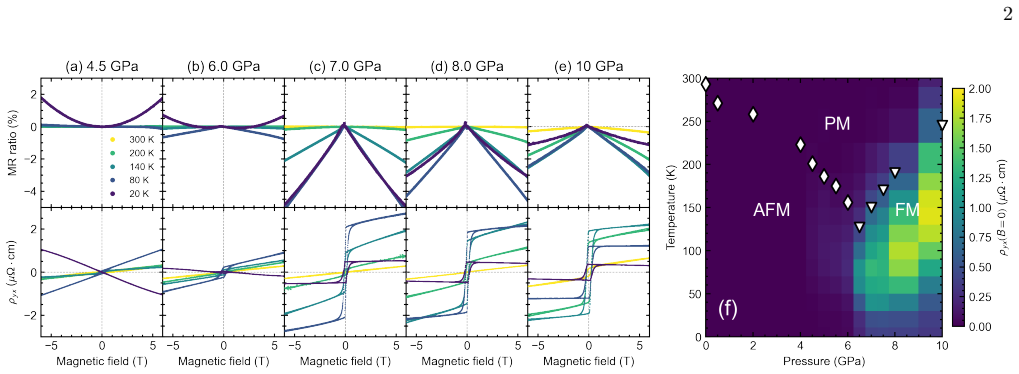
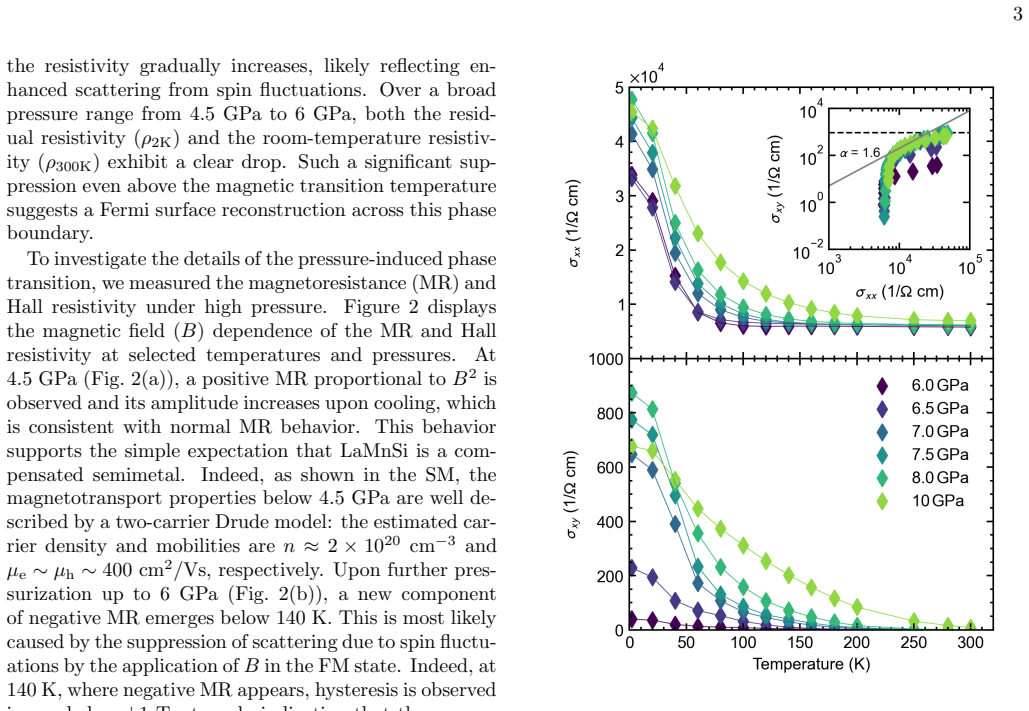
The central discovery is that pressure provides a clean external knob to switch LaMnSi from a PT-symmetric antiferromagnetic phase, where band degeneracy is protected and no anomalous Hall effect is possible, into a PT-broken phase where band splitting, spin polarization, and a large anomalous Hall conductivity of order 10^3 inverse ohm-cm all emerge. The carrier density and mobility extracted from a two-band Drude model at low pressure confirm the system is a compensated semimetal, and the scaling of anomalous Hall conductivity with longitudinal conductivity crosses from a dirty regime through a power-law with exponent near 1.6 toward saturation at the quasi-universal value e^2/(ha), which,
What carries the argument
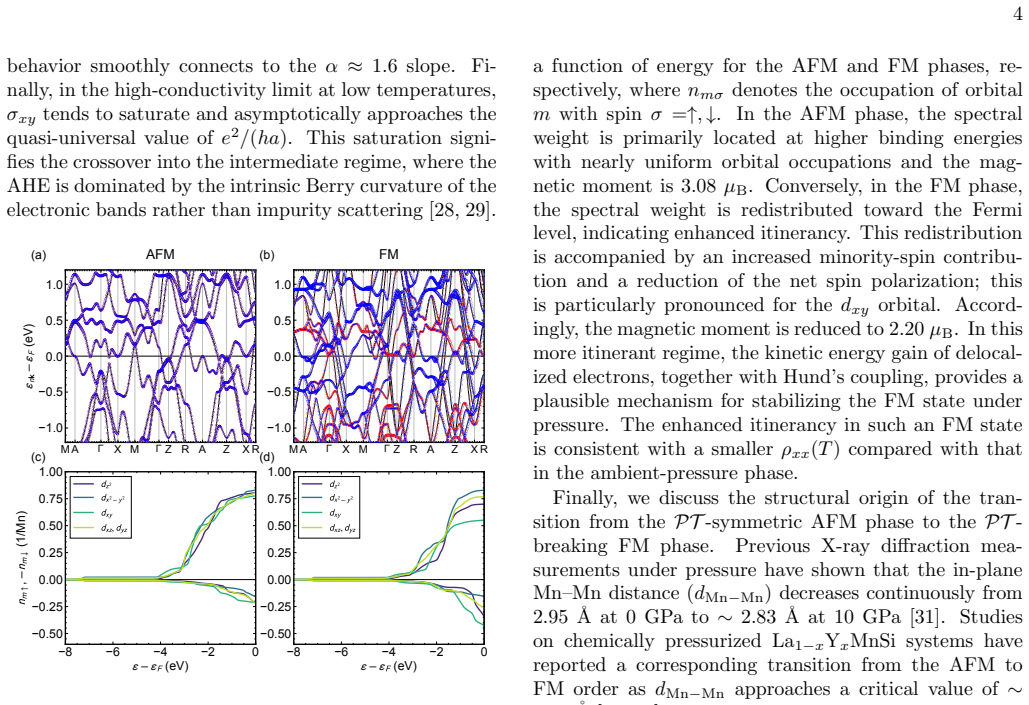
The load-bearing mechanism is the transition between two magnetic irreducible representations of the P4/nmm space group: the ambient-pressure B1u antiferromagnetic state, which preserves PT symmetry and enforces spin-degenerate, PT-warped bands, and the high-pressure A2g ferromagnetic state, which breaks PT symmetry, lifts band degeneracy, and enables Berry-curvature-driven anomalous Hall transport. The microscopic driver is the contraction of the in-plane Mn-Mn distance, which enhances 3d electron itinerancy and stabilizes the ferromagnetic arrangement through kinetic-energy gain and Hund coupling.
Load-bearing premise
The assignment of the high-pressure phase to the specific A2g ferromagnetic structure rests on symmetry arguments alone, since no direct magnetic structure measurement under pressure (such as neutron diffraction) is presented; the anomalous Hall effect is consistent with A2g but does not uniquely determine it, and other PT-broken configurations could also produce a Hall signal.
What would settle it
Neutron diffraction under pressure showing that the high-pressure magnetic structure is not the A2g ferromagnetic state would falsify the specific structural assignment, though not necessarily the broader claim of PT-symmetry breaking.
If this is right
- LaMnSi becomes a tunable platform for PT-symmetry control: pressure, chemical substitution (La1-xYxMnSi), and potentially strain or field could all serve as knobs to move the system across the PT-breaking boundary.
- The orbital-dependent spin polarization, particularly in the d_xy orbital, suggests that the transition is not a simple spin-flip but involves a reconfiguration of the orbital character at the Fermi level, which could be probed by angle-resolved photoemission under pressure.
- The crossover from dirty to intrinsic Berry-curvature-dominated anomalous Hall transport as pressure increases means the high-pressure phase could host topological electronic bands whose Berry curvature is controllable by an external parameter.
- The consistency between physical and chemical pressure effects, both converging on a critical Mn-Mn distance near 2.83 Angstroms, establishes a structural length scale as the universal tuning parameter for this class of materials.
Editorial analysis
A structured set of objections, weighed in public.
Referee Report
Summary. This manuscript reports pressure-induced PT symmetry breaking in the antiferromagnetic metal LaMnSi. Through magnetotransport measurements in a diamond anvil cell, the authors show that the ambient-pressure PT-symmetric AFM phase (B1u, Q=0) is suppressed above ~5 GPa, giving way to a phase exhibiting a large anomalous Hall effect (AHE) with anomalous Hall conductivity up to ~10^3 Omega^-1 cm^-1. The AHE scaling analysis (sigma_xy vs sigma_xx) shows a crossover from the dirty/hopping regime to the intermediate regime dominated by intrinsic Berry curvature. Based on symmetry analysis, the authors propose the A2g ferromagnetic structure as the candidate high-pressure magnetic state and support this with DFT calculations showing band splitting and orbital-dependent spin polarization in the FM phase relative to the AFM phase. The central experimental claim—pressure-induced PT symmetry breaking manifested through AHE—is well-supported by two independent experimental runs and standard transport analysis.
Significance. The paper addresses a timely question: whether PT-symmetric antiferromagnetic metals can be driven into PT-broken phases by external tuning. The experimental demonstration is clean, with reproducibility across two runs and a well-constructed T-P phase diagram. The AHE scaling analysis is standard and appropriately connects to the intrinsic Berry curvature regime. The symmetry analysis (SM, Tables S1-S2) is a straightforward group-theoretical decomposition that correctly identifies which irreps permit a c-axis ferromagnetic component. The DFT calculations provide illustrative electronic structures for both the AFM and candidate FM phases. The paper is appropriately hedged throughout ('candidate,' 'most plausible') regarding the specific magnetic structure assignment. The falsifiable prediction—that neutron diffraction under pressure should confirm or rule out the A2g FM structure—is clearly stated.
major comments (2)
- SM, Computational Details and Fig. 4: The DFT calculations compute band structures for the assumed A2g FM state but do not perform total-energy comparisons between the B1u AFM and A2g FM phases at compressed lattice parameters. The paper uses experimental ambient-pressure lattice parameters for both calculations (SM states 'experimental lattice parameters reported by Tanida et al. [17] were used'). Since the central claim is a pressure-induced transition, the absence of any pressure-dependent structural input or total-energy comparison means the DFT work illustrates what PT-breaking would look like but does not independently predict or confirm the transition. This is acknowledged indirectly ('Further diffraction experiments under high pressure will be necessary'), but the main text could more clearly state that the DFT serves as a consistency check rather than a predictive calculation. A
- SM, Magnetic Symmetry Analysis: The assignment of the high-pressure phase to the A2g FM structure rests on a symmetry exclusion argument: AHE is observed with B||c, and among Q=0 irreps, only A2g permits Fz. This is reasonable but not unique. Multi-irrep states mixing A2g with other representations, or incommensurate structures not considered in the Q=0 or Q=(0,0,1/2) analysis, could also produce a c-axis AHE. The paper acknowledges this gap but the main text (end of page 4) states the A2g assignment more confidently than the SM hedging warrants. The authors should clarify in the main text that the A2g assignment is a symmetry-consistent candidate, not a uniquely determined structure, since no direct magnetic structure measurement under pressure is presented.
minor comments (5)
- Fig. 2(f): The contour plot of Hall resistivity at B=0 superimposed on the phase diagram is difficult to read in terms of absolute values. Adding a colorbar with numerical scale for rho_yx(B=0) would improve readability.
- Fig. 1(c): The open triangles indicating Tc are described as derived from d rho/dT analysis, but the criteria for identifying Tc from the differential resistivity are not specified. A brief description of the criterion (e.g., inflection point, minimum) would help reproducibility.
- The reference list includes preprints (Refs. [24], [25]) that should be updated to published versions if available.
- The inset of Fig. 3 shows the scaling sigma_xy vs sigma_xx with a power law alpha=1.6, but individual data points are not labeled by pressure or temperature. Color-coding or symbol-coding by pressure would help the reader follow the scaling argument.
- The phrase 'quasi-universal value of e^2/(ha)' appears in the main text; the qualifier 'quasi' is not standard and could be replaced with 'approximately' or the context clarified (the value depends on the lattice constant a, which is not in the main text).
Circularity Check
No circularity: experimental AHE observation, symmetry analysis, and DFT calculations are each independently grounded.
full rationale
The paper's derivation chain is self-contained and free of circular reasoning. The central experimental claim — pressure-induced AHE above ~5 GPa — is grounded in direct transport measurements (Hall resistivity hysteresis, negative MR, conductivity scaling) across two independent experimental runs, with no parameter fitted to the target quantity and then presented as a prediction. The symmetry analysis (SM, Eq. S1 and Tables S1–S2) is a standard group-theoretical decomposition of the magnetic representation for the Mn site in P4/nmm, using only the experimentally known crystal structure and propagation vectors; it does not depend on the paper's own prior results. The A2g FM assignment is explicitly hedged as 'most plausible candidate' based on the observation that AHE occurs with B∥c and only A2g permits Fz among Q=0 irreps — this is a symmetry exclusion argument, not a circular definition. The DFT calculations (Fig. 4) use the experimentally determined crystal structure from Refs. [17, 22] (external, by different authors) and standard computational methods (WIEN2k, PBE-GGA), computing band structures for both the established B1u AFM and the candidate A2g FM states. These calculations illustrate the consequences of PT-symmetry breaking rather than predicting the phase transition; the paper does not claim they are predictive of the transition itself. No self-citation is load-bearing for the central claim. The paper appropriately acknowledges limitations ('Further diffraction experiments under high pressure will be necessary'). The absence of total-energy comparisons between AFM and FM phases is a correctness/completeness concern, not a circularity issue.
Axiom & Free-Parameter Ledger
free parameters (3)
- Carrier density n (low-pressure phase) =
~2×10^20 cm^-3
- Carrier mobility μ (low-pressure phase) =
~400 cm^2/Vs
- AHE scaling exponent α =
~1.6
axioms (4)
- domain assumption The crystal structure remains P4/nmm under pressure (no structural phase transition).
- domain assumption The AHE observed with B∥[001] implies the A2g representation (FM component Fz) is the most plausible candidate.
- domain assumption The two-carrier Drude model adequately describes the low-pressure magnetotransport.
- standard math PBE-GGA96 exchange-correlation functional is adequate for LaMnSi electronic structure.
Cite this review
Pith. "Pith review of Pressure-induced PT Symmetry Breaking in LaMnSi." pith.science (2026). https://pith.science/paper/JITIK4IQ
@misc{pith2026260707310,
  author       = {Pith},
  title        = {Pith review of: Pressure-induced PT Symmetry Breaking in LaMnSi},
  year         = {2026},
  howpublished = {\url{https://pith.science/paper/JITIK4IQ}},
  note         = {Machine review of arXiv:2607.07310}
}
read the original abstract
We investigate the magnetotransport properties of the antiferromagnetic metal LaMnSi, in which the collinear magnetic order breaks both spatial inversion (P) and time-reversal (T) symmetry yet preserves their combined PT symmetry. High pressure is found to suppress this PT-symmetric antiferromagnetic phase, inducing a transition into a PT-broken state characterized by a large anomalous Hall effect. Based on symmetry analysis, we propose a candidate magnetic structure for the high-pressure phase. Subsequent band calculations for this structure reveal the emergence of band splitting and orbital-dependent spin polarization. Our results establish LaMnSi as an ideal platform for controlling PT symmetry breaking via external parameters.
Figures

Reference graph
Works this paper leans on
-
[1]
Fiebig, Journal of Physics D: Applied Physics38, R123 (2005)
M. Fiebig, Journal of Physics D: Applied Physics38, R123 (2005)
work page 2005
-
[2]
N. A. Spaldin, M. Fiebig, and M. Mostovoy, Journal of Physics: Condensed Matter20, 434203 (2008)
work page 2008
- [3]
-
[4]
T. Jungwirth, X. Marti, P. Wadley, and J. Wunderlich, Nature Nanotechnology11, 231 (2016)
work page 2016
- [5]
-
[6]
I. E. Dzyaloshinskii, Soviet Physics JETP10, 628 (1960)
work page 1960
-
[7]
D. N. Astrov, Soviet Physics JETP11, 708 (1960)
work page 1960
-
[8]
G. T. Rado and V. J. Folen, Phys. Rev. Lett.7, 310 (1961)
work page 1961
-
[9]
L.-D. Yuan, Z. Wang, J.-W. Luo, and A. Zunger, Phys. Rev. Mater.5, 014409 (2021)
work page 2021
- [10]
-
[11]
J. ˇZelezn´ y, H. Gao, K. V´ yborn´ y, J. Zemen, J. Maˇ sek, A. Manchon, J. Wunderlich, J. Sinova, and T. Jungwirth, Phys. Rev. Lett.113, 157201 (2014)
work page 2014
-
[12]
P. Wadley, B. Howells, J. ˇZelezn´ y, C. Andrews, V. Hills, R. P. Campion, V. Nov´ ak, K. Olejn´ ık, F. Maccherozzi, S. S. Dhesi, S. Y. Martin, T. Wagner, J. Wunderlich, F. Freimuth, Y. Mokrousov, J. Kuneˇ s, J. S. Chauhan, M. J. Grzybowski, A. W. Rushforth, K. W. Edmonds, B. L. Gallagher, and T. Jungwirth, Science351, 587 (2016)
work page 2016
- [13]
- [14]
- [15]
-
[16]
M. Yatsushiro, H. Kusunose, and S. Hayami, Phys. Rev. B104, 054412 (2021)
work page 2021
- [17]
- [18]
-
[19]
J. Cao, W. Jiang, X.-P. Li, D. Tu, J. Zhou, J. Zhou, and Y. Yao, Phys. Rev. Lett.130, 166702 (2023)
work page 2023
- [20]
- [21]
- [22]
- [23]
-
[24]
Realization of a parity-violating antiferromagnetic state in LaMnSi
T. Iwata, K. Shiraishi, T. Aoyama, D. Senba, T. Takeda, Y. Fujisawa, M. Nurmamat, K. Nakanishi, K. Yamagami, M. Arita, T. Yamada, Y. Yanagi, A. Kimura, H. Tanida, and K. Kuroda, arXiv preprint arXiv:2605.19891 (2026), arXiv:2605.19891 [cond-mat.mtrl-sci]
work page internal anchor Pith review Pith/arXiv arXiv 2026
-
[25]
S. Nishiyama, H. Mima, J. ichi Hayashi, K. Takeda, C. Sekine, Y. Uwatoko, H. Takahashi, H. Tanida, and Y. Kawamura, arXiv preprint arXiv:2605.18230 (2026), arXiv:2605.18230 [cond-mat.str-el]
work page internal anchor Pith review Pith/arXiv arXiv 2026
-
[26]
P. N. Dheer, Phys. Rev.156, 637 (1967)
work page 1967
-
[27]
Y. Yao, L. Kleinman, A. H. MacDonald, J. Sinova, T. Jungwirth, D.-s. Wang, E. Wang, and Q. Niu, Phys. Rev. Lett.92, 037204 (2004)
work page 2004
- [28]
-
[29]
N. Nagaosa, J. Sinova, S. Onoda, A. H. MacDonald, and N. P. Ong, Rev. Mod. Phys.82, 1539 (2010)
work page 2010
-
[30]
T. Miyasato, N. Abe, T. Fujii, A. Asamitsu, S. Onoda, Y. Onose, N. Nagaosa, and Y. Tokura, Phys. Rev. Lett. 99, 086602 (2007)
work page 2007
-
[31]
Y. Kawamura, S. Nishiyama, J.-i. Hayashi, K. Takeda, C. Sekine, and H. Tanida, J. Phys. Soc. Jpn.95, 014601 (2026)
work page 2026
-
[32]
I. Ijjaali, R. Welter, G. Venturini, B. Malaman, and E. Ressouche, Journal of Alloys and Compounds270, 63 (1998)
work page 1998
- [33]
-
[34]
P. Blaha, K. Schwarz, F. Tran, R. Laskowski, G. K. H. Madsen, and L. D. Marks, The Journal of Chemical Physics152, 074101 (2020). 1 Supplemental Material: Pressure-inducedPTSymmetry Breaking in LaMnSi Takuya Aoyama, Hikaru Taneoka, Takemi Yamada, Hiroshi Tanida, and Kenya Ohgushi. Magnetic Symmetry Analysis Because experimental studies indicate that the c...
work page 2020
-
[35]
Simultaneously, the MR profile transits from a simpleB 2 dependence to complex behavior with a sharp low-field dip, reflecting the development of FM magnetization. These consistent observations across independent experimental runs confirm the robust nature of the pressure-inducedPTsymmetry breaking in LaMnSi. Here, we analyze the MR and Hall resistivity b...
This paper was first reviewed by glm-5.2 on July 9, 2026.
discussion (0)
Sign in with ORCID, Apple, or X to comment. Anyone can read and Pith papers without signing in.