REVIEW 2 major objections 7 minor 26 references
Unstructured-mesh CFD meets end-to-end differentiability
Reviewed by Pith at T0; open to challenge. T0 means a machine referee read the full paper against a public rubric. the ladder, T0–T4 →
JAX-FVM is a differentiable, entropy-stable finite volume solver for 2D compressible Euler/Navier-Stokes equations on unstructured meshes, built in JAX.
T0 review reviewed 2026-07-09 challenge →
load-bearing objection Open-source differentiable FVM for compressible Euler/NS on unstructured meshes in JAX — real gap-filler, but entropy-stability claim is not established for the second-order scheme as implemented. the 2 major comments →
JAX-FVM: A differentiable, entropy-stable finite volume solver on unstructured meshes for compressible flows
The pith
A machine-rendered reading of the paper's core claim, the machinery that carries it, and where it could break.
The reading
Core claim
The central object is the differentiable finite-volume residual on unstructured meshes, implemented entirely in JAX. The key technical insight is that forward-mode automatic differentiation (jax.jvp) can replace two traditionally hand-derived quantities: the entropy-variable-to-conservative-variable Jacobian in the dissipation term of the Tadmor/Ismail-Roe flux, and the Jacobian-vector products needed for matrix-free implicit time integration (Newton, SDIRK2). This means the entropy-stable discretization and the implicit solvers are formed exactly by AD rather than by analytical derivation, which simplifies implementation and ensures consistency. The unstructured mesh operators—cell-to-cell邻
What carries the argument
The differentiable finite-volume residual on unstructured meshes, where forward-mode AD (jax.jvp) replaces hand-derived Jacobians in both the entropy-variable dissipation and implicit solvers, and reverse-mode AD exposes end-to-end gradients for optimization.
Load-bearing premise
The paper assumes that the JAX vmap-based implementation of unstructured mesh operators overcomes the irregular memory access patterns that make unstructured meshes hostile to GPU execution. If this approach is not sufficiently efficient on accelerators, the tool may be too slow for practical large-scale use.
What would settle it
Benchmark the GPU throughput of JAX-FVM on unstructured meshes against a structured-grid differentiable solver (e.g., JAX-CFD) at equivalent resolution; if the unstructured implementation is orders of magnitude slower due to irregular memory access, the practical utility claim is undermined.
If this is right
- PDE-constrained optimization and inverse design on complex geometries with strong shocks become accessible to gradient-based methods without hand-coded adjoints, since the solver is differentiable by construction.
- Hybrid physics/ML models—such as learned turbulence closures or data-driven discretizations—can be trained end-to-end through an unstructured-mesh compressible solver, which was not previously possible in a single open tool.
- The entropy-stability property, which guarantees a discrete entropy inequality and robustness for strong shocks, is now coupled with differentiability, enabling gradient-based design optimization that respects nonlinear stability constraints.
- The matrix-free implicit time integrators formed by AD Jacobian-vector products could serve as a template for other PDE solvers seeking to avoid the implementation burden of hand-derived Jacobians.
Editorial analysis
A structured set of objections, weighed in public.
Referee Report
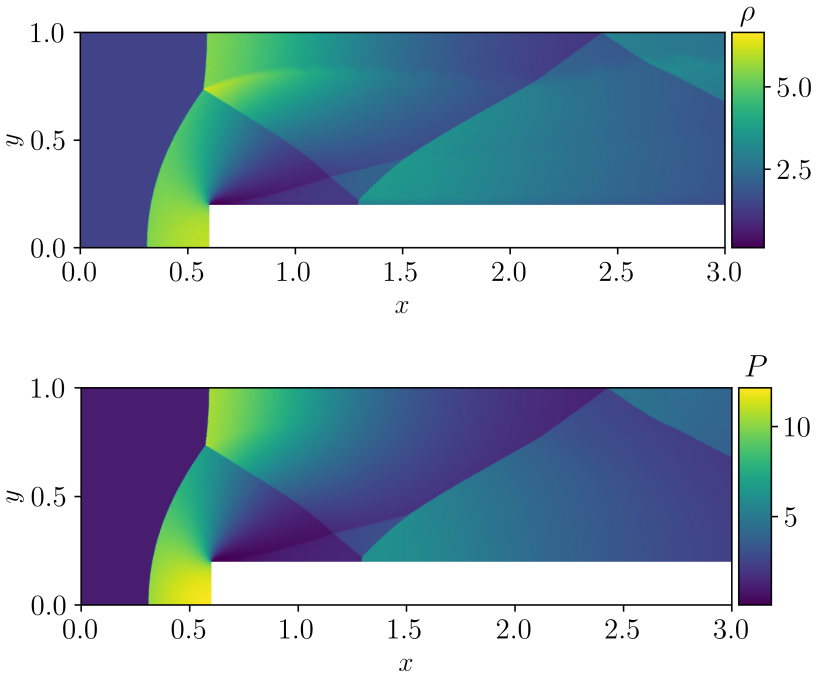
Summary. The manuscript presents JAX-FVM, an open-source finite volume solver for the 2D compressible Euler and Navier-Stokes equations on unstructured triangular meshes, implemented entirely in JAX. The solver features an entropy-conservative Tadmor/Ismail-Roe two-point flux with entropy-variable dissipation, second-order MUSCL reconstruction in primitive variables, and both explicit and matrix-free implicit time integrators whose Jacobian actions are obtained via automatic differentiation. The paper describes the governing equations, discretisation, software architecture, and presents a Mach 3 forward-facing step example. The combination of unstructured-mesh compressible FVM with end-to-end differentiability addresses a genuine gap in the differentiable CFD ecosystem.
Significance. The paper ships a publicly available, reproducible code repository (https://github.com/guigzair/jax_fvm), which is a significant strength for a software-description paper. The use of forward-mode AD (jax.jvp) to compute entropy-variable Jacobian actions in the dissipation operator and in the matrix-free implicit solver is an elegant design choice that leverages differentiability internally, not just as a user-facing feature. The scope of verification cases listed (nineteen 2D Riemann configurations, double Mach reflection, Kelvin-Helmholtz, Taylor-Green, isentropic vortex problems) is broad. However, the paper presents only one qualitative result (Figure 1) and no quantitative verification, which substantially limits the ability to assess whether the implemented scheme achieves its stated properties.
major comments (2)
- §2, point 2; §4.3–4.4: The entropy-stability claim is not established for the second-order scheme as implemented. The Ismail-Roe two-point flux (§4.4, Eq. 9) is entropy-conservative when evaluated on cell-averaged states. However, the second-order scheme reconstructs primitive variables (ρ, u, v, p) via MUSCL (§4.3, Eq. 7), and the flux in Eq. 9 is evaluated at these reconstructed left/right face states. The entropy-conservation property of the Ismail-Roe flux does not automatically extend to reconstructed states; preserving entropy stability at second order generally requires reconstruction in entropy variables (cf. Fisher & Carpenter 2013; Ranocha 2018) or an equivalent comparison principle. The paper does not address this gap: it neither proves that primitive-variable MUSCL preserves the discrete entropy inequality nor presents quantitative entropy diagnostics. Since entropy stability
- §9: The only verification shown is the Mach 3 forward-facing step (Figure 1), presented qualitatively. No quantitative convergence study, error analysis, or entropy conservation/stability diagnostic is provided, despite §7 mentioning a suite of diagnostics (total entropy, kinetic energy, enstrophy). For a paper whose central claims include both entropy stability and second-order accuracy, at least one quantitative verification — e.g., a grid convergence study on a smooth problem, or a time history of total entropy on a shock problem — is needed to substantiate the central claims.
minor comments (7)
- §4.4, Eq. (9): The definition of λ_max = c/M + |u·n| is unusual. Typically the spectral radius is |u·n| + c (where c is the sound speed). If c is already non-dimensionalised by the reference Mach number, this should be clarified; otherwise the dissipation scaling may be incorrect.
- §4.3: The viscous flux gradient formula is presented without an equation number and the notation is difficult to parse (the bar over ∇w_ij is not clearly distinguished from the face-averaged quantity). Consider assigning an equation number and clarifying the notation.
- §6: The SDIRK2 coefficient is written as 'x = 1 − 1/√2'; the variable name 'x' is unconventional for a Butcher tableau coefficient. Consider using γ or α.
- §7: The diagnostics suite (total entropy, kinetic energy, enstrophy, palinstrophy, vorticity, Mach number) is mentioned but no results from any of these are shown in the paper. Including at least one diagnostic plot would strengthen the verification.
- §8, Listing 1: The time-step loop recompiles the JIT function on every iteration because the static mesh argument is passed as a positional argument to jax.jit inside the loop. This is likely a performance issue; the compiled function should be created once outside the loop.
- §1: The phrase 'hostile to the SIMD/SIMT execution model' is informal; consider 'irregular memory access patterns complicate efficient vectorisation on accelerators'.
- References: Fisher & Carpenter (2013) and Ranocha (2018) are relevant to the entropy-variable reconstruction question and should be cited in the context of §4.3–4.4.
Simulated Author's Rebuttal
We thank the referee for a careful and constructive report. Both major comments identify genuine gaps in the current manuscript that we will address in revision. On the entropy-stability claim at second order, the referee is correct that primitive-variable MUSCL reconstruction does not automatically preserve the discrete entropy inequality established by the Ismail-Roe flux at first order; we will revise the manuscript to state precisely what is and is not proven, add the relevant literature, and include quantitative entropy diagnostics. On verification, we agree that a single qualitative figure is insufficient to substantiate the paper's central claims; we will add quantitative results including a grid convergence study and entropy time histories.
read point-by-point responses
-
Referee: §2, point 2; §4.3–4.4: The entropy-stability claim is not established for the second-order scheme as implemented. The Ismail-Roe two-point flux is entropy-conservative when evaluated on cell-averaged states, but the second-order scheme reconstructs primitive variables via MUSCL and evaluates the flux at reconstructed left/right face states. The entropy-conservation property does not automatically extend to reconstructed states; preserving entropy stability at second order generally requires reconstruction in entropy variables (Fisher & Carpenter 2013; Ranocha 2018) or an equivalent comparison principle. The paper neither proves that primitive-variable MUSCL preserves the discrete entropy inequality nor presents quantitative entropy diagnostics.
Authors: The referee is correct on the substance. The entropy-conservation property of the Ismail-Roe two-point flux is established for cell-averaged states; it does not automatically extend to second-order MUSCL reconstruction in primitive variables. We will make the following changes. (1) We will revise the entropy-stability claim throughout the manuscript to distinguish clearly between the first-order scheme (for which the semi-discrete entropy inequality follows from the Tadmor/Ismail-Roe theory and entropy-variable dissipation) and the second-order scheme (for which we do not currently have a proof). (2) We will add a discussion of the gap, citing Fisher & Carpenter (2013) and Ranocha (2018), and noting that entropy-variable reconstruction or an equivalent comparison principle would be needed to extend the proof. (3) We will add quantitative entropy diagnostics — specifically, time histories of total entropy (sum of eta_i * |C_i|) for shock-containing problems — so that the reader can assess the sign and magnitude of entropy production empirically. We will not claim that the second-order scheme is provably entropy-stable; the revised text will state that the first-order baseline is entropy-stable and that the second-order extension is entropy-stable in practice as verified by diagnostics, but not formally proven. revision: yes
-
Referee: §9: The only verification shown is the Mach 3 forward-facing step (Figure 1), presented qualitatively. No quantitative convergence study, error analysis, or entropy conservation/stability diagnostic is provided, despite §7 mentioning a suite of diagnostics. For a paper whose central claims include both entropy stability and second-order accuracy, at least one quantitative verification is needed.
Authors: We agree. The revised manuscript will include: (1) a grid convergence study on a smooth problem (the isentropic vortex), reporting L1 and L2 errors and observed convergence rates for both first- and second-order schemes on a sequence of refined unstructured meshes; (2) time histories of total entropy for the forward-facing step and at least one 2D Riemann configuration, showing that entropy is non-increasing (with dissipation) or conserved (without dissipation) as appropriate; and (3) for the Taylor-Green vortex, time histories of kinetic energy and enstrophy. These will be presented as new figures with quantitative data. We will also retain the qualitative forward-facing step result as a shock-capturing demonstration. revision: yes
Circularity Check
No circularity found; derivation chain rests on external citations and is independently verifiable via code
full rationale
This is a software/methods paper, not a derivation paper, and its central claims are independently verifiable through the open code repository. The entropy-stability claim (§2 point 2, §4.4 Eq. 9) rests on external citations: Tadmor (1987, 2003) for the entropy-conservative flux framework and Ismail and Roe (2009) for the specific affordable flux form. The dissipation term in Eq. 9 uses entropy-variable jumps whose Jacobian action is computed by AD (jax.jvp) — this is a computational technique, not a circular definition. The two self-citations (de Romémont et al., 2025, 2026) appear only in the introduction as examples of data-driven discretisation work and are not load-bearing for any claim of JAX-FVM's properties. No parameter is fitted and then 'predicted.' No uniqueness theorem from the authors is invoked. The skeptic's concern about whether second-order MUSCL in primitive variables preserves the discrete entropy inequality is a correctness risk, not a circularity: the paper does not define its output in terms of its input, nor does it rename a fit as a prediction. The derivation chain (governing equations → semi-discrete FVM → MUSCL reconstruction → entropy-conservative flux + dissipation) follows standard, externally cited methodology without self-referential reduction.
Axiom & Free-Parameter Ledger
free parameters (3)
- alpha
- K
- CFL
axioms (3)
- standard math Tadmor's entropy-conservative flux theory
- standard math Ismail-Roe affordable entropy-consistent Euler flux
- standard math Venkatakrishnan limiter formulation
Cite this review
Pith. "Pith review of JAX-FVM: A differentiable, entropy-stable finite volume solver on unstructured meshes for compressible flows." pith.science (2026). https://pith.science/paper/KLNVSM6H
@misc{pith2026260707385,
  author       = {Pith},
  title        = {Pith review of: JAX-FVM: A differentiable, entropy-stable finite volume solver on unstructured meshes for compressible flows},
  year         = {2026},
  howpublished = {\url{https://pith.science/paper/KLNVSM6H}},
  note         = {Machine review of arXiv:2607.07385}
}
read the original abstract
We present JAX-FVM, an open-source, fully differentiable finite volume method (FVM) for the two-dimensional compressible Euler and Navier-Stokes equations on unstructured triangular meshes. The solver is written entirely in JAX, so that every operation : mesh connectivity, flux evaluation, slope limiting, and time integration is just-in-time compiled, vectorised, and end-to-end differentiable through automatic differentiation (AD), and runs transparently on CPU or GPU. On the numerical side, JAX-FVM is built around an entropy-conservative Tadmor/Ismail-Roe two-point flux supplemented with entropy-variable Rusanov or Roe dissipation, second-order MUSCL reconstruction of primitive variables with least-squares gradients and Venkatakrishnan limiting, and a family of explicit (RK2-4) and matrix-free implicit (Newton, SDIRK2) time integrators whose Jacobian actions are obtained by AD. The combination of an unstructured-mesh compressible FVM with end-to-end differentiability fills a gap left by existing differentiable CFD frameworks, which are almost exclusively restricted to structured grids or spectral discretisations. We describe the governing equations, the discretisation, the software architecture, and a set of standard verification cases. The code is openly available at https://github.com/guigzair/jax_fvm.
Figures
Reference graph
Works this paper leans on
-
[1]
Bezanson, J., Edelman, A., Karpinski, S., Shah, V.B.,
doi:10.2514/6.1989-366. Bezanson, J., Edelman, A., Karpinski, S., Shah, V.B.,
-
[2]
Julia: A fresh approach to numerical computing. SIAM Review 59, 65–98. doi:10.1137/141000671. Bezgin, D.A., Buhendwa, A.B., Adams, N.A.,
-
[3]
Computer Physics Communications 282, 108527
JAX-Fluids: A fully-differentiable high-order computa- tional fluid dynamics solver for compressible two-phase flows. Computer Physics Communications 282, 108527. doi:10.1016/j.cpc.2022.108527. Bradbury, J., Frostig, R., Hawkins, P., Johnson, M.J., Leary, C., Maclaurin, D., Necula, G., Paszke, A., Van- derPlas, J., Wanderman-Milne, S., Zhang, Q.,
-
[4]
Annual Review of Fluid Mechanics 52, 477–508
Machine learning for fluid mechanics. Annual Review of Fluid Mechanics 52, 477–508. doi:10.1146/annurev-fluid-010719-060214. Du, P., Li, Y., Xu, M., Wang, J.X.,
-
[5]
arXiv preprint arXiv:2603.15920
Difvm: A vectorized graph-based finite volume solver for differentiable cfd on unstructured meshes. arXiv preprint arXiv:2603.15920 . Duraisamy, K., Iaccarino, G., Xiao, H.,
-
[6]
SU2: An open-source suite for multiphysics simulation and design. AIAA Journal 54, 828–846. doi:10.2514/1.J053813. Fan, X., Liu, X.Y., Wang, M., Wang, J.X.,
-
[7]
Computer Methods in Applied Mechanics and Engineering 448, 118455
Diff-FlowFSI: A GPU-optimized differentiable CFD platform for high-fidelity turbulence and FSI simulations. Computer Methods in Applied Mechanics and Engineering 448, 118455. doi:10.1016/j.cma.2025.118455. Fan, X., Wang, J.X.,
-
[8]
Journal of Computational Physics 496, 112584
Differentiable hybrid neural modeling for fluid-structure interaction. Journal of Computational Physics 496, 112584. doi:10.1016/j.jcp.2023.112584. Franz, A., Wei, H., Guastoni, L., Thuerey, N.,
-
[9]
arXiv preprint arXiv:2505.16992 doi:10.48550/arXiv.2505.16992
PICT – a differentiable, GPU-accelerated multi-block PISO solver for simulation-coupled learning tasks in fluid dynamics. arXiv preprint arXiv:2505.16992 doi:10.48550/arXiv.2505.16992. Holl, P., Koltun, V., Thuerey, N.,
-
[10]
Journal of Computational Physics 228, 5410–5436
Affordable, entropy-consistent Euler flux functions II: Entropy production at shocks. Journal of Computational Physics 228, 5410–5436. doi:10.1016/j.jcp.2009.04.021. 9 Karniadakis, G.E., Kevrekidis, I.G., Lu, L., Perdikaris, P., Wang, S., Yang, L.,
-
[11]
Kevrekidis, Lu Lu, Paris Perdikaris, Sifan Wang, and Liu Yang
Physics-informed machine learning. Nature Reviews Physics 3, 422–440. doi:10.1038/s42254-021-00314-5. Kochkov, D., Smith, J.A., Alieva, A., Wang, Q., Brenner, M.P., Hoyer, S.,
-
[12]
Proceedings of the National Academy of Sciences 118, e2101784118
Machine learning–accelerated computational fluid dynamics. Proceedings of the National Academy of Sciences 118, e2101784118. doi:10.1073/pnas.2101784118. Lax, P.D., Liu, X.D.,
-
[13]
SIAM Journal on Scientific Computing 19, 319–340
Solution of two-dimensional Riemann problems of gas dynamics by positive schemes. SIAM Journal on Scientific Computing 19, 319–340. doi:10.1137/S1064827595291819. List, B., Chen, L.W., Thuerey, N.,
-
[14]
Journal of Fluid Mechanics 949, A25
Learned turbulence modelling with differentiable fluid solvers: physics-based loss functions and optimisation horizons. Journal of Fluid Mechanics 949, A25. doi:10.1017/ jfm.2022.738. Mitusch, S., Funke, S., Dokken, J.,
work page 2022
-
[15]
Journal of Open Source Software 4,
dolfin-adjoint 2018.1: automated adjoints for FEniCS and Firedrake. Journal of Open Source Software 4,
work page 2018
-
[16]
Pant, S., Corsini, C., Baker, C., Hsia, T.Y., Pennati, G., Vignon-Clementel, I.E.,
doi:10.21105/joss.01292. Pant, S., Corsini, C., Baker, C., Hsia, T.Y., Pennati, G., Vignon-Clementel, I.E.,
-
[17]
Journal of The Royal Society Interface 14, 20160513
Inverse problems in reduced order models of cardiovascular haemodynamics: aspects of data assimilation and heart rate variability. Journal of The Royal Society Interface 14, 20160513. doi:10.1098/rsif.2016.0513. Paszke, A., Gross, S., Massa, F., Lerer, A., Bradbury, J., Chanan, G., Killeen, T., Lin, Z., Gimelshein, N., Antiga, L., et al.,
-
[18]
Journal of Computational Physics 43, 357–372
Approximate Riemann solvers, parameter vectors, and difference schemes. Journal of Computational Physics 43, 357–372. doi:10.1016/0021-9991(81)90128-5. de Romémont, G., Renac, F., Chinesta, F., Nunez, J., Gueyffier, D.,
-
[19]
Data-Driven Adaptive Gradient Recovery for Unstructured Finite Volume Computations
Data-driven adaptive gradient recovery for unstructured finite volume computations. arXiv preprint arXiv:2507.16571 . de Romémont, G., Renac, F., Nunez, J., Gueyffier, D., Chinesta, F.,
work page internal anchor Pith review Pith/arXiv arXiv
-
[20]
arXiv preprint arXiv:2406.09699 doi:10.48550/arXiv.2406.09699
Differentiable programming for differential equations: A review. arXiv preprint arXiv:2406.09699 doi:10.48550/arXiv.2406.09699. Shewchuk, J.R.,
-
[21]
The numerical viscosity of entropy stable schemes for systems of conservation laws. I. Mathematics of Computation 49, 91–103. doi:10.1090/S0025-5718-1987-0890255-3. Tadmor, E.,
-
[22]
Entropy stability theory for difference approximations of nonlinear conservation laws and related time-dependent problems. Acta Numerica 12, 451–512. doi:10.1017/S0962492902000156. Um, K., Brand, R., Fei, Y.R., Holl, P., Thuerey, N.,
-
[23]
doi:10.2514/6.1993-880. 10 Weymouth, G.D., Font, B.,
-
[24]
WaterLily.jl: A differentiable and backend-agnostic Julia solver to simulate incompressible viscous flow and dynamic bodies. arXiv preprint arXiv:2407.16032 doi:10.48550/arXiv. 2407.16032. Woodward, P., Colella, P.,
work page internal anchor Pith review Pith/arXiv arXiv doi:10.48550/arxiv
-
[25]
Journal of Computational Physics 54, 115–173
The numerical simulation of two-dimensional fluid flow with strong shocks. Journal of Computational Physics 54, 115–173. doi:10.1016/0021-9991(84)90142-6. Wu, J., Xiao, H., Sun, R., Wang, Q.,
-
[26]
Journal of Fluid Mechanics 869, 553–586
Reynolds-averaged Navier–Stokes equations with explicit data-driven Reynolds stress closure can be ill-conditioned. Journal of Fluid Mechanics 869, 553–586. doi:10.1017/jfm.2019.205. 11
This paper was first reviewed by glm-5.2 on July 9, 2026.
discussion (0)
Sign in with ORCID, Apple, or X to comment. Anyone can read and Pith papers without signing in.