REVIEW 3 major objections 6 minor 14 references
Modeling Failure Dynamics in Time-Constrained Authentication Systems: Evidence of a Success Cliff in USSD Workflows
T0 review · 3 major / 6 minor · reviewed 2026-07-09 · glm-5.2
Pith's one-line read SMS OTP triggers Success Cliff in USSD sessions
desk verdict Success Cliff framing is novel but cliff detection is structurally guaranteed by experimental design read the letter →
The pith
A machine-rendered reading of the paper's core claim, the machinery that carries it, and where it could break.
The reading
What carries the argument
The formal Success Cliff definition (Eq. 12): Q = min{C : Δ(C) ≥ δ and Γ(C) ≥ γ}, where Δ(C) is the consecutive drop in success rate between complexity levels and Γ(C) is the acceleration of that drop. The session time model (Eq. 1–2): t_k = U_k + R_k + D_k + H_k, where H_k is the blocking delay that is nonzero only for SMS OTP steps. The blocking delay model (Eq. 4–5): H_k = W_SMS if step k is an SMS OTP step, 0 otherwise, with W_SMS ~ U(5,30) seconds. The complexity metric (Eq. 6): C_j = E[U_j] / E[U_baseline], anchoring all step times to a 4-digit PIN baseline calibrated against empirical measurements from 34-participant field studies.
What would settle it
Run the same simulation with an empirically measured SMS OTP delivery distribution from a real deployment context. If the median delivery time is under ~5 seconds or the distribution is right-skewed with a thin tail rather than uniform, the blocking delay may not consume enough of the per-step budget to trigger user response timeout as a secondary failure mode, and the cliff would not materialize. The cliff's existence is structurally forced by the specific U(5,30) assumption.
Extended reading notes
Core claim
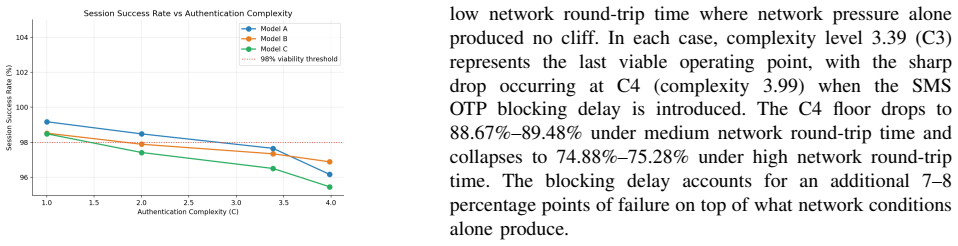
The Success Cliff is detected exclusively at the C3-to-C4 transition—where SMS OTP blocking delay is introduced—and this detection is perfectly robust across all three abandonment models, all three error-rate regimes (baseline, low, high), and all four gamma detection thresholds (12 of 12 combinations), with a cliff-location range of 0.000. Without blocking delay, no cliff is detected under baseline conditions (0 of 12 gamma combinations, 0 of 9 error combinations except the artificially inflated high-error regime). The blocking delay creates a dual failure pathway: cumulative session timeout through total time exhaustion, and per-step user response timeout through compression of the per-30s
Load-bearing premise
The SMS OTP delivery delay is modeled as uniformly distributed between 5 and 30 seconds (U(5,30)), reflecting what the authors describe as normal network conditions. This distribution is not empirically validated; the authors acknowledge field measurement is needed. The entire cliff phenomenon depends on this delay consuming enough of the per-step time budget to trigger concurrent timeout mechanisms. If real-world SMS delivery is faster—say, a median of 3–5 seconds ratherthan
Signed reviews
Editorial analysis
A structured set of objections, weighed in public.
Referee Report
Summary. This paper models failure dynamics in time-constrained USSD authentication systems, proposing a formal definition of a 'Success Cliff'—a sharp, non-linear collapse in session success rate. Through simulation, the authors vary authentication complexity, network round-trip time, and the presence of out-of-band blocking delay (SMS OTP). The central finding is that the cliff emerges specifically when stochastic blocking delay interacts with a fixed session time budget, rather than from authentication complexity or network latency alone. The experimental design is methodologically careful, with controlled one-factor-at-a-time variation and sensitivity analysis across error regimes and gamma thresholds.
Significance. The paper addresses a practically important problem for financial inclusion in USSD-based systems. Its strengths include a transparent simulation framework with clearly stated parameters anchored to documented operator thresholds and empirical KLM values, a formal and falsifiable definition of the Success Cliff (Eqs. 10–12), and a well-structured sensitivity analysis. The distinction between gradual degradation and non-linear collapse, and the identification of blocking delay as the necessary condition for the latter, is a useful architectural insight for authentication designers. However, the significance of the central claim is substantially undermined by a structural confound in the experimental design, detailed below.
major comments (3)
- The experimental design creates a structural near-tautology that undermines the central claim. Blocking delay (H_k > 0) is introduced exclusively at complexity level C4 (Table V). Since the Success Cliff definition (Eq. 12) identifies the complexity level with the largest consecutive drop Delta(C) and positive acceleration Gamma(C), and since blocking delay is the single largest time perturbation in the system (5–30 seconds vs. sub-second to few-second components), the cliff will always be detected at the C3-to-C4 transition by construction. The sensitivity analysis (Section VIII-E) confirms robustness across error rates and gamma thresholds, but this robustness is trivially expected: no variation in error probabilities or detection thresholds can move the cliff away from the only level where blocking delay is introduced. The Q range of 0.000 across all 21 combinations is not evidence of
- Section III-F, Eq. (5): The SMS OTP delivery delay model W_SMS ~ U(5,30) is the load-bearing premise for the cliff phenomenon. The entire argument hinges on this blocking delay consuming enough of the per-step time budget to trigger concurrent timeout mechanisms. However, this distribution is stated as reflecting 'normal network conditions' but is not empirically validated. If real-world SMS delivery is faster (e.g., median 3–5 seconds rather than uniform 5–30), the cliff may not materialize at the severity reported. The authors acknowledge in Section IX-D that field measurement is needed, but the paper's framing presents the cliff as a robust structural finding without adequately foregrounding this dependency.
- Section VIII-D: The paper claims that failure rates under blocking delay 'exceed the sum of their independent contributions,' implying super-additive interaction. However, because blocking delay is introduced only at C4, the comparison is between a configuration without blocking delay and one with it—this is a single design point, not a continuous manipulation. To distinguish a true non-linear collapse from a proportional effect of adding delay, the authors must vary the blocking delay magnitude continuously (e.g., W_SMS ~ U(a, b) with varying a, b) and show that success rate collapses sharply at a critical delay threshold rather than degrading smoothly. The current design cannot distinguish between these alternatives.
minor comments (6)
- Table I: The variable H_k is described as nonzero only for steps requiring delivery from a subsystem external to the active USSD session. It would help to explicitly note in the table caption or the table itself that H_k = 0 for C1–C3 and H_k > 0 only for C4, as this is central to interpreting the results.
- Section VIII-D mentions 'complexity level 3.39 (C3)' and 'complexity 3.99 (C4).' These values are not clearly defined in the text or tables. Adding a column to Table V showing the computed complexity value C for each configuration would improve clarity.
- Section VIII-D, paragraph on failure composition: the text notes that metrics sum to approximately 95% rather than 100%, leaving a residual attributable to user response timeout. It would be clearer to include user response timeout as an explicit metric in the evaluation metrics list (Section VII) and report it alongside the other timeout categories.
- Section V-A: The KLM adaptation mentions standard operator values (M=1.35s, K=0.28s, H=0.40s) and states these are 'adapted to the feature phone numeric keypad context,' but the specific adaptation methodology is not described. Clarifying what was changed from standard KLM and why would strengthen reproducibility.
- The paper uses 'Success Cliff' as a proper noun throughout. On first use (Abstract and Section I), a brief parenthetical noting that this is a term coined by the authors would be appropriate.
- Section IX-C: The claim that SMS OTP-based step-up authentication is 'not yet widely deployed for feature phone users' is important for contextualizing the findings. A citation or brief evidence for this claim would strengthen this point.
Simulated Author's Rebuttal
We thank the referee for a careful and substantive review. The referee identifies three interconnected concerns about our experimental design: (1) a structural confound wherein blocking delay is introduced only at C4, making cliff detection at the C3-to-C4 transition near-tautological; (2) insufficient empirical grounding for the SMS OTP delay distribution; and (3) the absence of continuous variation in blocking delay magnitude, which prevents distinguishing non-linear collapse from proportional degradation. We find these concerns largely valid and outline revisions below.
read point-by-point responses
-
Referee: The experimental design creates a structural near-tautology that undermines the central claim. Blocking delay (H_k > 0) is introduced exclusively at complexity level C4 (Table V). Since the Success Cliff definition (Eq. 12) identifies the complexity level with the largest consecutive drop Delta(C) and positive acceleration Gamma(C), and since blocking delay is the single largest time perturbation in the system (5–30 seconds vs. sub-second to few-second components), the cliff will always be detected at the C3-to-C4 transition by construction. The sensitivity analysis (Section VIII-E) confirms robustness across error rates and gamma thresholds, but this robustness is trivially expected: no variation in error probabilities or detection thresholds can move the cliff away from the only level where blocking delay is introduced. The Q range of 0.000 across all 21 combinations is not evidence of
Authors: The referee is correct that our experimental design introduces blocking delay only at C4, and that this creates a structural confound: the sensitivity analysis over error rates and gamma thresholds cannot, by construction, move the cliff away from the C3-to-C4 transition. We concede this point. The Q range of 0.000 across all 21 combinations demonstrates that the cliff detection is stable under parameter perturbation, but as the referee notes, this stability is expected given that blocking delay is introduced at exactly one complexity level. We over-claimed in framing this robustness as evidence of a structural property of the authentication flow; it is more accurately described as evidence that the cliff detection is not sensitive to secondary parameters, conditional on blocking delay being present at C4. We will revise the manuscript to accurately characterize what the sensitivity analysis does and does not demonstrate, and remove language that implies the robustness analysis validates the cliff as a general structural finding rather than a consequence of the experimental design. The genuine contribution of our current experiments is the contrast between the with-blocking-delay and without-blocking-delay conditions at the same complexity levels, which shows that the same C4 configuration produces gradual degradation without blocking delay and abrupt collapse with it. However, we agree this contrast alone is insufficient to establish non-linear collapse without the continuous manipulation described in our response to the third comment. revision: yes
-
Referee: Section III-F, Eq. (5): The SMS OTP delivery delay model W_SMS ~ U(5,30) is the load-bearing premise for the cliff phenomenon. The entire argument hinges on this blocking delay consuming enough of the per-step time budget to trigger concurrent timeout mechanisms. However, this distribution is stated as reflecting 'normal network conditions' but is not empirically validated. If real-world SMS delivery is faster (e.g., median 3–5 seconds rather than uniform 5–30), the cliff may not materialize at the severity reported. The authors acknowledge in Section IX-D that field measurement is needed, but the paper's framing presents the cliff as a robust structural finding without adequately foregrounding this dependency.
Authors: The referee is correct that W_SMS ~ U(5,30) is a load-bearing parameter and that our paper does not adequately foreground the dependency of the cliff phenomenon on this distribution. We chose U(5,30) as a conservative representation of SMS delivery latency under normal conditions, but we lack direct empirical validation for this range in USSD deployment contexts. The referee's concern that faster real-world SMS delivery (e.g., median 3–5 seconds) could attenuate or eliminate the cliff is legitimate and cannot be dismissed. We will address this in two ways. First, we will add a sensitivity analysis that varies the W_SMS distribution parameters systematically (e.g., W_SMS ~ U(a, b) with lower bounds from 0 to 5 seconds and upper bounds from 10 to 30 seconds), which directly addresses both this comment and the third comment. This will show whether the cliff emerges at a critical delay threshold or degrades smoothly as the referee suggests. Second, we will revise the manuscript framing to explicitly state that the severity of the cliff is contingent on the SMS delay distribution and that empirical validation of this distribution is a prerequisite for applying the finding to specific deployments. We will move this caveat from the Limitations section to the abstract and introduction so it is foregrounded rather than deferred. revision: yes
-
Referee: Section VIII-D: The paper claims that failure rates under blocking delay 'exceed the sum of their independent contributions,' implying super-additive interaction. However, because blocking delay is introduced only at C4, the comparison is between a configuration without blocking delay and one with it—this is a single design point, not a continuous manipulation. To distinguish a true non-linear collapse from a proportional effect of adding delay, the authors must vary the blocking delay magnitude continuously (e.g., W_SMS ~ U(a, b) with varying a, b) and show that success rate collapses sharply at a critical delay threshold rather than degrading smoothly. The current design cannot distinguish between these alternatives.
Authors: We agree. The current binary manipulation (blocking delay present vs. absent at C4) cannot distinguish between a true non-linear collapse at a critical delay threshold and a smooth proportional degradation. Our claim of super-additive interaction is not supported by the experimental design as described. We will add a new experiment that varies W_SMS continuously—for example, W_SMS ~ U(0, b) with b swept from 0 to 30 seconds in increments, holding complexity at C4 and network conditions fixed. This will allow us to plot session success rate as a function of blocking delay magnitude and determine whether there is a sharp transition (supporting the cliff characterization) or a smooth monotonic decline (supporting a proportional-effect interpretation). If the result is a smooth decline, we will revise the paper's central claim accordingly and reframe the contribution as identifying blocking delay as the dominant factor in session degradation rather than claiming a non-linear collapse. We will also remove or qualify the super-additive interaction claim until the continuous manipulation provides evidence for or against it. revision: yes
- The referee's observation that the sensitivity analysis robustness is trivially expected (Comment 1) is correct and cannot be refuted. We can reframe what the analysis demonstrates, but we cannot claim it provides independent evidence for the cliff as a structural property. The revised manuscript will acknowledge this limitation directly.
- The empirical validity of W_SMS ~ U(5,30) cannot be established without field measurement, which is beyond the scope of this revision. We can add sensitivity analysis on the distribution parameters and foreground the dependency, but we cannot resolve whether the cliff materializes at the severity reported under real-world SMS delivery conditions.
Circularity Check
Cliff location is structurally forced by experimental design, but the central claim (blocking delay as necessary condition) is tested via controlled comparison and has independent content
full rationale
The paper's formal Success Cliff definition (Eqs. 10–12) is general and not self-referential. The central claim—that blocking delay is the necessary condition for non-linear collapse—is tested through a controlled contrast: Experiment 1 (no blocking delay → no cliff detected) vs. Experiment 3 (with blocking delay → cliff detected). This contrast has genuine independent content. However, there is a structural near-tautology in the sensitivity analysis (Section VIII-E): since blocking delay (H_k > 0) is introduced exclusively at complexity level C4 (Table V, Eq. 4), and W_SMS ~ U(5,30) is by far the largest single time perturbation in the system, the cliff will always be detected at the C3→C4 transition regardless of error rate or γ threshold variations. The paper's claim of robustness across 21 parameter combinations (Q range = 0.000) is therefore trivially expected—no variation in error probabilities or detection thresholds can move the cliff away from the only level where blocking delay exists. The paper partially acknowledges this, stating the cliff is 'driven by the structural introduction of blocking delay rather than by parameter choices or detection thresholds.' This is a limitation of experimental design (the paper does not vary blocking delay magnitude continuously to test for a genuine threshold phenomenon), but it is not circularity in the strict sense: the formal definitions do not reduce to their inputs, no fitted parameters are renamed as predictions, and no self-citation chain is load-bearing. Reference [13] shares an author (Ndibwile) but is cited only for regulatory context, not as support for any derivation step. The score of 2 reflects the structural design issue in the sensitivity analysis without rising to the level where the central claim itself is forced by construction.
Assumptions & free parameters
free parameters (11)
- τ_s (session timeout) =
120s
- τ_u (user response timeout) =
30s
- τ_a (application timeout) =
15s
- W_SMS distribution =
U(5,30) seconds
- p_max (max abandonment prob) =
0.3
- a (Model A coefficient) =
0.3
- b (Model B coefficient) =
0.4
- c1, c2 (Model C coefficients) =
0.2, 0.3
- p_error (per step type) =
0.02–0.12
- δ (cliff drop threshold) =
0.02
- γ (cliff acceleration threshold) =
0.01–0.04 (swept)
assumptions (4)
- domain assumption KLM operator values (M=1.35s, K=0.28s, H=0.40s) are valid for feature phone USSD interaction
- domain assumption User response time, network RTT, and SMS delay are independent stochastic processes
- ad hoc to paper Abandonment probability is a function of elapsed time fraction and/or error count, bounded by p_max
- domain assumption The 4-digit PIN baseline interaction time from Panjwani and Cutrell [7] generalizes to the simulated USSD context
invented entities (1)
-
Success Cliff (Q)
Cite this review
Pith. "Pith review of Modeling Failure Dynamics in Time-Constrained Authentication Systems: Evidence of a Success Cliff in USSD Workflows." pith.science (2026). https://pith.science/paper/XD2QRRBT
@misc{pith2026260707650,
  author       = {Pith},
  title        = {Pith review of: Modeling Failure Dynamics in Time-Constrained Authentication Systems: Evidence of a Success Cliff in USSD Workflows},
  year         = {2026},
  howpublished = {\url{https://pith.science/paper/XD2QRRBT}},
  note         = {Machine review of arXiv:2607.07650}
}
read the original abstract
Time-constrained interactive systems such as USSD (Unstructured Supplementary Service Data)-based financial services operate under strict session limits and sequential user interaction. While stronger authentication mechanisms improve security, they also increase interaction complexity and time burden, potentially reducing transaction completion. In this work, we model the failure dynamics of such systems and investigate how authentication complexity interacts with user response time and network round-trip time to influence session success rate. We propose and implement a simulation-based framework to investigate these failure dynamics and formally define a non-linear failure phenomenon, termed the \textit{Success Cliff}, where session success rates sharply decline beyond a critical complexity threshold. Through controlled experiments, we quantify the trade-off between security and usability and identify conditions under which secure authentication workflows become operationally unreliable.
Figures


Figures from the paper (2 more)


Reference graph
Works this paper leans on
-
[1]
Exposed: Critical vulnerabilities in USSD banking authentication protocols,
Z. A. Lamoyero and O. Fajana, “Exposed: Critical vulnerabilities in USSD banking authentication protocols,” inProc. IEEE Int. Conf. Cyber Security and Resilience (CSR), Venice, Italy, Jul. 2023, pp. 275–280, doi: 10.1109/CSR57506.2023.10224933
-
[2]
Dynamic knowledge based authentication model for enhancing security of USSD banking transactions,
M. W. Njuguna, “Dynamic knowledge based authentication model for enhancing security of USSD banking transactions,” M.S. the- sis, Strathmore University, Nairobi, Kenya, 2020. [Online]. Available: http://hdl.handle.net/11071/12089
work page 2020
-
[3]
Using USSD-based mobile payment in context of low internet connection,
P. Dayang and A. Hamza, “Using USSD-based mobile payment in context of low internet connection,”Int. J. Wireless Com- mun. Mobile Comput., vol. 9, no. 1, pp. 1–6, Sep. 2021, doi: 10.11648/j.wcmc.20210901.11
-
[4]
A. Kinai, F. Otieno, N. Bore, and K. Weldemariam, “Multi- factor authentication for users of non-internet based applications of blockchain-based platforms,” inProc. IEEE Int. Conf. Blockchain (Blockchain), Rhodes Island, Greece, Nov. 2020, pp. 525–531, doi: 10.1109/Blockchain50366.2020.00076
-
[5]
S. K. Card, T. P. Moran, and A. Newell,The Psychology of Human- Computer Interaction. Hillsdale, NJ, USA: Lawrence Erlbaum Asso- ciates, 1983
work page 1983
-
[6]
Using the keystroke-level model to estimate execution times,
D. Kieras, “Using the keystroke-level model to estimate execution times,” Dept. Elect. Eng. Comput. Sci., Univ. Michigan, Ann Ar- bor, MI, USA, Tech. Rep. EECS-2001-53, 2001. [Online]. Available: http://www.eecs.umich.edu/ kieras/klm.html
work page 2001
-
[7]
Usably secure, low-cost authentication for mobile banking,
S. Panjwani and E. Cutrell, “Usably secure, low-cost authentication for mobile banking,” inProc. Sixth Symp. Usable Privacy and Se- curity (SOUPS), Redmond, W A, USA, Jul. 2010, pp. 1–12, doi: 10.1145/1837110.1837116
-
[8]
Security testing for USSD- and STK-based digital financial services applications,
ITU-T Focus Group on Digital Financial Services, “Security testing for USSD- and STK-based digital financial services applications,” Int. Telecommun. Union, Geneva, Switzerland, Tech. Rep., 2017. [Online]. Available: https://www.itu.int/pub/T-TUT-DFS
work page 2017
Show all 14 references
-
[9]
QoS and QoE aspects of digi- tal financial services,
J. Pomy and W. Balzer, “QoS and QoE aspects of digi- tal financial services,” ITU-T Focus Group on Digital Finan- cial Services, Int. Telecommun. Union, Geneva, Switzerland, Tech. Rep., May 2016. [Online]. Available: https://www.itu.int/en/ITU- T/focusgroups/dfs/Documents/09 2...
2016
-
[10]
Two-factor authentication scheme for mobile money: A review of threat models and countermeasures,
G. Ali, M. A. Dida, and A. E. Sam, “Two-factor authentication scheme for mobile money: A review of threat models and countermeasures,”Fu- ture Internet, vol. 12, no. 10, p. 160, Sep. 2020, doi: 10.3390/fi12100160
2020 doi
-
[11]
From disconnection to inclusion: Advancing financial services in Zambia through USSD technology,
P. Mwale et al., “From disconnection to inclusion: Advancing financial services in Zambia through USSD technology,”Int. J. Social Sci. Humanit. Manag. Res., vol. 4, no. 1, pp. 83–95, Jan. 2025. [Online]. Available: https://ijsshmr.com/v4i1/Doc/11.pdf
2025
-
[12]
Driving large-scale digital channel adoption through behavioral change, USSD innovation, and customer-centric strategies,
C. M. Okafor, V . C. Osuji, and O. F. Dako, “Driving large-scale digital channel adoption through behavioral change, USSD innovation, and customer-centric strategies,”Shodhshauryam Int. Sci. Refereed Res. J., vol. 5, no. 6, pp. 346–366, Nov. 2022, doi: 10.32628/SHISRRJ
2022 doi
-
[13]
Beyond SSO: Mobile money authentication for inclusive e-government in Sub-Saharan Africa,
O. Adewusi, W. S. Msagusa, J. P. Imanirumva, O. Obadofin, and J. D. Ndibwile, “Beyond SSO: Mobile money authentication for inclusive e-government in Sub-Saharan Africa,” Sep. 2025, arXiv: arXiv:2509.20592. doi: 10.48550/arXiv.2509.20592
2025 doi
-
[14]
Mitigat- ing SIM swap fraud in mobile money platforms in SSA: A zero trust identity and access management architecture,
P. Mutabazi, F. E. Ndalama, Y . Taenaka, and Y . Kadobayashi, “Mitigat- ing SIM swap fraud in mobile money platforms in SSA: A zero trust identity and access management architecture,” inProc. 8th Int. Conf. Inf. Commun. Technol. (ICOIACT), Yogyakarta, Indonesia: IEEE, Dec. 202...
2025 doi
Reviewed July 9, 2026 · model on record in the stance chip above.
Discussion (0). Continue with ORCID to comment.