REVIEW 3 major objections 5 minor 64 references
PGD-NO: A Neural Operator with Precomputed Geometry Decomposition for 3D Million-scale Physics Simulations
T0 review · 3 major / 5 minor · reviewed 2026-07-10 · grok-4.5
Pith's one-line read Precomputing geometry tokens lets a neural PDE solver train on meshes of tens of millions of nodes without exhausting single-GPU memory.
desk verdict Solid engineering fix for the single-node VRAM wall on million-scale 3D neural PDE solvers; competitive accuracy, real scaling, one load-bearing classical decomposition. read the letter →
The pith
A machine-rendered reading of the paper's core claim, the machinery that carries it, and where it could break.
The reading
What carries the argument
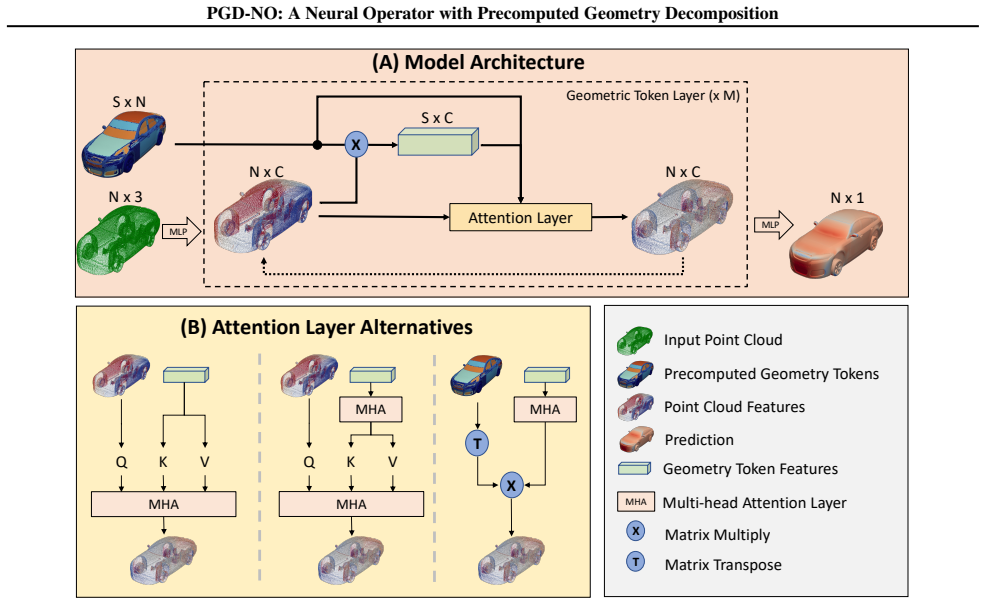
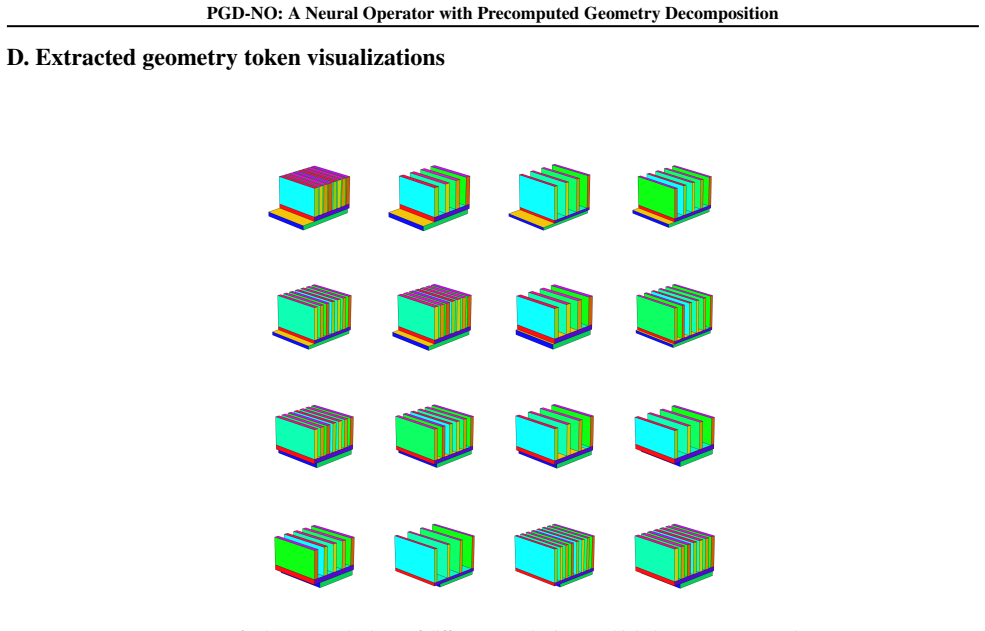
Precomputed Geometry Decomposition (Algorithm 1): a hierarchical graph partition driven by successive dihedral-angle thresholds that yields a sparse segmentation matrix S mapping mesh nodes onto a few dozen geometry tokens; those tokens are then cross-attended with query-point features inside stacked Geometric Token Layers.
What would settle it
Train PGD-NO and a strong baseline on a large library of deliberately smooth, organic geometries that contain almost no sharp dihedral edges; if the accuracy gap reverses or PGD-NO collapses while the baseline does not, the claim that precomputed tokens are universally sufficient is false.
Extended reading notes
Core claim
A non-learnable, iterative geometry decomposition that produces a sparse set of geometry tokens is already rich enough to let a simple multi-head attention decoder learn high-fidelity PDE solutions on free-form industrial meshes. Because token extraction is moved entirely offline, solution querying can be partitioned arbitrarily across devices, removing the single-node VRAM ceiling that has limited every previous neural operator.
Load-bearing premise
The fixed, hand-tuned sharp-edge hierarchy produces tokens that already capture every multi-scale geometric feature a free-form industrial shape needs; if it misses something, the decoder has no way to invent the missing information.
Editorial extensions
If this is right
- Meshes of 50–100 million nodes become routine training targets on a single high-memory GPU or a modest multi-GPU node.
- Surface-derived tokens alone can drive accurate external-flow volume predictions, simplifying the pipeline for CFD surrogates.
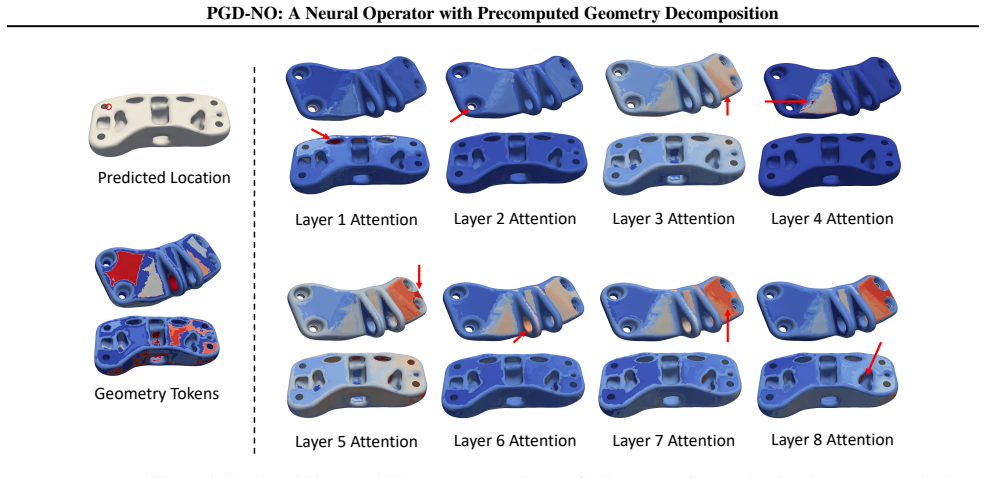
- Node-wise attention maps extracted from the Geometric Token Layers supply free, multi-scale design heuristics that highlight load paths and boundary-condition influence zones.
- Because encoding is deterministic and mesh-format agnostic, the same token set can serve as a common interface for foundation models trained across heterogeneous CAD and meshing sources.
Reading between the lines
- If the same decomposition is applied once to a multi-resolution CAD assembly, the resulting tokens could act as a shared latent vocabulary for transfer learning across entirely different physics (thermal, structural, fluid).
- Replacing the fixed angle thresholds with a cheap, once-per-geometry learned refinement of the merge radii would test whether the current accuracy plateau on organic shapes is an artifact of the non-learnable front-end.
- The linear memory profile suggests that real-time interactive design loops—where an engineer deforms a surface and immediately sees updated fields—become feasible even for full-vehicle meshes.
Signed reviews
Editorial analysis
A structured set of objections, weighed in public.
Referee Report
Summary. The paper proposes PGD-NO, a neural operator that extracts a fixed set of “geometry tokens” from a surface mesh via a deterministic iterative decomposition (dihedral-angle sharp-edge detection, hierarchical threshold decay, size filtering and hop-based merge; Algorithm 1 / §3.1) and then uses those tokens as a compact latent context for multi-head attention layers that query PDE solutions at arbitrary volume or surface points. By moving geometric encoding off the GPU and decoupling it from solution querying, the architecture claims linear memory scaling that supports meshes of 10–60 M (and theoretically ~100 M) nodes—scales at which Transolver++ and related operators exhaust single-node VRAM—while remaining competitive in L2 field error and engineering QoIs on five industrial 3D benchmarks (Heat Sink, JEB, DrivAerNet++, Aircraft, and a new CFD-VOL set). Three decoder variants, depth/token ablations, memory/time tables, error maps and attention-based interpretability visualizations are provided.
Significance. If the central claim holds, the work removes a practical single-node memory ceiling that currently limits neural PDE solvers on industrial free-form geometries, enabling high-fidelity surrogate modeling on meshes that previously required multi-node communication or aggressive down-sampling. The deterministic token construction, public code/datasets, direct comparison against strong recent baselines (Transolver++, GINO, GNOT, AB-UPT, etc.), and attention-based nodal importance maps constitute concrete engineering and scientific contributions. The approach is therefore of clear interest to the neural-operator and computational-engineering communities, provided the expressivity of the fixed geometric tokens is adequately characterized.
major comments (3)
- §3.1 / Algorithm 1 and the free-parameter list (Θ, α, ρ, h, M=128): the load-bearing premise that a non-learnable dihedral-angle hierarchical partition yields sufficiently expressive tokens for arbitrary free-form industrial shapes is only partially supported. Table 1 shows only modest gains on the organic JEB set; Table 4 shows large sensitivity to token count (65.4 % → 35.4 % as M rises from 32 to 256); the Limitations paragraph itself notes that smooth topologies remain harder. A systematic sensitivity study (or a simple adaptive/learnable refinement of the tokens) is needed before the accuracy and scalability claims can be regarded as robust across the full range of industrial geometries the abstract targets.
- Table 2 (60 M-node CFD-VOL results): the larger meshes are obtained by random spatial sampling and 3D interpolation of the original ~12 M mesh. While this is a legitimate stress test of memory scaling, it does not constitute an independent high-fidelity ground-truth dataset; residual interpolation error could inflate or mask true model error. The manuscript should either (a) quantify the interpolation error floor or (b) clearly label the 60 M experiment as a memory-scaling demonstration rather than a full accuracy claim at that resolution.
- Experimental reporting (Tables 1–5, §4): all accuracy numbers are single-run point estimates with no error bars, multiple random seeds, or statistical tests. Given that several of the reported margins over Transolver++ are modest (e.g., Aircraft field 4.77 vs 4.98, CFD-VOL 12.2 vs 15.8), the absence of variability estimates weakens the claim of consistent superiority. At minimum, standard deviations over 3–5 seeds (or bootstrap intervals) for the primary L2 and QoI metrics should be supplied.
minor comments (5)
- Appendix A complexity analysis: the claimed O(4Nv) vs O(8Nv) reduction is plausible but would be clearer with an explicit operation count table matching the three decoder variants of Figure 2.
- Figure 1 (right) and Table 5: peak-memory numbers are given for a 4-way GH200; stating the per-GPU footprint and whether model-parallel or data-parallel partitioning was used would improve reproducibility.
- Notation: the segmentation matrix is denoted both S and M in Algorithm 1 and §3.2; a single consistent symbol would avoid confusion.
- Related-work §2.2: classical mesh-segmentation literature is cited, yet the concrete relationship between the proposed dihedral-angle procedure and existing approximate-convex-decomposition or spectral methods is left implicit; a short paragraph situating Algorithm 1 would help.
- Typos / polish: “processable mesh resolution”, “single node bottleneck” (hyphenation), and a few missing articles appear in the abstract and introduction; a light copy-edit pass is warranted.
Circularity Check
No significant circularity: geometry tokens are deterministic mesh functions independent of PDE labels, and accuracy is measured on held-out industrial benchmarks.
full rationale
The paper's central claim is architectural: a deterministic hierarchical decomposition (Algorithm 1, dihedral-angle thresholds, merge hops) produces fixed geometry tokens that are then fed to a learnable attention decoder. The tokens themselves are never fitted to the PDE solution fields; they are pure functions of mesh connectivity and face normals. Predictive accuracy is evaluated by L2 relative error and QoIs on held-out test splits of five external or self-generated industrial datasets (Table 1, Table 2). Memory-complexity arguments (Appendix A) follow directly from the surface/volume decoupling once tokens exist and do not rely on circular definitions. Minor self-citations (Heat Sink dataset DOI, GANO) supply data or prior context but are not load-bearing uniqueness theorems that force the reported results. Consequently the derivation chain is self-contained against external benchmarks; the only residual risk is the empirical adequacy of the fixed token set (already flagged as the weakest assumption), which is an ordinary modeling assumption rather than circularity.
Assumptions & free parameters
free parameters (4)
- dihedral angle thresholds Θ and decay factor α
- min graph size ratio ρ and merge hop radius h
- number of retained tokens M (default 128)
- model depth M, hidden dimension, attention heads
assumptions (4)
- ad hoc to paper A fixed, non-learnable hierarchical partition of the surface mesh based on dihedral angles yields tokens that are sufficiently expressive for the target PDE solutions.
- domain assumption Surface-derived tokens alone are adequate for both surface and volumetric field prediction (including external fluid domains).
- domain assumption Random spatial sampling of volume points during training yields unbiased enough gradients for the operator learning task.
- standard math Standard multi-head attention and MLP layers can map the fixed token features to accurate nodal PDE solutions.
invented entities (1)
-
geometry tokens (via iterative sharp-edge decomposition)
Cite this review
Pith. "Pith review of PGD-NO: A Neural Operator with Precomputed Geometry Decomposition for 3D Million-scale Physics Simulations." pith.science (2026). https://pith.science/paper/IU3CILMI
@misc{pith2026260708025,
  author       = {Pith},
  title        = {Pith review of: PGD-NO: A Neural Operator with Precomputed Geometry Decomposition for 3D Million-scale Physics Simulations},
  year         = {2026},
  howpublished = {\url{https://pith.science/paper/IU3CILMI}},
  note         = {Machine review of arXiv:2607.08025}
}
read the original abstract
While neural PDE solvers have demonstrated significant potential for accelerating engineering simulations, existing architectures remain constrained by high memory consumption and the single node bottleneck, where the maximum processable mesh resolution is strictly limited by the VRAM of a single compute unit. To address these challenges, we propose PGD-NO, a neural operator with Precomputed Geometry Decomposition, that relocates the computational overhead of geometric encoding to a deterministic pre-computation phase. By utilizing an iterative geometry decomposition algorithm to extract geometry tokens, our model decouples feature extraction from solution querying. This architecture enables linear memory scalability, allowing high fidelity learning on meshes exceeding 10 million nodes, a scale where existing architectures typically encounter memory exhaustion. PGD-NO demonstrates competitive predictive accuracy across diverse industrial benchmarks and provides intrinsic interpretability through attention mechanisms. By effectively overcoming traditional mesh-size constraints, PGD-NO offers a robust and efficient solution for the next generation of large-scale, high-fidelity industrial design applications.
Figures


Figures from the paper (7 more)



Reference graph
Works this paper leans on
-
[1]
International Conference on Machine Learning , pages=
Gnot: A general neural operator transformer for operator learning , author=. International Conference on Machine Learning , pages=. 2023 , organization=
work page 2023
-
[2]
Walailak Journal of Science and Technology (WJST) , volume=
Finite element method: an overview , author=. Walailak Journal of Science and Technology (WJST) , volume=
-
[3]
Sustainable Cities and Society , volume=
Assessing environmental performance in early building design stage: An integrated parametric design and machine learning method , author=. Sustainable Cities and Society , volume=. 2019 , publisher=
work page 2019
-
[4]
Multi-objective optimization of building environmental performance: An integrated parametric design method based on machine learning approaches , author=. Energies , volume=. 2022 , publisher=
work page 2022
-
[5]
ASME Open Journal of Engineering , volume=
Mapping and enforcement of minimally restrictive manufacturability constraints in mechanical design , author=. ASME Open Journal of Engineering , volume=. 2022 , publisher=
work page 2022
-
[6]
Engineering Applications of Artificial Intelligence , volume=
Sequential deep operator networks (s-deeponet) for predicting full-field solutions under time-dependent loads , author=. Engineering Applications of Artificial Intelligence , volume=. 2024 , publisher=
work page 2024
-
[7]
Computer Methods in Applied Mechanics and Engineering , volume=
Physics-informed discretization-independent deep compositional operator network , author=. Computer Methods in Applied Mechanics and Engineering , volume=. 2024 , publisher=
work page 2024
-
[8]
ICLR 2020 workshop on integration of deep neural models and differential equations , year=
Neural operator: Graph kernel network for partial differential equations , author=. ICLR 2020 workshop on integration of deep neural models and differential equations , year=
work page 2020
Show all 64 references
-
[9]
International Design Engineering Technical Conferences and Computers and Information in Engineering Conference , volume=
Drivaernet: A parametric car dataset for data-driven aerodynamic design and graph-based drag prediction , author=. International Design Engineering Technical Conferences and Computers and Information in Engineering Conference , volume=. 2024 , organization=
2024
-
[10]
Proceedings of the 25th acm sigkdd international conference on knowledge discovery & data mining , pages=
Revisiting kd-tree for nearest neighbor search , author=. Proceedings of the 25th acm sigkdd international conference on knowledge discovery & data mining , pages=
-
[11]
Advances in Neural Information Processing Systems , volume=
Drivaernet++: A large-scale multimodal car dataset with computational fluid dynamics simulations and deep learning benchmarks , author=. Advances in Neural Information Processing Systems , volume=
-
[12]
Journal of Mechanical Design , volume=
Deepjeb: 3d deep learning-based synthetic jet engine bracket dataset , author=. Journal of Mechanical Design , volume=. 2025 , publisher=
2025
-
[13]
Journal of Computational Physics , volume=
Physics-informed PointNet: A deep learning solver for steady-state incompressible flows and thermal fields on multiple sets of irregular geometries , author=. Journal of Computational Physics , volume=. 2022 , publisher=
2022
-
[14]
Scientific reports , volume=
Mesh-based GNN surrogates for time-independent PDEs , author=. Scientific reports , volume=. 2024 , publisher=
2024
-
[15]
Computer Methods in Applied Mechanics and Engineering , volume=
Physics-informed geometry-aware neural operator , author=. Computer Methods in Applied Mechanics and Engineering , volume=. 2025 , publisher=
2025
-
[16]
Computer Methods in Applied Mechanics and Engineering , volume=
Geom-deeponet: A point-cloud-based deep operator network for field predictions on 3d parameterized geometries , author=. Computer Methods in Applied Mechanics and Engineering , volume=. 2024 , publisher=
2024
-
[17]
Advances in Neural Information Processing Systems , volume=
AROMA: Preserving spatial structure for latent PDE modeling with local neural fields , author=. Advances in Neural Information Processing Systems , volume=
-
[18]
Advances in Neural Information Processing Systems , volume=
Domain agnostic fourier neural operators , author=. Advances in Neural Information Processing Systems , volume=
-
[19]
Advances in Neural Information Processing Systems , volume=
Operator learning with neural fields: Tackling pdes on general geometries , author=. Advances in Neural Information Processing Systems , volume=
-
[20]
Advances in Neural Information Processing Systems , volume=
Nonlocal attention operator: Materializing hidden knowledge towards interpretable physics discovery , author=. Advances in Neural Information Processing Systems , volume=
-
[21]
Nature Reviews Physics , volume=
Neural operators for accelerating scientific simulations and design , author=. Nature Reviews Physics , volume=. 2024 , publisher=
2024
-
[22]
The finite volume method in computational fluid dynamics: An advanced introduction with OpenFOAM
The finite volume method , author=. The finite volume method in computational fluid dynamics: An advanced introduction with OpenFOAM. 2015 , publisher=
2015
-
[23]
2023 IEEE International Solid-State Circuits Conference (ISSCC) , pages=
9.3 NVLink-C2C: A coherent off package chip-to-chip interconnect with 40Gbps/pin single-ended signaling , author=. 2023 IEEE International Solid-State Circuits Conference (ISSCC) , pages=. 2023 , organization=
2023
-
[24]
Advances in neural information processing systems , volume=
Choose a transformer: Fourier or galerkin , author=. Advances in neural information processing systems , volume=
-
[25]
Nature machine intelligence , volume=
Learning nonlinear operators via DeepONet based on the universal approximation theorem of operators , author=. Nature machine intelligence , volume=. 2021 , publisher=
2021
-
[26]
Fourier neural operator for parametric partial differential equations , author=
Burigede liu, Kaushik Bhattacharya, Andrew Stuart, and Anima Anandkumar. Fourier neural operator for parametric partial differential equations , author=. International Conference on Learning Representations , volume=
-
[27]
Advances in Neural Information Processing Systems , volume=
Multipole graph neural operator for parametric partial differential equations , author=. Advances in Neural Information Processing Systems , volume=
-
[28]
Advances in Neural Information Processing Systems , volume=
Latent neural operator for solving forward and inverse pde problems , author=. Advances in Neural Information Processing Systems , volume=
-
[29]
2019 , publisher=
Lipschitz functions , author=. 2019 , publisher=
2019
-
[30]
Journal of Computational physics , volume=
Level set methods: an overview and some recent results , author=. Journal of Computational physics , volume=. 2001 , publisher=
2001
-
[31]
Engineering Applications of Artificial Intelligence , volume=
Sequential neural operator transformer for high-fidelity surrogates of time-dependent non-linear partial differential equations , author=. Engineering Applications of Artificial Intelligence , volume=. 2026 , publisher=
2026
-
[32]
Advances in Neural Information Processing Systems , volume=
Geometry-informed neural operator for large-scale 3d pdes , author=. Advances in Neural Information Processing Systems , volume=
-
[33]
Advances in neural information processing systems , volume=
Pde-gcn: Novel architectures for graph neural networks motivated by partial differential equations , author=. Advances in neural information processing systems , volume=
-
[34]
2025 , url=
Benedikt Alkin and Maurits Bleeker and Richard Kurle and Tobias Kronlachner and Reinhard Sonnleitner and Matthias Dorfer and Johannes Brandstetter , journal=. 2025 , url=
2025
-
[35]
Advances in neural information processing systems , volume=
Graph neural networks and non-commuting operators , author=. Advances in neural information processing systems , volume=
-
[36]
Computer Methods in Applied Mechanics and Engineering , volume=
Pi-vae: Physics-informed variational auto-encoder for stochastic differential equations , author=. Computer Methods in Applied Mechanics and Engineering , volume=. 2023 , publisher=
2023
-
[37]
Computer Methods in Applied Mechanics and Engineering , volume=
Separable physics-informed DeepONet: Breaking the curse of dimensionality in physics-informed machine learning , author=. Computer Methods in Applied Mechanics and Engineering , volume=. 2025 , publisher=
2025
-
[38]
Computer Methods in Applied Mechanics and Engineering , volume=
-VI DeepONet: A prior-robust variational Bayesian approach for enhancing DeepONets with uncertainty quantification , author=. Computer Methods in Applied Mechanics and Engineering , volume=. 2026 , publisher=
2026
-
[39]
Journal of Computational Physics , pages=
Deeponet as a multi-operator extrapolation model: Distributed pretraining with physics-informed fine-tuning , author=. Journal of Computational Physics , pages=. 2025 , publisher=
2025
-
[40]
Advances in Neural Information Processing Systems , volume=
Derivative-enhanced deep operator network , author=. Advances in Neural Information Processing Systems , volume=
-
[41]
Neural Networks , pages=
Point-DeepONet: Predicting Nonlinear Fields on Non-Parametric Geometries under Variable Load Conditions , author=. Neural Networks , pages=. 2026 , publisher=
2026
-
[42]
Scientific Reports , volume=
U-DeepONet: U-Net enhanced deep operator network for geologic carbon sequestration , author=. Scientific Reports , volume=. 2024 , publisher=
2024
-
[43]
2019 international joint conference on neural networks (IJCNN) , pages=
A proof of local convergence for the Adam optimizer , author=. 2019 international joint conference on neural networks (IJCNN) , pages=. 2019 , organization=
2019
-
[44]
Future Generation Computer Systems , volume=
Hashgrid: an optimized architecture for accelerating graph computing on fpgas , author=. Future Generation Computer Systems , volume=. 2025 , publisher=
2025
-
[45]
Computer Methods in Applied Mechanics and Engineering , volume=
D-FNO: A decomposed Fourier neural operator for large-scale parametric partial differential equations , author=. Computer Methods in Applied Mechanics and Engineering , volume=. 2025 , publisher=
2025
-
[46]
Computers & Fluids , volume=
Gabor-filtered fourier neural operator for solving partial differential equations , author=. Computers & Fluids , volume=. 2024 , publisher=
2024
-
[47]
Advances in Water Resources , volume=
U-FNO—An enhanced Fourier neural operator-based deep-learning model for multiphase flow , author=. Advances in Water Resources , volume=. 2022 , publisher=
2022
-
[48]
ACM/JMS Journal of Data Science , volume=
Physics-informed neural operator for learning partial differential equations , author=. ACM/JMS Journal of Data Science , volume=. 2024 , publisher=
2024
-
[49]
Computer Methods in Applied Mechanics and Engineering , volume=
A comprehensive and fair comparison of two neural operators (with practical extensions) based on fair data , author=. Computer Methods in Applied Mechanics and Engineering , volume=. 2022 , publisher=
2022
-
[50]
Advances in Neural Information Processing Systems , volume=
Scalable transformer for pde surrogate modeling , author=. Advances in Neural Information Processing Systems , volume=
-
[51]
Transolver: A Fast Transformer Solver for
Wu, Haixu and Luo, Huakun and Wang, Haowen and Wang, Jianmin and Long, Mingsheng , booktitle =. Transolver: A Fast Transformer Solver for. 2024 , editor =
2024
-
[52]
Advances in Neural Information Processing Systems , volume=
Universal physics transformers: A framework for efficiently scaling neural operators , author=. Advances in Neural Information Processing Systems , volume=
-
[53]
Advances in Neural Information Processing Systems , volume=
Alias-Free Mamba Neural Operator , author=. Advances in Neural Information Processing Systems , volume=
-
[54]
Computer Methods in Applied Mechanics and Engineering , volume=
GFN: A graph feedforward network for resolution-invariant reduced operator learning in multifidelity applications , author=. Computer Methods in Applied Mechanics and Engineering , volume=. 2024 , publisher=
2024
-
[55]
Proceedings of the AAAI Conference on Artificial Intelligence , volume=
Inducing point operator transformer: A flexible and scalable architecture for solving pdes , author=. Proceedings of the AAAI Conference on Artificial Intelligence , volume=
-
[56]
2025 , version =
Zhong, Weiheng , publisher =. 2025 , version =. doi:10.7910/DVN/OZQMD4 , url =
2025 doi
-
[57]
JSME international journal
Recent progress in nonlinear FEM-based sensitivity analysis , author=. JSME international journal. Ser. A, Mechanics and material engineering , volume=. 1995 , publisher=
1995
-
[58]
Transolver++: An Accurate Neural Solver for
Luo, Huakun and Wu, Haixu and Zhou, Hang and Xing, Lanxiang and Di, Yichen and Wang, Jianmin and Long, Mingsheng , booktitle =. Transolver++: An Accurate Neural Solver for. 2025 , editor =
2025
-
[59]
International Journal of Computational Geometry & Applications , volume=
Decomposition of geometric constraint systems: a survey , author=. International Journal of Computational Geometry & Applications , volume=. 2006 , publisher=
2006
-
[60]
2009 16th IEEE international conference on image processing (ICIP) , pages=
A simple and efficient approach for 3D mesh approximate convex decomposition , author=. 2009 16th IEEE international conference on image processing (ICIP) , pages=. 2009 , organization=
2009
-
[61]
understands
Laplace-beltrami eigenfunctions towards an algorithm that" understands" geometry , author=. IEEE International Conference on Shape Modeling and Applications 2006 (SMI'06) , pages=. 2006 , organization=
2006
-
[62]
Computer Aided Geometric Design , volume=
Approximate convex decomposition of polyhedra and its applications , author=. Computer Aided Geometric Design , volume=. 2008 , publisher=
2008
-
[63]
Chaos, Solitons & Fractals , volume=
From segmentation to shattering: Structural transitions in the breakup of brittle rings , author=. Chaos, Solitons & Fractals , volume=. 2026 , publisher=
2026
-
[64]
International Conference on Learning Representations (ICLR) , year=
Learning Mesh-Based Simulation with Graph Networks , author=. International Conference on Learning Representations (ICLR) , year=
Reviewed July 10, 2026 · model on record in the stance chip above.
Discussion (0). Continue with ORCID to comment.