REVIEW 2 major objections 4 minor 15 references
An adaptive LO tracking loop keeps a Rydberg atomic receiver's intermediate frequency locked inside its narrow atomic bandwidth under severe Doppler shifts.
Reviewed by Pith at T0; open to challenge. T0 means a machine referee read the full paper against a public rubric. the ladder, T0–T4 →
An adaptive LO tracking loop driven by cross-product AFC keeps the intermediate frequency of a Rydberg atomic receiver locked inside its narrow atomic bandwidth under high Doppler rates.
T0 review reviewed 2026-07-10 challenge →
load-bearing objection Solid first engineering fix for Doppler on Rydberg receivers; classical CPAFC loop, clean sims, but the static Lorentzian Ha is never checked under closed-loop dynamics. the 2 major comments →
Doppler-Resilient Rydberg Atomic Receiver for High-Dynamic Communication Networks via Adaptive Local Oscillator Tracking
The pith
A machine-rendered reading of the paper's core claim, the machinery that carries it, and where it could break.
The reading
Core claim
By feeding a CPAFC-derived frequency-error estimate back to both a digital NCO and an analog VCO that retunes the local oscillator, a Rydberg atomic receiver can keep its intermediate-frequency signal locked near the center of the atomic response bandwidth under high Doppler rates, thereby avoiding the severe attenuation and distortion that a fixed-LO architecture suffers once the offset exceeds half the atomic bandwidth.
What carries the argument
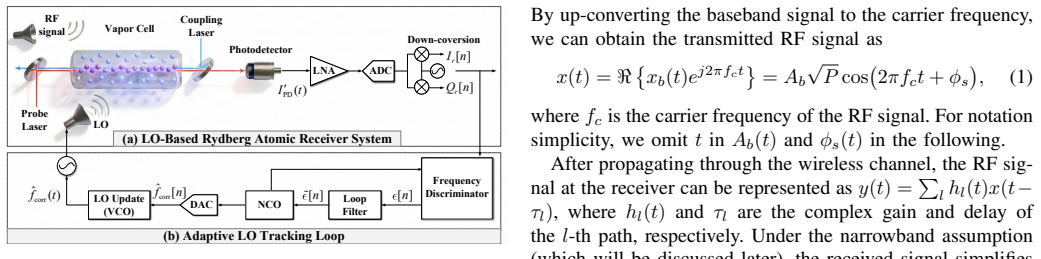
Cross-product automatic frequency control (CPAFC) loop: after M-th-power modulation wiping, a cross-product discriminator extracts residual frequency error; a second-order digital loop filter produces a control signal that simultaneously de-rotates the baseband samples and updates the physical LO frequency so that the effective IF remains fixed at the design value.
Load-bearing premise
The atomic response is treated as a fixed Lorentzian bandpass of constant width that does not change when the local-oscillator frequency or residual Doppler rate is varying.
What would settle it
Close the CPAFC loop on a real Rydberg vapor cell under a known linear Doppler ramp of several hundred kHz/s and measure whether the photocurrent spectrum remains centered inside the atomic linewidth while EVM stays low; any systematic walk-off or unexpected amplitude fade would refute the claim.
If this is right
- Fixed-LO Rydberg receivers become unusable for LEO or high-velocity platforms once Doppler exceeds a few megahertz; the adaptive-LO architecture restores link availability.
- The same feedback structure can be applied at higher carrier frequencies (THz and beyond) where Doppler rates scale linearly with frequency.
- Because the atomic bandwidth constraint is enforced at the physical front-end, subsequent digital demodulators see an essentially static intermediate frequency and need only ordinary phase tracking.
- The dual-path correction (digital NCO plus analog VCO) allows designers to allocate coarse Doppler compensation to hardware and fine residual cleanup to software.
Where Pith is reading between the lines
- The architecture is agnostic to the particular atomic species or ladder; any quantum sensor whose response is band-limited around a tunable LO beat note could adopt the same CPAFC loop.
- If the loop filter is retuned for higher natural frequency, the same receiver could track the faster Doppler rates expected in hypersonic or low-Earth-orbit constellations without changing the atomic cell.
- Because the LO itself is now a controlled oscillator, the system could also perform intentional frequency hopping while remaining inside the atomic window, opening a path to multi-band or anti-jam Rydberg links.
Editorial analysis
A structured set of objections, weighed in public.
Referee Report
Summary. The paper proposes a Doppler-resilient Rydberg atomic receiver that uses an adaptive LO tracking architecture driven by a cross-product automatic frequency control (CPAFC) loop. After reviewing the LO-based heterodyne system model and the quantum readout (Sections II–III), it shows that a fixed LO allows Doppler-induced IF drift to exit the narrow atomic response bandwidth Ba, producing severe attenuation and constellation distortion. The CPAFC algorithm (modulation wiping, cross-product discrimination, second-order loop filter, dual digital/analog correction paths; Eqs. 15–22 and Algorithm 1) estimates residual frequency error and retunes the physical LO so that the effective IF remains near the design value. Simulations under a linear 816 kHz/s Doppler ramp at 309 GHz with QPSK demonstrate that the adaptive architecture keeps the IF locked, yields low discrimination error, preserves constellation integrity, and substantially reduces EVM and SER relative to a fixed-LO baseline.
Significance. If the claimed gains hold under more complete atomic dynamics, the work supplies a concrete, implementable front-end solution to a recognized bottleneck of Rydberg receivers in high-mobility (especially LEO/THz) links. The architecture is a natural extension of classical frequency-locked loops to the quantum-sensor setting, the CPAFC derivation is transparent, and Algorithm 1 is fully specified, making the proposal reproducible and extensible. The contribution is therefore of clear engineering interest to the quantum-sensing and non-terrestrial-network communities, even though the present evidence is purely numerical.
major comments (2)
- The central performance claims (abstract, §III-B, Figs. 2–5) rest on the static Lorentzian atomic response |Ha(f)| of Eq. (11) and the fixed-LO approximation Pout(t) = P̄0 + κ cos(2π fIF t + Δϕ) of Eq. (6). The paper never re-integrates the Lindblad master equation of §II-C (or even the approximate susceptibility) along the closed-loop LO trajectory produced by Algorithm 1 under the 816 kHz/s ramp. Residual frequency error, LO-amplitude coupling, or non-adiabatic effects could therefore alter the effective response and erode the reported constellation tightness and SER curves. A short density-matrix validation (or an explicit statement of the adiabaticity conditions under which Eq. (6) remains valid) is needed before the quantitative gains can be regarded as established.
- All results are obtained from a single deterministic linear Doppler ramp with fixed atomic and loop parameters (Table I) and no Monte-Carlo error bars or alternative Doppler profiles. Consequently it is unclear how sensitive the EVM/SER improvements are to loop-filter design (ωn, ζ), residual phase noise, or realistic multipath/acceleration profiles typical of LEO links. At least a modest parameter sweep or a second, non-linear Doppler trajectory would strengthen the claim that the architecture “significantly outperforms existing Rydberg atomic receivers” under high dynamics.
minor comments (4)
- Fig. 2 contains garbled axis labels and overlay text that render the “out-of-bandwidth” region and the ideal IF line difficult to read; a clean redraw is required.
- Notation for residual frequency offset is inconsistent (Δfe[n], Δfe, fd(t)); a single symbol should be used throughout §III.
- The coherent integration time Tcoh is introduced in Eq. (20) but never related to the symbol period Ts used in the simulations; a one-sentence clarification would help.
- References [10] and [12] are arXiv preprints; if journal versions exist they should be cited, or the preprint status should be noted.
Circularity Check
No circularity: open engineering proposal with forward simulation under an explicit model; no fitted parameters re-presented as predictions and no load-bearing self-citation chain.
full rationale
The paper's derivation chain is self-contained and non-circular. Section II states the LO-based Rydberg receiver model (Lindblad master equation, approximate photocurrent I_PD(t) proportional to cos(2 pi f_IF t + Delta phi)) drawn from the fixed-LO literature. Section III-A introduces the Doppler-induced IF drift f'_IF(t) = f_IF + f_d(t) and the static Lorentzian atomic response |H_a(f)| of Eq. (11) as an analysis tool; these are modeling assumptions, not quantities later recovered as predictions. Section III-B/C then constructs a standard CPAFC frequency-locked loop (modulation wipe by M-th power, cross-product discriminator, second-order loop filter, dual digital/analog correction) whose equations (15)-(22) and Algorithm 1 follow directly from the residual-frequency definition Delta f_e and ordinary discrete-time control design; the loop coefficients omega_n, zeta, K are free design choices listed in Table I, not data fits. Section IV evaluates the closed-loop architecture by forward simulation under the same model (linear Doppler ramp k = 816 kHz/s taken from 3GPP [13], atomic parameters from ARC library), reporting IF lock, constellation tightness, EVM and SER. No step equates an output to an input by construction, no parameter is fitted to a subset of results and then called a prediction of a related quantity, and the citations that supply the underlying atomic physics or CPAFC technique do not overlap with the present authors. The architecture is therefore an ordinary engineering proposal whose performance claims are conditional on the stated model; any concern about the validity of the static Lorentzian under closed-loop dynamics is a correctness/validation issue, not circularity.
Axiom & Free-Parameter Ledger
free parameters (4)
- loop natural frequency ωn =
12500 rad/s
- damping factor ζ =
√2/2
- Doppler rate k =
816 kHz/s
- atomic bandwidth Ba
axioms (4)
- domain assumption The atomic response |Ha(f)| is a static Lorentzian of fixed width Ba centered at the nominal IF (Eq. 11).
- domain assumption ALO ≫ ARF so that the atomic system acts as a linear quantum mixer (Eq. 4).
- domain assumption Narrowband channel assumption reduces the multipath channel to a single complex gain h(t).
- standard math Cross-product discriminator with M-th power modulation wipe yields an unbiased frequency-error estimate for small residual offsets (Eqs. 18–20).
Cite this review
Pith. "Pith review of Doppler-Resilient Rydberg Atomic Receiver for High-Dynamic Communication Networks via Adaptive Local Oscillator Tracking." pith.science (2026). https://pith.science/paper/5MKMYMGV
@misc{pith2026260708145,
  author       = {Pith},
  title        = {Pith review of: Doppler-Resilient Rydberg Atomic Receiver for High-Dynamic Communication Networks via Adaptive Local Oscillator Tracking},
  year         = {2026},
  howpublished = {\url{https://pith.science/paper/5MKMYMGV}},
  note         = {Machine review of arXiv:2607.08145}
}
read the original abstract
Rydberg atomic receiver has emerged as promising candidate for next-generation wireless communication, due to the exceptional sensitivity and ability to overcome the physical limitations of traditional radio frequency antennas. Utilizing the resonant response of atomic energy levels for signal detection, Rydberg atomic receiver is inherently confined to a narrow instantaneous bandwidth. However, in high-mobility scenarios such as satellite communications, the severe Doppler effect induces carrier frequency offsets, which drive the signal beyond the instantaneous bandwidth and result in severe distortion. In this paper, we propose an adaptive local oscillator (LO) tracking Rydberg atomic receiver architecture designed to lock high-dynamic signals within the effective atomic response bandwidth. By employing a cross-product automatic frequency control (CPAFC) algorithm, the system dynamically estimates the instantaneous frequency offset, generates a corresponding error control signal, and adjusts the LO frequency through a feedback loop. Consequently, the intermediate frequency signal can always be locked close to the center of the atomic response bandwidth regardless of dynamics. Simulation results show that the proposed architecture significantly outperforms existing Rydberg atomic receiver, effectively alleviating performance degradation in high-dynamic environments.
Figures


Reference graph
Works this paper leans on
-
[1]
N. Schlossberger, N. Prajapati, S. Berweger, A. P. Rotunno, A. B. Artusio-Glimpse, M. T. Simons, A. A. Sheikh, E. B. Norrgard, S. P. Eckel, and C. L. Holloway, “Rydberg states of alkali atoms in atomic vapour as SI-traceable field probes and communications receivers,”Nat. Rev. Phys, vol. 6, no. 10, pp. 606–620, 2024
work page 2024
-
[2]
Assessment of Rydberg atoms for wideband electric field sensing,
D. H. Meyer, Z. A. Castillo, K. C. Cox, and P. D. Kunz, “Assessment of Rydberg atoms for wideband electric field sensing,”J. Phys. B: At. Mol. Opt. Phys., vol. 53, no. 3, p. 034001, 2020
work page 2020
-
[3]
D. A. Anderson, R. E. Sapiro, and G. Raithel, “Rydberg atoms for radio- frequency communications and sensing: Atomic receivers for pulsed rf field and phase detection,”IEEE Aerosp. Electron. Syst. Mag., vol. 35, no. 4, pp. 48–56, 2020
work page 2020
-
[4]
Atomic superheterodyne receiver based on microwave-dressed Rydberg spectroscopy,
M. Jing, Y . Hu, J. Ma, H. Zhang, L. Zhang, L. Xiao, and S. Jia, “Atomic superheterodyne receiver based on microwave-dressed Rydberg spectroscopy,”Nat. Phys., vol. 16, no. 9, pp. 911–915, 2020
work page 2020
-
[5]
Y . Cai, S. Shi, Y . Zhou, Y . Li, J. Yu, W. Li, and L. Li, “High-sensitivity Rydberg-atom-based phase-modulation receiver for frequency-division- multiplexing communication,”Phys. Rev. Appl., vol. 19, no. 4, p. 044079, 2023
work page 2023
-
[6]
W. Wen, S. Yan, R. Wang, X. Li, J. Tan, X. Pang, W. Zhai, W. Cui, and Y . Gao, “Rydberg-atom-based multiband frequency-hopping communi- cation receiver using five-level atomic system,”Opt. Express, vol. 32, no. 24, pp. 42 872–42 884, 2024
work page 2024
-
[7]
Detecting and receiving phase-modulated signals with a Rydberg atom-based receiver,
C. L. Holloway, M. T. Simons, J. A. Gordon, and D. Novotny, “Detecting and receiving phase-modulated signals with a Rydberg atom-based receiver,”IEEE Antennas Wirel. Propag. Lett, vol. 18, no. 9, pp. 1853– 1857, 2019
work page 2019
-
[8]
Rydberg atom electric field sensors for communications and sensing,
C. T. Fancher, D. R. Scherer, M. C. S. John, and B. L. S. Marlow, “Rydberg atom electric field sensors for communications and sensing,” IEEE Trans. Quantum Eng., vol. 2, pp. 1–13, 2021
work page 2021
-
[9]
Linear dynamic range of a Rydberg- atom microwave superheterodyne receiver,
F. Wu, Q. An, Z. Sun, and Y . Fu, “Linear dynamic range of a Rydberg- atom microwave superheterodyne receiver,”Phys Rev A., vol. 107, no. 4, p. 043108, 2023
work page 2023
-
[10]
Rydberg atomic quantum receivers for classical wireless communication and sensing,
T. Gong, A. Chandra, C. Yuen, Y . L. Guan, R. Dumke, C. M. S. See, M. Debbah, and L. Hanzo, “Rydberg atomic quantum receivers for classical wireless communication and sensing,”IEEE Wirel. Commun., 2025
work page 2025
-
[11]
M. Auzinsh, D. Budker, and S. Rochester,Optically polarized atoms: understanding light-atom interactions. Oxford University Press, 2010
work page 2010
-
[12]
Harnessing Rydberg Atomic Receivers: From Quantum Physics to Wireless Communications
Y . Chen, X. Guo, C. Yuen, Y . Zhao, Y . L. Guan, C. M. S. See, M. D ´ebbah, and L. Hanzo, “Harnessing Rydberg atomic receivers: From quantum physics to wireless communications,”arXiv preprint arXiv:2501.11842, 2025
work page internal anchor Pith review Pith/arXiv arXiv 2025
-
[13]
Study on new radio (NR) to support non-terrestrial networks,
Technical Specification Group Radio Access Network, “Study on new radio (NR) to support non-terrestrial networks,” 2018
work page 2018
-
[14]
Compact THz LTCC receiver module for 300 GHz wireless communications,
T. Tajima, H.-J. Song, and M. Yaita, “Compact THz LTCC receiver module for 300 GHz wireless communications,”IEEE Microwave and Wireless Components Letters, vol. 26, no. 4, pp. 291–293, 2016
work page 2016
-
[15]
ARC 3.0: An expanded python toolbox for atomic physics calculations,
E. J. Robertson, N. ˇSibali´c, R. M. Potvliege, and M. P. Jones, “ARC 3.0: An expanded python toolbox for atomic physics calculations,”Computer Physics Communications, vol. 261, p. 107814, 2021
work page 2021
This paper was first reviewed by grok-4.5 on July 10, 2026.
discussion (0)
Sign in with ORCID, Apple, or X to comment. Anyone can read and Pith papers without signing in.