REVIEW 2 major objections 5 minor 40 references
All known Be-rich stars belong to the accreted Thamnos-2 structure and point to a single hypernova-like spallation event.
Reviewed by Pith at T0; open to challenge. T0 means a machine referee read the full paper against a public rubric. the ladder, T0–T4 →
T0 review · grok-4.5
2026-07-10 11:46 UTC pith:A3UNODGH
load-bearing objection Solid new Be abundances that cleanly tag Thamnos-2; the hypernova story is plausible but the membership of the two literature stars is only qualitative. the 2 major comments →
Beryllium enhancement in stars of the accreted Thamnos-2 system
The pith
A machine-rendered reading of the paper's core claim, the machinery that carries it, and where it could break.
Core claim
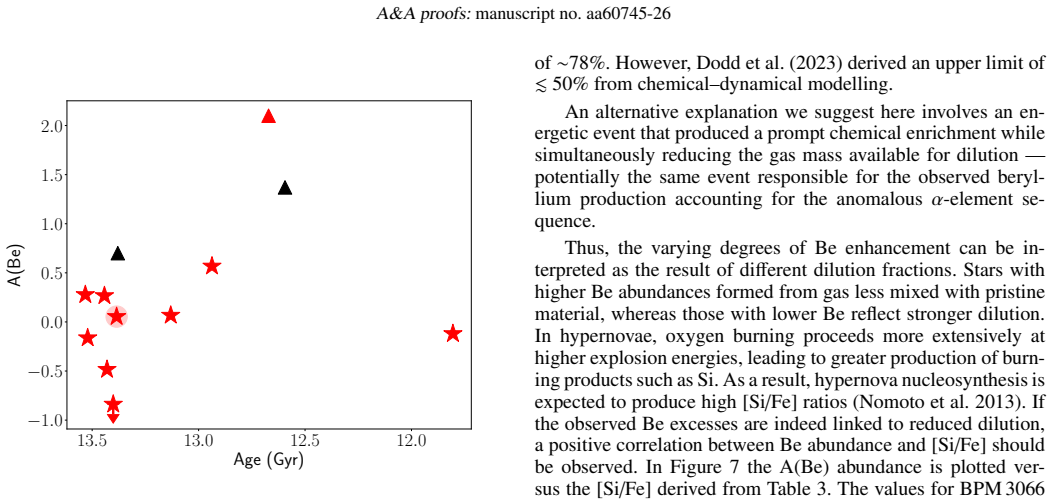
All currently known Be-rich stars are associated with the Thamnos-2 structure. The Be excess is accompanied by elevated Si and a correlation with neutron-capture elements; the A(Be)/A(Li) excess ratio of ~8–9 matches spallation yields and is interpreted as the chemical fingerprint of a single hypernova-like event that also raised the ambient metallicity to [Fe/H] ≃ −1.5.
What carries the argument
The A(Be)/A(Li) excess ratio (~8–9) together with the Be–Si–n-capture abundance correlations. These ratios and trends are used as a chemical tag that both identifies the enrichment process (spallation by energetic CNO nuclei) and chemically tags membership in Thamnos-2.
Load-bearing premise
That the observed Be–Si–n-capture correlations and the Be/Li excess ratio of ~8–9 were produced by one hypernova (or equivalent energetic event) whose ejecta mixed into roughly 10 000 solar masses of gas, rather than by several ordinary supernovae or other processes.
What would settle it
A statistically significant sample of confirmed Thamnos-2 members that show normal Be abundances at the same metallicity, or a Be-rich star whose orbit and chemistry place it firmly outside Thamnos-2.
If this is right
- Beryllium abundance becomes a practical chemical tag that can separate Thamnos-2 members from the more metal-poor Thamnos-1 and from in-situ halo contaminants.
- The high [Si/Fe] and neutron-capture overabundances observed in Thamnos candidates can be re-interpreted as products of the same energetic event rather than ordinary chemical evolution or heavy in-situ contamination.
- Old (~13 Gyr) stars can form at [Fe/H] ≈ −1.5 if a single hypernova rapidly pollutes a limited gas reservoir, relaxing the usual age–metallicity expectation for dwarf-galaxy debris.
- The same light-element signature is not expected in other accreted systems (GSE, Sequoia proper), so absence of Be-rich stars elsewhere supports the uniqueness of the Thamnos-2 event.
Where Pith is reading between the lines
- If the hypernova interpretation holds, similar rare Be-rich populations could exist in other low-mass accreted dwarfs that experienced a single extreme explosion early in their history; targeted Be surveys of other retrograde substructures would test this.
- The correlation of Be with neutron-capture elements suggests that the same event may have contributed an r-process component, offering a possible link between hypernovae and early heavy-element enrichment in dwarf galaxies.
- Because the dilution mass required (~10^4 M⊙) is a tiny fraction of the estimated stellar mass of the Thamnos progenitor, the event need not have disrupted the whole galaxy, only a local star-forming cloud.
Editorial analysis
A structured set of objections, weighed in public.
Referee Report
Summary. The paper reports homogeneous UVES abundances of Be and Li (plus a suite of heavier elements) for ten stars selected as Thamnos candidates, plus a reanalysis of the two previously known Be-rich stars HD 106038 and HD 132475. Four new stars show clear Be overabundances relative to the Galactic Be–Fe relation; two more are moderately elevated. All currently known Be-rich stars are argued to lie in the Thamnos-2 region of the (E, Lz) plane. The Be excess is accompanied by elevated [Si/Fe] and by a correlation with neutron-capture elements (Sr, Y, Zr, Ba), while O, Ca, Cr and V remain essentially flat. In the two most extreme objects the A(Be)/A(Li) excess ratio is ~8–9, matching spallation cross-section ratios. The authors interpret the pattern as the signature of a single hypernova (or equivalent energetic event) whose ejecta were diluted into ~10^4 M⊙ of pristine gas, rapidly enriching the gas to [Fe/H] ≃ −1.5 and explaining the high metallicities of these ~13 Gyr-old stars.
Significance. If the association of every known Be-rich star with Thamnos-2 holds, the result supplies a rare chemical tag for an accreted halo substructure and the first clear stellar evidence that a hypernova-scale spallation event can dominate light-element enrichment in a dwarf-galaxy progenitor. The homogeneous ATLAS9 + Turbospectrum + MyGIsFOS analysis, direct line-profile fitting of the Be II 313 nm doublet, and the clear Be–Si–n-capture correlations (Figs. 7–8) are solid technical contributions. The work also reinforces that unevolved stars from accreted systems share the same Spite-plateau Li abundance as the Galactic halo, thereby extending the cosmological lithium problem beyond the Milky Way.
major comments (2)
- The load-bearing claim that “all currently known Be-rich stars appear associated with the Thamnos-2 structure” rests, for HD 106038 and HD 132475, solely on a qualitative statement that they “fall in the same region of the diagram” (Sect. 3.2 and Fig. 5 caption). No orbital integrals, action-space distances, or membership probabilities from Dodd et al. (2023) or any other catalogue are reported for these two objects. Because the subsequent hypernova interpretation is built on the premise that Be enhancement is unique to Thamnos-2, a quantitative kinematic membership assessment (or an explicit statement of the selection criteria used for these two stars) is required.
- Sect. 4.2 and the dilution calculation that follows Fields et al. (2002) model (b) treat a single hypernova diluted into ~10^4 M⊙ as the preferred explanation. The same section notes that oxygen does not correlate with Be (Fig. 8), which is attributed to HN oxygen burning into Si. While the Be/Li excess ratio of ~8–9 is a strong spallation signature, the paper does not quantitatively exclude multiple ordinary CCSNe, a series of less energetic events, or residual selection effects within a mixed population (the contamination fraction discussed by Ceccarelli et al. 2025). A short quantitative comparison of expected yields and dilution masses for ordinary SNe versus HNe would strengthen the central interpretation.
minor comments (5)
- Table 1 lists eleven programme stars plus BPM 3066; the abstract and conclusions speak of “nine stars” and “ten stars.” Clarify the final sample size consistently.
- Fig. 5 caption and the surrounding text use both “Thamnos” and “Thamnos-2” without always distinguishing the two components defined by Koppelman et al. (2019). A brief reminder of the [Fe/H] and vφ cuts would help the reader.
- The online CSV table of abundances is mentioned but not described; a short note on which solar scale and which NLTE corrections (if any) are applied for each species would improve reproducibility.
- Typographical slips: “sellar explosion” in the keyword list; “turbospectrumand” missing a space (Methods); “a posteriori” is used correctly but “a posteriory” appears once in the text.
- Ages derived with SPInS + BASTI are quoted with formal errors of 0.3–1 Gyr (Table 2), yet the discussion treats the ~13 Gyr clustering as essentially free of systematic uncertainty. A one-sentence caveat on isochrone systematics would be appropriate.
Circularity Check
Minor non-load-bearing self-citation of the authors' own prior Be-rich star (Monaco et al. 2025); new abundances, kinematics, and hypernova interpretation remain independent of that input.
specific steps
-
self citation load bearing
[Abstract / §1 / Table 2 (TS 0)]
"following the discovery of a Be-rich star BPM 3066 by Monaco et al. (2025). ... The results for BPM 3066 (TS 0) are taken from Monaco et al. (2025)."
BPM 3066 is the most extreme Be-rich object and is included as TS 0 with its A(Be)=2.10 taken directly from the authors' own prior paper (overlapping author list). This supplies the upper end of the claimed Thamnos-2 Be sequence and the clearest Li/Be excess ratio, but the new measurements of the other nine stars and the kinematic placement of the literature Be-rich stars are independent; the self-citation is therefore present yet not load-bearing for the central claim.
full rationale
The paper is an empirical abundance survey. Targets are selected from independent GALAH+Gaia dynamical criteria (Feuillet et al. 2021; Dodd et al. 2023 E–Lz plane), Be and Li are measured from new or archival UVES spectra with ATLAS9/Turbospectrum/MyGIsFOS, and the known Be-rich stars HD 106038/HD 132475 are re-analysed only for homogeneity (recovering literature values). The association of all known Be-rich stars with Thamnos-2 is an a-posteriori kinematic observation, not a definition. The A(Be)/A(Li) excess ratio ~8–9 and the dilution calculation are compared to external spallation cross-sections and Fields et al. (2002) hypernova yields; neither quantity is fitted from the present sample and then re-predicted. The sole self-citation of note is Monaco et al. (2025) for BPM 3066 (TS 0), which supplies one extreme data point and the same analysis pipeline; it is not used to define membership, abundances, or the hypernova scenario. No self-definitional loop, fitted-input-as-prediction, uniqueness theorem, or ansatz smuggling appears. Score 1 reflects only that minor, non-load-bearing self-citation.
Axiom & Free-Parameter Ledger
free parameters (2)
- dilution mass of pristine ISM =
~10^4 M⊙
- stellar ages from SPInS + BASTI isochrones =
11.8–13.5 Gyr
axioms (4)
- domain assumption ATLAS9 model atmospheres with KOALA ODFs and microturbulence 1 km s−1 adequately describe the stellar atmospheres for abundance work.
- domain assumption Spallation of energetic CNO on protons/α-particles produces 7Li and 9Be with a yield ratio ≈8–9 (Steigman & Walker 1992; Fields et al. 2002).
- domain assumption Hypernova models of Fields et al. (2002) and Nomoto et al. (2013) correctly predict high Si yields and the absolute Li/Be masses used for the dilution argument.
- domain assumption Kinematic selection in the (E, Lz) plane following Dodd et al. (2023) and Feuillet et al. (2021) correctly isolates Thamnos members.
read the original abstract
Surveys of Galactic halo stars have revealed numerous streams and substructures tracing stellar populations accreted by the Milky Way. Among these, Gaia-Sausage-Enceladus (GSE) and Sequoia are the most prominent, both associated with dwarf galaxies accreted about 10 Gyr ago. We aim to measure beryllium abundances in nine stars associated with Thamnos, a substructure possibly linked to Sequoia, following the discovery of a Be-rich star BPM3066 by Monaco et al (2025). We used Gaia photometry and parallaxes to compute ATLAS9 model atmospheres. Synthetic spectra were generated with Turbospectrum and used with MyGIsFOS in single-model mode to analyze UVES high resolution spectra. Four new stars exhibit a significant beryllium overabundance. Moreover, the two known Be-rich stars, HD 106038 and HD 132475, are also found consistent with Thamnos membership. Thus, all currently known Be-rich stars appear associated with the Thamnos-2 structure. The Be enhancement is accompanied by elevated Si abundances, and we detect a correlation between Be and neutron-capture elements. No comparable Be-rich population is known elsewhere in the Galaxy, pointing to a rare enrichment event. The measured A(Be)/A(Li) excess ratio bears the imprint of spallation reactions, pointing to a highly energetic event in which fast CNO nuclei fragmented upon collision with the surrounding medium. The silicon overabundance is also consistent with a hypernova origin. Such an event may have rapidly enriched the surrounding gas to [Fe/H] about -1.5 explaining the relatively high metallicities of stars formed from this material despite their old ages (about 13 Gyr).
Figures




Reference graph
Works this paper leans on
-
[1]
Asplund, M., Lambert, D. L., Nissen, P. E., Primas, F., & Smith, V . V . 2006, ApJ, 644, 229
work page 2006
-
[2]
Belokurov, V ., Erkal, D., Evans, N. W., Koposov, S. E., & Deason, A. J. 2018, MNRAS, 478, 611
work page 2018
-
[3]
Boesgaard, A. M., Rich, J. A., Levesque, E. M., & Bowler, B. P. 2011, ApJ, 743, 140
work page 2011
-
[4]
Caffau, E., Bonifacio, P., Monaco, L., et al. 2024, A&A, 691, A245
work page 2024
-
[5]
Ceccarelli, E., Massari, D., Palla, M., et al. 2025, A&A, 704, A180
work page 2025
-
[6]
Dodd, E., Callingham, T. M., Helmi, A., et al. 2023, A&A, 670, L2
work page 2023
- [7]
-
[8]
Feuillet, D. K., Sahlholdt, C. L., Feltzing, S., & Casagrande, L. 2021, MNRAS, 508, 1489
work page 2021
-
[9]
D., Daigne, F., Cassé, M., & Vangioni-Flam, E
Fields, B. D., Daigne, F., Cassé, M., & Vangioni-Flam, E. 2002, ApJ, 581, 389
work page 2002
- [10]
- [11]
-
[12]
Howk, J. C., Lehner, N., Fields, B. D., & Mathews, G. J. 2012, Nature, 489, 121
work page 2012
-
[13]
H., Helmi, A., Massari, D., Price-Whelan, A
Koppelman, H. H., Helmi, A., Massari, D., Price-Whelan, A. M., & Starkenburg, T. K. 2019, A&A, 631, L9
work page 2019
-
[14]
Kurucz, R. L. 2005, Memorie della Societá Astronomica Italiana Supplementi, 8, 14
work page 2005
- [15]
-
[16]
Abundances of the elements in the solar system
Lodders, K., Palme, H., & Gail, H.-P. 2009, Landolt Börnstein [arXiv:0901.1149]
work page internal anchor Pith review Pith/arXiv arXiv 2009
-
[17]
Lombardo, L., François, P., Bonifacio, P., et al. 2021, A&A, 656, A155
work page 2021
- [18]
-
[19]
Molaro, P., Bonifacio, P., Castelli, F., & Pasquini, L. 1997, A&A, 319, 593
work page 1997
-
[20]
Molaro, P., Bonifacio, P., Cupani, G., & Howk, J. C. 2024, A&A, 690, A38
work page 2024
- [21]
-
[22]
Monaco, L., Bonifacio, P., Sbordone, L., Villanova, S., & Pancino, E. 2010, A&A, 519, L3
work page 2010
-
[23]
Monaco, L., Caffau, E., Molaro, P., Bonifacio, P., & Cescutti, G. 2025, A&A, 697, A75
work page 2025
-
[24]
Mucciarelli, A., Bonifacio, P., & Lardo, C. 2026, A&A, 705, A134
work page 2026
-
[25]
Mucciarelli, A., Salaris, M., Bonifacio, P., Monaco, L., & Villanova, S. 2014, MNRAS, 444, 1812
work page 2014
-
[26]
C., Vasiliev, E., Iorio, G., Evans, N
Myeong, G. C., Vasiliev, E., Iorio, G., Evans, N. W., & Belokurov, V . 2019, MNRAS, 488, 1235
work page 2019
- [27]
-
[28]
Pietrinferni, A., Hidalgo, S., Cassisi, S., et al. 2021, ApJ, 908, 102
work page 2021
-
[29]
2025 [ascl:2504.012] Prodanovi´c, T., Bogdanovi´c, T., & Uroševi´c, D
Plez, B., Gerber, J., Magg, E., & Bergemann, M. 2025 [ascl:2504.012] Prodanovi´c, T., Bogdanovi´c, T., & Uroševi´c, D. 2013, Phys. Rev. D, 87, 103014 Prodanovi´c, T. & ´Ciprijanovi´c, A. 2019, 219, 417
work page 2025
-
[30]
Reese, D. R. & Lebreton, Y . 2020, SPInS: Stellar Parameters INferred System- atically, Astrophysics Source Code Library, record ascl:2009.006
work page 2020
- [31]
- [32]
-
[33]
Sbordone, L., Bonifacio, P., Caffau, E., et al. 2010, A&A, 522, A26
work page 2010
-
[34]
2014, Astronomy & Astro- physics, 564, A109
Sbordone, L., Caffau, E., Bonifacio, P., & Duffau, S. 2014, Astronomy & Astro- physics, 564, A109
work page 2014
-
[35]
Simpson, J. D., Martell, S. L., Buder, S., et al. 2021, MNRAS, 507, 43
work page 2021
-
[36]
Smiljanic, R., Pasquini, L., Bonifacio, P., et al. 2009, A&A, 499, 103
work page 2009
-
[37]
Smiljanic, R., Pasquini, L., Primas, F., et al. 2008, MNRAS, 385, L93
work page 2008
- [38]
- [39]
-
[40]
2024, MNRAS, 527, 7144 Article number, page 8 of 8
Wang, J., Hammer, F., Yang, Y ., et al. 2024, MNRAS, 527, 7144 Article number, page 8 of 8
work page 2024
discussion (0)
Sign in with ORCID, Apple, or X to comment. Anyone can read and Pith papers without signing in.