REVIEW 2 major objections 4 minor 34 references
Braiding structures on categorical multi-Interval Jones-Wassermann subfactor
T0 review · 2 major / 4 minor · reviewed 2026-07-10 · grok-4.5
Pith's one-line read Braiding operators on multi-interval Jones-Wassermann planar algebras give a projective representation of the balanced superelliptic mapping class group and a new self-duality proof.
desk verdict Solid technical advance on multi-interval braidings that encode higher-genus data; the SMod representation is the load-bearing claim and rests on a long but standard list of graphical identities. read the letter →
The pith
A machine-rendered reading of the paper's core claim, the machinery that carries it, and where it could break.
The reading
What carries the argument
The family of braiding operators A_j, B_j, r_{i,j}, Δ (and the auxiliary T_j, T'_j, u) acting on Conf(C)_{m,n}. They satisfy the braid, commutation and half-twist relations needed both to factor the Fourier transform and to match a known presentation of the balanced superelliptic mapping class group.
What would settle it
Exhibit an explicit unitary modular fusion category and a pair of isotopic parity-compatible braids whose images under the constructed operators differ by a non-scalar factor, or produce a missing relation among the A_j, B_j that is required by the Hirose-Omori presentation.
Extended reading notes
Core claim
The multi-interval Jones-Wassermann configuration space Conf(C)_{m,n} admits unitary braiding operators A_j, B_j, T_j, T'_j, u and the half-twist Δ that together induce a unitary projective representation of the balanced superelliptic mapping class group SMod(Σ_{(n-1)(m-1)}). The same operators factor the Fourier transform, giving a new proof that the multi-interval Jones-Wassermann subfactors are self-dual, and they produce a generalized Verlinde formula for the structure constants of 2-box convolution.
Load-bearing premise
That the finite list of graphical identities verified for the generating braiding tangles is complete for the presentation of the balanced superelliptic mapping class group; a single missed relation or scalar mismatch would break the projective representation.
Editorial analysis
A structured set of objections, weighed in public.
Referee Report
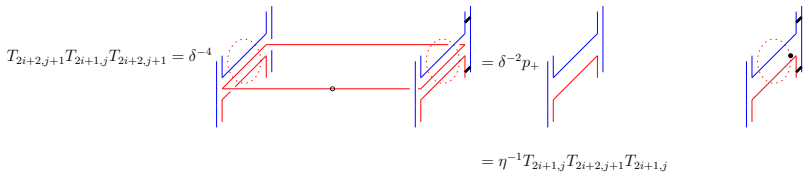
Summary. The paper constructs explicit braiding operators (Ti,j, Aj, Bj, u, and derived ti,j, ri,j, Δ) on the configuration spaces Conf(C)m,n of the multi-interval Jones–Wassermann subfactor planar algebra associated to any unitary modular fusion category C. These operators are shown to factor the Fourier transform of Liu–Xu as F = u-1 ∏ Tn-2-j A-1n-2-j (Theorem 3.17), yielding a new proof of self-duality of the subfactors. The same operators are claimed to induce a unitary projective representation of the balanced superelliptic mapping class group SMod(Σ(n-1)(m-1)) (Theorem 4.17), thereby encoding higher-genus data of C in planar-algebra language. As an application, the structure constants of the 2-box convolution product are expressed by a generalized Verlinde formula involving the Fourier matrix L (Theorem 5.8).
Significance. If the identities hold, the work supplies the missing braiding data needed to extend the authors’ earlier Z/2 permutation-gauging construction to cyclic gaugings of arbitrary order, and it gives a concrete planar-algebra realization of the balanced superelliptic mapping class group representations that arise from RT-TQFT. The factorization of the Fourier transform and the resulting generalized Verlinde formula are clean and potentially useful computational tools. The constructions are fully explicit (graphical calculus) and rest only on standard modular-category axioms (twist, cutting, handle-slide), so they are in principle checkable. The absence of machine-checked proofs is a practical limitation rather than a conceptual flaw.
major comments (2)
- Theorem 4.17 asserts that the operators Aj, Bj, ri,j, Δ give a unitary projective representation of SMod(Σ(n-1)(m-1)). The proof invokes the presentation of Hirose–Omori / Ghaswala–Winarski and claims that the relations are exhausted by Propositions 3.15, 4.7, 4.9, 4.15, 4.13 and Lemmas 4.5, 4.12 (together with the scalar-normalized identities after Definition 4.4). While the listed identities appear consistent with modular-category calculus, many multi-step diagram equalities (especially the long products in the proof of Proposition 4.15 and the induction steps for the ti,j commutation relations) are only sketched. A single missed braid or scalar mismatch would invalidate the projective representation. The authors should either supply a complete, self-contained verification of every generator relation against the cited presentation, or isolate a finite generating set of diagram identiti
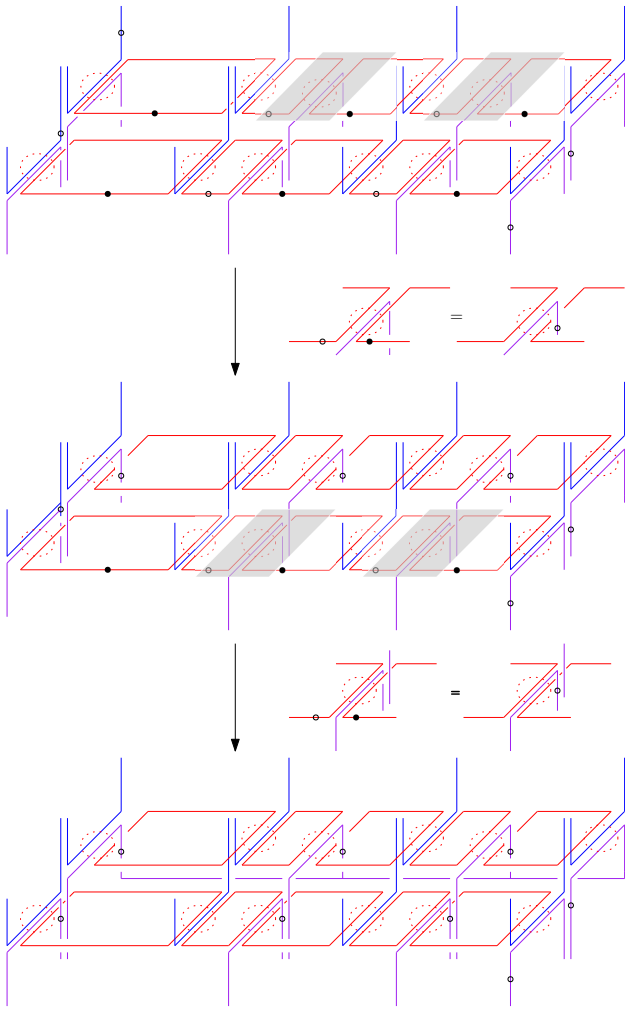
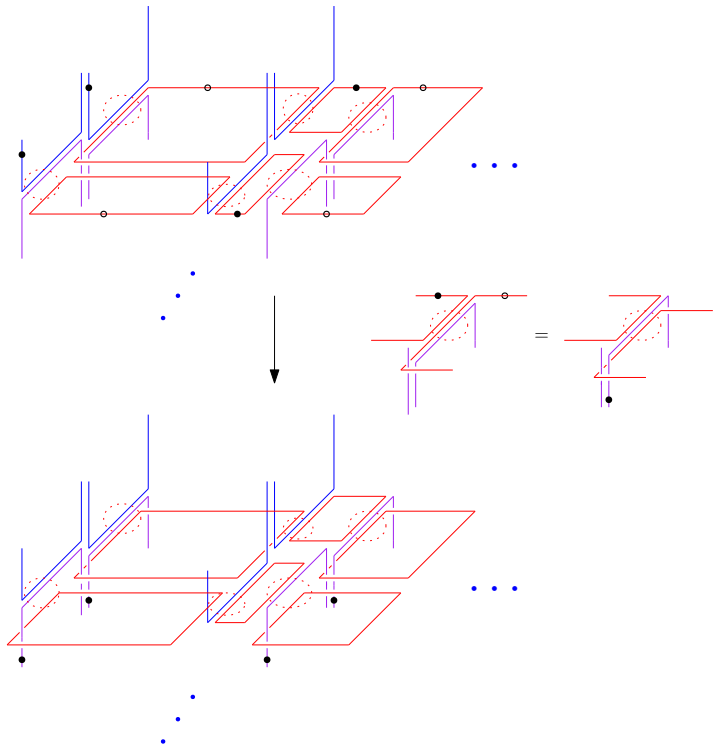
- The factorization F = u-1 ∏ Tn-2-j A-1n-2-j (Theorem 3.17) and the subsequent generalized Verlinde formula (Theorem 5.8) rest on the same operator algebra. The graphical argument for Theorem 3.17 (Figures 16–18) is lengthy and involves several handle-slides and resolutions of red loops whose scalar prefactors are tracked only partially. An independent check that the overall scalar matches the Liu–Xu pairing LL would strengthen the claim that self-duality follows immediately.
minor comments (4)
- Definition 4.4 introduces an abuse of notation that rescales Tk, T'k, u, Ak, Bk by powers of η. Subsequent statements of relations (e.g., after Proposition 3.21) mix the old and new normalizations; a consistent convention or a clear table of the rescaled operators would prevent confusion.
- Several figures (especially Figures 8–15 and 25) are dense and omit intermediate scalar factors. Adding a short caption that records the net scalar at each step would make the graphical calculus easier to follow.
- The notation for the configuration space Conf(C)m,n and the various Θ-actions is refined from Liu–Xu 2019, but a brief comparison paragraph would help readers who know only the earlier paper.
- Typographical inconsistencies appear in the arXiv source (e.g., “CA TEGORICAL MUL TI-INTER V AL”, missing spaces around operators). A careful copy-edit is needed.
Circularity Check
Minor foundational self-citations to authors' prior planar-algebra construction; core braiding operators, Fourier factorization, SMod representation and Verlinde formula are derived independently via internal graphical calculus.
-
self citation load bearing
[Sec. 3.1 Def. 3.1 and Rem. 3.1; also opening of Sec. 4]
"Let C be a unitary modular fusion category, Xi,j , Y i,j ∈ obj(C), … The configuration space Conf (C)m,n is the space spanned by the vectors as in Figure 1. … Our definition is a refinement of that in [25, Sec. 2] … the multi-interval Jones–Wassermann subfactor planar algebra is characterized as an unshaded subfactor planar algebra, with the n-box spaces defined by the configuration spaces Pn = Conf (C)m,n ."
The ambient vector spaces and planar-algebra structure on which all new braiding operators act are imported wholesale from the authors' own prior paper [25]. While the subsequent operators and relations are proved independently, every claim (self-duality via F, the SMod representation, the Verlinde constants) is formally relative to this self-cited foundation; if the base construction contained a hidden inconsistency it would propagate. This is the only self-citation that is even mildly load-bearing; it does not force the new identities by definition.
full rationale
The multi-interval configuration spaces Conf(C)_{m,n} and the unshaded planar algebra P_n are taken as given from the authors' earlier Liu-Xu Adv. Math. 2019 paper (cited as [25]), and the m=2 case is motivated by their arXiv:2408.17195. These are used as black-box starting points. All subsequent objects (the unitary operators T_{i,j}, A_j, B_j, u, r_{i,j}, Delta, the normalized versions after Def. 4.4) and every algebraic relation needed for Theorems 3.17, 4.17 and 5.8 are constructed and verified from scratch inside the present manuscript by explicit string-diagram identities (Props. 3.8, 3.15, 3.19-3.24, 4.7, 4.9, 4.13, 4.15; Lems. 3.10-3.14, 4.5, 4.10-4.14, 5.1-5.3). The presentation of SMod(Sigma_{(n-1)(m-1)}) is imported from independent external sources (Hirose-Omori, Ghaswala-Winarski). The factorization F = u^{-1} prod T A^{-1} is a new identity proved by direct evaluation of the pairing LL, yielding a genuinely independent re-proof of self-duality. The generalized Verlinde formula is obtained by expanding the 2-box convolution in the Fourier basis of the same operators. No step reduces a claimed prediction or uniqueness statement to a fitted parameter or to an unverified self-citation; the residual risk is only the finite (but lengthy) list of diagram identities, already flagged by the reader as a verification gap rather than circularity. Score 2 reflects the presence of self-citations that are foundational but not load-bearing for the novel claims.
Assumptions & free parameters
assumptions (4)
- domain assumption C is a unitary modular fusion category (UMFC) with the standard ribbon, braiding, and modular S/T data.
- domain assumption The multi-interval Jones-Wassermann configuration spaces Conf(C)m,n and the associated planar algebra exist and carry the Fourier transform of Liu-Xu (Adv. Math. 2019).
- standard math Standard graphical calculus identities of modular tensor categories (twist property, cutting property of the Kirby colour Ω, handle-slide) hold.
- domain assumption The presentation of the balanced superelliptic mapping class group SMod(Σ(n-1)(m-1)) given by Hirose-Omori / Ghaswala-Winarski is complete and correct.
invented entities (1)
-
Braiding operators Ti,j, Aj, Bj, u, ti,j, ri,j, Δ on Conf(C)m,n
Cite this review
Pith. "Pith review of Braiding structures on categorical multi-Interval Jones-Wassermann subfactor." pith.science (2026). https://pith.science/paper/2N2D6VPT
@misc{pith2026260708296,
  author       = {Pith},
  title        = {Pith review of: Braiding structures on categorical multi-Interval Jones-Wassermann subfactor},
  year         = {2026},
  howpublished = {\url{https://pith.science/paper/2N2D6VPT}},
  note         = {Machine review of arXiv:2607.08296}
}
read the original abstract
In this paper, we construct braiding structures on the multi-interval Jones-Wassermann subfactor planar algebra associated with any unitary modular fusion category. Utilizing this construction, we provide a new proof of the self-duality of these subfactors. Furthermore, we demonstrate that these braidings induce a projective unitary representation of the balanced superelliptic mapping class group; consequently, these structures effectively encode the non-trivial higher-genus data of the underlying category. As an application of this correspondence, we derive a generalized Verlinde formula as 2-box Fourier duality of the planar algebra.
Figures


Figures from the paper (22 more)







Reference graph
Works this paper leans on
-
[1]
B. Bakalov and A. Kirillov, Jr. Lectures on tensor categories and modular functors , volume 21 of University Lecture Series. American Mathematical Society, Providence, RI, 2001
work page 2001
-
[2]
P. Bantay. Characters and modular properties of permuta tion orbifolds. Phys. Lett. B , 419(1-4):175–178, 1998
work page 1998
-
[3]
P. Bantay. Permutation orbifolds. Nuclear Phys. B , 633(3):365–378, 2002
work page 2002
-
[4]
T. Barmeier and C. Schweigert. A geometric construction for permutation equivariant categories from modular functors. Transform. Groups, 16(2):287–337, 2011
work page 2011
-
[5]
J. S. Birman and H. M. Hilden. On isotopies of homeomorphi sms of Riemann surfaces. Ann. of Math. (2) , 97:424– 439, 1973
work page 1973
-
[6]
L. Borisov, M. B. Halpern, and C. Schweigert. Systematic approach to cyclic orbifolds. Internat. J. Modern Phys. A, 13(1):125–168, 1998
work page 1998
-
[7]
S. X. Cui, C. Galindo, J. Y. Plavnik, and Z. W ang. On gaugin g symmetry of modular categories. Comm. Math. Phys., 348(3):1043–1064, 2016. 49
work page 2016
-
[8]
C. Dong, L. Ren, and F. Xu. S-matrix in orbifold theory. J. Algebra , 568:139–159, 2021
work page 2021
Show all 34 references
-
[9]
C. Dong, F. Xu, and N. Yu. S-matrix in permutation orbifolds. J. Algebra, 606:851–876, 2022
2022
-
[10]
Etingof, S
P. Etingof, S. Gelaki, D. Nikshych, and V. Ostrik. Tensor categories, volume 205 of Mathematical Surveys and Monographs. American Mathematical Society, Providence, RI, 2015
2015
-
[11]
Etingof, D
P. Etingof, D. Nikshych, and V. Ostrik. On fusion catego ries. Ann. of Math. (2) , 162(2):581–642, 2005
2005
-
[12]
Etingof, D
P. Etingof, D. Nikshych, and V. Ostrik. Fusion categori es and homotopy theory. Quantum Topol. , 1(3):209–273,
-
[13]
With an appendix by Ehud Meir
-
[14]
D. E. Evans and T. Gannon. Reconstruction and local exte nsions for twisted group doubles, and permutation orbifolds. Trans. Amer. Math. Soc. , 375(4):2789–2826, 2022
2022
-
[15]
D. E. Evans and T. Gannon. Tambara-Yamagami, loop group s, bundles and KK -theory. Adv. Math. , 421:Paper No. 109002, 62, 2023
2023
-
[16]
Gannon and C
T. Gannon and C. Jones. Vanishing of categorical obstru ctions for permutation orbifolds. Comm. Math. Phys. , 369(1):245–259, 2019
2019
-
[17]
Ghaswala and R
T. Ghaswala and R. R. Winarski. The liftable mapping cla ss group of balanced superelliptic covers. New York J. Math., 23:133–164, 2017
2017
-
[18]
Ghaswala and R
T. Ghaswala and R. R. Winarski. Lifting homeomorphisms and cyclic branched covers of spheres. Michigan Math. J., 66(4):885–890, 2017
2017
-
[19]
b. Gui. Genus-zero permutation-twisted conformal blo cks for tensor product vertex operator algebras: The tensor - factorizable case. arXiv:2111.04662, 2021
2021
-
[20]
Hirose and G
S. Hirose and G. Omori. Finite presentations for the bal anced superelliptic mapping class groups. J. Topol. Anal. , 17(6):1625–1724, 2025
2025
-
[21]
Y.-Z. Huang. Vertex operator algebras, the Verlinde co njecture, and modular tensor categories. Proc. Natl. Acad. Sci. USA , 102(15):5352–5356, 2005
2005
-
[22]
V. Jones. Some unitary representations of Thompson’s g roups F and T . J. Comb. Algebra , 1(1):1–44, 2017
2017
-
[23]
V. G. Kac, R. Longo, and F. Xu. Solitons in affine and permut ation orbifolds. Comm. Math. Phys. , 253(3):723–764, 2005
2005
-
[24]
Kawahigashi, R
Y. Kawahigashi, R. Longo, and M. M¨ uger. Multi-interva l subfactors and modularity of representations in conforma l field theory. Comm. Math. Phys. , 219(3):631–669, 2001
2001
- [25]
-
[26]
Liu and F
Z. Liu and F. Xu. Jones-Wassermann subfactors for modul ar tensor categories. Adv. Math. , 355:106775, 40, 2019
2019
-
[27]
Longo and K.-H
R. Longo and K.-H. Rehren. Nets of subfactors. Rev. Math. Phys. , 7(4):567–597, 1995. W orkshop on Algebraic Quantum Field Theory and Jones Theory (Berlin, 1994)
1995
-
[28]
Longo and F
R. Longo and F. Xu. Topological sectors and a dichotomy i n conformal field theory. Comm. Math. Phys. , 251(2):321– 364, 2004
2004
-
[29]
Margalit and R
D. Margalit and R. R. Winarski. Braids groups and mappin g class groups: the Birman-Hilden theory. Bull. Lond. Math. Soc. , 53(3):643–659, 2021
2021
-
[30]
M. M¨ uger. Conformal orbifold theories and braided cro ssed G-categories. Comm. Math. Phys. , 260(3):727–762, 2005
2005
-
[31]
E. C. Rowell. From quantum groups to unitary modular ten sor categories. In Representations of algebraic groups, quantum groups, and Lie algebras , volume 413 of Contemp. Math. , pages 215–230. Amer. Math. Soc., Providence, RI, 2006
2006
-
[32]
V. G. Turaev. Quantum invariants of knots and 3-manifolds , volume 18 of De Gruyter Studies in Mathematics . W alter de Gruyter & Co., Berlin, revised edition, 2010
2010
-
[33]
W assermann
A. W assermann. Operator algebras and conformal field th eory. III. Fusion of positive energy representations of LSU(N ) using bounded operators. Invent. Math. , 133(3):467–538, 1998
1998
-
[34]
F. Xu. Jones-Wassermann subfactors for disconnected i ntervals. Commun. Contemp. Math. , 2(3):307–347, 2000. Z. LIU, Yau Mathematical Sciences Center and Department of Ma thematics, Tsinghua University, Beijing, 100084, China 50 Yanqi Lake Beijing Institute of Mathematical Sci...
2000
Reviewed July 10, 2026 · model on record in the stance chip above.
Discussion (0). Continue with ORCID to comment.