REVIEW 2 major objections 5 minor 88 references
In nine of 22 globular clusters the most chemically extreme second-population stars fail to reach the AGB, and anomalous stars skip it even more often.
Reviewed by Pith at T0; open to challenge. T0 means a machine referee read the full paper against a public rubric. the ladder, T0–T4 →
T0 review · grok-4.5
2026-07-10 08:27 UTC pith:DX3KICTM
load-bearing objection Solid largest homogeneous AGB multiple-population census with a transparent manqué criterion; nine clusters show extreme 2P underrepresentation, plus first anomalous-AGB and AGB iron-spread results. the 2 major comments →
Multiple populations along the asymptotic giant branch: a Gaia+APOGEE study of 22 Galactic globular clusters
The pith
A machine-rendered reading of the paper's core claim, the machinery that carries it, and where it could break.
Core claim
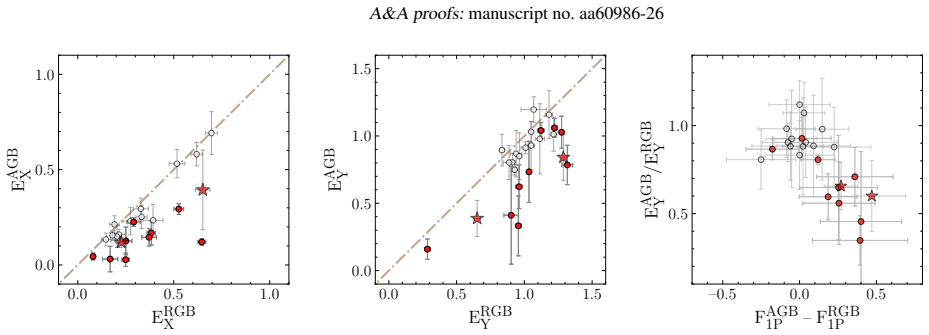
In nine of the 22 clusters the most chemically extreme second-population stars are significantly under-represented on the AGB relative to the RGB, satisfying the authors' criterion that the abundance extents in both light-element axes are smaller on the AGB at the 1-sigma level; anomalous stars in the two Type-II clusters show an even stronger deficit.
What carries the argument
The quantitative AGB-manqué criterion: after shifting AGB abundances so that first-population medians match the RGB, the 98th-percentile extents of the light-element distributions (Mg/Al or C/N) must both be smaller on the AGB than on the RGB at 1-sigma significance.
Load-bearing premise
The measured abundance offsets between RGB and AGB stars are treated as pure atmospheric or pipeline artefacts that can be removed by a rigid shift without erasing or inventing real population differences.
What would settle it
A homogeneous re-analysis of the same stars with an independent abundance pipeline that eliminates the RGB-to-AGB offsets; if the extreme second-population stars reappear on the AGB once the offsets vanish, the manqué classification collapses.
If this is right
- AGB population fractions can now be used as a mass-loss and helium diagnostic complementary to horizontal-branch morphology.
- Anomalous populations in Type-II clusters must form with higher helium or experience stronger RGB mass loss than ordinary second-population stars.
- Iron spreads among first-population stars persist into the AGB, so any formation model must keep iron variations intact through the most advanced evolutionary stages.
- Radial profiles of AGB second-population fractions in NGC 2808 and NGC 7078 invert the usual central concentration, requiring either new dynamical processing or larger samples to confirm.
Where Pith is reading between the lines
- If the manqué signature is driven by helium, the extreme second-population helium mass fractions implied by the missing AGB stars should match those already inferred from the horizontal branch in the same clusters.
- The same Gaia+APOGEE selection can be applied to the remaining APOGEE clusters to enlarge the sample beyond 22 and test whether the nine-cluster fraction is universal.
- Clusters that show no manqué signature may still host a small fraction of extreme stars that skip the AGB; larger AGB samples would reveal whether the phenomenon is continuous rather than binary.
Editorial analysis
A structured set of objections, weighed in public.
Referee Report
Summary. The paper combines Gaia DR3 photometry with APOGEE DR17 light-element abundances to isolate AGB members in 22 Galactic globular clusters and to separate first- and second-population (and, where present, anomalous) stars. Population fractions are measured for the largest AGB sample to date; the 1P fraction declines with cluster mass. A quantitative AGB-manqué criterion is introduced by comparing the 98th-percentile abundance extents of RGB and AGB stars after a rigid 1P-based offset correction; nine clusters satisfy the criterion that the most extreme 2P stars are underrepresented on the AGB. First spectroscopic characterizations of AGB multiple populations are given for eight clusters, anomalous AGB stars are mapped in NGC 6656 and ω Centauri, radial AGB 2P trends are presented for four clusters, and an intrinsic [Fe/H] spread among 1P AGB stars is reported in NGC 5272.
Significance. If the classification holds, the work supplies a homogeneous spectroscopic census of AGB multiple populations across a large GC sample, a reproducible empirical definition of AGB-manqué, and the first spectroscopic view of anomalous AGB subpopulations and of the extended-1P iron spread on the AGB. These results constrain the roles of helium and RGB mass loss in determining which stars reach the AGB and extend known multiple-population phenomenology to the most evolved phase studied so far. Strengths include the transparent 98th-percentile + bootstrap criterion, Wilson intervals for small-N fractions, and the explicit tabulation of extents and fractions (Table A.1).
major comments (2)
- Section 3.1 and Appendix B: the rigid RGB-to-AGB offsets (up to ~0.15 dex in [Al/Fe], ~0.19 dex in [Fe/H]) measured from 1P medians are treated as pure atmospheric/pipeline systematics. Because the manqué classification rests on post-correction extents, the manuscript should demonstrate more explicitly that the extreme 2P tail is already missing in the uncorrected diagrams for the nine manqué clusters (as is visually true for NGC 6205 and NGC 0288) and should quantify how often the 1σ classification flips when the offset is varied within its bootstrap uncertainty. Without that check the central claim remains vulnerable to residual differential systematics between evolutionary phases.
- Section 5 and Table A.1: several of the nine manqué classifications rest on AGB samples of N ≤ 6 (e.g., NGC 1904, NGC 5053, NGC 6171). The dual-axis 1σ criterion and Wilson intervals are appropriate, but the paper should state the false-positive rate expected under the null of identical RGB/AGB parent distributions for these sample sizes, or at least flag the lowest-N cases as tentative. This does not invalidate the overall result but is load-bearing for the precise count of nine clusters.
minor comments (5)
- Figure 8 and Section 4: the unexpected outer rise of AGB 2P fractions in NGC 2808 and NGC 7078 is intriguing but rests on very few outer AGB stars; the text already notes the need for larger samples—consider moving the strongest language about “opposite to the RGB” into a more cautious formulation.
- Appendix B: the mild metallicity trend of the Mg/Al offsets and the ΔTeff trend of the [Fe/H] offsets are useful; a short quantitative statement of the Spearman coefficients would help the reader assess their significance.
- Section 3.2–3.3: the AI/AII labeling for anomalous stars is clear, but a one-sentence reminder that these labels are not equivalent to 1P/2P would avoid confusion for readers less familiar with Type II clusters.
- Table A.1: the dual use of X = [Mg/Fe] or [C/Fe]STD (and Y = [Al/Fe] or [N/Fe]STD) is explained in the text; adding a footnote to the table column headers would make the table self-contained.
- Figure 1 and Appendix A: the magnitude cut that excludes the bright AGB–RGB merger region is sensible; stating the typical G limit for each cluster (or a uniform criterion) would improve reproducibility.
Circularity Check
No significant circularity: AGB-manqué criterion and population fractions are direct empirical comparisons of observed abundance extents and star counts; self-citations supply prior RGB tags and baselines but do not force the new AGB results.
specific steps
-
self citation load bearing
[Section 3.1 (and 3.3 for ω Cen)]
"We know they are 1P stars from Dondoglio et al. (2025), who cross-matched 1P and 2P stars identified from photometric diagrams with the APOGEE dataset, finding that they cluster around this threshold... To tag the different populations in the RGB, we rely on the identification performed by Dondoglio et al. (2026..."
RGB population labels in a subset of clusters are imported from the authors' own prior papers rather than re-derived ab initio from the present APOGEE sample alone. This is a minor convenience, not load-bearing for the AGB extents or manqué criterion, which are measured independently on the new AGB stars.
full rationale
The paper's central claims rest on new Gaia+APOGEE measurements of AGB stars in 22 clusters. 1P/2P (and AI/AII) separation uses light-element diagrams after a rigid offset correction measured solely on the 1P median; extents E_X and E_Y are then the error-subtracted 98th-percentile distances from that median, with bootstrap that already includes offset uncertainty (Section 5). The manqué classification is the empirical statement that both extents are smaller on the AGB than on the RGB at 1σ; it is not a fitted parameter renamed as a prediction, nor is it defined in terms of the fractions. Population fractions are simple binomial counts (Wilson intervals). Radial trends and the iron-width W_1P[Fe/H] are likewise direct measurements. Self-citations (Dondoglio et al. 2025/2026 for RGB tagging in a few clusters, Lagioia et al. 2021 for core fractions) provide convenient prior labels and comparison points, but the AGB abundance distributions, extents, and fractions are independently derived from the present sample and remain consistent with visual inspection of the uncorrected diagrams. No uniqueness theorem, ansatz, or self-definitional loop is invoked. The derivation chain is therefore self-contained against the data; the mild self-citation usage warrants only a score of 1.
Axiom & Free-Parameter Ledger
free parameters (2)
- RGB-to-AGB abundance offsets (Mg, Al, Fe)
- 98th-percentile definition of abundance extent E[X], E[Y]
axioms (4)
- domain assumption Light-element abundance patterns ([Mg/Fe]–[Al/Fe] or verticalized [C/Fe]–[N/Fe]) cleanly separate first- and second-population stars on both the RGB and AGB.
- ad hoc to paper The observed RGB–AGB abundance offsets are atmospheric or pipeline systematics that can be removed by a rigid shift without erasing true population differences.
- domain assumption AGB-manqué stars arise when envelope mass on the horizontal branch is ≲ 10^{-2} M_⊙, driven by higher helium and/or larger RGB mass loss.
- domain assumption Gaia CMD selection plus radial-velocity membership isolates genuine cluster AGB stars free of field contamination and RGB interlopers.
read the original abstract
We present an investigation of multiple stellar populations along the asymptotic giant branch (AGB) in 22 globular clusters (GCs), exploiting APOGEE spectroscopy combined with AGB selection based on Gaia color-magnitude diagrams. Using light-element abundances ([C/Fe], [N/Fe], [Mg/Fe], and [Al/Fe]), we disentangle first- (1P) and second- (2P) populations along the AGB. We derive their fractions in the AGB for the largest sample of GCs to date, finding that the 1P fraction decreases with cluster mass, as in other evolutionary phases. By comparing AGB and red giant branch (RGB), we define a quantitative criterion to identify clusters affected by the AGB-manque phenomenon. We find that in nine GCs the most chemically extreme 2P stars are underrepresented along the AGB, indicating that they fail to ascend this phase. Our classification is in agreement with previous studies and provides the first spectroscopic characterization of AGB multiple populations in eight GCs. We derive, for the first time, the radial distribution of AGB 2P stars in four clusters. While NGC5024 and omegaCentauri show trends consistent with the RGB, NGC2808 and NGC7078 may exhibit an unexpected increase of the AGB 2P fraction at large radii, opposite to the RGB stars. We present the first detailed spectroscopic characterization of anomalous AGB populations in NGC6656 and omegaCentauri, i.e. the populations enhanced in heavy elements compared to the bulk of 1P and 2P. In both clusters, anomalous stars show a more pronounced AGB-manque signature than 2P stars, with the fraction of the most Mg-poor and Al-rich AGB dropping compared to the RGB, possibly due to enhanced He and/or increased RGB mass loss. We report the first detection of iron inhomogeneities among 1P AGB stars in NGC5272, with a spread consistent with the RGB one. This extends the presence of iron variations to the most evolved stellar phase studied so far.
Figures



Reference graph
Works this paper leans on
-
[1]
The Seventeenth Data Release of the Sloan Digital Sky Surveys: Complete Release of MaNGA, MaStar, and APOGEE-2 Data. , keywords =. doi:10.3847/1538-4365/ac4414 , archivePrefix =. 2112.02026 , primaryClass =
-
[2]
Multiple Stellar Populations in Globular Clusters
Multiple Stellar Populations in Globular Clusters. , keywords =. doi:10.1146/annurev-astro-081817-051839 , archivePrefix =. 1712.01286 , primaryClass =
work page internal anchor Pith review Pith/arXiv arXiv doi:10.1146/annurev-astro-081817-051839
-
[3]
A catalogue of masses, structural parameters, and velocity dispersion profiles of 112 Milky Way globular clusters. , keywords =. doi:10.1093/mnras/sty1057 , archivePrefix =. 1804.08359 , primaryClass =
work page internal anchor Pith review Pith/arXiv arXiv doi:10.1093/mnras/sty1057
-
[4]
Lawrence D. Brown and T. Tony Cai and Anirban DasGupta , title =. Statistical Science , number =. 2001 , doi =
work page 2001
-
[5]
Cyanogen in NGC 1851 RGB and AGB Stars: Quadrimodal Distributions
Cyanogen in NGC 1851 Red Giant Branch and Asymptotic Giant Branch Stars: Quadrimodal Distributions. , keywords =. doi:10.1088/2041-8205/761/1/L2 , archivePrefix =. 1211.2052 , primaryClass =
work page internal anchor Pith review Pith/arXiv arXiv doi:10.1088/2041-8205/761/1/l2 2041
-
[6]
The structural properties of multiple populations in globular clusters: The instructive case of NGC 3201. , keywords =. doi:10.1051/0004-6361/202349021 , archivePrefix =. 2402.09514 , primaryClass =
work page internal anchor Pith review Pith/arXiv arXiv doi:10.1051/0004-6361/202349021
-
[7]
Sodium content as a predictor of the advanced evolution of globular cluster stars
Sodium content as a predictor of the advanced evolution of globular cluster stars. , keywords =. doi:10.1038/nature12191 , archivePrefix =. 1305.7090 , primaryClass =
work page internal anchor Pith review Pith/arXiv arXiv doi:10.1038/nature12191
-
[8]
On the missing second generation AGB stars in NGC6752
On the missing second generation AGB stars in NGC 6752. , keywords =. doi:10.1051/0004-6361/201424540 , archivePrefix =. 1410.3599 , primaryClass =
work page internal anchor Pith review Pith/arXiv arXiv doi:10.1051/0004-6361/201424540
-
[9]
On the Horizontal Branch of the Galactic Globular NGC2808
On the horizontal branch of the galactic globular cluster NGC 2808. , keywords =. doi:10.1051/0004-6361:20042170 , archivePrefix =. astro-ph/0505252 , primaryClass =
work page internal anchor Pith review Pith/arXiv arXiv doi:10.1051/0004-6361:20042170
-
[10]
Multiple stellar populations in the globular cluster NGC 1851
Multiple stellar populations in the globular cluster NGC 1851. , keywords =. doi:10.1051/0004-6361/201117269 , archivePrefix =. 1106.3174 , primaryClass =
work page internal anchor Pith review Pith/arXiv arXiv doi:10.1051/0004-6361/201117269
-
[11]
Mixing processes during the evolution of red giants with moderate metal deficiencies: the role of molecular-weight barriers. , keywords =. doi:10.48550/arXiv.astro-ph/9712207 , archivePrefix =. astro-ph/9712207 , primaryClass =
work page internal anchor Pith review Pith/arXiv arXiv doi:10.48550/arxiv.astro-ph/9712207
-
[12]
Why the globular cluster NGC 6752 contains no sodium-rich second-generation AGB star
Why the globular cluster NGC 6752 contains no sodium-rich second-generation AGB stars. , keywords =. doi:10.1051/0004-6361/201322422 , archivePrefix =. 1309.2073 , primaryClass =
work page internal anchor Pith review Pith/arXiv arXiv doi:10.1051/0004-6361/201322422 2073
-
[13]
Evolution of long-lived globular cluster stars. II. Sodium abundance variations on the asymptotic giant branch as a function of globular cluster age and metallicity. , keywords =. doi:10.1051/0004-6361/201527576 , archivePrefix =. 1512.03166 , primaryClass =
work page internal anchor Pith review Pith/arXiv arXiv doi:10.1051/0004-6361/201527576
-
[14]
oMEGACat. IV. Constraining the Ages of Omega Centauri Subgiant Branch Stars with HST and MUSE. , keywords =. doi:10.3847/1538-4357/ad8621 , archivePrefix =. 2409.13855 , primaryClass =
work page internal anchor Pith review Pith/arXiv arXiv doi:10.3847/1538-4357/ad8621
-
[15]
oMEGACat. V. Helium Enrichment in Centauri as a Function of Metallicity. , keywords =. doi:10.3847/1538-4357/adc1c5 , archivePrefix =. 2412.09783 , primaryClass =
work page internal anchor Pith review Pith/arXiv arXiv doi:10.3847/1538-4357/adc1c5
-
[16]
Helium variation due to self-pollution among Globular Cluster stars. Consequences on the horizontal branch morphology. , keywords =. doi:10.1051/0004-6361:20021220 , archivePrefix =. astro-ph/0209331 , primaryClass =
work page internal anchor Pith review Pith/arXiv arXiv doi:10.1051/0004-6361:20021220
-
[17]
Multiple stellar populations along the red Horizontal Branch and Red Clump of Globular Clusters
Multiple Stellar Populations along the Red Horizontal Branch and Red Clump of Globular Clusters. , keywords =. doi:10.3847/1538-4357/abc882 , archivePrefix =. 2011.03283 , primaryClass =
work page internal anchor Pith review Pith/arXiv arXiv doi:10.3847/1538-4357/abc882 2011
-
[18]
Survey of multiple populations in globular clusters among very low-mass stars
Survey of Multiple Populations in Globular Clusters among Very-low-mass Stars. , keywords =. doi:10.3847/1538-4357/ac5046 , archivePrefix =. 2201.08631 , primaryClass =
work page internal anchor Pith review Pith/arXiv arXiv doi:10.3847/1538-4357/ac5046
-
[19]
A deep dive into the Type II Globular Cluster NGC 1851
A deep dive into the Type II globular cluster NGC 1851. , keywords =. doi:10.1093/mnras/stad2950 , archivePrefix =. 2309.16423 , primaryClass =
work page internal anchor Pith review Pith/arXiv arXiv doi:10.1093/mnras/stad2950
-
[20]
Linking Photometry and spectroscopy: profiling multiple populations in globular clusters
Linking photometry and spectroscopy: profiling multiple populations in globular clusters. , keywords =. doi:10.1051/0004-6361/202453024 , archivePrefix =. 2503.15976 , primaryClass =
work page internal anchor Pith review Pith/arXiv arXiv doi:10.1051/0004-6361/202453024
-
[21]
Tracing Centauri's origins: Spatial and chemical signatures of its formation history. , keywords =. doi:10.1051/0004-6361/202556545 , archivePrefix =. 2509.16719 , primaryClass =
-
[22]
Ultraviolet Radiation from Evolved Stellar Populations. I. Models. , keywords =. doi:10.1086/173511 , archivePrefix =. astro-ph/9311022 , primaryClass =
work page internal anchor Pith review Pith/arXiv arXiv doi:10.1086/173511
-
[23]
MESA Isochrones and Stellar Tracks (MIST) 0: Methods for the construction of stellar isochrones
MESA Isochrones and Stellar Tracks (MIST) 0: Methods for the Construction of Stellar Isochrones. , keywords =. doi:10.3847/0067-0049/222/1/8 , archivePrefix =. 1601.05144 , primaryClass =
work page internal anchor Pith review Pith/arXiv arXiv doi:10.3847/0067-0049/222/1/8
-
[24]
Gaia Data Release 3: Summary of the content and survey properties
Gaia Data Release 3. Summary of the content and survey properties. , keywords =. doi:10.1051/0004-6361/202243940 , archivePrefix =. 2208.00211 , primaryClass =
work page internal anchor Pith review Pith/arXiv arXiv doi:10.1051/0004-6361/202243940
-
[25]
Clear Evidence for the Presence of Second-generation Asymptotic Giant Branch Stars in Metal-poor Galactic Globular Clusters. , keywords =. doi:10.1088/2041-8205/815/1/L4 , archivePrefix =. 1511.05714 , primaryClass =
work page internal anchor Pith review Pith/arXiv arXiv doi:10.1088/2041-8205/815/1/l4 2041
-
[26]
Light Element Abundances and Multiple Populations in M10
Light Element Abundances and Multiple Populations in M10. , keywords =. doi:10.3847/1538-3881/aac2d4 , archivePrefix =. 1805.01529 , primaryClass =
work page internal anchor Pith review Pith/arXiv arXiv doi:10.3847/1538-3881/aac2d4
-
[27]
Clues on the Hot Star Content and the Ultraviolet Output of Elliptical Galaxies. , keywords =. doi:10.1086/169384 , adsurl =
-
[28]
First evidence of multiple populations along the AGB from Str \"o mgren photometry. , keywords =. doi:10.1051/0004-6361/201630341 , adsurl =
-
[29]
A Catalog of Parameters for Globular Clusters in the Milky Way. , keywords =. doi:10.1086/118116 , adsurl =
-
[30]
The Updated BaSTI Stellar Evolution Models and Isochrones. I. Solar-scaled Calculations. , keywords =. doi:10.3847/1538-4357/aab158 , archivePrefix =. 1802.07319 , primaryClass =
work page internal anchor Pith review Pith/arXiv arXiv doi:10.3847/1538-4357/aab158
-
[31]
New Analyses of Star-to-Star Abundance Variations among Bright Giants in the Mildly Metal-poor Globular Cluster M5. , keywords =. doi:10.1086/322108 , archivePrefix =. astro-ph/0106249 , primaryClass =
work page internal anchor Pith review Pith/arXiv arXiv doi:10.1086/322108
-
[32]
Chromosome maps of Globular Clusters from wide-field ground-based photometry
Chromosome maps of globular clusters from wide-field ground-based photometry. , keywords =. doi:10.1093/mnras/stac3086 , archivePrefix =. 2211.00650 , primaryClass =
work page internal anchor Pith review Pith/arXiv arXiv doi:10.1093/mnras/stac3086
-
[33]
New Perspective on the Multiple-population Phenomenon in Galactic Globular Clusters from a Wide-field Photometric Survey. , keywords =. doi:10.3847/1538-4357/adafa1 , archivePrefix =. 2502.02585 , primaryClass =
work page internal anchor Pith review Pith/arXiv arXiv doi:10.3847/1538-4357/adafa1
-
[34]
Chemical Abundances for 855 Giants in the Globular Cluster Omega Centauri (NGC 5139)
Chemical Abundances for 855 Giants in the Globular Cluster Omega Centauri (NGC 5139). , keywords =. doi:10.1088/0004-637X/722/2/1373 , archivePrefix =. 1008.2232 , primaryClass =
work page internal anchor Pith review Pith/arXiv arXiv doi:10.1088/0004-637x/722/2/1373
-
[35]
Oxygen and Sodium Abundances in M13 (NGC 6205) Giants: Linking Globular Cluster Formation Scenarios, Deep Mixing, and Post-RGB Evolution. , keywords =. doi:10.1088/2041-8205/754/2/L38 , archivePrefix =. 1207.1919 , primaryClass =
work page internal anchor Pith review Pith/arXiv arXiv doi:10.1088/2041-8205/754/2/l38 2041
-
[36]
AGB Sodium Abundances in the Globular Cluster 47 Tucanae (NGC 104)
AGB Sodium Abundances in the Globular Cluster 47 Tucanae (NGC 104). , keywords =. doi:10.1088/0004-6256/149/2/71 , archivePrefix =. 1412.4108 , primaryClass =
work page internal anchor Pith review Pith/arXiv arXiv doi:10.1088/0004-6256/149/2/71
-
[37]
NLTE Chemical abundances in Galactic open and globular clusters
Non-LTE chemical abundances in Galactic open and globular clusters. , keywords =. doi:10.1051/0004-6361/201935861 , archivePrefix =. 1907.02876 , primaryClass =
work page internal anchor Pith review Pith/arXiv arXiv doi:10.1051/0004-6361/201935861 1907
-
[38]
Multiple stellar populations in Asymptotic Giant Branch stars of Galactic Globular Clusters
Multiple Stellar Populations in Asymptotic Giant Branch Stars of Galactic Globular Clusters. , keywords =. doi:10.3847/1538-4357/abdfcf , archivePrefix =. 2101.09843 , primaryClass =
work page internal anchor Pith review Pith/arXiv arXiv doi:10.3847/1538-4357/abdfcf
-
[39]
Exploring Simple-population and Multiple-population Globular Clusters in the Outer Galactic Halo Using the Hubble Space Telescope. , keywords =. doi:10.3847/1538-4357/ad98ee , archivePrefix =. 2406.16824 , primaryClass =
work page internal anchor Pith review Pith/arXiv arXiv doi:10.3847/1538-4357/ad98ee
-
[40]
Non-local Thermodynamical Equilibrium Effects on the Iron Abundance of Asymptotic Giant Branch Stars in 47 Tucanae. , keywords =. doi:10.1088/0004-637X/797/2/124 , adsurl =
-
[41]
Chemical analysis of Asymptotic Giant Branch stars in M62
Chemical Analysis of Asymptotic Giant Branch Stars in M62. , keywords =. doi:10.1088/0004-637X/813/2/97 , archivePrefix =. 1509.08917 , primaryClass =
work page internal anchor Pith review Pith/arXiv arXiv doi:10.1088/0004-637x/813/2/97
-
[42]
Lost and Found: Evidence of Second-generation Stars Along the Asymptotic Giant Branch of the Globular Cluster NGC 6752. , keywords =. doi:10.3847/2041-8205/826/1/L1 , archivePrefix =. 1606.09256 , primaryClass =
work page internal anchor Pith review Pith/arXiv arXiv doi:10.3847/2041-8205/826/1/l1 2041
-
[43]
Multiple populations along the asymptotic giant branch of the globular cluster M 4
Multiple populations along the asymptotic giant branch of the globular cluster M4. , keywords =. doi:10.1093/mnras/stw3374 , archivePrefix =. 1612.08929 , primaryClass =
work page internal anchor Pith review Pith/arXiv arXiv doi:10.1093/mnras/stw3374
-
[44]
High-precision abundances of first-population stars in NGC 2808: confirmation of a metallicity spread. , keywords =. doi:10.1051/0004-6361/202245090 , archivePrefix =. 2210.13369 , primaryClass =
work page internal anchor Pith review Pith/arXiv arXiv doi:10.1051/0004-6361/202245090
-
[45]
A stellar census in globular clusters with MUSE: Metallicity spread and dispersion among first-population stars. , keywords =. doi:10.1051/0004-6361/202452420 , archivePrefix =. 2501.09558 , primaryClass =
work page internal anchor Pith review Pith/arXiv arXiv doi:10.1051/0004-6361/202452420
-
[46]
Multiple Stellar Populations of Globular Clusters from Homogeneous Ca-CN Photometry. II. M5 (NGC 5904) and a New Filter System. , keywords =. doi:10.3847/1538-4357/aa7b8c , archivePrefix =. 1706.07969 , primaryClass =
work page internal anchor Pith review Pith/arXiv arXiv doi:10.3847/1538-4357/aa7b8c
-
[47]
Five Stellar Populations in M22 (NGC 6656)
Five Stellar Populations in M22 (NGC 6656). , keywords =. doi:10.3847/2041-8213/ab60b2 , archivePrefix =. 2001.00679 , primaryClass =
work page internal anchor Pith review Pith/arXiv arXiv doi:10.3847/2041-8213/ab60b2 2041
-
[48]
Multiple Stellar Populations of Globular Clusters from Homogeneous Ca-CN-CH-NH Photometry. VI. M3 (NGC 5272) Is Not a Prototypical Normal Globular Cluster. , keywords =. doi:10.3847/1538-4357/abd948 , archivePrefix =. 2006.01274 , primaryClass =
work page internal anchor Pith review Pith/arXiv arXiv doi:10.3847/1538-4357/abd948 2006
-
[49]
M92 (NGC~6341) Is a Metal-Complex Globular Cluster with an Atypical Primordial Population
M92 (NGC 6341) Is a Metal-complex Globular Cluster with an Atypical Primordial Population. , keywords =. doi:10.3847/2041-8213/acd05a , archivePrefix =. 2305.02983 , primaryClass =
work page internal anchor Pith review Pith/arXiv arXiv doi:10.3847/2041-8213/acd05a 2041
-
[50]
Constraining the original composition of the gas forming first-generation stars in globular clusters
Constraining the original composition of the gas forming first-generation stars in globular clusters. , keywords =. doi:10.1093/mnras/stac734 , archivePrefix =. 2203.07571 , primaryClass =
work page internal anchor Pith review Pith/arXiv arXiv doi:10.1093/mnras/stac734
-
[51]
Differential reddening in the direction of 56 Galactic globular clusters
Differential reddening in the direction of 56 Galactic globular clusters. , keywords =. doi:10.1093/mnras/stad1056 , archivePrefix =. 2304.05076 , primaryClass =
work page internal anchor Pith review Pith/arXiv arXiv doi:10.1093/mnras/stad1056
-
[52]
The original composition of the gas forming first-generation stars in clusters: Insights from HST and JWST. , keywords =. doi:10.1051/0004-6361/202449533 , archivePrefix =. 2405.02006 , primaryClass =
work page internal anchor Pith review Pith/arXiv arXiv doi:10.1051/0004-6361/202449533
-
[53]
A Wide-Field View on Multiple Stellar Populations in 28 Milky Way Globular Clusters
A wide-field view on multiple stellar populations in 28 Milky Way globular clusters. , keywords =. doi:10.1093/mnras/stad093 , archivePrefix =. 2301.04166 , primaryClass =
work page internal anchor Pith review Pith/arXiv arXiv doi:10.1093/mnras/stad093
-
[54]
An extreme paucity of second population AGB stars in the normal globular cluster M4
An extreme paucity of second population AGB stars in the `normal' globular cluster M4. , keywords =. doi:10.1093/mnrasl/slw073 , archivePrefix =. 1604.05040 , primaryClass =
work page internal anchor Pith review Pith/arXiv arXiv doi:10.1093/mnrasl/slw073
-
[55]
On the AGB stars of M 4: A robust disagreement between spectroscopic observations and theory
On the AGB stars of M 4: a robust disagreement between spectroscopic observations and theory. , keywords =. doi:10.1093/mnras/sty2297 , archivePrefix =. 1808.06735 , primaryClass =
work page internal anchor Pith review Pith/arXiv arXiv doi:10.1093/mnras/sty2297
-
[56]
Spectra of asymptotic giant branch stars in four southern globular clusters. , keywords =
-
[57]
A double stellar generation in the globular cluster NGC 6656 (M 22). Two stellar groups with different iron and s-process element abundances. , keywords =. doi:10.1051/0004-6361/200911827 , archivePrefix =. 0905.4058 , primaryClass =
work page internal anchor Pith review Pith/arXiv arXiv doi:10.1051/0004-6361/200911827
-
[58]
The two metallicity groups of the globular cluster M22: a chemical perspective
The two metallicity groups of the globular cluster M 22: a chemical perspective. , keywords =. doi:10.1051/0004-6361/201116546 , archivePrefix =. 1105.1523 , primaryClass =
work page internal anchor Pith review Pith/arXiv arXiv doi:10.1051/0004-6361/201116546
-
[59]
Sodium-oxygen anticorrelation and neutron capture elements in Omega Centauri stellar populations
Sodium-Oxygen Anticorrelation and Neutron-capture Elements in Omega Centauri Stellar Populations. , keywords =. doi:10.1088/0004-637X/731/1/64 , archivePrefix =. 1102.1653 , primaryClass =
work page internal anchor Pith review Pith/arXiv arXiv doi:10.1088/0004-637x/731/1/64
-
[60]
Iron and s-elements abundance variations in NGC 5286: comparison with `anomalous' globular clusters and Milky Way satellites. , keywords =. doi:10.1093/mnras/stv420 , archivePrefix =. 1502.07438 , primaryClass =
work page internal anchor Pith review Pith/arXiv arXiv doi:10.1093/mnras/stv420
-
[61]
Photometry and spectroscopy of multiple populations along the AGB of NGC2808 and NGC6121 (M4)
Spectroscopy and Photometry of Multiple Populations along the Asymptotic Giant Branch of NGC 2808 and NGC 6121 (M4). , keywords =. doi:10.3847/1538-4357/aa7852 , archivePrefix =. 1706.02278 , primaryClass =
work page internal anchor Pith review Pith/arXiv arXiv doi:10.3847/1538-4357/aa7852
-
[62]
Chemical abundances along the 1G sequence of the chromosome maps: The Globular Cluster NGC 3201
Chemical Abundances along the 1G Sequence of the Chromosome Maps: The Globular Cluster NGC 3201. , keywords =. doi:10.3847/1538-4357/ab53d9 , archivePrefix =. 1910.02892 , primaryClass =
work page internal anchor Pith review Pith/arXiv arXiv doi:10.3847/1538-4357/ab53d9 1910
-
[63]
Chemical tagging with APOGEE, Gaia, MUSE, and HST: constraints on the formation of Centauri. , keywords =. doi:10.1093/mnras/stag433 , archivePrefix =. 2504.06341 , primaryClass =
-
[64]
The complex stellar system M 22: confirming abundance variations with high precision differential measurements. , keywords =. doi:10.1093/mnras/stac2254 , adsurl =
-
[65]
Homogeneous analysis of globular clusters from the APOGEE survey with the BACCHUS code - II. The Southern clusters and overview. , keywords =. doi:10.1093/mnras/stz3496 , archivePrefix =. 1912.04839 , primaryClass =
work page internal anchor Pith review Pith/arXiv arXiv doi:10.1093/mnras/stz3496 1912
-
[66]
Spectrophotometry and radial distribution of multiple stellar populations in globular clusters from Gaia XP spectra. , keywords =. doi:10.1093/mnras/stae2542 , archivePrefix =. 2406.02755 , primaryClass =
work page internal anchor Pith review Pith/arXiv arXiv doi:10.1093/mnras/stae2542
-
[67]
The ACS survey of Galactic globular clusters. XII. Photometric binaries along the main sequence. , keywords =. doi:10.1051/0004-6361/201016384 , archivePrefix =. 1111.0552 , primaryClass =
work page internal anchor Pith review Pith/arXiv arXiv doi:10.1051/0004-6361/201016384
-
[68]
The Hubble Space Telescope UV Legacy Survey of Galactic Globular Clusters. III. A Quintuple Stellar Population in NGC 2808. , keywords =. doi:10.1088/0004-637X/808/1/51 , archivePrefix =. 1505.05934 , primaryClass =
work page internal anchor Pith review Pith/arXiv arXiv doi:10.1088/0004-637x/808/1/51
-
[69]
The Hubble Space Telescope UV Legacy Survey of Galactic globular clusters - IX. The Atlas of multiple stellar populations. , keywords =. doi:10.1093/mnras/stw2531 , archivePrefix =. 1610.00451 , primaryClass =
work page internal anchor Pith review Pith/arXiv arXiv doi:10.1093/mnras/stw2531
-
[70]
The Hubble Space Telescope UV legacy survey of galactic globular clusters - XVI. The helium abundance of multiple populations. , keywords =. doi:10.1093/mnras/sty2573 , archivePrefix =. 1809.05006 , primaryClass =
work page internal anchor Pith review Pith/arXiv arXiv doi:10.1093/mnras/sty2573
-
[71]
Multiple Populations in Star Clusters
Multiple Populations in Star Clusters. Universe , keywords =. doi:10.3390/universe8070359 , archivePrefix =. 2206.10564 , primaryClass =
work page internal anchor Pith review Pith/arXiv arXiv doi:10.3390/universe8070359
-
[72]
The SUMO project I. A survey of multiple populations in globular clusters
The SUMO project I. A survey of multiple populations in globular clusters. , keywords =. doi:10.1093/mnras/stt273 , archivePrefix =. 1303.5187 , primaryClass =
work page internal anchor Pith review Pith/arXiv arXiv doi:10.1093/mnras/stt273
-
[73]
Confirming the Presence of Second-population Stars and the Iron Discrepancy along the AGB of the Globular Cluster NGC 6752. , keywords =. doi:10.3847/1538-4357/aaf3a4 , archivePrefix =. 1811.10626 , primaryClass =
work page internal anchor Pith review Pith/arXiv arXiv doi:10.3847/1538-4357/aaf3a4
-
[74]
oMEGACat. I. MUSE Spectroscopy of 300,000 Stars within the Half-light Radius of Centauri. , keywords =. doi:10.3847/1538-4357/acf5db , archivePrefix =. 2309.02503 , primaryClass =
work page internal anchor Pith review Pith/arXiv arXiv doi:10.3847/1538-4357/acf5db
-
[75]
The cyanogen distribution of the giants in 47 Tucanae. , keywords =. doi:10.1086/182988 , adsurl =
-
[76]
The cyanogen distribution of M 4 and the possible connection between horizontal branch morphology and chemical inhomogeneity. , keywords =. doi:10.1086/159141 , adsurl =
-
[77]
The Giant Branch of omega Centauri. IV. Abundance Patterns Based on Echelle Spectra of 40 Red Giants. , keywords =. doi:10.1086/175909 , adsurl =
-
[78]
The Gaia-ESO Survey. Mg-Al anti-correlation in iDR4 globular clusters
The Gaia-ESO Survey. Mg-Al anti-correlation in iDR4 globular clusters. , keywords =. doi:10.1051/0004-6361/201730474 , archivePrefix =. 1702.06083 , primaryClass =
work page internal anchor Pith review Pith/arXiv arXiv doi:10.1051/0004-6361/201730474
-
[79]
Proton Capture Chains in Glubular Cluster Stars. I. Evidence for Deep Mixing Based on Sodium and Magnesium Abundances in M13 Giants. , keywords =. doi:10.1086/118033 , adsurl =
-
[80]
CN and CH Inhomogeneities among Red Horizontal Branch Stars in M71. , keywords =. doi:10.1086/115080 , adsurl =
discussion (0)
Sign in with ORCID, Apple, or X to comment. Anyone can read and Pith papers without signing in.