REVIEW 3 major objections 5 minor 47 references
PhononScore: a phonon-aware scoring function for dynamical stability
T0 review · 3 major / 5 minor · reviewed 2026-07-10 · grok-4.5
Pith's one-line read PhononScore ranks crystal candidates for dynamical stability in seconds and raises the average stable share of generator pools from 30.7% to 83.7% in the top 100.
desk verdict Solid, usable scoring-function paper for a real bottleneck; headline PhononBench numbers are same-label MatterSim, but DFT transfer and ablations still make it worth engaging. read the letter →
The pith
A machine-rendered reading of the paper's core claim, the machinery that carries it, and where it could break.
The reading
What carries the argument
PhononScore: a graph-neural scoring function on periodic atom and line graphs that jointly learns minimum phonon frequency, multi-threshold stability classification, local geometry likelihood, and a threshold-aware ranking loss, then combines the standardized heads into one unified reranking score.
What would settle it
Hold out a large set of generator candidates never seen in training, rank them with PhononScore, then recompute harmonic phonons with independent high-fidelity DFT-PBE for the top-100 versus a random sample of the same pool; if the true DFT stable fraction in the top-100 does not substantially exceed the pool baseline under ω_min > −0.1 THz, the central enrichment claim fails.
Extended reading notes
Core claim
The authors claim that dynamical-stability screening for generated crystals can be cast as learning a calibrated ranking score rather than predicting full phonon spectra, and that their multi-task PhononScore—pretrained on large MatterSim-labeled data and optionally fine-tuned on DFT-PBE phonons—recovers true stability order well enough to deliver roughly 2.7× enrichment on PhononBench (30.7% → 83.7% top-100 average) and about 5–6× enrichment under scarce-stable DFT hard-screening, at second-level cost.
Load-bearing premise
The main enrichment numbers rest on treating harmonic minimum phonon frequencies from the same machine-learning potential workflow as faithful labels for both training and judging stability, so if those labels mis-order near-threshold or anharmonic crystals, the reported gains can look large without matching real first-principles or experimental stability.
Signed reviews
Editorial analysis
A structured set of objections, weighed in public.
Referee Report
Summary. The manuscript introduces PhononScore, a multi-task graph neural scoring function that ranks crystal structures by dynamical stability without explicit phonon calculations. Structures are encoded as periodic atom and line graphs; a shared encoder jointly optimizes minimum-phonon-frequency regression, multi-threshold stability classification, local geometry likelihood via a mixture density network, and a threshold-aware pairwise ranking loss, then combines standardized head outputs into a unified score. Training uses a multi-fidelity set of 157,463 structures (MatterSim-labeled generated and MP40 data for pretraining; DFT-PBE for fine-tuning to PhononScore-DFT), with formula-level train/test exclusion. On PhononBench pools from nine generators, PhononScore raises average Top-100 stability (ω_min > −0.1 THz) from 30.7% to 83.7% (2.72× enrichment; Top-10 ~97.5%), outperforming an ALIGNN ω_min baseline. PhononScore-DFT reaches 93% Top-100 on a balanced DFT-PBE set and ~5–6× enrichment under resampled hard-screening, with supporting calibration, case studies (e.g., K–I–O), and an online platform.
Significance. If the ranking claims hold under independent high-fidelity labels, PhononScore would fill a genuine gap between crystal generative models and expensive phonon validation, analogous to docking or confidence scores in drug discovery. Strengths include a large multi-fidelity dataset with formula-level exclusion, explicit multi-task and ranking objectives, a clear ALIGNN ablation (Table 1), multi-threshold robustness (Appendix Table 2), DFT transfer and hard-screening analyses, calibration-by-bin plots, nontrivial case orderings, and public code, data, and a web service. These make the work practically useful for high-throughput reranking and potentially for RL/active-learning feedback, even if full closed-loop inverse design remains aspirational.
major comments (3)
- [Results; Fig. 1; Table 1] Results “PhononScore enables efficient enrichment…” and Fig. 1a–b / Methods: the headline PhononBench claim (30.7%→83.7% Top-100, 2.72×) uses MatterSim+phonopy ω_min both as pretraining labels and as evaluation ground truth. Formula-level exclusion blocks compositional leakage but not shared-label-family bias. Table 1 shows multi-task ranking beats ALIGNN under that same label family; it does not establish that the ranking matches independent DFT (or experiment) on generator pools. The central claim for generated candidates should be restated as MatterSim-label enrichment unless a subset of PhononBench structures is revalidated with DFT phonons, or the DFT transfer section is elevated as the primary high-fidelity claim.
- [Results (DFT transfer / hard-screening); Discussion] Results “Transferability…” and hard-screening (Fig. 3d–e): PhononScore-DFT transfer is demonstrated on Materials Project-like DFT structures and on synthetic resampling of a balanced 1k set, not on the nine-generator PhononBench pools with independent DFT labels. Hard-screening enrichment (5–6×) is therefore conditional on that distribution. For the closed-loop / generator-reranking narrative, either report DFT phonons on a stratified sample of high- vs low-PhononScore generated candidates, or clearly limit claims about generator pools to MatterSim-level ranking and treat DFT results as transfer on MP-like chemistry.
- [Methods; Appendix C] Methods (unified scoring) and Appendix C: evaluation uses within-pool z-score combination with fixed α=0.25, β=2.0 chosen on the MP20 generated validation benchmark for mean Top-100 stable rate. That is appropriate for pool reranking but makes absolute scores pool-dependent and couples weight selection to the same MatterSim-labeled generator distribution used in the headline metric. Report sensitivity of PhononBench and DFT metrics to α,β (beyond the heatmap) and state explicitly that single-CIF scores require inspecting head components rather than Seval.
minor comments (5)
- [Abstract; Introduction; Fig. 2] Abstract and Introduction: “nine” generators vs PhononBench “7” models and Appendix figures using eight sources—align counts and naming throughout.
- [Methods; Appendix I] Eqs. (12)–(17) vs Appendix I: training-time mix (0.6 S_thr + 0.1 S_geom) differs from evaluation weights; state both clearly in one place to avoid confusion.
- [Figures 2–3] Fig. 2f / Fig. 3f: add space-group and composition labels consistently; ensure ω_min units and stability threshold are readable in all panels.
- [Discussion] Discussion already notes harmonic/anharmonic limits; a short quantitative caveat on near-threshold (±0.1 THz) sensitivity would help readers use the score in practice.
- [Throughout] Minor typos and notation: “Candinates”, “Traning”, inconsistent ω_min vs ωmin, and arXiv-style citation formatting for journal submission.
Circularity Check
No derivation-by-construction circularity: PhononScore is a held-out supervised ranker; same-label MatterSim train/eval is a generalization risk, not a definitional loop.
full rationale
Walking the claimed chain (multi-fidelity labels → multi-task GNN + ranking loss → Top-K enrichment on PhononBench / DFT-PBE) does not yield a step that reduces by the paper’s own equations or by a load-bearing self-citation to its inputs. The unified score S = S_reg + β S_thr + α S_geom (and the evaluation-time z-scored form) is a learned combination of regression, multi-threshold classification, and geometry likelihood; enrichment EF@K and SR@K are measured against independently computed ω_min on formula-held-out structures, not set equal to S by definition. Optimizing a ranking loss for stable-structure enrichment and then reporting enrichment on held-out pools is standard supervised ranking, not self-definitional circularity. α, β are fixed after a validation sweep, not refit to the reported test metrics. Self-citations (PhononBench, InvDesFlow, MatterSim usage) supply the problem setup and data sources; they do not import a uniqueness theorem or force the numerical 30.7%→83.7% / 2.72× claims. Same MatterSim/phonopy labels for pretraining and PhononBench ground truth is a real external-validity concern (shared label family, harmonic approximation), but that is correctness/generalization risk, not circularity under the stated criteria. DFT-PBE fine-tuning and transfer metrics further treat labels as external supervision rather than renaming the training objective as a prediction. No circular steps identified.
Assumptions & free parameters
free parameters (6)
- evaluation score weights α (geometry), β (threshold) =
α=0.25, β=2.0
- training loss weights λ_cls, λ_rank, λ_ord, λ_mdn, λ_geom_rank =
0.3 / 0.3 / 0.02 / 0.05 / 0.05
- internal training score mix (0.6 S_thr + 0.1 S_geom) =
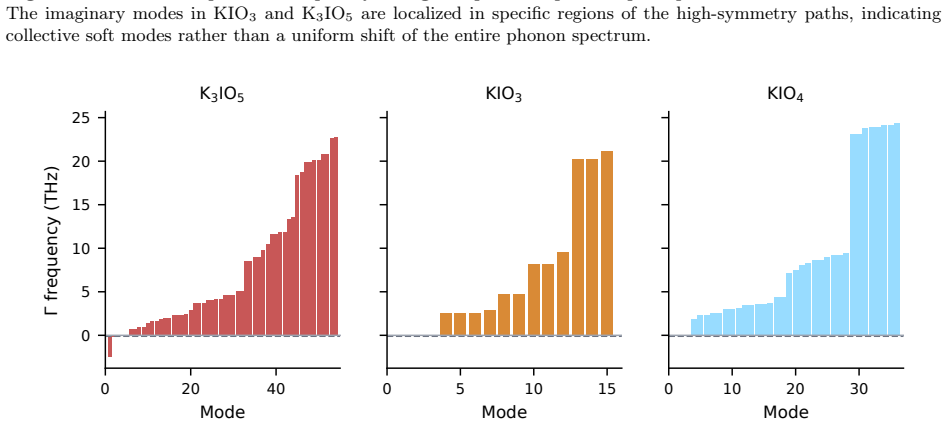
S_train = ω̂ + 0.6 S_thr + 0.1 S_geom
- stability thresholds τ and primary screening τ=−0.1 THz =
τ ∈ {−0.001,−0.01,−0.1,−1.0} THz; main τ=−0.1
- geometry MDN stability weight temperature T and τ_stable =
τ_stable=−0.1 THz, T=0.2
- ω_min clip range for regression =
[−5, 0] THz
assumptions (6)
- domain assumption Dynamical stability for screening is adequately represented by the harmonic minimum phonon frequency relative to fixed thresholds (esp. ω_min > −0.1 THz).
- domain assumption MatterSim+phonopy labels are useful large-scale proxies for learning stability ranking, even when final interest is DFT-level stability.
- domain assumption Formula-level exclusion sufficiently prevents leakage for fair ranking evaluation across generators and DFT sets.
- domain assumption Periodic atom graph + line graph message passing can encode the structural features needed for dynamical-stability ranking.
- standard math Standard GNN/multi-task learning and pairwise ranking losses are valid optimization machinery (no new math foundations claimed).
- ad hoc to paper Within-pool z-score standardization of head outputs is an appropriate way to combine heterogeneous scores for reranking.
invented entities (2)
-
PhononScore / PhononScore-DFT unified ranking score
independent evidence
-
Multi-fidelity PhononScore training dataset (157,463 structures)
independent evidence
Cite this review
Pith. "Pith review of PhononScore: a phonon-aware scoring function for dynamical stability." pith.science (2026). https://pith.science/paper/EOP7NQ37
@misc{pith2026260708518,
  author       = {Pith},
  title        = {Pith review of: PhononScore: a phonon-aware scoring function for dynamical stability},
  year         = {2026},
  howpublished = {\url{https://pith.science/paper/EOP7NQ37}},
  note         = {Machine review of arXiv:2607.08518}
}
read the original abstract
In recent years, crystal generation models have enabled the design of massive numbers of candidate materials. However, the lack of dynamical stability among generated structures has become a major bottleneck preventing their translation into practical materials discovery. To address this challenge, we propose PhononScore, a phonon-aware scoring function for crystal generation. Unlike computationally expensive explicit phonon calculations, PhononScore predicts a unified stability score from crystal structures, enabling ranking of candidate materials dynamical stability with second-level computational cost. We construct a multi-fidelity phonon dataset containing 157,463 crystal structures. On the PhononBench benchmark, PhononScore improves the average dynamical stability rate of candidate pools generated by nine crystal generation models from 30.7% to 83.7%, achieving a 2.72-fold enrichment of stable structures, while the average stability rate of the Top-10 candidates reaches 97.5%. On a high-fidelity DFT-PBE phonon benchmark, the DFT-finetuned PhononScore-DFT increases the Top-100 stability rate to 93.0% and achieves 5-6-fold enrichment of dynamically stable structures under an extremely imbalanced hard-screening scenario. As a materials-screening tool analogous to scoring functions in drug discovery, PhononScore can serve directly as a dynamical-stability feedback signal for crystal generation, active learning, and reinforcement learning, enabling second-level stability-aware reranking without explicit phonon calculations and providing a unified and efficient dynamical stability evaluator for high-throughput materials discovery, active learning, reinforcement learning, and closed-loop inverse design. The online PhononScore platform is available at: http://phononbench.cn/phononscore/
Figures


Figures from the paper (8 more)


Reference graph
Works this paper leans on
-
[1]
A generative model for inorganic materials design.Nature, 639(8055):624–632, 2025
Claudio Zeni, Robert Pinsler, Daniel Zügner, Andrew Fowler, Matthew Horton, Xiang Fu, Zilong Wang, Aliaksandra Shysheya, Jonathan Crabbé, Shoko Ueda, Roberto Sordillo, Lixin Sun, Jake Smith, Bichlien Nguyen, Hannes Schulz, Sarah Lewis, Chin-Wei Huang, Ziheng Lu, Yichi Zhou, Han Yang, Hongxia Hao, Jielan Li, Chunlei Yang, Wenjie Li, Ryota Tomioka, and Tian...
work page 2025
-
[2]
Schoenholz, Muratahan Aykol, Gowoon Cheon, and Ekin Dogus Cubuk
Amil Merchant, Simon Batzner, Samuel S. Schoenholz, Muratahan Aykol, Gowoon Cheon, and Ekin Dogus Cubuk. Scaling deep learning for materials discovery.Nature, 624(7990):80–85, 2023
work page 2023
-
[3]
Xiao-Qi Han, Zhenfeng Ouyang, Peng-Jie Guo, Hao Sun, Ze-Feng Gao, and Zhong-Yi Lu. In- vDesFlow: AnAI-drivenmaterialsinversedesignworkflowtoexplorepossiblehigh-temperature superconductors.Chin. Phys. Lett., 42(4):047301, 2025
work page 2025
-
[4]
Xiao-Qi Han, Peng-Jie Guo, Ze-Feng Gao, Hao Sun, and Zhong-Yi Lu. Invdesflow-al: active learning-basedworkflowforinversedesignoffunctionalmaterials.npj Computational Materials, 11(1):364, 2025
work page 2025
-
[5]
AI-Driven Inverse Design of Materials: Past, Present, and Future
Xiao-Qi Han, Xin-De Wang, Meng-Yuan Xu, Zhen Feng, Bo-Wen Yao, Peng-Jie Guo, Ze-Feng Gao, and Zhong-Yi Lu. AI-Driven Inverse Design of Materials: Past, Present, and Future. Chinese Physics Letters, 42(2):027403, 2025
work page 2025
-
[6]
Crystal Structure Prediction by Joint Equivariant Diffusion on Lattices and Fractional Coordinates
Rui Jiao, Wenbing Huang, Peijia Lin, Jiaqi Han, Pin Chen, Yutong Lu, and Yang Liu. Crystal Structure Prediction by Joint Equivariant Diffusion on Lattices and Fractional Coordinates. In Workshop on ”Machine Learning for Materials” ICLR 2023, 2023
work page 2023
-
[7]
Crystalflow: a flow-based generative model for crystalline materials
Xiaoshan Luo, Zhenyu Wang, Qingchang Wang, Xuechen Shao, Jian Lv, Lei Wang, Yanchao Wang, and Yanming Ma. Crystalflow: a flow-based generative model for crystalline materials. Nature Communications, 16(1):9267, 2025
work page 2025
-
[8]
Mouyang Cheng, Weiliang Luo, Hao Tang, Bowen Yu, Yongqiang Cheng, Weiwei Xie, Ju Li, Heather J. Kulik, and Mingda Li. Enhancing materials discovery with valence constrained design in generative modeling, 2025
work page 2025
Show all 47 references
-
[9]
High-temperature superconductivity inLi2AuH6 mediated by strong electron-phonon coupling under ambient pressure.Phys
Zhenfeng Ouyang, Bo-Wen Yao, Xiao-Qi Han, Peng-Jie Guo, Ze-Feng Gao, and Zhong-Yi Lu. High-temperature superconductivity inLi2AuH6 mediated by strong electron-phonon coupling under ambient pressure.Phys. Rev. B, 111:L140501, Apr 2025
2025
-
[10]
Superconductivity in atom-intercalated quaternary hydrides under ambient pressure.Phys
Bo-Wen Yao, Zhenfeng Ouyang, Xiao-Qi Han, Chang-Jiang Wu, Peng-Jie Guo, Ze-Feng Gao, and Zhong-Yi Lu. Superconductivity in atom-intercalated quaternary hydrides under ambient pressure.Phys. Rev. B, 113:094509, Mar 2026
2026
-
[11]
Phononbench:a large-scale phonon-based benchmark for dynamical stability in crystal generation, 2025
Xiao-Qi Han, Peng-Jie Guo, Ze-Feng Gao, and Zhong-Yi Lu. Phononbench:a large-scale phonon-based benchmark for dynamical stability in crystal generation, 2025. 17
2025
-
[12]
Mattersim: A deep learning atomistic model across elements, temperatures and pressures, 2024
Han Yang, Chenxi Hu, Yichi Zhou, Xixian Liu, Yu Shi, Jielan Li, Guanzhi Li, Zekun Chen, ShuizhouChen, ClaudioZeni, MatthewHorton, RobertPinsler, AndrewFowler, DanielZügner, Tian Xie, Jake Smith, Lixin Sun, Qian Wang, Lingyu Kong, Chang Liu, Hongxia Hao, and Ziheng Lu. Mattersi...
2024
-
[13]
Antoine Loew, Dewen Sun, Hai-Chen Wang, Silvana Botti, and Miguel A. L. Marques. Univer- salmachinelearninginteratomicpotentialsarereadyforphonons.npj Computational Materials, 11(1):178, 2025
2025
-
[14]
Graph networks as a universal machine learning framework for molecules and crystals.Chemistry of Materials, 31(9):3564–3572, 2019
Chi Chen, Weike Ye, Yunxing Zuo, Chen Zheng, and Shyue Ping Ong. Graph networks as a universal machine learning framework for molecules and crystals.Chemistry of Materials, 31(9):3564–3572, 2019
2019
-
[15]
A universal graph deep learning interatomic potential for the periodic table.Nature Computational Science, 2(11):718–728, 2022
Chi Chen and Shyue Ping Ong. A universal graph deep learning interatomic potential for the periodic table.Nature Computational Science, 2(11):718–728, 2022
2022
-
[16]
Bartel, and Gerbrand Ceder
Bowen Deng, Peichen Zhong, KyuJung Jun, Janosh Riebesell, Kevin Han, Christopher J. Bartel, and Gerbrand Ceder. Chgnet as a pretrained universal neural network potential for charge-informed atomistic modelling.Nature Machine Intelligence, 5(9):1031–1041, 2023
2023
-
[17]
Mace: Higher order equivariant message passing neural networks for fast and accurate force fields
Ilyes Batatia, David P Kovacs, Gregor Simm, Christoph Ortner, and Gabor Csanyi. Mace: Higher order equivariant message passing neural networks for fast and accurate force fields. In S. Koyejo, S. Mohamed, A. Agarwal, D. Belgrave, K. Cho, and A. Oh, editors,Advances in Neural I...
2022
-
[18]
Pet-mad as a lightweight universal interatomic potential for advanced materials modeling.Nature Communications, 16(1):10653, 2025
Arslan Mazitov, Filippo Bigi, Matthias Kellner, Paolo Pegolo, Davide Tisi, Guillaume Fraux, Sergey Pozdnyakov, Philip Loche, and Michele Ceriotti. Pet-mad as a lightweight universal interatomic potential for advanced materials modeling.Nature Communications, 16(1):10653, 2025
2025
-
[19]
Lawrence Zitnick
XiangFu, BrandonM.Wood, LuisBarroso-Luque, DanielS.Levine, MengGao, MiskoDzamba, and C. Lawrence Zitnick. Learning smooth and expressive interatomic potentials for physical property prediction, 2025
2025
-
[20]
DPA-2: a large atomic model as a multi-task learner.npj Computational Materials, 10(1):293, 2024
Duo Zhang, Xinzijian Liu, Xiangyu Zhang, et al. DPA-2: a large atomic model as a multi-task learner.npj Computational Materials, 10(1):293, 2024
2024
-
[21]
A graph neural network for the era of large atomistic models.npj Computational Materials, 2026
Duo Zhang, Anyang Peng, Chun Cai, Wentao Li, Yuanchang Zhou, Jinzhe Zeng, Mingyu Guo, Chengqian Zhang, Bowen Li, Hong Jiang, Tong Zhu, Weile Jia, Linfeng Zhang, and Han Wang. A graph neural network for the era of large atomistic models.npj Computational Materials, 2026
2026
-
[22]
Dpa4: Pushing the accuracy-cost frontier of interatomic potentials with emfa so(2) convolution, 2026
Tiancheng Li, Wentao Li, Anyang Peng, Jianming Xue, Linfeng Zhang, Duo Zhang, and Han Wang. Dpa4: Pushing the accuracy-cost frontier of interatomic potentials with emfa so(2) convolution, 2026
2026
-
[23]
Accurate structure prediction of biomolecular interactions with AlphaFold 3.Nature, 630(8016):493–500, 2024
Josh Abramson, Jonas Adler, Jack Dunger, and Richard Evans. Accurate structure prediction of biomolecular interactions with AlphaFold 3.Nature, 630(8016):493–500, 2024. 18
2024
-
[24]
Oleg Trott and Arthur J. Olson. Autodock vina: Improving the speed and accuracy of docking with a new scoring function, efficient optimization, and multithreading.Journal of Computa- tional Chemistry, 31(2):455–461, 2010
2010
-
[25]
Autodockvina 1.2.0: New docking methods, expanded force field, and python bindings.Journal of Chemical Information and Modeling, 61(8):3891–3898, 2021
JeromeEberhardt, DiogoSantos-Martins, AndreasF.Tillack, andStefanoForli. Autodockvina 1.2.0: New docking methods, expanded force field, and python bindings.Journal of Chemical Information and Modeling, 61(8):3891–3898, 2021
2021
-
[26]
Improving the reliability of language model-predicted structures as docking targets through geometric graph learning.Journal of Medicinal Chem- istry, 68(2):1956–1969, 2025
ChaoShen, XiaoqiHan, HengCai, TongChen, YuKang, PeichenPan, XiangyangJi, Chang-Yu Hsieh, Yafeng Deng, and Tingjun Hou. Improving the reliability of language model-predicted structures as docking targets through geometric graph learning.Journal of Medicinal Chem- istry, 68(2):1...
1956
-
[27]
Friesner, Jay L
Richard A. Friesner, Jay L. Banks, Robert B. Murphy, Thomas A. Halgren, Jasna J. Klicic, Daniel T. Mainz, Matthew P. Repasky, Eric H. Knoll, Mee Shelley, Jason K. Perry, David E. Shaw, Perry Francis, and Peter S. Shenkin. Glide: A new approach for rapid, accurate docking and s...
2004
-
[28]
Chao Shen, Xujun Zhang, Yafeng Deng, Junbo Gao, Dong Wang, Lei Xu, Peichen Pan, Tingjun Hou, andYuKang. Boostingprotein–ligandbindingposepredictionandvirtualscreeningbased on residue–atom distance likelihood potential and graph transformer.Journal of Medicinal Chemistry, 65(15...
2022
-
[29]
Ballard, Joshua Bambrick, Sebastian Bodenstein, David A
Josh Abramson, Jonas Adler, Jack Dunger, Richard Evans, Tim Green, Alexander Pritzel, Olaf Ronneberger, Lindsay Willmore, Andrew J. Ballard, Joshua Bambrick, Sebastian Bodenstein, David A. Evans, Adam C. Ferris, Isaac Good, James B. Hamrick, Demis Hassabis, Pushmeet Kohli, Cle...
2024
-
[30]
Phononbench-mp40: a spectrum-resolved bench- mark dataset for phonon stability.Chinese Physics B, 2026
Wen-Kao Li, Ze-Feng Gao, and Zhong-Yi Lu. Phononbench-mp40: a spectrum-resolved bench- mark dataset for phonon stability.Chinese Physics B, 2026
2026
-
[31]
Mdr phonon calculation database.https: //mdr.nims.go.jp/collections/8g84ms862?locale=en, 2024
National Institute for Materials Science (NIMS). Mdr phonon calculation database.https: //mdr.nims.go.jp/collections/8g84ms862?locale=en, 2024. Accessed: 2024-11-04
2024
-
[32]
Atomistic line graph neural network for improved ma- terials property predictions.npj Computational Materials, 7(1):185, 2021
Kamal Choudhary and Brian DeCost. Atomistic line graph neural network for improved ma- terials property predictions.npj Computational Materials, 7(1):185, 2021
2021
-
[33]
Margraf, and Stephan Günnemann
Johannes Gasteiger, Shankari Giri, Johannes T. Margraf, and Stephan Günnemann. Fast and uncertainty-aware directional message passing for non-equilibrium molecules, 2022
2022
-
[34]
Crystograph: A comprehensive predictive model for crystal material properties and the benchmark.Battery Energy, 4(4):e70004, 2025
Hongyi Wang, Ji Sun, Jinzhe Liang, Li Zhai, Zitian Tang, Zijian Li, Wei Zhai, Xusheng Wang, Weihao Gao, and Sheng Gong. Crystograph: A comprehensive predictive model for crystal material properties and the benchmark.Battery Energy, 4(4):e70004, 2025
2025
-
[35]
Kresse and J
G. Kresse and J. Furthmüller. Efficient iterative schemes for ab initio total-energy calculations using a plane-wave basis set.Phys. Rev. B, 54:11169–11186, Oct 1996. 19
1996
-
[36]
Kresse and J
G. Kresse and J. Furthmüller. Efficiency of ab-initio total energy calculations for metals and semiconductors using a plane-wave basis set.Computational Materials Science, 6(1):15–50, 1996
1996
-
[37]
First-principles phonon calculations with phonopy and phono3py.J
Atsushi Togo. First-principles phonon calculations with phonopy and phono3py.J. Phys. Soc. Jpn., 92(1):012001, 2023
2023
-
[38]
Implementation strategies in phonopy and phono3py.J
Atsushi Togo, Laurent Chaput, Terumasa Tadano, and Isao Tanaka. Implementation strategies in phonopy and phono3py.J. Phys. Condens. Matter, 35(35):353001, 2023. Acknowledgement:The work is supported by Beijing Natural Science Foundation(No.Z250005), the National Natural Scienc...
2023
-
[39]
PhononScore Captures the Ranking of Dynamical Stability
-
[40]
Robustness of PhononScore Across Stability Thresholds
-
[41]
Selection of the Standardized Score-Combination Weights
-
[42]
Additional DFT-PBE Transfer Metrics
-
[43]
Supplementary DFT Hard-Screening Analysis
-
[44]
Representative PhononScore-DFT Case Series
-
[45]
Additional K–I–O Phonon Diagnostics
-
[46]
Dataset Splitting and Formula-Level Exclusion
-
[47]
Training Objectives and Score Definitions A PhononScore Captures the Ranking of Dynamical Stability Figure. 5 illustrates the relationship between the final PhononScore and the true minimum phonon frequencyω min for all 8,000 generated crystal candidates collected from eight c...
Reviewed July 10, 2026 · model on record in the stance chip above.
Discussion (0). Continue with ORCID to comment.