REVIEW 4 minor 1 cited by
Large families of partition measures share the same moments, including two distinct sandpile-group laws for p=2.
Reviewed by Pith at T0; open to challenge. T0 means a machine referee read the full paper against a public rubric. the ladder, T0–T4 →
T0 review · grok-4.5
2026-07-10 05:04 UTC pith:7MUQG5HV
load-bearing objection Solid construction of multi-parameter moment-sharing families that cleanly unifies the Mészáros and bipartite p=2 sandpile cases; the bipartite conjecture is open but cleanly separated.
Sandpile groups of random bipartite graphs and families of distributions with the same moments
The pith
A machine-rendered reading of the paper's core claim, the machinery that carries it, and where it could break.
Core claim
For every strict partition κ of length r there exists a 2^{r−1}-parameter family of measures on partitions, all sharing the same collection of μ-moments as the weighted measure ˜P^{Sym,κ}_p. The two special p=2 sandpile distributions—one for even-regular graphs and one conjectured for bipartite graphs—both sit inside the r=1 subfamily and therefore have identical moments p^{n(μ)+ℓ(μ)}.
What carries the argument
The measures ˜P^{Sym,κ}_{p,α} obtained by multiplying the infinite symmetric cokernel measure by p^{∑κ_i λ′_i} and then taking affine combinations of the odd-sign twists indexed by subsets of [r]; their moments are computed by expressing the surjection counts via Hall–Littlewood skew polynomials and summing the resulting products of transition kernels K(a,b) with q-hypergeometric identities.
Load-bearing premise
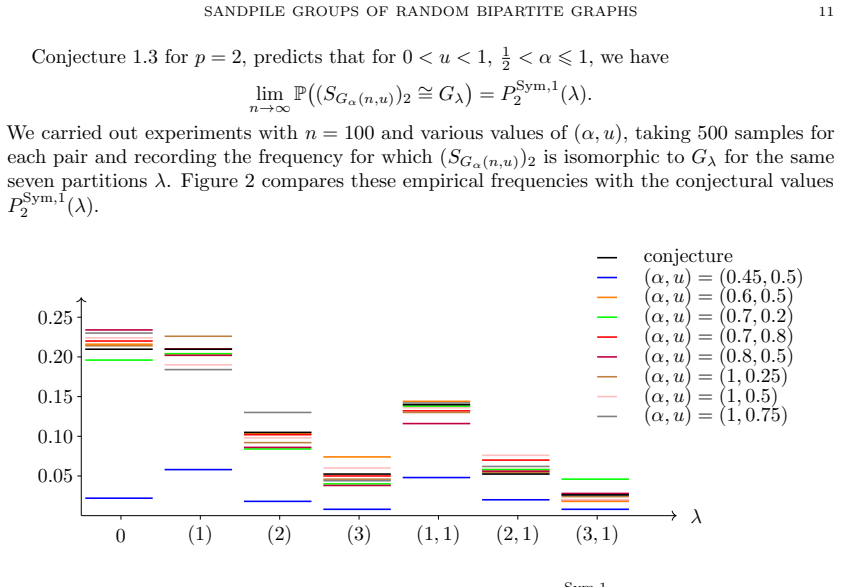
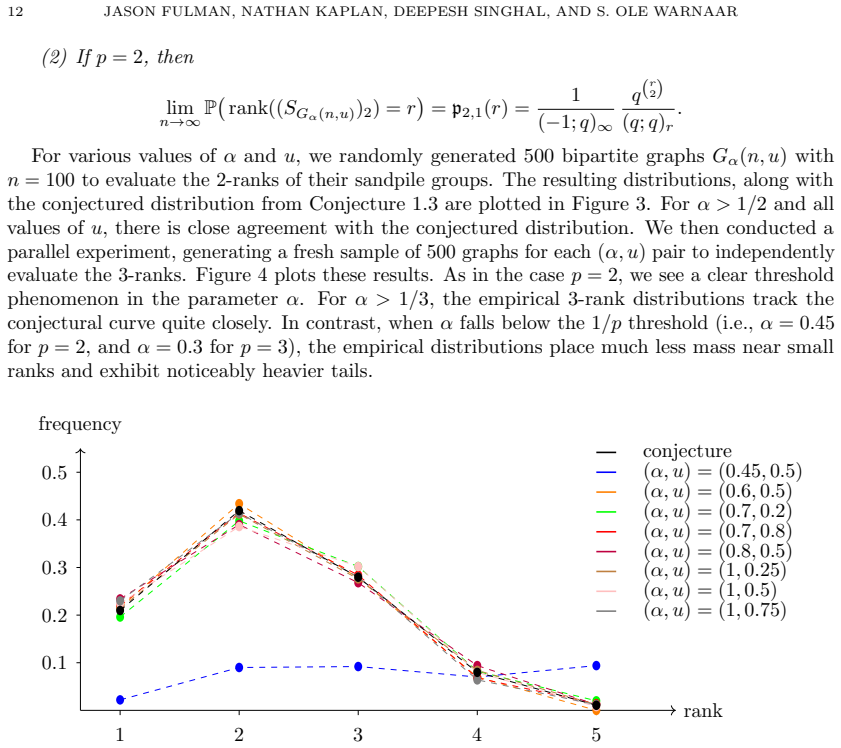
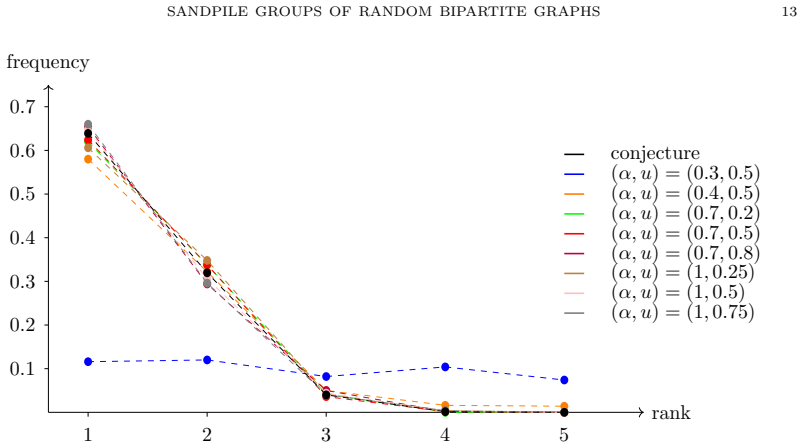
The numerical evidence offered for the bipartite-sandpile conjecture consists of only 500 samples of graphs on 100 vertices and supplies no concentration bounds that would justify the infinite-n limit.
What would settle it
Compute the empirical distribution of the 2-Sylow of the sandpile group for random bipartite graphs with part sizes n and ⌈αn⌉, α>1/2, for n several thousand, and check whether the observed frequencies for partitions of length 1–4 converge to 2^{ℓ(λ)−1}P^{Sym}_{∞,2}(λ).
Editorial analysis
A structured set of objections, weighed in public.
Referee Report
Summary. The paper constructs large families of measures on partitions that share identical μ-moments, using Hall–Littlewood specializations and transition kernels K(a,b). For a strict partition κ of length r it produces a 2^{r-1}-parameter family ˜P^{Sym,κ}_{p,α} (α∈A_r) whose moments equal those of ˜P^{Sym,κ}_p (Theorems 1.8–1.9); the r=1 subfamily recovers both Mészáros’ even-d, p=2 distribution and the conjectural p=2 bipartite distribution, both having moments p^{n(μ)+l(μ)} (Theorem 1.10). The same machinery yields closed-form moments for Cohen–Lenstra, Malle-type and Garton-type measures (Theorems 1.11–1.13). Conjecture 1.3 on Sylow p-subgroups of random bipartite graphs is stated and supported by n=100 numerics.
Significance. The work supplies the first systematic source of non-uniqueness for the method of moments when moments exceed the Wood bound, and cleanly embeds two previously isolated special cases (Mészáros even-d p=2 and the bipartite p=2 conjecture) into a single geometric family. The proofs are self-contained, relying only on the skew Cauchy identity and classical q-hypergeometric summations; the polytope A_r is shown to be a cube, guaranteeing non-negativity of the affine combinations. The moment formulae for the Cohen–Lenstra, Malle and Garton families are new for general real parameters and finite d. The numerical experiments and accompanying code repository give concrete, falsifiable predictions for Conjecture 1.3.
minor comments (4)
- [Section 2] Section 2: the n=100, 500-sample experiments for Conjecture 1.3 lack error bars or concentration bounds; a short remark that the numerics are only heuristic would clarify the separation between proved theorems and open conjecture.
- [§1.5] After (1.7): the definition of the polytope A_r is clear, but a one-sentence reminder that the inequalities are exactly those needed for non-negativity of every coordinate would help the reader.
- [§4.1] Lemma 4.1 and Corollary 4.2: the appeal to dominated convergence for the a o∞ limit is correct but could be flagged more explicitly for readers less familiar with q-series.
- [References] References: the forthcoming preprint [20] of the third author is cited for the odd-p case of Conjecture 1.3; if a public arXiv link becomes available before publication it should be added.
Circularity Check
No significant circularity: moments are derived from Hall–Littlewood identities and q-series, not inserted by definition or self-citation.
full rationale
The paper’s central claims (Theorems 1.8–1.10) construct families of measures that share identical μ-moments and prove those moments equal p^{n(μ)+|κ|l(μ)} (or the normalized form p^{n(μ)+kl(μ)}). The derivation proceeds by rewriting P^Sym_∞,p via the transition kernels K(a,b) (Eqs. 4.1–4.3), expressing |Sur_p(λ,μ)| via Hall–Littlewood specializations (Prop. 1.5, Lemmas 4.3), evaluating the resulting multi-sums by induction with the q-hypergeometric identities of Lemmas 4.1, 4.4, 4.8 (proved from the 2φ0 evaluation in Prop. 6.1), and verifying that odd-cardinality sign flips leave the moments unchanged (Thm. 4.10). Normalization constants are fixed by the empty-partition moment so that the measures become probability distributions; the polytope A_r is defined by the linear inequalities that keep all probabilities non-negative (Lemma 6.5). None of these steps inserts the target moment formula by hand, fits a free parameter to data that is later “predicted,” or relies on a uniqueness theorem whose only support is a self-citation. Background formulas from Fulman–Kaplan 2019 are re-derived in Section 5 via the same Hall–Littlewood machinery. The open Conjecture 1.3 and its n=100 numerics are cleanly separated from the proved statements and do not underwrite them. Consequently the derivation chain is self-contained and free of circular reduction.
Axiom & Free-Parameter Ledger
axioms (4)
- domain assumption Wood’s universality theorem for cokernels of random symmetric p-adic matrices (Theorem 1.1 / [23])
- domain assumption Mészáros’s theorem for d-regular graphs (Theorem 1.2 / [15])
- standard math Principal specializations and the skew Cauchy identity for Hall–Littlewood polynomials (Macdonald, Chapter III)
- domain assumption Koplewitz’s rank asymptotics for bipartite sandpile groups (Theorem 1.4 / [11])
invented entities (1)
-
The signed measures ˜P^{Sym,κ}_{p,S} and the affine combinations ˜P^{Sym,κ}_{p,α} for α∈A_r
no independent evidence
read the original abstract
Recently, there has been significant interest in applying the method of moments developed by Wood and others to study distributions of finite abelian groups that arise in number theory and combinatorics. When the moments do not grow too fast, they determine a unique distribution. We construct large families of distributions that have the same moments. These families include several distributions that arise naturally in the study of sandpile groups of families of random graphs. Wood determined the distribution of Sylow $p$-subgroups of sandpile groups of Erd\H{o}s--R\'enyi random graphs. This was extended by M\'esz\'aros to sandpile groups of random $d$-regular graphs, who observed an interesting special case when $d$ is even and $p = 2$. We study Sylow $p$-subgroups of sandpile groups of random bipartite graphs and similarly find a special case for $p =2$. Although this distribution differs from that of M\'esz\'aros, we show that they have the same moments and fit into our broader construction. To compute the moments of the distributions we study, we apply combinatorial tools from the theory of Hall--Littlewood functions.
Figures

Forward citations
Cited by 1 Pith paper
-
Distribution of Sandpile groups of random bipartite graphs
For odd primes p and α>1/p the p-Sylow of the sandpile group of G_α(n,u) converges in distribution to P^Sym_∞,p after discarding a rare set of graphs with too many p-divisible degrees.
Reference graph
Works this paper leans on
-
[1]
Positivity preserving transformations for q-binomial coefficients
Alexander Berkovich and S Ole Warnaar. Positivity preserving transformations for q-binomial coefficients. Transactions of the American Mathematical Society, 357(6):2291–2351, 2005
work page 2005
-
[2]
Atal Bhargava, Jack DePascale, and Jake Koenig. The rank of the sandpile group of random directed bipartite graphs.Annals of Combinatorics, 27(4):979–992, 2023
work page 2023
-
[3]
Vladimir V Bytev and Pengming Zhang. q-Derivatives of multivariable q-hypergeometric function with respect to their parameters.Physics of Particles and Nuclei Letters, 18(3):284–289, 2021
work page 2021
-
[4]
Julien Clancy, Nathan Kaplan, Timothy Leake, Sam Payne, and Melanie Matchett Wood. On a Cohen–Lenstra heuristic for Jacobians of random graphs.Journal of Algebraic Combinatorics, 42(3):701–723, 2015
work page 2015
-
[5]
On the distribution of divisor class groups of curves over a finite field
Eduardo Friedman and Lawrence C Washington. On the distribution of divisor class groups of curves over a finite field. InTh´ eorie des nombres, pages 227–239. de Gruyter Berlin, 1989
work page 1989
-
[6]
Random partitions and Cohen–Lenstra heuristics.Annals of Combina- torics, 23(2):295–315, 2019
Jason Fulman and Nathan Kaplan. Random partitions and Cohen–Lenstra heuristics.Annals of Combina- torics, 23(2):295–315, 2019
work page 2019
-
[7]
Sandpile groups of random bipartite graphs – numerical experiments
Jason Fulman, Nathan Kaplan, Deepesh Singhal, and S Ole Warnaar. Sandpile groups of random bipartite graphs – numerical experiments. https://github.com/DDeepuS/Sandpile_group_Bipartite_graph, 2026. GitHub repository
work page 2026
-
[8]
Derek Garton. Random matrices, the Cohen–Lenstra heuristics, and roots of unity.Algebra & Number Theory, 9(1):149–171, 2015
work page 2015
-
[9]
Cambridge University Press, Cambridge, second edition, 2004
George Gasper and Mizan Rahman.Basic Hypergeometric Series, volume 96 ofEncyclopedia of Mathematics and its Applications. Cambridge University Press, Cambridge, second edition, 2004
work page 2004
-
[10]
The distribution of sandpile groups of random graphs with their pairings.Trans
Eliot Hodges. The distribution of sandpile groups of random graphs with their pairings.Trans. Amer. Math. Soc., 377(12):8769–8815, 2024
work page 2024
-
[11]
Sandpile groups of random bipartite graphs.Annals of Combinatorics, 27(1):1–18, 2023
Shaked Koplewitz. Sandpile groups of random bipartite graphs.Annals of Combinatorics, 27(1):1–18, 2023
work page 2023
-
[12]
Cohen-Lenstra heuristics and bilinear pairings in the presence of roots of unity
Michael Lipnowski, Will Sawin, and Jacob Tsimerman. Cohen–Lenstra heuristics and bilinear pairings in the presence of roots of unity.arXiv:2007.12533, 2020
work page internal anchor Pith review Pith/arXiv arXiv 2007
-
[13]
Ian G Macdonald.Symmetric Functions and Hall Polynomials. Oxford University Press, 1998
work page 1998
-
[14]
On the distribution of class groups of number fields.Experimental Mathematics, 19(4):465–474, 2010
Gunter Malle. On the distribution of class groups of number fields.Experimental Mathematics, 19(4):465–474, 2010
work page 2010
-
[15]
Andr´ as M´ esz´ aros. The distribution of sandpile groups of random regular graphs.Transactions of the American Mathematical Society, 373(9):6529–6594, 2020
work page 2020
-
[16]
Universality for cokernels of random matrix products.Advances in Mathematics, 438:Paper No
Hoi H Nguyen and Roger Van Peski. Universality for cokernels of random matrix products.Advances in Mathematics, 438:Paper No. 109451, 70, 2024
work page 2024
-
[17]
Local and global universality of random matrix cokernels.Math
Hoi H Nguyen and Melanie Matchett Wood. Local and global universality of random matrix cokernels.Math. Ann., 391(4):5117–5210, 2025
work page 2025
-
[18]
Bjorn Poonen and Eric Rains. Random maximal isotropic subspaces and Selmer groups.Journal of the American Mathematical Society, 25(1):245–269, 2012
work page 2012
-
[19]
The moment problem for random objects in a category
Will Sawin and Melanie Matchett Wood. The moment problem for random objects in a category. arXiv:2210.06279, 2024
work page internal anchor Pith review Pith/arXiv arXiv 2024
-
[20]
Sandpile groups of random bipartite graphs.Preprint, 2026
Deepesh Singhal. Sandpile groups of random bipartite graphs.Preprint, 2026
work page 2026
-
[21]
Symmetric functions and the explicit moment problem for abelian groups.Proc
Roger Van Peski. Symmetric functions and the explicit moment problem for abelian groups.Proc. Amer. Math. Soc., 153(7):2799–2812, 2025
work page 2025
-
[22]
S Ole Warnaar and Wadim Zudilin. Dedekind’s η-function and Rogers–Ramanujan identities.Bulletin of the London Mathematical Society, 44(1):1–11, 2012
work page 2012
-
[23]
Melanie Matchett Wood. The distribution of sandpile groups of random graphs.Journal of the American Mathematical Society, 30(4):915–958, 2017
work page 2017
-
[24]
Probability theory for random groups arising in number theory
Melanie Matchett Wood. Probability theory for random groups arising in number theory. InProceedings of the International Congress of Mathematicians, volume 6, pages 4476–4508, 2022. Department of Mathematics, University of Southern California Email address:fulman@usc.edu Department of Mathematics, University of California, Irvine Email address:nckaplan@ma...
work page 2022
discussion (0)
Sign in with ORCID, Apple, or X to comment. Anyone can read and Pith papers without signing in.