REVIEW 3 major objections 8 minor 74 references
Steering Neural Network Training through Interpretable Constraints Based on Partial Dependence
T0 review · 3 major / 8 minor · reviewed 2026-07-10 · glm-5.2
Pith's one-line read Constrain the average response, not the full function
desk verdict PD-constraint method for regression is solid and novel; the extrapolation story has a real soft spot worth addressing read the letter →
The pith
A machine-rendered reading of the paper's core claim, the machinery that carries it, and where it could break.
The reading
What carries the argument
The partial dependence of a model h on a feature subset x_k is the expectation of h(x_k, x_{-k}) over the marginal distribution of the complementary features x_{-k}. The method minimizes a weighted sum of the standard prediction loss and a PD-matching loss (Eq. 7–8), alternating between updating the network parameters theta and the prior function parameters phi. A separate dataset LS_PD of constraint points x_k can be drawn either from the training distribution or as evenly spaced values across the input domain.
What would settle it
On a regression problem where the true partial dependence on the constrained features is not representable by the chosen parametric family and does not even approximately match it, the constrained model should perform no better than an unconstrained baseline in both prediction error and PD fidelity. The paper's own mis-specification experiment (Appendix C) tests only cases where the wrong form still reasonably approximates the true one.
Extended reading notes
Core claim
A neural network can be steered during training so that its partial dependence on selected features matches a known functional form, and when the constraint is applied over an evenly spaced grid rather than only at observed data points, the resulting model is simultaneously more accurate, more data-efficient, and more faithful to the injected knowledge — especially in extrapolation regimes where unconstrained models and in-distribution constraints fail.
Load-bearing premise
The method assumes that the partial dependence of the target function on the selected features is well-approximated by a known parametric form (a function of x_k plus scaling and bias constants). If the true PD involves complex interactions that cannot be captured by such a form, the constraint is mis-specified and may not help.
Editorial analysis
A structured set of objections, weighed in public.
Referee Report
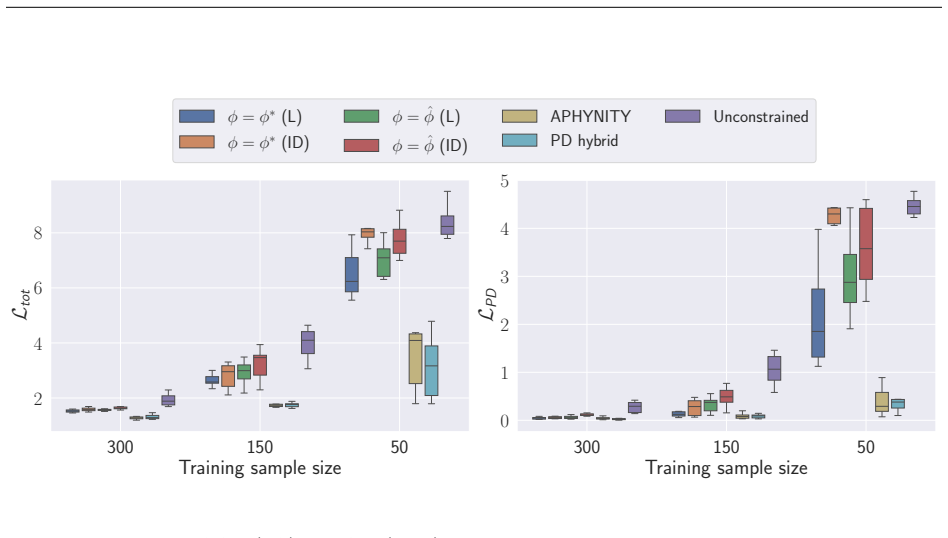
Summary. The paper introduces a method for steering neural network training by constraining the partial dependence (PD) of the model on selected features to align with a known functional form. The authors formulate a penalized objective (Eq. 7) that balances standard mean-squared error with a PD-matching loss, and propose an alternating optimization algorithm (Algorithm 1). The method is evaluated on synthetic regression problems (Friedman, Product), real-world datasets (Concrete, PHALK), and a dynamical systems forecasting task (damped pendulum). The authors compare four configurations (ground-truth vs. approximated prior; in-distribution vs. linspace constraint) against unconstrained training and physics-informed baselines, finding that constrained models are more data-efficient, generalize better under domain shift, and yield PD estimates more faithful to prior knowledge.
Significance. The paper addresses a genuine gap in explanation-guided learning (EGL): most prior work targets classification with feature-importance priors, whereas this work targets regression with functional-form priors on partial dependence. The formulation is clean and the relaxation from hard constraint (Eq. 5) to penalized objective (Eq. 7) is standard and well-motivated. The distinction between in-distribution and linspace constraining is a useful practical contribution, and the extension to dynamical systems (Appendix A.2) broadens applicability. The empirical coverage is commendable: synthetic problems with known ground truth, two real-world datasets, a dynamical system, and a comparison to physics-informed hybrid models (Appendix B). The mis-specification analysis (Appendix C) is a thoughtful addition that few papers in this area include.
major comments (3)
- Appendix C.2 constrains the Concrete dataset with a square-root PD (genuinely mis-specified, since the assumed true relationship is logarithmic) and reports that extrapolation performance is 'very close to that of models constrained with the logarithmic PD' and that linspace constraining 'reaches performance close to that obtained in the interpolation setting, even though prior knowledge is fundamentally mis-specified.' This directly implies that the extrapolation benefit stems partly from the regularization effect of imposing any smooth constraint on the PD, not specifically from correct domain knowledge. If wrong knowledge helps as much as right knowledge in the regime the paper emphasizes most (extrapolation with scarce data), the claimed mechanism—that performance gains come from correct knowledge alignment—is not fully supported. The authors should either (a) soften the causal claim
- On real-world datasets (§4.3, §4.4), claim (2) that 'interpretations align with user-provided knowledge' is partly circular: the PD is constrained to be logarithmic and then observed to be logarithmic. This is acknowledged implicitly by the absence of L_PD measurements on these datasets. The authors should clarify that on real-world data, only predictive performance is independently verifiable, while PD faithfulness is a consequence of the constraint by construction, not an independent validation of the prior.
- The method assumes the PD of the target function on the selected features is well-approximated by a known parametric form h_phi_k(x_k) (Eq. 3, §3.1). The derivation of Eq. 3 covers purely additive and purely multiplicative cases, but many real-world interactions do not decompose so cleanly. The paper does not discuss what happens when the true PD is not separable into a parametric form of x_k plus a constant. Appendix C shows robustness to mis-specification only for cases where the wrong form still reasonably approximates the true one (Fourier series for sine, square root for logarithm). A brief discussion of the failure mode—when the assumed form is structurally incompatible—would strengthen the paper.
minor comments (8)
- §3.2, Algorithm 1: the notation for the alternating schedule (s, r) is somewhat opaque. A brief inline comment explaining that S controls the frequency of phi-updates would help readers.
- §4.1, Figure 1: the y-axis label 'L_PD' lacks units/scale context. Figure 4 uses '×10^2' while Figure 1 does not; readers may miscompare across experiments.
- §4.3: the choice of logarithmic PD for age is attributed to Yeh (1998a), but the citation is to a neural network modeling paper. A more direct citation for the logarithmic relationship between concrete age and compressive strength would be appropriate.
- Appendix A.2.1: the redefinition of h_phi_k to map (x_0, x_1) -> (x_1, ...) is introduced abruptly. A sentence explaining that the PD constraint applies to the second component (acceleration) while the first component (velocity) is needed for trajectory integration would improve clarity.
- The term 'linspace constraint' is used throughout but defined only in §3.3. Using it in §4 before readers reach the definition could cause confusion; a forward reference or brief gloss at first use in §4 would help.
- Figure 9 (top row, 25 samples): the PD estimates for unconstrained models are described as 'diverging' but the visual scale makes it hard to distinguish from constrained models. Consider using a shared y-axis range or adding a zoomed inset.
- References: the PHALK dataset citation (Catalan et al., 2025; Batalla et al., 2026) lists a 2026 date for the introductory paper, which appears to be a future date. Please verify.
- §3.3: the distinction between LS and LS_PD is important but the notation is dense. A small worked example showing how LS_PD points are sampled for a 2D PD (e.g., the 25×25 grid mentioned in §4) would aid reproducibility.
Circularity Check
No circularity found; derivation is self-contained and empirically validated against external benchmarks.
full rationale
The paper's method defines a composite loss (Eq. 7) combining standard MSE (Eq. 6) with a PD-alignment penalty (Eq. 8). The PD is a well-defined functional of the model h_θ computed via Eq. 2, and the constraint function h_ϕ_k is either given ground-truth parameters (ϕ=ϕ*) or learned from raw outputs via Eq. 9. On synthetic problems (Friedman, Product, Pendulum), the evaluation metric L_PD is computed with ground-truth ϕ* that is independent of the fitted model, so there is no fitted-input-as-prediction circularity. On real-world datasets (Concrete, PHALK), the paper explicitly states it 'cannot measure L_PD' because ground truth is unknown, so it only reports L_tot—no circular claim of PD alignment is made there. The self-citation to Claes et al. (2025) appears only as a baseline comparison method (PD hybrid) in Appendix B, not as a load-bearing premise for the main derivation. The Appendix C.2 finding that mis-specified (square-root) priors still help in extrapolation is a legitimate scientific concern about mechanism attribution, but it is not circularity: the paper is transparent about the mis-specification and reports it honestly. The derivation chain from problem statement (Eq. 4-5) through relaxation (Eq. 7-8) to algorithm (Algorithm 1) contains no step where an output is defined in terms of itself.
Assumptions & free parameters
free parameters (6)
- lambda =
selected from {0.25, 0.5, 0.75}
- tau_2 =
selected from {5e-2, 5e-3, 5e-4}
- tau_1 =
1
- S =
50
- E =
1000
- phi (approximated prior) =
learned during training
assumptions (3)
- domain assumption The partial dependence of the target function on the selected features can be expressed as a parametric function h_phi_k(x_k) with scaling and bias constants (Eq. 3).
- domain assumption Gradient descent on the relaxed objective (Eq. 7) converges to a solution that approximately satisfies the PD constraint while minimizing prediction error.
- domain assumption The partial dependence estimator PD_N (Eq. 2) is a sufficiently accurate approximation of PD_infty (Eq. 1) for the training set sizes used.
Cite this review
Pith. "Pith review of Steering Neural Network Training through Interpretable Constraints Based on Partial Dependence." pith.science (2026). https://pith.science/paper/VQMTHEQO
@misc{pith2026260708641,
  author       = {Pith},
  title        = {Pith review of: Steering Neural Network Training through Interpretable Constraints Based on Partial Dependence},
  year         = {2026},
  howpublished = {\url{https://pith.science/paper/VQMTHEQO}},
  note         = {Machine review of arXiv:2607.08641}
}
read the original abstract
Over the last few years, there has been an increased interest in making machine learning models more interpretable. Although a great deal of effort goes into developing techniques for interpreting the interactions learned by a given model, fewer studies focus on assessing the quality of such explanations. Even fewer focus on how to adjust the model to produce explanations faithful to prior knowledge, a process known as explanation-guided learning. Furthermore, most approaches in this area focus on classification problems and usually assume prior knowledge about which input features or regions are most important. In this work, we introduce a new approach to steering neural networks based on partial dependence, such that their average response to certain features aligns with specific functional domain knowledge about the problem. We empirically demonstrate on a range of regression problems, including dynamical systems forecasting, that models whose training has been controlled using our method perform better than unconstrained models and are more data-efficient. Moreover, we highlight that interpretations obtained from the former actually align with the user-provided knowledge, whereas those obtained from the latter do not.
Figures


Figures from the paper (31 more)




Reference graph
Works this paper leans on
-
[1]
A Close Look at Deep Learning with Small Data , year=
Brigato, Lorenzo and Iocchi, Luca , booktitle=. A Close Look at Deep Learning with Small Data , year=
-
[2]
A survey on deep learning tools dealing with data scarcity: definitions, challenges, solutions, tips, and applications , author=. Journal of Big Data , volume=. 2023 , publisher=
work page 2023
-
[3]
Peeking inside the black-box: a survey on explainable artificial intelligence (XAI) , author=. IEEE access , volume=. 2018 , publisher=
work page 2018
-
[4]
ACM computing surveys (CSUR) , volume=
A survey of methods for explaining black box models , author=. ACM computing surveys (CSUR) , volume=. 2018 , publisher=
work page 2018
-
[5]
2018 IEEE 5th International Conference on data science and advanced analytics (DSAA) , pages=
Explaining explanations: An overview of interpretability of machine learning , author=. 2018 IEEE 5th International Conference on data science and advanced analytics (DSAA) , pages=. 2018 , organization=
work page 2018
-
[6]
Explainable ai: A review of machine learning interpretability methods , author=. Entropy , volume=. 2020 , publisher=
work page 2020
- [7]
-
[8]
Journal of the Royal Statistical Society Series A: Statistics in Society , volume=
Generalized linear models , author=. Journal of the Royal Statistical Society Series A: Statistics in Society , volume=. 1972 , publisher=
work page 1972
Show all 74 references
-
[9]
Statistical science , volume=
Generalized additive models , author=. Statistical science , volume=. 1986 , publisher=
1986
-
[10]
Proceedings of the 21th ACM SIGKDD international conference on knowledge discovery and data mining , pages=
Intelligible models for healthcare: Predicting pneumonia risk and hospital 30-day readmission , author=. Proceedings of the 21th ACM SIGKDD international conference on knowledge discovery and data mining , pages=
-
[11]
Advances in neural information processing systems , volume=
Neural additive models: Interpretable machine learning with neural nets , author=. Advances in neural information processing systems , volume=
-
[12]
Advances in neural information processing systems , volume=
A unified approach to interpreting model predictions , author=. Advances in neural information processing systems , volume=
-
[13]
Annals of statistics , pages=
Greedy function approximation: a gradient boosting machine , author=. Annals of statistics , pages=. 2001 , publisher=
2001
-
[14]
journal of Computational and Graphical Statistics , volume=
Peeking inside the black box: Visualizing statistical learning with plots of individual conditional expectation , author=. journal of Computational and Graphical Statistics , volume=. 2015 , publisher=
2015
-
[15]
Journal of the Royal Statistical Society Series B: Statistical Methodology , volume=
Visualizing the effects of predictor variables in black box supervised learning models , author=. Journal of the Royal Statistical Society Series B: Statistical Methodology , volume=. 2020 , publisher=
2020
-
[16]
Proceedings of the IEEE conference on computer vision and pattern recognition , pages=
Learning deep features for discriminative localization , author=. Proceedings of the IEEE conference on computer vision and pattern recognition , pages=
-
[17]
Proceedings of the IEEE international conference on computer vision , pages=
Grad-cam: Visual explanations from deep networks via gradient-based localization , author=. Proceedings of the IEEE international conference on computer vision , pages=
-
[18]
2018 IEEE winter conference on applications of computer vision (WACV) , pages=
Grad-cam++: Generalized gradient-based visual explanations for deep convolutional networks , author=. 2018 IEEE winter conference on applications of computer vision (WACV) , pages=. 2018 , organization=
2018
-
[19]
2014 , eprint=
Deep Inside Convolutional Networks: Visualising Image Classification Models and Saliency Maps , author=. 2014 , eprint=
2014
-
[20]
IEEE Signal Processing Magazine , volume=
Algorithm unrolling: Interpretable, efficient deep learning for signal and image processing , author=. IEEE Signal Processing Magazine , volume=. 2021 , publisher=
2021
-
[21]
Advances in neural information processing systems , volume=
This looks like that: deep learning for interpretable image recognition , author=. Advances in neural information processing systems , volume=
-
[22]
Frontiers of Information Technology & Electronic Engineering , volume=
Visual interpretability for deep learning: a survey , author=. Frontiers of Information Technology & Electronic Engineering , volume=. 2018 , publisher=
2018
-
[23]
Wiley Interdisciplinary Reviews: Data Mining and Knowledge Discovery , volume=
Interpretability of machine learning-based prediction models in healthcare , author=. Wiley Interdisciplinary Reviews: Data Mining and Knowledge Discovery , volume=. 2020 , publisher=
2020
-
[24]
Multimedia Systems , volume=
A survey on the interpretability of deep learning in medical diagnosis , author=. Multimedia Systems , volume=. 2022 , publisher=
2022
-
[25]
Neural computing and applications , volume=
The importance of interpretability and visualization in machine learning for applications in medicine and health care , author=. Neural computing and applications , volume=. 2020 , publisher=
2020
-
[26]
2016 , eprint=
Rationalizing Neural Predictions , author=. 2016 , eprint=
2016
-
[27]
ACM Computing Surveys , volume=
Post-hoc interpretability for neural nlp: A survey , author=. ACM Computing Surveys , volume=. 2022 , publisher=
2022
-
[28]
Proceedings of the 29th international conference on computational linguistics , pages=
SHAP-based explanation methods: a review for NLP interpretability , author=. Proceedings of the 29th international conference on computational linguistics , pages=
-
[29]
ACM Computing Surveys , volume=
Going beyond xai: A systematic survey for explanation-guided learning , author=. ACM Computing Surveys , volume=. 2024 , publisher=
2024
-
[30]
proceedings of the 28th ACM SIGKDD conference on knowledge discovery and data mining , pages=
Res: A robust framework for guiding visual explanation , author=. proceedings of the 28th ACM SIGKDD conference on knowledge discovery and data mining , pages=
-
[31]
Proceedings of the ACM on Human-Computer Interaction , volume=
Aligning eyes between humans and deep neural network through interactive attention alignment , author=. Proceedings of the ACM on Human-Computer Interaction , volume=. 2022 , publisher=
2022
-
[32]
Advances in Neural Information Processing Systems , volume=
Visual correspondence-based explanations improve AI robustness and human-AI team accuracy , author=. Advances in Neural Information Processing Systems , volume=
-
[33]
2022 , eprint=
What to Learn, and How: Toward Effective Learning from Rationales , author=. 2022 , eprint=
2022
-
[34]
Proceedings of the 2008 conference on Empirical methods in natural language processing , pages=
Modeling annotators: A generative approach to learning from annotator rationales , author=. Proceedings of the 2008 conference on Empirical methods in natural language processing , pages=
2008
-
[35]
Advances in Neural Information Processing Systems , volume=
Improving deep learning interpretability by saliency guided training , author=. Advances in Neural Information Processing Systems , volume=
-
[36]
annotator rationales
Using “annotator rationales” to improve machine learning for text categorization , author=. Human language technologies 2007: The conference of the North American chapter of the association for computational linguistics; proceedings of the main conference , pages=
2007
-
[37]
Data Mining and Knowledge Discovery , volume=
Reflective-net: Learning from explanations , author=. Data Mining and Knowledge Discovery , volume=. 2024 , publisher=
2024
-
[38]
2011 International Conference on Computer Vision , pages=
Annotator rationales for visual recognition , author=. 2011 International Conference on Computer Vision , pages=. 2011 , organization=
2011
-
[39]
Proceedings of the Conference on Empirical Methods in Natural Language Processing
Rationale-augmented convolutional neural networks for text classification , author=. Proceedings of the Conference on Empirical Methods in Natural Language Processing. Conference on Empirical Methods in Natural Language Processing , volume=
-
[40]
, author=
Rationale-based Human-in-the-Loop via Supervised Attention. , author=. Dash@ kdd , year=
-
[41]
Proceedings of the AAAI conference on artificial intelligence , volume=
Supervising model attention with human explanations for robust natural language inference , author=. Proceedings of the AAAI conference on artificial intelligence , volume=
-
[42]
Advances in neural information processing systems , volume=
Towards robust interpretability with self-explaining neural networks , author=. Advances in neural information processing systems , volume=
-
[43]
2020 , eprint=
Trustworthy Convolutional Neural Networks: A Gradient Penalized-based Approach , author=. 2020 , eprint=
2020
-
[44]
Asian Conference on Machine Learning , pages=
Generating deep networks explanations with robust attribution alignment , author=. Asian Conference on Machine Learning , pages=. 2021 , organization=
2021
-
[45]
Proceedings of the IEEE conference on computer vision and pattern recognition , pages=
Tell me where to look: Guided attention inference network , author=. Proceedings of the IEEE conference on computer vision and pattern recognition , pages=
-
[46]
2019 , eprint=
Learning what and where to attend , author=. 2019 , eprint=
2019
-
[47]
2019 , eprint=
Embedding Human Knowledge into Deep Neural Network via Attention Map , author=. 2019 , eprint=
2019
-
[48]
2024 , eprint=
MEGL: Multimodal Explanation-Guided Learning , author=. 2024 , eprint=
2024
-
[49]
Proceedings of the IEEE/CVF Conference on Computer Vision and Pattern Recognition , pages=
Don't judge an object by its context: learning to overcome contextual bias , author=. Proceedings of the IEEE/CVF Conference on Computer Vision and Pattern Recognition , pages=
-
[50]
International conference on machine learning , pages=
Interpretations are useful: penalizing explanations to align neural networks with prior knowledge , author=. International conference on machine learning , pages=. 2020 , organization=
2020
-
[51]
2020 , eprint=
Teaching the Machine to Explain Itself using Domain Knowledge , author=. 2020 , eprint=
2020
-
[52]
2019 , eprint=
Incorporating Priors with Feature Attribution on Text Classification , author=. 2019 , eprint=
2019
-
[53]
Advances in Neural Information Processing Systems , volume=
Learning deep attribution priors based on prior knowledge , author=. Advances in Neural Information Processing Systems , volume=
-
[54]
Nature machine intelligence , volume=
Improving performance of deep learning models with axiomatic attribution priors and expected gradients , author=. Nature machine intelligence , volume=. 2021 , publisher=
2021
-
[55]
IEEE transactions on neural networks , volume=
Neural-network feature selector , author=. IEEE transactions on neural networks , volume=. 1997 , publisher=
1997
-
[56]
2020 IEEE International Conference on Multisensor Fusion and Integration for Intelligent Systems (MFI) , pages=
Batch-wise regularization of deep neural networks for interpretability , author=. 2020 IEEE International Conference on Multisensor Fusion and Integration for Intelligent Systems (MFI) , pages=. 2020 , organization=
2020
-
[57]
Proceedings of the AAAI conference on artificial intelligence , volume=
Regional tree regularization for interpretability in deep neural networks , author=. Proceedings of the AAAI conference on artificial intelligence , volume=
-
[58]
International conference on machine learning , pages=
Input convex neural networks , author=. International conference on machine learning , pages=. 2017 , organization=
2017
-
[59]
Statistics and computing , volume=
Shape constrained additive models , author=. Statistics and computing , volume=. 2015 , publisher=
2015
-
[60]
Advances in neural information processing systems , volume=
Unconstrained monotonic neural networks , author=. Advances in neural information processing systems , volume=
-
[61]
arXiv preprint arXiv:2002.01600 , year=
Linearly constrained neural networks , author=. arXiv preprint arXiv:2002.01600 , year=
2002 arXiv
-
[62]
Advances in Neural Information Processing Systems , volume=
Structured neural networks for density estimation and causal inference , author=. Advances in Neural Information Processing Systems , volume=
-
[63]
Advances in Neural Information Processing Systems , volume=
Integrating expert ODEs into neural ODEs: pharmacology and disease progression , author=. Advances in Neural Information Processing Systems , volume=
-
[64]
Advances in Neural Information Processing Systems , volume=
Physics-integrated variational autoencoders for robust and interpretable generative modeling , author=. Advances in Neural Information Processing Systems , volume=
-
[65]
arXiv preprint arXiv:1904.10416 , year=
Regression-enhanced random forests , author=. arXiv preprint arXiv:1904.10416 , year=
1904 arXiv
-
[66]
Journal of Statistical Mechanics: Theory and Experiment , volume=
Augmenting physical models with deep networks for complex dynamics forecasting , author=. Journal of Statistical Mechanics: Theory and Experiment , volume=. 2021 , publisher=
2021
-
[67]
ICLR 2022-The Tenth International Conference on Learning Representations , year=
Constrained physical-statistics models for dynamical system identification and prediction , author=. ICLR 2022-The Tenth International Conference on Learning Representations , year=
2022
-
[68]
Machine Learning , volume=
Hybrid additive modeling with partial dependence for supervised regression and dynamical systems forecasting , author=. Machine Learning , volume=. 2025 , publisher=
2025
-
[69]
SIAM Journal on Scientific and Statistical Computing , volume=
Multidimensional additive spline approximation , author=. SIAM Journal on Scientific and Statistical Computing , volume=. 1983 , publisher=
1983
-
[70]
Advances in Neural Information Processing Systems , year=
Neural Ordinary Differential Equations , author=. Advances in Neural Information Processing Systems , year=
-
[71]
1998 , howpublished =
Yeh, I-Cheng , title =. 1998 , howpublished =
1998
-
[72]
Cement and Concrete research , volume=
Modeling of strength of high-performance concrete using artificial neural networks , author=. Cement and Concrete research , volume=. 1998 , publisher=
1998
-
[73]
and Batalla, M
Catalan, J. and Batalla, M. and Martínez-Artero, J. , title=. 2025 , howpublished=
2025
-
[74]
Scientific Data , year=
Global basin-scale mapping of pH and alkalinity in inland waters , author=. Scientific Data , year=
Reviewed July 10, 2026 · model on record in the stance chip above.
Discussion (0). Continue with ORCID to comment.