REVIEW 3 major objections 7 minor 185 references
Learned policy replaces hand-tuning in distributed robot optimization
Reviewed by Pith at T0; open to challenge. T0 means a machine referee read the full paper against a public rubric. the ladder, T0–T4 →
T0 review · glm-5.2
2026-07-10 02:05 UTC pith:MUCANFRK
load-bearing objection Solid L2O approach to distributed Lie-group optimization; train-test dynamics mismatch is a real but non-fatal gap the 3 major comments →
Learning Adaptive Solvers for Distributed Factor Graph Optimization on Matrix Lie Groups
The pith
A machine-rendered reading of the paper's core claim, the machinery that carries it, and where it could break.
Core claim
The central mechanism is the replacement of fixed solver hyperparameters with a shared, locally-computed feedback policy. Each robot constructs a two-hop augmented graph from its own variables and the most recently received neighbor states, attaches node-level features (body velocity, gradient, communication staleness), edge-level features (residuals, precision weights), and graph-level features (intra/inter-robot residual norms, update magnitudes), and feeds these through a GPS graph transformer with a parameter prediction head. The predicted mass, damping, and step size are then consumed by the underlying Riemannian optimizer update. The key empirical finding is that this policy, trained只在
What carries the argument
The load-bearing machinery is the deep unfolding of the CORD Riemannian optimizer: each iteration's parameter selection is made differentiable, gradients of the final optimization cost flow back through 50 iterations of solver steps, and a graph neural network learns to map local optimization state to solver parameters. Implicit differentiation through a preconditioned conjugate gradient solver avoids memory blowup from backpropagating through linear solves.
Load-bearing premise
The central assumption is that a policy trained on small graphs (~500 nodes) and short horizons (50 iterations) will generalize to graphs with 10,000+ nodes and 500+ iterations. The paper acknowledges this limitation but the empirical results on the Rim dataset provide the main evidence that it holds.
What would settle it
If the learned policy fails to outperform well-tuned fixed parameters on problem instances whose topology, noise level, or communication regime differs substantially from training data, the core claim of robust generalization would be undermined. The CampusRoad3 synchronous result, where the policy enters premature refinement due to small local gradients despite large global error, is a concrete instance of this failure mode.
If this is right
- If a learned policy can replace hand-tuned parameters for distributed Lie group optimization, the same approach could extend to other distributed iterative solvers where parameter sensitivity is the main deployment bottleneck.
- The finding that parameters trained on 500-node, 50-iteration graphs transfer to 10,000-node, 500-iteration settings suggests that optimization dynamics have transferable structure that a policy can capture without problem-specific retraining.
- The phase-specific parameter schedules discovered by the policy (conservative early, aggressive late, communication-aware) provide empirical priors that could inform the design of non-learned adaptive solvers.
- Generalization beyond SE(3) to SL(4) projective alignment with a separate trained model suggests the framework is group-agnostic in principle, though whether a single policy could span multiple groups remains open.
Where Pith is reading between the lines
- The paper trains separate models for SE(3) and SL(4), leaving open whether a unified policy across Lie groups is feasible or whether group-specific dynamics require separate learned components.
- The conservatism on CampusRoad3 (where small local gradients cause premature refinement) suggests that purely local features may be fundamentally insufficient for detecting global optimality, and that some form of global or dual information may be necessary for robust convergence detection.
- The energy dissipation argument for the simplified training dynamics (Appendix D) suggests that the learned parameters preserve convergence properties of the underlying ODE, but this is shown only for the simplified system used during training, not for the full dynamics used at inference.
Editorial analysis
A structured set of objections, weighed in public.
Referee Report
Summary. The paper presents DeepCORD, a learning-augmented framework for distributed factor graph optimization over general matrix Lie groups. The method unfolds the CORD distributed Riemannian optimizer into differentiable iterations and trains a GNN-based feedback policy to predict adaptive solver parameters (mass, damping, step size) from local optimization context. Training is self-supervised via deep unfolding, minimizing unrolled objectives without requiring optimal solutions. The method is evaluated on SE(3) pose graph optimization (13 benchmark sequences under synchronous and asynchronous communication) and SL(4) projective submap alignment (3 TUM RGB-D sequences), demonstrating lower objective values than distributed baselines on most benchmarks. The approach is principled in preserving the geometric structure of the underlying optimizer while replacing manual parameter tuning with a learned policy.
Significance. The problem addressed—parameter sensitivity in distributed geometric optimization—is practically important for multi-robot SLAM and 3D reconstruction systems. The contribution of extending learning-to-optimize to distributed optimization over general matrix Lie groups, including under asynchronous communication, is novel and fills a genuine gap in the literature. The self-supervised training formulation (Eq. 7) that avoids dependence on optimal solutions is a strength, as is the demonstration of generalization to graphs larger than those in training (Rim: 10,195 nodes vs. training at ~500 nodes). The extension beyond SE(3) to SL(4) projective alignment, motivated by recent feed-forward SLAM systems, is timely. The extensive experimental evaluation across 26 PGO instances and 3 SL(4) datasets, with both synchronous and asynchronous protocols, provides substantial empirical support for the central claim.
major comments (3)
- Train-test dynamics mismatch (§4, Eq. 4 vs. Eq. 8/Appendix D). The policy is trained by unrolling a simplified ODE (Eq. 8) that omits the co-adjoint term ad*_ξ(Mξ) and the time-varying mass term Ṁξ, but at test time the full CORD dynamics (Eq. 4) are used. The co-adjoint term captures Lie-group non-commutativity and is potentially non-negligible for SE(3) (rotation-translation coupling) and especially SL(4) (15-dimensional algebra). Appendix D shows the simplified dynamics preserves energy dissipation qualitatively, but this does not establish that parameters optimal for the simplified dynamics remain near-optimal under the full dynamics. The paper should provide at least one of the following: (a) an ablation comparing test-time performance when the policy is trained on full vs. simplified dynamics, (b) empirical evidence that state distributions (ξ, gradient, residuals) encountered at测试
- SL(4) results show a large gap to centralized reference (Table 2). On TUM1, DeepCORD achieves cost 2.304 vs. reference 0.876—a gap of ~2.6×. While the paper attributes this to 'severe initial perturbations' (0.2 rad rotation, 0.1 m translation), it is unclear whether the dynamics mismatch described above contributes to this gap, or whether the gap reflects a fundamental limitation of the distributed approach under such perturbations. A sensitivity analysis varying the perturbation magnitude on SL(4) (analogous to Appendix A.3 for SE(3)) would help disentangle these factors and clarify whether the learned policy is limited by the training simplification or by problem difficulty.
- Generalization horizon (§4, §7). The policy is trained on K=50 unrolled iterations but evaluated over 500 iterations (Fig. 5). While the performance profiles show stable convergence, the paper does not report whether the predicted parameters remain well-behaved beyond 100 iterations or whether the policy enters degenerate regimes (e.g., vanishing step sizes) over very long horizons. Reporting the distribution of predicted parameters over the full 500-iteration horizon (extending Fig. 6) would strengthen the claim of stable long-horizon generalization.
minor comments (7)
- §4, Eq. (6): The policy outputs (m_k^i, d_k^i, Δt_k^i) are robot-level scalars, but the CORD update in Eq. (4) uses block-diagonal M_i = mH_i and D_i = dH_i where H_i varies per robot. It would help to clarify whether the policy predicts a single scalar per parameter per robot, or per-node values that are aggregated.
- Table 1: The 'Ref.' column is described as obtained from SE-Sync, but for some datasets (e.g., S3E sequences) the reference cost is much lower than any distributed method. Clarifying whether SE-Sync was run to global optimality or to a tolerance would help interpret the gaps.
- Appendix B.1: The communication feature c_u^k for asynchronous communication is defined as qΔt_{k-q}^j, but the units and interpretation are unclear. Is this the product of delay (in iterations) and the delayed step size? A brief clarification would help reproducibility.
- §5.2: The SL(4) evaluation uses only 3 datasets with relatively small graphs (89–249 nodes). Given that the SE(3) evaluation includes graphs up to 10,195 nodes, the SL(4) evaluation would benefit from at least one larger-scale example to support the generalization claim.
- Figure 4: The architecture diagram is dense and some labels are difficult to read. Consider simplifying or enlarging key components for clarity.
- Appendix C.1: The downsampling procedure for real-trajectory graphs is described in detail, but the rationale for the specific thresholds (5 m for loop closures, 1.4 m for grid/helix, etc.) is not provided. A brief justification would improve reproducibility.
- §7 (Limitations): The discussion of overly conservative behavior on CampusRoad3 is useful but brief. Quantifying the 'premature refinement regime' (e.g., showing the predicted parameter trajectories for this specific case) would make the limitation more concrete and actionable.
Circularity Check
No significant circularity; self-citation to CORD is the base algorithm being extended, not a theorem invoked to force the conclusion.
full rationale
The paper's derivation chain is: (1) take CORD [45] dynamics (Eq. 3–5), co-authored by present authors; (2) unfold iterations into a differentiable computation graph; (3) learn a policy π_θ that predicts solver parameters (m, d, Δt) via self-supervised loss minimizing the actual cost function along unrolled iterates (Eq. 7); (4) evaluate on external benchmarks not seen during training. The self-citation to CORD [45] is load-bearing in the sense that DeepCORD unfolds CORD's iterations, but this is standard practice in learning-to-optimize: you extend an existing algorithm by learning its hyperparameters. CORD itself is independently validated against external baselines in [45], and the present paper's central contribution—learning adaptive parameters—is independent of CORD's theoretical properties. The training loss (Eq. 7) minimizes the actual optimization objective evaluated along unrolled iterates, not a proxy or fitted quantity, so there is no fitted-input-called-prediction circularity. The simplified ODE used during training (Eq. 8 / Appendix D) is a modeling approximation transparently disclosed and justified by an energy dissipation argument, not an ansatz smuggled through citation. The skeptic's concern about train-test dynamics mismatch (simplified vs. full CORD dynamics) is a correctness/generalization risk, not a circularity issue. No step in the derivation reduces to its own inputs by construction.
Axiom & Free-Parameter Ledger
free parameters (10)
- Monotonicity regularization weight λ_b =
1.0
- Damping regularization weight λ_d =
5.0
- Damping decay rate β =
0.5
- Damping decay offset τ =
5.0
- Number of unrolled iterations K =
50
- Learning rate =
5e-5
- Batch size =
16
- GPS hidden dimension h =
128
- Number of GPS layers =
4
- Minimum parameter values =
1e-2
axioms (4)
- domain assumption CORD dynamics (Eq. 3) converge to local minimizers with suitable parameters
- domain assumption Simplified ODE (Eq. 8) preserves energy dissipation
- ad hoc to paper Local graph features capture sufficient optimization context
- ad hoc to paper Training on 50 iterations generalizes to 500+ iterations
read the original abstract
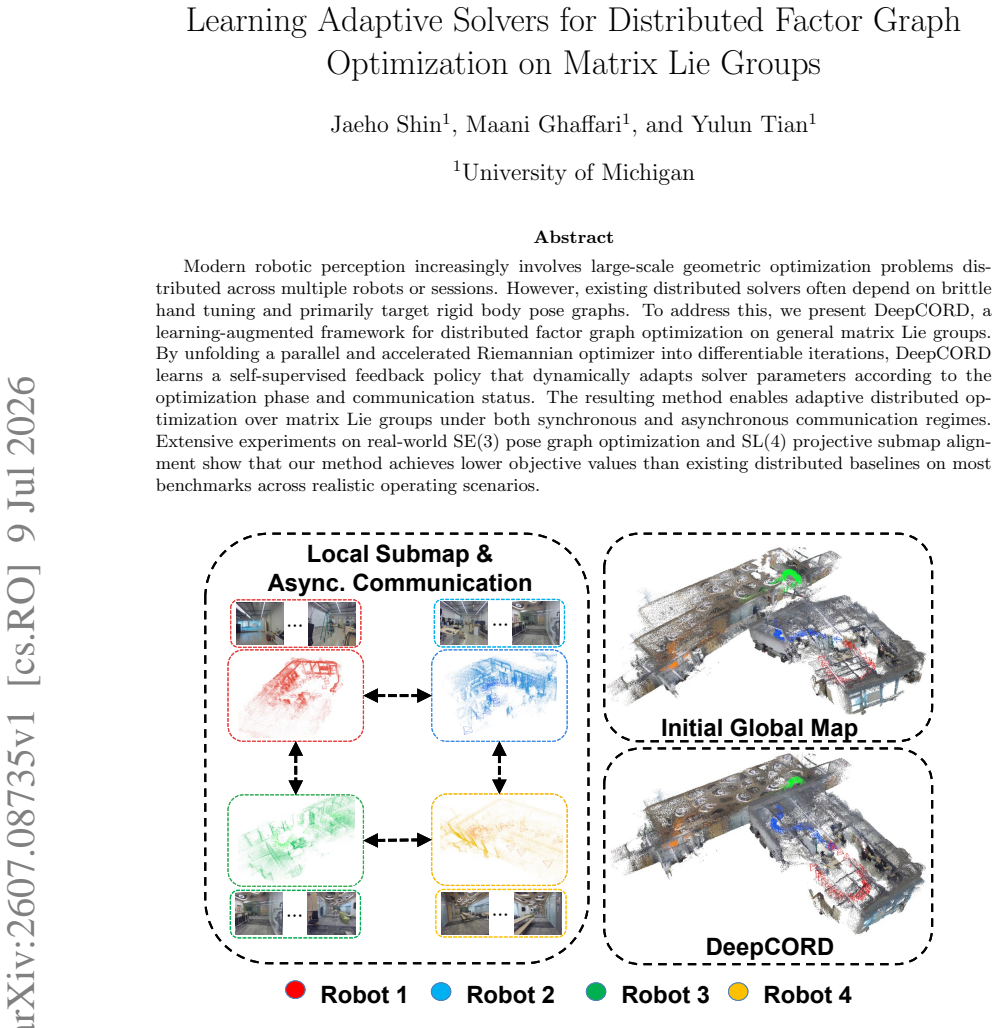
Modern robotic perception increasingly involves large-scale geometric optimization problems distributed across multiple robots or sessions. However, existing distributed solvers often depend on brittle hand tuning and primarily target rigid body pose graphs. To address this, we present DeepCORD, a learning-augmented framework for distributed factor graph optimization on general matrix Lie groups. By unfolding a parallel and accelerated Riemannian optimizer into differentiable iterations, DeepCORD learns a self-supervised feedback policy that dynamically adapts solver parameters according to the optimization phase and communication status. The resulting method enables adaptive distributed optimization over matrix Lie groups under both synchronous and asynchronous communication regimes. Extensive experiments on real-world $\mathrm{SE}$(3) pose graph optimization and $\mathrm{SL}$(4) projective submap alignment show that our method achieves lower objective values than existing distributed baselines on most benchmarks across realistic operating scenarios.
Figures



Reference graph
Works this paper leans on
-
[1]
Shin, Sungho , month = may, year =. Graph-. 2023. doi:10.23919/ACC55779.2023.10155947 , language =
-
[2]
Shin, Sungho and Anitescu, Mihai and Zavala, Victor , pages =. Overlapping. 2020 59th. doi:10.1109/CDC42340.2020.9304139 , abstract =
-
[3]
Na, Sen and Shin, Sungho and Anitescu, Mihai and Zavala, Victor , journal=. On the. 2022 , month=mar, volume=
work page 2022
-
[4]
Exponential Decay of Sensitivity in Graph-Structured Nonlinear Programs
Shin, Sungho and Anitescu, Mihai and Zavala, Victor , month = dec, year =. Exponential. doi:10.48550/arXiv.2101.03067 , abstract =
work page internal anchor Pith review Pith/arXiv arXiv doi:10.48550/arxiv.2101.03067
-
[5]
IEEE Trans.\ on Control of Network Systems , author =
Decentralized. IEEE Trans.\ on Control of Network Systems , author =. 2020 , keywords =. doi:10.1109/TCNS.2020.2967805 , abstract =
- [6]
-
[7]
D. McGann and M. Kaess , fullauthor =. Proc. Robotics: Science and Systems (RSS) , address =
-
[11]
and Dellaert, Frank , month = sep, year =
Choudhary, Siddharth and Carlone, Luca and Christensen, Henrik I. and Dellaert, Frank , month = sep, year =. Exactly sparse memory efficient. 2015. doi:10.1109/IROS.2015.7353543 , abstract =
-
[12]
2023 IEEE International Conference on Robotics and Automation (ICRA) , pages=
Cross-agent relocalization for decentralized collaborative SLAM , author=. 2023 IEEE International Conference on Robotics and Automation (ICRA) , pages=. 2023 , organization=
work page 2023
-
[13]
Distributed Pose Graph Optimization via Contractive Belief Sharing , year=
Liu, Xiangyu and Chli, Margarita , journal=. Distributed Pose Graph Optimization via Contractive Belief Sharing , year=
-
[14]
GeoD: Consensus-based Geodesic Distributed Pose Graph Optimization
Cristofalo, Eric and Montijano, Eduardo and Schwager, Mac , month = oct, year =. doi:10.48550/arXiv.2010.00156 , abstract =
work page internal anchor Pith review Pith/arXiv arXiv doi:10.48550/arxiv.2010.00156 2010
-
[15]
Carlone, Luca and Tron, Roberto and Daniilidis, Kostas and Dellaert, Frank , pages =. Initialization techniques for. 2015. doi:10.1109/ICRA.2015.7139836 , abstract =
-
[16]
Fan, Taosha and Murphey, Todd , editor =. Generalized. Robotics. 2022 , doi =
work page 2022
-
[17]
Fan, Taosha and Ortiz, Joseph and Hsiao, Ming and Monge, Maurizio and Dong, Jing and Murphey, Todd and Mukadam, Mustafa , month = jul, year =. Decentralization and. Robotics:. doi:10.15607/RSS.2023.XIX.111 , abstract =
-
[18]
Konolige, K and Grisetti, G and Kümmerle, Rainer and Burgard, W and Limketkai, B and Vincent, R , pages =. Efficient. 2010. doi:10.1109/IROS.2010.5649043 , abstract =
-
[19]
A fast and accurate approximation for planar pose graph optimization , volume =. The Int. Journal of Robotics Research , author =. 2014 , pages =. doi:10.1177/0278364914523689 , abstract =
-
[20]
Wei, Ermin and Ozdaglar, Asuman , month = dec, year =. On the. 2013. doi:10.1109/GlobalSIP.2013.6736937 , language =
-
[21]
Wei, Ermin and Ozdaglar, Asuman , month = dec, year =. Distributed. 2012. doi:10.1109/CDC.2012.6425904 , language =
-
[22]
Present and. IEEE Trans. on Robotics , author =. 2024 , keywords =. doi:10.1109/TRO.2023.3323938 , abstract =
-
[23]
Halsted, Trevor and Shorinwa, Ola and Yu, Javier and Schwager, Mac , month = mar, year =. A. doi:10.48550/arXiv.2103.12840 , abstract =
work page internal anchor Pith review Pith/arXiv arXiv doi:10.48550/arxiv.2103.12840
-
[24]
Karypis, G. and Kumar, V. , month = nov, year =. Multilevel. doi:10.1109/SC.1998.10018 , abstract =
- [25]
-
[26]
IEEE Robotics and Automation Letters , author =
Distributed. IEEE Robotics and Automation Letters , author =. 2024 , keywords =. doi:10.1109/LRA.2024.3382531 , abstract =
-
[27]
doi:10.48550/arXiv.2406.17249 , abstract =
Liu, Xu and Lei, Jiuzhou and Prabhu, Ankit and Tao, Yuezhan and Spasojevic, Igor and Chaudhari, Pratik and Atanasov, Nikolay and Kumar, Vijay , month = jul, year =. doi:10.48550/arXiv.2406.17249 , abstract =
-
[29]
Distributed mapping with privacy and communication constraints:. The Int. Journal of Robotics Research , author =. 2017 , pages =. doi:10.1177/0278364917732640 , abstract =
-
[30]
Cunningham, Alexander and Indelman, Vadim and Dellaert, Frank , keywords =. 2013. doi:10.1109/ICRA.2013.6631323 , abstract =
-
[31]
Cunningham, Alexander and Paluri, Manohar and Dellaert, Frank , keywords =. 2010. doi:10.1109/IROS.2010.5652875 , abstract =
-
[32]
Cristofalo, Eric and Montijano, Eduardo and Schwager, Mac , month = dec, year =. Consensus-based. 2019. doi:10.1109/CDC40024.2019.9029792 , abstract =
-
[34]
Journal of Intelligent & Robotic Systems , author =
Distributed. Journal of Intelligent & Robotic Systems , author =. 2025 , pages =. doi:10.1007/s10846-025-02257-w , abstract =
-
[35]
and Carlone, Luca , keywords =
Chang, Yun and Tian, Yulun and How, Jonathan P. and Carlone, Luca , keywords =. Kimera-. 2021. doi:10.1109/ICRA48506.2021.9561090 , abstract =
-
[36]
IEEE Trans. on Robotics , author =. 2021 , keywords =. doi:10.1109/TRO.2021.3075644 , abstract =
-
[38]
Towards. Field Robotics , author =. 2022 , keywords =. doi:10.55417/fr.2022032 , abstract =
-
[39]
Streaming. IEEE Trans. on Signal Processing , author =. 2022 , keywords =. doi:10.1109/TSP.2022.3188208 , abstract =
-
[40]
Zhang, Yetong and Hsiao, Ming and Dong, Jing and Engel, Jakob and Dellaert, Frank , keywords =. 2021. doi:10.1109/IROS51168.2021.9636687 , abstract =
-
[41]
Decentralised cooperative localisation for heterogeneous teams of mobile robots , doi =
Bailey, Tim and Bryson, Mitch and Mu, Hua and Vial, John and McCalman, Lachlan and Durrant-Whyte, Hugh , keywords =. Decentralised cooperative localisation for heterogeneous teams of mobile robots , doi =. 2011
work page 2011
-
[42]
Andersson, Lars A. A. and Nygards, Jonas , pages =. C-. 2008. doi:10.1109/ROBOT.2008.4543634 , abstract =
-
[43]
Spectral. IEEE Trans. on Robotics , author =. 2024 , pages =. doi:10.1109/TRO.2023.3327635 , abstract =
-
[44]
IEEE Robotics and Automation Letters , author =. 2022 , keywords =. doi:10.1109/LRA.2022.3191204 , abstract =
-
[45]
Schmuck, Patrik and Ziegler, Thomas and Karrer, Marco and Perraudin, Jonathan and Chli, Margarita , month = oct, year =. 2021. doi:10.1109/ISMAR-Adjunct54149.2021.00043 , abstract =
-
[46]
Li, Fu and Yang, Shaowu and Yi, Xiaodong and Yang, Xuejun , year =. Collaborative. doi:10.1007/978-3-030-00916-8_45 , abstract =
-
[47]
Rotation. Int. Journal of Computer Vision , author =. 2013 , pages =. doi:10.1007/s11263-012-0601-0 , abstract =
-
[48]
Communication- and. IEEE Trans. on Robotics , author =. 2025 , pages =. doi:10.1109/TRO.2025.3567540 , abstract =
-
[49]
IEEE Transactions on Robotics , volume=
Kimera-multi: Robust, distributed, dense metric-semantic slam for multi-robot systems , author=. IEEE Transactions on Robotics , volume=. 2022 , publisher=
work page 2022
-
[50]
Aneesa Sonawalla and Yulun Tian and Jonathan P. How , title =. 2026 , journal=
work page 2026
-
[51]
Barrau, Axel and Bonnabel, Silvere , journal=. The invariant extended. 2016 , publisher=
work page 2016
-
[52]
borglab/gtsam , month = May, year = 2022, publisher =
Frank Dellaert and. borglab/gtsam , month = May, year = 2022, publisher =. doi:10.5281/zenodo.5794541 , url =
-
[53]
Agarwal, Sameer and Mierle, Keir and
-
[55]
Journal of Machine Learning Research , year=
A differential equation for modeling Nesterov's accelerated gradient method: Theory and insights , author=. Journal of Machine Learning Research , year=
-
[56]
Soviet Mathematics Doklady , year=
A method for solving the convex programming problem with convergence rate O (1/k2) , author=. Soviet Mathematics Doklady , year=
-
[57]
proceedings of the National Academy of Sciences , volume=
A variational perspective on accelerated methods in optimization , author=. proceedings of the National Academy of Sciences , volume=. 2016 , publisher=
work page 2016
-
[58]
Journal of Machine Learning Research , pages=
A Lyapunov analysis of accelerated methods in optimization , author=. Journal of Machine Learning Research , pages=
-
[59]
On symplectic optimization , author=. arXiv preprint arXiv:1802.03653 , year=
work page internal anchor Pith review Pith/arXiv arXiv
-
[60]
Advances in Neural Information Processing Systems , volume=
Acceleration via symplectic discretization of high-resolution differential equations , author=. Advances in Neural Information Processing Systems , volume=
-
[61]
Optimization Methods and Software , volume=
Practical perspectives on symplectic accelerated optimization , author=. Optimization Methods and Software , volume=. 2023 , publisher=
work page 2023
-
[62]
Geometric numerical integration , volume=
Structure-preserving algorithms for ordinary differential equations , author=. Geometric numerical integration , volume=. 2006 , publisher=
work page 2006
-
[63]
2016 54th Annual Allerton Conference on Communication, Control, and Computing (Allerton) , year=
Projected gradient descent on Riemannian manifolds with applications to online power system optimization , author=. 2016 54th Annual Allerton Conference on Communication, Control, and Computing (Allerton) , year=
work page 2016
-
[64]
Journal of Nonlinear Science , volume=
Accelerated optimization on Riemannian manifolds via discrete constrained variational integrators , author=. Journal of Nonlinear Science , volume=. 2022 , publisher=
work page 2022
-
[65]
Proceedings of the IEEE conference on computer vision and pattern recognition , year=
Gravitational approach for point set registration , author=. Proceedings of the IEEE conference on computer vision and pattern recognition , year=
-
[66]
Proceedings of the IEEE/CVF International Conference on Computer Vision , pages=
Accelerated gravitational point set alignment with altered physical laws , author=. Proceedings of the IEEE/CVF International Conference on Computer Vision , pages=
-
[67]
IEEE Transactions on Image Processing , volume=
GraphReg: Dynamical point cloud registration with geometry-aware graph signal processing , author=. IEEE Transactions on Image Processing , volume=. 2022 , publisher=
work page 2022
-
[68]
2018 International Conference on 3D Vision (3DV) , pages=
Nrga: Gravitational approach for non-rigid point set registration , author=. 2018 International Conference on 3D Vision (3DV) , pages=. 2018 , organization=
work page 2018
-
[69]
IEEE transactions on pattern analysis and machine intelligence , volume=
Efficient registration of high-resolution feature enhanced point clouds , author=. IEEE transactions on pattern analysis and machine intelligence , volume=. 2018 , publisher=
work page 2018
-
[70]
Proceedings of the IEEE/CVF International Conference on Computer Vision , pages=
Dynamical pose estimation , author=. Proceedings of the IEEE/CVF International Conference on Computer Vision , pages=
-
[71]
Bloch, Anthony and Krishnaprasad, PS and Marsden, Jerrold E and Ratiu, Tudor S , journal=. The Euler-Poincar. 1996 , publisher=
work page 1996
-
[72]
IMA Journal of Numerical Analysis , volume=
Global rates of convergence for nonconvex optimization on manifolds , author=. IMA Journal of Numerical Analysis , volume=. 2019 , publisher=
work page 2019
-
[73]
SIAM Journal on Optimization , volume=
Asynchronous stochastic coordinate descent: Parallelism and convergence properties , author=. SIAM Journal on Optimization , volume=. 2015 , publisher=
work page 2015
-
[74]
International conference on machine learning , pages=
Asynchronous decentralized parallel stochastic gradient descent , author=. International conference on machine learning , pages=. 2018 , organization=
work page 2018
-
[75]
Georgia Institute of Technology, Tech
Factor graphs and GTSAM: A hands-on introduction , author=. Georgia Institute of Technology, Tech. Rep , volume=
-
[76]
Factor graphs for robot perception , author=. Foundations and Trends. 2017 , publisher=
work page 2017
-
[77]
Mathematical programming , volume=
Benchmarking optimization software with performance profiles , author=. Mathematical programming , volume=. 2002 , publisher=
work page 2002
-
[78]
Global formulations of Lagrangian and Hamiltonian dynamics on manifolds , author=. 2018 , publisher=
work page 2018
-
[79]
The International Journal of Robotics Research , volume=
Convex geometric motion planning of multi-body systems on lie groups via variational integrators and sparse moment relaxation , author=. The International Journal of Robotics Research , volume=. 2025 , publisher=
work page 2025
-
[80]
IEEE Transactions on Robotics , year=
Port-Hamiltonian neural ODE networks on Lie groups for robot dynamics learning and control , author=. IEEE Transactions on Robotics , year=
-
[81]
Optimization algorithms on matrix manifolds , author=. 2008 , publisher=
work page 2008
-
[82]
Advances in neural information processing systems , volume=
Learning to learn by gradient descent by gradient descent , author=. Advances in neural information processing systems , volume=
-
[84]
Proceedings of the 40th International Conference on Machine Learning , series =
Jialin Liu and Xiaohan Chen and Zhangyang Wang and Wotao Yin and HanQin Cai , title =. Proceedings of the 40th International Conference on Machine Learning , series =
-
[85]
Learning fast approximations of sparse coding , author=. Proceedings of the 27th international conference on international conference on machine learning , pages=
-
[86]
Advances in Neural Information Processing Systems , volume=
Accelerating quadratic optimization with reinforcement learning , author=. Advances in Neural Information Processing Systems , volume=
-
[88]
Alex Oshin and Rahul Vodeb Ghosh and Augustinos D. Saravanos and Evangelos A. Theodorou , title =. International Conference on Learning Representations , year=
-
[89]
IEEE Transactions on Mobile Computing , volume=
Distributed learn-to-optimize: Limited communications optimization over networks via deep unfolded distributed ADMM , author=. IEEE Transactions on Mobile Computing , volume=. 2024 , publisher=
work page 2024
discussion (0)
Sign in with ORCID, Apple, or X to comment. Anyone can read and Pith papers without signing in.