REVIEW 3 major objections 5 minor 48 references
Tonnetz-guided graph wedges compress piano accompaniment into fewer, harmonically coherent regions that stay playable scores.
Reviewed by Pith at T0; open to challenge. T0 means a machine referee read the full paper against a public rubric. the ladder, T0–T4 →
Adaptive graph wedgelets in a six-dimensional Tonnetz embedding compress piano subgraphs of vocal-pianistic scores into piecewise-constant, playable reconstructions that respect harmonic distance.
T0 review reviewed 2026-07-13 challenge →
load-bearing objection Clean, usable application of graph wedgelets to piano accompaniments via Tonnetz; evaluation is thin but the pipeline is real and referee-ready. the 3 major comments →
Tonnetz-Driven Graph Wedgelet for Harmonic Complexity Reduction in Music Scores
The pith
A machine-rendered reading of the paper's core claim, the machinery that carries it, and where it could break.
The reading
Core claim
A fully adaptive greedy binary-wedge partitioning tree that minimises L2 error inside a six-dimensional Tonnetz embedding of the piano subgraph yields piecewise-constant reconstructions that reduce harmonic complexity while remaining valid, playable MusicXML scores whose pitches stay inside the original pitch-class set of each wedge.
What carries the argument
Tonnetz-driven FA-greedy binary wedge partitioning trees: recursive splits of the piano graph that choose the next centre by minimising harmonic L2 error under the concatenated (k=3,4,7) angular embedding, then decode each wedge by its mean and nearest original pitch class.
Load-bearing premise
The Euclidean distance on that particular six-dimensional Tonnetz map, together with shortest-path connectivity on the piano graph, is assumed to be a faithful proxy for musical harmonic homogeneity when deciding where to split.
What would settle it
On the same corpus, replace the Tonnetz L2 metric with ordinary chromatic distance (or random splits) and check whether the resulting playable reconstructions produce systematically higher pitch-error rates or lose recognisable harmonic function at equal wedge budgets.
Editorial analysis
A structured set of objections, weighed in public.
Referee Report
Summary. The paper proposes a structure-preserving compression scheme for the piano accompaniment subgraph of vocal-pianistic symbolic scores. It adapts binary wedge partitioning trees (BWP) with fully adaptive greedy (FA-greedy) L2-error minimization, but evaluates the error inside a six-dimensional Tonnetz embedding of pitch classes (angular projections with multipliers k=3,4,7). Wedges remain connected under shortest-path distance on the piano graph; each wedge is represented by its mean in Tonnetz space and then quantized back to a pitch class already present in that wedge. The result is a piecewise-constant, playable MusicXML score whose pitches stay inside the original local pitch-class set. Experiments on a 70-score corpus from three composers report RMSE versus compression ratio r in the same Tonnetz space, together with qualitative score visualizations.
Significance. If the Tonnetz-driven wedges are musically meaningful, the method supplies a clean, graph-native, harmony-aware compressor that produces human-readable and playable simplified scores—something existing symbolic compressors (LZ-style, wavelet-on-melody, tokenisation) do not simultaneously achieve. The algorithmic construction is fully specified (Algorithms 1–2), the reconstruction constraint is musically sensible, and the export pipeline to MusicXML is practical. These are genuine strengths for computational musicology and for downstream tasks that need reduced harmonic complexity while preserving graph structure. The contribution is therefore of clear interest, provided the harmonic-fidelity claim can be substantiated beyond self-referential reconstruction error.
major comments (3)
- Section 4 and Eq. (13): the sole quantitative metric is RMSE computed inside the same six-dimensional Tonnetz space used for FA-greedy splitting (Fig. 3). No baseline (chromatic L2, single-axis Tonnetz, random connected partitions, non-adaptive BWP) is reported, nor any listening test, expert harmonic annotation, or re-evaluation of a downstream task (cadence detection, Roman-numeral analysis, voice separation) on the compressed scores. Without an external check, the claim that the Euclidean metric on Φ together with shortest-path connectivity yields harmonically homogeneous wedges remains untested; the RMSE curve alone cannot distinguish a musically faithful compressor from a self-consistent but musically arbitrary one.
- Section 3.2–3.3 and Algorithm 1: the free parameters of the embedding (the triple k1,k2,k3, currently fixed at 3,4,7) and of the initial centre v1 are never ablated. Because the entire partitioning criterion rests on the induced L2 metric, a short sensitivity study (or at least a comparison against the pure circle-of-fifths axis k=7) is required to show that the claimed harmonic advantage is robust rather than an artefact of one particular angular choice.
- Abstract and Section 5 assert that the scheme preserves “task-relevant information.” The experiments never re-run any of the analytical tasks cited in the introduction (cadence detection, voice separation, stylistic classification) on the compressed graphs. Either a concrete downstream experiment or a clear restriction of the claim to reconstruction fidelity is needed.
minor comments (5)
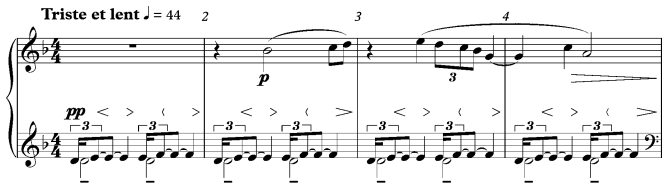
- Figure 1 caption and surrounding text: the example is taken from Mozart K. 620, yet the corpus description (Section 4) never names the three composers or the selection criteria; a short table or paragraph listing composers, number of scores per composer, and average N would improve reproducibility.
- Equation (10) and the paragraph that follows: the claim that “any permutation of k1,k2,k3 yields the same induced L2 metric” is true, but the text should also note that different unordered triples generally produce different metrics; the reader is left wondering why precisely {3,4,7} was chosen over other musically plausible sets.
- Section 3.4: the export pipeline overwrites MIDI pitches while leaving all other notational attributes untouched. A brief remark on how simultaneous notes that fall into different wedges are handled (or whether the current implementation forces them into the same wedge) would clarify edge cases.
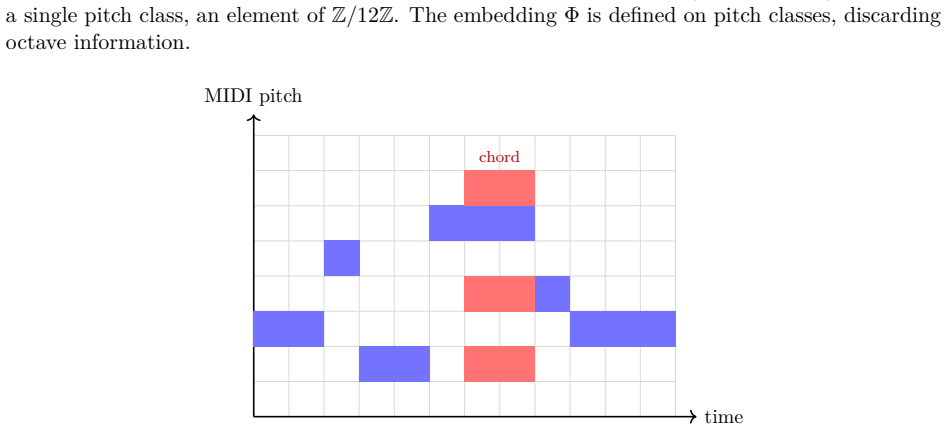
- Appendix figures (Alberti bass, ostinato, chromatic circle) are pedagogically useful but are never referenced from the main text; a single cross-reference in Section 3.2 would integrate them.
- Typographical: “wedglet” appears once (Section 3.1) instead of “wedgelet”; “thepresentsection” and similar spacing artefacts occur in Section 2.
Circularity Check
Mild self-referential evaluation: RMSE is the same Tonnetz L2 the FA-greedy already minimises; the compression map itself is a genuine non-identity reconstruction with no definitional loop.
specific steps
-
self definitional
[Abstract; Sec. 3.2–3.3, Eqs. (5)–(6), (10), (13)]
"The partitioning process employs a splitting criterion based on harmonic distance, resulting in regions that accurately reflect the intrinsic harmonic relationships among notes. … The L2-error in the partitioning is computed in a six-dimensional Tonnetz embedding of notes, whose euclidean metric captures harmonic rather than chromatic proximity. … RMSE = √(1/N ∑ ||f(v)-WMf(v)||^{2}_{2})"
“Harmonic distance” is defined to be Euclidean distance on the Tonnetz embedding Φ (Eq. 10). FA-greedy selects the split that minimises precisely that L2 residual (Eqs. 5–6). Consequently the claim that the resulting wedges “accurately reflect the intrinsic harmonic relationships” is true by construction of the objective, not an independent empirical finding. The sole quantitative figure of merit (RMSE) is the same residual, so reported success is definitionally guaranteed once the metric is chosen.
full rationale
The paper adapts Erb’s FA-greedy binary wedge partitioning trees to the piano subgraph, replacing the usual signal space by a fixed six-dimensional Tonnetz embedding (k=3,4,7). The algorithm therefore produces wedges that are homogeneous in that metric by construction, and the reported RMSE (Eq. 13, Fig. 3) simply quantifies the residual of the same objective. This is ordinary for a lossy compressor and does not make the reconstructed MusicXML an identity map: the decoder still replaces each wedge by a single mean-based pitch class drawn only from the original notes of that wedge, yielding a coarser but playable score. Self-citations to the authors’ earlier heterogeneous score-graph paper supply only the input representation and are not load-bearing for the compression claim. No parameter is fitted to data and then re-used as a “prediction,” no uniqueness theorem is imported, and no known empirical pattern is merely renamed. The musical interpretation of the Tonnetz metric remains an untested modelling assumption (correctness risk, not circularity). Hence the derivation chain is essentially self-contained; the only circularity is the mild, expected self-reference of reporting approximation error inside the optimisation metric.
Axiom & Free-Parameter Ledger
free parameters (3)
- compression ratio r
- Tonnetz angular multipliers (k1,k2,k3)
- initial centre v1
axioms (4)
- domain assumption Shortest-path distance on the undirected piano subgraph yields musically contiguous wedges.
- domain assumption Euclidean distance in the six-dimensional (k=3,4,7) Tonnetz embedding is a faithful proxy for harmonic proximity.
- ad hoc to paper Piecewise-constant approximation followed by nearest-pitch-class projection preserves a valid score in the original instrumentation and scale.
- standard math FA-greedy selection of the worst L2 region and best split is an adequate adaptive strategy.
invented entities (1)
-
six-dimensional Tonnetz error space for graph-wedgelet partitioning
no independent evidence
Cite this review
Pith. "Pith review of Tonnetz-Driven Graph Wedgelet for Harmonic Complexity Reduction in Music Scores." pith.science (2026). https://pith.science/paper/NKOWS2PY
@misc{pith2026260708806,
  author       = {Pith},
  title        = {Pith review of: Tonnetz-Driven Graph Wedgelet for Harmonic Complexity Reduction in Music Scores},
  year         = {2026},
  howpublished = {\url{https://pith.science/paper/NKOWS2PY}},
  note         = {Machine review of arXiv:2607.08806}
}
abstract
Heterogeneous graph built on notes, lyric syllables, and accompaniment events is a natural representation of symbolic music score, providing a substrate for both philological analysis and computational tasks. Music features are therefore well-captured by graph geometry and its properties. This representation has proved effective for analytical tasks as cadence detection, voice separation, and stylistic classification. In the present work, the reduction of harmonic complexity of a music score on graph, by preserving task-relevant information, relation between notes, and graph structure is investigated. A compression scheme for the piano subgraph of vocal-pianistic scores, built on binary wedge partitioning trees, is proposed. The wedges are generated through a fully adaptive greedy algorithm that recursively minimizes the $L^2$-error within a six-dimensional Tonnetz embedding of musical notes. The partitioning process employs a splitting criterion based on harmonic distance, resulting in regions that accurately reflect the intrinsic harmonic relationships among notes. The reconstructed music scores obtained through piecewise-constant functions and the mean values of the notes inside each wedge are used as a new simplified scores human-readable and playable. Some experiments on a corpus of symbolic music scores of three different composers are performed to assess the proposed approach.
Figures




Reference graph
Works this paper leans on
-
[1]
Müller,Fundamentals of Music Processing: Audio, Analysis, Algorithms, Applications, Springer, Cham, 2015
M. Müller,Fundamentals of Music Processing: Audio, Analysis, Algorithms, Applications, Springer, Cham, 2015
2015
-
[2]
Goodfellow, Y
I. Goodfellow, Y. Bengio, and A. Courville,Deep Learning, MIT Press, Cambridge, MA, 2016
2016
-
[3]
Purwins, B
H. Purwins, B. Li, T. Virtanen, J. Schlüter, S.-Y. Chang, and T. Sainath, Deep learning for audio signal processing,IEEE Journal of Selected Topics in Signal Processing, vol. 13, no. 2, pp. 206–219, 2019
2019
-
[4]
Zhang, E
H. Zhang, E. Karystinaios, S. Dixon, G. Widmer, and C. E. Cancino-Chacón, Symbolic music representations for classification tasks: a systematic evaluation, inProc. 24th Int. Soc. for Music Information Retrieval Conf. (ISMIR), 2023, pp. 848–858
2023
-
[5]
Karystinaios, F
E. Karystinaios, F. Foscarin, and G. Widmer, GraphMuse: a library for symbolic music graph processing, inProc. 25th Int. Soc. for Music Information Retrieval Conf. (ISMIR), 2024
2024
-
[6]
Briot, G
J.-P. Briot, G. Hadjeres, and F.-D. Pachet, Deep Learning Techniques for Music Generation, Springer, Cham, 2020
2020
-
[7]
Good, MusicXML for notation and analysis, inThe Virtual Score: Representation, Re- trieval, Restoration, W
M. Good, MusicXML for notation and analysis, inThe Virtual Score: Representation, Re- trieval, Restoration, W. B. Hewlett and E. Selfridge-Field, Eds. MIT Press, 2001, pp. 113–124
2001
-
[8]
MIDI Manufacturers Association,The Complete MIDI 1.0 Detailed Specification, MIDI Man- ufacturers Association, Los Angeles, CA, 1996
1996
-
[9]
Q. Kong, K. Choi, and Y. Wang, Large-scale MIDI-based composer classification, arXiv:2010.14805, 2020
Pith/arXiv arXiv 2010
-
[10]
S. Kim, H. Lee, S. Park, J. Lee, and J. Choi, Deep composer classification using symbolic representation, arXiv:2010.00823, 2020
Pith/arXiv arXiv 2010
-
[11]
C.-Z. A. Huanget al., Music Transformer: generating music with long-term structure, inInt. Conf. on Learning Representations (ICLR), 2019
2019
-
[12]
Fradet, J.-P
N. Fradet, J.-P. Briot, F. Chhel, A. El Fallah Seghrouchni, and N. Gutowski, MidiTok: a Python package for MIDI file tokenization, Late-Breaking Demo of ISMIR, 2021
2021
-
[13]
Karystinaios and G
E. Karystinaios and G. Widmer, Cadence detection in symbolic classical music using graph neural networks, inProc. 23rd Int. Soc. for Music Information Retrieval Conf. (ISMIR), 2022
2022
-
[14]
Karystinaios and G
E. Karystinaios and G. Widmer, Roman numeral analysis with graph neural networks: onset- wise predictions from note-wise features, inProc. 24th Int. Soc. for Music Information Re- trieval Conf. (ISMIR), 2023
2023
-
[15]
Karystinaios, F
E. Karystinaios, F. Foscarin, and G. Widmer, Musical voice separation as link prediction: modeling a musical perception task as a multi-trajectory tracking problem, inProc. Int. Joint Conf. on Artificial Intelligence (IJCAI), 2023
2023
-
[16]
Jeong, T
D. Jeong, T. Kwon, Y. Kim, and J. Nam, Graph neural network for music score data and modeling expressive piano performance, inProc. Int. Conf. on Machine Learning (ICML), 2019, pp. 3060–3070. 15
2019
-
[17]
S. Licciardi, D. Macchione, E. Caronna, and E. Francomano, Advanced Scientific Methodology Plays Rossini,Advances in Computational Science and Engineering, 2026, 8: 74-94. doi: 10.3934/acse.2026008
-
[18]
Cilibrasi and P
R. Cilibrasi and P. M. B. Vitányi, Clustering by compression,IEEE Trans. Inf. Theory, vol. 51, no. 4, pp. 1523–1545, 2005
2005
-
[19]
C. Ding, A. Gorle, S. Bhattacharya, D. Hasteer, N. Sagan, and T. Weissman, LZMidi: compression-based symbolic music generation, arXiv:2503.17654, 2025
Pith/arXiv arXiv 2025
-
[20]
G. Ala, M. L. Di Silvestre, E. Francomano and A. Tortorici, Wavelet-based efficient simulation ofelectromagnetictransientsinalightningprotectionsystem, IEEETransactionsonMagnetics 39(3), 2006, pp. 1257–1260. 2006
2006
-
[21]
C. K. Chui,An Introduction to Wavelets, Academic Press, San Diego, CA, 1992
1992
-
[22]
Strang and T
G. Strang and T. Nguyen,Wavelets and Filter Banks, Wellesley–Cambridge Press, Wellesley, MA, 1996
1996
-
[23]
Velarde, T
G. Velarde, T. Weyde, and D. Meredith, An approach to melodic segmentation and classifica- tion based on filtering with the Haar wavelet,Journal of New Music Research, 2013
2013
-
[24]
A. McLeod and K. Yoshii, The MIDI Degradation Toolkit: symbolic music augmentation and correction, Late-Breaking Demo of ISMIR, arXiv:2010.00059, 2020
Pith/arXiv arXiv 2010
-
[25]
D. I. Shuman, S. K. Narang, P. Frossard, A. Ortega, and P. Vandergheynst, The emerging field of signal processing on graphs,IEEE Signal Processing Magazine, vol. 30, no. 3, pp. 83–98, 2013
2013
-
[26]
Ortega, P
A. Ortega, P. Frossard, J. Kovačević, J. M. F. Moura, and P. Vandergheynst, Graph signal processing: overview, challenges and applications,Proceedings of the IEEE, vol. 106, no. 5, pp. 808–828, 2018
2018
-
[27]
Erb, Graph wedgelets: adaptive data compression on graphs based on binary wedge partitioning trees and geometric wavelets,IEEE Trans
W. Erb, Graph wedgelets: adaptive data compression on graphs based on binary wedge partitioning trees and geometric wavelets,IEEE Trans. Signal Inf. Process. Netw., vol. 9, pp. 24–34, 2023
2023
-
[28]
W. Erb, Split-and-merge segmentation of biomedical images using graph wedgelet decomposi- tions, inComputational Science and Its Applications – ICCSA 2025 Workshops, Lecture Notes in Computer Science, vol. 15899, Springer, 2026, pp. 252–263
2025
-
[29]
Harte, M
C. Harte, M. Sandler, and M. Gasser, Detecting harmonic change in musical audio, inProc. ACM Workshop on Audio and Music Computing Multimedia, pp. 21–26, 2006
2006
-
[30]
Cohn, Introduction to neo-Riemannian theory: a survey and a historical perspective, Journal of Music Theory, vol
R. Cohn, Introduction to neo-Riemannian theory: a survey and a historical perspective, Journal of Music Theory, vol. 42, no. 2, pp. 167–180, 1998
1998
-
[31]
E. Karystinaios, J. Hentschel, M. Neuwirth, and G. Widmer, AnalysisGNN: unified music analysis with graph neural networks, arXiv:2509.06654, 2025
Pith/arXiv arXiv 2025
-
[32]
W. L. Hamilton, R. Ying, and J. Leskovec, Inductive representation learning on large graphs, inAdvances in Neural Information Processing Systems (NeurIPS), 2017, pp. 1024–1034. 16
2017
-
[33]
A. C. M. da Silva, D. F. Silva, and R. M. Marcacini, Heterogeneous graph neural network for music emotion recognition, inProc. 23rd Int. Soc. for Music Information Retrieval Conf. (ISMIR), 2022
2022
-
[34]
A. C. M. da Silva, D. F. Silva, and R. M. Marcacini, Artist similarity based on heterogeneous graph neural networks,IEEE/ACM Trans. on Audio, Speech, and Language Processing, 2024
2024
-
[35]
Ziv and A
J. Ziv and A. Lempel, A universal algorithm for sequential data compression,IEEE Transac- tions on Information Theory, vol. 23, no. 3, pp. 337–343, 1977
1977
-
[36]
Cilibrasi, P
R. Cilibrasi, P. M. B. Vitányi, and R. de Wolf, Algorithmic clustering of music based on string compression,Computer Music Journal, vol. 28, no. 4, pp. 49–67, 2004
2004
-
[37]
Euler,Tentamen Novae Theoriae Musicae, Saint Petersburg Academy of Sciences, 1739
L. Euler,Tentamen Novae Theoriae Musicae, Saint Petersburg Academy of Sciences, 1739
-
[38]
von Oettingen,Harmoniesystem in dualer Entwickelung, W
A. von Oettingen,Harmoniesystem in dualer Entwickelung, W. Gläser, Dorpat and Leipzig, 1866
-
[39]
Riemann, Ideen zu einer Lehre von den Tonvorstellungen,Jahrbuch der Musikbibliothek Peters, vol
H. Riemann, Ideen zu einer Lehre von den Tonvorstellungen,Jahrbuch der Musikbibliothek Peters, vol. 21–22, pp. 1–26, 1914
1914
-
[40]
Tymoczko,A Geometry of Music: Harmony and Counterpoint in the Extended Common Practice, Oxford University Press, 2011
D. Tymoczko,A Geometry of Music: Harmony and Counterpoint in the Extended Common Practice, Oxford University Press, 2011
2011
-
[41]
Chuan and D
C.-H. Chuan and D. Herremans, Modeling temporal tonal relations in polyphonic music through deep networks with a novel image-based representation, inProc. 32nd AAAI Conf. on Artificial Intelligence, 2018
2018
-
[42]
Kehoeet al., Exploring musical structure using Tonnetz lattice geometry and LSTMs, in Int
E. Kehoeet al., Exploring musical structure using Tonnetz lattice geometry and LSTMs, in Int. Conf. on Computational Science (ICCS), Springer, 2020
2020
-
[43]
K. Choi, G. Fazekas, and M. Sandler, Text-based LSTM networks for automatic music compo- sition, inProc. 1st Conf. on Computer Simulation of Musical Creativity (CSMC),Huddersfield, UK, 2016
2016
-
[44]
Hochreiter and J
S. Hochreiter and J. Schmidhuber, Long short-term memory,Neural Computation, vol. 9, no. 8, pp. 1735–1780, 1997
1997
-
[45]
S. Licciardi, A. Di Fatta, G. Ala, P. Romano, A. Imburgia, and E. Francomano, Artificial learning algorithms for partial discharge classification,IEEE Transactions on Magnetics, 2025, doi:10.1109/TMAG.2025.3641965
-
[46]
G. Ala, P. Catrini, M. G. Ippolito, M. La Villetta, S. Licciardi, and R. Musca, Deep learning for smart grid and energy context, inProc. Asia Meeting on Environment and Electrical Engineering (EEE-AM), Hanoi, Vietnam, 2023, pp. 1–6
2023
-
[47]
M. S. Cuthbert and C. Ariza,music21: a toolkit for computer-aided musicology and symbolic music data, inProc. 11th Int. Soc. for Music Information Retrieval Conf. (ISMIR), 2010, pp. 637–642
2010
-
[48]
Piston and M
W. Piston and M. DeVoto,Harmony, 5th ed., W. W. Norton, New York, 1987. 17
1987
This paper was first reviewed by grok-4.5 on July 13, 2026.
discussion (0)
Sign in with ORCID, Apple, or X to comment. Anyone can read and Pith papers without signing in.