REVIEW 2 major objections 5 minor 153 references
SN 2023vjh is a 1991bg-like Type Ia supernova that is systematically fainter than its class and explosion models, with reddening that may come from circumstellar dust rather than the host galaxy.
Reviewed by Pith at T0; open to challenge. T0 means a machine referee read the full paper against a public rubric. the ladder, T0–T4 →
T0 review · grok-4.5
2026-07-13 06:26 UTC pith:Z5PHPOGW
load-bearing objection Solid multi-wavelength data set on an extreme 91bg-like SN whose faintness and color excess are real; the CSM reading is plausible but not forced, and the paper already flags residual model tension. the 2 major comments →
The type Ia supernova 2023vjh: a peculiar 1991bg-like SN with unusually faint light curves
The pith
A machine-rendered reading of the paper's core claim, the machinery that carries it, and where it could break.
Core claim
SN 2023vjh is a spectroscopically and photometrically confirmed 1991bg-like (extreme-cool) Type Ia supernova whose light curves are systematically fainter than other well-studied members of the class and than Chandrasekhar-mass and sub-Chandrasekhar explosion models. The inferred host reddening is unusually high for the class, yet the lack of Na I D and large distance from a passive host imply that ordinary interstellar extinction is small, pointing instead to possible circumstellar dust.
What carries the argument
Joint light-curve fitting (SNooPy 91bg templates, Lira-law color, and Goobar-style CSM extinction) compared with Blondin DDC25 and SCH2p0 explosion models, together with the spectroscopic absence of Na I D and the measured 6.8 kpc projected offset from the host center.
Load-bearing premise
That missing Na I D absorption and a large projected distance from a passive elliptical galaxy together prove that any substantial reddening must be circumstellar rather than interstellar dust along the line of sight.
What would settle it
A high-resolution spectrum that either detects host Na I D (or equivalent dust tracers) at a strength matching E(B-V) ~ 0.2–0.35, or a multi-wavelength SED that rules out low-R_V CSM extinction while still matching the observed blue-band faintness.
If this is right
- 91bg-like samples used for cosmology or template building must allow for objects that are systematically under-luminous relative to current models.
- CSM extinction becomes a plausible extra parameter for at least some fast-declining SNe Ia even in elliptical hosts.
- Residual i-band discrepancies after CSM correction indicate that model spectral energy distributions still need improvement in the red/NIR for cool events.
- Color-based and Tripp-style standardization of fast decliners can still return H0 values consistent with larger samples even for this outlier.
Where Pith is reading between the lines
- If CSM is confirmed around other 91bg-like events, it would tighten the link between subluminous explosions and residual binary-interaction material.
- The lack of a clear H-band break in the late NIR spectra may be another signature of the same cool, low-56Ni ejecta that produces the extreme-cool classification.
- Future surveys that catch similar objects early enough for dense multi-band coverage could separate CSM from intrinsic under-luminosity by tracking color evolution before maximum.
Editorial analysis
A structured set of objections, weighed in public.
Referee Report
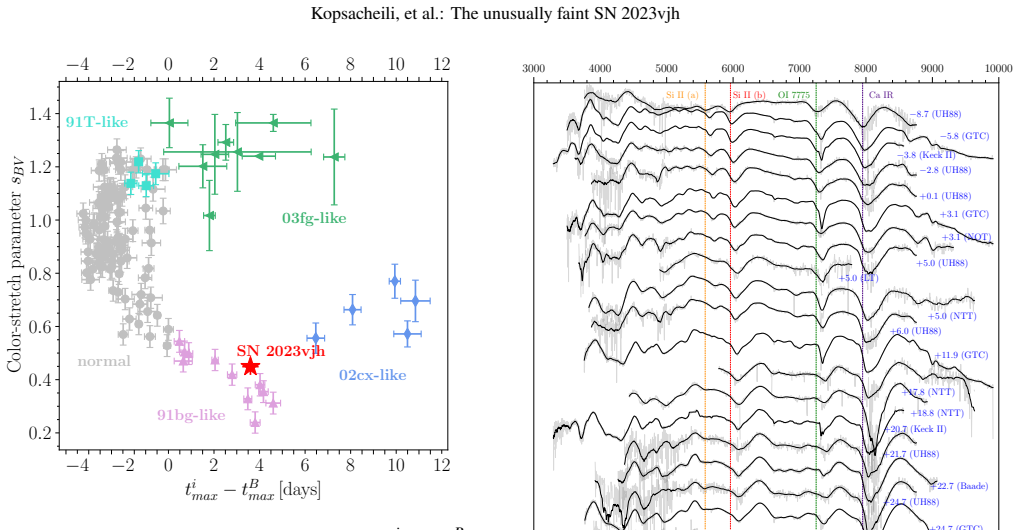
Summary. The manuscript presents multi-band photometry (POISE/Swope, ZTF, ATLAS) and optical/NIR spectroscopy of SN 2023vjh, a fast-declining Type Ia supernova in the elliptical galaxy MCG+04-10-013. Light-curve parameters from SNooPy (Δm15(B) = 1.89 ± 0.01 mag, sBV = 0.45 ± 0.03) and spectral features (strong Si II, Ca II, Ti II; cool/extreme-cool placement on Branch/Wang and pEW diagrams) firmly place it among 91bg-like events. The central claim is that SN 2023vjh is systematically fainter than both typical 91bg-like SNe and the Blondin et al. (2018) DDC25/SCH2p0 models, while color-based and SNooPy fits imply unusually large host reddening (E(B-V)host ~ 0.2–0.35 mag). The non-detection of host Na I D (3σ EW upper limit < 0.53 Å) and the 6.8 kpc projected offset from the center of a passive elliptical are used to argue that ordinary interstellar extinction is minimal, so circumstellar (Goobar 2008) dust may be required; residual i-band discrepancies are attributed to model SED limitations. An H0 estimate using the Phillips et al. (2026) Tripp and Color methods for fast decliners is also presented.
Significance. If the faintness and the need for non-standard (CSM-like) extinction hold, SN 2023vjh expands the known diversity of 91bg-like events and supplies a concrete case where color-inferred reddening and spectroscopic/host indicators of dust disagree. The data set is of high quality: dense early multi-band coverage, consistent SNooPy parameters across max/EBV2/color models, Monte-Carlo continuum-varied velocities and pEWs, three late NIR spectra, and host IFS age/metallicity. The H0 exercise with the Phillips et al. (2026) calibrations is a useful consistency check for the emerging standardization of fast decliners. These strengths make the paper a solid observational contribution even if the CSM interpretation remains provisional.
major comments (2)
- §4.2 and Abstract: The inference that E(B-V)host ~ 0.2–0.35 mag must be circumstellar rests on the non-detection of Na I D (3σ EW < 0.53 Å from the smoothed spectra in Fig. A.3) plus the 6.8 kpc projected offset. Na I D is an imperfect tracer (large scatter in EW–E(B-V) relations; dust can exist without detectable Na, especially if ionization or composition is atypical). Projected galactocentric distance does not exclude a line-of-sight cloud or halo material. The paper should either (i) quantify how much of the color excess could still be ordinary host ISM given the EW limit and known scatter, or (ii) present the CSM scenario more explicitly as one possible interpretation among others (intrinsic coolness/template mismatch, atypical R_V, undetected ISM). Without that, the claim that the object is 'systematically fainter than models/other 91bg-likes' under MW-only correction (Fig. 6 fille
- §4.2 and Fig. 4: Even after applying MW-type CSM extinction with E(B-V)host = 0.2, residual discrepancies remain, especially in the i-band (and a milder one in B). The text attributes these to model SED limitations (Ca II NIR triplet, line blanketing). Because the same residual is used both to justify CSM and to excuse model mismatch, the paper should test whether an intrinsic luminosity offset (lower 56Ni or different ejecta mass) plus ordinary extinction can reproduce the multi-band light curves equally well, or show that the i-band residual is quantitatively expected from the model spectra. Otherwise the conclusion that 'including CSM-like extinction improves agreement' is only partially demonstrated.
minor comments (5)
- Table 1: The host MB is listed as 20.13 ± 0.53; absolute magnitudes of galaxies are conventionally negative. Clarify whether this is an absolute magnitude or an apparent magnitude, and correct the sign if needed.
- §4.1 / Fig. A.2: The r-band light curve is broader and the i-band narrower than the 91bg template. A short quantitative statement of the residual (e.g., peak-to-template magnitude difference or reduced χ^{2} per band) would help the reader assess the quality of the SNooPy fits used for Δm15 and sBV.
- Fig. 14 / §5.2: The absence of an H-band break is noted but left ambiguous (S/N vs. physical). A simple upper limit on the break contrast or a direct comparison of continuum S/N with SN 2015bo/2022xkq at the same wavelengths would strengthen the statement.
- Throughout: Occasional missing spaces after punctuation and a few duplicated words in the abstract/introduction (e.g., 'We presentobservations') should be cleaned in production.
- §4.5: The H0 values are consistent with Phillips et al. (2026), but the i-band systematically pulls H0 low. A one-sentence note that this is expected from the already-noted faint i-band light curve would avoid the impression of tension.
Circularity Check
No significant circularity: observational measurements and empirical comparisons; secondary H0 uses co-authored calibration but is not load-bearing for the faintness/CSM claim.
full rationale
The paper is a standard observational characterization of SN 2023vjh. Light-curve shape parameters (Δm15(B), sBV), absolute magnitudes, expansion velocities, and pEWs are measured directly from photometry and spectra (Sects. 4.1, 5.1; Tables B.2). Classification as 91bg-like / cool / extreme-cool follows by placing those measured quantities on established diagrams (Branch, Wang, Folatelli, Alburai) against external comparison samples; this is comparison, not a self-definitional loop. Host reddening is inferred from SNooPy EBV/color models and the Lira relation, then tested against the independent spectroscopic non-detection of Na I D and the projected offset; the paper does not redefine the non-detection as the extinction value. Model comparisons (Blondin DDC25/SCH2p0 + Goobar CSM law) are external templates applied after the fact; residual i-band tension is acknowledged rather than forced away. The only self-citation of note is the secondary H0 estimate (Sect. 4.5) that adopts coefficients from Phillips et al. (2026), whose author list overlaps; that result is not required for the central faintness/CSM interpretation and does not reduce the main claim by construction. No equation equates a claimed prediction to a fitted input, no uniqueness theorem is imported to forbid alternatives, and no ansatz is smuggled as a derivation. Score 1 reflects only the minor, non-load-bearing co-authored calibration use.
Axiom & Free-Parameter Ledger
free parameters (4)
- E(B-V)_host =
0.20–0.35 mag
- R_V (host) =
2.1±0.5
- s_BV / Δm15(B) =
s_BV=0.45, Δm15=1.89
- power-law rise indices n_r, n_g =
n_r=1.31±0.11, n_g=1.51±0.17
axioms (5)
- domain assumption Cardelli et al. (1989) extinction law with R_V=3.1 for Milky Way dust (E(B-V)_MW=0.236 from Schlafly & Finkbeiner 2011).
- domain assumption Blondin et al. (2018) DDC25 and SCH2p0 models correctly represent the expected luminosity and colors of 91bg-like explosions in the absence of extra dust.
- domain assumption Goobar (2008) CSM extinction law (A_λ = A_V (1-α + α(λ/λ_V)^p) with p=-1.5/-2.5, α=0.9/0.8) is an adequate description of possible circumstellar dust.
- ad hoc to paper Non-detection of Na I D (EW upper limit <0.53 Å) plus large projected galactocentric distance implies negligible host interstellar extinction.
- domain assumption SNooPy 91bg templates and the updated Lira relation of Burns et al. (2014) correctly recover shape and color parameters for fast decliners.
read the original abstract
We present observations of the 1991bg-like type Ia supernova (SN) 2023vjh, associated with the elliptical galaxy MCG+04-10-013. Its light-curve shape parameters ($\Delta m_{15}(B)=1.89 \pm 0.01$ mag and $s_{BV} = 0.45 \pm 0.03$), together with its spectroscopic evolution, place it firmly within the class of fast-declining, subluminous SNe Ia. The near-peak spectra show prominent features of Si II, Ca II, and Ti II, consistent with a cool photosphere, and place SN 2023vjh within the "cool" and extreme cool regions on the classification diagrams. In addition, the three late-phase near-infrared (NIR) spectra display the Ca II NIR triplet, Fe II, and Co II absorptions, but no obvious $H$-band break. Although SN 2023vjh falls in the same regions of the classification diagrams as other well-studied 91bg-like events, it shows some deviation within this class. In particular, it is systematically fainter than predicted by explosion models and fainter than other well-studied 91bg-like SNe. Light-curve fitting and color-based analyses indicate a relatively large reddening ($E(B-V)_{host}\sim$ 0.2 - 0.35 mag), which is unusual for 91bg-like SNe. Yet, the lack of detectable Na I D absorption in its spectra, along with its large projected distance from the center of its passive host galaxy (6.8 kpc), suggests that interstellar extinction along the line of sight is minimal. SN 2023vjh appears to be fainter than typical 91bg-like SNe, and it could be affected by circumstellar material (CSM). Comparisons with explosion models and alternative extinction prescriptions show that including CSM-like extinction improves agreement in the blue bands, but residual discrepancies in the $i$-band may reflect limitations in the model.
Figures




Reference graph
Works this paper leans on
-
[1]
ZTF SN Ia DR2 follow-up: Characterization of subluminous Type Ia supernovae in the ZTF DR2 full sample. , keywords =. doi:10.1051/0004-6361/202555976 , archivePrefix =. 2512.21256 , primaryClass =
-
[2]
Analytic solutions for light curves of supernovae of Type II. , keywords =. doi:10.1086/157898 , adsurl =
-
[3]
Carnegie Supernova Project-II: Using Near-infrared Spectroscopy to Determine the Location of the Outer ^ 56 Ni in Type Ia Supernovae. , keywords =. doi:10.3847/2041-8213/ab1654 , archivePrefix =. 1902.10088 , primaryClass =
-
[4]
Carnegie Supernova Project-II: A New Method to Photometrically Identify Sub-types of Extreme Type Ia Supernovae. , keywords =. doi:10.3847/2041-8213/ab8e37 , archivePrefix =. 2003.11121 , primaryClass =
work page internal anchor Pith review Pith/arXiv arXiv doi:10.3847/2041-8213/ab8e37 2041
-
[5]
The Zwicky Transient Facility: System Overview, Performance, and First Results. , keywords =. doi:10.1088/1538-3873/aaecbe , archivePrefix =. 1902.01932 , primaryClass =
-
[6]
Using Line Profiles to Test the Fraternity of Type Ia Supernovae at High and Low Redshifts
Using Line Profiles to Test the Fraternity of Type Ia Supernovae at High and Low Redshifts. , keywords =. doi:10.1086/498724 , archivePrefix =. astro-ph/0510089 , primaryClass =
work page internal anchor Pith review Pith/arXiv arXiv doi:10.1086/498724
-
[7]
The Spectroscopic Diversity of Type Ia Supernovae
The Spectroscopic Diversity of Type Ia Supernovae. , keywords =. doi:10.1088/0004-6256/143/5/126 , archivePrefix =. 1203.4832 , primaryClass =
work page internal anchor Pith review Pith/arXiv arXiv doi:10.1088/0004-6256/143/5/126
-
[8]
One-dimensional delayed-detonation models of Type Ia supernovae: confrontation to observations at bolometric maximum. , keywords =. doi:10.1093/mnras/sts484 , archivePrefix =. 1211.5892 , primaryClass =
work page internal anchor Pith review Pith/arXiv arXiv doi:10.1093/mnras/sts484
-
[9]
The detonation of a sub-Chandrasekhar-mass white dwarf at the origin of the low-luminosity Type Ia supernova 1999by. , keywords =. doi:10.1093/mnras/stx3058 , archivePrefix =. 1711.09107 , primaryClass =
work page internal anchor Pith review Pith/arXiv arXiv doi:10.1093/mnras/stx3058
-
[10]
Comparative Direct Analysis of Type Ia Supernova Spectra. II. Maximum Light. , keywords =. doi:10.1086/502778 , archivePrefix =. astro-ph/0601048 , primaryClass =
work page internal anchor Pith review Pith/arXiv arXiv doi:10.1086/502778
-
[11]
The Astronomer's Telegram , year = 2021, month = mar, volume =
Introducing POISE: Precision Observations of Infant Supernova Explosions. The Astronomer's Telegram , year = 2021, month = mar, volume =
2021
-
[12]
The Carnegie Supernova Project: Absolute Calibration and the Hubble Constant. , keywords =. doi:10.3847/1538-4357/aae51c , archivePrefix =. 1809.06381 , primaryClass =
-
[13]
The Carnegie Supernova Project: Intrinsic Colors of Type Ia Supernovae. , keywords =. doi:10.1088/0004-637X/789/1/32 , archivePrefix =. 1405.3934 , primaryClass =
-
[14]
The Carnegie Supernova Project: Light-curve Fitting with SNooPy. , keywords =. doi:10.1088/0004-6256/141/1/19 , archivePrefix =. 1010.4040 , primaryClass =
-
[15]
Carnegie Supernova Project: Classification of Type Ia Supernovae
Carnegie Supernova Project: Classification of Type Ia Supernovae. , keywords =. doi:10.3847/1538-4357/abafa2 , archivePrefix =. 2008.07636 , primaryClass =
work page internal anchor Pith review Pith/arXiv arXiv doi:10.3847/1538-4357/abafa2 2008
-
[16]
The Messenger , keywords =
The ESO Faint Object Spectrograph and Camera / EFOSC. The Messenger , keywords =
-
[17]
Parametric Recovery of Line-of-Sight Velocity Distributions from Absorption-Line Spectra of Galaxies via Penalized Likelihood. , keywords =. doi:10.1086/381875 , archivePrefix =. astro-ph/0312201 , primaryClass =
-
[18]
MNRAS , eprint =
Full spectrum fitting with photometry in PPXF: stellar population versus dynamical masses, non-parametric star formation history and metallicity for 3200 LEGA-C galaxies at redshift z 0.8. MNRAS , eprint =
-
[19]
The Relationship between Infrared, Optical, and Ultraviolet Extinction. , keywords =. doi:10.1086/167900 , adsurl =
-
[20]
The stellar atmospheric parameters
Medium-resolution Isaac Newton Telescope library of empirical spectra - II. The stellar atmospheric parameters. , keywords =. doi:10.1111/j.1365-2966.2006.11196.x , archivePrefix =. astro-ph/0611618 , primaryClass =
-
[21]
Galactic Stellar and Substellar Initial Mass Function. , keywords =. doi:10.1086/376392 , archivePrefix =. astro-ph/0304382 , primaryClass =
-
[22]
The Carnegie Supernova Project: First Photometry Data Release of Low-Redshift Type Ia Supernovae
The Carnegie Supernova Project: First Photometry Data Release of Low-Redshift Type Ia Supernovae. , keywords =. doi:10.1088/0004-6256/139/2/519 , archivePrefix =. 0910.3330 , primaryClass =
work page internal anchor Pith review Pith/arXiv arXiv doi:10.1088/0004-6256/139/2/519
-
[23]
Supernova Rates and Luminosity Functions from ASAS-SN III: Over a Decade of Type Ia SNe and Their Subtypes. arXiv e-prints , keywords =. doi:10.48550/arXiv.2602.00223 , archivePrefix =. 2602.00223 , primaryClass =
-
[24]
Supernova Rates and Luminosity Functions from ASAS-SN I: 2014--2017 Type Ia SNe and Their Subtypes
Supernova rates and luminosity functions from ASAS-SN I: 2014-2017 Type Ia SNe and their subtypes. , keywords =. doi:10.1093/mnras/stae606 , archivePrefix =. 2306.11100 , primaryClass =
work page internal anchor Pith review Pith/arXiv arXiv doi:10.1093/mnras/stae606 2014
-
[25]
Transient Name Server Classification Report , keywords =
SCAT Transient Classification Report for 2023-10-20. Transient Name Server Classification Report , keywords =
2023
-
[26]
ZTF SN Ia DR2: The diversity and relative rates of the thermonuclear supernova population. , keywords =. doi:10.1051/0004-6361/202451852 , archivePrefix =. 2409.04200 , primaryClass =
-
[27]
Highlights of Spanish Astrophysics V , year = 2010, editor =
The Nordic Optical Telescope. Highlights of Spanish Astrophysics V , year = 2010, editor =. doi:10.1007/978-3-642-11250-8_21 , archivePrefix =. 0901.4015 , primaryClass =
-
[28]
, year = 2011, month = mar, volume =
IMACS: The Inamori-Magellan Areal Camera and Spectrograph on Magellan-Baade. , year = 2011, month = mar, volume =. doi:10.1086/658908 , adsurl =
doi:10.1086/658908 2011
-
[29]
The Subluminous, Spectroscopically Peculiar Type 1a Supernova 1991bg in the Elliptical Galaxy NGC 4374. , keywords =. doi:10.1086/116339 , adsurl =
-
[30]
, year = 1997, month = jan, volume =
Optical Spectra of Supernovae. , year = 1997, month = jan, volume =. doi:10.1146/annurev.astro.35.1.309 , adsurl =
-
[31]
The Cosmic Microwave Background Spectrum from the Full COBE FIRAS Data Set. , keywords =. doi:10.1086/178173 , archivePrefix =. astro-ph/9605054 , primaryClass =
-
[32]
The Carnegie Supernova Project: Analysis of the First Sample of Low-Redshift Type-Ia Supernovae
The Carnegie Supernova Project: Analysis of the First Sample of Low-Redshift Type-Ia Supernovae. , keywords =. doi:10.1088/0004-6256/139/1/120 , archivePrefix =. 0910.3317 , primaryClass =
work page internal anchor Pith review Pith/arXiv arXiv doi:10.1088/0004-6256/139/1/120
-
[33]
Spectroscopy of Type Ia Supernovae by the Carnegie Supernova Project. , keywords =. doi:10.1088/0004-637X/773/1/53 , archivePrefix =. 1305.6997 , primaryClass =
-
[34]
CfAIR2: Near Infrared Light Curves of 94 Type Ia Supernovae
CfAIR2: Near-infrared Light Curves of 94 Type Ia Supernovae. , keywords =. doi:10.1088/0067-0049/220/1/9 , archivePrefix =. 1408.0465 , primaryClass =
work page internal anchor Pith review Pith/arXiv arXiv doi:10.1088/0067-0049/220/1/9
-
[35]
PISCO: The PMAS/PPak Integral-field Supernova Hosts Compilation. , keywords =. doi:10.3847/1538-4357/aaaf20 , archivePrefix =. 1802.01589 , primaryClass =
-
[36]
On the Ca-strong 1991bg-like type Ia supernova 2016hnk: evidence for a Chandrasekhar-mass explosion
Evidence for a Chandrasekhar-mass explosion in the Ca-strong 1991bg-like type Ia supernova 2016hnk. , keywords =. doi:10.1051/0004-6361/201935537 , archivePrefix =. 1904.10034 , primaryClass =
work page internal anchor Pith review Pith/arXiv arXiv doi:10.1051/0004-6361/201935537 1904
-
[37]
Rapid follow-up observations of infant supernovae with the Gran Telescopio Canarias
Rapid follow-up observations of infant supernovae with the Gran Telescopio Canarias. , keywords =. doi:10.1088/1475-7516/2025/08/053 , archivePrefix =. 2501.19108 , primaryClass =
work page internal anchor Pith review Pith/arXiv arXiv doi:10.1088/1475-7516/2025/08/053 2025
-
[38]
Results of the Lick Observatory Supernova Search Follow-up Photometry Program: BVRI Light Curves of 165 Type Ia Supernovae. , keywords =. doi:10.1088/0067-0049/190/2/418 , adsurl =
-
[39]
The Low-Velocity, Rapidly Fading Type Ia Supernova 2002es
The Low-velocity, Rapidly Fading Type Ia Supernova 2002es. , keywords =. doi:10.1088/0004-637X/751/2/142 , archivePrefix =. 1202.3140 , primaryClass =
work page internal anchor Pith review Pith/arXiv arXiv doi:10.1088/0004-637x/751/2/142
-
[40]
CAVITY: Calar Alto Void Integral-field Treasury surveY. I. First public data release
CAVITY: Calar Alto Void Integral-field Treasury surveY: I. First public data release. , keywords =. doi:10.1051/0004-6361/202451400 , archivePrefix =. 2410.08265 , primaryClass =
work page internal anchor Pith review Pith/arXiv arXiv doi:10.1051/0004-6361/202451400
-
[41]
Handbook of Supernovae , year = 2017, editor =
Dynamical Mergers. Handbook of Supernovae , year = 2017, editor =. doi:10.1007/978-3-319-21846-5_60 , adsurl =
-
[42]
The Luminosity of SN 1999by in NGC 2841 and the Nature of `Peculiar' Type Ia Supernovae
The Luminosity of SN 1999by in NGC 2841 and the Nature of ``Peculiar'' Type Ia Supernovae. , keywords =. doi:10.1086/422986 , archivePrefix =. astro-ph/0105490 , primaryClass =
work page internal anchor Pith review Pith/arXiv arXiv doi:10.1086/422986
-
[43]
Underluminous 1991bg-like Type Ia supernovae are standardizable candles. , keywords =. doi:10.1093/mnras/stae949 , archivePrefix =. 2311.16245 , primaryClass =
-
[44]
Low R_v from circumstellar dust around supernovae
Low R _ V from Circumstellar Dust around Supernovae. , keywords =. doi:10.1086/593060 , archivePrefix =. 0809.1094 , primaryClass =
work page internal anchor Pith review Pith/arXiv arXiv doi:10.1086/593060
-
[45]
No plateau observed in late-time near-infrared observations of the underluminous Type Ia supernova 2021qvv. , keywords =. doi:10.1093/mnras/stad2960 , archivePrefix =. 2306.12858 , primaryClass =
work page internal anchor Pith review Pith/arXiv arXiv doi:10.1093/mnras/stad2960
-
[46]
Understanding the (SiII) line-strength ratio and beyond
Spectral luminosity indicators in Type Ia supernovae. Understanding the (SiII) line-strength ratio and beyond. , keywords =. doi:10.1111/j.1365-2966.2008.13645.x , archivePrefix =. 0806.4177 , primaryClass =
-
[47]
An asymptotic-giant-branch star in the progenitor system of a type Ia supernova. , keywords =. doi:10.1038/nature01854 , archivePrefix =. astro-ph/0306270 , primaryClass =
-
[48]
The Carnegie Supernova Project: The Low-Redshift Survey. , keywords =. doi:10.1086/500228 , archivePrefix =. astro-ph/0512039 , primaryClass =
-
[49]
CfA3: 185 Type Ia Supernova Light Curves from the CfA. , keywords =. doi:10.1088/0004-637X/700/1/331 , archivePrefix =. 0901.4787 , primaryClass =
-
[50]
Explosion Models for Type IA Supernovae: A Comparison with Observed Light Curves, Distances, H 0, and Q 0. , keywords =. doi:10.1086/176748 , archivePrefix =. astro-ph/9602025 , primaryClass =
work page internal anchor Pith review Pith/arXiv arXiv doi:10.1086/176748
-
[51]
Infrared Spectra of the Subluminous Type Ia Supernova 1999by
Infrared Spectra of the Subluminous Type Ia Supernova SN 1999by. , keywords =. doi:10.1086/339063 , archivePrefix =. astro-ph/0112126 , primaryClass =
work page internal anchor Pith review Pith/arXiv arXiv doi:10.1086/339063
-
[52]
Light and Color Curve Properties of Type Ia Supernovae: Theory Versus Observations. , keywords =. doi:10.3847/1538-4357/aa84b2 , archivePrefix =. 1707.05350 , primaryClass =
-
[53]
A Tale of Two Type Ia Supernovae: The fast-declining siblings SNe 2015bo and 1997cn
A Tale of Two Type Ia Supernovae: The Fast-declining Siblings SNe 2015bo and 1997cn. , keywords =. doi:10.3847/1538-4357/ac54aa , archivePrefix =. 2109.14644 , primaryClass =
work page internal anchor Pith review Pith/arXiv arXiv doi:10.3847/1538-4357/ac54aa
-
[54]
Early and Extensive Ultraviolet through Near Infrared Observations of the Intermediate-luminosity Type Iax Supernovae 2024pxl. , keywords =. doi:10.3847/1538-4357/ade787 , archivePrefix =. 2505.04610 , primaryClass =
work page internal anchor Pith review Pith/arXiv arXiv doi:10.3847/1538-4357/ade787
-
[55]
An optimal extraction algorithm for CCD spectroscopy. , keywords =. doi:10.1086/131801 , adsurl =
-
[56]
, year = 1960, month = nov, volume =
Nucleosynthesis in Supernovae. , year = 1960, month = nov, volume =. doi:10.1086/146963 , adsurl =
doi:10.1086/146963 1960
-
[57]
K-Corrections and Spectral Templates of Type Ia Supernovae. , keywords =. doi:10.1086/518232 , archivePrefix =. astro-ph/0703529 , primaryClass =
-
[58]
The Earliest Near-infrared Time-series Spectroscopy of a Type Ia Supernova. , keywords =. doi:10.1088/0004-637X/766/2/72 , archivePrefix =. 1301.6287 , primaryClass =
-
[59]
Carnegie Supernova Project-II: The Near-infrared Spectroscopy Program. , keywords =. doi:10.1088/1538-3873/aae961 , archivePrefix =. 1810.08213 , primaryClass =
-
[60]
PyCosmic: a robust method to detect cosmics in CALIFA and other fiber-fed integral-field spectroscopy datasets. , keywords =. doi:10.1051/0004-6361/201220102 , archivePrefix =. 1208.1696 , primaryClass =
-
[61]
Supernovae of type I as end products of the evolution of binaries with components of moderate initial mass. , keywords =. doi:10.1086/190932 , adsurl =
-
[62]
Infrared Surface Brightness Fluctuation Distances for MASSIVE and Type Ia Supernova Host Galaxies
Infrared Surface Brightness Fluctuation Distances for MASSIVE and Type Ia Supernova Host Galaxies. , keywords =. doi:10.3847/1538-4365/ac01e7 , archivePrefix =. 2105.08299 , primaryClass =
work page internal anchor Pith review Pith/arXiv arXiv doi:10.3847/1538-4365/ac01e7
-
[63]
PMAS: The Potsdam Multi-Aperture Spectrophotometer. II. The Wide Integral Field Unit PPak. , keywords =. doi:10.1086/497455 , archivePrefix =. astro-ph/0512557 , primaryClass =
work page internal anchor Pith review Pith/arXiv arXiv doi:10.1086/497455
-
[64]
On the variation of the initial mass function. , keywords =. doi:10.1046/j.1365-8711.2001.04022.x , archivePrefix =. astro-ph/0009005 , primaryClass =
-
[65]
Optical Light Curves of the Type Ia Supernovae 1990N and 1991T
Optical Light Curves of the Type IA Supernovae SN 1990N and SN 1991T. , keywords =. doi:10.1086/300175 , archivePrefix =. astro-ph/9709262 , primaryClass =
work page internal anchor Pith review Pith/arXiv arXiv doi:10.1086/300175
-
[66]
Burke and Hans Boesgaard and Ken Chambers and Mark Richard Chun and James N
Nicholas Kaiser and Herve Aussel and Barry E. Burke and Hans Boesgaard and Ken Chambers and Mark Richard Chun and James N. Heasley and Klaus-Werner Hodapp and Bobby Hunt and Robert Jedicke and D. Jewitt and Rolf Kudritzki and Gerard Anthony Luppino and Michael Maberry and Eugene Magnier and David G. Monet and Peter M. Onaka and Andrew J. Pickles and Pui H...
2002
-
[67]
The K-Band Galaxy Luminosity Function. , keywords =. doi:10.1086/322488 , archivePrefix =. astro-ph/0011456 , primaryClass =
-
[68]
Hubble Diagrams of Type Ia Supernovae in the Near Infrared
Hubble Diagrams of Type Ia Supernovae in the Near-Infrared. , keywords =. doi:10.1086/382731 , archivePrefix =. astro-ph/0312626 , primaryClass =
work page internal anchor Pith review Pith/arXiv arXiv doi:10.1086/382731
-
[69]
Optical and Infrared Photometry of the Type Ia Supernovae 1991T, 1991bg, 1999ek, 2001bt, 2001cn, 2001cz, and 2002bo. , keywords =. doi:10.1086/425629 , archivePrefix =. astro-ph/0409036 , primaryClass =
work page internal anchor Pith review Pith/arXiv arXiv doi:10.1086/425629
-
[70]
The Carnegie Supernova Project. I. Third Photometry Data Release of Low-redshift Type Ia Supernovae and Other White Dwarf Explosions. , keywords =. doi:10.3847/1538-3881/aa8df0 , archivePrefix =. 1709.05146 , primaryClass =
-
[71]
Double-detonation Sub-Chandrasekhar Supernovae: Synthetic Observables for Minimum Helium Shell Mass Models. , keywords =. doi:10.1088/0004-637X/719/2/1067 , archivePrefix =. 1006.4489 , primaryClass =
work page internal anchor Pith review Pith/arXiv arXiv doi:10.1088/0004-637x/719/2/1067
-
[72]
SN 2010lp---a Type Ia supernova from a violent merger of two carbon--oxygen White Dwarfs
SN 2010lp a Type Ia Supernova from a Violent Merger of Two Carbon-Oxygen White Dwarfs. , keywords =. doi:10.1088/2041-8205/778/1/L18 , archivePrefix =. 1311.0310 , primaryClass =
work page internal anchor Pith review Pith/arXiv arXiv doi:10.1088/2041-8205/778/1/l18 2041
-
[73]
The peculiar Type Ia supernova iPTF14atg: Chandrasekhar-mass explosion or violent merger?
The peculiar Type Ia supernova iPTF14atg: Chandrasekhar-mass explosion or violent merger?. , keywords =. doi:10.1093/mnras/stw962 , archivePrefix =. 1604.05730 , primaryClass =
work page internal anchor Pith review Pith/arXiv arXiv doi:10.1093/mnras/stw962
-
[74]
UBVRI Photometric Standard Stars in the Magnitude Range 11.5 < V < 16.0 Around the Celestial Equator. , keywords =. doi:10.1086/116242 , adsurl =
-
[75]
Optical Design and Engineering , year = 2004, editor =
SNIFS: a wideband integral field spectrograph with microlens arrays. Optical Design and Engineering , year = 2004, editor =. doi:10.1117/12.512493 , adsurl =
-
[76]
The 2M++ galaxy redshift catalogue. , keywords =. doi:10.1111/j.1365-2966.2011.19233.x , archivePrefix =. 1105.6107 , primaryClass =
-
[77]
Central Bureau Electronic Telegrams , year = 2007, month = jan, volume =
Supernovae 2007N and 2007O. Central Bureau Electronic Telegrams , year = 2007, month = jan, volume =
2007
-
[78]
SN 1991bg: A Type IA Supernova With a Difference. , keywords =. doi:10.1086/116427 , adsurl =
-
[79]
The observed luminosity functions and fractions of supernovae in a complete sample
Nearby supernova rates from the Lick Observatory Supernova Search - II. The observed luminosity functions and fractions of supernovae in a complete sample. , keywords =. doi:10.1111/j.1365-2966.2011.18160.x , archivePrefix =. 1006.4612 , primaryClass =
-
[80]
Successive Detonations in Accreting White Dwarfs as an Alternative Mechanism for Type I Supernovae. , keywords =. doi:10.1086/185721 , adsurl =
discussion (0)
Sign in with ORCID, Apple, or X to comment. Anyone can read and Pith papers without signing in.