REVIEW 2 major objections 5 minor 50 references
Uncorrected detector-to-detector filter wavelength shifts on Roman would bias dark-energy parameters beyond statistical errors; the absolute 0.06% calibration floor does not.
Reviewed by Pith at T0; open to challenge. T0 means a machine referee read the full paper against a public rubric. the ladder, T0–T4 →
T0 review · grok-4.5
2026-07-13 06:01 UTC pith:NAMXPKSX
load-bearing objection Solid, mission-relevant quantification: uncorrected Roman FPA chromatic shifts alone can exceed the statistical floor on w0–wa; the 20% characterization requirement is the usable takeaway. the 2 major comments →
Chromatic Effects Across the Roman Focal Plane: Implications for Supernova Photometry and Measurements of Cosmological Parameters
The pith
A machine-rendered reading of the paper's core claim, the machinery that carries it, and where it could break.
Core claim
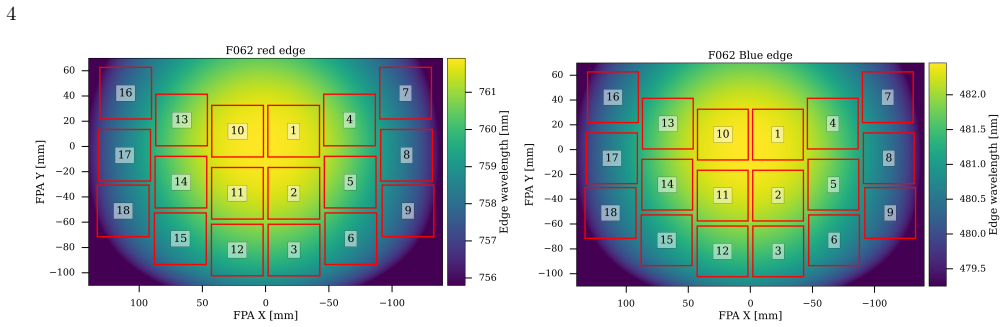
If left uncorrected, the measured FPA-dependent wavelength shifts (ranging roughly +6 to -80 Å across the 18 SCAs) introduce a redshift-dependent distance-modulus bias that propagates to Δw0 ≈ -0.066 and Δwa ≈ 0.236, exceeding the forecast statistical uncertainties of 0.025 and 0.114 and rendering the survey systematics-limited. Detector-specific filter curves recover unbiased constraints, and characterization of the shifts to within ~20% keeps the bias below the statistical noise floor; the coherent 0.06% absolute-calibration residual is already subdominant.
What carries the argument
SCA-specific filter transmission curves obtained by a linear edge-to-edge mapping of the measured TVAC red and blue edges onto the reference SCA-2 bandpass, applied inside end-to-end SNANA simulations of the Sundial HLTDS cadence.
Load-bearing premise
The assumption that a simple linear stretch of the two measured filter edges fully captures every SCA's true transmission, including unmodeled ripple and higher-order coating variations.
What would settle it
Apply the same SCA-specific curves to an independent high-SNR stellar sample (or an early on-orbit standard-star campaign) and check whether the predicted color-dependent magnitude offsets match the observed photometry at the few-millimag level across the focal plane.
Editorial analysis
A structured set of objections, weighed in public.
Referee Report
Summary. The paper quantifies how wavelength-dependent filter transmission variations across Roman's 18 SCAs affect SN Ia photometry and cosmology for the HLTDS. Using controlled SNANA/Pippin simulations with identical seeds, SALT3-NIR light-curve fits, BBC bias corrections, and wfit cosmology, the authors compare a nominal (no-shift) case against FPA-dependent shifts (linear edge-to-edge maps of TVAC-measured red/blue edges relative to SCA 2) and coherent 0.06% absolute-wavelength offsets. Uncorrected FPA shifts produce a redshift-dependent distance-modulus bias that yields Δw0 ≈ −0.066 and Δwa ≈ 0.236 (CMB prior), exceeding the forecast statistical errors σstat,w0 = 0.025 and σstat,wa = 0.114. Detector-specific filter curves recover unbiased cosmology; a half-shift test shows near-linear scaling, implying that the FPA shifts must be known to ~20% to keep the systematic below the statistical floor. Coherent 0.06% offsets produce negligible bias (Δwa ≈ −0.0004).
Significance. Calibration systematics dominate modern SN Ia cosmology, and Roman's Stage-IV dark-energy goals make a quantitative assessment of FPA chromatic effects essential before launch. The work supplies a concrete, falsifiable requirement (characterize FPA wavelength shifts to ~20%) and demonstrates that the already-achieved pre-launch 0.06% absolute edge-wavelength precision is sufficient for the coherent residual. Strengths include the controlled identical-seed simulation design that isolates the transmission change, the half-shift scaling test, public SNANA/Pippin configuration files and detector-specific transmission curves, and an explicit path to on-orbit validation with stellar photometry. If the numerical results hold, the paper will be a required reference for the Roman SN cosmology pipeline and for the mission's systematic-error budget.
major comments (2)
- Abstract vs. body sign inconsistency on Δwa: the abstract states Δwa = −0.236 while Table 2 and §3.3 report Δwa = +0.236 (and the abstract's Δw0 ~ −0.06 is consistent with Table 2's −0.066). The definition ΔX = X(nominal) − X(shifted) is given in Eqs. (9)–(11); the abstract must be brought into agreement with the body so that the central numerical claim is unambiguous.
- §2.2, Eqs. (1)–(3): the linear edge-to-edge map that matches only the red and blue 50% edges of SCA 2 is the load-bearing model of FPA-dependent transmission. The text itself notes that a full transmission model requires additional field dependence of the ripple and higher-order coating variations that are not yet included. Because the half-shift test (Table 2) already shows near-linear scaling of the cosmological bias, a short quantitative bound or sensitivity test on residual ripple (even a simple estimate of the mmag-level impact) would strengthen the claim that the 20% characterization requirement remains robust once the full optical model is available.
minor comments (5)
- Figure 4 caption and surrounding text: the best-fit cosmology line is described as a 'simple Roman-only sample MCMC' while the main cosmology results use wfit with BBC and a CMB prior; a one-sentence clarification of the difference would avoid confusion.
- Table 1 column headers and the COH-FIXED impact column: the sign convention for 'impact [mmag]' (nominal − shifted) should be stated explicitly so that positive/negative values can be compared directly with Figures 6–7.
- §2.4: the statement that SNANA supports at most 62 filters and that 9 unique SCA pairs reduce the set to 54 is useful; a brief note on whether the pairing is exact or approximate (and whether any residual SCA-to-SCA difference remains) would help reproducibility.
- §3.1 / Figure 7: the filter-dropout redshifts (z ~ 1.0, 1.8, 2.4) are correctly identified as the source of the >50 mmag outliers; a short remark that these outliers are excluded from the linear slope fits (as done for the Tripp components) would make the analysis chain fully transparent.
- References: Switzer et al. (2025) is the key laboratory source; ensure the citation is complete and that the GitHub optical-model link remains accessible for readers.
Circularity Check
No significant circularity: forward simulation of laboratory-measured filter edges through an independent SNANA/BBC/wfit pipeline; outputs are not forced by construction from the inputs.
full rationale
The paper's derivation chain is a controlled forward model: TVAC-measured edge wavelengths (Switzer et al. 2025) are converted via a linear map (Eqs. 1–3) into per-SCA transmission curves, applied to identical-seed SNANA light-curve simulations of the Sundial HLTDS cadence, then processed through SALT3 fitting, BBC bias corrections, and wfit cosmology. The reported Δw0 ≈ −0.066 and Δwa ≈ 0.236 (and the 20 % characterization requirement from the half-shift test) are numerical outputs of that pipeline, not quantities that were fitted and then re-used as inputs, nor quantities that are definitionally identical to the input edge shifts. Self-citations (K25, Rose et al. 2025, Paulin in prep, Switzer et al. 2025) supply the observing strategy, simulation infrastructure, and laboratory filter data; none of them is a uniqueness theorem or ansatz that forces the cosmological bias result. The linear edge-to-edge approximation is an acknowledged modeling choice (Section 2.2 notes that ripple/higher-order coating variations remain unmodeled), not a circular redefinition. No step reduces a claimed prediction to its own inputs by construction.
Axiom & Free-Parameter Ledger
free parameters (3)
- per-SCA linear slope m and intercept C
- 0.06% absolute edge-wavelength uncertainty
- SALT3-NIR stretch and color population parameters
axioms (4)
- ad hoc to paper A linear transformation of the SCA-2 bandpass that matches only the red and blue 50% edges fully represents the true SCA-dependent transmission (including ripple).
- domain assumption Spectroscopic redshifts are known perfectly and there is no core-collapse or peculiar-Ia contamination.
- domain assumption The SALT3-NIR spectral model remains valid when the observed-frame filters are shifted by tens of angstroms.
- domain assumption Water-ice accumulation and temporal evolution of the coatings can be ignored for the present bias estimate.
read the original abstract
Calibration uncertainties are the leading systematics in cosmological analyses using Type Ia supernovae (SNe Ia). For the \textit{Nancy Grace Roman Space Telescope (Roman)}, we quantify the impact of chromatic effects on SNe Ia photometry and derived cosmological parameters, using simulated light curves from the High-Latitude Time Domain Survey. We investigate two sources of wavelength-dependent bias: focal plane array (FPA)-dependent wavelength shifts arising from spatial variations across \textit{Roman's} 18 detectors, and coherent wavelength shifts corresponding to the measured $0.06\%$ uncertainty in absolute filter wavelength calibration. Using simulated SNe Ia light curves, we find that the FPA-dependent shifts -- which range from +6 to -80 $\rm \AA$ introduce a redshift-dependent distance modulus bias that, if left uncorrected, propagates to $\Delta w_0 \sim -0.06$ and $\Delta w_a = -0.236$, which are larger than the forecast statistical uncertainties of $\sigma_{\rm stat, w_0} = 0.025$ and $\sigma_{\rm stat, w_a} = 0.114$, rendering the survey systematics-limited. We probe the impact of chromatic effects by employing detector-specific filter curves that recover unbiased cosmological constraints; to remain below the statistical noise floor, FPA wavelength shifts must be characterized to within 20\%. In contrast, a coherent 0.06\% offset in filter wavelength calibration -- ranging from -3 to -11 $\rm \AA$ -- produces negligible redshift-dependent bias, with a minimal spread in $w_a$ ($\Delta w_a = -0.0004, \sigma_{w_{a,\rm sys}} = 0.114)$, demonstrating that the achieved pre-launch calibration precision is sufficient for this systematic to remain subdominant. Our results establish that chromatic effects are a required component of SN Ia cosmology with \textit{Roman}.
Figures



Reference graph
Works this paper leans on
-
[1]
G., Aguilar, J., Ahlen, S., et al
Adame, A. G., Aguilar, J., Ahlen, S., et al. 2025, JCAP, 2025, 012, doi: 10.1088/1475-7516/2025/04/012
-
[2]
2019, arXiv e-prints, arXiv:1902.05569, doi: 10.48550/arXiv.1902.05569
Akeson, R., Armus, L., Bachelet, E., et al. 2019, arXiv e-prints, arXiv:1902.05569, doi: 10.48550/arXiv.1902.05569
-
[3]
2026, AJ, 171, 129, doi: 10.3847/1538-3881/ae3714 Astropy Collaboration, Price-Whelan, A
Aldoroty, L., Scolnic, D., Kannawadi, A., et al. 2026, AJ, 171, 129, doi: 10.3847/1538-3881/ae3714 Astropy Collaboration, Price-Whelan, A. M., Sip˝ ocz, B. M., et al. 2018, AJ, 156, 123, doi: 10.3847/1538-3881/aabc4f
-
[4]
2014, A&A, 568, A22, doi: 10.1051/0004-6361/201423413
Betoule, M., Kessler, R., Guy, J., et al. 2014, A&A, 568, A22, doi: 10.1051/0004-6361/201423413
-
[5]
C., Gordon, K
Bohlin, R. C., Gordon, K. D., & Tremblay, P.-E. 2014, PASP, 126, 711
2014
-
[6]
Brout, D., Hinton, S. R., & Scolnic, D. 2021, ApJL, 912, L26, doi: 10.3847/2041-8213/abf4db
-
[7]
2022, ApJ, 938, 111, doi: 10.3847/1538-4357/ac8bcc
Brout, D., Taylor, G., Scolnic, D., et al. 2022, ApJ, 938, 111, doi: 10.3847/1538-4357/ac8bcc
-
[8]
Burke, D. L., Rykoff, E. S., Allam, S., et al. 2018, AJ, 155, 41, doi: 10.3847/1538-3881/aa9f22 DES Collaboration, Abbott, T. M. C., Acevedo, M., et al. 2024, ApJL, 973, L14, doi: 10.3847/2041-8213/ad6f9f
-
[9]
Fitzpatrick, E. L. 1999, PASP, 111, 63, doi: 10.1086/316293
doi:10.1086/316293 1999
-
[10]
2007, A&A, 466, 11, doi: 10.1051/0004-6361:20066930
Guy, J., Astier, P., Baumont, S., et al. 2007, A&A, 466, 11, doi: 10.1051/0004-6361:20066930
-
[11]
2020, The Journal of Open Source Software, 5, 2122, doi: 10.21105/joss.02122
Hinton, S., & Brout, D. 2020, The Journal of Open Source Software, 5, 2122, doi: 10.21105/joss.02122
-
[12]
Hinton, S. R. 2016, The Journal of Open Source Software, 1, 00045, doi: 10.21105/joss.00045
-
[13]
2012, ApJ, 752, 79, doi: 10.1088/0004-637X/752/2/79
Hlozek, R., Kunz, M., Bassett, B., et al. 2012, ApJ, 752, 79, doi: 10.1088/0004-637X/752/2/79
-
[14]
Hounsell, R., Scolnic, D., Foley, R. J., et al. 2018, ApJ, 867, 23, doi: 10.3847/1538-4357/aac08b
-
[15]
Hunter, J. D. 2007, Computing in Science & Engineering, 9, 90, doi: 10.1109/MCSE.2007.55
-
[16]
Jones, D. O., Scolnic, D. M., Foley, R. J., et al. 2019, ApJ, 881, 19, doi: 10.3847/1538-4357/ab2bec
-
[17]
2025, arXiv e-prints, arXiv:2506.04402, doi: 10.48550/arXiv.2506.04402
Kessler, R., Hounsell, R., Joshi, B., et al. 2025, arXiv e-prints, arXiv:2506.04402, doi: 10.48550/arXiv.2506.04402
-
[18]
2017, ApJ, 836, 56, doi: 10.3847/1538-4357/836/1/56
Kessler, R., & Scolnic, D. 2017, ApJ, 836, 56, doi: 10.3847/1538-4357/836/1/56
-
[19]
2023, The Astrophysical Journal Letters, 952, L8, doi: 10.3847/2041-8213/ace34d
Kessler, R., Vincenzi, M., & Armstrong, P. 2023, The Astrophysical Journal Letters, 952, L8, doi: 10.3847/2041-8213/ace34d
-
[20]
Kessler, R., Bernstein, J. P., Cinabro, D., et al. 2009, PASP, 121, 1028, doi: 10.1086/605984
doi:10.1086/605984 2009
-
[21]
Kunz, M., Bassett, B. A., & Hlozek, R. A. 2007, PhRvD, 75, 103508, doi: 10.1103/PhysRevD.75.103508
-
[22]
2019, MNRAS, 485, 5329, doi: 10.1093/mnras/stz619
Lasker, J., Kessler, R., Scolnic, D., et al. 2019, MNRAS, 485, 5329, doi: 10.1093/mnras/stz619
-
[23]
Marlin, E. G., Murakami, Y. S., Brout, D., et al. 2025, arXiv e-prints, arXiv:2512.21903, doi: 10.48550/arXiv.2512.21903
-
[24]
Marriner, J., Bernstein, J. P., Kessler, R., et al. 2011, ApJ, 740, 72, doi: 10.1088/0004-637X/740/2/72
-
[25]
Mosby, G., Rauscher, B. J., Bennett, C., et al. 2020, Journal of Astronomical Telescopes, Instruments, and Systems, 6, 046001, doi: 10.1117/1.JATIS.6.4.046001
-
[26]
Oke, J. B. 1974, ApJS, 27, 21, doi: 10.1086/190287
doi:10.1086/190287 1974
-
[27]
2025, MNRAS, 544, 3799, doi: 10.1093/mnras/staf1833
OpenUniverse, LSST Dark Energy Science Collaboration, Roman HLIS Project Infrastructure, et al. 2025, MNRAS, 544, 3799, doi: 10.1093/mnras/staf1833
-
[28]
1999, ApJ, 517, 565, doi: 10.1086/307221
Perlmutter, S., Aldering, G., Goldhaber, G., et al. 1999, ApJ, 517, 565, doi: 10.1086/307221
doi:10.1086/307221 1999
-
[29]
Pickles, A. J. 1998, PASP, 110, 863, doi: 10.1086/316197
doi:10.1086/316197 1998
-
[30]
Pierel, J. D. R., Jones, D. O., Kenworthy, W. D., et al. 2022, ApJ, 939, 11, doi: 10.3847/1538-4357/ac93f9
-
[31]
2023, ApJ, 945, 84, doi: 10.3847/1538-4357/aca273
Popovic, B., Brout, D., Kessler, R., & Scolnic, D. 2023, ApJ, 945, 84, doi: 10.3847/1538-4357/aca273
-
[32]
2021, ApJ, 913, 49, doi: 10.3847/1538-4357/abf14f
Popovic, B., Brout, D., Kessler, R., Scolnic, D., & Lu, L. 2021, ApJ, 913, 49, doi: 10.3847/1538-4357/abf14f
-
[33]
2025, A&A, 694, A5, doi: 10.1051/0004-6361/202450391
Popovic, B., Rigault, M., Smith, M., et al. 2025, A&A, 694, A5, doi: 10.1051/0004-6361/202450391
-
[34]
Riess, A. G., Filippenko, A. V., Challis, P., et al. 1998, AJ, 116, 1009, doi: 10.1086/300499
doi:10.1086/300499 1998
-
[35]
M., Baltay, C., Hounsell, R., et al
Rose, B. M., Baltay, C., Hounsell, R., et al. 2021, arXiv e-prints, arXiv:2111.03081, doi: 10.48550/arXiv.2111.03081 17
-
[36]
M., Vincenzi, M., Hounsell, R., et al
Rose, B. M., Vincenzi, M., Hounsell, R., et al. 2025, ApJ, 988, 65, doi: 10.3847/1538-4357/ade1d6
-
[37]
2025, ApJ, 986, 231, doi: 10.3847/1538-4357/adc0a5
Rubin, D., Aldering, G., Betoule, M., et al. 2025, ApJ, 986, 231, doi: 10.3847/1538-4357/adc0a5
-
[38]
Schlafly, E. F., Finkbeiner, D. P., Juri´ c, M., et al. 2012, ApJ, 756, 158, doi: 10.1088/0004-637X/756/2/158
-
[39]
Schlegel, D. J., Finkbeiner, D. P., & Davis, M. 1998, ApJ, 500, 525, doi: 10.1086/305772
doi:10.1086/305772 1998
-
[40]
2015, ApJ, 815, 117, doi: 10.1088/0004-637X/815/2/117
Scolnic, D., Casertano, S., Riess, A., et al. 2015, ApJ, 815, 117, doi: 10.1088/0004-637X/815/2/117
-
[41]
Scolnic, D. M., Jones, D. O., Rest, A., et al. 2018, ApJ, 859, 101, doi: 10.3847/1538-4357/aab9bb
-
[42]
2013, arXiv e-prints, arXiv:1305.5422, doi: 10.48550/arXiv.1305.5422
Spergel, D., Gehrels, N., Breckinridge, J., et al. 2013, arXiv e-prints, arXiv:1305.5422, doi: 10.48550/arXiv.1305.5422
-
[43]
2015, arXiv e-prints, arXiv:1503.03757, doi: 10.48550/arXiv.1503.03757
Spergel, D., Gehrels, N., Baltay, C., et al. 2015, arXiv e-prints, arXiv:1503.03757, doi: 10.48550/arXiv.1503.03757
-
[44]
Switzer, E. R., Bray, E., Will, S. D., et al. 2025, ApOpt, 64, 10525, doi: 10.1364/AO.569503
-
[45]
Taylor, G., Lidman, C., Tucker, B. E., et al. 2021, Monthly Notices of the Royal Astronomical Society, 504, 4111–4122, doi: 10.1093/mnras/stab962
-
[46]
Taylor, G., Jones, D. O., Popovic, B., et al. 2023, MNRAS, 520, 5209, doi: 10.1093/mnras/stad320
-
[47]
2024, The Dark Energy Survey Supernova Program: Cosmological Analysis and Systematic Uncertainties
Vincenzi, M., Brout, D., Armstrong, P., et al. 2024, The Dark Energy Survey Supernova Program: Cosmological Analysis and Systematic Uncertainties. https://arxiv.org/abs/2401.02945
Pith/arXiv arXiv 2024
-
[48]
Virtanen, P., Gommers, R., Oliphant, T. E., et al. 2020, Nature Methods, 17, 261, doi: 10.1038/s41592-019-0686-2
-
[49]
2008, Phys
Wang, Y. 2008, Phys. Rev. D, 77, 123525
2008
-
[50]
2025, Nancy Grace Roman Space Telescope: Wide Field Instrument Calibration Touchstone Field Recommendations, Tech
Williams, B., Bellini, A., Walth, G., et al. 2025, Nancy Grace Roman Space Telescope: Wide Field Instrument Calibration Touchstone Field Recommendations, Tech. rep. https://roman.gsfc.nasa.gov/science/calibration/ WFI Touchstone Fields RevA 2025-03-31.pdf
2025
discussion (0)
Sign in with ORCID, Apple, or X to comment. Anyone can read and Pith papers without signing in.