REVIEW 3 major objections 5 minor 191 references
A newly mapped molecular structure around Cygnus X-1 is powered mainly by the companion star's wind and reshaped by its jets.
Reviewed by Pith at T0; open to challenge. T0 means a machine referee read the full paper against a public rubric. the ladder, T0–T4 →
T0 review · grok-4.5
2026-07-13 01:08 UTC pith:PKVKHLM2
load-bearing objection New IRAM CO maps find a real spider structure around Cyg X-1; the dual-outflow story is plausible and carefully hedged, but association still rests on a narrow velocity cut and order-of-magnitude energetics. the 3 major comments →
A cooler look at the environment of Cygnus X-1: Searching for dynamical interactions within cold molecular gas
The pith
A machine-rendered reading of the paper's core claim, the machinery that carries it, and where it could break.
Core claim
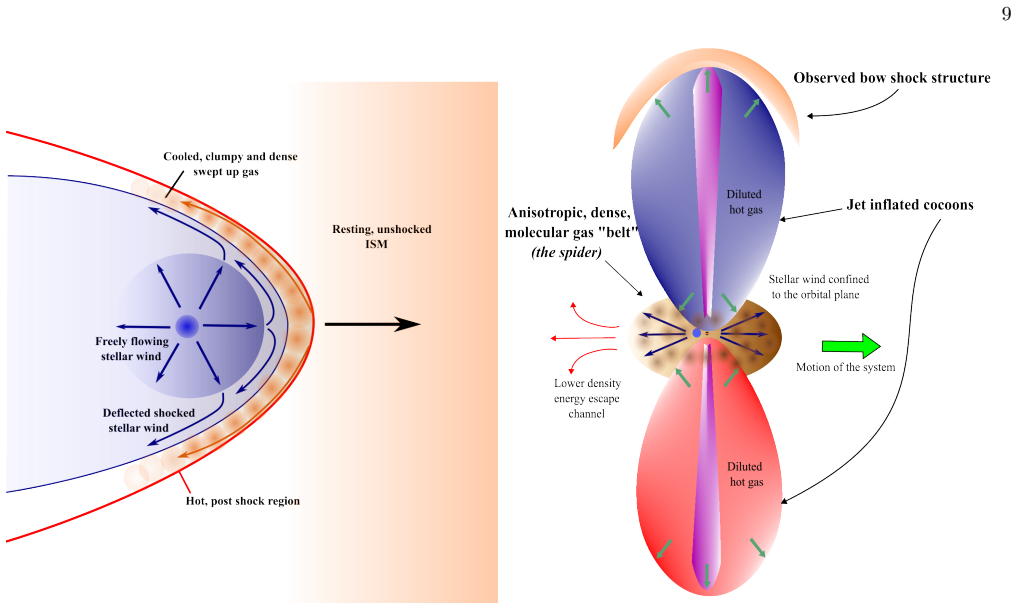
The spider, an extended irregular molecular structure surrounding Cygnus X-1, has kinematics and radiative output consistent with a dense cooled belt produced primarily by the stellar wind of the O-star companion and then sculpted by the cocoons of the binary's relativistic jets.
What carries the argument
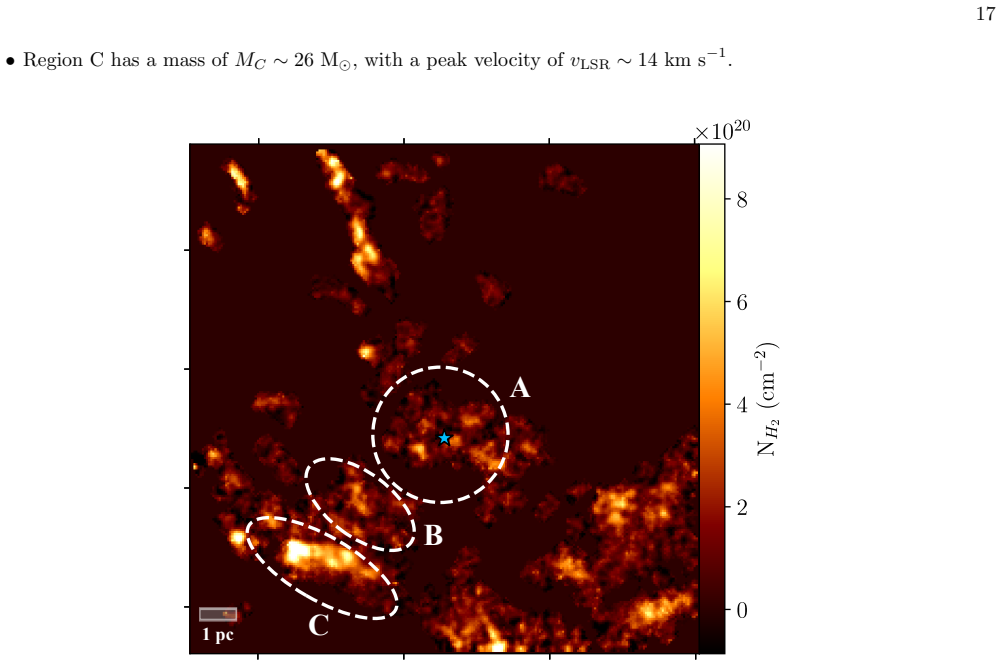
The spider: a ~2-pc molecular shell whose undulating position-velocity pattern, ~10 solar-mass mass, and CO luminosity (~3e31 erg/s) match a momentum-driven wind bow shock that has been laterally confined by jet cocoons.
Load-bearing premise
The cold molecular gas seen only in the narrow velocity window near the binary's own speed is assumed to be physically associated with Cygnus X-1 rather than unrelated foreground or background material.
What would settle it
Higher-resolution molecular maps that either erase the spider's undulating velocity pattern relative to other clouds, or place its bulk motion far outside the binary's known radial-velocity range, would falsify the wind-jet association.
If this is right
- Molecular-line imaging can separate stellar-wind and jet contributions in other high-mass X-ray binaries where continuum maps alone remain ambiguous.
- Calorimetric estimates of jet power around Cygnus X-1 must now account for a multiphase medium that includes a cold wind-driven shell.
- A still-undetected receding cocoon may be revealed by deeper mapping of the southeastern molecular cloud.
- Future hydrodynamical simulations can be constrained by the observed size, mass and velocity gradients of the spider.
Where Pith is reading between the lines
- If the spider is confirmed, similar wind-jet molecular belts should appear around other high-mass systems that have both strong winds and persistent jets.
- The method supplies a practical observational filter: look for undulating velocity patterns on circular paths around the binary that exceed those of neighboring clouds.
- The same CO maps can be re-used to place quantitative upper limits on any molecular gas still hidden at the leading edge of the known northern bow shock.
Editorial analysis
A structured set of objections, weighed in public.
Referee Report
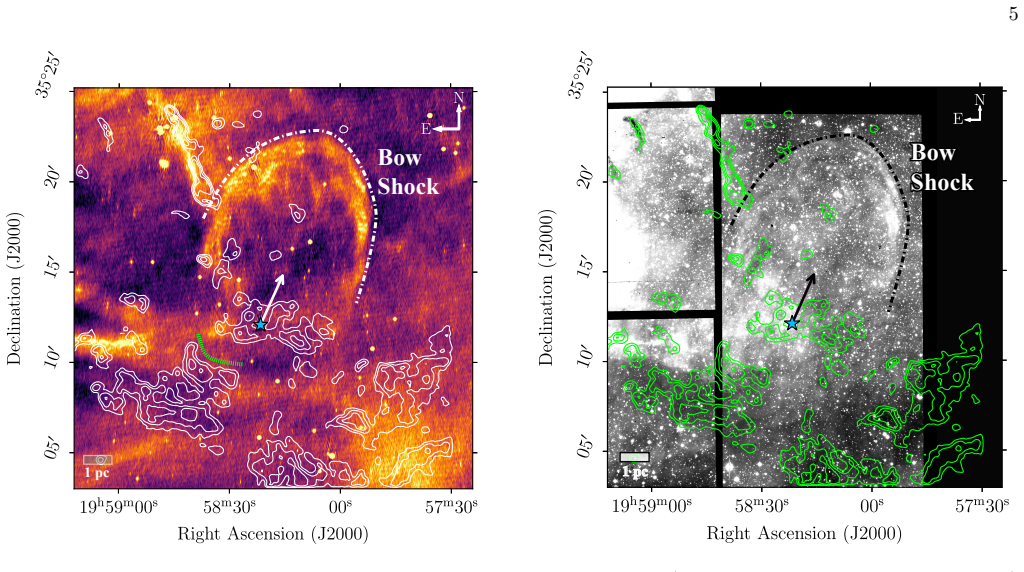
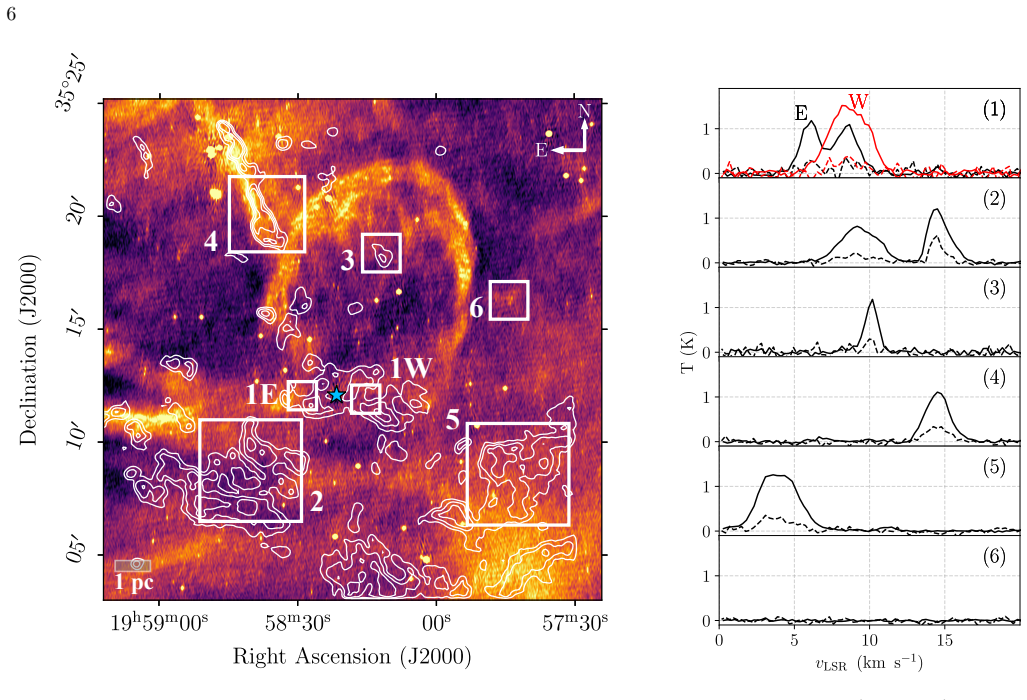
Summary. The paper presents IRAM-30m 12CO and 13CO (J=2-1) maps of the Cygnus X-1 field and reports a previously unseen molecular structure ("the spider") surrounding the binary, plus a southeastern cloud. Spectra and position-velocity diagrams show multi-peaked/asymmetric lines and an undulating velocity pattern around the spider. The authors argue that this structure is consistent with a stellar-wind-driven, motion-induced bow shock that has been further sculpted by jet-inflated cocoons, while the known radio/optical bow shock remains largely devoid of molecular gas in the observed velocity range. They compare a preferred high-relative-motion (momentum-driven) scenario with a low-relative-motion (energy-driven) alternative, estimate a rough energy budget, and assess chance alignment after a velocity cut.
Significance. If the spider is physically associated with Cygnus X-1, the work supplies a concrete observational path for disentangling stellar-wind and jet feedback in a high-mass X-ray binary using molecular-line imaging rather than continuum alone. The data products (masked cubes, spectra, P-V diagrams, column-density map) are carefully reduced and the dual-outflow framing is of clear interest to the jet-ISM and HMXB communities. The energy-budget comparison (L_spider vs L_CO) and the uniqueness check against other circular paths (App. C) are useful first steps, even though both remain order-of-magnitude.
major comments (3)
- The central claim (abstract; §4.1; Fig. 5) that the spider is powered by the stellar wind and sculpted by the jets rests on physical association with Cyg X-1. That association is justified in §2.2 by restricting analysis to the only significant emission in v_LSR = [0, 20] km s^{-1} (near the system’s ~10.2 km s^{-1}) and in §4.3 by a ~5% chance-alignment probability after the same velocity cut. The cut is partly circular: emission outside the window is discarded a priori, so the filling-factor argument only measures how much of the remaining map is occupied. The undulating P-V pattern (Fig. 4) and the comparison to two other circular paths (App. C) are suggestive but not decisive; similar undulations can arise in unrelated turbulent or expanding clouds. The manuscript should either (i) quantify the association more robustly (e.g., full-cube chance-alignment statistics without the velocit
- The preferred high-relative-motion scenario (§4.1) is qualitative. The free parameters (system-ISM relative velocity 10-20 km s^{-1}, filling factor f, sound speed c_s, post-shock density, cooling function Λ) enter the cooling-time and L_spider estimates (Eqs. 1-3) at order-of-magnitude level; the geometry of the jet-wind confinement (Fig. 5) assumes a near-perpendicular offset that the text itself notes is only approximate (~110-120°). Without even a simple parameter sweep or a clear falsifiable prediction for higher-resolution data, it is hard to judge how unique the wind+jet picture is relative to other dynamical explanations of an irregular molecular belt. A short quantitative sensitivity discussion or an explicit list of observables that would distinguish the scenario would strengthen the claim.
- The southeastern-cloud discussion (§4.4) notes a ~25° offset from the known jet axis and a recession velocity far below the expected cocoon expansion speed (>90 km s^{-1}). The text correctly flags that a direct jet-flow interaction is unlikely, yet still presents the cloud as a possible receding-cocoon signature. Given that this is the second of the two "potentially driven" features highlighted in the abstract and summary, the manuscript should either tighten the language to "kinematically interesting but currently unassociated" or supply a concrete test (e.g., higher-resolution kinematics or shock tracers) that could confirm or rule out a cocoon interaction.
minor comments (5)
- Fig. 1 and Fig. 2: the contour levels [4.8, 9.6, 16.3] K km s^{-1} are stated but the corresponding σ multiples are not; a brief note would help the reader judge significance at a glance.
- Eq. (3): the step from L_spider ~ S c_s ρ(r) v_∞^{2} to ~ Ṁ v_∞ f c_s is correct under the adopted wind profile, but the intermediate algebra is compressed; a short expansion would improve readability.
- App. B: the H2 masses (~10, 7, 26 M_⊙) assume LTE and a fixed 13CO/H2 conversion; a one-sentence caveat on possible non-LTE or abundance variations would be useful.
- The draft date (July 13, 2026) and several 2025-2026 references are fine for a draft but should be checked for final citation status before acceptance.
- Typos/clarity: "the spiderhereafter" spacing (p. 5); "reminiscent of a bow shock" indentation description could be cross-referenced to the green dashed line in Fig. 2 more explicitly.
Circularity Check
No significant circularity: central claims rest on new IRAM maps/P-V data and external wind parameters, not on self-forced predictions or definitional reductions.
full rationale
The paper's load-bearing steps are (i) detection of the spider morphology and undulating P-V pattern in new 12CO/13CO cubes (Figs. 1, 3, 4), (ii) comparison of that pattern's gradients to two control circular paths (App. C), (iii) order-of-magnitude energy-budget consistency L_spider ≳ Ṁ v_∞ f c_s ~ 10^32 erg s^{-1} versus observed L_CO ~ 3×10^31 erg s^{-1} using literature wind parameters (Herrero, Gies et al.), and (iv) a simple geometric chance-alignment estimate after a velocity cut near the system's known v_LSR. None of these reduce by construction to their inputs: the velocity window is an explicit selection assumption justified by the system's measured radial velocity and the absence of other significant emission, not a fitted parameter re-labeled as a prediction; the energy comparison uses independent O-star wind values and does not solve for them from the CO data; prior method papers (Tetarenko, Bosch-Cabot) supply analysis tools but are not invoked as uniqueness theorems that force the wind+jet scenario. The dual-outflow interpretation is therefore an interpretive model consistent with the new data, not a circular derivation. Minor self-citation of the authors' earlier astrochemistry technique papers exists but is non-load-bearing.
Axiom & Free-Parameter Ledger
free parameters (6)
- system-ISM relative velocity =
10-20 km s^{-1}
- interaction surface filling factor f =
f ≲ 1
- molecular-gas sound speed c_s =
0.4-0.8 km s^{-1}
- momentum-transfer efficiency epsilon =
0.1-1
- spider H2 mass M_c =
~10 M_sun
- post-shock density and cooling function Lambda =
order-of-magnitude ranges
axioms (5)
- domain assumption Galactic rotation curve of Reid et al. (2019) and kinematic-distance methods of Wenger et al. (2018) correctly map v_LSR to distance near Cygnus X-1.
- domain assumption 12CO(J=2-1) and 13CO(J=2-1) are reliable density and optical-depth tracers with critical density ~10^3 cm^{-3}.
- domain assumption Standard O-star wind density profile rho(r) = M_dot/(4 pi r^2 v_inf) applies at parsec scales.
- domain assumption Post-shock cooling rates of Sutherland & Dopita (1993) for solar-metallicity gas are applicable.
- ad hoc to paper Emission detected only inside v_LSR = [0,20] km s^{-1} is the relevant gas that could have been affected by Cygnus X-1 feedback.
read the original abstract
We present IRAM--30m observations aimed at identifying potential outflow-interstellar medium interaction sites in the vicinity of the black hole X-ray binary Cygnus X--1, which displays persistent relativistic jets and a prominent stellar wind. Using this dataset, we construct molecular line emission maps, identifying a never before seen molecular structure potentially linked to X-ray binary-driven feedback. This structure, surrounding the source, exhibits properties consistent with an interaction powered primarily by the stellar wind of the massive stellar companion and further sculpted by the relativistic jets. Our results indicate that multiple outflow mechanisms (stellar winds and relativistic jets) may simultaneously be shaping the interstellar medium around Cygnus X--1, and that molecular line imaging can help to disentangle complex feedback processes in environments where multiple outflows take place.
Figures



Reference graph
Works this paper leans on
-
[1]
The Astropy Project: Sustaining and Growing a Community-oriented Open-source Project and the Latest Major Release (v5.0) of the Core Package. , keywords =. doi:10.3847/1538-4357/ac7c74 , archivePrefix =. 2206.14220 , primaryClass =
-
[2]
The Astropy Project: Building an Open-science Project and Status of the v2.0 Core Package. , keywords =. doi:10.3847/1538-3881/aabc4f , archivePrefix =. 1801.02634 , primaryClass =
-
[4]
SExtractor: Software for source extraction. , keywords =. 1996. doi:10.1051/aas:1996164 , adsurl =
-
[5]
Quantifying the Observational Effort Required for the Radial Velocity Characterization of TESS Planets. , keywords =. 2018. doi:10.3847/1538-3881/aacea9 , archivePrefix =. 1807.01263 , primaryClass =
-
[6]
X-Ray Scattering Echoes and Ghost Halos from the Intergalactic Medium: Relation to the Nature of AGN Variability. , keywords =. 2015. doi:10.1088/0004-637X/805/1/23 , archivePrefix =. 1503.01475 , primaryClass =
-
[7]
, keywords =
The 2013 Release of Cloudy. , keywords =. 2013
2013
-
[8]
1989", month =
T _ E X and LAT _ E X Macro Definition Files for Astronomical Publications. , year = "1989", month = "Mar", pages =
1989
-
[9]
LaTeX: A Document Preparation System. 1994
1994
-
[10]
Quasi-periodic Fast Propagating Magnetoacoustic Waves during the Magnetic Reconnection Between Solar Coronal Loops. , keywords =. 2018. doi:10.3847/2041-8213/aaf167 , archivePrefix =. 1811.08553 , primaryClass =
-
[11]
Nominal Values for Selected Solar and Planetary Quantities: IAU 2015 Resolution B3. , keywords =. 2016. doi:10.3847/0004-6256/152/2/41 , archivePrefix =. 1605.09788 , primaryClass =
-
[12]
Swift X-Ray Observations of Classical Novae. II. The Super Soft Source Sample. , keywords =. 2011. doi:10.1088/0067-0049/197/2/31 , archivePrefix =. 1110.6224 , primaryClass =
-
[13]
Galaxy Emission Line Classification Using Three-dimensional Line Ratio Diagrams. , keywords =. 2014. doi:10.1088/0004-637X/793/2/127 , archivePrefix =. 1406.5186 , primaryClass =
-
[14]
The Astronomer's Telegram , volume=
MAXI/GSC discovery of a new X-ray transient MAXI J1348-630 , author=. The Astronomer's Telegram , volume=
-
[15]
Detection and polarization properties of the high-energy emission , author=
INTEGRAL study of MAXI J1535- 571, MAXI J1820+ 070, and MAXI J1348- 630 outbursts-I. Detection and polarization properties of the high-energy emission , author=. Astronomy & Astrophysics , volume=. 2023 , publisher=
2023
-
[16]
Monthly Notices of the Royal Astronomical Society , volume=
The black hole transient MAXI J1348--630: evolution of the compact and transient jets during its 2019/2020 outburst , author=. Monthly Notices of the Royal Astronomical Society , volume=. 2021 , publisher=
2019
-
[17]
Monthly Notices of the Royal Astronomical Society , volume=
NICER observations reveal that the X-ray transient MAXI J1348- 630 is a black hole X-ray binary , author=. Monthly Notices of the Royal Astronomical Society , volume=. 2020 , publisher=
2020
-
[18]
Monthly Notices of the Royal Astronomical Society , volume=
Modelling the kinematics of the decelerating jets from the black hole X-ray binary MAXI J1348--630 , author=. Monthly Notices of the Royal Astronomical Society , volume=. 2022 , publisher=
2022
-
[19]
Monthly Notices of the Royal Astronomical Society: Letters , volume=
The black hole X-ray binary MAXI J1348--630 in quiescence , author=. Monthly Notices of the Royal Astronomical Society: Letters , volume=. 2022 , publisher=
2022
-
[20]
Monthly Notices of the Royal Astronomical Society: Letters , volume=
Measuring the distance to the black hole candidate X-ray binary MAXI J1348--630 using H i absorption , author=. Monthly Notices of the Royal Astronomical Society: Letters , volume=. 2021 , publisher=
2021
-
[21]
Astronomy & Astrophysics , volume=
MAXI J1348--630: Estimating the black hole mass and binary inclination using a scaling technique , author=. Astronomy & Astrophysics , volume=. 2023 , publisher=
2023
-
[22]
Astronomy & Astrophysics , volume=
A giant X-ray dust scattering ring discovered with SRG/eROSITA around the black hole transient MAXI J1348--630 , author=. Astronomy & Astrophysics , volume=. 2021 , publisher=
2021
-
[23]
The Astrophysical Journal Letters , volume=
No Need for an Extreme Jet Energy in the Black Hole X-Ray Binary MAXI J1348--630 , author=. The Astrophysical Journal Letters , volume=. 2023 , publisher=
2023
-
[24]
Galaxies , volume=
Properties of MAXI J1348-630 during Its Second Outburst in 2019 , author=. Galaxies , volume=. 2022 , publisher=
2019
-
[25]
Annual Review of Astronomy and Astrophysics, Volume 32, 1994, pp
Abundances in the interstellar medium , author=. Annual Review of Astronomy and Astrophysics, Volume 32, 1994, pp. 191-226. , volume=
1994
-
[26]
Monthly Notices of the Royal Astronomical Society , volume=
CO-to-H2 conversion and spectral column density in molecular clouds: the variability of the X CO factor , author=. Monthly Notices of the Royal Astronomical Society , volume=. 2020 , publisher=
2020
-
[27]
Monthly Notices of the Royal Astronomical Society , volume=
A self-similar model for extragalactic radio sources , author=. Monthly Notices of the Royal Astronomical Society , volume=. 1997 , publisher=
1997
-
[28]
Publications of the Astronomical Society of the Pacific , volume=
How to calculate molecular column density , author=. Publications of the Astronomical Society of the Pacific , volume=. 2015 , publisher=
2015
-
[29]
Nature , volume=
A dark jet dominates the power output of the stellar black hole Cygnus X-1 , author=. Nature , volume=. 2005 , publisher=
2005
-
[30]
Monthly Notices of the Royal Astronomical Society , volume=
Mapping jet--ISM interactions in X-ray binaries with ALMA: a GRS 1915+ 105 case study , author=. Monthly Notices of the Royal Astronomical Society , volume=. 2018 , publisher=
1915
-
[31]
Monthly Notices of the Royal Astronomical Society , volume=
Jet--ISM interactions near the microquasars GRS 1758- 258 and 1E 1740.7- 2942 , author=. Monthly Notices of the Royal Astronomical Society , volume=. 2020 , publisher=
2020
-
[32]
Annual Review of Astronomy and Astrophysics , volume=
Ultraluminous X-ray sources , author=. Annual Review of Astronomy and Astrophysics , volume=. 2017 , publisher=
2017
-
[33]
The Astrophysical Journal Supplement Series , volume=
PHANGS--ALMA data processing and pipeline , author=. The Astrophysical Journal Supplement Series , volume=. 2021 , publisher=
2021
-
[34]
Publications of the Astronomical Society of the Pacific , volume=
The ALMA interferometric pipeline heuristics , author=. Publications of the Astronomical Society of the Pacific , volume=. 2023 , publisher=
2023
-
[35]
The Astrophysical Journal , volume=
The Milky Way in Molecular Clouds: A New Complete COSurvey , author=. The Astrophysical Journal , volume=. 2001 , publisher=
2001
-
[36]
The Astrophysical Journal , volume=
Trigonometric parallaxes of high-mass star-forming regions: our view of the Milky Way , author=. The Astrophysical Journal , volume=. 2019 , publisher=
2019
-
[37]
The Astrophysical Journal , volume=
Kinematic distances: a Monte Carlo method , author=. The Astrophysical Journal , volume=. 2018 , publisher=
2018
-
[38]
2009 , publisher=
Tools of radio astronomy , author=. 2009 , publisher=
2009
-
[39]
The Astrophysical Journal , volume=
CO isotopologues in the Perseus molecular cloud complex: the X-factor and regional variations , author=. The Astrophysical Journal , volume=. 2008 , publisher=
2008
-
[40]
Astronomical data analysis software and systems XVI , volume=
CASA architecture and applications , author=. Astronomical data analysis software and systems XVI , volume=
-
[41]
Publications of the Astronomical Society of Japan , volume=
The MAXI mission on the ISS: science and instruments for monitoring all-sky X-ray images , author=. Publications of the Astronomical Society of Japan , volume=. 2009 , publisher=
2009
-
[42]
The Astronomer's Telegram , volume=
MAXI J1348-630: Swift XRT localization, possible periodicity , author=. The Astronomer's Telegram , volume=
-
[43]
The Astrophysical Journal Letters , volume=
ASASSN-18ey: the rise of a new black hole X-ray binary , author=. The Astrophysical Journal Letters , volume=. 2018 , publisher=
2018
-
[44]
The Astrophysical Journal , volume=
X-ray, optical, and near-infrared monitoring of the new X-ray transient MAXI J1820+ 070 in the low/hard state , author=. The Astrophysical Journal , volume=. 2018 , publisher=
2018
-
[45]
Monthly Notices of the Royal Astronomical Society: Letters , volume=
A radio parallax to the black hole X-ray binary MAXI J1820+ 070 , author=. Monthly Notices of the Royal Astronomical Society: Letters , volume=. 2020 , publisher=
2020
-
[46]
Monthly Notices of the Royal Astronomical Society , volume=
The varying kinematics of multiple ejecta from the black hole X-ray binary MAXI J1820+ 070 , author=. Monthly Notices of the Royal Astronomical Society , volume=. 2021 , publisher=
2021
-
[47]
The Astrophysical Journal Letters , volume=
The binary mass ratio in the black hole transient MAXI J1820+ 070 , author=. The Astrophysical Journal Letters , volume=. 2020 , publisher=
2020
-
[48]
Monthly Notices of the Royal Astronomical Society , volume=
Physical origin of the non-physical spin evolution of MAXI J1820+ 070 , author=. Monthly Notices of the Royal Astronomical Society , volume=. 2021 , publisher=
2021
-
[49]
The Astrophysical Journal , volume=
Estimating the black hole spin for the X-ray binary MAXI J1820+ 070 , author=. The Astrophysical Journal , volume=. 2021 , publisher=
2021
-
[50]
Monthly Notices of the Royal Astronomical Society , volume=
A timing-based estimate of the spin of the black hole in MAXI J1820+ 070 , author=. Monthly Notices of the Royal Astronomical Society , volume=. 2021 , publisher=
2021
-
[51]
The Astrophysical Journal Letters , volume=
Relativistic X-ray jets from the black hole X-ray binary MAXI J1820+ 070 , author=. The Astrophysical Journal Letters , volume=. 2020 , publisher=
2020
-
[52]
Nature Astronomy , volume=
An extremely powerful long-lived superluminal ejection from the black hole MAXI J1820+ 070 , author=. Nature Astronomy , volume=. 2020 , publisher=
2020
-
[53]
The Astronomical Journal , volume=
The demography of massive dark objects in galaxycenters , author=. The Astronomical Journal , volume=. 1998 , publisher=
1998
-
[54]
Heating hot atmospheres with active galactic nuclei , author=. Annu. Rev. Astron. Astrophys. , volume=. 2007 , publisher=
2007
-
[55]
Astronomy & Astrophysics , volume=
Stellar black holes at the dawn of the universe , author=. Astronomy & Astrophysics , volume=. 2011 , publisher=
2011
-
[56]
nature , volume=
The heating of gas in a galaxy cluster by X-ray cavities and large-scale shock fronts , author=. nature , volume=. 2005 , publisher=
2005
-
[57]
The Astrophysical Journal , volume=
Estimating the kinetic luminosity function of jets from Galactic x-ray binaries , author=. The Astrophysical Journal , volume=. 2005 , publisher=
2005
-
[58]
Monthly Notices of the Royal Astronomical Society , volume=
Energization of interstellar media and cosmic ray production by jets from X-ray binaries , author=. Monthly Notices of the Royal Astronomical Society , volume=. 2005 , publisher=
2005
-
[59]
Monthly Notices of the Royal Astronomical Society , volume=
Evidence for a compact jet dominating the broad-band spectrum of the black hole accretor XTE J1550--564 , author=. Monthly Notices of the Royal Astronomical Society , volume=. 2010 , publisher=
2010
-
[60]
Monthly Notices of the Royal Astronomical Society , volume=
Radio lobes and X-ray hotspots in the microquasar S26 , author=. Monthly Notices of the Royal Astronomical Society , volume=. 2010 , publisher=
2010
-
[61]
Nature , volume=
A 300-parsec-long jet-inflated bubble around a powerful microquasar in the galaxy NGC 7793 , author=. Nature , volume=. 2010 , publisher=
2010
-
[62]
Monthly Notices of the Royal Astronomical Society: Letters , volume=
Unveiling recurrent jets of the ULX Holmberg II X-1: evidence for a massive stellar-mass black hole? , author=. Monthly Notices of the Royal Astronomical Society: Letters , volume=. 2014 , publisher=
2014
-
[63]
Astrophysical Journal, vol
Interstellar bubbles , author=. Astrophysical Journal, vol. 200, Sept. 1, 1975, pt. 2, p. L107-L110. , volume=
1975
-
[64]
, author=
Estimates of the Total Energy in Particles and Magnetic Field in the Non-Thermal Radio Sources. , author=. Astrophysical Journal, vol. 129, p. 849-852 , volume=
-
[65]
The Astrophysical Journal , volume=
Composition, collimation, contamination: The jet of Cygnus X-1 , author=. The Astrophysical Journal , volume=. 2006 , publisher=
2006
-
[66]
Monthly Notices of the Royal Astronomical Society , volume=
The jet-powered optical nebula of Cygnus X--1 , author=. Monthly Notices of the Royal Astronomical Society , volume=. 2007 , publisher=
2007
-
[67]
Monthly Notices of the Royal Astronomical Society , volume=
Shell-shocked: the interstellar medium near Cygnus X-1 , author=. Monthly Notices of the Royal Astronomical Society , volume=. 2015 , publisher=
2015
-
[68]
The Astronomical Journal , volume=
A high-resolution radio study of the W50-SS 433 system and the surrounding medium , author=. The Astronomical Journal , volume=. 1998 , publisher=
1998
-
[69]
7--2942 , author=
A double-sided radio jet from the compact Galactic Centre annihilator 1E1740. 7--2942 , author=. Nature , volume=. 1992 , publisher=
1992
-
[70]
The Astrophysical Journal , volume=
Revision of the properties of the GRS 1915+ 105 jets: clues from the large-scale structure , author=. The Astrophysical Journal , volume=. 2004 , publisher=
1915
-
[71]
arXiv preprint astro-ph/9811250 , year=
The surroundings of the superluminal source GRS 1915+ 105 , author=. arXiv preprint astro-ph/9811250 , year=
Pith/arXiv arXiv 1915
-
[72]
Astronomy & Astrophysics , volume=
A search for possible interactions between ejections from GRS 1915+ 105 and the surrounding interstellar medium , author=. Astronomy & Astrophysics , volume=. 2001 , publisher=
1915
-
[73]
The Astrophysical Journal , volume=
Discovery of X-ray jets in the microquasar H1743--322 , author=. The Astrophysical Journal , volume=. 2005 , publisher=
2005
-
[74]
Science , volume=
Large-scale, decelerating, relativistic X-ray jets from the microquasar XTE J1550-564 , author=. Science , volume=. 2002 , publisher=
2002
-
[75]
The Astrophysical Journal , volume=
X-Ray Emission from the Jets of XTE J1550--564 , author=. The Astrophysical Journal , volume=. 2003 , publisher=
2003
-
[76]
Monthly Notices of the Royal Astronomical Society , volume=
Evolving morphology of the large-scale relativistic jets from XTE J1550- 564 , author=. Monthly Notices of the Royal Astronomical Society , volume=. 2017 , publisher=
2017
-
[77]
Monthly Notices of the Royal Astronomical Society , volume=
A highly polarized radio jet during the 1998 outburst of the black hole transient XTE J1748--288 , author=. Monthly Notices of the Royal Astronomical Society , volume=. 2007 , publisher=
1998
-
[78]
Nature , volume=
Episodic ejection of relativistic jets by the X-ray transient GRO J1655-40 , author=. Nature , volume=. 1995 , publisher=
1995
-
[79]
The Astrophysical Journal , volume=
Radio Emission from GRO J1655--40 during the 1994 Jet EjectionEpisodes , author=. The Astrophysical Journal , volume=. 2000 , publisher=
1994
-
[80]
Monthly Notices of the Royal Astronomical Society , volume=
A transient large-scale relativistic radio jet from GX 339- 4 , author=. Monthly Notices of the Royal Astronomical Society , volume=. 2004 , publisher=
2004
-
[81]
The Astrophysical Journal , volume=
Evolution of the X-Ray Jets from 4U 1755--33 , author=. The Astrophysical Journal , volume=. 2006 , publisher=
2006
discussion (0)
Sign in with ORCID, Apple, or X to comment. Anyone can read and Pith papers without signing in.