REVIEW 3 major objections 5 minor 24 references
End-to-end driving systems that keep actor hypotheses alive through full occlusion recover hidden agents and cut open-loop planning error.
Reviewed by Pith at T0; open to challenge. T0 means a machine referee read the full paper against a public rubric. the ladder, T0–T4 →
T0 review · grok-4.5
2026-07-13 05:07 UTC pith:6BOPKHNH
load-bearing objection Solid engineering paper that makes object permanence a first-class requirement in E2E driving, with a usable benchmark; the 0.249 unobs mAP is softer than the abstract implies because of adaptive matching, but the planning gains still hold. the 3 major comments →
BeyondSight: Object Permanence for End-to-End Autonomous Driving
The pith
A machine-rendered reading of the paper's core claim, the machinery that carries it, and where it could break.
Core claim
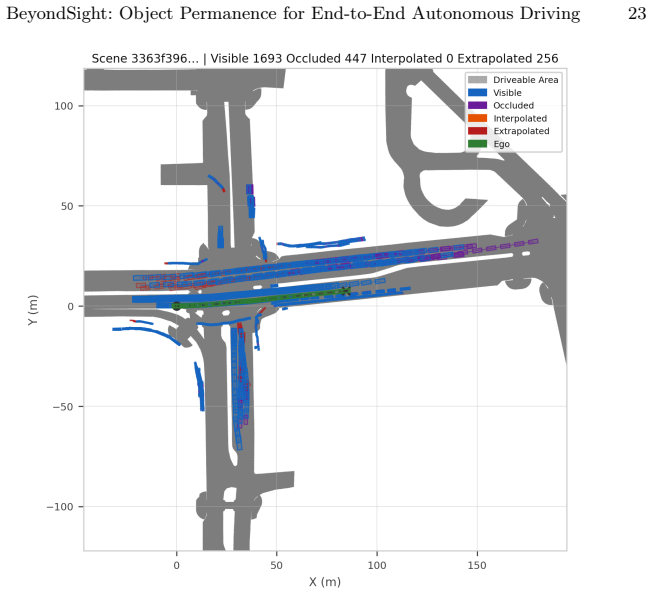
Decoupling actor existence from instantaneous observability—by maintaining temporally propagated, observation-conditioned actor hypotheses that survive full occlusion—improves joint perception, prediction, and planning. On nuScenes-Permanence, BeyondSight lifts unobservable-actor mAP from 0 to 0.249 and reduces open-loop planning L2avg from 0.61 to 0.54 without harming standard visible-actor scores.
What carries the argument
A three-stage actor belief update: a Temporal Prior Decoder that propagates previous queries without image features, an Observation Decoder that conditions on current BEV features, and a Posterior Fusion Decoder that retains the higher-confidence hypothesis—paired with permanence-aware supervision over both observable and unobservable ground truth.
Load-bearing premise
The offline reconstruction of occluded trajectories—by interpolation and short-horizon forecasting—is accurate enough to serve as ground truth for both training and evaluation.
What would settle it
Train and evaluate the identical architecture on a multi-observer or privileged-sensor dataset that records true 3D states of fully occluded actors without reconstruction; if mAPunobs collapses and the planning L2 gains vanish, the permanence claim fails.
Editorial analysis
A structured set of objections, weighed in public.
Referee Report
Summary. BeyondSight proposes a permanence-aware end-to-end driving stack that decouples actor existence from instantaneous observability by propagating sparse actor queries through a Temporal Prior Decoder, updating them with an Observation Decoder, and reconciling them in a Posterior Fusion Decoder (Eqs. 3–8). The authors also introduce nuScenes-Permanence, which retains zero-point boxes and completes unobservable trajectory intervals offline, together with an observability-conditioned evaluation protocol (mAPobs/unobs/all). On standard nuScenes, BeyondSight improves open-loop planning from 0.61 to 0.54 L2avg and slightly improves detection/tracking over SparseDrive and related baselines (Tables 1–2). On nuScenes-Permanence, unobservable detection rises from 0 to 0.249 mAPunobs (Table 3), with ablations attributing gains to temporal prior, fusion, and unobservable supervision (Table 4).
Significance. Object permanence under full occlusion is a genuine and under-addressed requirement for end-to-end autonomous driving; most current stacks and benchmarks equate existence with sensor support. The paper’s contribution is both architectural (explicit prior/observation/fusion query stages) and infrastructural (nuScenes-Permanence annotations and observability-conditioned metrics). If the permanence gains hold under tighter evaluation, the work would establish a useful modeling principle and a reusable benchmark extension. Strengths include clear ablations isolating temporal prior, fusion, and unobservable supervision; a high-occlusion planning subset; occlusion-duration stratification; and competitive standard-protocol metrics showing that persistence does not collapse official mAP/NDS. The planning L2 and collision improvements without changing the planner itself are practically relevant.
major comments (3)
- [Table 3; Supp. D Eqs. (17)–(18); Supp. C Table 10] The headline unobservable detection claim (abstract; Table 3: mAPunobs 0 → 0.249) depends on the adaptive matching threshold in Supp. D, Eqs. (17)–(18), whose coefficients are fit by 90th-percentile quantile regression on the same offline completion pipeline used to create unobservable labels (Supp. C, Table 10). Reconstruction L2 already reaches mean 1.11 m / P90 3.22 m for 4–6 s gaps. Because the tolerance is deliberately enlarged with velocity/acceleration terms, a non-trivial fraction of counted true positives may be loose matches to noisy extrapolated boxes rather than accurate persistent hypotheses. Please report mAPunobs under fixed nuScenes thresholds (or with tolerance ablated to zero extra slack) and under zero-point-only / interpolation-only subsets, so the permanence gain can be separated from matching slack.
- [Supp. Table 8; §6.2 Object Permanence Performance] Supp. Table 8 reports very high false-discovery rates for unobservable predictions (FDRunobs 0.85 at 0–2 s, rising to 0.98 at 4–6 s) while TPRunobs falls from 0.62 to 0.35. This is load-bearing for the claim that BeyondSight “maintains persistent actor hypotheses”: high FDR implies many maintained unobservable queries do not correspond to valid unobservable actors. The main text does not discuss this precision failure mode. Please surface FDR/TPR (or precision–recall) for unobservable actors in the main results, analyze pruning/confidence calibration of stale hypotheses, and clarify how high FDR interacts with the reported mAPunobs and planning gains.
- [§5.1; Supp. C; Table 4] Unobservable supervision and evaluation rest on offline trajectory completion (constant-turn-rate/acceleration interpolation plus a SparseDrive-derived short-horizon forecaster for terminal gaps; §5.1, Supp. C). The paper correctly notes that abrupt hidden maneuvers are out of scope and that error grows with horizon, but training and adaptive evaluation both use this generated GT. Mild circularity risk remains because the completion model is architecturally related to the SparseDrive family. Please quantify how much of the Table 4 gain survives when (i) only zero-point retained boxes are used for unobs supervision (no interp/extrap), and (ii) evaluation ignores extrapolated terminal states. Without that, the 0.249 figure is hard to interpret as pure permanence rather than fitting the completion prior.
minor comments (5)
- [Fig. 1; Fig. 3] Figure 1 and Figure 3 are persuasive but would benefit from explicit timestamps and occlusion duration annotations so readers can judge “prolonged” occlusion quantitatively.
- [§3 Eq. (2)] Eq. (2) formalizes permanence as existence of a representation ri_t, but does not constrain localization quality or confidence; a short remark linking this definition to the observability head and pruning would tighten the formalism.
- [Table 2] Table 2 reports minADE identical to SparseDrive (0.610) while EPA improves slightly; a one-sentence interpretation of why permanence helps EPA more than ADE would help.
- [Supp. B Latency Analysis] Latency is reported only in the supplement (6.1 → 6.0 FPS). A brief main-text note that permanence adds <5% parameters and negligible runtime would strengthen the practicality claim.
- [Abstract; Table 4] Minor wording: abstract and intro say “increasing detection performance for unobservable actors from 0 to 0.249 mAP” without immediately noting that SparseDrive’s zero is protocol-induced under standard filtering; Table 4’s SparseDrive-on-Permanence baseline (0.021) should be cited alongside the abstract claim.
Circularity Check
Mild risk that adaptive matching tolerances fitted to the same offline completion pipeline inflate mAPunobs; core gains still hold vs. baselines under identical protocol and on planning metrics.
specific steps
-
fitted input called prediction
[Supp. D Adaptive Matching Threshold (Eqs. 17–18); used for Table 3 mAPunobs]
"To avoid conflating model error with extrapolation drift, we augment the standard nuScenes matching threshold with an adaptive tolerance: d_match(v, a, t, ℓ) = d_nuScenes(ℓ) + d̂_ℓ(v, a, t), ... The coefficients (α_ℓ, β_ℓ, γ_ℓ) are estimated using non-negative 90th-percentile quantile regression on approximately 1.5×10^6 extrapolated box–horizon pairs generated by masking observable nuScenes annotations."
The key reported figure mAPunobs = 0.249 is computed with a matching radius whose extra slack is fitted directly to reconstruction errors of the identical offline trajectory-completion process that creates the unobservable labels. Longer-horizon (noisier) labels automatically receive larger tolerance, so a non-trivial fraction of “true positives” can be loose matches enabled by the fitted slack rather than precise persistent hypotheses. Baselines still score 0, so the result is not fully forced, but the metric is partially self-calibrated to the label generator.
full rationale
BeyondSight is an empirical end-to-end driving paper whose central claims are measured improvements (mAPunobs 0 o0.249, L2avg 0.61 o0.54) on held-out nuScenes validation scenes and a self-constructed permanence extension. There is no mathematical derivation chain, uniqueness theorem, or self-definitional loop that forces the result by construction. The sole mild circularity concern is that both the unobservable ground-truth labels (Supp. C: interpolation + SparseDrive-adapted forecaster) and the adaptive matching radius used for mAPunobs (Supp. D Eqs. 17–18, 90th-percentile quantile regression on the same reconstruction errors) originate from the identical offline pipeline. This can loosen the criterion in proportion to label noise, especially for longer occlusions. However, SparseDrive scores exactly 0 under the same protocol, ablations show progressive gains only when permanence components are added, and planning/collision metrics (independent of detection matching) also improve on a high-occlusion subset. The annotation model is never used at inference. Thus the circularity is limited to evaluation calibration rather than the model’s learned behavior, warranting only a low score of 2.
Axiom & Free-Parameter Ledger
free parameters (3)
- λ_obs (observability loss weight) =
1.0
- Stage-1 / Stage-2 learning rates and backbone multipliers =
4e-4 / 3e-4
- Adaptive matching coefficients (α_ℓ, β_ℓ, γ_ℓ) =
class-specific (Table 13)
axioms (3)
- domain assumption An actor is unobservable exactly when it has zero associated LiDAR/radar points (Eq. 1).
- domain assumption Actor motion during unobservable intervals is approximately continuous and can be recovered by constant-turn-rate interpolation or short-horizon forecasting.
- domain assumption SparseDrive’s sparse-query detection, motion and planning heads remain a valid backbone once permanence modules are added.
invented entities (2)
-
Temporal Prior Decoder + Posterior Fusion Decoder
no independent evidence
-
nuScenes-Permanence annotation set and observability-conditioned metrics
no independent evidence
read the original abstract
Autonomous driving operates in partially observable environments where actors may become fully occluded by other vehicles or infrastructure. Most end-to-end driving systems implicitly couple actor existence to instantaneous observations, causing actor hypotheses to degrade or disappear during prolonged occlusion and removing potentially critical agents from downstream prediction and planning. We introduce BeyondSight, a permanence-aware end-to-end driving framework that decouples actor existence from observability by maintaining persistent actor hypotheses over time. BeyondSight propagates actor queries temporally and updates them with observation-conditioned evidence, enabling joint perception, prediction, and planning to reason about actors even when they are temporarily unobservable. To enable principled training and evaluation of persistence-aware models, we further introduce nuScenes-Permanence, an extension of nuScenes that provides supervision and observability-conditioned evaluation for unobservable actors. Experiments show that BeyondSight substantially improves reasoning under occlusion, increasing detection performance for unobservable actors from 0 to 0.249 mAP while reducing planning error from 0.61 to 0.54 L2avg. These results highlight object permanence as an important modeling principle for robust end-to-end autonomous driving.
Figures


Reference graph
Works this paper leans on
-
[1]
In: Proceedings of the IEEE/CVF conference on computer vision and pattern recognition
Caesar, H., Bankiti, V., Lang, A.H., Vora, S., Liong, V.E., Xu, Q., Krishnan, A., Pan, Y., Baldan, G., Beijbom, O.: nuscenes: A multimodal dataset for autonomous driving. In: Proceedings of the IEEE/CVF conference on computer vision and pattern recognition. pp. 11621–11631 (2020)
2020
-
[2]
In: Proceedings of the IEEE/CVF Winter Conference on Applications of Computer Vision
Cheong, B., Wang, L., Papais, S., Waslander, S.L.: Scatr: Mitigating new instance suppression in lidar-based tracking-by-attention via second chance assignment and track query dropout. In: Proceedings of the IEEE/CVF Winter Conference on Applications of Computer Vision. pp. 3330–3339 (2026)
2026
-
[3]
In: Proceedings of the IEEE/CVF Conference on Computer Vision and Pattern Recognition
Gu, J., Hu, C., Zhang, T., Chen, X., Wang, Y., Wang, Y., Zhao, H.: Vip3d: End- to-end visual trajectory prediction via 3d agent queries. In: Proceedings of the IEEE/CVF Conference on Computer Vision and Pattern Recognition. pp. 5496– 5506 (2023)
2023
-
[4]
Hu, S., Chen, L., Wu, P., Li, H., Yan, J., Tao, D.: St-p3: End-to-end vision-based autonomousdrivingviaspatial-temporalfeaturelearning.In:EuropeanConference on Computer Vision. pp. 533–549. Springer (2022)
2022
-
[5]
In: Proceedings of the IEEE/CVF Conference on Computer Vision and Pattern Recognition
Hu, Y., Yang, J., Chen, L., Li, K., Sima, C., Zhu, X., Chai, S., Du, S., Lin, T., Wang, W., et al.: Planning-oriented autonomous driving. In: Proceedings of the IEEE/CVF Conference on Computer Vision and Pattern Recognition. pp. 17853– 17862 (2023)
2023
-
[6]
In: Proceedings of the IEEE/CVF International Conference on Computer Vision (ICCV) (2023)
Jia, X., Gao, Y., Chen, L., Yan, J., Liu, P.L., Li, H.: DriveAdapter: Breaking the coupling barrier of perception and planning in end-to-end autonomous driving. In: Proceedings of the IEEE/CVF International Conference on Computer Vision (ICCV) (2023)
2023
-
[7]
arXiv preprint arXiv:2503.07656 (2025)
Jia, X., You, J., Zhang, Z., Yan, J.: Drivetransformer: Unified transformer for scalable end-to-end autonomous driving. arXiv preprint arXiv:2503.07656 (2025)
Pith/arXiv arXiv 2025
-
[8]
In: Proceedings of the IEEE/CVF International Conference on Computer Vision
Jiang, B., Chen, S., Xu, Q., Liao, B., Chen, J., Zhou, H., Zhang, Q., Liu, W., Huang,C.,Wang,X.:Vad:Vectorizedscenerepresentationforefficientautonomous driving. In: Proceedings of the IEEE/CVF International Conference on Computer Vision. pp. 8340–8350 (2023)
2023
-
[9]
arXiv preprint arXiv:2409.18341 (2024)
Li, P., Cui, D.: Navigation-guided sparse scene representation for end-to-end au- tonomous driving. arXiv preprint arXiv:2409.18341 (2024)
Pith/arXiv arXiv 2024
-
[10]
In: European conference on computer vision
Li, Z., Wang, W., Li, H., Xie, E., Sima, C., Lu, T., Qiao, Y., Dai, J.: Bevformer: Learning bird’s-eye-view representation from multi-camera images via spatiotem- poral transformers. In: European conference on computer vision. pp. 1–18. Springer (2022)
2022
-
[11]
In: 2024 IEEE International Conference on Robotics and Automation (ICRA)
Papais, S., Ren, R., Waslander, S.: Swtrack: Multiple hypothesis sliding window 3d multi-object tracking. In: 2024 IEEE International Conference on Robotics and Automation (ICRA). pp. 4939–4945. IEEE (2024)
2024
-
[12]
In: Proceedings of the IEEE/CVF 16 S
Papais, S., Wang, L., Cheong, B., Waslander, S.L.: Foresight: Multi-view streaming joint object detection and trajectory forecasting. In: Proceedings of the IEEE/CVF 16 S. Papais et al. International Conference on Computer Vision (ICCV). pp. 25474–25484 (October 2025)
2025
-
[13]
In: European Conference on Computer Vision (ECCV)
Philion, J., Fidler, S.: Lift, splat, shoot: Encoding images from arbitrary camera rigs by implicitly unprojecting to 3d. In: European Conference on Computer Vision (ECCV). pp. 194–210 (2020).https://doi.org/10.1007/978-3-030-58568-6_12
-
[14]
In: European Conference on Computer Vision
Shamsian, A., Kleinfeld, O., Globerson, A., Chechik, G.: Learning object per- manence from video. In: European Conference on Computer Vision. pp. 35–50. Springer (2020)
2020
-
[15]
In: Proceedings of the IEEE/CVF conference on computer vision and pattern recognition
Shao, H., Wang, L., Chen, R., Waslander, S.L., Li, H., Liu, Y.: Reasonnet: End-to- end driving with temporal and global reasoning. In: Proceedings of the IEEE/CVF conference on computer vision and pattern recognition. pp. 13723–13733 (2023)
2023
-
[16]
In: Proceedings of the IEEE/CVF Conference on Computer Vision and Pattern Recognition (CVPR)
Song, Z., Jia, C., Liu, L., Pan, H., Zhang, Y., Wang, J., Zhang, X., Xu, S., Yang, L., Luo, Y.: Don’t shake the wheel: Momentum-aware planning in end-to-end au- tonomous driving. In: Proceedings of the IEEE/CVF Conference on Computer Vision and Pattern Recognition (CVPR). pp. 22432–22441 (June 2025)
2025
-
[17]
In: 2025 IEEE International Conference on Robotics and Automation (ICRA)
Sun, W., Lin, X., Shi, Y., Zhang, C., Wu, H., Zheng, S.: Sparsedrive: End-to-end autonomous driving via sparse scene representation. In: 2025 IEEE International Conference on Robotics and Automation (ICRA). pp. 8795–8801. IEEE (2025)
2025
-
[18]
In: International Conference on Machine Learning
Tokmakov, P., Jabri, A., Li, J., Gaidon, A.: Object permanence emerges in a random walk along memory. In: International Conference on Machine Learning. pp. 21506–21519. PMLR (2022)
2022
-
[19]
In: Proceedings of the IEEE/CVF international conference on computer vision
Tokmakov, P., Li, J., Burgard, W., Gaidon, A.: Learning to track with object per- manence. In: Proceedings of the IEEE/CVF international conference on computer vision. pp. 10860–10869 (2021)
2021
-
[20]
In: Proceedings of the IEEE/CVF Conference on Computer Vision and Pattern Recognition
Van Hoorick, B., Tokmakov, P., Stent, S., Li, J., Vondrick, C.: Tracking through containers and occluders in the wild. In: Proceedings of the IEEE/CVF Conference on Computer Vision and Pattern Recognition. pp. 13802–13812 (2023)
2023
-
[21]
Foundations and Trends®in Robotics13(1-2), 1–269 (2026)
Wang, L., Lavoie, M.A., Papais, S., Nisar, B., Chen, Y., Ding, W., Ivanovic, B., Shao, H., Abuduweili, A., Cook, E., et al.: Trends in motion prediction toward deployable and generalizable autonomy: A revisit and perspectives. Foundations and Trends®in Robotics13(1-2), 1–269 (2026)
2026
-
[22]
In: Proceedings of the IEEE/CVF International Conference on Computer Vision
Wang, S., Liu, Y., Wang, T., Li, Y., Zhang, X.: Exploring object-centric tempo- ral modeling for efficient multi-view 3d object detection. In: Proceedings of the IEEE/CVF International Conference on Computer Vision. pp. 3621–3631 (2023)
2023
-
[23]
In: Proceedings of the Computer Vision and Pattern Recognition Conference
Xue, Z., Guo, M., Fan, H., Zhang, S., Zhang, Z.: Corrbev: Multi-view 3d object detection by correlation learning with multi-modal prototypes. In: Proceedings of the Computer Vision and Pattern Recognition Conference. pp. 27413–27423 (2025)
2025
-
[24]
In: Proceedings of the IEEE/CVF Conference on Computer Vision and Pattern Recognition (CVPR)
Zhang, B., Song, N., Jin, X., Zhang, L.: Bridging past and future: End-to-end autonomous driving with historical prediction and planning. In: Proceedings of the IEEE/CVF Conference on Computer Vision and Pattern Recognition (CVPR). pp. 6854–6863 (June 2025) BeyondSight: Object Permanence for End-to-End Autonomous Driving 17 Supplementary Material A Additi...
2025
discussion (0)
Sign in with ORCID, Apple, or X to comment. Anyone can read and Pith papers without signing in.