REVIEW 3 major objections 6 minor 71 references
Qubit-Boson Hybrid Beam-Splitter Gate with Kerr Nonlinearity in Circuit QED for Many-Body Dynamics
T0 review · 3 major / 6 minor · reviewed 2026-07-13 · grok-4.5
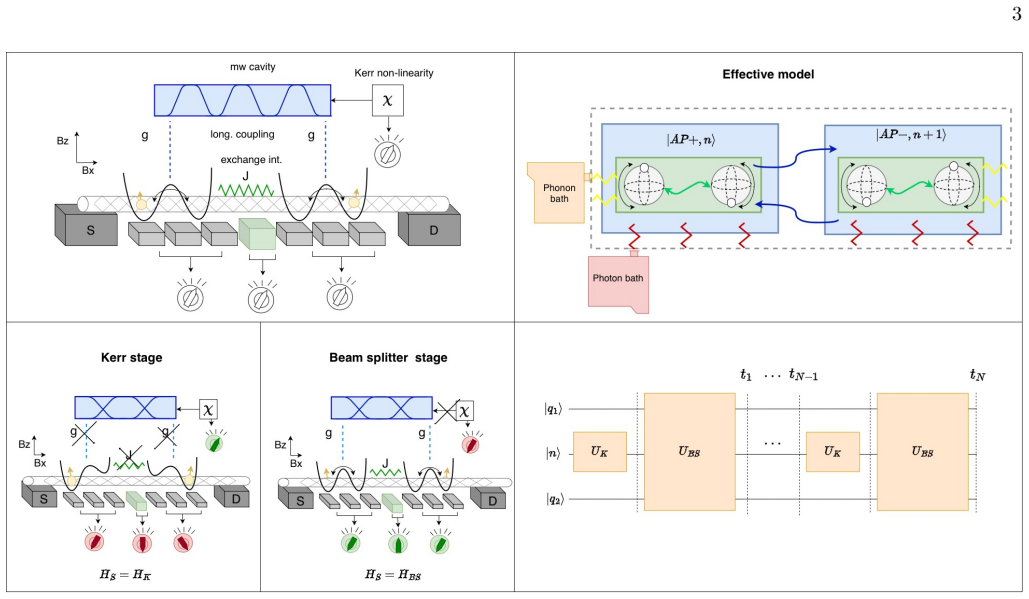
Pith's one-line read A hybrid beam-splitter gate couples a dressed two-qubit sector to a microwave cavity mode with Kerr nonlinearity, with an analytical weak-noise fidelity and a carbon-nanotube route.
desk verdict Solid hybrid-gate construction with transparent math, but the quoted F_avg≈0.985 sits outside the spectral-resolution assumptions that justify the master equation and analytic fidelity. read the letter →
The pith
A machine-rendered reading of the paper's core claim, the machinery that carries it, and where it could break.
The reading
What carries the argument
The hybrid qubit–boson beam-splitter Hamiltonian H_BS ≃ g_eff (a† τ_- e^{iδt} + a τ_+ e^{-iδt}), g_eff = 4 J g / ω_c, acting only on the dressed odd-parity subspace {|AP±⟩} in number-resolved Rabi blocks; sequential composition with Kerr U_K = exp(−i t_K χ (a†a)^2) is the target gate.
What would settle it
In a carbon-nanotube double-dot cQED device at the stated point (g_eff/2π ≈ 3.85 MHz, t_BS ≈ 65 ns, Q_c ≈ 3×10^4, χ/2π ≈ 5 MHz), measure process or average fidelity of the sequential protocol; a clear shortfall below ~0.98 with phonon-dominated error, or failure of the odd-parity Rabi swap, would falsify the claim.
Extended reading notes
Core claim
A polaron transform of two longitudinally cavity-coupled qubits with exchange J yields an effective Jaynes–Cummings beam-splitter between the cavity and the exchange-dressed antiparallel manifold, with coupling g_eff = 4 J g / ω_c. Composed sequentially with Kerr evolution U_K, this defines a hybrid qubit–boson gate whose weak-dissipation average fidelity is F_avg = 1 − t_g / [4(n_max+1)+1] (Σ_γ + Σ_ν), and a realistic carbon-nanotube cQED point reaches F_avg ≈ 0.985 with cavity loss dominating the error.
Load-bearing premise
The gate and fidelity formula assume the cavity Kerr and hybrid exchange remain unresolved by the baths, and that qubit noise stays negligible while the qubits are parked during the Kerr stage.
Editorial extensions
If this is right
- The same local exchange-plus-Kerr block can be tiled into quantum-cellular-automaton or lattice-gauge update rules with a persistent bosonic field mode.
- Collision-model rewriting of the gate supplies a stroboscopic open-system simulator with interleaved coherent and dissipative slices.
- Parity-preserving qubit dynamics plus linear bosonic mediation form a structured baseline; Kerr then drives non-Gaussian cavity structure usable for reservoir-style processing.
- Cavity quality factor and total gate time (via g_eff and t_K) are the primary levers for fidelity; phonon channels are predicted sub-percent of the error budget.
Reading between the lines
- If the parked-qubit assumption fails, the analytical fidelity formula would understate phonon error and the sequential protocol would need active dynamical decoupling during the Kerr window.
- The odd-parity-only action suggests a matchgate-like or fermionic-linear-optics sector that could keep classical simulation easier until Kerr and multi-site updates are stacked.
- Hybrid syndrome extraction or bosonic-assisted codes could reuse the same longitudinal cavity coupling without leaving the CNT hardware stack.
Editorial analysis
A structured set of objections, weighed in public.
Referee Report
Summary. The manuscript introduces a hybrid qubit–boson beam-splitter gate obtained by longitudinally coupling a microwave cavity to an exchange-dressed odd-parity two-level subsystem of two interacting qubits, and composing that interaction with a weak Kerr nonlinearity. From a general cQED Hamiltonian the authors derive, via a polaron transformation and RWA near resonance, an effective Jaynes–Cummings-type interaction H_BS ≃ g_eff (a† τ_- e^{iδt} + a τ_+ e^{-iδt}) with g_eff = 4 J g / ω_c, construct a sequential gate U = U_BS U_K, and obtain a Markovian open-system description (Born–Markov–Davies and collision-model) including photon- and qubit-sector baths. In the weak-dissipation regime they give a compact first-order average-fidelity formula, identify a carbon-nanotube cQED implementation route with a representative operating point, and benchmark noiseless/noisy dynamics and the analytic fidelity against QuTiP Lindblad simulations. Broader perspectives toward QCA, lattice-gauge-inspired updates, noisy QCA and reservoir-style processing are discussed.
Significance. If the effective gate, open-system treatment and operating-point claims hold, the work supplies a concrete hybrid primitive that actively uses the cavity Hilbert space rather than only virtual mediation, together with an analytical weak-dissipation fidelity formula and an explicit CNT cQED control route. The dual derivation of the master equation (Davies and collision model), the block structure of U_BS, and the direct QuTiP benchmark of the first-order fidelity expansion are genuine strengths. The many-body and reservoir perspectives are speculative but well motivated as outlook. The result is of clear interest for hybrid cQED gate design and hardware-aware many-body simulation, provided the spectral-resolution assumptions used for the dissipators and fidelity formula are made consistent with the quoted operating regime.
major comments (3)
- Sec. III.A states the unresolved-Kerr condition 2|χ|n_max ≪ κ and the weak-hybridization condition g_eff √(n_max+1) ≪ bath linewidths as prerequisites for using collapse operators a, a† and for neglecting H_J in the Davies eigenoperator decomposition. Sec. V.C then quotes a representative CNT point with χ/2π = 5.1 MHz, κ/2π ≃ 0.10 MHz, g_eff/2π ≃ 3.85 MHz and n_max = 3, for which 2|χ|n_max ≃ 30.6 MHz ≫ κ and g_eff √(n_max+1) ≃ 7.7 MHz ≫ κ. The same point is used to claim F_avg ≈ 0.985 and that the operating regime is “compatible with the approximations.” These statements are mutually inconsistent: the jump operators and the first-order fidelity formula of Eq. (52) are not justified at the parameters used to advertise performance. Either a revised operating point that restores both hierarchies, or a resolved-Kerr / hybridized eigenoperator treatment with a recomputed fidelity, is required
- Sec. III and Appendix B retain H_J in the coherent dynamics but drop it from the dissipative eigenoperator construction, and treat cavity loss with unresolved operators during both sequential stages. At the Sec. V.C parameters the hybridization scale is larger than κ, so the baths resolve the hybridized spectrum during the beam-splitter window; the analytic Σ_γ, Σ_ν and the QuTiP Lindblad model used for |F_num − F_an| therefore share the same uncontrolled approximation. Agreement at the 10^{-4} level only validates the first-order Haar expansion against that Lindblad model, not the physical correctness of the dissipators. The manuscript should either (i) recompute the master equation with hybridized/number-resolved jump operators at the quoted point, or (ii) restrict the fidelity benchmark to a parameter window where the stated spectral-resolution conditions hold and restate the CNT numb
- Sec. III.A and V.C assume that during the Kerr stage the qubits can be parked so that phonon-induced channels remain subleading relative to cavity loss. This is used to drop qubit-sector dissipators over t_K when evaluating fidelity. The paper does not quantify residual spin–charge hybridization or the residual matrix elements of S_ν in the parked configuration for the nine-gate CNT layout of Sec. V. Without an estimate (even order-of-magnitude) of residual γ_ν during the Kerr window, the claim that phonon contributions are ~10^{-3}% of the error budget remains an assumption rather than a controlled approximation. A short estimate or a sensitivity scan would make this load-bearing step falsifiable.
minor comments (6)
- Eq. (22) / (A41): the operator form of U_BS with a / √N̂ and a† / √(N̂+1) is standard but the removable singularity at N̂ = 0 is only mentioned in the appendix; a one-line clarification in the main text would help readers implementing the gate.
- Fig. 3 caption and Sec. VI: residuals |F_num − F_an| are reported at the 10^{-4} level for n_max = 3; it would help to state explicitly that this tests the first-order expansion against the same (unresolved) Lindblad model, not an independent microscopic simulation.
- Notation: τ operators are introduced with and without tildes after the odd-parity rotation (Appendix A); dropping tildes is fine but a single sentence in Sec. II.B would avoid confusion when comparing to H′_ap,J.
- Table I lists broad ranges; the concrete Sec. V.C point is more useful—consider adding a second column with the representative values used for fidelity and simulations.
- Typos / style: “longitudinally coupled” appears twice in Sec. II.A (“two capacitively gate defined… longitudinally coupled”); “to much” → “too much” in Sec. V; “founded from” → “funded by” in Acknowledgements.
- Sec. VII outlook on QCA, reservoir computing and bosonic QEC is appropriate as perspective but could be shortened slightly so that the load-bearing technical claims remain the focus of the conclusion.
Circularity Check
No load-bearing circularity: effective gate, master equation and weak-dissipation fidelity are derived from the microscopic Hamiltonian under explicit approximations; self-citations supply only platform context.
full rationale
The derivation chain is self-contained. Section II starts from the microscopic cQED Hamiltonian (1)–(3), applies the polaron unitary (4), diagonalizes the parity sectors, and obtains the resonant beam-splitter interaction (19) by RWA; the sequential gate (21)–(22) follows by composition with Kerr. Section III constructs the GKLS generators both from Born–Markov–Davies eigenoperators of the same reference Hamiltonian and from a collision-model continuum limit, with rates identified to bath spectral densities; no quantity is defined in terms of the fidelity it later “predicts.” Section IV expands the average fidelity to first order in the rates, yielding the compact expression (52) whose only inputs are the already-derived Lindblad operators and the truncated dimension. The CNT operating point of Sec. V.C is a representative parameter choice used to evaluate that formula and to benchmark it numerically; it is not a fit that is then re-labeled a prediction. Self-citations ([9], [10], [17]) motivate the platform and the broader QCA perspective but do not enter the algebraic steps that produce H_BS, the jump operators or F_avg. Minor self-reference therefore exists but is not load-bearing, justifying a score of 1 rather than 0. The skeptic’s observation that the chosen numbers violate the unresolved-Kerr / weak-hybridization assumptions is a correctness issue, not a circularity reduction.
Assumptions & free parameters
free parameters (2)
- representative CNT operating point (ω1/2π=4 GHz, ω2/2π=7 GHz, g/2π=J/2π=170 MHz, χ/2π=5.1 MHz, Qc=3e4, nmax=3)
- phonon rates γν ~ 10^1–10^2 s^{-1}
assumptions (5)
- domain assumption Born–Markov–secular (Davies) weak-coupling limit for both photon and phonon baths
- domain assumption Polaron transformation truncated at leading order in λ = g/ωc ≪ 1, with HJ retained only in coherent dynamics
- domain assumption Unresolved-Kerr regime 2|χ|nmax ≪ κ so that cavity jump operators remain a and a†
- ad hoc to paper Sequential control windows in which beam-splitter and Kerr stages can be activated independently and qubit-sector decoherence is suppressed during the Kerr stage
- standard math Haar-average first-order expansion of average gate fidelity for traceless Lindblad operators
invented entities (1)
-
hybrid qubit-boson beam-splitter gate (exchange-dressed odd-parity subsystem coupled to cavity)
Cite this review
Pith. "Pith review of Qubit-Boson Hybrid Beam-Splitter Gate with Kerr Nonlinearity in Circuit QED for Many-Body Dynamics." pith.science (2026). https://pith.science/paper/EUWEDFXE
@misc{pith2026260709513,
  author       = {Pith},
  title        = {Pith review of: Qubit-Boson Hybrid Beam-Splitter Gate with Kerr Nonlinearity in Circuit QED for Many-Body Dynamics},
  year         = {2026},
  howpublished = {\url{https://pith.science/paper/EUWEDFXE}},
  note         = {Machine review of arXiv:2607.09513}
}
read the original abstract
We introduce a hybrid qubit-boson beam-splitter gate in which a microwave cavity mode couples to an exchange-dressed two-level subsystem of an interacting two-qubit system in the presence of Kerr nonlinearity. Starting from a general circuit quantum electrodynamics (cQED) model, we derive the corresponding hybrid qubit-cavity interaction, develop its open-system description including photon- and qubit-sector-bath-induced dissipation and obtain in the weak-dissipation regime an analytical expression for the average gate fidelity. We further identify carbon-nanotube circuit QED as a concrete platform for implementing and controlling the gate, provide a representative operating regime and perform noiseless and noisy numerical simulations to study the gate dynamics and benchmark the analytical results. Beyond this implementation route, the proposed hybrid primitive provides a natural building block for many-body dynamics, including quantum-cellular-automaton (QCA) and lattice-gauge-inspired architectures and, through its collision-model reformulation, also suggests connections to noisy QCA, non-Markovian extensions and reservoir-style quantum information processing.
Figures


Figures from the paper (1 more)

Reference graph
Works this paper leans on
-
[1]
Photon-induced channels After the polaron transformation, the photon coupling becomes SP γ :=U † P SγUP =a+a † −2λZ,(35) whereZ=σ (1) z −σ(2) z . In the unresolved-Kerr regime, the cavity contribution is described by the standard collapse operators La = √κ↓ a, L a† = √κ↑ a†,(36) whereκ ↓ =γ γ(ωc) andκ ↑ =γ γ(−ωc) are the pho- ton emission and absorption r...
-
[2]
Qubit-sector bath-induced channels In the polaron frame, the qubit-sector bath coupling operator to leading order inλreads SP ν :=U † P SνUP =S ν +λS (1) ν +O(λ 2),(38) with Sν = 2X i=1 αiσ(i) x +β iσ(i) z ,(39) S(1) ν = 2i(a† −a) α1σ(1) y −α 2σ(2) y .(40) DecomposingS ν in the dressed eigenbasis produces three classes of channels. a. Even-parity sector. ...
-
[3]
The orbital degree of freedom of this DQD forms a charge qubit
between source and drain contacts above five elec- trostatic gates, which define a single-electron DQD. The orbital degree of freedom of this DQD forms a charge qubit. A magnetic texture, generated either by a micro- magnet [31] or by ferromagnetic contacts [11], induces an artificial spin-orbit interaction together with a Zee- man splitting, thereby enab...
-
[4]
The time evolution of ∆G(t) shows that the dominant departures from Gaus- sian closure already arise under the hybrid beam-splitter dynamics alone
We compare pure beam- splitter evolution with the repeated sequential protocol UKUBS, in which each cycle consists of a beam-splitter stage followed by a Kerr stage. The time evolution of ∆G(t) shows that the dominant departures from Gaus- sian closure already arise under the hybrid beam-splitter dynamics alone. This indicates that the exchange stage is t...
-
[5]
antiparallel
Microscopic model and notation We consider two qubits longitudinally coupled to a mi- crowave cavity mode, with a transverse inter-qubit ex- change interaction and a weak Kerr nonlinearity, HS =H Q +H c HQ := 2X i=1 ωi 2 σ(i) z +g(σ (1) z −σ (2) z )(a+a †) +J σ(1) x σ(2) x , Hc :=ω ca†a+χ(a †a)2. (A1) We define the differential operator Z:=σ (1) z −σ (2) ...
-
[6]
Polaron transformation We apply the polaron unitary to the system Hamilto- nian of Eq. A1 UP =e S, S=λZ(a † −a), λ= g ωc ,(A5) Using BCH, UP OU † P =O+ [S, O] + 1 2[S,[S, O]] +· · ·.(A6) Choosingλ=g/ω c cancels the linear cavity term in HC|χ=0 +H I and generates HZZ = 2g2 ωc σ(1) z σ(2) z (up to an irrelevant constant). (A7) Using the decomposition of the...
-
[7]
Diagonalization in the even and odd parity manifolds Since the exchange termσ (1) x σ(2) x couples separately even and odd parity sectors andH J only has support on the odd parity sector, it is convenient to diagonalize the two sectors separately. a. Even (parallel) manifold Let Σ :=ω 1 +ω 2. Up to a constant shift, the block is diagonalized by an angleθ ...
-
[8]
Effective Hamiltonian in the dressed interaction picture We now move to the interaction picture with respect to H0 :=ω ca†a+H ′ ap,(A25) where the parallel sector Hamiltonian was omitted since it commutes throughH J trivially. The cavity operators evolve as aI(t) =ae −iωct, a † I(t) =a †eiωct, and, using [τz, τ±] =±2τ ±, the dressed ladder operators evolv...
Show all 71 references
-
[9]
(A29) The resulting gate is a composition of beam-splitter and Kerr evolutions, which in general do not factorize into two separate gate operations because [H BS(t), HK]̸= 0
Bosonic beam-splitter gate and phase engineering We work with the effective Hamiltonian (interaction picture ofH 0) H(t) =H BS(t) +H K, H BS =g eff τ+a+τ −a† , HK =χ(a †a)2. (A29) The resulting gate is a composition of beam-splitter and Kerr evolutions, which in general do not...
-
[10]
the Born–Markov and secular approximations [23, 24]
Total Hamiltonian, baths, and approximation scheme We start from Htot =H S +H γ +H γS +H ν +H νS ,(B1) with the system Hamiltonian split as HS =H Q +H C +H I ,(B2) where HQ = 2X i=1 ωi 2 σ(i) z +J σ (1) x σ(2) x ,(B3) HC =ω ca†a+χ(a †a)2,(B4) HI =g Z(a+a †), Z:=σ (1) z −σ (2) ...
-
[11]
Photon Lindblad operators In the polaron frame, the photon coupling operator reads SP γ =U P (a+a †)U † P = (a+a †)−2λZ.(B14) a
Born-Markov secular derivation a. Photon Lindblad operators In the polaron frame, the photon coupling operator reads SP γ =U P (a+a †)U † P = (a+a †)−2λZ.(B14) a. Cavity channelsIn the unresolved-Kerr regime, where the bath cannot resolve Kerr-split cavity transi- tions over t...
-
[12]
Collision-model derivation In this subsection we show that the same effective Lindblad dynamics derived above from the Davies weak- coupling limit also arises from a collision-model construc- tion [19, 20]. a. Weak-collision scaling We model the environment as a sequence of in...
-
[13]
unitarity
Truncated Hilbert space and projected operators All Haar averages and traces are evaluated on the same finite-dimensional Hilbert space used in the numerics, Hd =H qb ⊗ H(nmax) cav ,H (nmax) cav = span{|n⟩}nmax n=0 , d= dimH d = 4(nmax + 1). (C1) a. Remark (truncation and “uni...
-
[14]
General weak-dissipation formula forF avg We start from the Lindblad equation ˙ρ(t) =L0[ρ(t)] +L D[ρ(t)],L 0[ρ] =−i[H(t), ρ], LD[ρ] = X k D[Lk]ρ, (C3) withD[L]ρ=LρL † − 1 2 {L†L, ρ}. To first order in the rates, we evaluateL D along the ideal unitary trajectoryρ 0(t) =U(t)ρ(0)...
-
[15]
Photon contribution a. (i) Cavity loss/absorption.UsingL a =p γγ(ωc)a P andL a† = p γγ(−ωc)a † P , Tr(L† aLa) =γ γ(ωc) Trq(Iq)Trc(a† P aP ) =γ γ(ωc)·4 nmaxX n=0 n= 2γ γ(ωc)n max(nmax + 1), Tr(L† a† La†) =γ γ(−ωc)·4 nmax−1X n=0 (n+ 1) = 2γ γ(−ωc)n max(nmax + 1). (C13) 22 b. (ii...
-
[16]
Qubit-sector bath contributionF ν (block-internal + cross-manifold channels) The qubit-sector bath is coupled through HνS =S ν ⊗B ν, S ν = 2X i=1 αiσ(i) x +β iσ(i) z .(C16) a. (i) Block-internalβ-channels.Using the dressed- basis qubit-sector bath Lindbladians from the previou...
-
[17]
Preskill, Quantum2, 79 (2018)
J. Preskill, Quantum2, 79 (2018)
2018
-
[18]
Schuch and J
N. Schuch and J. Siewert, Phys. Rev. A67, 032301 (2003)
2003
-
[19]
I. M. Georgescu, S. Ashhab, and F. Nori, Reviews of Modern Physics86, 153 (2014)
2014
-
[20]
Monbroussou, E
L. Monbroussou, E. Z. Mamon, J. Landman, A. B. Grilo, R. Kukla, and E. Kashefi, Quantum9, 1745 (2025)
2025
-
[21]
Shaydulin, P
R. Shaydulin, P. C. Lotshaw, J. Larson, J. Ostrowski, T. S. Humble, and A. J. McCaskey, npj Quantum Infor- mation9, 103 (2023)
2023
-
[22]
Eickbusch, M
A. Eickbusch, M. McEwen, V. Sivak,et al., Nat. Phys. 21, 1994 (2025)
1994
-
[23]
D. M. Abrams, N. Didier, B. R. Johnson, M. P. da Silva, and C. A. Ryan, Nature Electronics3, 744 (2020)
2020
-
[24]
Dijkema, X
J. Dijkema, X. Xue, P. Harvey-Collard, M. Rimbach- Russ, S. L. de Snoo, G. Zheng, A. Sammak, G. Scap- pucci, and L. M. K. Vandersypen, Nature Physics21, 168 (2025)
2025
-
[25]
Neukelmance, B
B. Neukelmance, B. Hue, Q. Schaeverbeke, L. Jarjat, A. Th´ ery, J. Craquelin, W. Legrand, T. Cubaynes, G. Abulizi, J. Becdelievre,et al., Nature Communica- tions16, 5636 (2025)
2025
-
[26]
Mammola, M
A. Mammola, M. M. Desjardins, and Q. Schaeverbeke, Phys. Rev. A111, 042621 (2025)
2025
-
[27]
Cottet and T
A. Cottet and T. Kontos, Physical Review Letters105, 160502 (2010)
2010
-
[28]
Penfold-Fitch, F
Z. Penfold-Fitch, F. Sfigakis, and M. Buitelaar, Physical Review Applied7, 054017 (2017)
2017
-
[29]
Delbecq,Spin quantum dynamics in hybrid circuits, Habilitation ` a diriger des recherches, Sorbonne Universit´ e (2020)
M. Delbecq,Spin quantum dynamics in hybrid circuits, Habilitation ` a diriger des recherches, Sorbonne Universit´ e (2020)
2020
-
[30]
Khivrich and S
I. Khivrich and S. Ilani, Nature communications11, 2299 (2020)
2020
-
[31]
J.-S. Chen, K. J. Trerayapiwat, L. Sun, M. D. Krzyaniak, M. R. Wasielewski, T. Rajh, S. Sharifzadeh, and X. Ma, Nature communications14, 848 (2023)
2023
-
[32]
Arrighi, Natural Computing18, 885 (2019)
P. Arrighi, Natural Computing18, 885 (2019)
2019
-
[33]
Mammola, Q
A. Mammola, Q. Schaeverbeke, and G. Di Molfetta, Phys. Rev. Res.8, 013117 (2026)
2026
-
[34]
Sellapillay, P
K. Sellapillay, P. Arrighi, and G. Di Molfetta, Scientific Reports12, 2198 (2022)
2022
-
[35]
Ciccarello, S
F. Ciccarello, S. Lorenzo, V. Giovannetti, and G. M. Palma, Physics Reports954, 1 (2022)
2022
-
[36]
Cusumano, Entropy24, 1258 (2022)
S. Cusumano, Entropy24, 1258 (2022)
2022
-
[37]
Avalle and A
M. Avalle and A. Serafini, Physical Review Letters112, 170403 (2014)
2014
-
[38]
Sannia, M
A. Sannia, M. A. C. Rossi, A. M. Timpanaro, M. Pino, G. M. Palma, and F. Ciccarello, Quantum8, 1481 (2024)
2024
-
[39]
Breuer and F
H.-P. Breuer and F. Petruccione,The Theory of Open Quantum Systems(Oxford University Press, Oxford, 2002)
2002
-
[40]
E. B. Davies, Communications in Mathematical Physics 39, 91 (1974)
1974
-
[41]
J. R. Johansson, P. D. Nation, and F. Nori, Computer Physics Communications183, 1760 (2012)
2012
-
[42]
J. R. Johansson, P. D. Nation, and F. Nori, Computer Physics Communications184, 1234 (2013)
2013
-
[43]
Casas, A
F. Casas, A. Murua, and M. Nadinic, Computer Physics Communications183, 2386 (2012)
2012
-
[44]
Attal and Y
S. Attal and Y. Pautrat, Annales Henri Poincar´ e7, 59 (2006)
2006
-
[45]
M. A. Nielsen, Physics Letters A303, 249 (2002)
2002
-
[46]
Cubaynes, M
T. Cubaynes, M. R. Delbecq, M. Dartiailh, R. Assouly, M. M. Desjardins, L. Contamin, L. Bruhat, Z. Leghtas, F. Mallet, A. Cottet,et al., npj Quantum Information5, 47 (2019)
2019
-
[47]
Legrand, S
W. Legrand, S. Lopes, Q. Schaeverbeke, F. Montaigne, and M. M. Desjardins, Physical Review Applied20, 044062 (2023)
2023
-
[48]
Benito, J
M. Benito, J. R. Petta, and G. Burkard, Physical Review B100, 081412 (2019)
2019
-
[49]
Loss and D
D. Loss and D. P. DiVincenzo, Physical Review A57, 120 (1998)
1998
-
[50]
Craquelin, L
J. Craquelin, L. Jarjat, B. Hue, A. Th´ ery, C. Fruy, N. Struchkov, D. Stefani, M. Desjardins, A. Cottet, M. Delbecq,et al., Nature Communications (2026)
2026
-
[51]
Cottet, T
A. Cottet, T. Kontos, and B. Dou¸ cot, Physical Review B 91, 205417 (2015)
2015
-
[52]
Bourassa, F
J. Bourassa, F. Beaudoin, J. M. Gambetta, and A. Blais, Physical Review A86, 013814 (2012), arXiv:1204.2237 [quant-ph]
2012 arXiv
-
[53]
Y. Lu, A. Eriksson, T. S´ epulcre, T. Hillmann, M. Kervi- nen, M. Kudra, S. Dupouy, J. Yang, M. Khanahmadi, P. Delsing, and S. Gasparinetti, Nature Communications 14, 6323 (2023)
2023
-
[54]
Joshi, W
C. Joshi, W. Chen, H. G. LeDuc, P. K. Day, and M. Mirhosseini, Physical Review Applied18, 064088 (2022), arXiv:2208.00317 [quant-ph]
2022 arXiv
-
[55]
Khalifa and J
M. Khalifa and J. Salfi, Phys. Rev. Appl.19, 034024 (2023)
2023
-
[56]
Jozsa and A
R. Jozsa and A. Miyake, Proceedings of the Royal Society A464, 3089 (2008)
2008
-
[57]
D. J. Brod, Physical Review A93, 062332 (2016)
2016
-
[58]
Weedbrook, S
C. Weedbrook, S. Pirandola, R. Garc´ ıa-Patr´ on, N. J. Cerf, T. C. Ralph, J. H. Shapiro, and S. Lloyd, Reviews of Modern Physics84, 621 (2012)
2012
-
[59]
M. K. Olsen and J. F. Corney, Physical Review A87, 033839 (2013)
2013
-
[60]
Yanagimoto, T
R. Yanagimoto, T. Onodera, E. Ng, L. G. Wright, P. L. McMahon, and H. Mabuchi, Physical Review Letters 124, 240503 (2020)
2020
-
[61]
Spagnolo, D
N. Spagnolo, D. J. Brod, E. F. Galv˜ ao, A. Crespi, R. Osellame, and F. Sciarrino, npj Quantum Information 9, 3 (2023)
2023
-
[62]
Dias and R
B. Dias and R. K¨ onig, Physical Review A110, 042402 (2024)
2024
-
[63]
Gonz´ alez-Garc´ ıa, A
G. Gonz´ alez-Garc´ ıa, A. V. Gorshkov, J. I. Cirac, and R. Trivedi, Phys. Rev. Lett.135, 190401 (2025)
2025
-
[64]
Ghosh, A
S. Ghosh, A. Opala, M. Matuszewski, T. Paterek, and T. C. H. Liew, npj Quantum Information5, 35 (2019)
2019
-
[65]
Araiza Bravo, K
R. Araiza Bravo, K. Najafi, X. Gao, and S. F. Yelin, PRX Quantum3, 030325 (2022)
2022
- [66]
-
[67]
Vitali, C
G. Vitali, C. Vercellino, P. Viviani, O. Terzo, B. Montruc- chio, V. Zaffaroni, F. Cibrario, C. Mattia, G. Ranieri, A. Sabatino, F. Bonazzi, and D. Corbelletto, arXiv preprint arXiv:2510.04747 10.48550/arXiv.2510.04747 (2025)
2025 doi
-
[68]
S. Puri, A. Grimm, P. Campagne-Ibarcq, A. Eickbusch, K. Noh, G. Roberts, L. Jiang, M. Mirrahimi, M. H. De- 25 voret, and S. M. Girvin, Physical Review X9, 041009 (2019)
2019
-
[69]
J. M. Gertler, B. Baker, J. Li, S. Shirol, J. Koch, and C. Wang, Nature590, 243 (2021)
2021
-
[70]
Tsunoda, J
T. Tsunoda, J. D. Teoh, W. D. Kalfus, S. J. de Graaf, B. J. Chapman, J. C. Curtis, N. Thakur, S. M. Girvin, and R. J. Schoelkopf, PRX Quantum4, 020354 (2023)
2023
-
[71]
Q. Xu, P. Zeng, D. Xu, and L. Jiang, Physical Review X 14, 031016 (2024)
2024
Reviewed July 13, 2026 · model on record in the stance chip above.
Discussion (0). Continue with ORCID to comment.