REVIEW 4 minor 53 references
A delta-shaped potential trough can make quasi-one-dimensional continuous waves completely stable against modulational breakup in a cubic-quintic optical medium.
Reviewed by Pith at T0; open to challenge. T0 means a machine referee read the full paper against a public rubric. the ladder, T0–T4 →
T0 review · grok-4.5
2026-07-13 01:45 UTC pith:V33SO5L2
load-bearing objection Clean exact stable bright CW for the delta trough plus solid DM and soliton-chain results; finite-domain numerics are a minor caveat, not a load-bearing flaw.
Stabilization of two-dimensional optical continuous-wave states by a potential trough
The pith
A machine-rendered reading of the paper's core claim, the machinery that carries it, and where it could break.
Core claim
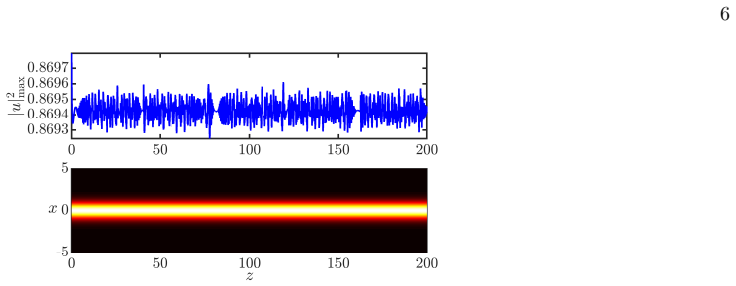
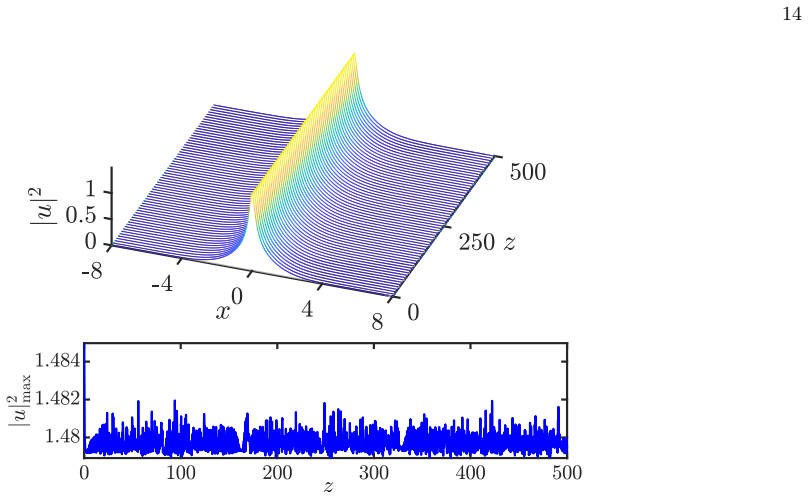
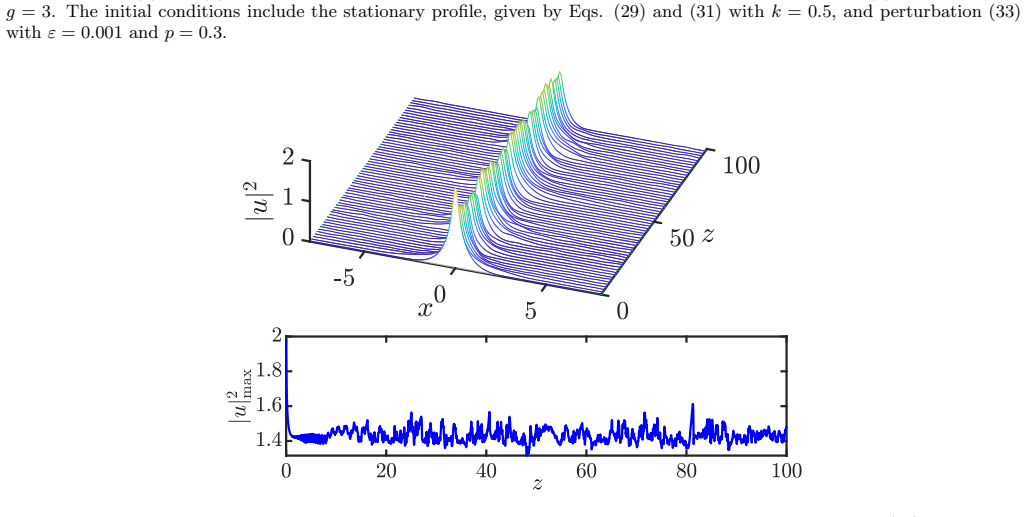
In the two-dimensional cubic-quintic nonlinear Schrödinger equation with a delta-functional potential trough, the exact continuous-wave family that exists for trough strengths above a critical value is completely stable against all modulational perturbations, as confirmed by both the Bogoliubov–de Gennes spectrum and direct simulations of strongly perturbed initial data.
What carries the argument
The exact pinned-soliton profiles of Case 2 (Eqs. 29–31), obtained by grafting a free-space singular solution onto the jump condition imposed by the delta trough; their stability is verified by the full two-dimensional Bogoliubov–de Gennes eigenvalue problem.
Load-bearing premise
The numerical proofs of stability rest on a finite computational box with periodic boundaries in the free direction and on a regularized Gaussian of small but nonzero width that approximates the ideal delta function.
What would settle it
Compute the continuous-wave profile for Case-2 parameters, embed it in a domain whose free-direction length is several times larger than any previously used, and check whether any positive real growth rate appears for long-wavelength modulational wavenumbers; a nonzero rate would falsify complete stability.
If this is right
- Stable continuous-wave beams can be guided by a narrow refractive-index stripe without spontaneous breakup into filaments.
- Periodic chains of two-dimensional solitons trapped in the same trough remain intact under moderate localized kicks and can therefore serve as reconfigurable optical lattices.
- The analytic delta-trough solutions supply exact benchmarks for testing numerical codes that solve the cubic-quintic equation.
- The same stabilization mechanism should apply to the Lee-Huang-Yang fluid model of quantum droplets once a delta-like trap is introduced.
Where Pith is reading between the lines
- Because the stable family lives entirely on the defocusing side of the nonlinearity, similar delta-trough stabilization may work for other competing nonlinearities that lack a pure cubic focusing term.
- The practical-stability windows found near the edges of the ground-state and dipole families suggest that shallow or strongly defocusing troughs could already be usable in present-day cubic-quintic glasses without requiring an ideal delta profile.
- Vortex-soliton chains with alternating charge, proposed in the outlook, would inherit the same transverse confinement and might remain stable for moderate topological charges.
Editorial analysis
A structured set of objections, weighed in public.
Referee Report
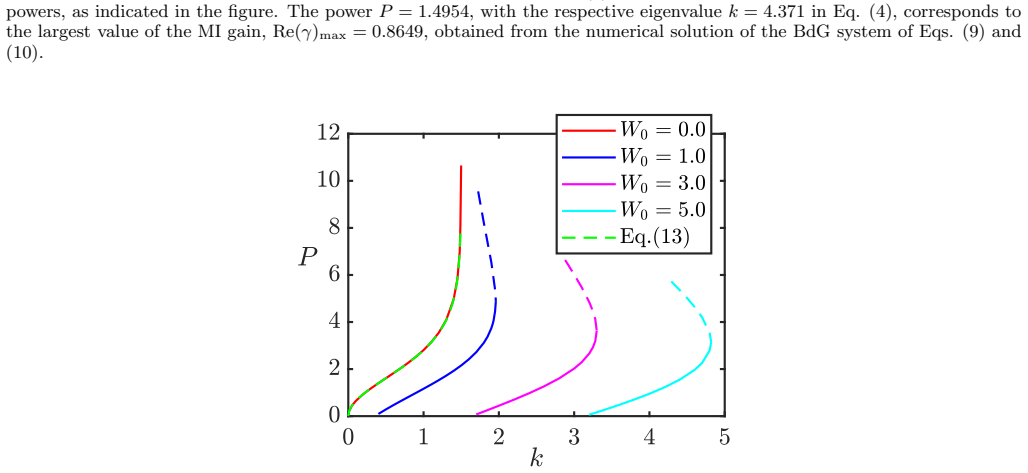
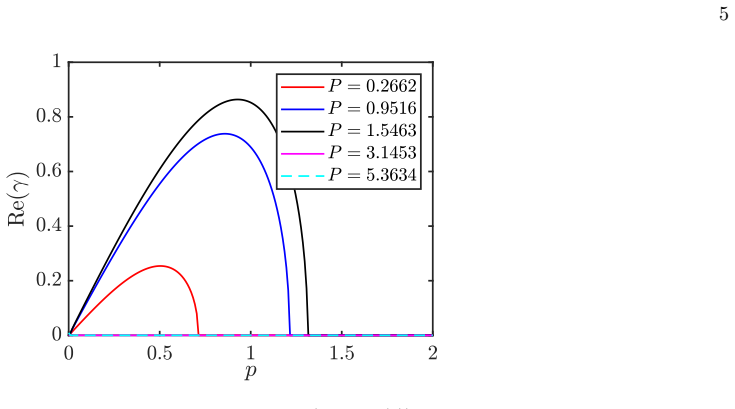
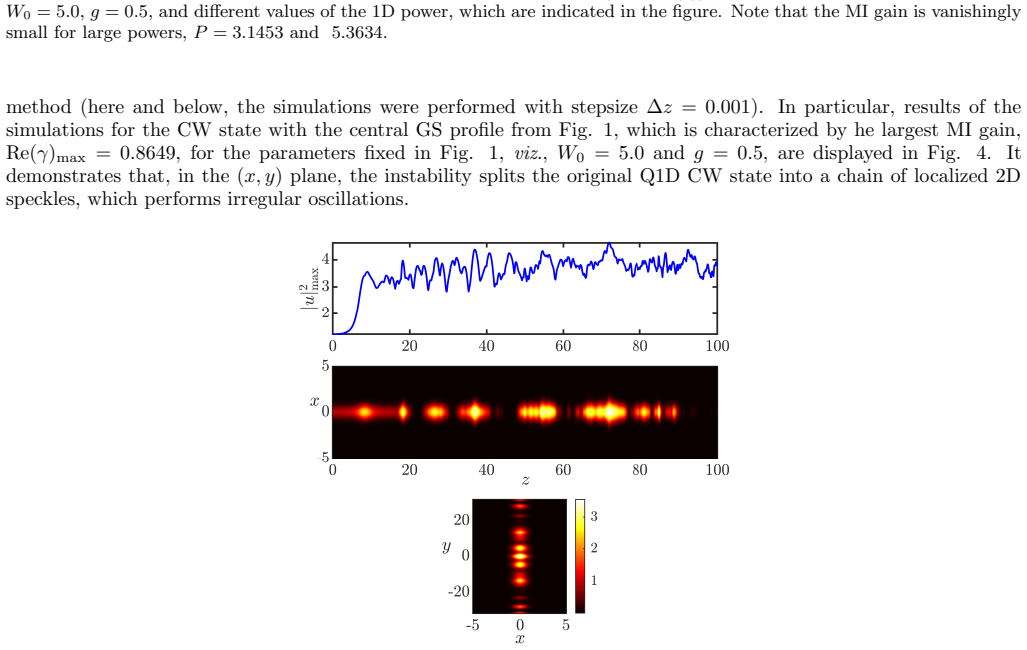
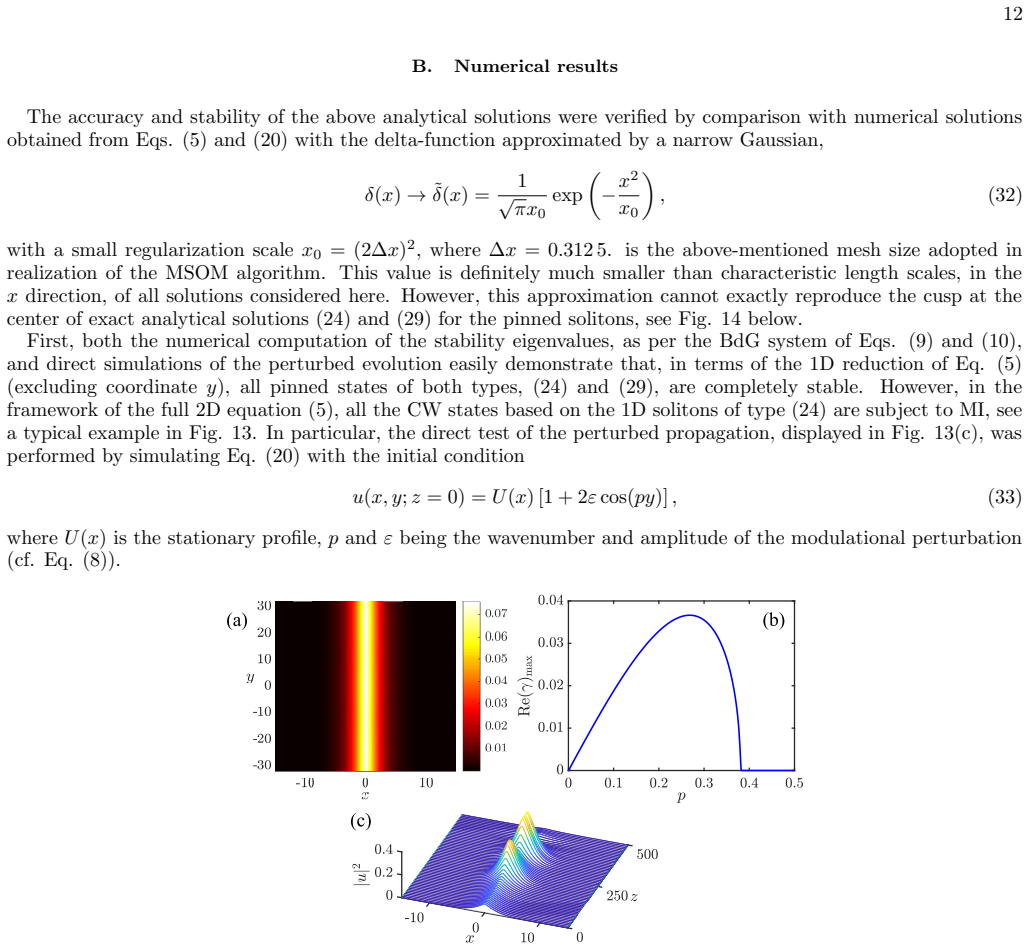
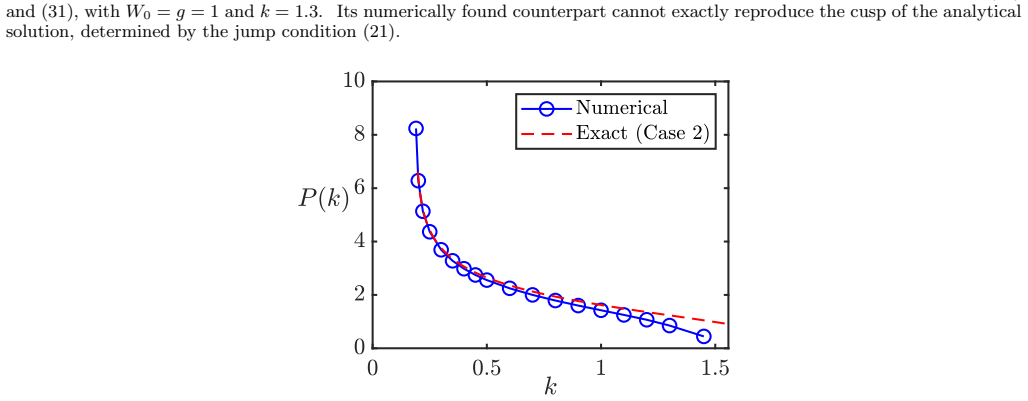
Summary. The paper studies quasi-one-dimensional continuous-wave (CW) states of the two-dimensional cubic-quintic NLS equation confined by a Q1D potential trough. For a smooth Gaussian trough it confirms the known modulational instability (MI) of ground-state (GS) CWs, establishes MI for dipole-mode (DM) CWs, and shows that both families become practically stable near the edges of their existence domains. Stable stationary chains of alternating-sign 2D solitons are constructed numerically and their response to localized kicks is examined. For a delta-functional trough two exact analytic CW families are derived; the family that exists for W0 > Wcr (Eqs. (29)–(31)) is shown by Bogoliubov–de Gennes spectra and direct simulations to be completely stable against modulational perturbations.
Significance. The central analytic result—an exact, completely stable Q1D bright CW supported by a delta trough and the competing cubic-quintic nonlinearity—is new and non-trivial. The solutions satisfy the jump condition by construction, reduce correctly to the linear bound state, obey the anti-Vakhitov–Kolokolov criterion, and remain intact under strong perturbations. The numerical findings for the smooth trough (DM MI, practical stability near edges, and robust soliton chains) systematically extend earlier work and supply concrete experimental estimates for CS2. Together these results enlarge the known repertoire of stable two-dimensional continuous-wave states.
minor comments (4)
- The phrase “practically stable” used for GS and DM CWs near existence edges is informal; a quantitative threshold on Re(γ)max (or a statement that the growth length exceeds the experimental propagation distance) would make the claim sharper.
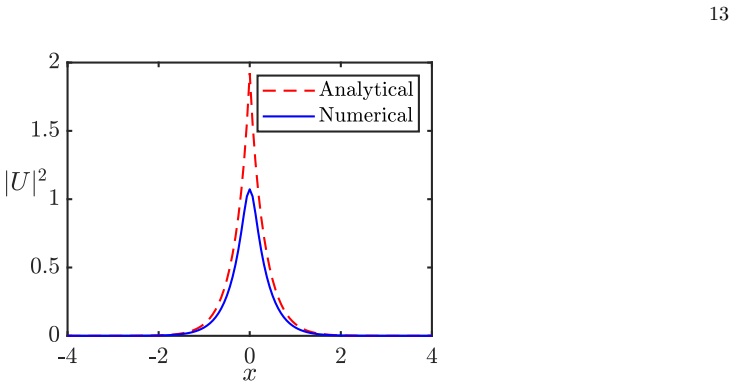
- Section IV.B: the Gaussian regularization of the delta function (width x0 = (2Δx)^{2}) is adequate for the profiles shown, but a brief remark on residual cusp error and its possible effect on long-wavelength BdG eigenvalues would strengthen the numerical validation.
- Figure captions occasionally refer to “Fig. 2” when the intended panel is Fig. 5 (e.g., the caption of Fig. 5 itself); these cross-references should be corrected.
- A short sentence clarifying that the soliton-chain solutions inherit alternating signs from the cosine input (16) would help readers who skip the methods paragraph.
Circularity Check
No significant circularity: exact CW solutions and stability claims are derived independently from free-space profiles plus jump conditions and from BdG/direct numerics.
full rationale
The paper's central results (MI of GS/DM CWs for smooth troughs; existence and complete stability of one exact CW family for the delta trough) do not reduce to their inputs by construction. Exact solutions (24)–(26) and (29)–(31) are obtained by taking the known free-space CQ soliton (or its singular counterpart), imposing a spatial shift, and fixing the shift from the analytic jump condition (21) that follows directly from integrating the stationary ODE (20) across the delta; the existence intervals (23) and (27) and the anti-VK slope of P(k) follow parameter-free. Stability is established by independent numerical solution of the BdG system (9)–(10) and by direct integration of the evolution equation under both weak and strong perturbations (Figs. 13, 16–17). Soliton-chain solutions are obtained by MSOM applied to the stationary PDE (15) and likewise checked by BdG plus evolution. Self-citations (VK/anti-VK criteria, earlier GS-MI results, annular-trough multipoles) supply only background context and are not load-bearing for any new claim. No fitted parameters are re-labeled as predictions, no uniqueness theorem is imported from the authors' prior work to force a choice, and no ansatz is smuggled via citation. The derivation chain is therefore self-contained against the paper's own equations and external numerical checks.
Axiom & Free-Parameter Ledger
free parameters (2)
- g (quintic strength)
- W0 (trough depth)
axioms (3)
- domain assumption The 2D cubic-quintic nonlinear Schrödinger equation (1) or (5) correctly describes paraxial propagation in the optical medium (or the corresponding Gross-Pitaevskii dynamics).
- standard math The free-space CQ soliton (11) and the singular free-space solution (28) are exact solutions of the 1D stationary equation without potential.
- standard math A delta-functional potential induces the derivative jump condition (21).
read the original abstract
We consider quasi-one-dimensional (Q1D) continuous waves (CWs) in the two-dimensional (2D) optical system with the cubic-quintic nonlinearity and a Q1D potential trough. In the case of a smooth trough profile, we confirm the known modulational instability (MI) of Q1D CWs with the transverse structure corresponding to the 1D ground state (GS) in the potential trough, and demonstrate the MI of CWs with the dipole-mode (DM) transverse structure, corresponding to the lowest 1D excited state in the potential trough. The CWs of both GS and DM types remain nearly stable close to the edges of their existence regions. Stable stationary states in the form of periodic chains of 2D solitons, trapped in the potential trough, are produced in a numerical form. The dynamics of the soliton chains excited by a localized kick is studied too. For the potential trough with the singular delta-functional profile, we find two species of exact analytical solutions for CWs, one of which is completely stable.
Figures



Reference graph
Works this paper leans on
-
[1]
Y. S. Kivshar, and B. Luther-Davies, Dark optical solitons: physics and applications, Phys. Rep.298, 81-197 (1998)
1998
-
[2]
Y. S. Kivshar and G. P. Agrawal,Optical Solitons: From Fibers to Photonic Crystals(Academic Press, San Diego, 2003)
2003
-
[3]
Dauxois and M
T. Dauxois and M. Peyrard,Physics of Solitons(Cambridge University Press, Cambridge, 2006), 16
2006
-
[4]
Y. Shen, X. Wang, Z. Xie, C. Min, X. Fu , Q. Liu, M. Gong, and X. Yuan, Optical vortices 30 years on: OAM manipulation from topological charge to multiple singularities, Light: Science & Applications8, 90 (2019)
2019
-
[5]
G. F. Quinteiro Rosen, P. I. Tamborenea, and T. Kunn, Interplay between optical vortices and condensed matter, Rev. Mod. Phys.94, 035003 (2022)
2022
-
[6]
Zhang, J
H. Zhang, J. Zeng, X. Lu, Z. Wang, C. Zhao, and Y. Cai, Review on fractional vortex beam, Nanophotonics11, 241-273 (2022)
2022
-
[7]
S. Chen, J. Chen, T. Xia, Z. Xie, Z. Huang, H. Zhou, J. Liu, Y. Chen, Y. Li, S. Yu, D. Fan, and X. Yuan, Optical vortices in communication systems: mode (de)modulation, processing, and transmission, Advanced Photonics7, 044001 (2025)
2025
-
[8]
A. L. Fetter, Rotating trapped Bose{Einstein condensates, Rev. Mod. Phys.81, 657-691 (2009)
2009
-
[9]
Sakaguchi, New models for multi-dimensional stable vortex solitons, Frontiers of Physics14, 12301 (2018)
H. Sakaguchi, New models for multi-dimensional stable vortex solitons, Frontiers of Physics14, 12301 (2018)
2018
-
[10]
Karnieli, S
A. Karnieli, S. Tsesses, G. Bartal, and A. Arie, Emulating spin transport with nonlinear optics, from high-order skyrmions to the topological Hall effect, Nature Commun.12, 1092 (2021)
2021
-
[11]
Y. J. Shen, Q. Zhang, P. Shi, L. P. Du, X. C. Yuan, and A. V. Zayats, Optical skyrmions and other topological quasiparticles of light, Nature Photonics18, 15-25 (2024)
2024
-
[12]
Sulem and P.-L
C. Sulem and P.-L. Sulem,The Nonlinear Schr¨ odinger Equation: Self-Focusing and Wave Collapse(Springer, New York, 1999)
1999
-
[13]
Fibich,The Nonlinear Schr¨ odinger Equation: Singular Solutions and Optical Collapse(Springer, Heidelberg, 2015)
G. Fibich,The Nonlinear Schr¨ odinger Equation: Singular Solutions and Optical Collapse(Springer, Heidelberg, 2015)
2015
-
[14]
B. A. Malomed, D. Mihalache, F. Wise, and L. Torner, Spatiotemporal optical solitons, J. Optics B: Quant. Semicl. Opt. 7, R53-R72 (2005)
2005
-
[15]
Boudebs, S
G. Boudebs, S. Cherukulappurath, H. Leblond, J. Troles, F. Smektala, and F. Sanchez, Experimental and theoretical study of higher-order nonlinearities in chalcogenide glasses, Opt. Commun.219, 427-433 (2003)
2003
-
[16]
A. S. Reyna and C. B. de Ara´ ujo, High-order optical nonlinearities in plasmonic nanocomposites – a review, Adv. Opt. Phot.9, 720-774 (2017)
2017
-
[17]
B. A. Malomed,Multidimensional Solitons(American Institute of Physics Publishing, Melville, NY, 2022)
2022
-
[18]
B. A. Malomed, (INVITED) Vortex solitons: Old results and new perspectives, Physica D399, 108-137 (2019)
2019
-
[19]
Quiroga-Teixeiro and H
M. Quiroga-Teixeiro and H. Michinel, Stable azimuthal stationary state in quintic nonlinear optical media, J. Opt. Soc. Am. B14, 2004-2009 (1997)
2004
-
[20]
R. L. Pego and H. A.Warchall, Spectrally stable encapsulated vortices for nonlinear Schr¨ odinger equations, J. Nonlinear Sci.12, 347-394 (2002)
2002
-
[21]
B. B. Baizakov, B. A. Malomed, and M. Salerno, Multidimensional solitons in periodic potentials, Europhys. Lett.63, 642-648 (2003)
2003
-
[22]
Yang and Z
J. Yang and Z. H. Musslimani, Fundamental and vortex solitons in a two-dimensional optical lattice, Opt. Lett.28, 2094-2096 (2003)
2094
-
[23]
B. B. Baizakov, B. A. Malomed, and M. Salerno, Multidimensional solitons in a low-dimensional periodic potential, Phys. Rev. A70, 053613 (2004)
2004
-
[24]
Mihalache, D
D. Mihalache, D. Mazilu, F. Lederer, Y. V. Kartashov, L.-C. Crasovan, and L. Torner, Stable three-dimensional spatiotem- poral solitons in a two-dimensional photonic lattice, Phys. Rev. E70, 055603(R) (2004)
2004
-
[25]
C. P. Jisha, T. Mithun, A. Rodriguez, and K. Porsezian, Transverse instability of solitons in nonlinear systems, J. Opt. Soc. Am. B32, 1106-1112 (2015)
2015
-
[26]
T. B. Benjamin and J. F, Feir, The disintegration of wave trains on deep water. Part 1. Theory, J. Fluid Mech.27, 417–430 (1967)
1967
-
[27]
N. N. Akhmediev and V. I. Korneev, Modulational instability and periodic solutions of the nonlinear Schr¨ odinger equation, Theoretical and Mathematical Physics69, 1089-1093 (1986)
1986
-
[28]
Y. S. Kivshar and D. E. Pelinovsky, Self-focusing and transverse instabilities of solitary waves, Phys. Rep.331, 118-195 (2000)
2000
-
[29]
Segur, D
H. Segur, D. Henderson, J. Carter, J. Hammack, C. M. Li, D. Pheiff, and K. Socha, Stabilizing the Benjamin-Feir instability, J. Fluid Mech.539, 229-271 (2005)
2005
-
[30]
V. E. Zakharov and L. A. Ostrovsky, Modulation instability: The beginning, Physica D238, 540-548 (2009)
2009
-
[31]
V. E. Zakharov and A. A. Gelash, Nonlinear Stage of Modulation Instability, Phys. Rev. Lett.111, 054101 (2013)
2013
-
[32]
Kibler, A
B. Kibler, A. Chabchoub, A. Gelash, N. Akhmediev, and V. E. Zakharov Superregular Breathers in Optics and Hydrody- namics: Omnipresent Modulation Instability beyond Simple Periodicity, Phys. Rev. X5, 041026 (2015)
2015
-
[33]
L. Wang, J. H. Zhang, Z. Q. Wang, C. Liu, M. Li, F. H. Qi, and R. Guo, Breather-to-soliton transitions, nonlinear wave interactions, and modulational instability in a higher-order generalized nonlinear Schr¨ odinger equation, Phys. Rev. E93, 012214 (2016)
2016
-
[34]
Onorato, S
M. Onorato, S. Residori, U. Bortolozzo, U. Bortolozzo, A. Montina, and F. T. Arecchi, Rogue waves and their generating mechanisms in different physical contexts, Phys. Rep.528, 47-89 (2013)
2013
-
[35]
Baronio, M
F. Baronio, M. Conforti, A. Degasperis, S. Lombardo, M. Onorato, and S. Wabnitz, Vector Rogue Waves and Baseband Modulation Instability in the Defocusing Regime, Phys. Rev. Lett.113, 034101 (2014)
2014
-
[36]
S. H. Chen, F. Baronio, J. M. Soto-Crespo, P. Grelu, and D. Mihalache, Versatile rogue waves in scalar, vector, and multidimensional nonlinear systems. J. Phys. A – Math. Theor.50, 463001 (2017)
2017
-
[37]
B. F. Feng, L. M. Ling, and D. A. Takahashi, Multi-breather and high-order rogue waves for the nonlinear Schr¨ odinger equation on the elliptic function background, Stud. Appl. Math,144, 46-101 (2020)
2020
-
[38]
Tlidi and M
M. Tlidi and M. Taki, Rogue waves in nonlinear optics, Advances in Optics and Photonics14, 87 (2022). 17
2022
-
[39]
M. Ma, R. Carretero-Gonz´ alez, P. G. Kevrekidis, D. J. Frantzeskakis, and B. A. Malomed, Controlling the transverse instability of dark solitons and nucleation of vortices by a potential barrier, Phys. Rev. A82, 023621 (2010)
2010
-
[40]
L. P. Pitaevskii and S. Stringari,Bose-Einstein Condensation(Oxford University Press, Oxford, 2003)
2003
-
[41]
Kh. I. Pushkarov, D. I. Pushkarov, and I. V. Tomov, Self-action of light beams in nonlinear media: soliton solutions, Opt. Quant. Electr.11, 471-478 (1979)
1979
-
[42]
Yang and T
J. Yang and T. I. Lakoba, Universally-Convergent Squared-Operator Iteration Methods for Solitary Waves in General Nonlinear Wave Equations. Stud. Appl. Math.118, 153-197 (2007)
2007
-
[43]
N. G. Vakhitov and A. A. Kolokolov, Stationary solutions of the wave equation in a medium with nonlinearity saturation, Radiophys. Quantum Electron.16, 783-789 (1973); https://doi.org/10.1007/BF01031343
-
[44]
Berg´ e, Wave collapse in physics: principles and applications to light and plasma waves, Phys
L. Berg´ e, Wave collapse in physics: principles and applications to light and plasma waves, Phys. Rep.303, 259-370 (1998)
1998
-
[45]
Sakaguchi and B
H. Sakaguchi and B. A. Malomed, Solitons in combined linear and nonlinear lattice potentials, Phys. Rev. A81, 013624 (2010)
2010
-
[46]
L. Dong, M. Fan, and B. A. Malomed, Stable higher-charge vortex solitons in the cubic-quintic medium with a ring potential, Opt. Lett.48, 4817-4820 (2023)
2023
-
[47]
L. Dong, M. Fan, C. Huang, and B. A. Malomed, Multipole solitons in competing nonlinear media with an annular potential, Phys. Rev. A108, 063501 (2023)
2023
-
[48]
Reyna, H
S. Reyna, H. T. M. C. M. Baltar, E. Bergmann, A. M. Amaral, E. L. Falcao-Filho, P.-F. Brevet, B. A. Malomed, and C. B. de Ara´ ujo, Observation and analysis of creation, decay, and regeneration of annular soliton clusters in a lossy cubic-quintic optical medium, Phys. Rev. A102, 033523 (2020)
2020
-
[49]
D. S. Petrov, Quantum Mechanical Stabilization of a Collapsing Bose-Bose Mixture, Phys. Rev. Lett.115, 155302 (2015)
2015
-
[50]
D. S. Petrov and G. E. Astrakharchik, Ultradilute Low-Dimensional Liquids, Phys. Rev. Lett.117, 100401 (2016)
2016
-
[51]
T. Ilg, J. Kumlin, L. Santos, D. S. Petrov, and H. P. B¨ uchler, Dimensional crossover for the beyond-mean-field correction in Bose gases, Phys. Rev. A98, 051604(R) (2018)
2018
-
[52]
T. D. Lee, K. Huang, and C. N. Yang, Eigenvalues and Eigenfunctions of a Bose System of Hard Spheres and Its Low- Temperature Properties, Phys. Rev.106, 1135-1145 (1957)
1957
-
[53]
T. G. Skov, M. G. Skou, N. B. Jørgensen, and J. J. Arlt, Observation of a Lee-Huang-Yang Fluid, Phys. Rev. Lett.126, 230404 (2021)
2021
discussion (0)
Sign in with ORCID, Apple, or X to comment. Anyone can read and Pith papers without signing in.