REVIEW 5 minor 49 references
Lower-threshold scouting data sets the tightest limits yet on soft, unclustered energy patterns from heavy scalar mediators.
Reviewed by Pith at T0; open to challenge. T0 means a machine referee read the full paper against a public rubric. the ladder, T0–T4 →
T0 review · grok-4.5
2026-07-13 01:40 UTC pith:SNQ6RHET
load-bearing objection Solid CMS scouting search that genuinely improves SUEP limits by lowering the HT threshold; null result and exclusions hold up under the usual data-driven checks.
Search for soft unclustered energy patterns in proton-proton collisions at sqrt{s} = 13 TeV using data scouting
The pith
A machine-rendered reading of the paper's core claim, the machinery that carries it, and where it could break.
Core claim
Using scouting data that lower the hadronic trigger threshold, the search finds no excess of soft unclustered energy patterns over Standard Model multijet backgrounds and places the most stringent limits yet on the gluon-fusion production of heavy scalar mediators that decay to SUEP-like final states.
What carries the argument
Data scouting combined with an extended ABCD background estimate that uses the number of charged constituents and the boosted sphericity of the highest-multiplicity large-radius jet.
Load-bearing premise
The data-driven background method, after a linear shape correction taken from adjacent control regions, fully accounts for residual correlations so that the remaining yield uncertainties stay adequate after the fit.
What would settle it
An excess of events in the high-multiplicity, high-boosted-sphericity signal region relative to the extended-ABCD prediction that cannot be absorbed by the assigned 50 % yield and 100 % last-bin uncertainties.
Editorial analysis
A structured set of objections, weighed in public.
Referee Report
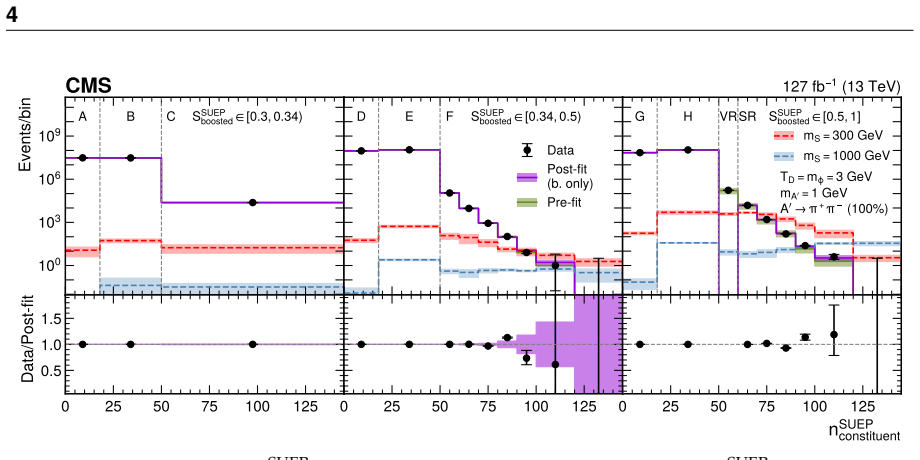
Summary. This CMS Letter reports a search for soft unclustered energy patterns (SUEPs) in 127 fb^{-1} of 13 TeV pp data collected with the scouting stream. By recording only HLT-level PF candidates, jets, and vertices, the analysis lowers the HT threshold from ~1 TeV (offline) to 410 GeV, increasing acceptance for soft, high-multiplicity isotropic signals predicted by hidden-valley models with large 't Hooft coupling. Events are selected with HT > 560 GeV, two AK15 jets, n_SUEP_constituent > 50 and S_SUEP_boosted > 0.5; the SUEP candidate is the higher-multiplicity jet. Background (primarily QCD multijet) is estimated with an extended ABCD method in the (n_SUEP_constituent, S_SUEP_boosted) plane, including a linear c_bin shape correction from control regions F/C (Eq. 1) and a floating 50 % SR normalization uncertainty. A binned likelihood fit yields results consistent with the SM; 95 % CL CLs limits on ggF scalar-mediator production improve prior offline CMS constraints by up to an order of magnitude over most of the (m_S, T_D, m_ϕ) space.
Significance. The work is a clear experimental advance: scouting enables a substantially lower HT threshold that is essential for soft SUEP acceptance, and the resulting limits are the most stringent to date on this class of models. The analysis employs standard, well-documented tools (CLs with pseudo-experiments and asymptotic approximation, profiled systematics, data-driven background with simulation and VR validation). Strengths include the explicit quantification of the dominant tracking-efficiency uncertainty (scaled from offline D* measurements), the transparent extended-ABCD construction with residual-shape and normalization uncertainties, and the direct comparison to the earlier offline search. The result is immediately usable by the BSM community and demonstrates the physics reach of CMS scouting for unconventional signatures.
minor comments (5)
- In the text describing the SR binning (just before Eq. 1), the last bin is written “>120 GeV”; the variable is dimensionless multiplicity, so the unit should be dropped.
- Figure 2 caption and body text refer to “VR” without defining the acronym on first use; a parenthetical “(validation region)” would help readers who skip Appendix A.
- The factor of ≈3 that scales the offline tracking-efficiency uncertainty to the scouting case is stated without a quantitative reference or plot; a short sentence or citation to the relevant CMS DP note would improve reproducibility.
- Appendix A.1: the linear fit for c_bin uses bin centers up to 125 for the overflow bin; a brief statement that the result is stable under reasonable variations of the fit range would strengthen confidence in the correction.
- Figure 4: the exclusion curves for different m_S values become dense at low T_D/m_ϕ; a color bar or explicit legend entry for the “few hard tracks” and “m_ϕ < 2 m_A′” regions would improve readability.
Circularity Check
No significant circularity: data-driven ABCD background and independent MC signal shapes yield limits without self-definitional or fitted-as-prediction reductions.
full rationale
This is a standard CMS experimental search paper. The central claims (consistency with SM background; most stringent limits on ggF scalar-mediator SUEP production) rest on (i) a data-driven extended ABCD estimate of the QCD multijet background (Eq. 1, with linear c_bin shape correction extracted from adjacent CRs F and C, plus floating 50 % SR normalization and 100 % last-bin uncertainty), validated in a low-n VR and in QCD simulation (Appendix A, Figs. 5–6), and (ii) signal templates generated from an independent custom dark-shower package + PYTHIA + GEANT4. Neither the background prediction nor the CLs upper limits reduce by construction to a fitted parameter that is later re-labeled a discovery; residual higher-order correlations are quantified and constrained by the fit itself. Self-citations (prior CMS offline SUEP search, tracking-efficiency D* measurements, luminosity) supply external calibrations or comparison benchmarks, not load-bearing uniqueness theorems or ansätze that force the result. The scouting HT threshold reduction is a genuine experimental advance that increases acceptance; the derivation chain is therefore self-contained against external data and simulation.
Axiom & Free-Parameter Ledger
free parameters (3)
- c_bin linear correction coefficients
- 50 % SR normalization uncertainty
- tracking-efficiency scale factor ≈3
axioms (3)
- domain assumption QCD multijet events dominate the high-multiplicity, high-sphericity background after the n_constituent > 50 and S_boosted > 0.5 selection, and their correlations are adequately captured by the extended ABCD construction.
- domain assumption The simplified scalar-mediator model (ggF production, 100 % branching fraction to SUEP, Boltzmann dark-meson spectrum, prompt dark-photon decays) correctly represents the experimental signature of large-’t Hooft-coupling hidden valleys.
- domain assumption Standard Model particle-flow reconstruction and the HLT scouting objects provide unbiased charged-particle multiplicities and sphericity once the stated p_T and η cuts are applied.
invented entities (3)
-
SUEP (soft unclustered energy pattern) cluster
independent evidence
-
scalar mediator S with effective ggS coupling
no independent evidence
-
dark mesons ϕ and dark photons A′
no independent evidence
read the original abstract
A search for soft unclustered energy patterns (SUEPs) is conducted using proton-proton collision data corresponding to an integrated luminosity of 127 fb$^{-1}$ at a center-of-mass energy of 13 TeV, collected via the data scouting stream of the CMS experiment at the LHC. Only the results of the high-level trigger reconstruction are recorded to enable a lower threshold on the hadronic activity. This increases the acceptance for SUEP signatures, which are predicted by hidden-valley models with a large 't Hooft coupling. The observed results are consistent with the standard model background prediction. The most stringent limits to date are set on the gluon fusion production of heavy scalar mediators resulting in SUEP-like signals.
Figures



Reference graph
Works this paper leans on
-
[1]
Echoes of a hidden valley at hadron colliders
M. J. Strassler and K. M. Zurek, “Echoes of a hidden valley at hadron colliders”,Phys. Lett. B651(2007) 374,doi:10.1016/j.physletb.2007.06.055, arXiv:hep-ph/0604261
-
[2]
B. Batell, M. Low, E. T. Neil, and C. B. Verhaaren, “Review of neutral naturalness”,Phys. Rept.1165(2026) 1,doi:10.1016/j.physrep.2025.12.001,arXiv:2203.05531
-
[3]
Naturalness: past, present, and future
N. Craig, “Naturalness: past, present, and future”,Eur. Phys. J. C83(2023) 825, doi:10.1140/epjc/s10052-023-11928-7,arXiv:2205.05708
-
[4]
Semivisible jets: Dark matter undercover at the LHC
T. Cohen, M. Lisanti, and H. K. Lou, “Semivisible jets: Dark matter undercover at the LHC”,Phys. Rev. Lett.115(2015) 171804,doi:10.1103/PhysRevLett.115.171804, arXiv:1503.00009
-
[5]
P . Schwaller, D. Stolarski, and A. Weiler, “Emerging jets”,JHEP05(2015) 059, doi:10.1007/JHEP05(2015)059,arXiv:1502.05409
-
[6]
Triggering soft bombs at the LHC
S. Knapen, S. Pagan Griso, M. Papucci, and D. J. Robinson, “Triggering soft bombs at the LHC”,JHEP08(2017) 076,doi:10.1007/JHEP08(2017)076,arXiv:1612.00850
-
[7]
Dark sector searches with the CMS experiment
CMS Collaboration, “Dark sector searches with the CMS experiment”,Phys. Rept.1115 (2025) 448,doi:10.1016/j.physrep.2024.09.013,arXiv:2405.13778
-
[8]
Enriching the physics program of the CMS experiment via data scouting and data parking
CMS Collaboration, “Enriching the physics program of the CMS experiment via data scouting and data parking”,Phys. Rept.1115(2025) 678, doi:10.1016/j.physrep.2024.09.006,arXiv:2403.16134
-
[9]
What RHIC experiments and theory tell us about properties of quark-gluon plasma?
E. V . Shuryak, “What RHIC experiments and theory tell us about properties of quark-gluon plasma?”,Nucl. Phys. A750(2005) 64, doi:10.1016/j.nuclphysa.2004.10.022,arXiv:hep-ph/0405066
-
[10]
T. Sch ¨afer and E. V . Shuryak, “Instantons in QCD”,Rev. Mod. Phys.70(1998) 323, doi:10.1103/RevModPhys.70.323,arXiv:hep-ph/9610451
-
[11]
Viscosity in strongly interacting quantum field theories from black hole physics
P . Kovtun, D. T. Son, and A. O. Starinets, “Viscosity in strongly interacting quantum field theories from black hole physics”,Phys. Rev. Lett.94(2005) 111601, doi:10.1103/PhysRevLett.94.111601,arXiv:hep-th/0405231
-
[12]
Gauge/string duality, hot QCD and heavy ion collisions
J. Casalderrey-Solana et al., “Gauge/string duality, hot QCD and heavy ion collisions”. Cambridge University Press, 2014.doi:10.1017/CBO9781139136747
-
[13]
Why unparticle models with mass gaps are examples of hidden valleys
M. J. Strassler, “Why unparticle models with mass gaps are examples of hidden valleys”, 2008.arXiv:0801.0629
Pith/arXiv arXiv 2008
-
[14]
Unsupervised hadronic SUEP at the LHC
J. Barron et al., “Unsupervised hadronic SUEP at the LHC”,JHEP12(2021) 129, doi:10.1007/JHEP12(2021)129,arXiv:2107.12379. References 9
-
[15]
Black holes and the LHC: A review
S. C. Park, “Black holes and the LHC: A review”,Prog. Part. Nucl. Phys.67(2012) 617, doi:10.1016/j.ppnp.2012.03.004,arXiv:1203.4683
-
[16]
Handbook of LHC Higgs cross sections: 4. Deciphering the nature of the Higgs sector
LHC Higgs Cross Section Working Group, “Handbook of LHC Higgs cross sections: 4. Deciphering the nature of the Higgs sector”, CERN Report CERN-2017-002-M, 2016. doi:10.23731/CYRM-2017-002,arXiv:1610.07922
-
[17]
An unbiased Hessian representation for Monte Carlo PDFs
S. Carrazza et al., “An unbiased Hessian representation for Monte Carlo PDFs”,Eur. Phys. J. C75(2015) 369,doi:10.1140/epjc/s10052-015-3590-7, arXiv:1505.06736
-
[18]
T. Sj ¨ostrand et al., “An introduction to PYTHIA 8.2”,Comput. Phys. Commun.191(2015) 159,doi:10.1016/j.cpc.2015.01.024,arXiv:1410.3012
-
[19]
Extraction and validation of a new set of CMS PYTHIA8 tunes from underlying-event measurements
CMS Collaboration, “Extraction and validation of a new set of CMS PYTHIA8 tunes from underlying-event measurements”,Eur. Phys. J. C80(2020) 4, doi:10.1140/epjc/s10052-019-7499-4,arXiv:1903.12179
-
[20]
GEANT4 Collaboration, “GEANT4—a simulation toolkit”,Nucl. Instrum. Meth. A506 (2003) 250,doi:10.1016/S0168-9002(03)01368-8
-
[21]
The CMS experiment at the CERN LHC
CMS Collaboration, “The CMS experiment at the CERN LHC”,JINST3(2008) S08004, doi:10.1088/1748-0221/3/08/S08004
-
[22]
Development of the CMS detector for the CERN LHC Run 3
CMS Collaboration, “Development of the CMS detector for the CERN LHC Run 3”, JINST19(2024) P05064,doi:10.1088/1748-0221/19/05/P05064, arXiv:2309.05466
-
[23]
Electron and photon reconstruction and identification with the CMS experiment at the CERN LHC
CMS Collaboration, “Electron and photon reconstruction and identification with the CMS experiment at the CERN LHC”,JINST16(2021) P05014, doi:10.1088/1748-0221/16/05/P05014,arXiv:2012.06888
-
[24]
CMS Collaboration, “Performance of the CMS muon detector and muon reconstruction with proton-proton collisions at √s=13 TeV”,JINST13(2018) P06015, doi:10.1088/1748-0221/13/06/P06015,arXiv:1804.04528
-
[25]
Description and performance of track and primary-vertex reconstruction with the CMS tracker
CMS Collaboration, “Description and performance of track and primary-vertex reconstruction with the CMS tracker”,JINST9(2014) P10009, doi:10.1088/1748-0221/9/10/P10009,arXiv:1405.6569
-
[26]
Particle-flow reconstruction and global event description with the CMS detector
CMS Collaboration, “Particle-flow reconstruction and global event description with the CMS detector”,JINST12(2017) P10003,doi:10.1088/1748-0221/12/10/P10003, arXiv:1706.04965
-
[27]
Jet energy scale and resolution in the CMS experiment in pp collisions at 8 TeV
CMS Collaboration, “Jet energy scale and resolution in the CMS experiment in pp collisions at 8 TeV”,JINST12(2017) P02014, doi:10.1088/1748-0221/12/02/P02014,arXiv:1607.03663
-
[28]
CMS Collaboration, “Performance of missing transverse momentum reconstruction in proton-proton collisions at √s=13 TeV using the CMS detector”,JINST14(2019) P07004,doi:10.1088/1748-0221/14/07/P07004,arXiv:1903.06078
-
[29]
Performance of the CMS Level-1 trigger in proton-proton collisions at √s=13 TeV
CMS Collaboration, “Performance of the CMS Level-1 trigger in proton-proton collisions at √s=13 TeV”,JINST15(2020) P10017, doi:10.1088/1748-0221/15/10/P10017,arXiv:2006.10165. 10
-
[30]
Performance of the CMS high-level trigger during LHC Run 2
CMS Collaboration, “Performance of the CMS high-level trigger during LHC Run 2”, JINST19(2024) P11021,doi:10.1088/1748-0221/19/11/P11021, arXiv:2410.17038
-
[31]
CMS Collaboration, “The CMS trigger system”,JINST12(2017) P01020, doi:10.1088/1748-0221/12/01/P01020,arXiv:1609.02366
-
[32]
Search for soft unclustered energy patterns in proton-proton collisions at 13 TeV
CMS Collaboration, “Search for soft unclustered energy patterns in proton-proton collisions at 13 TeV”,Phys. Rev. Lett.133(2024) 191902, doi:10.1103/PhysRevLett.133.191902,arXiv:2403.05311
-
[33]
CMS Collaboration, “Search for soft unclustered energy patterns produced in association with a W or Z boson in proton-proton collisions at s=13TeV”,Phys. Lett. B879(2026) 140671,doi:10.1016/j.physletb.2026.140671,arXiv:2604.05996
-
[34]
ATLAS Collaboration, “Search for soft unclustered energy patterns containing muons in the final state in pp collisions at √s=13 TeV with the ATLAS detector”, 2026. arXiv:2605.20015. Submitted toJHEP
Pith/arXiv arXiv 2026
-
[35]
The anti-kT jet clustering algorithm
M. Cacciari, G. P . Salam, and G. Soyez, “The anti-kT jet clustering algorithm”,JHEP04 (2008) 063,doi:10.1088/1126-6708/2008/04/063,arXiv:0802.1189
-
[36]
M. Cacciari, G. P . Salam, and G. Soyez, “FastJet user manual”,Eur. Phys. J. C72(2012) 1896,doi:10.1140/epjc/s10052-012-1896-2,arXiv:1111.6097
-
[37]
The efficacy of event isotropy as an event shape observable
C. Cesarotti, M. Reece, and M. J. Strassler, “The efficacy of event isotropy as an event shape observable”,JHEP07(2021) 215,doi:10.1007/JHEP07(2021)215, arXiv:2011.06599
-
[38]
Improved extrapolation methods of data-driven background estimations in high energy physics
S. Choi and H. Oh, “Improved extrapolation methods of data-driven background estimations in high energy physics”,Eur. Phys. J. C81(2021) 643, doi:10.1140/epjc/s10052-021-09404-1,arXiv:1906.10831
-
[39]
Precision luminosity measurement in proton-proton collisions at√s=13 TeV in 2015 and 2016 at CMS
CMS Collaboration, “Precision luminosity measurement in proton-proton collisions at√s=13 TeV in 2015 and 2016 at CMS”,Eur. Phys. J. C81(2021) 800, doi:10.1140/epjc/s10052-021-09538-2,arXiv:2104.01927
-
[40]
CMS luminosity measurement for the 2017 data-taking period at√s=13 TeV
CMS Collaboration, “CMS luminosity measurement for the 2017 data-taking period at√s=13 TeV”, CMS Physics Analysis Summary CMS-PAS-LUM-17-004, CERN, 2018
2017
-
[41]
CMS luminosity measurement for the 2018 data-taking period at√s=13 TeV
CMS Collaboration, “CMS luminosity measurement for the 2018 data-taking period at√s=13 TeV”, CMS Physics Analysis Summary CMS-PAS-LUM-18-002, CERN, 2019
2018
-
[42]
Precise predictions for boosted Higgs production
K. Becker et al., “Precise predictions for boosted Higgs production”,SciPost Phys. Core7 (2024) 001,doi:10.21468/SciPostPhysCore.7.1.001,arXiv:2005.07762
-
[43]
Tracking performance for charged pions with Run2 Legacy data
CMS Collaboration, “Tracking performance for charged pions with Run2 Legacy data”, CMS Detector Performance Note CMS-DP-2022-012, 2022
2022
-
[44]
Muon tracking efficiency for 2018 dataset using tag and probe method
CMS Collaboration, “Muon tracking efficiency for 2018 dataset using tag and probe method”, CMS Detector Performance Note CMS-DP-2020-013, 2019
2018
-
[45]
The CMS statistical analysis and combination tool: COMBINE
CMS Collaboration, “The CMS statistical analysis and combination tool: COMBINE”, Comput. Softw. Big Sci.8(2024) 19,doi:10.1007/s41781-024-00121-4, arXiv:2404.06614. 11
-
[46]
Confidence level computation for combining searches with small statistics
T. Junk, “Confidence level computation for combining searches with small statistics”, Nucl. Instrum. Meth. A434(1999) 435,doi:10.1016/S0168-9002(99)00498-2, arXiv:hep-ex/9902006
-
[47]
Presentation of search results: The CL s technique
A. L. Read, “Presentation of search results: The CL s technique”,J. Phys. G28(2002) 2693, doi:10.1088/0954-3899/28/10/313
-
[48]
Asymptotic formulae for likelihood-based tests of new physics
G. Cowan, K. Cranmer, E. Gross, and O. Vitells, “Asymptotic formulae for likelihood-based tests of new physics”,Eur. Phys. J. C71(2011) 1554, doi:10.1140/epjc/s10052-011-1554-0,arXiv:1007.1727. [Erratum: doi:10.1140/epjc/s10052-013-2501-z]
-
[49]
HEPData record for this analysis, 2026.doi:10.17182/hepdata.167851. A Additional details A.1 Corrections for the background estimation in the signal region In the extended ABCD method, then SUEP constituent distribution in CR F is used as a proxy for the background shape in the SR. However, because of higher-order correlations betweennSUEP constituent and...
discussion (0)
Sign in with ORCID, Apple, or X to comment. Anyone can read and Pith papers without signing in.