REVIEW 4 major objections 5 minor 64 references
SpindleFlexNet is the first one-dimensional object detector for sleep spindles, localizing their starts and ends in multi-spindle EEG segments with F1 of 0.67 on two public datasets.
Reviewed by Pith at T0; open to challenge. T0 means a machine referee read the full paper against a public rubric. the ladder, T0–T4 →
T0 review · grok-4.5
2026-07-14 17:40 UTC pith:QRSPCKBT
load-bearing objection First solid 1D RetinaNet adaptation for multi-spindle localization; competitive F1 on public data, but union-of-experts GT and low mean IoU soften the claims. the 4 major comments →
SpindleFlexNet: Flexible sleep spindles detection for EEG signals based on an adaptive one-dimensional RetinaNet-based framework
The pith
A machine-rendered reading of the paper's core claim, the machinery that carries it, and where it could break.
Core claim
The central claim is that a carefully adapted one-dimensional RetinaNet can perform flexible, point-wise detection of sleep spindles directly from band-pass-filtered EEG segments: by generating multi-scale temporal anchors, matching them with a one-dimensional IoU, training with a customized focal-plus-smooth-L1 loss, and cleaning overlaps with one-dimensional non-maximum suppression, the network simultaneously classifies spindle presence and regresses start and end coordinates for one to seven spindles per 15-second window, achieving stable F1-scores of 0.67 on both MASS and DREAMS under five-fold subject-wise cross-validation.
What carries the argument
SpindleFlexNet: a one-dimensional RetinaNet built from a 1-D ResNet-18 backbone, a temporal feature-pyramid network, parallel classification and regression heads, multi-scale 1-D anchors (aspect ratios 0.65-1.8, scales 0.85-1.3), 1-D IoU matching (threshold 0.3), focal loss, and 1-D non-maximum suppression.
Load-bearing premise
The union of two experts' annotations is treated as reliable ground truth for both training and scoring, even though the paper notes the experts often disagree and never measures that disagreement or tests against each expert alone.
What would settle it
Re-train and re-evaluate SpindleFlexNet on the same MASS and DREAMS subjects but score against each expert's annotations separately (or against a third independent rater); if F1 falls well below 0.67 or becomes unstable across experts, the claim that the detector is robust and generalizable collapses.
If this is right
- Automated clinical pipelines can replace or accelerate manual spindle scoring, cutting annotation time from roughly 2.3 s per spindle to 0.015 s.
- Researchers can obtain dense, multi-spindle onset/offset labels inside fixed-length EEG windows without hand-crafted thresholds or two-stage feature pipelines.
- The same 1-D object-detection recipe can be extended to other short sleep micro-events such as K-complexes or high-frequency oscillations.
- Stable cross-dataset F1 supports use of the detector as a reference labeler for concurrent EEG-fMRI experiments.
- Dense temporal localization supplies higher-resolution spindle features for studies linking spindles to memory consolidation or neurological disease.
Where Pith is reading between the lines
- Because the method already produces continuous start-end coordinates, it could feed directly into closed-loop stimulation systems that aim to enhance or suppress spindles in real time.
- The low IoU values (mean ~0.28) suggest that even when spindles are detected their boundaries remain fuzzy; adding explicit frequency-domain priors or multi-channel input might tighten localization without changing the detector backbone.
- If the same architecture is trained on patient cohorts (sleep apnea, schizophrenia, infants) rather than healthy adults, any drop in F1 would quantify how much spindle morphology shifts with pathology.
- The 15-second non-overlapping window is a design choice that could be relaxed to sliding or whole-night inference once memory and anchor density are re-tuned.
Editorial analysis
A structured set of objections, weighed in public.
Referee Report
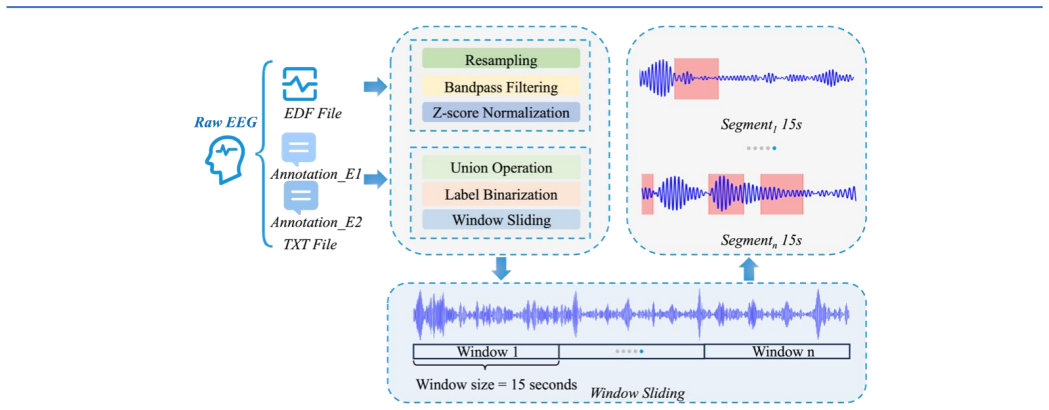
Summary. The paper presents SpindleFlexNet, claimed as the first deep-learning object-detection framework for sleep-spindle localization in EEG. It adapts RetinaNet to one dimension via 1-D convolutions, ResNet-18 backbone, temporal FPN, multi-scale anchors (aspect ratios [0.65,0.85,1.0,1.3,1.8], scales [0.85,1.0,1.3]), 1-D IoU matching (threshold 0.3), focal loss, Smooth-L1 regression, and 1-D NMS. On 15 s non-overlapping segments containing ≥1 spindle (11 061 from MASS SS2, 15 subjects; 335 from DREAMS, 6 subjects), five-fold subject-wise cross-validation against the union of dual-expert labels yields mean recall/precision/F1 of 0.61/0.76/0.67 (MASS) and 0.58/0.80/0.67 (DREAMS), with mean IoU ≈0.28–0.29 and the ability to localize 1–7 spindles per segment. Comparisons to prior rule-based, ML and DL methods on the same union labels are presented as competitive; inference is shown to be far faster than expert annotation.
Significance. If the performance numbers hold under more rigorous ground-truth protocols, the work supplies a practical, end-to-end coordinate-regression detector that directly addresses multi-spindle localization—an acknowledged gap relative to classification-only or heuristic pipelines. The explicit transfer of a mature 2-D detector (RetinaNet) to 1-D EEG, the public-data subject-wise CV protocol, and the quantitative speed comparison versus human experts are concrete strengths that make the method immediately usable for automated labeling and EEG–fMRI studies. The contribution is therefore of clear applied value to sleep research even if absolute F1 scores are later revised.
major comments (4)
- [Section II.B and Tables III–VI] All reported metrics (Tables III–VI) and the multi-spindle localization claim rest on the union of two experts (E1∪E2, E3∪E4) as both training and evaluation ground truth. Section II.B and the Introduction explicitly note that the experts produce “significantly varied annotations,” yet no inter-rater agreement (Cohen’s κ, event-level IoU or F1 between experts) is quantified and the detector is never evaluated against each expert separately. Because the positive set is expanded by the union operation, both precision and recall can be inflated relative to a single-expert or consensus standard; the numerical support for “stable detection performance and good generalization” is therefore only as reliable as the uncharacterized labels.
- [§II.D, Eq. (6) and Table III] True-positive matching requires 1-D IoU > 0.3 (Eq. 6, §II.D), yet Table III reports mean IoU values of 0.28 (MASS) and 0.29 (DREAMS). If the tabulated IoU is the average over accepted detections it cannot lie below the acceptance threshold; if it is computed differently the metric is undefined. Either interpretation undermines the claim of “strong temporal precision” and the comparison to prior work that used a 0.2 threshold.
- [Tables V–VI and §III.E] Tables V–VI present F1 scores that are competitive but not superior to several published baselines (e.g., SST+RUSBoost 0.72 on MASS; Teager+bagging / OpenSpindleNet 0.69 on DREAMS). No statistical significance tests, confidence intervals or paired subject-level comparisons are supplied, so it is impossible to judge whether the observed differences are meaningful or whether SpindleFlexNet actually improves upon the strongest existing methods under identical evaluation conditions.
- [§II.B (segment extraction)] Only segments that already contain at least one spindle are retained for training and testing (§II.B). Consequently the reported precision never reflects the model’s behavior on pure non-spindle EEG; false-positive rates on long stretches of background activity—the dominant clinical scenario—remain unquantified and may be higher than the tabulated figures suggest.
minor comments (5)
- [Throughout] Section heading “IV. DISSCUSION” is misspelled; abstract and keywords contain stray spaces (“s leep”, “one -dimensional”).
- [Title, abstract, Tables V–VI] Model name appears inconsistently as SpindleFlexNet / SpindleFlex-Net; unify.
- [Figure 5] Figure 5 learning curves lack axis labels, loss-component breakdown and early-stopping criteria; hard to judge convergence.
- [§II.C] Anchor aspect ratios and scales are stated to be “selected based on the empirical distribution” yet no histogram or sensitivity analysis is provided; a short ablation would strengthen reproducibility.
- [§II.F] Code and exact train/validation subject splits are not released; public availability would allow direct verification of the five-fold numbers.
Circularity Check
No circularity: empirical 1-D RetinaNet detector evaluated by subject-wise CV; metrics do not reduce to inputs by construction.
full rationale
SpindleFlexNet is a standard supervised object-detection pipeline (1-D ResNet-18 backbone + FPN + classification/regression heads) trained end-to-end on band-pass-filtered EEG segments whose binary labels are the union of two expert annotations. Five-fold subject-wise cross-validation produces the reported recall/precision/F1/AP/IoU numbers; no equation equates any of those metrics to a fitted constant or to the training labels by definition. Anchor scales and aspect ratios are chosen once from the empirical length histogram of the training folds (a conventional hyper-parameter decision that does not force the subsequent F1 scores). There are no self-citations that carry uniqueness theorems, no ansatz smuggled from prior author work, and no renaming of a known empirical pattern. The only data-dependent choice (union ground truth) affects absolute metric values but does not create a circular derivation chain. The paper is therefore self-contained against its external benchmarks.
Axiom & Free-Parameter Ledger
free parameters (5)
- anchor aspect ratios =
[0.65, 0.85, 1.0, 1.3, 1.8]
- anchor scales =
[0.85, 1.0, 1.3]
- positive IoU threshold =
0.3
- NMS suppression threshold =
0.05
- focal-loss focusing parameter γ =
2.0
axioms (3)
- domain assumption Union of two independent expert annotations constitutes reliable ground truth for both training and evaluation.
- domain assumption Sleep spindles are adequately captured by a 11–16 Hz bandpass filter and durations between 0.5–3.0 s.
- ad hoc to paper 15-second non-overlapping windows containing at least one spindle are a sufficient training unit for dense multi-spindle detection.
invented entities (1)
-
SpindleFlexNet (1D RetinaNet adaptation)
no independent evidence
read the original abstract
Sleep spindle is a physiologically significant biomedical signal in electroencephalographic (EEG) waveforms, which is typically a low-amplitude event in sleep. Due to the small signal ratio in the overall EEG, previous detection methods have limited capability to capture its start and end points and lack flexibility in handling multi-spindle scenarios. To address the gap, we address the problem from a new perspective and introduce SpindleFlexNet, the first framework in this field to apply deep learning-based one-dimensional object detection, leveraging an adapted one-dimensional RetinaNet architecture. The framework employs one-dimensional anchor generation, matching, and regression, along with a customized one-dimensional loss function. Analyses were conducted on two public datasets: the Montreal Archive of Sleep Studies and DREAMS, from which a total of 11,061 and 335 segments were obtained, respectively. When trained on these datasets, SpindleFlexNet achieved an average recall, precision, and F1-score of 0.61, 0.76, 0.67, and 0.58, 0.80, 0.67 in five-fold cross-validation. The model demonstrates stable detection performance and good generalization, making it a practical tool for sleep research. Potential applications include automated spindle labeling in clinical settings and as a reference for studies combining EEG with simultaneous functional magnetic resonance imaging.
Figures


Reference graph
Works this paper leans on
-
[1]
Sleep Spindles and Memory Reprocessing,
J. W. Antony, M. Schonauer, B. P. Staresina, and S. A. Cairney, “Sleep Spindles and Memory Reprocessing,” Trends Neurosci, vol. 42, no. 1, pp. 1- 3, Jan, 2019
2019
-
[2]
Occurrence of periodic sleep spindles within and across non -REM sleep episodes,
S. L. Himanen, J. Virkkala, E. Huupponen, J. Niemi, and J. Hasan, “Occurrence of periodic sleep spindles within and across non -REM sleep episodes,” Neuropsychobiology, vol. 48, no. 4, pp. 209-16, 2003
2003
-
[3]
Systematic review: the relationship between sleep spindle activity with cognitive functions, positive and negative symptoms in psychosis,
C. H. Au, and C. J. Harvey, “Systematic review: the relationship between sleep spindle activity with cognitive functions, positive and negative symptoms in psychosis,” Sleep Med X, vol. 2, pp. 100025, Dec, 2020
2020
-
[4]
Manipulating sleep spindles --expanding views on sleep, memory, and disease,
S. Astori, R. D. Wimmer, and A. Luthi, “Manipulating sleep spindles --expanding views on sleep, memory, and disease,” Trends Neurosci, vol. 36, no. 12, pp. 738-48, Dec, 2013
2013
-
[5]
Automated sleep spindle detection with mixed EEG features,
P. Chen, D. Chen, L. Zhang, Y. Tang, and X. Li, “Automated sleep spindle detection with mixed EEG features,” Biomedical Signal Processing and Control, vol. 70, pp. 103026, 2021
2021
-
[6]
Changes in sleep structure and sleep spindles are associated with the neuropsychiatric profile in paradoxical insomnia,
G. Benbir Senel, O. Aydin, E. Tanriover Aydin, M. R. Bayar, and D. Karadeniz, “Changes in sleep structure and sleep spindles are associated with the neuropsychiatric profile in paradoxical insomnia,” Int J Psychophysiol, vol. 168, pp. 27-32, Oct, 2021
2021
-
[7]
DOSED: A deep learning approach to detect multiple sleep micro -events in EEG signal,
S. Chambon, V. Thorey, P. J. Arnal, E. Mignot, and A. Gramfort, “DOSED: A deep learning approach to detect multiple sleep micro -events in EEG signal,” J Neurosci Methods, vol. 321, pp. 64-78, Jun 1, 2019
2019
-
[8]
SleepZzNet: Sleep Stage Classification Using Single-Channel EEG Based on CNN and Transformer,
H. Chen, Z. Yin, P. Zhang, and P. Liu, “SleepZzNet: Sleep Stage Classification Using Single-Channel EEG Based on CNN and Transformer,” International Journal of Psychophysiology, vol. 168, pp. S168, 2021
2021
-
[9]
Sleep spindles may predict response to cognitive -behavioral therapy for chronic insomnia,
T. T. Dang -Vu, B. Hatch, A. Salimi, M. Mograss, S. Boucetta, J. O'Byrne, M. Brandewinder, C. Berthomier, and J. P. Gouin, “Sleep spindles may predict response to cognitive -behavioral therapy for chronic insomnia,” Sleep Med, vol. 39, pp. 54 -61, Nov, 2017
2017
-
[10]
Sleep Spindle-dependent Functional Connectivity Correlates with Cognitive Abilities,
Z. Fang, L. B. Ray, E. Houldin, D. Smith, A. M. Owen, and S. M. Fogel, “Sleep Spindle-dependent Functional Connectivity Correlates with Cognitive Abilities,” J Cogn Neurosci, vol. 32, no. 3, pp. 446-466, Mar, 2020
2020
-
[11]
Sleep Spindles and Auditory Sensory Gating: Two Measures of Cerebral Inhibition in Preschool-Aged Children are Strongly Correlated,
P.-P. Wei, S. K. Hunter, and R. G. Ross, “Sleep Spindles and Auditory Sensory Gating: Two Measures of Cerebral Inhibition in Preschool-Aged Children are Strongly Correlated,” Colorado journal of psychiatry & psychology, vol. 2, no. 1, pp. 75-83, 2017, 2017
2017
-
[12]
Sleep Spindles and Fragmented Sleep as Prodromal Markers in a Preclinical Model of LRRK2-G2019S Parkinson's Disease,
L. M. Crown, M. J. Bartlett, J. L. Wiegand, A. J. Eby, E. J. Monroe, K. Gies, L. Wohlford, M. J. Fell, T. Falk, and S. L. Cowen, “Sleep Spindles and Fragmented Sleep as Prodromal Markers in a Preclinical Model of LRRK2-G2019S Parkinson's Disease,” Front Neurol, vol. 11, pp. 324, 2020
2020
-
[13]
Sleep Biomarkers Help Predict the Development of Alzheimer Disease,
M. M. Grigg -Damberger, and N. Foldvary -Schaefer, “Sleep Biomarkers Help Predict the Development of Alzheimer Disease,” J Clin Neurophysiol, vol. 39, no. 5, pp. 327-334, Jul 1, 2022
2022
-
[14]
Spindle frequency remains slow in sleep apnea patientsthroughout the night,
S.-L. Himanen, J. Virkkala, E. Huupponen, and J. Hasan, “Spindle frequency remains slow in sleep apnea patientsthroughout the night,” Sleep Medicine, vol. 4, no. 4, pp. 361-366, 2003
2003
-
[15]
Sleep spindle abnormalities related to Alzheimer's disease: a systematic mini-review,
Y. Y. Weng, X. Lei, and J. Yu, “Sleep spindle abnormalities related to Alzheimer's disease: a systematic mini-review,” Sleep Med, vol. 75, pp. 37 - 44, Nov, 2020
2020
-
[16]
Detection of weak transient signals based on unsupervised learning for bearing fault diagnosis,
L. Chen, G. Xu, Y. Wang, and J. Wang, “Detection of weak transient signals based on unsupervised learning for bearing fault diagnosis,” Neurocomputing, vol. 314, pp. 445-457, 2018
2018
-
[17]
Massive online data annotation, crowdsourcing to generate high quality sleep spindle annotations from EEG data,
K. Lacourse, B. Yetton, S. Mednick, and S. C. Warby, “Massive online data annotation, crowdsourcing to generate high quality sleep spindle annotations from EEG data,” Sci Data, vol. 7, no. 1, pp. 190, Jun 19, 2020
2020
-
[18]
SpindleU-Net: An Adaptive U -Net Framework for Sleep Spindle Detection in Single -Channel EEG,
J. You, D. Jiang, Y. Ma, and Y. Wang, “SpindleU-Net: An Adaptive U -Net Framework for Sleep Spindle Detection in Single -Channel EEG,” IEEE Trans Neural Syst Rehabil Eng, vol. 29, pp. 1614 -1623, 2021
2021
-
[19]
Spindle -AI: Sleep Spindle Number and Duration Estimation in Infant EEG,
L. Wei, S. Ventura, S. Mathieson, G. Boylan, M. Lowery, and C. Mooney, “Spindle -AI: Sleep Spindle Number and Duration Estimation in Infant EEG,” IEEE Trans Biomed Eng, vol. 69, no. 1, pp. 465 -474, Jan, 2022
2022
-
[20]
Montreal Archive of Sleep Studies: an open ‐access resource for instrument benchmarking and exploratory research,
C. O'reilly, N. Gosselin, J. Carrier, and T. Nielsen, “Montreal Archive of Sleep Studies: an open ‐access resource for instrument benchmarking and exploratory research,” Journal of sleep research, vol. 23, no. 6, pp. 628-635, 2014.[21] J. Pan, Z. Yang, Q. Shen, M. Li, C. Jiang, Y. Li, and Y. Li, “Deep Learning - Augmented Sleep Spindle Detection for Acute...
2014
-
[21]
Automatic sleep-spindle detection procedure: aspects of reliability and validity,
P. Schimicek, J. Zeitlhofer, P. Anderer, and B. Saletu, “Automatic sleep-spindle detection procedure: aspects of reliability and validity,” Clinical Electroencephalography, vol. 25, no. 1, pp. 26 -29, 1994
1994
-
[22]
Optimization of sigma amplitude threshold in sleep spindle detection,
E. Huupponen, A. Värri, S. L. Himanen, J. Hasan, M. Lehtokangas, and J. Saarinen, “Optimization of sigma amplitude threshold in sleep spindle detection,” Journal of sleep research, vol. 9, no. 4, pp. 327 -334, 2000
2000
-
[23]
A comparison of two sleep spindle detection methods based on all night averages: individually adjusted vs. fixed frequencies,
P. P. Ujma, F. Gombos, L. Genzel, B. N. Konrad, P. Simor, A. Steiger, M. Dresler, and R. Bódizs, “A comparison of two sleep spindle detection methods based on all night averages: individually adjusted vs. fixed frequencies,” Frontiers in Human Neuroscience, vol. 9, pp. 52, 2015
2015
-
[24]
Learning - dependent increases in sleep spindle density,
S. Gais, M. Mölle, K. Helms, and J. Born, “Learning - dependent increases in sleep spindle density,” Journal of Neuroscience, vol. 22, no. 15, pp. 6830-6834, 2002
2002
-
[25]
Elevated sleep spindle density after learning or after retrieval in rats,
O. Eschenko, M. Mölle, J. Born, and S. J. Sara, “Elevated sleep spindle density after learning or after retrieval in rats,” Journal of Neuroscience, vol. 26, no. 50, pp. 12914-12920, 2006
2006
-
[26]
Sleep spindles detection: A mixed method using stft and wmsd,
J. Costaab, M. Ortigueirab, A. Batistab, and T. Paivac, “Sleep spindles detection: A mixed method using stft and wmsd,” Sleep, vol. 14, no. 4, pp. 229-233, 2012
2012
-
[27]
Automatic sleep spindle detection and genetic influence estimation using continuous wavelet transform,
M. Adamczyk, L. Genzel, M. Dresler, A. Steiger, and E. Friess, “Automatic sleep spindle detection and genetic influence estimation using continuous wavelet transform,” Frontiers in human neuroscience, vol. 9, pp. 624, 2015
2015
-
[28]
Stage -independent, single lead EEG sleep spindle detection using the continuous wavelet transform and local weighted smoothing,
A. Tsanas, and G. D. Clifford, “Stage -independent, single lead EEG sleep spindle detection using the continuous wavelet transform and local weighted smoothing,” Frontiers in human neuroscience, vol. 9, pp. 181, 2015
2015
-
[29]
Reduced sleep spindle activity in schizophrenia patients,
F. Ferrarelli, R. Huber, M. J. Peterson, M. Massimini, M. Murphy, B. A. Riedner, A. Watson, P. Bria, and G. Tononi, “Reduced sleep spindle activity in schizophrenia patients,” American Journal of Psychiatry, vol. 164, no. 3, pp. 483-492, 2007
2007
-
[30]
Topography of age -related changes in sleep spindles,
N. Martin, M. Lafortune, J. Godbout, M. Barakat, R. Robillard, G. Poirier, C. Bastien, and J. Carrier, “Topography of age -related changes in sleep spindles,” Neurobiology of aging, vol. 34, no. 2, pp. 468-476, 2013
2013
-
[31]
Grouping of spindle activity during slow oscillations in human non-rapid eye movement sleep,
M. Mölle, L. Marshall, S. Gais, and J. Born, “Grouping of spindle activity during slow oscillations in human non-rapid eye movement sleep,” Journal of Neuroscience, vol. 22, no. 24, pp. 10941-10947, 2002
2002
-
[32]
Reduced sleep spindles and spindle coherence in schizophrenia: mechanisms of impaired memory consolidation?,
E. J. Wamsley, M. A. Tucker, A. K. Shinn, K. E. Ono, S. K. McKinley, A. V. Ely, D. C. Goff, R. Stickgold, and D. S. Manoach, “Reduced sleep spindles and spindle coherence in schizophrenia: mechanisms of impaired memory consolidation?,” Biological psychiatry, vol. 71, no. 2, pp. 154-161, 2012
2012
-
[33]
A sleep spindle detection algorithm that emulates human expert spindle scoring,
K. Lacourse, J. Delfrate, J. Beaudry, P. Peppard, and S. C. Warby, “A sleep spindle detection algorithm that emulates human expert spindle scoring,” Journal of neuroscience methods, vol. 316, pp. 3-11, 2019
2019
-
[34]
Detection of K -complexes and sleep spindles (DETOKS) using sparse optimization,
A. Parekh, I. W. Selesnick, D. M. Rapoport, and I. Ayappa, “Detection of K -complexes and sleep spindles (DETOKS) using sparse optimization,” Journal of neuroscience methods, vol. 251, pp. 37-46, 2015
2015
-
[35]
Association of sleep spindle characteristics with executive functioning in healthy sedentary middle ‐aged and older adults,
V. Guadagni, H. Byles, A. V. Tyndall, J. Parboosingh, R. S. Longman, D. B. Hogan, P. J. Hanly, M. Younes, and M. J. Poulin, “ Association of sleep spindle characteristics with executive functioning in healthy sedentary middle ‐aged and older adults, ” Journal of sleep research, vol. 30, no. 2, pp. e13037, 2021
2021
-
[36]
Expert and crowd-sourced validation of an individualized sleep spindle detection method employing complex demodulation and individualized normalization,
L. B. Ray, S. Sockeel, M. Soon, A. Bore, A. Myhr, B. Stojanoski, R. Cusack, A. M. Owen, J. Doyon, and S. M. Fogel, “Expert and crowd-sourced validation of an individualized sleep spindle detection method employing complex demodulation and individualized normalization,” Frontiers in human neuroscience, vol. 9, pp. 507, 2015
2015
-
[37]
Sleep Spindle Detection Using RUSBoost and Synchrosqueezed Wavelet Transform,
T. Kinoshita, K. Fujiwara, M. Kano, K. Ogawa, Y. Sumi, M. Matsuo, and H. Kadotani, “Sleep Spindle Detection Using RUSBoost and Synchrosqueezed Wavelet Transform,” IEEE Trans Neural Syst Rehabil Eng, vol. 28, no. 2, pp. 390-398, Feb, 2020
2020
-
[38]
A robust two -stage sleep spindle detection approach using single -channel EEG,
D. Jiang, Y. Ma, and Y. Wang, “A robust two -stage sleep spindle detection approach using single -channel EEG,” J Neural Eng, vol. 18, no. 2, Mar 3, 2021
2021
-
[39]
Sleep spindle detection using multivariate Gaussian mixture models,
C. R. Patti, T. Penzel, and D. Cvetkovic, “Sleep spindle detection using multivariate Gaussian mixture models,” J Sleep Res, vol. 27, no. 4, pp. e12614, Aug, 2018
2018
-
[40]
A deep learning approach for real -time detection of sleep spindles,
P. M. Kulkarni, Z. Xiao, E. J. Robinson, A. S. Jami, J. Zhang, H. Zhou, S. E. Henin, A. A. Liu, R. S. Osorio, and J. Wang, “A deep learning approach for real -time detection of sleep spindles,” Journal of neural engineering, vol. 16, no. 3, pp. 036004, 2019
2019
-
[41]
Classification and transfer learning of sleep spindles based on convolutional neural networks,
J. Liang, A. N. Belkacem, Y. Song, J. Wang, Z. Ai, X. Wang, J. Guo, L. Fan, C. Wang, and B. Ji, “Classification and transfer learning of sleep spindles based on convolutional neural networks,” Frontiers in Neuroscience, vol. 18, pp. 1396917, 2024
2024
-
[42]
Advanced sleep spindle identification with neural networks,
L. Kaulen, J. T. Schwabedal, J. Schneider, P. Ritter, and S. Bialonski, “Advanced sleep spindle identification with neural networks,” Scientific reports, vol. 12, no. 1, pp. 7686, 2022
2022
-
[43]
SpindleU-Net: An adaptive u -net framework for sleep spindle detection in single -channel EEG,
J. You, D. Jiang, Y. Ma, and Y. Wang, “SpindleU-Net: An adaptive u -net framework for sleep spindle detection in single -channel EEG,” IEEE transactions on neural systems and rehabilitation engineering, vol. 29, pp. 1614-1623, 2021
2021
-
[44]
Rich feature hierarchies for accurate object detection and semantic segmentation
R. Girshick, J. Donahue, T. Darrell, and J. Malik, "Rich feature hierarchies for accurate object detection and semantic segmentation." pp. 580-587
-
[45]
You only look once: Unified, real -time object detection
J. Redmon, S. Divvala, R. Girshick, and A. Farhadi, "You only look once: Unified, real -time object detection." pp. 779-788
-
[46]
Focal loss for dense object detection
T.-Y. Lin, P. Goyal, R. Girshick, K. He, and P. Dollár, "Focal loss for dense object detection." pp. 2980-2988
-
[47]
YOLO -ResTinyECG: ECG-based lightweight embedded AI arrhythmia small object detector with pruning methods,
Y.-L. Xie, and C. -W. Lin, “YOLO -ResTinyECG: ECG-based lightweight embedded AI arrhythmia small object detector with pruning methods,” Expert Systems with Applications, vol. 263, pp. 125691, 2025
2025
-
[48]
EMG-YOLO: An efficient fire detection model for embedded devices,
L. Xiao, W. Li, X. Zhang, H. Jiang, B. Wan, and D. Ren, “EMG-YOLO: An efficient fire detection model for embedded devices,” Digital Signal Processing, vol. 156, pp. 104824, 2025
2025
-
[49]
Reduced sleep spindle activity in schizophrenia patients,
F. Ferrarelli, R. Huber, M. J. Peterson, M. Massimini, M. Murphy, B. A. Riedner, A. Watson, P. Bria, and G. Tononi, “Reduced sleep spindle activity in schizophrenia patients,” Am J Psychiatry, vol. 164, no. 3, pp. 483-92, Mar, 2007
2007
-
[50]
Validation of a novel automatic sleep spindle detector with high performance during sleep in middle aged subjects,
S. L. Wendt, J. A. Christensen, J. Kempfner, H. L. Leonthin, P. Jennum, and H. B. Sorensen, “Validation of a novel automatic sleep spindle detector with high performance during sleep in middle aged subjects,” Annu Int Conf IEEE Eng Med Biol Soc, vol. 2012, pp. 4250-3, 2012
2012
-
[51]
Topography of age -related changes in sleep spindles,
N. Martin, M. Lafortune, J. Godbout, M. Barakat, R. Robillard, G. Poirier, C. Bastien, and J. Carrier, “Topography of age -related changes in sleep spindles,” Neurobiol Aging, vol. 34, no. 2, pp. 468-76, Feb, 2013
2013
-
[52]
A sleep spindle detection algorithm that emulates human expert spindle scoring,
K. Lacourse, J. Delfrate, J. Beaudry, P. Peppard, and S. C. Warby, “A sleep spindle detection algorithm that emulates human expert spindle scoring,” J Neurosci Methods, vol. 316, pp. 3-11, Mar 15, 2019
2019
-
[53]
Advanced sleep spindle identification with neural networks,
L. Kaulen, J. T. C. Schwabedal, J. Schneider, P. Ritter, and S. Bialonski, “Advanced sleep spindle identification with neural networks,” Sci Rep, vol. 12, no. 1, pp. 7686, May 10, 2022
2022
-
[54]
OpenSpindleNet: An open -source deep learning network for reliable sleep spindle detection in scalp and intracranial EEG,
S. Michal, M. Filip, S. Vladimir, V. Vit, and K. Vaclav, “OpenSpindleNet: An open -source deep learning network for reliable sleep spindle detection in scalp and intracranial EEG,” Computers in Biology and Medicine, vol. 197, pp. 110854, 2025
2025
-
[55]
Sleep -spindle detection: crowdsourcing and evaluating performance of experts, non-experts and automated methods,
S. C. Warby, S. L. Wendt, P. Welinder, E. G. Munk, O. Carrillo, H. B. Sorensen, P. Jennum, P. E. Peppard, P. Perona, and E. Mignot, “Sleep -spindle detection: crowdsourcing and evaluating performance of experts, non-experts and automated methods,” Nature methods, vol. 11, no. 4, pp. 385-392, 2014
2014
-
[56]
A comparative analysis of sleep spindle characteristics of sleep - disordered patients and normal subjects,
C. Chen, K. Wang, A. N. Belkacem, L. Lu, W. Yi, J. Liang, Z. Huang, and D. Ming, “A comparative analysis of sleep spindle characteristics of sleep - disordered patients and normal subjects,” Frontiers in Neuroscience, vol. 17, pp. 1110320, 2023
2023
-
[57]
Deep -spindle: An automated sleep spindle detection system for analysis of infant sleep spindles,
L. Wei, S. Ventura, M. A. Ryan, S. Mathieson, G. B. Boylan, M. Lowery, and C. Mooney, “Deep -spindle: An automated sleep spindle detection system for analysis of infant sleep spindles,” Computers in Biology and Medicine, vol. 150, pp. 106096, 2022
2022
-
[58]
Frequency domain models of the EEG,
P. Valdés, J. Bosch, R. Grave, J. Hernandez, J. Riera, R. Pascual, and R. Biscay, “Frequency domain models of the EEG,” Brain topography, vol. 4, no. 4, pp. 309- 319, 1992
1992
-
[59]
Can we open the black box of AI?,
D. Castelvecchi, “Can we open the black box of AI?,” Nature News, vol. 538, no. 7623, pp. 20, 2016
2016
-
[60]
Interpreting black -box models: a review on explainable artificial intelligence,
V. Hassija, V. Chamola, A. Mahapatra, A. Singal, D. Goel, K. Huang, S. Scardapane, I. Spinelli, M. Mahmud, and A. Hussain, “Interpreting black -box models: a review on explainable artificial intelligence,” Cognitive Computation, vol. 16, no. 1, pp. 45-74, 2024
2024
-
[61]
USSD: Unsupervised Sleep Spindle Detector,
E. Ramirez, P. A. Estevez, M. Adams, C. A. Perez, M. Garrido, and P. Peirano, “USSD: Unsupervised Sleep Spindle Detector,” IEEE Access, 2025
2025
-
[62]
Advancing sleep detection by modelling weak label sets: A novel weakly supervised learning approach,
M. Boeker, V. Thambawita, M. Riegler, P. Halvorsen, and H. L. Hammer, “Advancing sleep detection by modelling weak label sets: A novel weakly supervised learning approach,” arXiv preprint arXiv:2402.17601, 2024
Pith/arXiv arXiv 2024
-
[63]
Automatic Segmentation of Sleep Spindles: A Variational Switching State -Space Approach,
M. He, P. Das, G. Hotan, and P. L. Purdon, “Automatic Segmentation of Sleep Spindles: A Variational Switching State -Space Approach,” 2022 56th Asilomar Conference on Signals, Systems, and Computers, pp. 1301-1305, 2022
2022
-
[64]
Switching state-space modeling of neural signal dynamics,
M. He, P. Das, G. Hotan, and P. L. Purdon, “Switching state-space modeling of neural signal dynamics,” PLoS Computational Biology, vol. 19, no. 8, pp. e1011395, 2023
2023
discussion (0)
Sign in with ORCID, Apple, or X to comment. Anyone can read and Pith papers without signing in.