REVIEW 2 major objections 5 minor 43 references
Unknown data symbols can still sharpen multistatic target localization when receivers either average over them or reuse decoded ones as virtual pilots.
Reviewed by Pith at T0; open to challenge. T0 means a machine referee read the full paper against a public rubric. the ladder, T0–T4 →
T0 review · grok-4.5
2026-07-14 14:11 UTC pith:RB7KYS23
load-bearing objection Solid multistatic ISAC paper: closed-form data-aided SPEBs for two receiver strategies, joint ρ–Rd design under rate constraints, and matching estimators that hit the bounds above low SNR. the 2 major comments →
Data-Aided Target Localization in Multistatic ISAC Systems With Communication Constraints
The pith
A machine-rendered reading of the paper's core claim, the machinery that carries it, and where it could break.
Core claim
Under OFDM multistatic ISAC, statistical marginalization of Gaussian data and reliable reuse of decoded data as virtual pilots both produce strictly better squared position error bounds than pilot-only sensing; the resulting joint SPEB-rate region is characterized by optimizing the pilot fraction and the data covariance under a broadcast-rate constraint.
What carries the argument
The equivalent Fisher information matrix (EFIM) of target position, written as a sum of rank-one directional intensities (bistatic delay, AOA, AOD). Theorems 1–3 and Corollaries 1–2 give the intensities for the pilot-only, marginalized-data, and decoded-data cases; the SPEB is then the closed-form inverse-trace of that EFIM, and communication-constrained optimization simply reshapes those intensities.
Load-bearing premise
The stronger scheme treats the whole data block as perfectly known once decoding succeeds, an idealization that holds only away from low signal-to-noise ratio and can fail when decoding errors feed back into the position update.
What would settle it
At moderate-to-high SNR with the same OFDM multistatic geometry, measure whether the two data-aided localizers produce position RMSE that tracks their theoretical SPEBs and lies strictly below the pilot-only SPEB; a collapse of that gap, or RMSE that never approaches the Scenario-2 bound even when decoding is near-perfect, would falsify the claimed data-aided gains.
Editorial analysis
A structured set of objections, weighed in public.
Referee Report
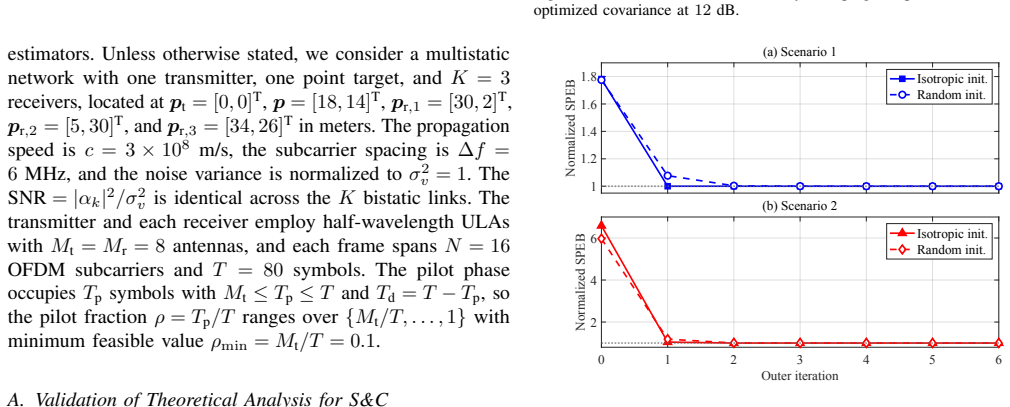
Summary. The paper studies data-aided target localization in OFDM multistatic ISAC networks where sensing receivers do not know the transmitted data realizations. It introduces two receiver strategies: Scenario 1, which marginalizes unknown Gaussian data and extracts covariance-based angular information, and Scenario 2, a reliable-recovery benchmark that reuses correctly decoded data as virtual pilots. Closed-form channel-domain EFIMs and position SPEBs are derived (Theorems 1–3, Corollaries 1–2, Proposition 1), the achievable ergodic broadcast rate is characterized under pilot-based channel estimation, and a joint pilot-fraction and data-covariance design problem is solved under a rate constraint to trace the SPEB–rate region. Two matched localization algorithms are developed, a finite-alphabet extension is sketched, and simulations confirm the ordering P2 < P1 < NDA and that practical RMSEs approach the PEBs above a low-SNR threshold.
Significance. If the results hold, the paper gives a unified multistatic localization framework that quantifies how much position information unknown communication symbols can contribute under different receiver processing strategies and under an explicit rate constraint. The closed-form EFIMs, the geometric intensity–direction decomposition, and the joint ρ–Rd design are concrete tools for SPEB–rate tradeoff analysis beyond monostatic or pilot-only baselines. Strengths include first-principles complex-Gaussian FIM derivations with Schur complements (Appendices I–IV), a compact SPEB inversion for rank-one directional EFIMs (Proposition 1), matched estimators that approach the bounds in simulation, and transparent scoping of Scenario 2 as a reliable-recovery benchmark rather than an all-SNR claim. These contributions are relevant to ISAC transceiver design and performance characterization in multistatic networks.
major comments (2)
- Scenario 2 is repeatedly used as the upper-bound data-aided sensing regime (Theorems 3, Corollary 2, Figs. 3–5, 7), yet it is defined under error-free recovery of the full data block (footnote 4; Remark 7; §V-B). Fig. 7 shows a clear low-SNR RMSE departure and residual gap even at moderate SNR due to data-estimation errors. The central SPEB–rate claims remain valid as a benchmark, but the manuscript should more sharply separate the information-theoretic known-data bound from the practical alternating MAP estimator, and quantify (even approximately) how residual symbol error rate degrades the effective intensities in (35) or the SPEB in (36).
- The abstract and contribution list claim an extension to finite-alphabet signaling (§III-D), but that section only sketches the Gaussian-mixture likelihood (44) and notes exponential complexity, without closed-form FIM, optimized SPEB–rate curves, or Monte Carlo results. Either provide at least one finite-alphabet numerical case (e.g., QPSK SISO/MIMO SPEB vs. SNR or rate) that supports the claimed delay-information retention under discrete rotational symmetries, or demote the finite-alphabet material to a brief outlook so the abstract matches the delivered results.
minor comments (5)
- Notation density is high: η, ξ, θk, ϑk, and multiple intensity symbols (λ, μ̃, γ) appear in close succession. A short notation table or a one-paragraph roadmap at the start of §III would help.
- In §IV-B, Algorithm 1 is shown to monotonically decrease SPEB, but stationarity of (ρ, Rd) is only checked numerically (Fig. 6). A brief remark on when block-SCA guarantees apply under the rate-feasible set C(ρ) would strengthen the optimization section.
- Fig. 5 plots 1/SPEB vs. rate with optimized covariance; the caption and text should state more clearly whether Rd is re-optimized at each rate point or fixed to one target-directed beam while only ρ is swept.
- SISO special case (Corollary 2) is clean; a short numerical SISO panel (even in the appendix) would make the pilot-only vs. known-data contrast more visible for readers less focused on MIMO angular gains.
- Minor typos and style: “Cramér-Rao” is inconsistently spaced; “beampatterna H_t” in Theorem 2 needs a space; arXiv-style “e-prints” references could be updated if journal versions exist.
Circularity Check
No significant circularity: SPEB/rate limits are derived from the observation model via standard complex-Gaussian FIM rules, not from fitted inputs or load-bearing self-citation chains.
full rationale
The paper's central claims (Theorems 1–3, Corollaries 1–2, joint SPEB-rate region under rate constraints) follow by applying the standard complex-Gaussian FIM formula (Eq. 7) to the OFDM multistatic observation model (Eqs. 4–6), then eliminating nuisance amplitudes via Schur complement and mapping channel parameters to position via the geometric Jacobian of §III-A. Scenario 1's covariance-only angular contribution and Scenario 2's full-frame mean contribution are direct consequences of whether data symbols are marginalized or treated as known; neither quantity is fitted to data and then re-presented as a prediction. The SPEB definition P = tr(J_e^{-1}) and the ergodic-rate metric are independent external performance measures. Self-citations (e.g., Shen & Win SPEB/geometry framework [34], [35]) supply standard localization machinery that is externally published and widely used; they do not force the multistatic data-aided gains, which are derived from the present observation model. Scenario 2 is explicitly scoped as a reliable-recovery benchmark rather than an all-SNR claim. No uniqueness theorem is imported to forbid alternatives, no ansatz is smuggled in as a first-principles result, and no fitted parameter is renamed a prediction. The derivation chain is self-contained against its own model assumptions.
Axiom & Free-Parameter Ledger
free parameters (2)
- pilot fraction ρ
- data covariance Rd
axioms (6)
- standard math Complex circularly-symmetric Gaussian observation model yields the standard FIM formula (7).
- domain assumption Data symbols are i.i.d. zero-mean Gaussian with known covariance Rd (or finite alphabet later).
- domain assumption Single point target; direct path and static clutter already removed or absorbed into noise.
- domain assumption Transmitter and receiver positions known; target position is the sole unknown of interest.
- ad hoc to paper Scenario 2 assumes error-free recovery of the data block so that it acts as known waveform.
- domain assumption Orthogonal pilots on every subcarrier with Rp = Mt^{-1} I.
read the original abstract
Integrated sensing and communication (ISAC) enables future wireless networks to perform sensing and communication (S&C) over a shared waveform. In multistatic ISAC systems, however, the sensing receivers do not know the realizations of transmitted data symbols, making it challenging to exploit communication signals for sensing. In this paper, we propose a data-aided framework for target localization with two receiver strategies, namely statistical data-aided sensing and joint data-aided sensing and decoding, where the former marginalizes the random unknown data symbols and the latter reuses the reliably decoded data symbols as known virtual pilots. Under orthogonal frequency division multiplexing (OFDM) signaling, we derive the performance limits for target localization in both strategies and adopt the achievable ergodic data rate as the communication metric. Then, we formulate a joint time-allocation and transmit data-covariance design problem for target localization under communication constraints, which characterizes the joint S&C bound and quantifies the sensing gain provided by data symbols. In addition, we develop two target localization algorithms that implement the proposed data-aided receiver processing, and extend the framework to finite-alphabet signaling. Simulation results validate theoretical analysis and the effectiveness of the proposed data-aided schemes.
Figures



Reference graph
Works this paper leans on
-
[1]
Sensing with communication signals: From information theory to signal processing,
F. Liu, Y .-F. Liu, Y . Cui, C. Masouros, J. Xu, T. X. Han, S. Buzzi, Y . C. Eldar, and S. Jin, “Sensing with communication signals: From information theory to signal processing,”IEEE J. Sel. Areas Commun., vol. 44, pp. 1–30, Oct. 2025
2025
-
[2]
ISAC with UWB: Reliable decoupling and target sensing,
F. Liu, T. Zhang, Z. Zhang, Y . Shen, and Q. Zhang, “ISAC with UWB: Reliable decoupling and target sensing,”IEEE Trans. Wireless Commun., vol. 23, pp. 15 957–15 972, Nov. 2024
2024
-
[3]
Cooperative ISAC-empowered low-altitude economy,
J. Tang, Y . Yu, C. Pan, H. Ren, D. Wang, J. Wang, and X. You, “Cooperative ISAC-empowered low-altitude economy,”IEEE Trans. Wireless Commun., vol. 24, no. 5, pp. 3837–3853, May 2025
2025
-
[4]
Cooperative tracking by multi-agent systems using signals of opportunity,
Y . Wang, Y . Wu, and Y . Shen, “Cooperative tracking by multi-agent systems using signals of opportunity,”IEEE Trans. Commun., vol. 68, no. 1, pp. 93–105, Jan. 2020
2020
-
[5]
Toward ISAC- empowered vehicular networks: Framework, advances, and opportunities,
Z. Du, F. Liu, Y . Li, W. Yuan, Y . Cui, and Z. Zhang, “Toward ISAC- empowered vehicular networks: Framework, advances, and opportunities,” IEEE Wireless Commun. Mag., vol. 32, no. 2, pp. 222–229, Apr. 2025
2025
-
[6]
MU-MIMO com- munications with MIMO radar: From co-existence to joint transmission,
F. Liu, C. Masouros, A. Li, H. Sun, and L. Hanzo, “MU-MIMO com- munications with MIMO radar: From co-existence to joint transmission,” IEEE Trans. Wireless Commun., vol. 17, no. 4, pp. 2755–2770, Feb. 2018
2018
-
[7]
On the fundamental tradeoff of integrated sensing and communications under Gaussian channels,
Y . Xiong, F. Liu, Y . Cui, W. Yuan, T. X. Han, and G. Caire, “On the fundamental tradeoff of integrated sensing and communications under Gaussian channels,”IEEE Trans. Inf. Theory, vol. 69, no. 9, pp. 5723– 5751, Sep. 2023
2023
-
[8]
Fundamental tradeoff of bistatic ISAC under Gaussian fading channels at finite blocklength,
X. Shen, Z. Lu, N. Zhao, H. Zhao, and Y . Shen, “Fundamental tradeoff of bistatic ISAC under Gaussian fading channels at finite blocklength,” IEEE Trans. Inf. Theory, vol. 72, no. 2, pp. 1176–1200, Feb. 2026. 15
2026
-
[9]
Fundamental trade-offs in monostatic ISAC: A holistic investigation toward 6G,
M. F. Keskin, M. M. Mojahedian, J. O. Lacruz, C. Marcus, O. Eriksson, A. Giorgetti, J. Widmer, and H. Wymeersch, “Fundamental trade-offs in monostatic ISAC: A holistic investigation toward 6G,”IEEE Trans. Wireless Commun., vol. 24, pp. 7856–7873, Sep. 2025
2025
-
[10]
Joint transmit beamforming for multiuser MIMO communications and MIMO radar,
X. Liu, T. Huang, N. Shlezinger, Y . Liu, J. Zhou, and Y . C. Eldar, “Joint transmit beamforming for multiuser MIMO communications and MIMO radar,”IEEE Trans. Signal Process., vol. 68, pp. 3929–3944, Jun. 2020
2020
-
[11]
Joint transmit and receive beamforming design for integrated sensing and communication,
N. Zhao, Y . Wang, Z. Zhang, Q. Chang, and Y . Shen, “Joint transmit and receive beamforming design for integrated sensing and communication,” IEEE Commun. Lett., vol. 26, no. 3, pp. 662–666, Jan. 2022
2022
-
[12]
Reshaping the ISAC tradeoff under OFDM signaling: A probabilistic constellation shaping approach,
Z. Du, F. Liu, Y . Xiong, T. X. Han, Y . C. Eldar, and S. Jin, “Reshaping the ISAC tradeoff under OFDM signaling: A probabilistic constellation shaping approach,”IEEE Trans. Signal Process., vol. 72, pp. 4782–4797, Sep. 2024
2024
-
[13]
CP-OFDM achieves the lowest average ranging sidelobe under QAM/PSK constellations,
F. Liu, Y . Zhang, Y . Xiong, S. Li, W. Yuan, F. Gao, S. Jin, and G. Caire, “CP-OFDM achieves the lowest average ranging sidelobe under QAM/PSK constellations,”IEEE Trans. Inf. Theory, vol. 71, no. 9, pp. 6950–6968, Sep. 2025
2025
-
[14]
Joint target localization and data detection in bistatic ISAC networks,
N. Zhao, Q. Chang, X. Shen, Y . Wang, and Y . Shen, “Joint target localization and data detection in bistatic ISAC networks,”IEEE Trans. Commun., vol. 73, no. 5, pp. 3531–3546, May 2025
2025
-
[15]
Integrated sensing and communication receiver design for OTFS-based MIMO system: A unified variational inference framework,
N. Wu, H. Li, D. He, A. Nallanathan, and T. Q. S. Quek, “Integrated sensing and communication receiver design for OTFS-based MIMO system: A unified variational inference framework,”IEEE J. Sel. Areas Commun., vol. 43, no. 4, pp. 1339–1353, Apr. 2025
2025
-
[16]
Limited feedforward waveform design for OFDM dual-functional radar-communications,
M. F. Keskin, V . Koivunen, and H. Wymeersch, “Limited feedforward waveform design for OFDM dual-functional radar-communications,” IEEE Trans. Signal Process., vol. 69, pp. 2955–2970, Apr. 2021
2021
-
[17]
MIMO integrated sensing and communication: CRB-rate tradeoff,
H. Hua, T. X. Han, and J. Xu, “MIMO integrated sensing and communication: CRB-rate tradeoff,”IEEE Trans. Wireless Commun., vol. 23, pp. 2839–2854, Apr. 2024
2024
-
[18]
Fundamental CRB-rate tradeoff in multi-antenna ISAC systems with information multicasting and multi-target sensing,
Z. Ren, Y . Peng, X. Song, Y . Fang, L. Qiu, L. Liu, D. W. K. Ng, and J. Xu, “Fundamental CRB-rate tradeoff in multi-antenna ISAC systems with information multicasting and multi-target sensing,”IEEE Trans. Wireless Commun., vol. 23, pp. 3870–3885, Apr. 2024
2024
-
[19]
Fundamental limits for ISAC: CRB-rate bound and bound-achieving input distribution,
Y . Guo, Y . Gu, M. Wang, and B. Xia, “Fundamental limits for ISAC: CRB-rate bound and bound-achieving input distribution,”IEEE Trans. Wireless Commun., vol. 25, pp. 5605–5621, Oct. 2025
2025
-
[20]
A framework for uplink ISAC receiver designs: Performance analysis and algorithm development,
Z. Yu, H. Ren, C. Pan, G. Zhou, D. Wang, C. Yuen, and J. Wang, “A framework for uplink ISAC receiver designs: Performance analysis and algorithm development,”arXiv e-prints, arXiv:2503.02647, Mar. 2025
Pith/arXiv arXiv 2025
-
[21]
Cooperative ISAC networks: Performance analysis, scaling laws, and optimization,
K. Meng, C. Masouros, A. P. Petropulu, and L. Hanzo, “Cooperative ISAC networks: Performance analysis, scaling laws, and optimization,” IEEE Trans. Wireless Commun., vol. 24, pp. 877–892, Feb. 2025
2025
-
[22]
Joint communication and localization in millimeter wave networks,
G. Kwon, A. Conti, H. Park, and M. Z. Win, “Joint communication and localization in millimeter wave networks,”IEEE J. Sel. Topics Signal Process., vol. 15, no. 6, pp. 1439–1454, Nov. 2021
2021
-
[23]
Fundamental MMSE-rate performance limits of integrated sensing and communication systems,
Z. Wang and X. Wang, “Fundamental MMSE-rate performance limits of integrated sensing and communication systems,”arXiv e-prints, arXiv:2501.01053, Jan. 2025
Pith/arXiv arXiv 2025
-
[24]
CRB-rate tradeoff for bistatic ISAC with Gaussian information and deterministic sensing signals,
X. Song, X. Yu, J. Xu, and D. W. K. Ng, “CRB-rate tradeoff for bistatic ISAC with Gaussian information and deterministic sensing signals,”IEEE Trans. Wireless Commun., vol. 25, pp. 11 768–11 782, Feb. 2026
2026
-
[25]
On the trade-off between angle of arrival and symbol estimation in bistatic ISAC systems using unitary signaling,
S. Fodor, G. Fodor, and M. Telek, “On the trade-off between angle of arrival and symbol estimation in bistatic ISAC systems using unitary signaling,”IEEE Trans. Commun., vol. 73, pp. 5328–5343, Jul. 2025
2025
-
[26]
Data-aided channel estimation in large antenna systems,
J. Ma and L. Ping, “Data-aided channel estimation in large antenna systems,”IEEE Trans. Signal Process., vol. 62, no. 12, pp. 3111–3124, Jun. 2014
2014
-
[27]
Fundamental limits via CRB of semi-blind channel estimation in Massive MIMO systems,
X. Zhang, A. Kammoun, and M.-S. Alouini, “Fundamental limits via CRB of semi-blind channel estimation in Massive MIMO systems,”IEEE Trans. Signal Process., vol. 73, pp. 3572–3587, Aug. 2025
2025
-
[28]
Exploiting both pilots and data payloads for integrated sensing and communications,
C. Xu, X. Yu, F. Liu, and S. Jin, “Exploiting both pilots and data payloads for integrated sensing and communications,”IEEE Trans. Wireless Commun., vol. 25, pp. 5573–5586, Oct. 2025
2025
-
[29]
Bridging the gap via data-aided sensing: Can bistatic ISAC converge to genie performance?
M. F. Keskin, S. Mura, M. Mizmizi, D. Tagliaferri, and H. Wymeersch, “Bridging the gap via data-aided sensing: Can bistatic ISAC converge to genie performance?” inProc. IEEE Radar Conf. (RadarConf), Krakow, Poland, Oct. 2025
2025
-
[30]
Communication-assisted sensing in 6G networks,
F. Dong, F. Liu, S. Lu, Y . Xiong, Q. Zhang, Z. Feng, and F. Gao, “Communication-assisted sensing in 6G networks,”IEEE J. Sel. Areas Commun., vol. 43, pp. 1371–1386, Apr. 2025
2025
-
[31]
Joint localization and orientation estimation in millimeter-wave MIMO OFDM systems via atomic norm minimization,
J. Li, M. F. D. Costa, and U. Mitra, “Joint localization and orientation estimation in millimeter-wave MIMO OFDM systems via atomic norm minimization,”IEEE Trans. Signal Process., vol. 70, pp. 4252–4264, Aug. 2022
2022
-
[32]
Joint delay and doppler estimation for passive sensing with direct-path interference,
X. Zhang, H. Li, J. Liu, and B. Himed, “Joint delay and doppler estimation for passive sensing with direct-path interference,”IEEE Trans. Signal Process., vol. 64, no. 3, pp. 630–640, Oct. 2015
2015
-
[33]
Conditional and unconditional Cram ´er-Rao bounds for near-field localization in bistatic MIMO radar systems,
L. Khamidullina, I. Podkurkov, and M. Haardt, “Conditional and unconditional Cram ´er-Rao bounds for near-field localization in bistatic MIMO radar systems,”IEEE Trans. Signal Process., vol. 69, pp. 3220– 3234, May 2021
2021
-
[34]
Fundamental limits of wideband localization – Part I: A general framework,
Y . Shen and M. Z. Win, “Fundamental limits of wideband localization – Part I: A general framework,”IEEE Trans. Inf. Theory, vol. 56, no. 10, pp. 4956–4980, Oct. 2010
2010
-
[35]
Power optimization for network localization,
Y . Shen, W. Dai, and M. Z. Win, “Power optimization for network localization,”IEEE/ACM Trans. Netw., vol. 22, no. 4, pp. 1337–1350, Aug. 2014
2014
-
[36]
How much training is needed in multiple-antenna wireless links?
B. Hassibi and B. M. Hochwald, “How much training is needed in multiple-antenna wireless links?”IEEE Trans. Inf. Theory, vol. 49, no. 4, pp. 951–963, Apr. 2013
2013
-
[37]
Boyd and L
S. Boyd and L. Vandenberghe, Convex Optimization. Cambridge, U.K.: Cambridge Univ. Press, 2004
2004
-
[38]
A unified convergence analysis of block successive minimization methods for nonsmooth optimization,
M. Razaviyayn, M. Hong, and Z.-Q. Luo, “A unified convergence analysis of block successive minimization methods for nonsmooth optimization,” SIAM Journal on Optimization, vol. 23, no. 2, pp. 1126–1153, 2013
2013
-
[39]
Parallel and distributed methods for constrained nonconvex optimization—part I: Theory,
G. Scutari, F. Facchinei, L. Lampariello, and P. Song, “Parallel and distributed methods for constrained nonconvex optimization—part I: Theory,”IEEE Trans. Signal Process., vol. 65, no. 8, pp. 1929–1944, Apr. 2017
1929
-
[40]
Majorization-minimization algo- rithms in signal processing, communications, and machine learning,
Y . Sun, P. Babu, and D. P. Palomar, “Majorization-minimization algo- rithms in signal processing, communications, and machine learning,” IEEE Trans. Signal Process., vol. 65, no. 3, pp. 794–816, Feb. 2017
2017
-
[41]
Performance study of conditional and unconditional direction-of-arrival estimation,
P. Stoica and A. Nehorai, “Performance study of conditional and unconditional direction-of-arrival estimation,”IEEE Trans. Acoust., Speech, Signal Process., vol. 38, no. 10, pp. 1783–1795, Oct. 1990
1990
-
[42]
Direct target localization with an active radar network,
J. Bosse, O. Krasnov, and A. Yarovoy, “Direct target localization with an active radar network,”Signal Process., vol. 125, pp. 21–35, Jan. 2016
2016
-
[43]
Efficient joint maximum-likelihood channel estimation and signal detection,
H. Vikalo, B. Hassibi, and P. Stoica, “Efficient joint maximum-likelihood channel estimation and signal detection,”IEEE Trans. Wireless Commun., vol. 5, no. 7, pp. 1838–1845, Jul. 2006
2006
discussion (0)
Sign in with ORCID, Apple, or X to comment. Anyone can read and Pith papers without signing in.