REVIEW 3 major objections 5 minor 36 references
A spherical array of simple planar patches can give low-altitude base stations full-sky sensing and better angle accuracy than a flat array, without phase shifters.
Reviewed by Pith at T0; open to challenge. T0 means a machine referee read the full paper against a public rubric. the ladder, T0–T4 →
Spherical directly-connected antenna arrays give more uniform 3D sensing SNR, lower angle CRLBs, and a better communication–sensing tradeoff than conventional UPAs for low-altitude ISAC under a greedy joint selection and beamforming design.
T0 review reviewed 2026-07-14 challenge →
load-bearing objection Solid ISAC systems paper on spherical DCAA: new sensing metrics and a greedy+SCA optimizer, with the big SNR/detection gains mostly coming from the directional-element peak-gain assumption. the 3 major comments →
Low-Altitude ISAC With Spherical Directly-Connected Antenna Array: Performance Analysis and Beamforming Optimization
The pith
A machine-rendered reading of the paper's core claim, the machinery that carries it, and where it could break.
The reading
Core claim
A spherical directly-connected antenna array (DCAA) of simple uniform planar sub-arrays, selected by switches rather than steered by phase shifters, simultaneously delivers full three-dimensional sensing coverage, direction-independent angular resolution, and a superior communication–sensing SNR trade-off relative to a conventional uniform planar array of the same aperture and number of RF chains.
What carries the argument
Spherical DCAA: multiple M imes M simple UPAs fixed on a sphere, each hard-wired to a single RF port; only a binary selection matrix chooses which sub-arrays connect to the digital beamformer. The architecture supplies both the uniform-resolution array factor and the per-sub-array directional gain that drive the analytic SNR and CRLB expressions.
Load-bearing premise
Each small planar patch can use a highly directional element pattern whose beam is only wide enough for its own angular cell, so its peak gain is much higher than that of a single flat panel that must cover the whole sky.
What would settle it
Build or electromagnetically simulate a spherical DCAA and a same-size UPA with realistic element patterns and mutual coupling; measure worst-case sensing SNR and CRLB over the full elevation–azimuth hemisphere at identical total radiated power and RF-chain count. If the spherical array’s advantage disappears, the claim fails.
Editorial analysis
A structured set of objections, weighed in public.
Referee Report
Summary. This paper studies low-altitude ISAC using a spherical directly-connected antenna array (DCAA) formed by multiple simple UPAs on a sphere, without phase shifters. It derives sensing SNR (best/worst-case), area-average detection probability via Marcum-Q monotonicity, and approximate closed-form CRLBs for azimuth and elevation (Theorem 1, Appendix). It then formulates a mixed-integer problem maximizing worst-case sensing SNR over a discretized aerial region subject to ground-user SINR and power constraints, and proposes a greedy array-selection framework with SCA (or MRT/MMSE surrogates) for digital beamforming. Simulations against a conventional UPA with Kronecker-product codebook claim superior sensing coverage, angle estimation accuracy, and communication–sensing tradeoff, especially with directional element patterns.
Significance. If the claims hold under realistic hardware, the work is a useful step for low-altitude ISAC: it couples a full-3D, phase-shifter-free array architecture to concrete sensing metrics (SNR maps, average PD, CRLBs) and a tractable joint selection/beamforming design. Strengths include the explicit CRLB derivation under the slow-pattern assumption (Theorem 1 + Appendix), the structural closed-form beamformer for the orthogonal special case (Eqs. 45–47), and side-by-side omnidirectional vs directional comparisons that make the energy-focusing mechanism transparent. The contribution is incremental relative to the authors’ prior DCAA/RAA line but is a natural and timely extension to regional low-altitude sensing.
major comments (3)
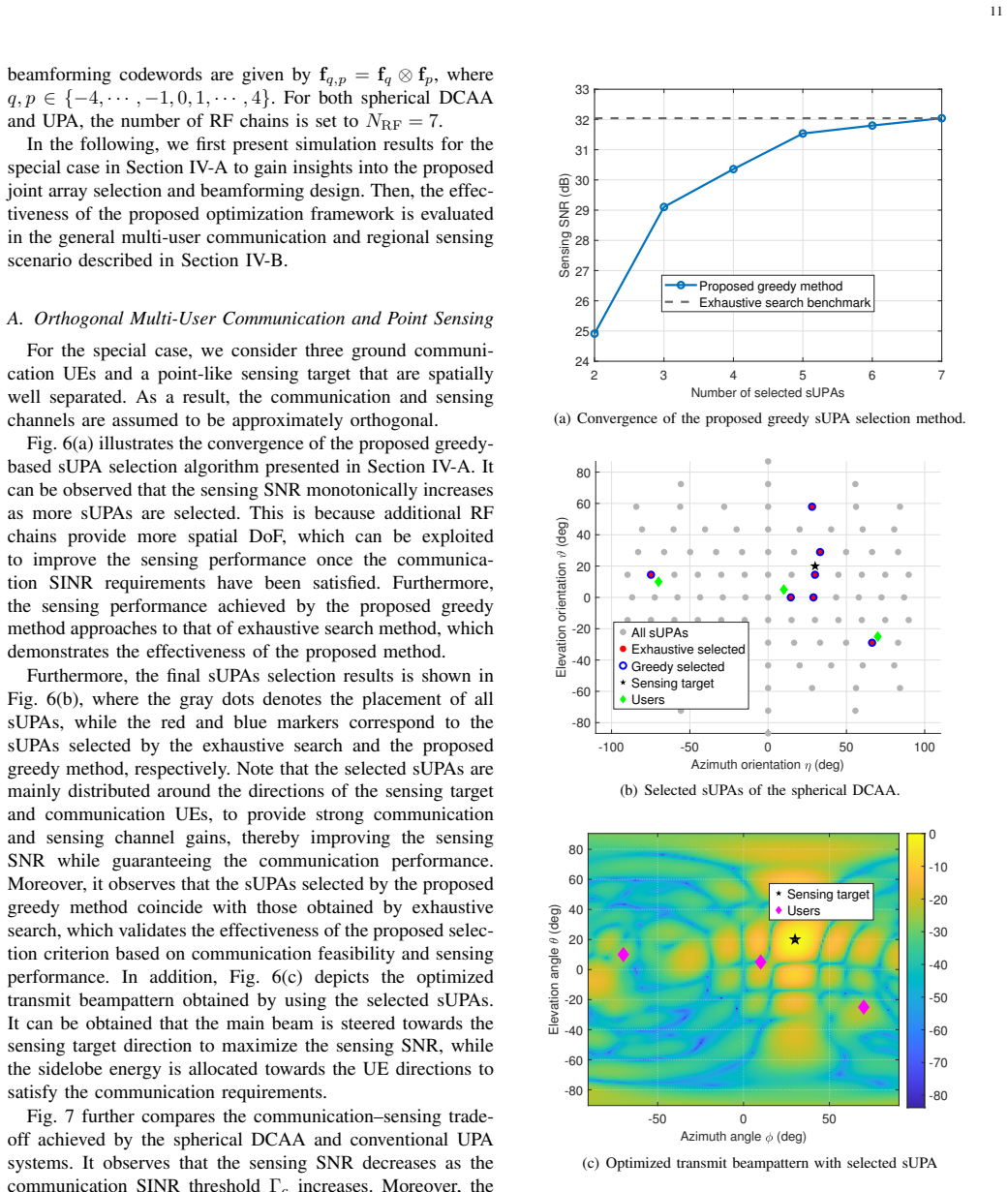
- Sec. III-A, Eq. (26) and surrounding text: the headline claim that spherical DCAA “significantly outperforms” UPA in sensing coverage, average PD, and communication–sensing tradeoff rests primarily on assigning each sUPA a directional element pattern whose 3 dB beamwidth need only cover its own angular cell, so G_n(0,0)/G_UPA(0,0) ≈ (φ_3dB,UPA θ_3dB,UPA)/(φ_3dB,n θ_3dB,n) ≫ 1 with fixed integrated gain G_sum. Figs. 3–4 and 7 show that under omnidirectional elements the gains are modest; large gaps appear only after directional patterns are introduced. Mutual coupling, spherical-surface blockage, and realistic element efficiency can force wider beams or lower peak gain and collapse this ratio. The paper should either (i) quantify the gain under measured/EM-simulated patterns with coupling, or (ii) clearly bound the claim to the ideal directional-element model and treat γ_s,worst ≥ γ_th as
- Sec. V (Figs. 7–9) and baseline fairness: the UPA benchmark uses a fixed Kronecker-product codebook, while spherical DCAA is given joint greedy selection plus SCA/MRT/MMSE beamforming under the same power and SINR constraints. Part of the reported tradeoff and coverage gain may therefore come from optimization asymmetry rather than array geometry alone. A fairer comparison would re-optimize digital beamforming (and, if applicable, hybrid weights) for the UPA under the same worst-case regional sensing objective, or at least report an optimized-UPA curve alongside KPC.
- Sec. IV-A orthogonality assumption and Algorithm 1: the closed-form solution (Eqs. 45–47) and the greedy metric ζ(S) rely on asymptotic orthogonality when M ≫ KL and N_RF > KL. In the general multi-user regional case this is dropped, but the greedy still initializes from dominant-path sUPAs and has no proven approximation ratio or optimality gap relative to exhaustive search except in the special case of Fig. 6. The manuscript should state the regimes where the special-case insight remains valid and, for the general case, report a small-N exhaustive or branch-and-bound gap (or a clear complexity–performance tradeoff table) so that the “novel greedy-based framework” claim is quantifiable.
minor comments (5)
- Abstract and throughout: “greed-based” should be “greedy-based”; also “To effective solve”, “breifly introduce”, “genercal case”, “rational distance” (range), “Cassini oval A_c” introduced without definition of the constant C_0 geometry.
- Eq. (6) and Remark 2: azimuth resolution is written Δϕ(ϑ)=arcsin(2/(M cos ϑ)); clarify whether ϑ is the sUPA pitch or the target elevation, and consistency with the later claim of “uniform azimuth resolution when elevation is fixed.”
- Fig. 3 and Fig. 5: axis labels and colorbars are hard to read in the manuscript text; ensure numerical dynamic ranges and units (dB) are explicit so the “uniform SNR” claim can be checked quantitatively.
- Notation: r(w), r̄, h̄_ek, a_s(U) mix overlines and tildes; a short notation table would help. Also N_R (receive antennas at BS-2) appears without a default value in simulations.
- Related work: heavy citation of the authors’ DCAA/RAA series [29]–[33] is appropriate for architecture continuity, but a short paragraph contrasting spherical DCAA with other full-3D or conformal arrays (beyond lens/FA/MA) would better situate novelty for a general ISAC audience.
Circularity Check
No circular derivation of the claimed ISAC metrics; overlapping-author DCAA citations supply architecture only, while SNR/PD/CRLB and the greedy–SCA optimization are independently derived from standard array and Fisher machinery.
specific steps
-
self citation load bearing
[Sec. I (Introduction) and opening of Sec. II-A]
"More recently, a spherical DCAA was proposed [33], which generalizes the RAA from a planar to a spherical configuration. ... As the pioneering work on spherical DCAA, [33] mainly focuses on the architecture design, beampattern characterization, and angular resolution analysis. However, how to fully exploit the unique characteristics of spherical DCAA for low-altitude ISAC remains largely unexplored."
The existence and qualitative advantages of spherical DCAA are imported from [33] (overlapping co-author Dong). This is ordinary architectural prior work, not a uniqueness theorem or fitted constant that forces the paper’s SNR/CRLB/optimization results; those results are re-derived from first principles in Secs. III–IV. Flagged only as minor self-citation of the enabling hardware concept.
full rationale
The paper’s load-bearing performance claims—closed-form sensing SNR (19)–(25), area-average detection probability via Marcum-Q (27)–(28), approximate CRLBs in Theorem 1 (37a–b) with Appendix FIM derivation, and the worst-case regional sensing SNR under SINR constraints (P0)–(P2)—are obtained from the spherical-DCAA array response (3)–(5), standard bistatic radar SNR, and Fisher information under an explicit slow-variation antenna-pattern assumption. None of these expressions is defined in terms of the quantity it is said to predict, nor is any free parameter fitted to data and then re-presented as a prediction. Self-citations [29]–[33] (overlapping authors Dong/Xiao) introduce the DCAA/spherical-DCAA architecture and its qualitative energy-focusing and angular-resolution properties; the present manuscript re-derives the relevant beampattern and resolution formulas (4)–(6) and then builds new ISAC analysis and a greedy joint selection/beamforming algorithm on top of them. That architectural dependence is ordinary prior-work citation, not a self-citation chain that forces the numerical superiority claims. The directional-element peak-gain argument (26) is a design assumption, not a circular step. Simulations compare against an independent UPA+KPC baseline. Consequently the derivation chain is self-contained against external benchmarks; circularity is at most a minor, non-load-bearing self-citation of the array concept.
Axiom & Free-Parameter Ledger
free parameters (5)
- sUPA size M and candidate count N =
M=8 (64 elements), N=101
- RF chain count NRF and total power Pt =
NRF=7; Pt varied (e.g. Fig. 4)
- Communication SINR thresholds Γ_k =
swept in simulations (Fig. 7)
- Element pattern 3 dB beamwidths and G_sum
- Sensing-region discretization Q and SCA tolerance ε
axioms (6)
- domain assumption Far-field plane-wave propagation at mmWave with array response (3)–(5).
- domain assumption Element pattern G is symmetric about boresight, max at (0,0), slowly varying vs array factor inside the mainlobe, and non-increasing in the mainlobe.
- domain assumption Point-like non-fluctuating target; bi-static BS-2 knows BS-1 symbols via backhaul and applies optimal receive beamformer g=b(θ′_s,φ′_s).
- ad hoc to paper When M≫KL and NRF>KL, effective user and sensing channels after selection are asymptotically orthogonal.
- standard math Fisher information for deterministic α_s and CSCG noise yields CRLBs (36); only the aligned sUPA n* contributes near boresight.
- domain assumption Peak gain scales as G(0,0)≈G_sum/(ε φ_3dB θ_3dB) so narrower required beamwidth implies higher peak gain.
invented entities (1)
-
Spherical directly-connected antenna array (spherical DCAA)
no independent evidence
Cite this review
Pith. "Pith review of Low-Altitude ISAC With Spherical Directly-Connected Antenna Array: Performance Analysis and Beamforming Optimization." pith.science (2026). https://pith.science/paper/6PEJJ5DK
@misc{pith2026260710215,
  author       = {Pith},
  title        = {Pith review of: Low-Altitude ISAC With Spherical Directly-Connected Antenna Array: Performance Analysis and Beamforming Optimization},
  year         = {2026},
  howpublished = {\url{https://pith.science/paper/6PEJJ5DK}},
  note         = {Machine review of arXiv:2607.10215}
}
read the original abstract
The safety development requirements of low-altitude economy (LAE) renders the robust low-altitude airspace monitoring critical important than ever before. Integrated sensing and communication (ISAC) as one of the key development trends of 6G provides potential solutions for the LAE. However, conventional antenna arrays suffer from limited three-dimensional (3D) sensing coverage and degraded angular resolution at high elevation angles. To address these challenges, this paper investigates low-altitude ISAC systems enabled by the recently proposed spherical directly-connected antenna array (DCAA). By carefully deploying multiple simple uniform planar arrays (sUPAs) over a spherical surface, without relying on any phase shifter, spherical DCAA enjoys advantages of full 3D coverage, superior and uniform angular resolution, enhanced energy-focusing and low hardware cost. In this paper, we first characterizes the sensing performance of the spherical DCAA, in terms of the sensing signal-to-noise ratio (SNR), area average probability of detection, and Cram\'er-Rao lower bounds (CRLBs) for both elevation and azimuth angle estimation. Then, a low-altitude ISAC optimization problem is formulated to maximize the worst-case sensing SNR over a prescribed aerial region while satisfying the communication quality-of-service requirements of ground users. To effective solve this mixed-integer non-convex problem, we develop a novel greed-based joint array selection and beamforming optimization framework. Simulation results demonstrate that spherical DCAA significantly outperforms conventional UPA in terms of sensing coverage, angle estimation accuracy, and communication-sensing SNR tradeoff, highlighting its potential for future low-altitude ISAC systems.
Figures




Reference graph
Works this paper leans on
-
[1]
Integrated sensing and communication for low altitude economy: Opportunities and challenges,
Y . Jiang, X. Li, G. Zhu, H. Li, J. Deng, K. Han, C. Shen, Q. Shi, and R. Zhang, “Integrated sensing and communication for low altitude economy: Opportunities and challenges,”IEEE Commun. Mag., vol. 63, no. 2, pp. 72–78, Dec. 2025
2025
-
[2]
An overview of cellular ISAC for low-altitude UA V: New opportunities and challenges,
Y . Song, Y . Zeng, Y . Yanget al., “An overview of cellular ISAC for low-altitude UA V: New opportunities and challenges,”IEEE Commun. Mag., vol. 63, no. 12, pp. 88–95, Jul. 2025
2025
-
[3]
Low-altitude wireless networks: A comprehensive survey,
J. Wu, Y . Yang, W. Yuanet al., “Low-altitude wireless networks: A comprehensive survey,”China Commun., vol. 23, no. 3, pp. 99–141, Mar. 2026
2026
-
[4]
Networked ISAC for low-altitude economy: Coordinated transmit beamforming and uav trajectory design,
G. Cheng, X. Song, Z. Lyuet al., “Networked ISAC for low-altitude economy: Coordinated transmit beamforming and uav trajectory design,” IEEE Trans. Commun., vol. 73, no. 8, pp. 5832–5847, Aug. 2025
2025
-
[5]
Networked ISAC- based UA V tracking and handover toward low-altitude economy,
C. Zhao, Y . Feng, H. Luo, F. Gao, F. Liu, and S. Jin, “Networked ISAC- based UA V tracking and handover toward low-altitude economy,”IEEE Trans. Wireless Commun., vol. 24, no. 9, pp. 7670–7685, Sep. 2025
2025
-
[6]
A unified RCS modeling of typical targets for 3GPP ISAC channel standardization and experimental analysis,
Y . Zhang, J. Zhang, H. Gonget al., “A unified RCS modeling of typical targets for 3GPP ISAC channel standardization and experimental analysis,”IEEE J. Sel. Areas Commun., vol. 44, pp. 702–716, Sep. 2025
2025
-
[7]
On the fundamental tradeoff of integrated sensing and communications under Gaussian channels,
Y . Xiong, F. Liu, Y . Cui, W. Yuan, T. X. Han, and G. Caire, “On the fundamental tradeoff of integrated sensing and communications under Gaussian channels,”IEEE Tran. Inf. Theory, vol. 69, no. 9, pp. 5723– 5751, 2023
2023
-
[8]
Waveform design and performance analysis for full-duplex integrated sensing and communication,
Z. Xiao and Y . Zeng, “Waveform design and performance analysis for full-duplex integrated sensing and communication,”IEEE J. Sel. Areas Commun., vol. 40, no. 6, pp. 1823–1837, Jun. 2022
2022
-
[9]
Simultaneous multi-beam sweeping for mmWave massive MIMO integrated sensing and communication,
Z. Xiao, S. Chen, and Y . Zeng, “Simultaneous multi-beam sweeping for mmWave massive MIMO integrated sensing and communication,”IEEE Trans. V ehi. Tech., vol. 73, no. 6, pp. 8141–8152, Jan. 2024
2024
-
[10]
Cooperative ISAC networks: Performance analysis, scaling laws and optimization,
K. Meng, C. Masouros, A. P. Petropuluet al., “Cooperative ISAC networks: Performance analysis, scaling laws and optimization,”IEEE Trans. Wireless Commun., vol. 24, no. 2, pp. 877–892, Feb. 2024
2024
-
[11]
ISAC–a survey on its layered architecture, technologies, standardizations, prototypes and testbeds,
X. Luo, Q. Lin, R. Zhanget al., “ISAC–a survey on its layered architecture, technologies, standardizations, prototypes and testbeds,” IEEE Commun. Surveys Tuts., vol. 28, pp. 485–526, Apr. 2025
2025
-
[12]
3D MIMO for 5G NR: Several observations from 32 to massive 256 antennas based on channel measurement,
J. Zhang, Z. Zheng, Y . Zhang, J. Xi, X. Zhao, and G. Gui, “3D MIMO for 5G NR: Several observations from 32 to massive 256 antennas based on channel measurement,”IEEE Commun. Mag., vol. 56, no. 3, pp. 62– 70, Mar. 2018
2018
-
[13]
ISAC enabled cooperative detection for cellular-connected UA V network,
Y . Wang, K. Zu, L. Xiang, Q. Zhang, Z. Feng, J. Hu, and K. Yang, “ISAC enabled cooperative detection for cellular-connected UA V network,” IEEE Trans. Wireless Commun., vol. 24, no. 2, pp. 1541–1554, Dec. 2024
2024
-
[14]
Cooperative ISAC-empowered low-altitude economy,
J. Tang, Y . Yu, C. Panet al., “Cooperative ISAC-empowered low-altitude economy,”IEEE Trans. Wireless Commun., vol. 24, no. 5, pp. 3837– 3853, Feb. 2025
2025
-
[15]
Cooperative sensing for isac: Challenges, system design, beam management, and performance validation,
G. Liu, R. Xi, X. Wang, L. Han, X. Gui, J. Jin, J. Dong, N. Wei, H. He, L. Xiaet al., “Cooperative sensing for isac: Challenges, system design, beam management, and performance validation,”IEEE J. Sel. Areas Commun., vol. 44, pp. 608–625, Sep. 2025
2025
-
[16]
Integrated localization and communication with sparse MIMO: Will virtual array technology also benefit wireless communication?
H. Min, X. Li, R. Li, and Y . Zeng, “Integrated localization and communication with sparse MIMO: Will virtual array technology also benefit wireless communication?”IEEE Trans. Signal Process., vol. 73, pp. 5090–5105, Nov. 2025
2025
-
[17]
Spatially sparse precoding in millimeter wave MIMO systems,
O. El Ayach, S. Rajagopal, S. Abu-Surra, Z. Pi, and R. W. Heath, “Spatially sparse precoding in millimeter wave MIMO systems,”IEEE Trans. Wireless Commun., vol. 13, no. 3, pp. 1499–1513, 2014
2014
-
[18]
Compact 140–220 GHz E/H waveguide phase shifter and its application to terahertz multiport circuits,
J. Deng, P. Burasa, and K. Wu, “Compact 140–220 GHz E/H waveguide phase shifter and its application to terahertz multiport circuits,”IEEE Trans. Terahertz Sci. Tech., vol. 13, no. 5, pp. 511–525, Jul. 2023
2023
-
[19]
Multi-user millimeter wave MIMO with full-dimensional lens antenna array,
Y . Zeng, L. Yang, and R. Zhang, “Multi-user millimeter wave MIMO with full-dimensional lens antenna array,”IEEE Trans. Wireless Com- mun., vol. 17, no. 4, pp. 2800–2814, Apr. 2018
2018
-
[20]
Cram ´er– Rao lower bound on AoA estimation using an RF lens-embedded antenna array,
J.-N. Shim, H. Park, C.-B. Chae, D. K. Kim, and Y . C. Eldar, “Cram ´er– Rao lower bound on AoA estimation using an RF lens-embedded antenna array,”IEEE Antennas Wireless Propag. Lett., vol. 17, no. 12, pp. 2359–2363, 2018
2018
-
[21]
Embracing reconfigurable antennas in the tri-hybrid MIMO architecture for 6G and beyond,
M. R. Castellanos, S. Yang, C.-B. Chae, and R. W. Heath, “Embracing reconfigurable antennas in the tri-hybrid MIMO architecture for 6G and beyond,”IEEE Trans. Commun., vol. 74, pp. 381–401, 2026
2026
-
[22]
Reconfigurable integrated sensing and communications (RISAC): Sparse MIMO and hybrid beamforming in far and near fields,
X. Wang, F. Gini, and K. Cai, “Reconfigurable integrated sensing and communications (RISAC): Sparse MIMO and hybrid beamforming in far and near fields,”Proceedings of IEEE, 2026, early Access
2026
-
[23]
Sparse MIMO for ISAC: New opportunities and challenges,
X. Li, H. Min, Y . Zeng, S. Jin, L. Dai, Y . Yuan, and R. Zhang, “Sparse MIMO for ISAC: New opportunities and challenges,”IEEE Wireless Commun., vol. 32, no. 4, pp. 170–178, Aug. 2025
2025
-
[24]
Fluid antenna-assisted ISAC systems,
L. Zhou, J. Yao, M. Jin, T. Wu, and K.-K. Wong, “Fluid antenna-assisted ISAC systems,”IEEE Wireless Commun. Lett., vol. 13, no. 12, pp. 3533– 3537, 2024. 14
2024
-
[25]
Movable antenna enhanced wireless sensing via antenna position optimization,
W. Ma, L. Zhu, and R. Zhang, “Movable antenna enhanced wireless sensing via antenna position optimization,”IEEE Trans. Wireless Com- mun., vol. 23, no. 11, pp. 16 575–16 589, Aug. 2024
2024
-
[26]
Rate region of ISAC for pinching-antenna systems,
C. Ouyang, Z. Wang, Y . Liu, and Z. Ding, “Rate region of ISAC for pinching-antenna systems,”IEEE Trans. Commun., vol. 74, pp. 5849– 5866, Feb. 2026
2026
-
[27]
Intelligent rotatable antenna for integrated sensing, communication, and computation: Challenges and opportunities,
X. Xiong, B. Zheng, W. Wuet al., “Intelligent rotatable antenna for integrated sensing, communication, and computation: Challenges and opportunities,”IEEE Wireless Commun., vol. 33, no. 1, pp. 173–180, Nov. 2025
2025
-
[28]
The tri-hybrid MIMO architecture,
R. W. Heath, J. Carlson, N. V . Deshpande, M. R. Castellanos, M. Akrout, and C.-B. Chae, “The tri-hybrid MIMO architecture,”IEEE Wireless Commun., 2025
2025
-
[29]
A novel cost-effective MIMO archi- tecture with ray antenna array for enhanced wireless communication performance,
Z. Dong, Z. Zhou, and Y . Zeng, “A novel cost-effective MIMO archi- tecture with ray antenna array for enhanced wireless communication performance,”IEEE Transa. Wireless Commun., vol. 25, pp. 15 166– 15 182, Apr. 2026
2026
-
[30]
Ray antenna array achieves uniform angular resolution cost-effectively for low-altitude UA V swarm ISAC,
H. Jiang and Y . Zeng, “Ray antenna array achieves uniform angular resolution cost-effectively for low-altitude UA V swarm ISAC,”IEEE Trans. Wireless Commun., vol. 25, pp. 9200–9213, Dec. 2025
2025
-
[31]
Ray antenna array enhanced low-altitude ISAC: Performance analysis and beamforming design,
Z. Xiao, T. Zhang, H. Wu, X. Qiao, J. Zhang, Z. Dong, and Y . Zeng, “Ray antenna array enhanced low-altitude ISAC: Performance analysis and beamforming design,” inProc. IEEE Wireless Commun. Netw. Conf. (WCNC), Kuala Lumpur, Malaysia, 2026, pp. 1–6, accepted
2026
-
[32]
Cost-effective XL-MIMO communication with cylinder directly connected antenna array,
X. Zhu, Z. Zhou, Z. Dong, and Y . Zeng, “Cost-effective XL-MIMO communication with cylinder directly connected antenna array,”IEEE Trans. Wireless Commun., vol. 25, pp. 17 559–17 575, May 2026
2026
-
[33]
3D spherical directly- connected antenna array for low-altitude UA V swarm ISAC,
H. Jiang, Z. Dong, Z. Zhou, and Y . Zeng, “3D spherical directly- connected antenna array for low-altitude UA V swarm ISAC,”arXiv preprint arXiv:2603.17620, 2026
arXiv 2026
-
[34]
Tutorial: Passive radar tutorial,
H. Kuschel, D. Cristallini, and K. E. Olsen, “Tutorial: Passive radar tutorial,”IEEE Aerosp. Electron. Syst. Mag., vol. 34, no. 2, pp. 2–19, 2019
2019
-
[35]
C. A. Balanis,Antenna theory: analysis and design. John wiley & sons, 2015
2015
-
[36]
Cram ´er-rao bounds for near-field sensing with extremely large-scale mimo,
H. Wang, Z. Xiao, and Y . Zeng, “Cram ´er-rao bounds for near-field sensing with extremely large-scale mimo,”IEEE Trans. Signal Process., vol. 72, pp. 701–717, 2024
2024
This paper was first reviewed by grok-4.5 on July 14, 2026.
discussion (0)
Sign in with ORCID, Apple, or X to comment. Anyone can read and Pith papers without signing in.