REVIEW 2 major objections 4 minor 73 references
Lab experiments of rotating turbulence with zonal jets show a Richardson-to-diffusive transition at the transitional scale L_β, with eddy diffusivity scaling more weakly on energy dissipation than theory predicts.
Reviewed by Pith at T0; open to challenge. T0 means a machine referee read the full paper against a public rubric. the ladder, T0–T4 →
T0 review · grok-4.5
2026-07-14 13:22 UTC pith:AEA6IJVI
load-bearing objection First lab pair-dispersion data in true zonostrophic turbulence; the Richardson-to-diffusion transition at L_eta is solid, the shallower κ–ε exponent is only suggestive. the 2 major comments →
Relative dispersion and eddy diffusivity in laboratory experiments of β-plane turbulence
The pith
A machine-rendered reading of the paper's core claim, the machinery that carries it, and where it could break.
Core claim
In laboratory zonostrophic turbulence, relative pair dispersion exhibits a Richardson regime (κ ∝ r^{4/3}) between the forcing scale and the transitional scale L_β, followed by a classical diffusive regime (κ constant) at larger scales; the large-scale diffusivity extracted from both relative diffusivity and CIST scales as κ ∝ ε^{0.45±0.12}, weaker than the theoretically expected 3/5 power.
What carries the argument
The cumulative inverse separation time (CIST), defined from the half-crossing times of the cumulative distribution of pair separations; analytical solutions of the Fokker–Planck equation give CIST ∼ r^{-2/3} in the Richardson range and CIST ∼ r^{-2} in the diffusive range, allowing direct extraction of ε and κ.
Load-bearing premise
The analytical formulae used to read ε and κ from the data assume the turbulence is homogeneous and isotropic, yet the measured flow is strongly anisotropic and inhomogeneous because of the zonal jets.
What would settle it
A controlled set of experiments or simulations in which β is varied at fixed ε (or vice versa) and the measured large-scale diffusivity fails to follow either the observed 0.45 power or the classical 3/5 power would falsify the claimed scaling.
If this is right
- Ocean and atmospheric models can adopt a shallower ε-dependence when parameterizing eddy diffusivity across zonal jets.
- The same CIST diagnostic can be applied to surface-drifter clusters to extract local energy-dissipation rates without needing full velocity fields.
- Because L_β sets the outer scale of the isotropic cascade, laboratory tanks that contain several jets automatically possess a clearer scale separation between Richardson and diffusive regimes than pure 2-D turbulence experiments.
- Radial (across-jet) diffusivity profiles can now be measured to test whether prograde jets act as true transport barriers.
Where Pith is reading between the lines
- The residual anisotropy that survives after subtracting the mean flow suggests that eddy anisotropy itself, not merely the mean shear, contributes to the shallower diffusivity scaling.
- If the CIST continues to outperform FSLE/FAGR for detecting diffusion in other anisotropic flows (stratified, magnetized), it may become the default diagnostic for large-scale mixing in geophysical and fusion plasmas.
- A follow-up campaign that systematically varies both ε and β would cleanly separate the two exponents and decide whether the classical zonostrophic formula needs a new prefactor or a new functional form.
Editorial analysis
A structured set of objections, weighed in public.
Referee Report
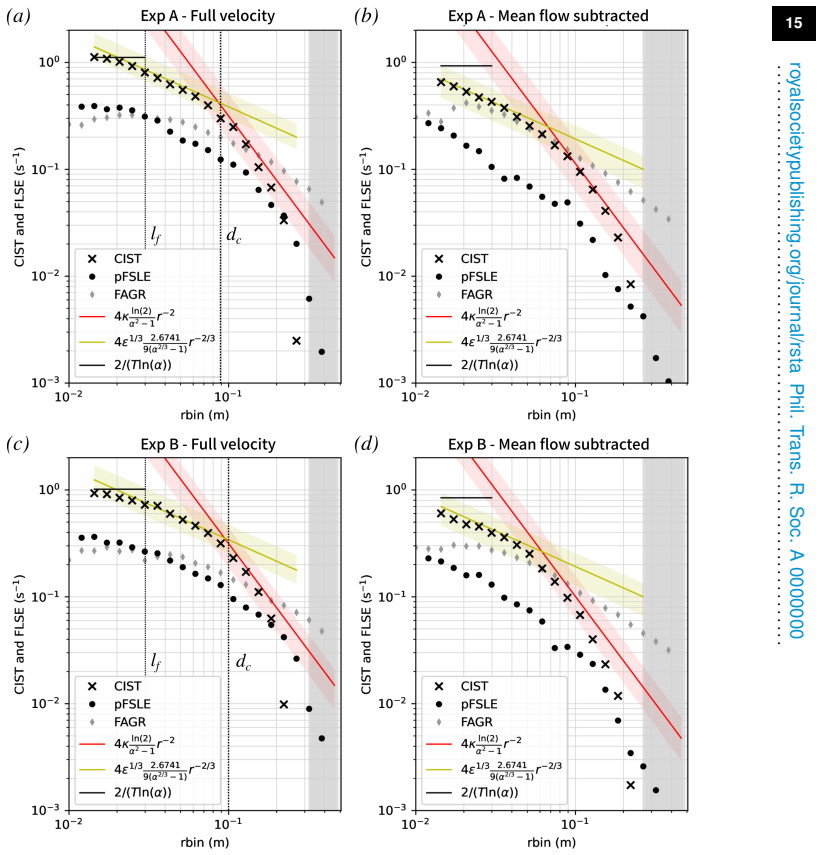
Summary. The paper reports the first laboratory measurements of two-particle relative dispersion and eddy diffusivity in the zonostrophic regime of rapidly rotating β-plane turbulence, using synthetic Lagrangian trajectories advected by time-resolved PIV velocity fields from four experiments. Time-based statistics (relative dispersion, relative diffusivity K(t), kurtosis) and separation-based statistics (FAGR, CIST, pFSLE) are compared against analytical solutions of the Fokker–Planck equation for the pair-separation PDF. The diagnostics indicate a Richardson regime (κ ∝ r^{4/3}) between the energy-injection scale and a correlation scale that coincides with the transitional scale L_β, followed by a diffusive regime at larger scales. Energy dissipation rate ε and large-scale diffusivity κ are extracted from the amplitudes of these scalings; the measured κ scales as ε^{0.45±0.12}, shallower than the zonostrophic mixing-length prediction κ ∼ ε^{3/5} β^{-4/5}.
Significance. If the reported Richardson-to-diffusive transition at L_β and the shallower κ–ε scaling hold, the work supplies the first controlled experimental benchmark for transport parameterizations in zonostrophic turbulence, with direct relevance to ocean jets, planetary atmospheres, liquid cores and magnetically confined plasmas. Strengths include the public release of processing scripts and data, the first experimental application of the CIST diagnostic, and the convergence of multiple independent diagnostics (relative-diffusivity plateau, kurtosis o 2, CIST/pFSLE ∝ r^{-2}, d_c ≈ L_β from spectra). These features make the regime-transition claim robust and useful even if the precise exponent remains provisional.
major comments (2)
- §4d, Fig. 8 and Table 3: the fitted exponent κ ∝ ε^{0.45±0.12} is obtained by extracting both κ and ε from the amplitudes of isotropic analytical solutions (Table 1) that assume homogeneity, isotropy and unit prefactors (κ = ε^{1/3} r^{4/3}). The measured flow violates these assumptions (zonal-to-radial rms-separation ratio already ∼3 at t_c for the full field and ∼1.5 for fluctuations; Fig. 4). Removing the mean flow halves both ε and κ while leaving the exponent almost unchanged, showing that residual anisotropy systematically affects the isotropic amplitudes. With only four experiments at fixed β, any such bias can tilt the reported exponent. The regime-transition claim itself does not require absolute prefactors and is robust; the quantitative shallower-scaling claim does. A clearer statement of this limitation, or a sensitivity test that varies the prefactors within plausible bounds
- §4c and Fig. 6: the short non-local (constant) plateau on the CIST/FAGR at scales ≲ l_f is interpreted as the enstrophy-cascade range because T = η^{-1/3} matches the independent Ekman estimate. However, the same plateau disappears when the mean flow is subtracted, and a simple shear-time estimate (T_s = L/U) yields a comparable scale L_s ∼ 1.5 cm. The manuscript notes this possibility but still uses the enstrophy-cascade formula to report η. Clarifying whether the early exponential growth is cascade- or shear-dominated is load-bearing for the claim that the non-local regime is resolved by the PIV.
minor comments (4)
- Table 2 vs Table 3: ε^{1/3} extracted from relative diffusivity is systematically a factor of ∼2 smaller than the spectral estimate ε_s. The text attributes this to prefactors, but a short quantitative discussion of which prefactor (Kolmogorov–Kraichnan constant versus the unit coefficient assumed in Table 1) is preferred would help readers.
- Fig. 2 caption and §3: the CDF half-time is obtained by fitting an exponential plus offset. The functional form is not justified; a brief note on why this form is preferred over a direct interpolation of the CDF would improve reproducibility.
- §3: the domain-selection bias introduced by the two shadow regions (and the subsequent restriction to r < 37 cm) is acknowledged but not quantified. A short appendix panel comparing statistics with and without the outer annulus would strengthen confidence that the reported ε and κ are not systematically high.
- Throughout: the geometric factor α = 1.2 is fixed without a sensitivity check. A one-sentence statement that results are unchanged for α ∈ [1.1, 1.3] would be useful.
Circularity Check
No significant circularity: ε and κ are extracted by fitting measured statistics to external isotropic theory; the shallower κ–ε exponent is an empirical fit to those values, not a result forced by construction.
full rationale
The paper's derivation chain is ordinary experimental measurement plus comparison to prior theory. Analytical CIST/PDF solutions (Table 1) are taken from LM22 and classical Richardson/Taylor theory; they are not derived from the present data. ε and κ are obtained by fitting the amplitude of measured relative diffusivity (and CIST) to those external power laws (Fig. 5b,e; Table 3). The central regime-transition claim (Richardson → diffusion near L_β) is diagnosed by multiple independent diagnostics (velocity correlation, kurtosis, FAGR, CIST, relative diffusivity) and does not require the absolute prefactors. The secondary claim of a shallower exponent (κ ∝ ε^{0.45±0.12} vs. Sukoriansky et al.'s 3/5) is simply a power-law fit to the four extracted (ε, κ) pairs (Fig. 8). Self-citations to the authors' prior experimental papers [55,56] supply the velocity fields and spectral L_β/ε_s values; they do not close a logical loop that forces the dispersion results. The acknowledged mismatch between isotropic theory and anisotropic data is a correctness/assumption issue, not circularity. Score 1 for minor self-citation of experimental setup only.
Axiom & Free-Parameter Ledger
free parameters (6)
- geometric bin factor α =
1.2
- unit prefactor in Richardson diffusivity κ=ε^{1/3}r^{4/3} =
1 (assumed)
- unit prefactor in non-local diffusivity κ=η^{1/3}r^2 =
1 (assumed)
- velocity-correlation threshold for t_c, d_c =
0.5
- CDF half-time threshold for CIST =
0.5
- fitted κ–ε exponent =
0.45 ± 0.12
axioms (6)
- domain assumption Pair-separation PDF obeys the isotropic Fokker–Planck equation ∂p/∂t = (1/r)∂/∂r(κ r ∂p/∂r) under delta-correlated Eulerian flow or Kraichnan DIA.
- domain assumption In the inverse-cascade range the scale-dependent diffusivity is κ∝ε^{1/3}r^{4/3} (Richardson); in the enstrophy range κ=η^{1/3}r^2; in the diffusive range κ is constant.
- domain assumption Low Rossby number (Ro≤7×10^{-3}) justifies treating the measured horizontal PIV field as quasi-two-dimensional for Lagrangian advection.
- domain assumption Zonostrophic mixing-length theory predicts κ∼ε^{3/5}β^{-4/5} for r>L_β (Sukoriansky et al. 2009).
- domain assumption Dissipation is dominated by linear Ekman friction, allowing ε_E≈u_rms^2/(2τ_E) and η_E≈ζ_rms^2/(2τ_E).
- standard math Standard calculus and geometric binning of pair separations; no novel mathematical axioms.
Cite this review
Pith. "Pith review of Relative dispersion and eddy diffusivity in laboratory experiments of $\beta$-plane turbulence." pith.science (2026). https://pith.science/paper/AEA6IJVI
@misc{pith2026260710225,
  author       = {Pith},
  title        = {Pith review of: Relative dispersion and eddy diffusivity in laboratory experiments of $\beta$-plane turbulence},
  year         = {2026},
  howpublished = {\url{https://pith.science/paper/AEA6IJVI}},
  note         = {Machine review of arXiv:2607.10225}
}
read the original abstract
We present the first experimental measures of relative dispersion and turbulent diffusion in rapidly-rotating turbulence in the zonostrophic regime, i.e., in the presence of instantaneous and dominant zonal jets. Synthetic Lagrangian trajectories are computed from time-resolved experimental velocity fields, from which we measure relative (two-particle) dispersion. Time-based and separation-based statistics are calculated, including the cumulative inverse separation time (CIST), for which analytical predictions exist in the inertial ranges (direct enstrophy cascade and inverse energy cascade) and in the diffusive regime. These statistics show evidence of a transition from a Richardson regime at scales larger than the energy-injection scale, to a diffusive regime, at scales larger than the transitional scale, the scale at which turbulence becomes anisotropic due to the interaction between turbulent eddies and Rossby waves. The analytical predictions for the CIST allow us to measure the turbulent energy dissipation rate in the Richardson regime, and the turbulent diffusivity in the diffusive regime. Our measurements of diffusivity are broadly consistent with predictions from mixing-length and zonostrophic theories but suggest a shallower dependence on the energy dissipation rate.
Figures




Reference graph
Works this paper leans on
-
[1]
Zonal Jets : Phenomenology , Genesis , and Physics
Galperin B, Read PL. Zonal Jets : Phenomenology , Genesis , and Physics . Cambridge: Cambridge University Press; 2019. Available from: https://www.cambridge.org/core/books/zonal-jets/82763ED4E81E4906C95CC6B248A42F02
2019
-
[2]
Lagrangian ocean analysis: Fundamentals and practices
van Sebille E, Griffies SM, Abernathey R, Adams TP, Berloff P, Biastoch A, et al. Lagrangian ocean analysis: Fundamentals and practices. Ocean Modelling. 2018 Jan;121:49-75. Available from: https://www.sciencedirect.com/science/article/pii/S1463500317301853
2018
-
[3]
Ocean mixing: drivers, mechanisms and impacts
Meredith M, Naveira Garabato A. Ocean mixing: drivers, mechanisms and impacts. Amsterdam [etc.]: Elsevier; 2022
2022
-
[4]
Chapter 12 - Mixing in the Southern Ocean
Gille ST, Sheen KL, Swart S, Thompson AF. Chapter 12 - Mixing in the Southern Ocean . In: Meredith M, Naveira Garabato A, editors. Ocean Mixing . Elsevier; 2022. p. 301-27. Available from: https://www.sciencedirect.com/science/article/pii/B9780128215128000190
2022
-
[5]
Challenges and Prospects in Ocean Circulation Models
Fox-Kemper B, Adcroft A, Böning CW, Chassignet EP, Curchitser E, Danabasoglu G, et al. Challenges and Prospects in Ocean Circulation Models . Frontiers in Marine Science. 2019;6. Available from: https://www.frontiersin.org/articles/10.3389/fmars.2019.00065/full
-
[6]
Convective heat transfer and the pattern of thermal emission on the gas giants
Aurnou J, Heimpel M, Allen L, King E, Wicht J. Convective heat transfer and the pattern of thermal emission on the gas giants. Geophysical Journal International. 2008 Jun;173(3):793-801. Available from: https://doi.org/10.1111/j.1365-246X.2008.03764.x
-
[7]
Yadav RK, Gastine T, Christensen UR, Duarte LDV, Reiners A. Effect of shear and magnetic field on the heat-transfer efficiency of convection in rotating spherical shells. Geophysical Journal International. 2016 Feb;204(2):1120-33. Available from: https://doi.org/10.1093/gji/ggv506
-
[8]
Jets and large-scale vortices in rotating Rayleigh - B 'enard convection
Guervilly C, Hughes DW. Jets and large-scale vortices in rotating Rayleigh - B 'enard convection. Physical Review Fluids. 2017 Nov;2(11):113503. Available from: https://link.aps.org/doi/10.1103/PhysRevFluids.2.113503
-
[9]
Guervilly C, Cardin P. Multiple zonal jets and convective heat transport barriers in a quasi-geostrophic model of planetary cores. Geophysical Journal International. 2017;211(1):455-71. Tex.publisher= Oxford University Press. Available from: https://doi.org/10.1093/gji/ggx315
-
[10]
Gravity darkening in late-type stars - I
Raynaud R, Rieutord M, Petitdemange L, Gastine T, Putigny B. Gravity darkening in late-type stars - I . The Coriolis effect. Astronomy & Astrophysics. 2018 Jan;609:A124. Available from: https://www.aanda.org/articles/aa/abs/2018/01/aa31729-17/aa31729-17.html
2018
-
[11]
Convection with misaligned gravity and rotation: simulations and rotating mixing length theory
Currie LK, Barker AJ, Lithwick Y, Browning MK. Convection with misaligned gravity and rotation: simulations and rotating mixing length theory. Monthly Notices of the Royal Astronomical Society. 2020 Apr;493(4):5233-56. Available from: https://doi.org/10.1093/mnras/staa372
-
[12]
Suppression of turbulence and transport by sheared flow
Terry PW. Suppression of turbulence and transport by sheared flow. Reviews of Modern Physics. 2000 Jan;72(1):109-65. Available from: https://link.aps.org/doi/10.1103/RevModPhys.72.109
-
[13]
Zonal flows in plasma—a review
Diamond PH, Itoh SI, Itoh K, Hahm TS. Zonal flows in plasma—a review. Plasma Physics and Controlled Fusion. 2005 May;47(5):R35-R161. Available from: https://iopscience.iop.org/article/10.1088/0741-3335/47/5/R01
-
[14]
A review of zonal flow experiments
Fujisawa A. A review of zonal flow experiments. Nuclear Fusion. 2009 Jan;49(1):013001. Available from: https://iopscience.iop.org/article/10.1088/0029-5515/49/1/013001
-
[15]
Zonal flows and pattern formation
Gürcan OD, Diamond PH. Zonal flows and pattern formation. Journal of Physics A: Mathematical and Theoretical. 2015 Jul;48(29):293001. Available from: https://iopscience.iop.org/article/10.1088/1751-8113/48/29/293001
-
[16]
Rossby and drift wave turbulence and zonal flows: The Charney – Hasegawa – Mima model and its extensions
Connaughton C, Nazarenko S, Quinn B. Rossby and drift wave turbulence and zonal flows: The Charney – Hasegawa – Mima model and its extensions. Physics Reports. 2015 Dec;604:1-71. Available from: https://www.sciencedirect.com/science/article/pii/S0370157315004421
2015
-
[17]
Atmospheric and Oceanic Fluid Dynamics : Fundamentals and Large - Scale Circulation
Vallis GK. Atmospheric and Oceanic Fluid Dynamics : Fundamentals and Large - Scale Circulation . 2nd ed. Cambridge: Cambridge University Press; 2017. Available from: https://www.cambridge.org/core/books/atmospheric-and-oceanic-fluid-dynamics/41379BDDC4257CBE11143C466F6428A4
2017
-
[18]
Interaction between eddies and mean flow in Jupiter 's atmosphere: Analysis of Cassini imaging data
Salyk C, Ingersoll AP, Lorre J, Vasavada A, Del Genio AD. Interaction between eddies and mean flow in Jupiter 's atmosphere: Analysis of Cassini imaging data. Icarus. 2006 Dec;185(2):430-42. Tex.ids= salyk\_interaction\_2006-1. Available from: https://www.sciencedirect.com/science/article/pii/S0019103506002727
2006
-
[19]
Physics of negative viscosity phenomena
Starr V. Physics of negative viscosity phenomena. Earth and Planetary Science Series. 1966;256. Available from: https://cir.nii.ac.jp/crid/1573387448912410880
arXiv 1966
-
[20]
Potential-vorticity inversion and the wave-turbulence jigsaw: some recent clarifications
McIntyre M. Potential-vorticity inversion and the wave-turbulence jigsaw: some recent clarifications. Advances in Geosciences. 2008;15:47-56. Tex.publisher= Copernicus GmbH. Available from: https://adgeo.copernicus.org/articles/15/47/2008/
2008
-
[21]
Multiple jets as PV staircases: the Phillips effect and the resilience of eddy-transport barriers
Dritschel D, McIntyre M. Multiple jets as PV staircases: the Phillips effect and the resilience of eddy-transport barriers. Journal of the Atmospheric Sciences. 2008;65(3):855-74. Tex.ids= dritschel\_multiple\_2008-1. Available from: https://journals.ametsoc.org/view/journals/atsc/65/3/2007jas2227.1.xml
2008
-
[22]
Zonal Jets as Transport Barriers in Planetary Atmospheres
Beron-Vera FJ, Brown MG, Olascoaga MJ, Rypina II, Koçak H, Udovydchenkov IA. Zonal Jets as Transport Barriers in Planetary Atmospheres . Journal of the Atmospheric Sciences. 2008 Oct;65(10):3316-26. Available from: https://journals.ametsoc.org/view/journals/atsc/65/10/2008jas2579.1.xml
2008
-
[23]
On the Lagrangian Dynamics of Atmospheric Zonal Jets and the Permeability of the Stratospheric Polar Vortex
Rypina II, Brown MG, Beron-Vera FJ, Koçak H, Olascoaga MJ, Udovydchenkov IA. On the Lagrangian Dynamics of Atmospheric Zonal Jets and the Permeability of the Stratospheric Polar Vortex . Journal of the Atmospheric Sciences. 2007 Oct;64(10):3595-610. Available from: https://journals.ametsoc.org/view/journals/atsc/64/10/jas4036.1.xml
2007
-
[24]
Statistics from Lagrangian observations
LaCasce JH. Statistics from Lagrangian observations. Progress in Oceanography. 2008 Apr;77(1):1-29. Available from: https://www.sciencedirect.com/science/article/pii/S0079661108000232
2008
-
[25]
Advances in the Application of Surface Drifters
Lumpkin R, Özgökmen T, Centurioni L. Advances in the Application of Surface Drifters . Annual Review of Marine Science. 2017 Jan;9(Volume 9, 2017):59-81. Available from: https://www.annualreviews.org/content/journals/10.1146/annurev-marine-010816-060641
-
[26]
Turbulence in rotating, stratified and electrically conducting fluids
Davidson PA. Turbulence in rotating, stratified and electrically conducting fluids. Cambridge University Press; 2013. Available from: https://books.google.fr/books?hl=en&lr=&id=-QpCAQAAQBAJ&oi=fnd&pg=PR15&dq=Davidson,+P.+A.+(2013).+Turbulence+in+rotating,+stratified+and+electrically+conducting+fluids.+Cam-+bridge:+Cambridge+University+Press.&ots=lmBYYEpjv...
2013
-
[27]
Boffetta G, Ecke RE. Two- Dimensional Turbulence . Annual Review of Fluid Mechanics. 2012;44(1):427-51. \_eprint: https://doi.org/10.1146/annurev-fluid-120710-101240. Available from: https://doi.org/10.1146/annurev-fluid-120710-101240
-
[28]
Two- Particle Dispersion in Isotropic Turbulent Flows
Salazar JPLC, Collins LR. Two- Particle Dispersion in Isotropic Turbulent Flows . Annual Review of Fluid Mechanics. 2009 Jan;41(Volume 41, 2009):405-32. Available from: https://www.annualreviews.org/content/journals/10.1146/annurev.fluid.40.111406.102224
-
[29]
Atmospheric diffusion shown on a distance-neighbour graph
Richardson LF. Atmospheric diffusion shown on a distance-neighbour graph. Proceedings of the Royal Society of London Series A, Containing Papers of a Mathematical and Physical Character. 1926 Apr;110(756):709-37. Available from: https://doi.org/10.1098/rspa.1926.0043
-
[30]
Diffusion by Continuous Movements
Taylor GI. Diffusion by Continuous Movements . Proceedings of the London Mathematical Society. 1922;s2-20(1):196-212. \_eprint: https://londmathsoc.onlinelibrary.wiley.com/doi/pdf/10.1112/plms/s2-20.1.196. Available from: https://onlinelibrary.wiley.com/doi/abs/10.1112/plms/s2-20.1.196
-
[31]
Finite size Lyapunov exponent: review on applications
Cencini M, Vulpiani A. Finite size Lyapunov exponent: review on applications. Journal of Physics A: Mathematical and Theoretical. 2013 Jun;46(25):254019. Available from: https://iopscience.iop.org/article/10.1088/1751-8113/46/25/254019
-
[32]
Okubo A. Oceanic diffusion diagrams. In: Deep sea research and oceanographic abstracts. vol. 18. Elsevier; 1971. p. 789-802. Available from: https://www.sciencedirect.com/science/article/pii/0011747171900465
arXiv 1971
-
[33]
Relative dispersion in the subsurface North Atlantic
LaCasce J, Bower A. Relative dispersion in the subsurface North Atlantic . Journal of Marine Research. 2000 Jan;58(6). Available from: https://elischolar.library.yale.edu/journal_of_marine_research/2375
2000
-
[34]
Open ocean regimes of relative dispersion
Ollitrault M, Gabillet C, Verdière ACD. Open ocean regimes of relative dispersion. Journal of Fluid Mechanics. 2005 Jun;533:381-407. Available from: https://www.cambridge.org/core/journals/journal-of-fluid-mechanics/article/abs/open-ocean-regimes-of-relative-dispersion/0ECE50797C2F376485CB60FA7B05FCFF
2005
-
[35]
Relative dispersion in the Nordic Seas
Koszalka I, LaCasce J, Orvik K. Relative dispersion in the Nordic Seas . Journal of Marine Research. 2009 Jan;67(4). Available from: https://elischolar.library.yale.edu/journal_of_marine_research/238
2009
-
[36]
Relative dispersion at the surface of the Gulf of Mexico
LaCasce J, Ohlmann C. Relative dispersion at the surface of the Gulf of Mexico . Journal of Marine Research. 2003 Jan;61(3). Available from: https://elischolar.library.yale.edu/journal_of_marine_research/11
2003
-
[37]
Submesoscale dispersion in the vicinity of the Deepwater Horizon spill
Poje AC, Özgökmen TM, Lipphardt BL, Haus BK, Ryan EH, Haza AC, et al. Submesoscale dispersion in the vicinity of the Deepwater Horizon spill. Proceedings of the National Academy of Sciences. 2014 Sep;111(35):12693-8. Available from: https://www.pnas.org/doi/abs/10.1073/pnas.1402452111
-
[38]
General characteristics of relative dispersion in the ocean
Corrado R, Lacorata G, Palatella L, Santoleri R, Zambianchi E. General characteristics of relative dispersion in the ocean. Scientific Reports. 2017 May;7(1):46291. Available from: http://www.nature.com/articles/srep46291
2017
-
[39]
Evidence for a k--5/3 Spectrum from the EOLE Lagrangian Balloons in the Low Stratosphere
Lacorata G, Aurell E, Legras B, Vulpiani A. Evidence for a k--5/3 Spectrum from the EOLE Lagrangian Balloons in the Low Stratosphere . Journal of the Atmospheric Sciences. 2004 Dec;61(23):2936-42. Available from: https://journals.ametsoc.org/view/journals/atsc/61/23/jas-3292.1.xml
2004
-
[40]
Statistics of Simulated and Observed Pair Separations in the Gulf of Mexico
Beron-Vera FJ, LaCasce JH. Statistics of Simulated and Observed Pair Separations in the Gulf of Mexico . Journal of Physical Oceanography. 2016 Jul;46(7):2183-99. Available from: https://journals.ametsoc.org/view/journals/phoc/46/7/jpo-d-15-0127.1.xml
2016
-
[41]
Inferring Submesoscale Energy Spectra in the Gulf of Mexico from Surface Drifters
Qian YK, LaCasce JH, Peng S. Inferring Submesoscale Energy Spectra in the Gulf of Mexico from Surface Drifters . Journal of Physical Oceanography. 2025 Aug;55(9):1475-91. Available from: https://journals.ametsoc.org/view/journals/phoc/55/9/JPO-D-24-0258.1.xml
2025
-
[42]
Richardson Pair Dispersion in Two - Dimensional Turbulence
Jullien MC, Paret J, Tabeling P. Richardson Pair Dispersion in Two - Dimensional Turbulence . Physical Review Letters. 1999 Apr;82(14):2872-5. Available from: https://link.aps.org/doi/10.1103/PhysRevLett.82.2872
-
[43]
Pair Dispersion and Doubling Time Statistics in Two - Dimensional Turbulence
Rivera MK, Ecke RE. Pair Dispersion and Doubling Time Statistics in Two - Dimensional Turbulence . Physical Review Letters. 2005 Nov;95(19):194503. Available from: https://link.aps.org/doi/10.1103/PhysRevLett.95.194503
-
[44]
von Kameke A, Huhn F, Fernández-García G, Muñuzuri AP, Pérez-Muñuzuri V. Double Cascade Turbulence and Richardson Dispersion in a Horizontal Fluid Flow Induced by Faraday Waves . Physical Review Letters. 2011 Aug;107(7):074502. Available from: https://link.aps.org/doi/10.1103/PhysRevLett.107.074502
-
[45]
Lagrangian scale of particle dispersion in turbulence
Xia H, Francois N, Punzmann H, Shats M. Lagrangian scale of particle dispersion in turbulence. Nature Communications. 2013 Jun;4(1):2013. Available from: https://www.nature.com/articles/ncomms3013
2013
-
[46]
Galperin B, Sukoriansky S, Dikovskaya N. Zonostrophic turbulence. Physica Scripta. 2008 Dec;2008(T132):014034. Available from: https://doi.org/10.1088/0031-8949/2008/T132/014034
-
[47]
Energy spectra and coherent structures in forced two-dimensional and beta-plane turbulence
Maltrud ME, Vallis GK. Energy spectra and coherent structures in forced two-dimensional and beta-plane turbulence. Journal of Fluid Mechanics Digital Archive. 1991 Jul;228:321. Available from: http://www.journals.cambridge.org/abstract_S0022112091002720
1991
-
[48]
Turbulent diffusion in the geostrophic inverse cascade
Smith KS, Boccaletti G, Henning CC, Marinov I, Tam CY, Held IM, et al. Turbulent diffusion in the geostrophic inverse cascade. Journal of Fluid Mechanics. 2002 Oct;469:13-48. Available from: https://www.cambridge.org/core/journals/journal-of-fluid-mechanics/article/abs/turbulent-diffusion-in-the-geostrophic-inverse-cascade/4D64DFCB2C30A2C476C0D90798E2C454
2002
-
[49]
Diffusivity, Kinetic Energy Dissipation , and Closure Theories for the Poleward Eddy Heat Flux
Lapeyre G, Held IM. Diffusivity, Kinetic Energy Dissipation , and Closure Theories for the Poleward Eddy Heat Flux . Journal of the Atmospheric Sciences. 2003 Dec;60(23):2907-16. Available from: https://journals.ametsoc.org/view/journals/atsc/60/23/1520-0469_2003_060_2907_dkedac_2.0.co_2.xml
2003
-
[50]
Tracer transport along and across coherent jets in two-dimensional turbulent flow
Smith KS. Tracer transport along and across coherent jets in two-dimensional turbulent flow. Journal of Fluid Mechanics. 2005 Dec;544:133-42. Available from: https://www.cambridge.org/core/journals/journal-of-fluid-mechanics/article/tracer-transport-along-and-across-coherent-jets-in-twodimensional-turbulent-flow/E96CAEB0039B7389DD4BA68CC0EA8851
2005
-
[51]
Transport of momentum and scalar in turbulent flows with anisotropic dispersive waves
Sukoriansky S, Dikovskaya N, Galperin B. Transport of momentum and scalar in turbulent flows with anisotropic dispersive waves. Geophysical Research Letters. 2009;36(14). \_eprint: https://agupubs.onlinelibrary.wiley.com/doi/pdf/10.1029/2009GL038632. Available from: https://agupubs.onlinelibrary.wiley.com/doi/abs/10.1029/2009GL038632
-
[52]
The Eddy Diffusivity in Barotropic β- Plane Turbulence
Kong H, Jansen M. The Eddy Diffusivity in Barotropic β- Plane Turbulence . Fluids. 2017 Oct;2(4):54. Available from: https://www.mdpi.com/2311-5521/2/4/54
2017
-
[53]
Galperin B, Hoemann J, Espa S, Di Nitto G, Lacorata G. Anisotropic macroturbulence and diffusion associated with a westward zonal jet: From laboratory to planetary atmospheres and oceans. Physical Review E. 2016 Dec;94(6):063102. Available from: https://link.aps.org/doi/10.1103/PhysRevE.94.063102
-
[54]
On the influence of a β-effect on Lagrangian diffusion
Lacorata G, Espa S. On the influence of a β-effect on Lagrangian diffusion. Geophysical Research Letters. 2012;39(11):L11605. \_eprint: https://onlinelibrary.wiley.com/doi/pdf/10.1029/2012GL051841. Available from: http://agupubs.onlinelibrary.wiley.com/doi/abs/10.1029/2012GL051841
-
[55]
Zonal jets at the laboratory scale: hysteresis and Rossby waves resonance
Lemasquerier D, Favier B, Le Bars M. Zonal jets at the laboratory scale: hysteresis and Rossby waves resonance. Journal of Fluid Mechanics. 2021 Mar;910:A18. Tex.ids= lemasquerier\_zonal\_2020 arXiv: 2008.10304. Available from: https://www.cambridge.org/core/journals/journal-of-fluid-mechanics/article/zonal-jets-at-the-laboratory-scale-hysteresis-and-ross...
Pith/arXiv arXiv 2021
-
[56]
Zonal jets experiments in the gas giants’ zonostrophic regime
Lemasquerier D, Favier B, Le Bars M. Zonal jets experiments in the gas giants’ zonostrophic regime. Icarus. 2023 Jan;390:115292. Available from: https://www.sciencedirect.com/science/article/pii/S0019103522003840
2023
-
[57]
The Finite Size Lyapunov Exponent and the Finite Amplitude Growth Rate
Meunier T, LaCasce JH. The Finite Size Lyapunov Exponent and the Finite Amplitude Growth Rate . Fluids. 2021 Oct;6(10):348. Available from: https://www.mdpi.com/2311-5521/6/10/348
2021
-
[58]
Relative dispersion with finite inertial ranges
LaCasce JH, Meunier T. Relative dispersion with finite inertial ranges. Journal of Fluid Mechanics. 2022 Feb;932:A39. Available from: https://www.cambridge.org/core/journals/journal-of-fluid-mechanics/article/abs/relative-dispersion-with-finite-inertial-ranges/A4810AD4971C9C9FC920CE4BDAF8AE95
2022
-
[59]
Turbulent pair dispersion and scalar diffusion
Lundgren TS. Turbulent pair dispersion and scalar diffusion. Journal of Fluid Mechanics. 1981 Oct;111:27-57. Available from: https://www.cambridge.org/core/journals/journal-of-fluid-mechanics/article/turbulent-pair-dispersion-and-scalar-diffusion/47ED9279A8E4AFE60F349A5C82C830CC
1981
-
[60]
Lagrangian‐ History Closure Approximation for Turbulence
Kraichnan RH. Lagrangian‐ History Closure Approximation for Turbulence . The Physics of Fluids. 1965 Apr;8(4):575-98. Available from: https://doi.org/10.1063/1.1761271
-
[61]
Dispersion of Particle Pairs in Homogeneous Turbulence
Kraichnan RH. Dispersion of Particle Pairs in Homogeneous Turbulence . The Physics of Fluids. 1966 Oct;9(10):1937-43. Available from: https://doi.org/10.1063/1.1761547
-
[62]
Relative displacement probability distribution functions from balloons and drifters
LaCasce JH. Relative displacement probability distribution functions from balloons and drifters. Journal of Marine Research. 2010 May;68(3):433-57. Available from: http://www.ingentaconnect.com/content/10.1357/002224010794657155
-
[63]
Relative dispersion in generalized two-dimensional turbulence
Foussard A, Berti S, Perrot X, Lapeyre G. Relative dispersion in generalized two-dimensional turbulence. Journal of Fluid Mechanics. 2017 Jun;821:358-83. Available from: https://www.cambridge.org/core/journals/journal-of-fluid-mechanics/article/relative-dispersion-in-generalized-twodimensional-turbulence/08FB0083BEF447F4E528555341687809
2017
-
[64]
Lagrangian Fluid Dynamics
Bennett A. Lagrangian Fluid Dynamics . Cambridge Monographs on Mechanics . Cambridge: Cambridge University Press; 2006. Available from: https://www.cambridge.org/core/books/lagrangian-fluid-dynamics/80C52C6CCB59865D99A076E35FEC3546
2006
-
[65]
xdispersion: For calculation of relative dispersion from Lagrangian particle pairs
Qian YK. xdispersion: For calculation of relative dispersion from Lagrangian particle pairs;. Available from: https://github.com/miniufo/xdispersion
-
[66]
Relative Dispersion in the Atmosphere from Reanalysis Winds
Graff LS, Guttu S, LaCasce JH. Relative Dispersion in the Atmosphere from Reanalysis Winds . Journal of the Atmospheric Sciences. 2015 Jul;72(7):2769-85. Available from: https://journals.ametsoc.org/view/journals/atsc/72/7/jas-d-14-0225.1.xml
2015
-
[67]
Relative Dispersion of Constant – Level Balloons in the 200–mb General Circulation
Morel P, Larceveque M. Relative Dispersion of Constant – Level Balloons in the 200–mb General Circulation . Journal of the Atmospheric Sciences. 1974 Nov;31(8):2189-96. Available from: https://journals.ametsoc.org/view/journals/atsc/31/8/1520-0469_1974_031_2189_rdocbi_2_0_co_2.xml
1974
-
[68]
Suppression of eddy diffusivity across jets in the Southern Ocean
Ferrari R, Nikurashin M. Suppression of eddy diffusivity across jets in the Southern Ocean . Journal of Physical Oceanography. 2010;40(7):1501-19. Available from: https://doi.org/10.1175/2010JPO4278.1
-
[69]
A laboratory model for deep-seated jets on the gas giants
Cabanes S, Aurnou J, Favier B, Le Bars M. A laboratory model for deep-seated jets on the gas giants. Nature Physics. 2017 Apr;13(4):387-90. Available from: http://www.nature.com/articles/nphys4001
2017
-
[70]
Jet Formation and Evolution in Baroclinic Turbulence with Simple Topography
Thompson AF. Jet Formation and Evolution in Baroclinic Turbulence with Simple Topography . Journal of Physical Oceanography. 2010 Feb;40(2):257-78. Available from: https://journals.ametsoc.org/view/journals/phoc/40/2/2009jpo4218.1.xml
2010
-
[71]
Estimating Suppression of Eddy Mixing by Mean Flows
Klocker A, Ferrari R, LaCasce JH. Estimating Suppression of Eddy Mixing by Mean Flows . Journal of Physical Oceanography. 2012 Sep;42(9):1566-76. Available from: https://journals.ametsoc.org/view/journals/phoc/42/9/jpo-d-11-0205.1.xml
2012
-
[72]
Reynolds Stress and Eddy Diffusivity of β- Plane Shear Flows
Srinivasan K, Young WR. Reynolds Stress and Eddy Diffusivity of β- Plane Shear Flows . Journal of the Atmospheric Sciences. 2014 Jun;71(6):2169-85. Available from: https://journals.ametsoc.org/view/journals/atsc/71/6/jas-d-13-0246.1.xml
2014
-
[73]
Complexity of Mesoscale Eddy Diffusivity in the Ocean
Kamenkovich I, Berloff P, Haigh M, Sun L, Lu Y. Complexity of Mesoscale Eddy Diffusivity in the Ocean . Geophysical Research Letters. 2021;48(5):e2020GL091719. \_eprint: https://onlinelibrary.wiley.com/doi/pdf/10.1029/2020GL091719. Available from: https://onlinelibrary.wiley.com/doi/abs/10.1029/2020GL091719
discussion (0)
Sign in with ORCID, Apple, or X to comment. Anyone can read and Pith papers without signing in.