REVIEW 3 major objections 4 minor 61 references
Magnetically arrested discs, not ordinary advection flows, power the jets of low-accretion FR I radio galaxies.
Reviewed by Pith at T0; open to challenge. T0 means a machine referee read the full paper against a public rubric. the ladder, T0–T4 →
T0 review · grok-4.5
2026-07-14 12:20 UTC pith:PRQWRRL7
load-bearing objection Solid sample extension of the MAD-for-FR-I result; the a<0.5 preference and the necessity of MAD both ride on the same free f=1 that the authors already flag as movable. the 3 major comments →
Magnetically Arrested Discs Powering Jets in a Large Sample of Low-Accretion FR I Radio Galaxies
The pith
A machine-rendered reading of the paper's core claim, the machinery that carries it, and where it could break.
Core claim
In a uniformly selected sample of 289 low-accretion FR I radio galaxies the observed jet powers systematically exceed the maximum Blandford-Znajek output of a standard advection-dominated flow, even for a near-maximally spinning black hole; the magnetically arrested disc solution, in which large-scale poloidal flux saturates near the horizon, fully accounts for the jets and prefers moderate-to-slow spins under the authors' fiducial assumptions.
What carries the argument
The magnetically arrested disc (MAD) field-strength formula that replaces the weaker standard-ADAF magnetic pressure inside the Blandford-Znajek power expression, thereby raising the theoretical jet-power ceiling by the amount needed to match the radio-inferred powers.
Load-bearing premise
The conversion from radio luminosity to jet power is taken at its lowest conventional normalization (f = 1); a larger but still allowed factor would raise every jet power and push the preferred spins higher.
What would settle it
An independent, cavity- or lobe-calorimetry-based jet-power measurement for a statistically useful subset of the same LoTSS FR I sources that returns powers systematically lower than the MAD tracks at a = 0.5 would falsify the claim that magnetically arrested discs are required.
Editorial analysis
A structured set of objections, weighed in public.
Referee Report
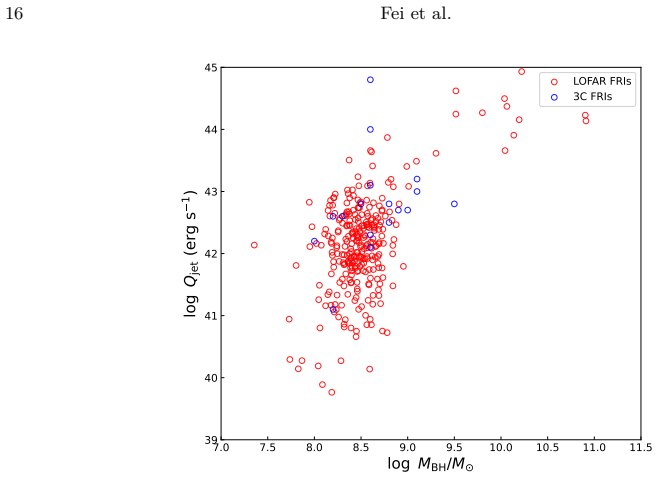
Summary. The paper presents a sample of 289 LoTSS DR1 FR I radio galaxies with SDSS optical data, deriving black-hole masses from host magnitudes and Eddington-scaled accretion rates from nuclear g-band luminosities (median log ṁ ≈ −2.84, vast majority below 0.01). Jet powers are estimated via the Willott et al. (1999) 151 MHz scaling with f = 1. Even for a = 0.95 the standard ADAF Blandford–Znajek ceiling under-predicts the observed Q_jet for ~70 % of sources; the MAD field-strength formula is shown to encompass the data, and under MAD the points prefer a ≲ 0.5. The authors conclude that magnetically arrested discs are common across the FR I luminosity range, extending earlier 3CR results.
Significance. A uniformly selected LoTSS sample an order of magnitude larger than the classic 3CR FR I set is a clear advance. Three independent accretion-rate estimators (g-band core, Hβ, M_BH–σ) all place the bulk of sources in the ADAF regime, and the Q_jet–M_BH comparison is performed with publicly available radio morphologies and SDSS decompositions. If the MAD requirement survives a proper exploration of the free normalization f, the work would establish magnetic-flux saturation as a generic feature of low-accretion FR I engines rather than a peculiarity of the brightest objects.
major comments (3)
- [Section 2, Eq. (2); §4.3] Section 2 and Eq. (2): the entire MAD-required claim and the a < 0.5 preference rest on the single free parameter f = 1 in Q_jet ≃ 3 × 10^38 f^{3/2} L_151^{6/7} W. Raising f to the still-plausible value 10 multiplies every Q_jet by ~30, which (i) shrinks or eliminates the ~70 % ADAF shortfall shown in Fig. 3 and (ii) moves the MAD tracks in Figs. 6–7 into the a ≳ 0.5 regime previously claimed for 3CR sources (explicitly noted by the authors in §4.3). No sample-specific constraint on f is supplied. The abstract and summary statements must be re-phrased to state the range of f over which both conclusions hold, or an independent argument for f ≃ 1 in this LoTSS sample must be provided.
- [Section 3.2, Fig. 3] Section 3.2 and Fig. 3: the ADAF ceiling is drawn only at the sample median log ṁ = −2.84. Because individual sources span more than four decades in ṁ, a fair comparison requires either source-by-source evaluation of L_BZ(ṁ_i, a = 0.95) or a Monte-Carlo realization that folds in the measured ṁ distribution and its uncertainties. The quoted “approximately 70 %” fraction is therefore not yet robust.
- [Section 4.1, Fig. 5] Section 4.1 and Fig. 5: the two spectroscopic estimators systematically return lower ṁ than the photometric values used for the main figures. Lower ṁ raises the required spin under MAD (Eq. 11). The paper should either adopt a joint posterior on ṁ or demonstrate that the a < 0.5 preference survives the lower-ṁ solutions.
minor comments (4)
- [Abstract, §2] Abstract and throughout: several typographical artefacts remain (“iin which”, “sufficiently”, “o the Fundamental”, “1-D profiles are shown for illustration purposes only”). A careful proof-read is needed.
- [Section 3.3, Eq. (6)] Equation (6): the numerical prefactor 1.5 × 10^9 and the adopted values ϵ = 0.01, f_Ω = 0.5 are stated without a short derivation or reference to the precise simulation calibration used; a one-sentence justification would help reproducibility.
- [Figure 1] Figure 1 caption: the one-dimensional profiles are described twice; the second description can be deleted for clarity.
- [Table 1] Table 1: only 20 of 289 sources are listed; either expand the electronic table or state that the full catalogue will be released.
Circularity Check
No derivation reduces to its inputs by construction; only minor non-load-bearing self-citation to the authors' prior 3CR MAD analysis.
specific steps
-
self citation load bearing
[Abstract; §1 (Introduction); §4.3; §5 (Summary point 4)]
"This large, uniformly selected LoTSS sample extends the MAD requirement previously established for the bright 3CR FR I population, indicating that magnetically arrested discs are common in FR I radio galaxies across a wide range of luminosities. ... He et al. (2024) applied this MAD framework to a sample of 17 FR I radio galaxies from the 3CR catalog and demonstrated that it successfully accounts for their unexpectedly powerful jets."
The claim that MADs are a 'common feature' of the FR I population rests in part on the prior He et al. (2024) result (same first/second authors). That prior result is not re-derived or independently verified here; it is simply cited. The circularity is mild because the present sample's own ADAF-deficit and MAD-coverage calculations stand alone and do not logically require the 3CR paper.
full rationale
The paper's central chain is: (i) independent LoTSS+SDSS measurements of L_151, host magnitude and nuclear g-band luminosity yield Q_jet (Willott et al. 1999 with fixed f=1), M_BH (McLure & Dunlop 2002) and ṁ (McLure & Dunlop 2004); (ii) these are compared to the external Blandford–Znajek formula evaluated first with the standard ADAF B-field scaling and then with the MAD B-field scaling of Narayan et al. (2003). The MAD tracks cover the data while the ADAF tracks do not; spin is then read off by eye against the same external tracks. None of these steps is tautological: Q_jet, ṁ and M_BH are measured quantities, the MAD/ADAF formulae are taken from the literature, and no free parameter is fitted to the present sample and then re-used as a prediction. The sole self-citation (He et al. 2024, overlapping authors) is used only for historical comparison and to claim that the new LoTSS result “extends” the earlier 3CR finding; it is not invoked as a uniqueness theorem or as the sole justification that MAD is required for the present sample. The acknowledged sensitivity to the free factor f is a systematic uncertainty, not circularity. Hence the score is 2 (one minor self-citation that is not load-bearing).
Axiom & Free-Parameter Ledger
free parameters (4)
- f (Willott jet-power normalization) =
1 (fiducial; range 1–20 discussed)
- ϵ (radial-to-Keplerian velocity ratio in MAD) =
0.01
- f_Ω (angular-velocity ratio Ω/Ω_K) =
0.5
- a = 0.95 (upper-limit spin for ADAF ceiling) =
0.95
axioms (5)
- domain assumption Willott et al. (1999) scaling Q_jet ≃ 3 × 10^38 f^{3/2} L_151^{6/7} W converts 151 MHz luminosity into time-averaged jet power.
- domain assumption McLure & Dunlop (2002) host-galaxy magnitude–BH mass relation yields log(M_BH/M_⊙) from absolute R-band magnitude.
- domain assumption MAD magnetic-field strength scales as B_MAD ∼ 1.5 × 10^9 (1−f_Ω)^{1/2} ϵ^{-1/2} m_BH^{-1/2} ṁ^{1/2} R^{-5/4} G (Narayan et al. 2003).
- domain assumption Optical g-band nuclear luminosity can be converted to bolometric luminosity via the McLure & Dunlop (2004) quasar relation L_bol = 10 L_B.
- domain assumption Sources with ṁ < 0.01 are in the ADAF regime and the standard ADAF magnetic-pressure scaling applies.
read the original abstract
We study a sample of 289 Fanaroff-Riley type I (FR I) radio galaxies selected from the LOFAR Two-Metre Sky Survey (LoTSS) DR1, identified by their edge-darkened radio morphologies. Using Sloan Digital Sky Survey (SDSS) DR17 optical photometry and spectroscopy, we derive Eddington-scaled accretion rates spanning -6.84 < log $\dot{m}$ < -0.87 (median $\approx$ -2.84). The vast majority of sources lie below $\dot{m}$ = 0.01, indicating that their central engines are well described by advection-dominated accretion flows (ADAFs). However, even for a rapidly spinning black hole with a = 0.95, the maximum jet power predicted by the Blandford-Znajek mechanism in the standard ADAF regime is lower than the observed jet power (estimated from 151 MHz radio luminosity) for approximately 70% of the sample. We demonstrate that the magnetically arrested disc (MAD) scenario, in which large-scale poloidal magnetic flux accumulates near the event horizon, can fully account for the powerful jets observed in these low-accretion systems. Within the MAD framework, the data are consistent with slow-spinning black holes with $a < 0.5$. This large, uniformly selected LoTSS sample extends the MAD requirement previously established for the bright 3CR FR I population, indicating that magnetically arrested discs are common in FR I radio galaxies across a wide range of luminosities.
Figures



Reference graph
Works this paper leans on
-
[1]
2022, The Astrophysical Journal Supplement Series, 259 4, 12
Abdurro’uf, et al. 2022, The Astrophysical Journal Supplement Series, 259 4, 12
2022
-
[2]
M., Press, W
Bardeen, J. M., Press, W. H., & Teukolsky, S. A. 1972, ApJ, 178, 347 10
1972
-
[3]
A., Zirbel, E
Baum, S. A., Zirbel, E. L., & O’Dea, C. P. 1995, ApJ, 451, 88 2
1995
-
[4]
N., & Heckman, T
Best, P. N., & Heckman, T. M. 2012, MNRAS, 421, 1569 2
2012
-
[5]
Bicknell, G. V. 1995, ApJS, 101, 29 2
1995
-
[6]
2021, The Journal of Open Source Software, 6, 3283 4, 5 18 Fei et al
Birrer, S., et al. 2021, The Journal of Open Source Software, 6, 3283 4, 5 18 Fei et al. Bîrzan, L., McNamara, B. R., Nulsen, P. E. J., Carilli, C. L., & Wise, M. W. 2008, ApJ, 686, 859 6
2021
-
[7]
D., & Znajek, R
Blandford, R. D., & Znajek, R. L. 1977, MNRAS, 179, 433 3
1977
-
[8]
Brinchmann, J., Charlot, S., Heckman, T. M., et al. 2004, arXiv preprint astro-ph/0406220 11
Pith/arXiv arXiv 2004
-
[9]
2004, MNRAS, 349, 1419 2, 3, 7, 8
Cao, X., & Rawlings, S. 2004, MNRAS, 349, 1419 2, 3, 7, 8
2004
-
[10]
1999, A&A, 349, 77 3
Chiaberge, M., Capetti, A., & Celotti, A. 1999, A&A, 349, 77 3
1999
-
[11]
M., Smith, R
Croom, S. M., Smith, R. J., Boyle, B. J., et al. 2001, MNRAS, 322, L29 7
2001
-
[12]
Dihingia, I. K., & Fendt, C. 2024, arXiv e-prints, arXiv:2404.06140 9
Pith/arXiv arXiv 2024
-
[13]
2020, ApJ, 888, 37 4, 5 Event Horizon Telescope Collaboration, Akiyama, K., et al
Ding, X., et al. 2020, ApJ, 888, 37 4, 5 Event Horizon Telescope Collaboration, Akiyama, K., et al. 2021, ApJ, 910, L13 3, 9 Event Horizon Telescope Collaboration, Akiyama, K., et al. 2022, ApJ, 930, L16 3, 9
2020
-
[14]
L., & Riley, J
Fanaroff, B. L., & Riley, J. M. 1974, MNRAS, 167, 31P 2
1974
-
[15]
2001, A&A, 379, L1 2, 3
Ghisellini, G., & Celotti, A. 2001, A&A, 379, L1 2, 3
2001
-
[16]
2014, Nature, 515, 376 6 Gopal-Krishna, & Wiita, P
Ghisellini, G., Tavecchio, F., Maraschi, L., Celotti, A., & Sbarrato, T. 2014, Nature, 515, 376 6 Gopal-Krishna, & Wiita, P. J. 1988, Nature, 333, 49 2
2014
-
[17]
2018, PyQSOFit: Python code to fit quasar spectra, Astrophysics Source Code Library, ascl:1809.008 12
Guo, H., Shen, Y., & Wang, S. 2018, PyQSOFit: Python code to fit quasar spectra, Astrophysics Source Code Library, ascl:1809.008 12
2018
-
[18]
2026, arXiv e-prints, arXiv:2601.16370 10
Gupta, S., & Dexter, J. 2026, arXiv e-prints, arXiv:2601.16370 10
arXiv 2026
-
[19]
Hardcastle, M. J. 2018, MNRAS, 475, 2768 3
2018
-
[20]
2024, Monthly Notices of the Royal Astronomical Society, 530, 530 4, 6, 14, 16, 17
He, H., You, B., Jiang, N., et al. 2024, Monthly Notices of the Royal Astronomical Society, 530, 530 4, 6, 14, 16, 17
2024
-
[21]
M., & Best, P
Heckman, T. M., & Best, P. N. 2014, ARA&A, 52, 589 2
2014
-
[22]
Hu, J. F. 2018, Acta Astronomica Sinica, 59, 40 3
2018
-
[23]
K., & Fromm, C
Jiang, H.-X., Mizuno, Y., Lai, D., Dihingia, I. K., & Fromm, C. M. 2025, ApJ, 995, 112 10
2025
-
[24]
S., Netzer, H., et al
Kaspi, S., Smith, P. S., Netzer, H., et al. 2000, ApJ, 533, 631 7
2000
-
[25]
M., White, S
Kauffmann, G., Heckman, T. M., White, S. D., et al. 2003, Monthly Notices of the Royal Astronomical Society, 341, 33 11
2003
-
[26]
2021, ApJ, 920, L24 2
Kino, M., Niinuma, K., Kawakatu, N., et al. 2021, ApJ, 920, L24 2
2021
-
[27]
S., & Fang, K
Kuze, R., Kimura, S. S., & Fang, K. 2025, ApJ, 985, 139 9
2025
-
[28]
2022, ApJ, 926, 11 10
Li, J.-W., & Cao, X. 2022, ApJ, 926, 11 10
2022
-
[29]
2025, ApJ, 978, 68 9
Li, J.-W., & Cao, X. 2025, ApJ, 978, 68 9
2025
-
[30]
2014, ApJ, 788, 71 2
Li, S.-L. 2014, ApJ, 788, 71 2
2014
-
[31]
2022, A&A, 663, L4 4 MAD in FR I Radio Galaxies 19
Li, S.-L., Zhou, M., & Gu, M. 2022, A&A, 663, L4 4 MAD in FR I Radio Galaxies 19
2022
-
[32]
2024, ApJ, 972, 34 3
Li, S.-L., Zuo, W., & Cao, X. 2024, ApJ, 972, 34 3
2024
-
[33]
I., & Pringle, J
Livio, M., Ogilvie, G. I., & Pringle, J. E. 1999, ApJ, 512, 100 8, 9, 12
1999
-
[34]
H., Hardcastle, M
Mahatma, V. H., Hardcastle, M. J., Williams, W. L., et al. 2019, A&A, 622, A13 6
2019
-
[35]
J., & Ma, C.-P
McConnell, N. J., & Ma, C.-P. 2013, The Astrophysical Journal, 764, 184 12
2013
-
[36]
J., & Dunlop, J
McLure, R. J., & Dunlop, J. S. 2002, MNRAS, 331, 795 4
2002
-
[37]
J., & Dunlop, J
McLure, R. J., & Dunlop, J. S. 2004, MNRAS, 352, 1390 7
2004
-
[38]
H., Hardcastle, M
Mingo, B., Croston, J. H., Hardcastle, M. J., et al. 2019, MNRAS, 488, 2701 2, 3, 4, 6, 7, 17
2019
-
[39]
H., Best, P
Mingo, B., Croston, J. H., Best, P. N., et al. 2022, MNRAS, 511, 3250 3
2022
-
[40]
V., & Abramowicz, M
Narayan, R., Igumenshchev, I. V., & Abramowicz, M. A. 2003, PASJ, 55, L69 3, 9, 10, 12
2003
-
[41]
1995, ApJ, 452, 710 2
Narayan, R., & Yi, I. 1995, ApJ, 452, 710 2
1995
-
[42]
2022, MNRAS, 510, 2084 2
Perucho, M., Martí, J.-M., & Quilis, V. 2022, MNRAS, 510, 2084 2
2022
-
[43]
2024, The Astrophysical Journal Supplement Series 12
Ren, W., et al. 2024, The Astrophysical Journal Supplement Series 12
2024
-
[44]
P., Fan, X., Hall, P
Schneider, D. P., Fan, X., Hall, P. B., et al. 2003, AJ, 126, 2579 7
2003
-
[45]
S., Santoso, J
Shabala, S. S., Santoso, J. S., & Godfrey, L. E. H. 2012, ApJ, 756, 161 6
2012
-
[46]
I., & Sunyaev, R
Shakura, N. I., & Sunyaev, R. A. 1973, A&A, 24, 337 2
1973
-
[47]
2019, The Astrophysical Journal Supplement Series, 241, 34 12
Shen, Y., et al. 2019, The Astrophysical Journal Supplement Series, 241, 34 12
2019
-
[48]
N., Williams, W., et al
Shimwell, T., Röttgering, H., Best, P. N., Williams, W., et al. 2017, Astronomy & Astrophysics, 598, A104 3
2017
-
[49]
2019, Astronomy & Astrophysics, 622, A1 3
Shimwell, T., Tasse, C., Hardcastle, M., et al. 2019, Astronomy & Astrophysics, 622, A1 3
2019
-
[50]
Tchekhovskoy, A., Narayan, R., & McKinney, J. C. 2011, MNRAS, 418, L79 4
2011
-
[51]
A., Heckman, T
Tremonti, C. A., Heckman, T. M., Kauffmann, G., et al. 2004, The Astrophysical Journal, 613, 898 11
2004
-
[52]
J., Rawlings, S., Blundell, K
Willott, C. J., Rawlings, S., Blundell, K. M., & Lacy, M. 1999, MNRAS, 309, 1017 2, 6
1999
-
[53]
C., & Wang, D.-X
Wu, Q., Cao, X., Ho, L. C., & Wang, D.-X. 2013, ApJ, 770, 31 7
2013
-
[54]
2011, ApJ, 735, 50 2
Wu, Q., Cao, X., & Wang, D.-X. 2011, ApJ, 735, 50 2
2011
-
[55]
2012, ApJ, 761, 109 10
You, B., Cao, X., & Yuan, Y.-F. 2012, ApJ, 761, 109 10
2012
-
[56]
2023, Science, 381, 961 3
You, B., Cao, X., Yan, Z., et al. 2023, Science, 381, 961 3
2023
-
[57]
2014, ARA&A, 52, 529 9
Yuan, F., & Narayan, R. 2014, ARA&A, 52, 529 9
2014
-
[58]
2022, ApJ, 924, 124 3, 9
Yuan, F., Wang, H., & Yang, H. 2022, ApJ, 924, 124 3, 9
2022
-
[59]
2014, Nature, 510, 126 3, 9
Zamaninasab, M., Clausen-Brown, E., Savolainen, T., & Tchekhovskoy, A. 2014, Nature, 510, 126 3, 9
2014
-
[60]
A., Sikora, M., Pjanka, P., & Tchekhovskoy, A
Zdziarski, A. A., Sikora, M., Pjanka, P., & Tchekhovskoy, A. 2015, MNRAS, 451, 927 4
2015
-
[61]
L., & Baum, S
Zirbel, E. L., & Baum, S. A. 1995, ApJ, 448, 521 2
1995
discussion (0)
Sign in with ORCID, Apple, or X to comment. Anyone can read and Pith papers without signing in.