REVIEW 4 major objections 5 minor 51 references
Spatula: Exploring On-Demand In-Situ Interfaces and Interaction for Attribute Control
T0 review · 4 major / 5 minor · reviewed 2026-08-02 · deepseek-v4-flash
Pith's one-line read Spatula's central claim is that attribute control for LLM-generated motion graphics can be operationalized as an on-demand, in-situ 'Elastic Attribute Control Space' — and that this framing turns black-box generative output into a malleable
desk verdict A promising integration of on-demand in-situ controls for LLM-generated animation, but the evaluation stops short of verifying the runtime manipulation claim. read the letter →
The pith
A machine-rendered reading of the paper's core claim, the machinery that carries it, and where it could break.
The reading
What carries the argument
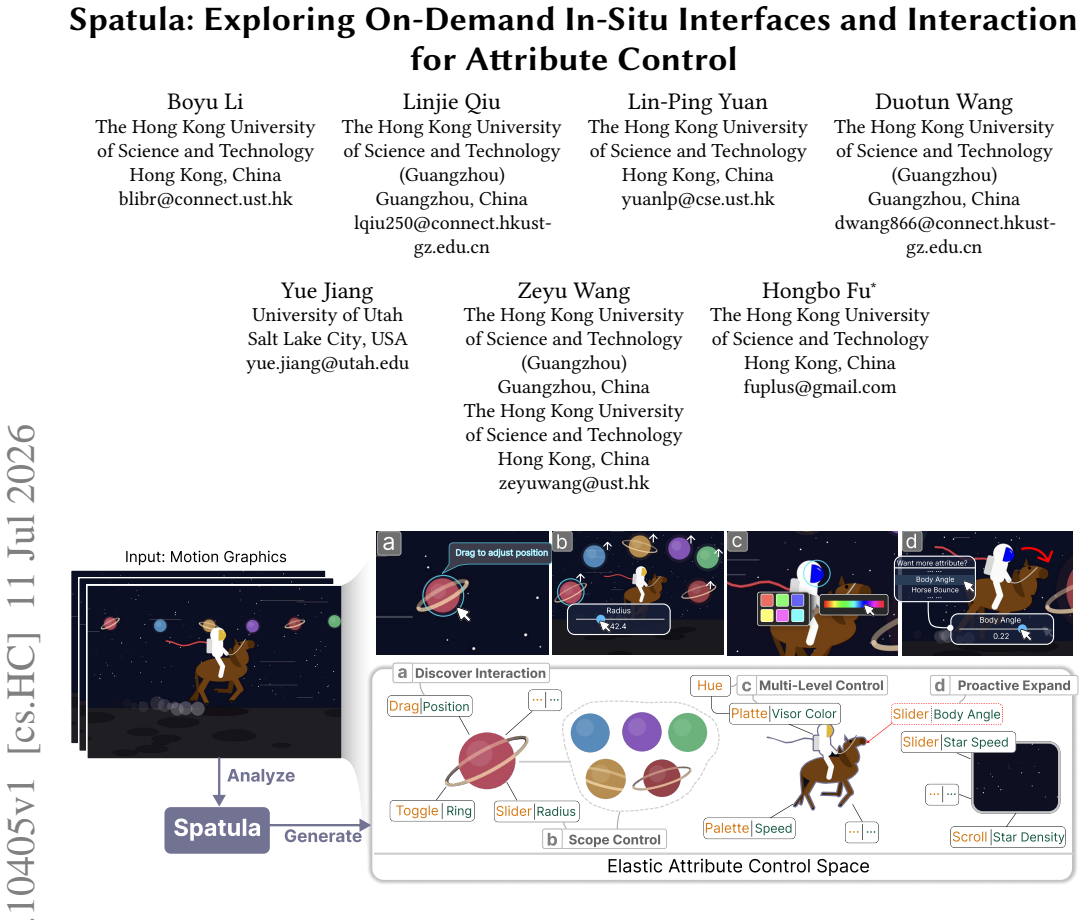
The Elastic Attribute Control Space — a conceptual and practical framework that treats control as a four-dimensional, reconfigurable interaction space. The skill base, a curated library of over 300 UI controls, direct-manipulation techniques, and interaction rules, carries the argument: it is the mechanism that makes LLM-generated control mappings reliable, lifting precision from 53.5% to 83.2% in the benchmark. Code injection of event handlers into the running p5.js program is the technical enabler connecting the skill base to runtime manipulation.
What would settle it
Run Spatula on a set of p5.js animations that deliberately use hard-coded drawing commands and closure-scoped variables instead of named parameters, and count how many attributes the system can expose and control. If the success rate drops below the benchmark's 83.2% mapping precision — or if injected controls visibly alter the original animation — the core assumption is falsified. A second check: re-run the user study with counterbalanced condition order; if the reported controllability and enjoyment advantages disappear when Spatula is not always last, the empirical claim is weakened.
Extended reading notes
Core claim
Spatula's central claim is that attribute control for LLM-generated motion graphics can be operationalized as an on-demand, in-situ 'Elastic Attribute Control Space.' The system uses a skill base of over 300 UI controls and interaction rules distilled from commercial authoring software to guide an LLM in parameterizing expressions in p5.js code and injecting event bindings. This yields context-aware hints, multi-resolution widgets (slider to Bézier curve), semantic group editing, and proactive attribute expansion. The empirical support is two-sided: a comparative user study (N=12) in which participants rated Spatula high on controllability and enjoyment, and a technical benchmark where the s
Load-bearing premise
Spatula's claim depends on the assumption that the LLM can reliably analyze a p5.js program, parameterize its expressions, and inject event-binding code that reaches the running animation's state without changing the animation's behavior; for animations written with hard-coded drawing commands or closure-scoped variables, this silently fails.
Editorial extensions
If this is right
- AI-assisted creative tools can be architected as 'interaction compilers' that synthesize controls on the fly rather than exposing fixed toolbars.
- Users can move from prompt-iteration to direct manipulation, which the study suggests increases engagement and exploration.
- The skill-base approach provides a concrete recipe for improving LLM reliability in UI generation: ground mappings in existing authoring conventions.
- The plug-and-play design suggests the same scaffold could apply to any program-based visual domain, such as CSS styling or 3D geometry scripts.
- The benchmark establishes a measurable target: skill-base guidance roughly doubles mapping precision, and further gains may come from expanding the skill base.
Reading between the lines
- The boundary of what counts as an editable attribute is set by the skill base; as that library grows to cover procedural representations (SDFs, relation graphs), the same architecture could extend to geometry-level and choreography-level edits.
- The paper's study design fixed the condition order with Spatula always last; a replication with counterbalanced order or a longitudinal deployment would clarify how much of the reported advantage is novelty versus design.
- The Elastic Attribute Control Space could be tested as a general theory of on-demand UI: predicting that any creative tool's control surface can be described along the same four dimensions.
- A natural extension is to measure user-perceived mapping quality on the benchmark dataset, not just expert-annotation match, to see which mapping errors actually hurt the editing experience.
Editorial analysis
A structured set of objections, weighed in public.
Referee Report
Summary. The paper proposes Spatula, a proof-of-concept system that generates on-demand, in-situ attribute control interfaces and interactions for LLM-generated p5.js motion graphics. It reframes attribute control as an 'Elastic Attribute Control Space' and operationalizes it along four dimensions: Discoverability, Resolution, Scope, and Expandability. The system uses an LLM together with a hand-built skill base of UI controls and interaction rules to identify editable attributes, map them to widgets/gestures, and inject event bindings into the running animation. The empirical support consists of a comparative user study (N=12) against three baselines, a 50-script technical benchmark of attribute extraction and attribute-to-control mapping across four LLMs, and two proof-of-concept applications in web design and 3D modeling. The paper claims Spatula 'provides intuitive and convenient interactions while supporting diverse needs for fine-grained parameter control' and that the design generalizes to other creative domains.
Significance. If fully supported, the paper would be a meaningful contribution to creativity-support and on-demand UI research: the four design dimensions are well motivated by a formative study, the skill base and interaction rules are a substantial engineering artifact, and the concept of an elastic attribute control space provides a useful framing for LLM-generated interfaces. The authors also honestly acknowledge important limitations in §7, including that the editable-attribute boundary is 'largely determined by the skill base.' The main weaknesses are empirical: the user study lacks counterbalancing and statistical reporting, the technical evaluation stops at static mapping and never verifies end-to-end runtime injection, and the benchmark ground truth is partially LLM-initialized. These issues are fixable within the paper's scope, so the central idea deserves publication after major revision.
major comments (4)
- [§5.1.2, §5.2] The user study is the primary evidence for the claim that Spatula 'provides intuitive and convenient interactions while supporting diverse needs for fine-grained parameter control.' As reported, participants always experienced the four interfaces in the fixed order LLM → panel → probe → Spatula (§5.1.2), each condition had only two 5-minute trials, and the results section reports qualitative quotes but no descriptive statistics, effect sizes, or significance tests for the ratings shown in Fig. 12. The fixed order confounds interface effects with learning, task familiarity, and fatigue; the short trials make it hard to assess 'fine-grained' editing. The paper should either re-run with counterbalancing or substantially temper the empirical claims to qualitative proof-of-concept observations.
- [§10.0.3, Appendix 9.2.3, §7] The technical evaluation measures attribute extraction and attribute-to-control mapping as static JSON outputs; it does not execute the generated bindings or verify that manipulating a control actually changes the rendered animation. The central 'real-time, fine-grained parameter manipulation' claim requires this end-to-end validation. Appendix 9.2.3, Eq. (2), shows that group propagation is implemented by traversing 'the underlying data structure array in the runtime environment (e.g., window[group.elementType])'; this only succeeds when animation state is stored in globally reachable arrays/objects. §7 acknowledges that hard-coded drawing commands (e.g., the flower in Fig. 7) cannot be exposed and that the editable boundary is 'largely determined by the skill base.' Without a runtime test on a broader corpus, the system may silently degrade to a narrow demonstration. Please add an exec
- [§10.0.1, §10.0.3] The benchmark's ground truth is initialized by an LLM and then corrected by experts (§10.0.1). Because the task is LLM attribute extraction, measuring LLM agreement against LLM-initialized labels can inflate scores even after expert correction; the expert edits are not quantified. Report inter-annotator agreement and/or the number and nature of expert additions and re-categorizations. Also, the mapping evaluation compares direct prompting to skill-base-guided prompting, but the two conditions differ in prompt structure and exemplars; it would be useful to ablate the rule content to confirm the improvement is due to the skill base itself.
- [§6.2, Abstract] The abstract states 'our applications demonstrate that the plug-and-play design generalizes to other domains, such as web design and 3D modeling,' but §6.2 describes only two implementation sketches with no user or technical evaluation. If generalization is part of the contribution, the paper should either present evidence (e.g., a small feasibility test or runtime validation on the CSS/3D cases) or explicitly rephrase this as untested speculation.
minor comments (5)
- [Fig. 1, Fig. 4] The word 'Resolusion' appears in the figure labels; it should be 'Resolution.'
- [§4.2.4] 'the system initially suggests a c of potential attributes' appears to be missing a noun; likely 'a set of potential attributes.'
- [§5.2] Fig. 12 is described as 'User ratings results,' but the text does not report the numerical values, scales, or variance underlying these ratings. Please provide at least descriptive statistics in the text or table.
- [§5.1.2] The procedure says 'each condition is repeated for two trials,' but it is not clear whether the two trials use different motion graphics/targets. Clarify the task design to help readers interpret the 5-minute trial constraint.
- [§6.1] 'every generated objects' should be 'every generated object.'
Circularity Check
No significant circularity; design-and-evaluate paper with honest scope limits, not a derivation that reduces to its inputs.
full rationale
The paper's chain is a design-and-evaluate cycle rather than a formal derivation: formative study (Sec. 3) yields design guidelines (Sec. 3.2.5), the system is built to those guidelines (Sec. 4), and evidence comes from a user study (Sec. 5) plus a technical benchmark (Sec. 10). There are no fitted parameters or equations that derive a predicted quantity from its own input. The technical benchmark's ground truth is human-in-the-loop: 'First, we utilized an LLM to automatically generate an initial set of primary and secondary attributes for each script. Subsequently, we recruited 5 expert motion graphics designers to act as annotators... The finalized, expert-validated attribute sets were then adopted as the ground truth' (Sec. 10.0.1). Because experts 'systematically reviewed' and 're-categorizing misaligned attributes,' the labels are not identical by construction to any evaluated LLM's output; the LLM seeding is a possible anchoring risk, but the paper reports an external human check, so this is not a demonstrated reduction. The skill-base-guided mapping evaluation is judged against 'expert-annotated control type or an equivalent authoring convention' (Sec. 10.0.3); the skill base and the annotations share a domain source (commercial authoring conventions), but this is a legitimate benchmark design rather than a circular fit. Self-citations ([16], [18], [19], [52]) are related-work and methodology references and are not load-bearing for the central claim. Section 7 explicitly limits the editable-attribute boundary to the skill base ('this practical boundary is largely determined by the skill base') and honestly acknowledges hard-coded shapes such as the flower in Fig. 7 cannot be exposed; this is a scope limitation, not circularity. The fixed condition order in the user study (Spatula always last, Sec. 5.1.2) is a validity threat but not a circularity. Overall, no load-bearing step reduces to its own input, so no significant circularity is found.
Assumptions & free parameters
free parameters (1)
- skill_base content (300+ UI controls, mappings, interaction rules) =
unpublished
assumptions (4)
- domain assumption Attribute control is best operationalized by exposing parameter-level controls on the canvas rather than through text prompts or separate panels.
- domain assumption p5.js LLM-generated animations expose explicit, interpretable attributes that can be parameterized and bound to runtime UI controls.
- ad hoc to paper The four dimensions (Discoverability, Resolution, Scope, Expandability) are the correct structuring of the attribute control space.
- domain assumption Injected event-handling code preserves the original animation logic and can access runtime state through global references.
invented entities (2)
-
Elastic Attribute Control Space
-
Skill base (300+ UI controls, direct-manipulation techniques, attribute mappings, interaction rules)
Cite this review
Pith. "Pith review of Spatula: Exploring On-Demand In-Situ Interfaces and Interaction for Attribute Control." pith.science (2026). https://pith.science/paper/MWDUMKH3
@misc{pith2026260710405,
  author       = {Pith},
  title        = {Pith review of: Spatula: Exploring On-Demand In-Situ Interfaces and Interaction for Attribute Control},
  year         = {2026},
  howpublished = {\url{https://pith.science/paper/MWDUMKH3}},
  note         = {Machine review of arXiv:2607.10405}
}
read the original abstract
Controlling attributes is a critical step toward achieving the final creative outcome, yet current approaches fall short in supporting users in the iterative refinement of generative content. We propose Spatula, a proof-of-concept system that generates on-demand, in-situ attribute control interfaces and interactions for creating motion graphics. Building on a technical probe that automatically analyzes animation context and generates corresponding attributes and UI, we frame attribute control as an explorable landscape and explore the attribute control space along four key dimensions: Discoverability, Resolution, Scope, and Expandability. Findings from a user study (N=12) show that our system provides intuitive and convenient interactions while supporting diverse needs for fine-grained parameter control. Furthermore, our applications demonstrate that the plug-and-play design generalizes to other domains, such as web design and 3D modeling.
Figures


Figures from the paper (17 more)


Reference graph
Works this paper leans on
-
[1]
2026.RGB curves
Adobe. 2026.RGB curves. https://helpx.adobe.com/premiere/desktop/correct- color/add-color-effects/correct-color-using-rgb-curves.html
2026
-
[2]
Cai, Michael Terry, Quoc Le, and Charles Sutton
Jacob Austin, Augustus Odena, Maxwell Nye, Maarten Bosma, Henryk Michalewski, David Dohan, Ellen Jiang, Carrie J. Cai, Michael Terry, Quoc Le, and Charles Sutton. 2021. Program Synthesis with Large Language Models. arXiv:2108.07732 [cs.PL] https://arxiv.org/abs/2108.07732
arXiv 2021
-
[3]
Jazbo Beason, Ruijia Cheng, Eldon Schoop, and Jeffrey Nichols. 2025. Athena: Intermediate Representations for Iterative Scaffolded App Generation with an LLM.arXiv preprint arXiv:2508.20263(2025)
arXiv 2025
-
[4]
Samuelle Bourgault, Li-Yi Wei, Jennifer Jacobs, and Rubaiat Habib Kazi. 2025. Narrative Motion Blocks: Combining Direct Manipulation and Natural Language Interactions for Animation Creation. InProceedings of the 2025 ACM Designing Interactive Systems Conference (DIS ’25). Association for Computing Machinery, New York, NY, USA, 1366–1386. doi:10.1145/37153...
arXiv 2025
-
[5]
Jiaqi Chen, Yanzhe Zhang, Yutong Zhang, Yijia Shao, and Diyi Yang. 2025. Generative Interfaces for Language Models. arXiv:2508.19227 [cs.CL] https: //arxiv.org/abs/2508.19227
arXiv 2025
-
[6]
Mark Chen, Jerry Tworek, Heewoo Jun, Qiming Yuan, Henrique Ponde de Oliveira Pinto, Jared Kaplan, Harri Edwards, Yuri Burda, Nicholas Joseph, Greg Brockman, Alex Ray, Raul Puri, Gretchen Krueger, Michael Petrov, Heidy Khlaaf, Girish Sastry, Pamela Mishkin, Brooke Chan, Scott Gray, Nick Ryder, Mikhail Pavlov, Alethea Power, Lukasz Kaiser, Mohammad Bavarian...
arXiv 2021
-
[7]
Adobe After Effect. 2025. Adobe After Effects - Motion graphics software. https: //www.adobe.com/products/aftereffects.html
2025
-
[8]
2026.Color Wheel
Figma. 2026.Color Wheel. https://www.figma.com/color-wheel/
2026
Show all 51 references
-
[9]
Gajos, Daniel S
Krzysztof Z. Gajos, Daniel S. Weld, and Jacob O. Wobbrock. 2010. Automatically generating personalized user interfaces with Supple.Artificial Intelligence174, UIST ’26, November 02–05, 2026, Detroit, MI, USA Boyu Li, Linjie Qiu, Lin-Ping Yuan, Duotun Wang, Yue Jiang, Zeyu Wang...
2010 doi
-
[10]
François Guimbretiére and Terry Winograd. 2000. FlowMenu: combining com- mand, text, and data entry. InProceedings of the 13th Annual ACM Sympo- sium on User Interface Software and Technology(San Diego, California, USA) (UIST ’00). Association for Computing Machinery, New York...
2000
-
[12]
Robert Held, Ankit Gupta, Brian Curless, and Maneesh Agrawala. 2012. 3D Puppetry: A Kinect-based Interface for 3D Animation. InProceedings of the 25th Annual ACM Symposium on User Interface Software and Technology(Cambridge, Massachusetts, USA)(UIST ’12). Association for Compu...
2012
-
[13]
Ken Hinckley and Mike Sinclair. 1999. Touch-sensing input devices. InProceedings of the SIGCHI Conference on Human Factors in Computing Systems(Pittsburgh, Pennsylvania, USA)(CHI ’99). Association for Computing Machinery, New York, NY, USA, 223–230. doi:10.1145/302979.303045
1999
-
[14]
Yuki Koyama and Masataka Goto. 2022. BO as Assistant: Using Bayesian Op- timization for Asynchronously Generating Design Suggestions. InProceedings of the 35th Annual ACM Symposium on User Interface Software and Technology (Bend, OR, USA)(UIST ’22). Association for Computing M...
2022
-
[15]
Yuki Koyama, Daisuke Sakamoto, and Takeo Igarashi. 2016. SelPh: Progressive Learning and Support of Manual Photo Color Enhancement. InProceedings of the 2016 CHI Conference on Human Factors in Computing Systems(San Jose, California, USA)(CHI ’16). Association for Computing Mac...
2016
-
[16]
Boyu Li, Linjie Qiu, Duotun Wang, Qianxi Liu, Ryo Suzuki, Mingming Fan, and Zeyu Wang. 2025. DesignMemo: Integrating Discussion Context into Online Collaboration with Enhanced Design Rationale Tracking.Proc. ACM Hum.- Comput. Interact.9, 7, Article CSCW398 (Oct. 2025), 32 page...
2025 doi
-
[17]
Beichen Li, Rundi Wu, Armando Solar-Lezama, Changxi Zheng, Liang Shi, Bernd Bickel, and Wojciech Matusik. 2025. VLMaterial: Procedural Material Generation with Large Vision-Language Models. InProceedings of the International Conference on Learning Representations (ICLR)(Singap...
2025
-
[18]
Boyu Li, Linping Yuan, Zhe Yan, Qianxi Liu, Yulin Shen, and Zeyu Wang. 2024. AniCraft: Crafting Everyday Objects as Physical Proxies for Prototyping 3D Character Animation in Mixed Reality. InProceedings of the 37th Annual ACM Symposium on User Interface Software and Technolog...
2024
-
[20]
Yi-Chi Liao, Paul Streli, Zhipeng Li, Christoph Gebhardt, and Christian Holz
-
[21]
Shaoteng Liu, Tianyu Wang, Jui-Hsien Wang, Qing Liu, Zhifei Zhang, Joon-Young Lee, Yijun Li, Bei Yu, Zhe Lin, Soo Ye Kim, and Jiaya Jia. 2024. Generative Video Propagation. arXiv:2412.19761 [cs.CV] https://arxiv.org/abs/2412.19761
2024 arXiv
-
[22]
Vivian Liu, Rubaiat Habib Kazi, Li-Yi Wei, Matthew Fisher, Timothy Langlois, Seth Walker, and Lydia Chilton. 2025. LogoMotion: Visually-Grounded Code Synthesis for Creating and Editing Animation. InProceedings of the 2025 CHI Conference on Human Factors in Computing Systems (C...
2025
-
[23]
Xiang Liu, Peijie Dong, Xuming Hu, and Xiaowen Chu. 2024. LongGenBench: Long-context Generation Benchmark. InFindings of the Association for Computa- tional Linguistics: EMNLP 2024, Yaser Al-Onaizan, Mohit Bansal, and Yun-Nung Chen (Eds.). Association for Computational Linguis...
2024 doi
-
[25]
Jiaju Ma and Maneesh Agrawala. 2025. MoVer: Motion Verification for Motion Graphics Animations.ACM Trans. Graph.44, 4, Article 33 (July 2025), 17 pages. doi:10.1145/3731209
2025 doi
-
[26]
Damien Masson, Sylvain Malacria, Géry Casiez, and Daniel Vogel. 2024. Direct- GPT: A Direct Manipulation Interface to Interact with Large Language Models. InProceedings of the 2024 CHI Conference on Human Factors in Computing Systems (Honolulu, HI, USA)(CHI ’24). Association f...
2024
-
[27]
2002.The Design and Evaluation of Multiple Interfaces: A Solution for Complex Software
Joanna McGrenere. 2002.The Design and Evaluation of Multiple Interfaces: A Solution for Complex Software. Ph. D. Dissertation. University of Toronto
2002
-
[28]
Bryan Min and Haijun Xia. 2025. Meridian: A Design Framework for Malleable Overview-Detail Interfaces. InProceedings of the 38th Annual ACM Symposium on User Interface Software and Technology (UIST ’25). Association for Computing Machinery, New York, NY, USA, Article 200, 14 p...
2025 doi
-
[29]
Brad A. Myers. 1998. A brief history of human-computer interaction technology. Interactions5, 2 (March 1998), 44–54. doi:10.1145/274430.274436
1998
-
[30]
2026.Audio Routing, Remote Control, and Macro Con- trols
Native Instruments. 2026.Audio Routing, Remote Control, and Macro Con- trols. https://www.native-instruments.com/ni-tech-manuals/maschine-plus- manual/en/audio-routing%2C-remote-control%2C-and-macro-controls.html
2026
-
[32]
Peter O’Donovan, Aseem Agarwala, and Aaron Hertzmann. 2015. DesignScape: Design with Interactive Layout Suggestions. InProceedings of the 33rd Annual ACM Conference on Human Factors in Computing Systems(Seoul, Republic of Korea)(CHI ’15). Association for Computing Machinery, N...
2015
-
[33]
Sharon Oviatt. 2006. Human-centered design meets cognitive load theory: de- signing interfaces that help people think. InProceedings of the 14th ACM Interna- tional Conference on Multimedia(Santa Barbara, CA, USA)(MM ’06). Association for Computing Machinery, New York, NY, USA...
2006 doi
-
[34]
Michael Sedlmair, Miriah Meyer, and Tamara Munzner. 2012. Design Study Methodology: Reflections from the Trenches and the Stacks.IEEE Transactions on Visualization and Computer Graphics18, 12 (2012), 2431–2440. doi:10.1109/ TVCG.2012.213
2012
-
[35]
Bernstein
Omar Shaikh, Shardul Sapkota, Shan Rizvi, Eric Horvitz, Joon Sung Park, Diyi Yang, and Michael S. Bernstein. 2025. Creating General User Models from Com- puter Use. InProceedings of the 38th Annual ACM Symposium on User Interface Software and Technology (UIST ’25). Association...
2025
-
[36]
Yulin Shen, Yifei Shen, Jiawen Cheng, Chutian Jiang, Mingming Fan, and Zeyu Wang. 2024. Neural Canvas: Supporting Scenic Design Prototyping by Integrating 3D Sketching and Generative AI. InProceedings of the 2024 CHI Conference on Human Factors in Computing Systems(Honolulu, H...
2024
-
[37]
Xinyu Shi, Yinghou Wang, Yun Wang, and Jian Zhao. 2024. Piet: Facilitating Color Authoring for Motion Graphics Video. InProceedings of the 2024 CHI Conference on Human Factors in Computing Systems(Honolulu, HI, USA)(CHI ’24). Association for Computing Machinery, New York, NY, ...
2024
-
[38]
Ben Shneiderman. 1981. Direct manipulation: A step beyond programming languages (abstract only).SIGSOC Bull.13, 2–3 (May 1981), 143. doi:10.1145/ 1015579.810991
1981
-
[39]
2016.Designing the User Interface: Strategies for Effective Human–Computer Interaction(6 ed.)
Ben Shneiderman, Catherine Plaisant, Maxine Cohen, Steven Jacobs, Niklas Elmqvist, and Nicholas Diakopoulos. 2016.Designing the User Interface: Strategies for Effective Human–Computer Interaction(6 ed.). Pearson
2016
-
[41]
Ryo Suzuki, Rubaiat Habib Kazi, Li-yi Wei, Stephen DiVerdi, Wilmot Li, and Daniel Leithinger. 2020. RealitySketch: Embedding Responsive Graphics and Visualizations in AR through Dynamic Sketching. InProceedings of the 33rd Annual ACM Symposium on User Interface Software and Te...
2020
-
[42]
2010.Designing Interfaces: Patterns for Effective Interaction Design
Jenifer Tidwell. 2010.Designing Interfaces: Patterns for Effective Interaction Design. O’Reilly Media
2010
-
[43]
Theophanis Tsandilas and m. c. schraefel. 2007. Bubbling menus: a selective mechanism for accessing hierarchical drop-down menus. InProceedings of the SIGCHI Conference on Human Factors in Computing Systems(San Jose, California, USA)(CHI ’07). Association for Computing Machine...
2007
-
[44]
Glassman, Jeevana Priya Inala, and Chenglong Wang
Priyan Vaithilingam, Elena L. Glassman, Jeevana Priya Inala, and Chenglong Wang. 2024. DynaVis: Dynamically Synthesized UI Widgets for Visualization Editing. InProceedings of the 2024 CHI Conference on Human Factors in Computing Systems(Honolulu, HI, USA)(CHI ’24). Association...
2024
-
[45]
Jason Wu, Eldon Schoop, Alan Leung, Titus Barik, Jeffrey Bigham, and Jeffrey Nichols. 2024. UICoder: Finetuning Large Language Models to Generate User Interface Code through Automated Feedback. InProceedings of the 2024 Conference of the North American Chapter of the Associati...
2024
-
[46]
Haijun Xia, Bruno Araujo, Tovi Grossman, and Daniel Wigdor. 2016. Object- Oriented Drawing. InProceedings of the 2016 CHI Conference on Human Factors in Computing Systems(San Jose, California, USA)(CHI ’16). Association for Computing Machinery, New York, NY, USA, 4610–4621. do...
2016 doi
-
[47]
Haijun Xia, Bruno Araujo, and Daniel Wigdor. 2017. Collection Objects: Enabling Fluid Formation and Manipulation of Aggregate Selections. InProceedings of the 2017 CHI Conference on Human Factors in Computing Systems(Denver, Colorado, USA)(CHI ’17). Association for Computing M...
2017
-
[48]
Haijun Xia, Nathalie Henry Riche, Fanny Chevalier, Bruno De Araujo, and Daniel Wigdor. 2018. DataInk: Direct and Creative Data-Oriented Drawing. InProceed- ings of the 2018 CHI Conference on Human Factors in Computing Systems(Montreal QC, Canada)(CHI ’18). Association for Comp...
2018
-
[50]
Zhijie Xia, Kyzyl Monteiro, Kevin Van, and Ryo Suzuki. 2023. RealityCanvas: Augmented Reality Sketching for Embedded and Responsive Scribble Animation Effects. InProceedings of the 36th Annual ACM Symposium on User Interface Software and Technology (UIST ’23). Association for ...
2023
-
[51]
Liwenhan Xie, Yanna Lin, Can Liu, Huamin Qu, and Xinhuan Shu. 2025. DataWink: Reusing and Adapting SVG-based Visualization Examples with Large Multimodal Models.IEEE Transactions on Visualization and Computer Graphics (2025), 1–11. doi:10.1109/TVCG.2025.3634635
2025
-
[52]
Hui Ye, Chufeng Xiao, Jiaye Leng, Pengfei Xu, and Hongbo Fu. 2026. Mo- GraphGPT: Creating Interactive Scenes Using Modular LLM and Graphical Con- trol.IEEE Transactions on Visualization and Computer Graphics(2026), 1–16. doi:10.1109/TVCG.2026.3667904
2026
-
[53]
Shengdong Zhao and Ravin Balakrishnan. 2004. Simple vs. compound mark hierarchical marking menus. InProceedings of the 17th Annual ACM Symposium on User Interface Software and Technology(Santa Fe, NM, USA)(UIST ’04). Association for Computing Machinery, New York, NY, USA, 33–4...
2004 doi
-
[54]
Yuheng Zhao, Xueli Shu, Liwen Fan, Lin Gao, Yu Zhang, and Siming Chen
-
[55]
Chenfei Zhu, Shao-Kang Hsia, Xiyun Hu, Ziyi Liu, Jingyu Shi, and Karthik Ramani. 2025. agentAR: Creating Augmented Reality Applications with Tool- Augmented LLM-based Autonomous Agents. InProceedings of the 38th Annual ACM Symposium on User Interface Software and Technology (U...
2025
-
[2025]
InProceedings of the 2025 CHI Conference on Human Factors in Computing Systems (CHI ’25)
Continual Human-in-the-Loop Optimization. InProceedings of the 2025 CHI Conference on Human Factors in Computing Systems (CHI ’25). Association for Computing Machinery, New York, NY, USA, Article 795, 26 pages. doi:10. 1145/3706598.3713603
2025
-
[2026]
ProactiveVA: Proactive Visual Analytics with LLM-Based UI Agent.IEEE Transactions on Visualization and Computer Graphics32, 1 (2026), 451–461. doi:10. 1109/TVCG.2025.3642628
2026
Reviewed August 2, 2026 · model on record in the stance chip above.
Discussion (0). Continue with ORCID to comment.