REVIEW 3 major objections 5 minor 300 references
SS-GEN turns multivariate tail simulation into learning a compact angular law, so ordinary deep generative models can produce extremes and rare-event probabilities beyond the observed data.
Reviewed by Pith at T0; open to challenge. T0 means a machine referee read the full paper against a public rubric. the ladder, T0–T4 →
SS-GEN splices an explicit radial tail law with a DGM-learned angular law so standard generative models produce asymptotically exact multivariate extremes and rare-event probabilities beyond the data.
T0 review reviewed 2026-07-14 challenge →
load-bearing objection Clean EVT reduction that lets ordinary DGMs do multivariate tails, with real density theorems; the formal guarantees stop at exact angular density while the experiments use a GAN. the 3 major comments →
An Extreme Value Perspective on Learning Stress Laws
The pith
A machine-rendered reading of the paper's core claim, the machinery that carries it, and where it could break.
The reading
Core claim
Under regular variation or Weibull-type density asymptotics, the conditional tail density of a random vector factors into an explicit radial component and a nonparametric angular component. Learning only that compact angular law with a standard deep generative model, then splicing it with the closed-form radial law, produces a generative density that converges uniformly (in relative or log-relative error) to the true tail density and therefore yields consistent rare-event probability estimates beyond the observed sample.
What carries the argument
The asymptotic radial-angular splice: beyond a large threshold t the joint density of (R, Φ) separates into a Pareto (heavy-tail) or direction-dependent Gamma (Weibull-type) radial factor times the conditional angular density f^(t), so any DGM that learns f^(t) on the unit sphere can be recombined with the analytic radial law to form the SS-GEN density f_gen^(t).
Load-bearing premise
The density (or its logarithm) must settle, uniformly on compact directions away from the origin, to a single positive continuous limit; if the tail mechanism switches with level or the directional decay oscillates, the separation and the guarantees collapse.
What would settle it
On a synthetic regularly-varying mixture with known true tail, train SS-GEN at an intermediate threshold and check whether the uniform relative error between the spliced density and the true conditional density, and the relative error of estimated rare-set probabilities, both go to zero as the threshold and the rarity level increase.
Editorial analysis
A structured set of objections, weighed in public.
Referee Report
Summary. The paper proposes Self-Similar Generative Estimation (SS-GEN), which uses classical multivariate tail asymptotics to factor the tail density into an explicit radial law and a compactly supported angular law. Under regular variation (Assumption 1) the radial factor is asymptotically Pareto and independent of angle; under Weibull-type tails (Assumption 2) it is direction-dependent Gamma after a power transform. Standard deep generative models are then used only to learn the angular exceedance law at an intermediate threshold, after which the analytic radial law is used to sample deeper extremes and estimate rare-event probabilities. Idealized theorems give vanishing uniform relative error (Theorem 3.1) and uniform log-relative error (Theorem 4.1) for the spliced density when the angular density is known exactly, and corresponding consistency for rare-set probabilities (Theorem 4.2, Corollary 3.1). Heavy-tailed numerical experiments on a 10-d mixture illustrate VaR/CVaR estimation and conditional portfolio-loss distributions via a GAN angular model.
Significance. If the guarantees extend in a controlled way from the idealized angular law to a learned angular model, the contribution is practically important: it converts unbounded multivariate tail generation into compact-domain density estimation that off-the-shelf DGMs can handle, without specialized heavy-tailed architectures or modified latent priors. The EVT-based reduction is clean, the idealized density and probability asymptotics are carefully proved (incomplete-gamma and continuous-convergence arguments in Appendix A), and the heavy-tailed experiments give concrete support for risk functionals (VaR/CVaR, conditional KS distances) beyond pure bulk fitting. That combination of structural reduction plus approximation guarantees is a genuine advance relative to architecture- or prior-modification strands of generative extremes work.
major comments (3)
- [Theorems 3.1, 4.1; Algorithms 1–2; Abstract] Theorems 3.1 and 4.1 (and the proofs in Appendix A) establish uniform relative / log-relative exactness only for the idealized spliced density that uses the exact conditional angular density f^{(t)}. Algorithms 1–2 and Experiments 1–2 replace f^{(t)} by a finite-sample GAN trained on |Y| = 50–200 exceedances, yet the manuscript supplies no quantitative bound on how angular approximation error propagates into the density ratio or into the rare-event statements of Corollary 3.1 and Theorem 4.2. The abstract and introduction attribute asymptotic exactness to “SS-GEN” as implemented. Either add an error-propagation / estimation-rate result that closes this gap, or revise the claims so that the theorems are clearly scoped to the oracle-angular sampler and the learned-angular pipeline is presented as empirical only.
- [Section 4; Algorithm 2; Lemma 4.1; Section 5] Half of the theory (Section 4, Proposition 4.1, Theorem 4.1, Algorithm 2, Theorem 4.2(ii)) concerns Weibull-type tails and requires a direction-dependent rate Λ⋆. Estimation of Λ⋆ is only sketched (“local angular smoothing… deferred to the full version”), Lemma 4.1 assumes Λ⋆ known exactly, and Section 5 explicitly omits all light-tailed experiments. As submitted, the light-tailed half of the central claim is incomplete: the generative construction is not fully data-driven and is unvalidated numerically. Complete a data-driven Λ⋆ procedure with at least consistency discussion and include light-tailed experiments, or substantially narrow the light-tailed claims.
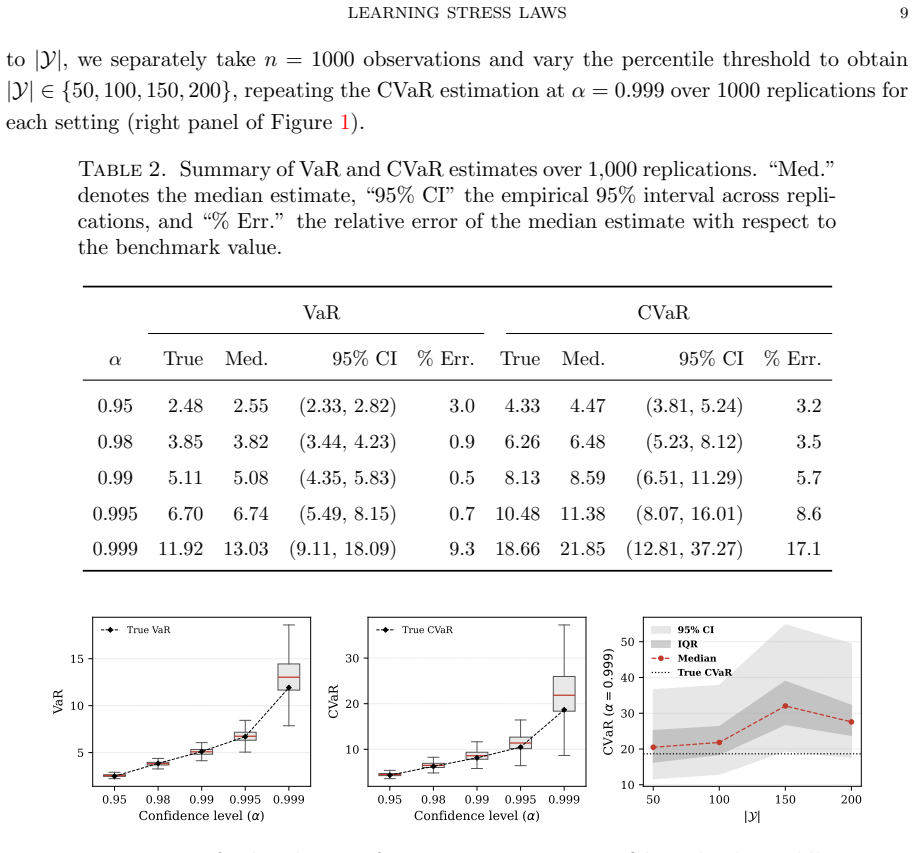
- [Section 5, Experiment 1; Table 2; Figure 1] In Experiment 1 the angular GAN is trained once on an independent n = 1000 sample; reported 95% intervals and % errors in Table 2 and Figure 1 reflect only Monte Carlo variability conditional on that fixed generator, not end-to-end estimation uncertainty (threshold, Hill ŝ, angular training). For the most extreme level α = 0.999 the median CVaR error is already 17.1% with a very wide CI. Without retraining variability or a clearer uncertainty accounting, the experimental support for “accurate” extrapolation of risk measures is weaker than the tables suggest. Report end-to-end replications (or at least multiple angular trainings) and discuss threshold/Hill sensitivity more systematically.
minor comments (5)
- [Introduction, contribution (i)] The term “Self-Similar” is used for Pareto scaling and direction-dependent log-decay stabilization; a short clarification relative to classical self-similarity / regular variation terminology would help readers outside the authors’ circle.
- [Table 1] Table 1 is useful but sparse; a sentence on how SS-GEN relates to Boulaguiem et al. (2022) and Lhaut et al. (2026) beyond the three binary columns would better locate the contribution.
- [Algorithm 2] In Algorithm 2 the Gamma sampling step writes Z ∼ Γ(d/γ, Λ⋆(Φ∗)); specify shape/rate (or shape/scale) convention explicitly to avoid implementation ambiguity.
- [Appendix B; Section 5] Appendix B GAN details (widths, checkpoint by projected Wasserstein) are welcome; consider moving a brief summary into the main experimental section so the main text is self-contained on training choices.
- [Throughout] Minor typography: “Na¨ ıve” spacing, “st sr” vs “s t^s” style inconsistencies in radial densities, and occasional missing spaces after periods in the arXiv text.
Circularity Check
No load-bearing circularity: core density guarantees follow from classical EVT assumptions; only a minor non-central self-citation appears in an application proof.
specific steps
-
self citation load bearing
[Proof of Theorem 4.2(ii), Appendix A, eq. (17)]
"We first note the following consequence of Deo and Murthy (2025), Theorem 2: for each fixed a > 0, log ∫_{R_u} f_ξ(z)^a dz = −a Λ⋆_u (1+o(1)), u→∞."
Anand Deo co-authors both papers, so the citation is self-referential. It is not load-bearing for the main density theorems (3.1, 4.1), and the same proof immediately supplies independent upper/lower bounds establishing (17); the step is therefore only a minor technical self-pointer in an application result, not a circular reduction of the central claim.
full rationale
The derivation chain is self-contained. Assumptions 1–2 are nonparametric tail-stability hypotheses (uniform regular variation / Weibull log-asymptotics on compact angular sets). Propositions 3.1 and 4.1 rewrite the polar density under those limits; Theorems 3.1 and 4.1 then show that the spliced generator that keeps the exact conditional angular law f^{(t)} and the explicit radial law has vanishing uniform relative (resp. log-relative) error. The proofs in Appendix A are direct asymptotic arguments (Jacobian, incomplete-gamma tails, uniform control of remainder terms) and do not define the target ratio in terms of a fitted quantity. Hill’s estimator and empirical p_t are ordinary plug-ins used only in experiments; the theorems treat s, p_t and f^{(t)} as known. The sole self-citation is Deo & Murthy (2025) in the proof of Theorem 4.2(ii), used as a pointer for a large-deviation integral asymptotic; the paper immediately re-derives the needed upper/lower bounds, and that theorem is an application of the density approximation rather than the central claim. No equation reduces a claimed prediction to a quantity defined by the same fit. The gap between idealized exact f^{(t)} and the finite-sample GAN is a correctness/coverage issue, not circularity.
Axiom & Free-Parameter Ledger
free parameters (4)
- radial threshold t (or percentile)
- tail index s (Hill estimator)
- GAN architecture and training hyperparameters
- Λ⋆ angular rate function (light-tailed case)
axioms (4)
- domain assumption Assumption 1: density regularly varying of index −(s+d) uniformly on compact subsets of E\{0}
- domain assumption Assumption 2: −log f(nz)/n^γ → Λ⋆(z) > 0 uniformly on compact subsets
- standard math Jacobian identity f_{R,Φ}(r,φ)=r^{d−1}f_ξ(rφ)
- standard math Incomplete-gamma tail asymptotics and continuous convergence of Λ⋆, L⋆
invented entities (1)
-
SS-GEN spliced generative density f_gen^{(t)}
no independent evidence
Cite this review
Pith. "Pith review of An Extreme Value Perspective on Learning Stress Laws." pith.science (2026). https://pith.science/paper/XH5GD72A
@misc{pith2026260710700,
  author       = {Pith},
  title        = {Pith review of: An Extreme Value Perspective on Learning Stress Laws},
  year         = {2026},
  howpublished = {\url{https://pith.science/paper/XH5GD72A}},
  note         = {Machine review of arXiv:2607.10700}
}
read the original abstract
We introduce Self-Similar Generative Estimation (SS-GEN), a method for simulating multivariate tail events and estimating rare-event probabilities in both heavy and light-tailed settings. SS-GEN exploits asymptotic tail structure to decompose the tail distribution into an explicit radial component and a nonparametric angular component, reducing tail learning to a compact-domain problem that can be handled by off-the-shelf deep generative models. The resulting sampler generates representative extreme scenarios and supports probability estimation far beyond the observed data. Under mild nonparametric tail assumptions, we show that the SS-GEN density is asymptotically exact in the tail, with vanishing uniform relative error for regularly varying distributions and vanishing uniform log-relative error for Weibull-type distributions. Unlike existing approaches that rely on specialized architectures or parametric tail specifications, SS-GEN leverages asymptotic tail structure to enable standard generative models to generate representative extreme samples and estimate rare-event probabilities beyond the observed data.
Figures

Reference graph
Works this paper leans on
-
[1]
Management Science , volume=
Machine learning and portfolio optimization , author=. Management Science , volume=. 2018 , publisher=
2018
-
[2]
Advances in neural information processing systems , volume=
Generative adversarial nets , author=. Advances in neural information processing systems , volume=
-
[3]
arXiv preprint arXiv:2603.17344 , year=
Decision-Scaled Scenario Approach for Rare Chance-Constrained Optimization , author=. arXiv preprint arXiv:2603.17344 , year=
-
[4]
IEEE Control Systems Letters , volume=
Reduced Sample Complexity in Scenario-Based Control System Design via Constraint Scaling , author=. IEEE Control Systems Letters , volume=. 2024 , publisher=
2024
-
[5]
, author=
State-dependent importance sampling for rare-event simulation: An overview and recent advances. , author=. Surveys in Operations Research and Management Science , volume=
-
[6]
Journal of Machine Learning Research , volume=
How well generative adversarial networks learn distributions , author=. Journal of Machine Learning Research , volume=
-
[7]
Management Science , volume=
Systemic risk in financial systems , author=. Management Science , volume=. 2001 , publisher=
2001
-
[8]
Insurance: Mathematics and Economics , volume=
Multivariate stress scenarios and solvency , author=. Insurance: Mathematics and Economics , volume=. 2012 , publisher=
2012
-
[9]
Journal of Banking & Finance , volume=
A systematic approach to multi-period stress testing of portfolio credit risk , author=. Journal of Banking & Finance , volume=. 2012 , publisher=
2012
-
[10]
Scientific reports , volume=
Reverse stress testing interbank networks , author=. Scientific reports , volume=. 2017 , publisher=
2017
-
[11]
European Journal of Operational Research , volume=
A theory of multivariate stress testing , author=. European Journal of Operational Research , volume=. 2024 , publisher=
2024
-
[12]
Journal of Machine Learning Research , volume=
EV-GAN: Simulation of extreme events with ReLU neural networks , author=. Journal of Machine Learning Research , volume=
-
[13]
Proceedings of the AAAI Conference on Artificial Intelligence , volume=
Exgan: Adversarial generation of extreme samples , author=. Proceedings of the AAAI Conference on Artificial Intelligence , volume=
-
[14]
Environmental Data Science , volume=
Modeling and simulating spatial extremes by combining extreme value theory with generative adversarial networks , author=. Environmental Data Science , volume=. 2022 , publisher=
2022
-
[15]
International Conference on Machine Learning , pages=
Pareto gan: Extending the representational power of gans to heavy-tailed distributions , author=. International Conference on Machine Learning , pages=. 2021 , organization=
2021
-
[16]
arXiv preprint arXiv:2401.10280 , year=
GANs for EVT Based Model Parameter Estimation in Real-time Ultra-Reliable Communication , author=. arXiv preprint arXiv:2401.10280 , year=
-
[17]
arXiv preprint arXiv:2203.01664 , year=
Tail-gan: Learning to simulate tail risk scenarios , author=. arXiv preprint arXiv:2203.01664 , year=
-
[18]
The Journal of Derivatives , volume=
Robust risk estimation and hedging: A reverse stress testing approach , author=. The Journal of Derivatives , volume=. 2015 , publisher=
2015
-
[19]
Mathematics of Operations Research , volume=
Quantifying distributional model risk via optimal transport , author=. Mathematics of Operations Research , volume=. 2019 , publisher=
2019
-
[20]
Mathematical Programming , volume=
On distributionally robust chance constrained programs with Wasserstein distance , author=. Mathematical Programming , volume=. 2021 , publisher=
2021
-
[21]
Journal of Optimization Theory and Applications , volume=
Distributionally robust portfolio optimization under marginal and copula ambiguity , author=. Journal of Optimization Theory and Applications , volume=. 2024 , publisher=
2024
-
[22]
Operations Research , volume=
Distributionally robust optimization under distorted expectations , author=. Operations Research , volume=. 2025 , publisher=
2025
-
[23]
Operations Research , volume=
Optimal impact portfolios with general dependence and marginals , author=. Operations Research , volume=. 2024 , publisher=
2024
-
[24]
European Journal of Operational Research , volume=
60 years of portfolio optimization: Practical challenges and current trends , author=. European Journal of Operational Research , volume=. 2014 , publisher=
2014
-
[25]
Management Science , volume=
Tail risk and robust portfolio decisions , author=. Management Science , volume=. 2021 , publisher=
2021
-
[26]
Stochastic Systems , volume=
Efficient scenario generation for heavy-tailed chance constrained optimization , author=. Stochastic Systems , volume=. 2024 , publisher=
2024
-
[27]
International statistical review , volume=
The t copula and related copulas , author=. International statistical review , volume=. 2005 , publisher=
2005
-
[28]
arXiv preprint arXiv:2506.16230 , year=
On Design of Representative Distributionally Robust Formulations for Evaluation of Tail Risk Measures , author=. arXiv preprint arXiv:2506.16230 , year=
-
[29]
Portugaliae Mathematica , volume=
A new class of semi-parametric estimators of the second order parameter , author=. Portugaliae Mathematica , volume=. 2003 , publisher=
2003
-
[30]
Operations Research Letters , volume=
On approximations of data-driven chance constrained programs over Wasserstein balls , author=. Operations Research Letters , volume=. 2023 , publisher=
2023
-
[31]
Available at SSRN 4926070 , year=
Characterizing the Minimum Cost to Achieve High Reliability via Asymptotic Analysis of Chance Constrained Programs , author=. Available at SSRN 4926070 , year=
-
[32]
The operations research revolution , pages=
Data-driven stochastic programming using phi-divergences , author=. The operations research revolution , pages=. 2015 , publisher=
2015
-
[33]
Journal of Applied Probability , volume=
Robust Wasserstein profile inference and applications to machine learning , author=. Journal of Applied Probability , volume=. 2019 , publisher=
2019
-
[34]
Mathematics of Operations Research , volume=
Optimal transport-based distributionally robust optimization: Structural properties and iterative schemes , author=. Mathematics of Operations Research , volume=. 2022 , publisher=
2022
-
[35]
Open Journal of Mathematical Optimization , volume=
Frameworks and results in distributionally robust optimization , author=. Open Journal of Mathematical Optimization , volume=
-
[36]
Available at SSRN 557214 , year=
The modelling of operational risk: experience with the analysis of the data collected by the Basel Committee , author=. Available at SSRN 557214 , year=
-
[37]
Econometrics and statistics , volume=
A high quantile estimator based on the log-generalized Weibull tail limit , author=. Econometrics and statistics , volume=. 2018 , publisher=
2018
-
[38]
2019 American Control Conference (ACC) , pages=
Data-driven chance constrained optimization under Wasserstein ambiguity sets , author=. 2019 American Control Conference (ACC) , pages=. 2019 , organization=
2019
-
[39]
Journal of Statistical Planning and Inference , volume=
On the estimation of high quantiles , author=. Journal of Statistical Planning and Inference , volume=. 1993 , publisher=
1993
-
[40]
Methodology and Computing in Applied Probability , volume=
Properties of distortion risk measures , author=. Methodology and Computing in Applied Probability , volume=. 2009 , publisher=
2009
-
[41]
Insurance: Mathematics and Economics , volume=
Tail distortion risk and its asymptotic analysis , author=. Insurance: Mathematics and Economics , volume=. 2012 , publisher=
2012
-
[42]
Mathematics of Operations Research , volume=
Distributionally robust stochastic optimization with Wasserstein distance , author=. Mathematics of Operations Research , volume=. 2023 , publisher=
2023
-
[43]
Operations research , volume=
Constructing risk measures from uncertainty sets , author=. Operations research , volume=. 2009 , publisher=
2009
-
[44]
Principles for Sound Liquidity Risk Management and Supervision (September 2008) , year=
Basel committee on banking supervision , author=. Principles for Sound Liquidity Risk Management and Supervision (September 2008) , year=
2008
-
[45]
Annual Review of Financial Economics , volume=
Climate stress testing , author=. Annual Review of Financial Economics , volume=. 2023 , publisher=
2023
-
[46]
A coherent framework for stress-testing , author=
-
[47]
Risk management: value at risk and beyond , volume=
Stress testing in a value at risk framework , author=. Risk management: value at risk and beyond , volume=. 2002 , publisher=
2002
-
[48]
JP Morgan, New York , volume=
Creditmetrics-technical document , author=. JP Morgan, New York , volume=
-
[49]
International Journal of Forecasting , volume=
Stress testing banks , author=. International Journal of Forecasting , volume=. 2014 , publisher=
2014
-
[50]
Journal of Monetary Economics , volume=
Testing macroprudential stress tests: The risk of regulatory risk weights , author=. Journal of Monetary Economics , volume=. 2014 , publisher=
2014
-
[51]
International Journal of Central Banking , year=
How to Find Plausible, Severe, and Useful Stress Scenarios , author=. International Journal of Central Banking , year=
-
[52]
Quantitative Finance , volume=
Stress scenario selection by empirical likelihood , author=. Quantitative Finance , volume=. 2015 , publisher=
2015
-
[53]
Operations Research , volume=
Achieving efficiency in black-box simulation of distribution tails with self-structuring importance samplers , author=. Operations Research , volume=. 2025 , publisher=
2025
-
[54]
Top , volume=
Robust portfolio choice with CVaR and VaR under distribution and mean return ambiguity , author=. Top , volume=. 2014 , publisher=
2014
-
[55]
arXiv preprint arXiv:2206.12835 , year=
Combining Retrospective Approximation with Importance Sampling for Optimising Conditional Value at Risk , author=. arXiv preprint arXiv:2206.12835 , year=
-
[56]
2013 , publisher=
Convergence of probability measures , author=. 2013 , publisher=
2013
-
[57]
2013 , publisher=
Introduction to rare event simulation , author=. 2013 , publisher=
2013
-
[58]
Portfolio Selection , urldate =
Harry Markowitz , journal =. Portfolio Selection , urldate =
-
[59]
Quantitative Finance , volume=
Robust risk measurement and model risk , author=. Quantitative Finance , volume=. 2014 , publisher=
2014
-
[60]
Operations Research , volume=
Recovering best statistical guarantees via the empirical divergence-based distributionally robust optimization , author=. Operations Research , volume=. 2019 , publisher=
2019
-
[61]
Management Science , volume=
Robust solutions of optimization problems affected by uncertain probabilities , author=. Management Science , volume=. 2013 , publisher=
2013
-
[62]
Mathematics of Operations Research , volume=
Statistics of robust optimization: A generalized empirical likelihood approach , author=. Mathematics of Operations Research , volume=. 2021 , publisher=
2021
-
[63]
Quantitative Finance , volume=
Portfolio optimization under expected shortfall: contour maps of estimation error , author=. Quantitative Finance , volume=. 2018 , publisher=
2018
-
[64]
Advances in Neural Information Processing Systems , pages=
Risk-sensitive and robust decision-making: a cvar optimization approach , author=. Advances in Neural Information Processing Systems , pages=
-
[65]
2007 , publisher=
Extreme value theory: an introduction , author=. 2007 , publisher=
2007
-
[66]
Stochastic Processes and their Applications , volume=
On regular variation of probability densities , author=. Stochastic Processes and their Applications , volume=. 1987 , publisher=
1987
-
[67]
Mathematical Finance , volume=
Portfolio value-at-risk with heavy-tailed risk factors , author=. Mathematical Finance , volume=. 2002 , publisher=
2002
-
[68]
2024 International Joint Conference on Neural Networks (IJCNN) , pages=
Generalized Pareto GAN: Generating Extremes of Distributions , author=. 2024 International Joint Conference on Neural Networks (IJCNN) , pages=. 2024 , organization=
2024
-
[69]
Extremes , pages=
Simulation of multivariate extremes: A Wasserstein--Aitchison GAN approach , author=. Extremes , pages=. 2026 , publisher=
2026
-
[70]
2020 , eprint=
Tails of Lipschitz Triangular Flows , author=. 2020 , eprint=
2020
-
[71]
Kim, Juno and Kwon, Jaehyuk and Cho, Mincheol and Lee, Hyunjong and Won, Joong-Ho , journal=. t^
-
[72]
arXiv preprint arXiv:2410.14171 , year=
Heavy-tailed diffusion models , author=. arXiv preprint arXiv:2410.14171 , year=
-
[73]
Extremes , pages=
ExceedGAN: simulation above extreme thresholds using Generative Adversarial Networks , author=. Extremes , pages=. 2026 , publisher=
2026
-
[74]
2024 , KEYWORDS =
Girard, St. 2024 , KEYWORDS =
2024
-
[75]
Operations Research Letters , volume=
Asymptotic representations for importance-sampling estimators of value-at-risk and conditional value-at-risk , author=. Operations Research Letters , volume=. 2010 , publisher=
2010
-
[76]
Management Science , volume=
Simulating sensitivities of conditional value at risk , author=. Management Science , volume=. 2009 , publisher=
2009
-
[77]
Journal of Risk , volume=
Portfolio optimization with conditional value-at-risk objective and constraints , author=. Journal of Risk , volume=. 2002 , publisher=
2002
-
[78]
Operations Research , volume=
A probabilistic model for minmax regret in combinatorial optimization , author=. Operations Research , volume=. 2014 , publisher=
2014
-
[79]
Quantitative Finance , volume=
Robust portfolio techniques for mitigating the fragility of CVaR minimization and generalization to coherent risk measures , author=. Quantitative Finance , volume=. 2013 , publisher=
2013
-
[80]
Operations research , volume=
Worst-case conditional value-at-risk with application to robust portfolio management , author=. Operations research , volume=. 2009 , publisher=
2009
This paper was first reviewed by grok-4.5 on July 14, 2026.
discussion (0)
Sign in with ORCID, Apple, or X to comment. Anyone can read and Pith papers without signing in.